ISSN Online: 2163-9361 ISSN Print: 2163-9353
DOI: 10.4236/aa.2018.83008 Aug. 28, 2018 140 Advances in Anthropology
Evolution Subject to an Energy Driven
Fundamental Time Arrow
Helmut Tributsch
Bio-Mimetics in Energy Systems Program, Carinthia University for Applied Sciences, Villach, Austria
Abstract
Adopting a fundamental time arrow in nature, a free energy aiming at creasing its presence per state by generating a flow of action, as recently de-rived from the principle of least action, entrains significant consequences for understanding mechanisms in evolution and biology. Simultaneously, the presently favoured statistical, entropic time arrow is tolerated as a limiting case. The entropy law, which self-organized systems follow, is deducible and time reading for feedback processes is functioning at very short time scale during energy turnover, even during build-up of order (decrease of entropy). As a consequence, living systems can self-organize on molecular level and evolution has an aim. This aim is maximizing entropy and thus energy turnover, within given constraints. Genetic mechanisms, here seen as self-organized chemical information handling, had to deal with such a parallel entropy (en-ergy) aim of self-organized living structures and should be considered super-posed, adapted to it and controlling it. Since increasing energy turnover is paralleled by an increasing ability of self-organized systems for generating order, this explains evolution towards higher perfection and the trend to-wards symbiotic energy harvesting. Information as well, which has an energy content, can self-organize within the neuronal structure of the brain and cre-ate a higher hierarchy of information handling. It is recognized as conscious-ness and spirit, which thus can be explained on purely materialistic basis. Evolution towards maximum energy (entropy) turnover as a fate for human civilization, when restraints are further decreasing, is a pessimistic prospect due to unavoidable environmental consequences. However, evolution of spirit is a straightforward parallel consequence and this may be considered the ultimate aim of evolution. The introduction of a fundamental energy driven time arrow as a paradigm change is verifiable via convincing falsifica-tion condifalsifica-tions and would revolufalsifica-tionize our understanding of life and human evolution within a significantly more friendly universe.
How to cite this paper: Tributsch, H. (2018). Evolution Subject to an Energy Driven Fun-damental Time Arrow. Advances in Anthro-pology, 8, 140-174.
https://doi.org/10.4236/aa.2018.83008
Received: July 30, 2018 Accepted: August 25, 2018 Published: August 28, 2018
Copyright © 2018 by author and Scientific Research Publishing Inc. This work is licensed under the Creative Commons Attribution International License (CC BY 4.0).
DOI: 10.4236/aa.2018.83008 141 Advances in Anthropology
Keywords
Time Arrow, Self-Organization, Maximum Entropy Production, Aim of Evolution, Consciousness, Spirit
1. Introduction
1.1. Time Is Now Considered an Illusion, Just Used as an Ordering
Parameter
Science has an ambivalent relation to time. On one hand, the experience is that everything is moving in one direction only, including evolution. On the other hand, physics deals with time neutral particles, considers time to be an illusion (a statement, for example, by A. Einstein in a letter to the family of his passed away friend Besso) and carefully avoids expressing time in fundamental laws and formulas. They are all formulated in a way that allows them to function both in positive and negative time direction. The only time direction, which science is presently admitting, because of empirical evidence, is the statistical, probabilistic one, which is showing the obvious direction of increasing disorder, entropy. It is, in fact not a real time arrow, because it is not pushing time, the progress of changes, as a time arrow should do. Statistical, probabilistic processes just ap-pear to favour this time direction (and not the opposite one). For reasons of simplicity, it will nevertheless be called “statistical” or “probabilistic” time arrow.
DOI: 10.4236/aa.2018.83008 142 Advances in Anthropology (a)
[image:3.595.215.531.75.272.2](b)
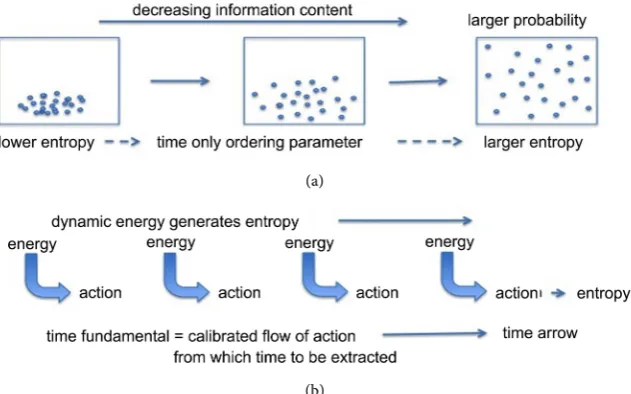
Figure 1. The statistical, probabilistic time arrow in direction of increasing entropy (a) is
compared with the proposed fundamental time arrow (b), where not probability but a dynamic energy is driving time (Tributsch, 2016a) (further explanation in the text).
entropy. It is not obvious how such a statistical time arrow could support feed-back processes for self-organization. Is such a purely statistical, probabilistic time arrow, together with an energy without any “dynamic” property towards producing action, adequate for a description of molecular biological processes and of evolution, where molecular structures exposed to feedback processes have to react in a time oriented way towards an increase of order and a decrease of probability (decrease of entropy)? In addition, present science cannot yet give a statement on the expected entropy (energy) behaviour of such self-organized systems, which are subject to non-linear irreversible behaviour.
1.2. Why Is a Fundamental Energy Driven Time Arrow Crucial for
Biology?
Life and its most important mechanisms are self-organized processes. It is known that they function far from thermodynamic equilibrium and involve feedback processes (compare scheme in Figure 2). Without feedback processes, that distinguish between “before” and “after” dynamic self-organization would simply not be possible. This can mathematically clearly be demonstrated, since without feedback processes the necessary complexity and order could not be achieved.
DOI: 10.4236/aa.2018.83008 143 Advances in Anthropology
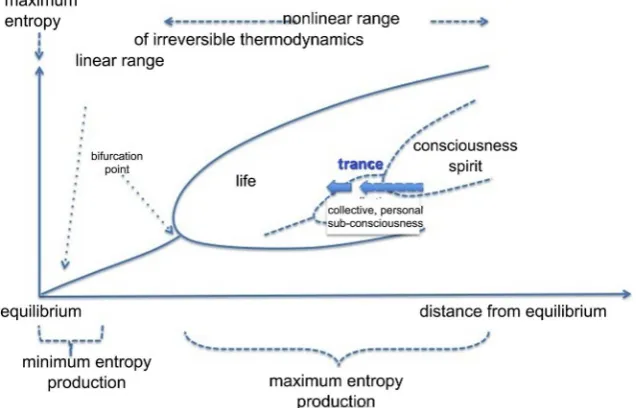
Figure 2. Scheme explaining life, consciousness and spirit as a function of distance from
equilibrium. Also the presently accepted entropy laws, maximum entropy at equilibrium, minimum entropy production in the near equilibrium linear range are indicated, besides of the here proposed maximum entropy production in the nonlinear range of irreversible thermodynamics. Consciousness and spirit require high energy flow and distance from equilibrium. With decreasing energy supply consciousness is breaking down yielding trance-like states and rudimentary forms of consciousness (arrows).
and cheap, which explains many scientific efforts in this direction (e.g. Lewerenz & Peter eds., 2013; Chen et al., Eds., 2013; Tributsch, 2008a).
What is the main problem with water splitting? In order to liberate one molecule of oxygen a catalyst has to extract 4 electrons from water. The mini-mum required energy would be 4 times 1.23 eV plus some losses. However, when a first electron is extracted from water already 2.8 eV are required and an OH radical is formed, which is not desired as an intermediate. An example of such a catalyst, working with UV-light, is titanium dioxide, which is now used to fabricate self-cleaning interfaces (Fujishima et al., 1999). But also when a plati-num electrode is applied, a quite unfavourable mechanism of oxygen evolution proceeds. Nature, however, found a way to extract all four electrons from water with negligible losses of only 60 meV per electron (Watanabe et al., 1990). In contrast, the best presently known artificial catalyst for oxygen evolution is the noble metal compound RuO2 with a loss of 300 meV per extracted electron. But
a remarkable fact is that in spite of many efforts no synthetic 4-centre manga-nese complex tailored to match the photosynthetic original, was found to show bio-analogue favourable catalytic properties (a review from 2004 already dis-cusses 171 manganese complexes including 54 Mn4 clusters, on the basis of 410
references (Mukhopadhyay et al., 2004). What is nature’s secret? How can it make structurally equivalent complexes, which science finds essentially inactive, highly active? Already 25 years ago the problem was addressed (Pohlmann &
DOI: 10.4236/aa.2018.83008 144 Advances in Anthropology self-organized molecular catalytic reaction. This is not a farfetched assumption because most structures in biological systems are self-organized. The Mn4-complex
in photosynthesis accumulates stepwise four positive charges until the S4 state of
the complex is reached (Kolling et al., 2012; Rhee et al., 1997). This state starts reacting with water and here feedback processes become crucial. When the first electron is extracted from water there will be, via some molecular reaction steps, a feedback to the next electron extraction step and from this to the following and so on. Mathematically it is then seen that under certain parameter constellation one equation only is sufficient to describe the transfer of all four electrons from water with low activation energy. This means that the first electron is “slaving” the others, increasing order and decreasing entropy (like what photons do in a laser pointer). As a consequence, the activation energy is seen to decrease dra-matically and could even become negative (Pohlmann & Tributsch, 1993). The unfavourable first electron extraction is avoided and the collective reaction be-comes fast and highly directed. This is exactly what is seen to happen with the manganese complex in nature. But a key condition is that the protein environ-ment of the manganese complex facilitates such feedback processes. This is an important detail, which is not yet adequately considered in present water split-ting research (Tributsch, 2018a). And the feedback processes involved during self-organization definitely require a “before” and an “after” in time. What time? How can the Mn4-complex, on the basis of time-neutral particles, “know” how
to react during feedback situations? Can we imagine that an efficient molecular catalyst, in which the overall reaction proceeds in the millisecond range or faster, relies on and monitors a probabilistic, statistical time arrow in the environment, a time arrow towards increasing entropy (disorder), to determine a “before” and an “after”? Such a statistical time arrow in direction of entropy increase would, on the basis of established knowledge, rely on a huge number of statistically re-acting particles to function. What statistical disorder within and around the mo-lecular complex, which itself is reducing its entropy and building up order dur-ing the self-organization process, would it be? How could a statistical time arrow be experienced by the manganese complex anyhow? How could a monitoring of the time flow for the fast proceeding self-organized molecular catalytic reaction proceed to allow distinction between “before” and “after”? On molecular level this is not imaginable to occur on the basis of a probabilistic time mechanism. But it is imaginable, when energy turnover itself, by generating action, is indi-cating the pulse of time. Even our clocks do not monitor an increase in statistical disorder. They rely on an energy input and special energy driven mechanisms to measure a flow of action, energy times time, from which our clock time is ex-tracted via calibration.
DOI: 10.4236/aa.2018.83008 145 Advances in Anthropology what will be “after”. It is argued (Tributsch, 2016a) that time cannot be a statis-tical phenomenon, it must be fundamental, driven by energy turnover. Figure 1(b) explains how such an energy driven time arrow can be imagined. Energy is not any more time-neutral, but gets a fundamentally dynamic property and gen-erates action. Many energy conversion steps, which are schematically shown in
Figure 1(b), generate a flow of action (e.g. trickling sand in an hourglass), which can be calibrated to yield time. Here feedback processes during energy conver-sion processes can occur.
Such a fundamental time flow, an energy driven time arrow, will, of course, be equally needed for explaining the wealth of other biological mechanisms, of population dynamics, and of the process of biological evolution in general. The expectation is: only when accepting such a reality of an energy driven funda-mental time arrow we will be able to learn how to construct working bio-mimetic models for photo-catalytic water splitting (which could be essential for human’s energy future) and to understand relevant laws determining evolution of the universe and of life within. When trying to understand self-organized biological processes we have to think in terms of a time generating mechanism, which ac-tually controls the biological, structure forming processes. We cannot use a time concept based on statistical probability towards disorder for understanding mechanisms in which energy flow and time control is required for building up order. This motivates and outlines the aim of this investigation: While historical and present understanding of evolution is based on a probabilistic time arrow, on energy which has no drive, and on ignorance of how self-organized systems far from equilibrium may behave in terms of entropy (energy) turnover, the present paper introduces an energy driven time arrow, which allows feedback processes. It explores the now deducible limiting entropy (energy) law for self-organized systems, and investigates consequences for understanding mechanisms of evolution. The principal interest is a re-evaluation of the situa-tion of humans, subject to such a new proposed energy driven time arrow in a fundamentally irreversible universe.
2. Deriving and Understanding the Fundamental Energy
Driven Time Arrow
2.1. The Principle of Least Action Shows the Way
DOI: 10.4236/aa.2018.83008 146 Advances in Anthropology also became never clear why scalar, non oriented quantities, such as energy and time, as they are presently used to calculate least action, succeed in describing dynamic motion, which is a standard procedure in physics for calculations of ballistic trajectories or satellite orbits.
When action, the time integral over energy, is split up into infinitesimal small sections, then these still have to minimize in order to fulfil the principle’s claim of minimization of action. This is, however, only possible, when the quantities involved, energy and time, are themselves dynamic quantities. Free, available energy, however, as it is understood now, is a scalar quantity, just a number without interest in changing and doing work. And time is just a parameter, monitoring changes. When these quantities do not have directed, vectorial properties, how can then the least action path of a stone be calculated? This is accomplished with a mathematical trick: the so called “variational calculus”. Mathematics is achieving what we are not allowing energy and time to be: dy-namic variables.
In contrast, as suggested in (Tributsch, 2016a), one should claim that energy and time are dynamic quantities, with the tendency of energy to decrease its presence per state, thus generating entropy while driving time. This also simply explains the final cause, which seemed to govern physical systems subject to the principle of least action. The principle of least action is just demonstrating a fundamental energy driven time arrow. It is a dynamic energy, which decreases its presence per state and thus generates entropy and drives time. This is, in principle, exactly what the empirical second law of thermodynamics is saying: that entropy is maximising in a closed space (which could not be derived from basic principles up to now) and what makes snowflakes grow (a minimum free energy is approached). Already these empirically observed important phenom-ena, which cannot be derived from time neutral basic principles, make the pro-posal of an energy driven fundamental time arrow credible and necessary.
Energy turnover drives time, but the real “essence” of time is not the parame-ter t, clock time, which we use to monitor changes. It is rather the flow of action, energy times time, as it follows from the principle of least action. Even clocks are powered by a flow of action, from which a calibrated clock time t is deduced. But clock time t itself has no substance and there is no energy behind. Clock time cannot directly be measured like a stream of air or of water and it should not be able to manipulate objects and space (as assumed in Relativity Theory). It has always to be measured and handled via a flow of action (as described by the principle of least action, and implemented in a clock), which is the actual time flow in nature.
DOI: 10.4236/aa.2018.83008 147 Advances in Anthropology action remains the same. Life there may consequently proceed like it proceeds on our planet. Time travel, which follows from the Theory of Relativity, and would create so many incredible paradoxes, is simply not possible.
The claim here, that time flow is fundamental and energy driven, means a paradigm change. Our world is, on the level of atoms and elementary particles (which are equivalent to energy and mean self-organized energy (Tributsch,
2015; 2018a) not fundamentally time neutral, as it is claimed now, but
funda-mentally time-oriented and irreversible.
This conclusion has significant consequences for understanding physical mechanisms ranging from quantum physics to evolution of life and cosmology
(Tributsch, 2015; 2016a, 2016b; 2018a). In quantum physics, for example,
parti-cle and wave concept are not equivalent (and time neutral) any more, but a wave, with its distributed energy, follows from a particle, with its concentrated energy. For a quantum state, with both particle and wave properties, information on matter is needed to recreate a particle from a wave. This would work like seen with a modern three-dimensional printer, which creates a structured object from information. The information on matter is part of a quantum state and turned out to be relevant for a “rational” understanding of quantum phenomena
(Tributsch, 2016a), which itself should be a discussion point for science
phi-losophy. Information on matter has an energy content, is localized around a par-ticle and increases with parpar-ticle numbers. It could be identified with the phe-nomenon of gravitation (Tributsch, 2016b). Since a particle is reconstructed via this information on matter (like an object can be reliably reconstructed via a 3D-printer from digital information transmitted to a moving plane), an always constant light velocity immediately follows. Such a simple and reasonable ex-planation of gravitation and of the always constant light velocity questions, of course, the generation of these phenomena by empty space (as postulated in the Theory of Relativity).
Due to the ongoing exchange between particle and wave, via information, in cosmology a spreading radiation of photons can lose energy for entropy forma-tion, as required by the well known entropy law, which also Einstein used and compared with the entropy law for an expanding gas to derive the photon prop-erty of radiation (Einstein, 1905). For the reason of entropy generation alone stellar radiation should be experiencing a redshift, which is the stronger the longer the distance of the cosmic object. In quantum physics, as understood to-day, such entropy formation is not permitted. A photon, once released, can only change its energy when interacting with matter and gravitation. Therefore, an explosive spreading of empty space is presently assumed in physics to explain most of the observed stellar redshift (cosmological redshift). But how can empty space, defined to contain nothing, assume such a property of expanding and where is the missing energy going?
DOI: 10.4236/aa.2018.83008 148 Advances in Anthropology cosmology can be avoided and replaced by rational explanations (Tributsch,
2016a, 2016b; Tributsch, 2015). It is claimed here that they arise in present
physics because scientists look at an irreversible world applying laws deduced for a world with assumed time neutral fundamental properties (for philosophy a case of counter induction). And, as to be claimed and explained here, evolution does not fit into a time neutral world either. Our present concept of evolution has consequently to be re-evaluated.
2.2. Statistical Time Arrow Is Only Specialized Manifestation of
the Fundamental Energy Driven One
Those phenomena attributed to the “statistical” time arrow actually exist. An “ordered” gas (compressed, assumed time-reversible) indeed becomes an ex-panded, statistically distributed, chaotic one (Figure 1(a)). The distribution of gas particles becomes a more probable one with less information content. The entropy S of this gas, thereby, following the statistical time arrow towards in-creasing entropy, grows from S1 to S2 by ΔS. When multiplying the entropy with
the temperature T of the system, however, one realizes that this means, that the not anymore useful (entropic) energy of the system is simply increasing by TΔS. Since energy cannot be created from nothing and cannot be lost (1st law of
thermodynamics) this means that the statistical time arrow is simply explaining that original free (available) energy, contained in the more ordered system, is being converted into non available (entropic) energy of the more disordered system. Instead of saying that a system assumes a more probable state of disor-der (compared to a time-neutral initial state) it is therefore entirely equivalent saying that (original) free energy has the tendency or drive to decrease its pres-ence per state while generating entropic, not available energy (TΔS). Such a phenomenon is actually observed, for example as reason for the growth of ice crystals, and can accordingly be interpreted without claiming time-neutral gas particles (or time neutral energy).This however is exactly the proposed defini-tion of the “fundamental” energy driven time arrow (Tributsch, 2016a). Energy and the resulting action (from which clock time can be derived) can therefore be understood as dynamic variables. These simple considerations are, besides of the conclusions derived from the principle of least action, another support for an energy concept, in which energy is not dormant, but dynamic. It can also gener-ate statistical disorder (simulgener-ate a statistical time arrow) while converting energy and producing action and entropy.
irre-DOI: 10.4236/aa.2018.83008 149 Advances in Anthropology versible mechanisms.
There is, namely, a big difference between the two time concepts: While the statistical, probabilistic time arrow does not allow to understand self-organization (via feedback processes) in highly organised fast reacting molecular structures and in elementary particles, the fundamental time arrow does. It is the flow of action as a result of energy conversion, which is determining the progress of time. The fundamental time arrow, related to a dynamic energy, is much deeper rooted and more general than a probabilistic, statistical time arrow. And before all: it is the time, which is actually relevant in natural processes and determin-ing molecular self-organization, evolution, population dynamics and cosmo-logical phenomena. Considering it is crucial. It will allow understanding nature, and especially mechanisms which depend on time, feed-back and self-organization, in a more rational, simpler and deeper way.
Energy turnover, the flow of action and the build-up of order are fundamental characteristics of biological and human evolution. In the following some impor-tant consequences of a fundamental time arrow for biology, evolution and population dynamics should be investigated.
3. What Entropy Law Is Determining Self-Organized Systems
Such as Life?
Our traditional science cannot convincingly derive the empirical second law of thermodynamics from fundamental principles, the well-established law, which states that in a closed space entropy, disorder, increases and maximises. Addi-tional ad hoc assumptions would be necessary. For physics, which claims that elementary particles and processes are time neutral, this is a humiliating fact. But when the discussed fundamental time arrow is accepted, with an energy, which aims at decreasing its presence per state and drives time (like during the growth of snow crystals), the second law of thermodynamics follows immediately. It al-lows understanding and deriving the entropy law for equilibrium thermody-namics and is an important result which alone justifies taking the fundamental energy driven time arrow seriously.
Life is a phenomenon of self-organization, which is proceeding far from equi-librium in the range of nonlinear irreversible thermodynamics. Its position in a diagram explaining systems exposed to different distances from thermodynamic equilibrium is shown in Figure 2. Also the known entropy laws (maximum en-tropy, minimum entropy production) for equilibrium and near equilibrium, and the new proposed entropy law for self-organized systems (maximum entropy production, see later) are indicated.
DOI: 10.4236/aa.2018.83008 150 Advances in Anthropology is different and quite clear: such self-organized energy systems, which are pow-ered by the through-flux of energy, will finally transform all available energy by decreasing its presence per (energy) state thereby producing entropy. Feedback processes, which cycle products again into initial reactions and amplify them, will fuel the self-organization phenomenon, increase the energy turnover and consume the available energy influx, intensifying the process, when more energy becomes available.”Maximum entropy production” is the determining mecha-nism of feedback driven processes and only limited by the constraints of the sys-tem, by the limitations, which the system itself or the environment are imposing. It is interesting to note now that maximum entropy production within the con-straints of the system has already been empirically proposed by other scientists for self-organized systems including human ecology (Paltridge, 1979; Swenson, 1997; Liu et al., 2011).
Empirical evidence has been given by these authors, but they could not justify such an entropy law and derive it from more fundamental principles. In addi-tion, they met strong objection from experienced physical chemists. John Ross wrote a paper on the “invalidity of the principle of maximum entropy produc-tion” and argues that the rates of chemical reactions are controlled by (non-vectorial, non-oriented) thermodynamic quantities such as Gibbs free en-ergy and activation enen-ergy and not by the rate of entropy production (Ross,
2008). His arguments are certainly valid, however for the traditional handling of
energy as quantity of state without a time orientation. If energy is however un-derstood to be a time oriented, dynamic variable aiming at decreasing its pres-ence per state, and is thereby indeed generating entropy via feedback controlled mechanisms in a rate determining process, the situation changes. Self-organized systems do therefore aim at maximum entropy production, of course within the constraints of the system concerned. Then, published empirical observations in support of maximum entropy generation make sense (Paltridge, 1979; Swenson, 1997; Liu et al., 2011).
There are practically interesting examples of self-organized system, which will allow us to imagine how life may behave, how population dynamics may work, when such a law of maximum entropy production applies and constraints are changed, for example reduced:
A well known inorganic phenomenon of a self-organized system, which is causing many problems to humans, are hurricanes. Many of these quite fre-quently arising storms remain relatively small and modest. When they hit land they also typically lose power and disappear.
atmos-DOI: 10.4236/aa.2018.83008 151 Advances in Anthropology phere of the earth is occurring in the atmosphere of Jupiter (where no continents can be identified) and seen as red spot on its surface. Its dimension extends over 22,000 times 12,000 km and it already has been raging for centuries. It is so vio-lent that the temperature above the spot on this cold planet reaches 1300˚C. Maximum entropy production within the constraints of the system would per-fectly explain the self-organized behaviour of such atmospheric storms. They tend to become as big and as violent as the constraints of the system allow it. Within their constraints they generate maximum entropy turnover.
Let us now look at a laboratory example of a self-organized system and focus on its ability to adapt and evolve towards additional energy sources. It is an os-cillating chemical reaction, the Belousov-Zhabotinsky reaction, which, with its beautiful propagating rings and waves, is often used as a relatively simple labo-ratory demonstration for the function of (much more complex) biological self-organized systems (compare Wikipedia). If the system would be scaled up, while maintaining the parameters needed for sustaining oscillations, oscillating energy conversion would expand and proceed, adjusting itself to higher energy turnover, until all the additional chemical energy (malonic acid) is consumed. How does such a system respond, when additional energy, for example in form of light, is made available? As a consequence of addition of the light absorbing dye tris (bipyridine)ruthenium(II)chloride, which can supply photo-excited electrons to the system, the self-organized reaction adjusts and oscillation pat-terns can now be controlled by light. The self-organized system adopts a photo-reaction and readily learns to utilize light, solar energy (!). If a light pattern is now projected onto the oscillating solution, it is clearly reflected and recognized in the correspondingly adjusted oscillation patterns. Chemically, energy conver-sion via an electron transfer process, occurring in the dark, was completed and replaced by a light-induced one, providing more and a different form of energy to the system. When looking at the introduction of the photochemical process (via addition of a dye molecule) as a “macro-mutation”, then the system simply adjusts to higher energy turnover and entropy production (maximum entropy production within the new restraints of the system) by using light energy. It simply allows additional energy into the system as long as existing restraints al-low it. That way it becomes, as a photo-chemical reaction, more complex and differently self-organized. This shows that self-organized systems can, when ad-ditional energy is made available, evolve towards higher complexity and higher energy consumption. The complicated feedback processes involved in this case (at least 12 kinetic differential equations needed for a mathematical description) presuppose a time flow, a distinction between “before” and “after”. As explained earlier, it cannot be a probabilistic time, but must be a time dictated by energy conversion steps involved in this complex reaction, which generates order within this oscillating chemical system.
DOI: 10.4236/aa.2018.83008 152 Advances in Anthropology metres high. Trees use solar energy via quantum processes and solar evaporation for photosynthesis and tensile water transport. They generate useful work via massive entropy production in form of environmental heat and water vapour. Trees are definitively systems which function via self-organized processes subject to maximum entropy production (energy turnover), within their restraints, which largely vary. They are, of course, genetically controlled, which shows that genetic mechanisms had to deal, and successfully dealt with and had to “respect” the fundamental properties of self-organized systems (maximum entropy pro-duction within existing restraints). Living systems and genetic control evolved within the basic conditions imposed by self-organized systems. Genetic mecha-nisms developed and acted towards the evolution and diversification of self-organized systems, which, however, remained subject to the fundamental entropy law, governing them. Only within its characteristic entropy law life as a self-organized system remained operable.
4. What Consequences for Understanding Evolution?
4.1. Early Evolution towards Light Harvesting
Today there is agreement that evolution follows no purpose, is blind and indif-ferent, just exposed to statistical mutations, which epigenetic mechanisms can to some degree influence. But this established concept ignores, how self-organized systems themselves deal with time in feedback reactions and with energy. Tradi-tional theory of biological evolution emphasizes genetic mechanisms, but essen-tially excludes the influence of fundamental laws which control self-organization (which physics and thermodynamics could not identify on the basis of time-neutral laws and a probabilistic time arrow).The before mentioned example of the Belousov-Zhabotinsky reaction shows, how easily a self-organized mecha-nism integrates light absorbing molecules and a photoreaction towards solar en-ergy utilization and a maximization of entropy (enen-ergy) turnover (within the new restraints of the system). All available energy is finally converted into en-tropic, not any more available energy (TΔS, with T = absolute temperature, ΔS = entropy change). Since a similar step must have happened during early evolution of photosynthesis, which occurred between 3.2 and 3.5 billion years ago, when life started using solar energy, it is reasonable to have a closer look at it. Life it-self, of course, started earlier and a credible hypothesis is, that this happened around black smokers in the deep sea on the surface of pyrite mineral
(Wächtershäuser, 2000). In favour of this model is not only that life (bacteria)
how-DOI: 10.4236/aa.2018.83008 153 Advances in Anthropology ever, was that due to the then missing ozone layer the UV irradiation there must have been 100 times stronger than today. How could early life have nevertheless survived there? The explanation, proposed by the author, is that pyrite can also serve as an excellent energy acceptor and quenching agent, via non radiating en-ergy transfer, of excitation enen-ergy of molecules at a distance within approxi-mately 10 nm (Tributsch et al., 2003; see also Mullen, 2004). In pyrite, as the fi-nal acceptor of this UV excitation energy, the excitation state is quenched within 10-14 s, converted into heat. As a consequence, evolving life in a thin layer on
py-rite was reasonably protected against radiation damage. Here the “living” or-ganic layer could have started first taking advantage from a photovoltaic effect, which has been demonstrated for natural pyrite. It would have been like replac-ing dark electron transfer by photo-induced electron transfer in the Belou-sov-Zhabotinsky reaction when introducing a dye. In such self-organized thin organic layers on pyritemineral surfaces in tidal areas of the ocean Chloro-phyll-like dye molecules may have appeared. They started interacting photo-chemically, contributing radiation energy into the “energy-hungry” self-organized early living system, which then gradually separated from pyrite and continued increasing local order at the expense of solar energy. The entropy law identified for self-organized systems explains the feedback-driven “pressure” towards maximum energy turnover and towards mechanisms facilitating it. All available energy for the self-organized system is turned over in direction of dis-sipation and entropy formation (of course within the restraints of the system). A higher energy through-flux will shift the system further away from equilibrium. This can facilitate additional build-up of order. Early evolution of photosynthe-sis, as analysed in detail in the literature (Blankenship, 2010), could proceed its way. But somewhere during the early stage of life genetic mechanisms must have been integrated to take control over reproduction and evolution including life’s sometimes critical and destructive exposure to maximum entropy (energy) turnover (see later). Formation of self-similar copies is a characteristic property of self-organization and self-organization of chemical DNA information (as to be explained below) will provide the necessary mechanism.
4.2. Opportunities for Endosymbiosis and Macro-Mutations
DOI: 10.4236/aa.2018.83008 154 Advances in Anthropology The processes just followed the here discussed entropy (energy) law of self-organized systems. The evolving systems simply acquired new energy sources (as explained for the Belousov-Zhabotinsky reaction with the incorpora-tion of a light harvesting mechanism). This also opens the consequence that mutations now have a bigger chance to succeed. The reason is that more energy is available, which helps them to be more successful (like ideas in industry are more successful when sufficient money (energy) is available). In addition, the increasing energy turnover can give access to new self-organization structures, because the system can move further away from equilibrium (compare Figure 2) towards new bifurcation opportunities.
Such fundamentally tolerated and imposed mechanisms could play a role in explaining significant shifts and reorientations within evolution (endosymbiosis and macro-mutations via adaptive radiation), which started new species. But they, of course, required genetic mechanisms to participate, in order to perpetu-ate information and to guarantee that the complex parameter space, which sus-tains self-organization, is not left.
Self-organized systems, subject to maximum entropy (energy) turnover, have an inherent drive to facilitate evolution towards higher complexity and higher energy turnover. As long as the system can survive and control order within its special parameter constellation, it will allow entropy turnover to increase. The energy hunger is inherent. But the adjustment to the right parameter constella-tion, which facilitates and propagates self-organizaconstella-tion, can be expected to be a great challenge. The essential point is: maximising energy (entropy) turnover shows a direction of evolution, explains the energy hunger of living organisms, but it does not yet shape a living and multiplying organism. Here, of course, the complex mechanisms of selection and evolution enter, as science has learned to understand them from sometimes somewhat different points of view (e.g. No-vak, 2006; Okasha, 2006; Lynch, 2007; Futuyma & Kirkpatrick 2017). For real life to develop, the drive towards maximum entropy production, as applicable to self-organized mechanism, had to be superimposed by the evolving information carrying and selecting genetic mechanisms (which is also subject to self-organization, as explained further below).
4.3. Maximum Entropy Production of Self-Organized Systems and
Expected Overall Trend of Evolution
ad-DOI: 10.4236/aa.2018.83008 155 Advances in Anthropology aptations on the way towards increasing energy turnover? Life, as we know it, would not have survived, if increasing energy (entropy) turnover would have been the only determining factor. Not considering reproduction now, earlier or later self-organization and build-up of order would have broken down, because the systems would have drifted out of the narrow parameter space, which sus-tains self-organization. The evolutionary process of statistical mutations and adaptations towards fitter living species (e.g. Ruse, 1996; Futuyma & Kirkpatrick 2017) must have taken over to safeguard and shape the survival ability. It is, however, to be expected, that the trend towards increasing energy (entropy) turnover of self-organized systems essentially shaped evolution because living systems with their genetic mechanism do not stop being self-organized. Evolu-tion would be like introducing small and arbitrary changes into the self-organization patterns of a hurricane or the Belousov-Zhabotinsky reaction. The fundamental drive towards increasing energy turnover is expected to be maintained, to favour macro-mutations and to explore new self-organization patterns (which could improve the survival ability of species).But this is expected to have been a delicate process. As a consequence, it has to be assumed that DNA and the genetic code may not only have evolved for handling, transfer and multiplication of information between subsequent generations. The genetic tools may have also evolved to safeguard life against an uncontrolled maximization of energy turnover imposed by the very nature of self-organised living systems. The danger to drop out from the parameter space, which can sustain self-organization, was quite big. This situation may be characterized as follows: evolution, since it deals with self-organized systems, is subject to a natural law that drives them towards maximum entropy (energy) turnover (within the re-straints of the system). But genetic control (self-organized, see later) and statis-tically occurring mutations are superposed to such a drive, handle reproduction, avoid destructive maximisation of energy turnover, and find the way to keep life in the appropriate parameter spaces for survival. But a mutation is not only an arbitrary statistical change during reproduction. It becomes also a modification within the self-organized system itself. And such a modification can trigger changes in self-organization and in the restraints of the system. This would, of course, also contribute to evolution. The result is what was above mentioned as an example: trees. They are genetically controlled but show the property of maximum entropy production (energy turnover) within their restraints (differ-ent sizes, differ(differ-ent climatic adaptations, differ(differ-ent water needs).
That genetic mechanisms can also act towards a control of excessive energy turnover is obvious. Many living species are experiencing this during periods of hibernation and sleeping. Here, genetic mechanisms care for a reduction of en-ergy consumption of living species as an adaptation to reduced enen-ergy supply. That way the parameter space for self-organization (life) could still be sustained.
DOI: 10.4236/aa.2018.83008 156 Advances in Anthropology for evolution. It is to be expected that different restraints apply for the long-term, genetically controlled evolution of individual species and for much shorter term population dynamics.
It is interesting to look at simpler examples of self-organized systems to un-derstand more about their inherent properties. How they behave when they are not subject to a longer term genetic or external control, can best be seen from examples of population dynamics. Self-organized systems, succeeding in a spe-cial environment, will increase their energy turnover and adjust it to the new constraints. The outcome can be temporary but is still impressive. An example is the population dynamics of imported rabbits in Australia. Their energy con-sumption devastated large landscapes until they were more or less controlled by external restraints. Another example is the Gipsy moth, Lymantria dispar dispar. It appears in a chaotic rhythm, many years inconspicuously, but then in an ex-plosive manner, generating maximum entropy turnover. This chaotic behaviour is a possible, typical reaction pattern for a feed-back controlled self-organized mechanism. A further example is sheep, when developing uncontrolled on is-lands. The ecosystem of Santa Cruz Island, one of the Channel Islands off the Californian coast, was practically destroyed, with a peak of 130,000 sheep and 5000 pigs living wild, before radical conservation measures were initiated to-wards creation of a National Park. These examples show how uncontrolled self-organizing systems behave on their way towards maximum entropy produc-tion.
When an adequate restraint (e.g. genetic control) is superposed, there will still be a pressure and trend in evolution towards increasing energy turnover, be-cause this property is fundamental, explains the energy hunger of living systems and may pioneer relevant adaptations. But evolution is expected to be much more focussed and will be more safely guided through varying environmental situations, because unfavourable mutations will simply be eliminated. For indi-vidual species there is consequently still a long-term trend in evolution of life towards higher energy turnover to be expected. Can this be recognized in na-ture? There exists, for example, an evolutionary trend towards multi-cellular or-ganisms and higher energy consumption via a larger size. The biggest living creatures did not live during the time of dinosaurs but they are living now, not accounting for the prehistoric extinction of many other large animals, by hu-mans (e.g. Camelops spp., Mammut americanum, N-America; Mammuthus
primigenius, Coelodonta antiquitatis, Bos primigenius, Eurasia; Diprotodon
op-tatum in Australia, Megalapterix didinus in New Zealand; Aepyornis maximus
in Madagascar). There is the blue whale, (Balaenoptera musculus), which reaches a length of 33 m and a weight of 200 tons. The biggest tree,
Sequoiaden-dron giganteum (General Sherman tree in Sequoia National Park, USA) is 83.8
m high, has a circumference of 31 m at its base and a volume of approximately 1500 cubic metres. A plant fungus of the Physalacriaceae family, a specimen of
DOI: 10.4236/aa.2018.83008 157 Advances in Anthropology covers an area of 9 square kilometres and is estimated to weight approximately 600 tons. The bigger a creature, a self-organized system, the more energy is turned over and consequently the more entropy is generated. This is also true for the growing human world population.
When more energy is turned over, systems are pushed further away from equilibrium. This favours, in self-organized systems, a change and increase of order via new self-organization patterns. Evolution of species should conse-quently also show a clear trend towards higher order and perfection, from sim-ple unicellular to more and more sophisticated multicellular living beings and symbiotic associations. The latter will simply be experienced as a source for ad-ditional energy, supporting the trend towards maximum entropy (energy) turn-over, within the (new) restraints. Also, significant organelles and organs in living species may have been incorporated through endosymbiosis or developed be-cause of their role in energy turnover towards maximum entropy production.
Paleontological studies show that there is such a trend towards higher perfec-tion. Living systems of today are technically more advanced than those that ex-isted a few hundred million years ago. They also consume more energy. A hu-man from a primitive hunter-gatherer tribe has a power consumption of ap-proximately 100 Watt, 10 times more than the power consumption of a cold-blooded crocodile of similar size. The power consumption of a modern human is 60 to 120 times higher than that of a primitive human. The use of fire, coal, oil and gas has helped him to follow the trend of self-organized systems and people also tend to increasingly crowd in cities, because more opportunities (energy) are available there.
With more energy available there should also be more implemented muta-tions. The rate of mutations should therefore have increased towards present time. They act like innovations in a technical society, which can be more suc-cessfully implemented when abundant money (energy) is available. An increas-ing rate of mutations towards present time seems actually to have been con-firmed for evolution (Hawks et al., 2007). But, as the introduction of a light-inducted reaction into the Belousov-Zhabotinsky mechanism has shown, changes towards an increased energy through-flow via a new technology will simultaneously be favoured. Industrial inventions, “mutations”, cars, airplanes, computers, cellphones, digitalized and automatic factories, all add to energy (entropy) turnover.
DOI: 10.4236/aa.2018.83008 158 Advances in Anthropology example, remained essentially the same during this long time period. It made no energetic sense to increase the size of the Gingko leaf. On the basis of the exist-ing tree architecture, the large number of leaves and their attachment there would not have been an advantage. In contrast, the leaves of the water lily
Victo-ria amazonica could become bigger and bigger, because their constraints allowed
them to harvest more and more energy. They could float on water, where they now reach a diameter of up to 3 m and a weight of 6 kg. Also the leaves of the palm Raphia regalis could become large (up to 25 m), because their anchoring allowed it.
What about humans, who, during the last centuries have been exploiting and “slaving” more and more plants and animals for energy consumption? They win competition with other self-organized systems and continuously reduce the con-straints applied to their own self-organized system. The step towards globaliza-tion with the steadily increasing rate of global exchange of materials and energy is an example of developments in that direction. The fate of human civilisation, according to the deduced dynamic law governing self-organized systems, will be that more and more entropy will be produced. This means more and more en-ergy turnover. More recent contributions to enen-ergy consumption arose from cell phones, computers, the Internet and the worldwide exchange of industrial products. Science fiction movies suggest how humans imagine the future: mas-sive energy is turned over to sustain their living standard. Based on this materi-alistic interpretation human society will basically behave and go on like an at-mospheric storm. It will increase energy turnover as long as the external re-straints (and genetic control) permit it. Energy turnover will become bigger and bigger, because natural restraints for modern humans are (temporarily?) de-creasing and humans learn to harvest more and more energy.
5. Consciousness and Spirit
5.1. Subject to a Fundamental Energy Driven Time Information
Can Self-Organize
Generation and turnover of information involves energy (one bit is equivalent to kTln2, k =Boltzmann constant, T = absolute temperature). We know that matter can self-organize. We see this in living nature. Matter is related to mass, mass to energy. When (dynamic) energy flow is linked to time flow then information is consequently also able to self-organize. This can mathematically be demon-strated (Tributsch, 2016b). When a reasonable degree of complexity is given, so that feedback processes can be activated at a high rate, information modes within a nervous structure should be able to develop self-organization. However, the information processing system has to be pushed far from equilibrium, which requires that a high through-flux of energy through the brain is warranted
(Figure 2). Another precondition would, of course, be that information on time,
DOI: 10.4236/aa.2018.83008 159 Advances in Anthropology fundamental time arrow. As already emphasized, it is not imaginable that a sta-tistical time arrow, relying on probabilistic events of many particles, as favoured today in physics, could do the job in a brain system. How could anyhow an in-crease of entropy, of disorder (in a system relying on building up order, thus re-ducing entropy) be monitored on a fast time scale? It must be, as here suggested, the flow of action as a consequence of energy conversion within the neural net-work of the brain, which controls and monitors the flow of time and which al-lows cascades of feed-back reactions to facilitate self-organization of informa-tion.
What does, in fact, self-organization of information mean? The consequence should be that a higher hierarchy of information processing is enabled. The dif-ference in quality between pure information processing (like in our computers) and self-organized information processing (like in our brain) should be ap-proximately the same as between water with the dissolved chemical components of a bacterial cell and a living bacterium itself. In the bacterial cell chemicals are handled in an “intelligent” way. The same can be assumed for self-organized processing of information. It may handle more basic information in an intelli-gent way and behave like a living system. Such a phenomenon can only be con-sciousness and human spirit. It may be considered as something, which is proc-essing available information from memory, the body and the environment while creating a functioning model of oneself. Can animals do that? The question of consciousness in biological organisms is very complex. Intelligent questions have been raised in that context, last not least by the philosopher Nagel (1974), who argued, that then there must be something that is “to be like that organism”. Nagel imagined a bat. Obviously, with such a definition, the information avail-able on the particular living being should be provided and be availavail-able in a higher hierarchy of computation. This is exactly what should be expected from self-organized information. But there are additional conditions: The brain sys-tem must be driven for feedback processes far from equilibrium, which requires high energy turnover, and the species should show clear behavioural signs of thinking and acting in a higher hierarchy of information handling. Humans evolved a brain which is 3 times larger than those of the closest relatives among primates and show this consciousness.
DOI: 10.4236/aa.2018.83008 160 Advances in Anthropology Like with self-organization of matter in biological systems consciousness should have evolved gradually, forming earlier, more rudimentary and later more elaborated states of consciousness (compare Figure 2). Psychological sci-ence actually distinguishes collective and personal sub-consciousness (Jung,
1958-1981). They may function closer to equilibrium. Some primates as well
may have already developed a primitive form of consciousness, but a clear evaluation seems not yet possible, especially since the phenomenon of con-sciousness itself is not sufficiently well understood.
Figure 2 shows, how life and consciousness developed far from equilibrium,
the first via self-organization of matter, the second via self-organization of in-formation (which requires and presupposes a certain degree of organization of matter). Higher energy turnover in the brain increases the distance from equilib-rium and generates increasingly evolved self-organized states of consciousness.
The identified drive of evolution towards maximum entropy (energy) turn-over within the restraints of the system has facilitated a significantly increased energy flow through the brain, which finally allowed self-organization of infor-mation leading to evolution of spirit and intelligence. It is important to empha-size here that the inability of traditional science to explain consciousness and spirit on the basis of established time-neutral natural laws has been seriously criticized. Thomas Nagel argued that the necessary preconditions for spirit must have been present in nature before human evolution (Nagel, 2012). The title of his book: “Mind and Cosmos. Why the Materialist Neo-Darwinian Conception of Nature Is Almost Certainly False” is quite provocative.In the present paper the explanation is easily given and it is entirely materialistic. It requires the here discussed paradigm change towards a fundamental energy driven time arrow and thus to a fundamentally irreversible world: “The preconditions for a devel-opment and for a materialistic understanding of spirit were present in nature in form of a drive towards maximum entropy production present in self-organized (living) systems, which are exposed to an energy driven time arrow. Genetic mechanisms sustained and developed spirit via natural selection”. According to what we know about their brain and behaviour, largely cold blooded dinosaurs did not yet make it to develop spirit, even though nature experimented with very large body sizes to increase entropy production. But mammals much later suc-ceeded in developing a brain with high energy throughput via the human spe-cies. Nagel (2012) argues that evolution itself cannot be justified via evolutionary arguments. But this ignores the here emphasized drive of self-organized systems towards maximum entropy production, subject to superposed genetic mecha-nisms (which, when self-organized, themselves turn over, multiply and maxi-mize information, see below).This provides the drive towards survival and re-production seen in evolution.
al-DOI: 10.4236/aa.2018.83008 161 Advances in Anthropology low understanding the entropy law, which is dominating self-organized systems and facilitating high energy turnover as a precondition for self-organization of information.
5.2. Spirit as a Materialistic Phenomenon
Subject to a fundamental time arrow, which is directly related to the turnover of energy and the flow of action within biological structures, consciousness, intelli-gence and spirit become natural materialistic phenomena. They are conse-quences of self-organization of information, triggered via a sufficiently strong through-flux of energy, which displaces the information system far enough from equilibrium (Figure 2). On the basis of known behaviour of self-organized sys-tems several properties of consciousness and spirit may be immediately recog-nized. One is that consciousness will function only within well defined parame-ter constellations. If it leaves them, chaotic (break down), oscillating (manic de-pression?) or bi-stable (schizophrenic?) conditions may occur. Another factor will certainly be the supply of oxygen to the brain, which promotes energy con-version by serving as final acceptor for electrons. If oxygen supply is too low or when the energy flux through the brain decreases for other reasons, conscious-ness may be significantly reduced or lost, situations like trance may temporarily appear. This may be experienced in the altitude sickness, in ecstatic situations or in spiritual dementia. The operation conditions for consciousness would simply shift too much towards equilibrium and self-organization of information would drift into more primitive forms or entirely cease (arrows shown in Figure 2).
Since the self-organized information system, spirit, will involve many infor-mation sources, including those from memory, from sub-consciousness, from the living body, and the environment, it’s very complex structure and dynamics will be significantly different from person to person. The created image of one-self, within “consciousness”, and the resulting formation of intentions should therefore be very individual. To a large extent there will be a “free will”. Due to the complexity involved it may not easily be possible to trace decisions back to trivial causes. But, on the other hand, self-organized systems can, under certain conditions, also become synchronized, maybe explaining mass psychogenic phenomena.
5.3. Self-Organization of Chemical (DNA) Information
DOI: 10.4236/aa.2018.83008 162 Advances in Anthropology blueprint for the body’s structure and function and that it can properly handle and arrange the approximately 30 trillion human cells in the living body. How-ever, a puzzling situation arose when the information storable in the human ge-nome was estimated to be only of the order of 750 Megabyte, the storage capac-ity needed to operate a typical videogame (e.g. McElheny, 2012; Dharma-Wardana, 2013). Life is, of course, much more complex than a videogame.
What if the genetic code would only be a reference facilitating and shaping self-organization of its contained chemical information, while interacting with the living organism? Complex feedback processes would, of course, be needed for such a function. The self-organized living organism could provide that on the basis of a fundamental time arrow. A much more complex self-organized (chemically intelligent) information structure would result. A living body, into which modified genetic information is introduced, could facilitate the dynamics of self-organization using the genetic information as a reference system. A simi-lar need for interaction has already been recognized between the DNA and the living organism within epigenetic concepts. Similar as the information contained in the structure and function of a living bacterial cell is much more extensive than that contained in its dissolved (not self-organized) chemicals, self-organized chemical information will be much enhanced but still largely determined by the DNA blueprint which defines the parameters involved. The system would not only be able to synthesize the necessary molecular biological building stones. It would also know how to arrange them and how to get them communicating with each other. It would be, superficially seen, like entering the (self-organized) Internet with keywords to retrieve and activate relevant and abundant informa-tion. The key-words would come from the DNA, the self-organized structure from a living, self-organized body.
DOI: 10.4236/aa.2018.83008 163 Advances in Anthropology chemical information handling thus helps to better understand living processes and may also shed new light on evolution of life on earth and in the universe. Evolution of “spirit and intelligence”, as self-organization processes, both in neuronal and DNA systems, may become interesting new long-term research subjects.
In Section 4.1, it was shown how easily a new energy source (such as solar en-ergy) could have been integrated into self-organized evolving life via incorpora-tion of light absorbing molecules. Now, photosynthetic activities are all rooted in the controlling genetic code, which here is suggested to function in a self-organized way. What is the interrelation between the tendency of a self-organized system to maximize energy (entropy) turnover for locally increasing order, and the ge-netic code, which seems to be a quite fixed blueprint of life? An interaction may be less rigid, when both processes are considered self-organized. Self-organized systems can, as already well known from neuroscience (e.g. Izhikevich, 2007; Hesse & Gross, 2014), get synchronized. This synchronization is also self-organized. Many examples from biology show that. Could this possibly indicate that in-creasing complexity due to inin-creasing energy turnover eventually finds its way somehow into the (self-organizing) genetic code? Is this ability to synchronize another unexplored way to shape evolutionary pathways and maybe an addi-tional opportunity to learn more about early evolution and the function of the genetic code when new species evolved?
DOI: 10.4236/aa.2018.83008 164 Advances in Anthropology when constraints become weak or break down. In this case not a genetic modifi-cation causing uncontrolled growth, but a genetic failure of not limiting growth should be in the focus of interest.
Corpulence and obesity are other situations, which may be related to a fun-damental tendency of self-organized systems towards increasing energy turnover and entropy production. It is now often explained as a behavioural relict from stone age, where food was scarce and not always available. This makes sense, but it could also be related to the discussed inherent and fundamental disposition of self-organized life towards increasing energy turnover, which surfaces under certain genetic, social and environmental conditions. What could speak for such an interpretation is the observation that populations originating from very dif-ferent cultural backgrounds and geographic (arctic, tropic) environments in the world seem to become equally exposed to such problems, when abundant food is available.
6. Discussion
Accepting a fundamental time arrow as a paradigm change for physics and natural science means understanding that a (dynamic) energy is driving time in form of a flow of action (which is proposed to be the ultimate manifestation of time in nature) (Tributsch, 2015, 2016a). Energy turnover (and not higher probability) is the cause for observed changes and the passage of time. This, as shown here, is not in contradiction with the presently accepted probabilistic time concept towards higher probability and increasing entropy. It includes it as a special case, since entropy increase ΔS in a probabilistic, statistical ensemble means increase of not any more available (entropic) energy (TΔS). It must arise from available energy. The fundamental time arrow, however, which could be derived from the important principle of least action (Tributsch, 2016a), opens the possibility to enable and understand fast responding feedback processes as required for self-organization in molecular systems, in evolution and develop-ment of human consciousness and spirit. It also allows deriving and under-standing the second law of thermodynamics, which conventional physics cannot do. Most important, it also yields the entropy law governing self-organized sys-tems such as life, ecosyssys-tems or galactic phenomena: maximum entropy produc-tion (energy turnover) within the restraints of the system will be approached. Genetic mechanisms, themselves proposed to be self-organized, evolved dealing with, controlling and safeguarding such a fundamental aimed property of self-organized biological systems.
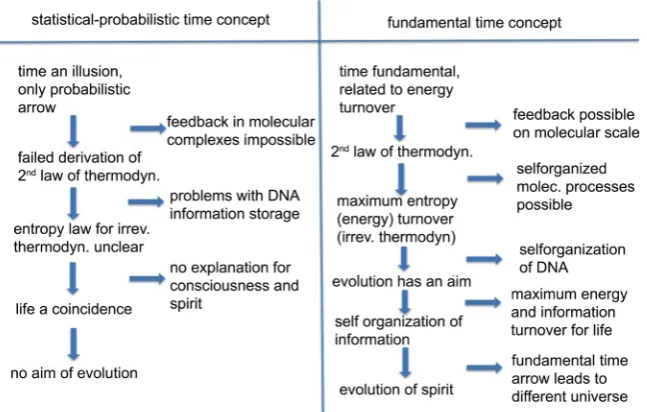
The paradigm change towards a fundamental time arrow entrains very differ-ent consequences for understanding irreversible processes and evolution of life,
as Figure 3 visualizes. The entropy law, which aims at maximum entropy
DOI: 10.4236/aa.2018.83008 165 Advances in Anthropology
Figure 3. Scheme comparing implications of statistical, probabilistic time (left) and of
fundamental (energy driven) time arrow (right).
biological evolution. When considered to be self-organized, chemical DNA in-formation will aim at creating new self-similar inin-formation which is the basis of new life and continuation in evolution.
The here presented approach opens a new dimension for understanding and argumentation. According to the explained concept, statistical mutations func-tion and develop superposed to the law of maximum energy (entropy) turnover of self-organized systems, which self-organized genetic mechanisms are safe-guarding. Mutations, which occur in presence of abundant energy, have a higher probability to succeed and resulting energetic changes in the self-organized liv-ing systems can induce altered structural patterns or they may change the con-straints. Such a superposed activity is expected to shape the progress of evolution in a more pronounced and better focussed way than arbitrary micro-mutations alone. Before all it is immediately clear why there is a characteristic orientation in life: it is the ability and drive to harvest additional energy for the sustainment of self-organized activities. It is contained in food, in solar or environmental en-ergy. Here the claimed fundamental property of self-organized systems towards maximising entropy (energy) turnover becomes evident.
[image:26.595.214.538.73.279.2]DOI: 10.4236/aa.2018.83008 166 Advances in Anthropology take over.
When accepting a fundamental time arrow and its consequences time is not any more an illusion. It is the track which energy turnover is carving into our environment and into our brain. Biological evolution as well visualizes this track. From the flow of action, associated with energy turnover, clock time can be ex-tracted via calibration. This is actually the process proceeding in clocks.
Subject to such a fundamental time arrow, the universe has to be understood quite differently and evolution in general, geological and biological evolution, has an aim (Tributsch, 2015; 2016b; 2018a). This aim of evolution is maximizing entropy and energy turnover respectively, within given constraints. It includes, in biological evolution, the shaping property of the genetic code (with the here emphasized self-organized function) and natural selection. The essential differ-ence to the conventional understanding of evolution is that up to now no funda-mental property, in terms of an entropy law, has been attributed to self-organized inorganic and living system themselves. Life was just considered to be a given, neutral phenomenon, exposed to arbitrary statistical mutations and natural se-lection.
In contrast, according to the here proposed considerations natural selection is not a process of chance only, but, with the properties of self-organized systems, includes a clearly deterministic element. It concerns the turnover and acquisi-tion of energy. Natural selecacquisi-tion acts on systems that aim at building up order by maximising entropy production (energy turnover). Natural selection is a shaping force, while the acquired energy flows towards maximum energy turnover are the orienting and driving forces. They sustain life and define the orientation, because they favour mutations which support energy flows. And additional en-ergy flows can induce new self-organization patterns, since they can push the systems further away from equilibrium and may change the restraints. During biogenic and anthropogenic evolution these energy thrusts included the discov-ery of photosynthesis, the availability of oxygen in the atmosphere, the discovdiscov-ery of fire by humans, of agriculture, and the use of hydrocarbons.
DOI: 10.4236/aa.2018.83008 167 Advances in Anthropology explains evolution towards higher perfection, but also towards an increasing rate of implemented mutations (as identified by Hawks et al., 2007). It also could explain why the biggest mammals and plants, blue whale and sequoia, and the spe-cies with the highest specific energy consumption, humans, are living today.
Information (related to energy) can also self-organize subject to a fundamen-tal time arrow, because fast feedback processes can function in a highly ordered environment, and are able to create a higher hierarchy of information handling above mere computation. This is recognized as the phenomenon of conscious-ness and spirit, which thus can be explained on purely materialistic basis
(Tributsch, 2016b; 2015). It is subject to similar boundary conditions as
evolu-tion of material life. It may now be easier to understand the reason why the hu-man brain and consciousness had such a fast start (one to two million years), compared to more than 3.5 billion years of evolution of life. They significantly accelerated energy (entropy) turnover and thus gave access to new successful structural and spiritual patterns.
All these results and conclusions appear to be compatible with experience and observations. There is evolution towards higher complexity (compare however deviating opinions, Gould, 1996; Wilkins, 1997), mankind moved towards in-creased energy turnover and there is human consciousness and spirit. This in turn inevitably requires that a fundamental time arrow is accepted for our world and the universe. A probabilistic statistical time arrow and an energy without interest to do work cannot give reasonable access to the complex world of irre-versible thermodynamics including the phenomena of life. Subject to a funda-mental time arrow and its consequences complex properties of evolution be-come more easily understandable.
The energy hunger of living species arose from their property as self-organized systems. Also their ability to form symbiotic unions, which significantly in-creased their energy input, has the same origin. However, many open questions remain. For example, the mutual interaction between the energy hunger of self-organized living systems and the (proposed) self-organized genetic code could become a major challenge for future evolution research. An interaction and synchronization between self-organized mechanisms is possible and bears the potential for new insight into evolution towards higher complexity.