http://dx.doi.org/10.4236/jsip.2012.31004 Published Online February 2012 (http://www.SciRP.org/journal/jsip)
Neural Network Based Order Statistic Processing Engines
Mehmet S. Unluturk1*, Jafar Saniie2
1
Department of Software Engineering, Izmir University of Economics, Izmir, Turkey; 2Electrical and Computer Engineering De-partment, Illinois Institute of Technology, Chicago, USA.
Email: *[email protected]
Received November 8th,2011; revised December 16th, 2011; accepted December 30th, 2011
ABSTRACT
Order statistic filters are used often in the applications of science and engineering problems. This paper investigates the design and training of a feed-forward neural network to approximate minimum, median and maximum operations. The design of order statistic neural network filtering (OSNNF) is further refined by converting the input vectors with ele-ments of real numbers to a set of inputs consisting of ones and zeros, and the neural network is trained to yield a rank vector which can be used to obtain the exact ranked values of the input vector. As a case study, the OSNNF is used to improve the visibility of target echoes masked by clutter in ultrasonic nondestructive testing applications.
Keywords: Neural Networks; Back-Propagation Algorithm; Order Statistic Filters; Target Echo Detection
1. Introduction
Order statistic (OS) processors have been widely used in the field of signal and image processing [1-3]. OS results can be obtained by sorting the elements of an input vec- tor according to the rank of each element. Ranked out- puts such as minimum, median and maximum have been used for target detection with applications in radar, sonar and ultrasonic nondestructive testing [4,5]. The problem of sorting has already been solved by sequential and it-erative methods such as the bubble sort, selection sort, insertion sort, and quick sort with computational effi-ciency ranging between O(NlogN) and O(N2) compari-sons and swapping operations [6]. As an alternative to conventional sorting techniques, a neural network design resulting from the harmony theory has been proposed for the sorting operation [7]. Neural network hardware can be implemented with parallel architecture using VLSI and FPGA technology, and this is highly desirable for high-speed computation [8-11].
In this paper, feed-forward neural network models [12] are introduced to find the minimum, the median, and the maximum of the input vectors consisting of real numbers. The back-propagation learning algorithm [13] is utilized in the training phase of the order statistic neural network filters (OSNNF). If the size of the input data is n, there is
n! different input vectors including the same real num-bers which give the same sorted output. Furthermore, the input vectors with real numbers demand an unlimited number of input vectors for training. Therefore, it is im- practical to train an OSNNF with that many input data.
Consequently, the trained OSNNF filter might not pro- vide exact sorted results. In spite of this drawback, neural network filters can be trained to provide good approxi-mation for the sorted results, and perhaps this might be sufficient for sorting the random processes in certain applications [4,5].
In practice, it is desirable to develop an efficient neural network model that can be used in finding the estimates of minimum, median, and maximum of the input vectors. To achieve this, simulation data is used in the training phase. The training set of data consists of random num- bers with uniform distribution scaled between zero and one. Then, the neural network is trained to yield the ranked output (e.g., the minimum, the median or the maximum value of the input vector with real numbers). In the next section we present the design techniques for the neural network OS filters. Section 3 discusses an im-proved neural network solution that finds the rank of each input in order to reveal the exact sorted result. Sec-tion 4 utilizes these neural network filters to enhance the visibility of target echoes in high scattering clutter using split-spectrum processing (SSP).
2. Neural Network OS Filters
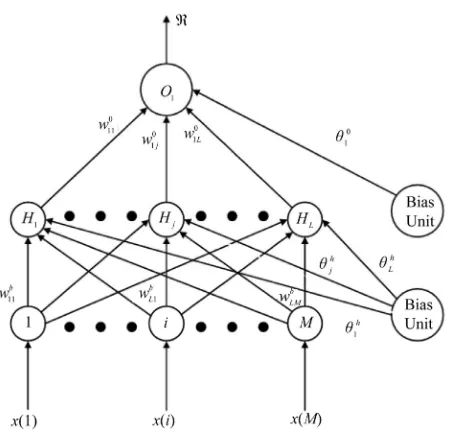
Figure 1 displays the structure for the neural network OS filter where the number of inputs is 8 (M = 8). This filter is a fully connected feed-forward neural network. When unordered uniformly distributed random numbers, x(i), are presented as an input vector of real numbers to the neural network, each output of the hidden neurons is the weighted sum of the input nodes and bias node passes
Neural Network Based Order Statistic Processing Engines 31
Figure 1. A three-layer model of an order statistic neural network filter.
through an activation function. The hidden neuron’s out- put of this neural network, y jj, 1L, is given as
1
( )
M
h h
j ji j
i
y x i w
(1)
where the activation function for the hidden and output layer,
, is a tangent hyperbolic function defined as
yy ye e
y
e e
y (2)
The term x(i) is an element of the input vector consist- ing of random numbers between 0 and 1, whji is the
weight from ith input neuron to the jth hidden neuron, and
h j
is the bias for the jth hidden neuron. Then, the ranked output, , of the neural network is the weighted sum of all the hidden neurons and the bias node, given as
1 1 1 L o o j j j y w
(3) The training matrix is prepared using uniform random numbers between 0 and 1. Each column in the training matrix represents one set of these random numbers with a length of 8. Note that the size of the training set can be any number. The bigger the size of the training set, the better the estimation of the ranked output by the neural network is.Training statistics of the neural network filters are given in Table 1. A total of 4000 sample vectors were applied to estimate the minimum (MinNNet), the median (MedNNet), and the maximum (MaxNNet). This training was reiterated for 2000 times (i.e., epochs) in order to find the best solution for the neural network. Training results show that the MinNNet, MedNNet and MaxNNet reach a lower training sum squared error that is 0.04. In
Table 1. Training statistics for MinNNet, MedNNet, and MaxNNet.
Neural Network
# of Sample Vectors Input Nodes Output Node Hidden Nodes Epochs
Error Bound
MinNNet 4000 8 1 65 2000 0.04
MedNNet 4000 8 1 65 2000 0.04
MaxNNet 4000 8 1 65 2000 0.04
this study, Hinton diagrams [14] were utilized to examine the effectiveness of the neural network weights.
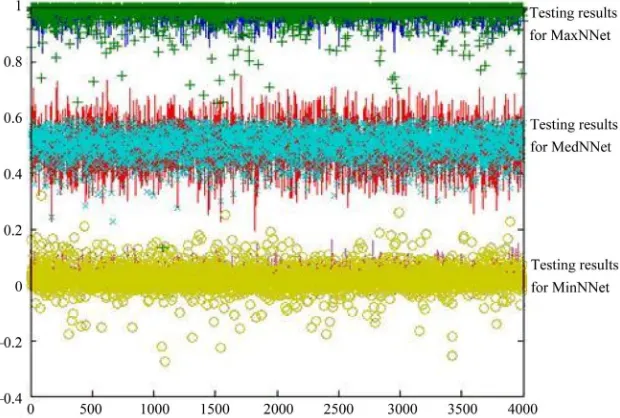
Testing results are shown in Figure 2. In this figure “+” shows the estimates for MaxNNet , “×” displays the estimates for MedNNet, and “o” depicts the estimates for MinNNet. In addition, solid lines indicate the desired values and estimates of order statistic neural network filters are superimposed over these desired values. Fur- thermore, as expected, Figure 2 shows that the Min- NNET estimates the minimum values around 0, the Med- NNET estimates the median values around 0.5 and the MaxNNET estimates the maximum values around 1. To obtain a better performance evaluation, the probability density functions of error for each neural network are estimated using the Parzen method [15]:
1, Min, Med or Max
ji j
i
j j
r r
f r j
n
(4)where r iji
1, 2,, n
is the difference between the neural network output and the actual output for MinNNet, MedNNet or MaxNNet, is the Gaussian density function and constant 2j is the variance.Figure 3 shows the probability density functions of estimation error for each neural network. This figure illu- strates how the neural network output values are affected by each neural network type to emphasize specific re- gions of the uniform random number distribution. Over- all, the neural network is particularly efficient in obtain-ing the actual sorted result. For example, as can be seen in Figure 3, the maximum is 1, the median is 0.5 and the minimum is 0 with a high probability compared to other estimated values. The next section discusses an improved and precise neural network architecture for obtaing the actual ranked value.
3. Neural Network for Precise Order
Statistic Filtering
[image:2.595.307.538.112.185.2]Figure 2. Testing results for MinNNet, MedNNet and MaxNNet. “+” shows the estimates for MaxNNet, “×” displays the es-timates for MedNNet, and “o” depicts the eses-timates for MinNNet. These eses-timates are superimposed over the actual values shown by solid lines.
Figure 3. The probability density functions of errors for MinNNet, MedNNet and MaxNNet.
0.9501 0.2311 0.6068 0.4860 0.8913 0.7621 0.4565 0.0185
X can only approximate the sorted outputs. Hence, to
im-prove this design where the neural network output yields the exact ranked value, the input vectors are converted to a finite set of input vectors consisting of ones and zeroes elements.
Based on the transformation shown in Equation (5), the following matrix can be generated
1 0 0 0 0 0 0 0
1 0 1 1 1 1 1 0
1 0 1 0 1 1 0 0
1 0 0 0 1 1 0 0
1 0 0 0 1 0 0 0
1 0 1 1 1 1 0 0
1 1 1 1 1 1 1 0
R
Consider sorting N random numbers xi where i = 1,
2, ..., N. To generate ones and zeros as inputs to the neu-ral network, each xi is compared with xj, where j = 1… N
and j ≠ i:
0, 1,
i
i
x i j
i j
j
x x
r x x
x x
[image:3.595.151.442.351.545.2]Neural Network Based Order Statistic Processing Engines 33
where the elements of the first column are calculated by comparing the first number, 0.9501, with the rest of the numbers within the input vector, the elements of the second column are calculated by comparing the second number, 0.2311, with the rest of the numbers and so on. Then, the output of the OSNNF becomes the actual rank vector, corresponding to each element within the in- put vector:
8 2 5 4 7 6 3 1
.Examination of the rank vector reveals that the mini- mum element of x is 0.0185, because the corresponding neural network output for this element is 1; the maximum element in x is 0.9501, because the corresponding neural network output for this element is 8 and so on. The ad-vantage of this input conversion is that the infinite input vectors of random numbers is converted to a finite set of input vectors with elements consisting of ones and zeros. And, for example, the size of the input space for an input vector with 8 elements will be 128. Consequently for an input vector of size N, the input space for the neural network is 2N-1.
For sorting 8 random numbers, the number of input elements to OSNNF is 7 and the output number repre-sents the rank of xi. During training 10 hidden neurons
were sufficient for detecting the rank of xi with a sum
squared error of 0.0001 within 140 epochs. The OSNNF training took less iterations because of the finite size of the input space. In the next section we make use of OSNNF in ultrasonic target detection when the signal is corrupted by high scattering clutter [5].
4. OSNNF for Target Detection
Applying split-spectrum processing (SSP) to ultrasonic signals combined with order statistic filters improves the signal-to-noise ratio and the target visibility [5]. The or-der statistic detection filters perform better when signal and clutter have good statistical separation associated with a particular ranked output, such as minimum, me-dian or maximum [4]. Our objective in this section is to replace the conventional order statistic filters with the OSNNF.
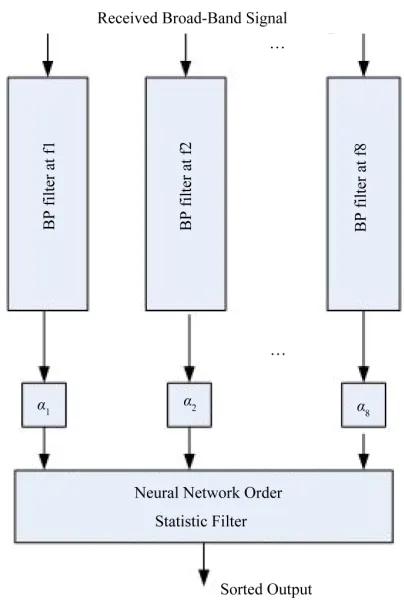
The block diagram of SSP coupled with the OSNNF is shown in Figure 4. The received broadband signal is partitioned into several subband channels [5] and the out- put of these channels are normalized using scaling fac- tors i,i1,,8
1 Max
i
i
(6)
where i is the output of i-th bandpass (BP) filter at
center frequency i
[image:4.595.321.523.81.381.2]f . There are three important issues in implementing SSP. These are the number of subbands (i.e., bandpass filters), the correlation among subbands due to spectral overlap, and the target information in each subband. There is an upper limit on the number of
Figure 4. The block diagram of SSP based neural network order statistic target detector. In this figure αi, i = 1 ··· 8 are the scaling factors.
subbands that can be chosen without a large amount of overlap among the subbands. Correlation among sub- bands is not as critical to the performance of SSP as se- lecting the frequency range which contains information pertaining to the target echo.
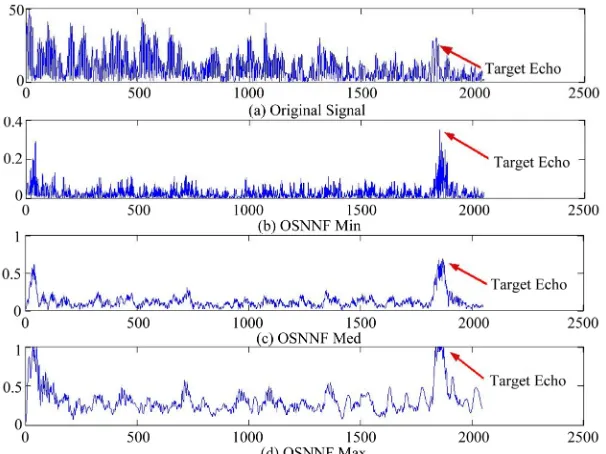
The OSNNF is tested using experimental data to detect the target in presence of high scattering noise where the signal-to-noise ratio is less than zero dB (Figure 5(a)). The frequencies of the 8-channel bandpass filters reside within the frequency range of zero to 5 MHz and the bandwidth of each channel is 2.44 MHz. Figure 5 shows the outputs of OSNNF where it finds the exact values for the minimum, the median and the maximum of the 8 bandpass filters. The ranked output of OSNNF improves the SNR significantly and enhances the target echo visi-bility.
5. Conclusions
Figure 5. Performance of OSNNF for target detection. The target echo is representing the ultrasonic backscattered echo of a hole within a steel block. (a) Original experimental measurement with SNR less than zero dB; (b) OSNNF minimum output; (c) OSNNF medium output; (d) OSNNF maximum output.
[7] T. Tambouratzis, “A Novel Artificial Neural Network for Sorting,” IEEE Transactıons on Systems, Man, and Cyb- ernetıcs—Part B: Cybernetıcs, Vol. 29, No. 2, 1999, pp. 271-275. doi:10.1109/3477.752799
tions offer three major advantages: 1) the size of the in- put space for the neural network becomes a finite number, 2) the zeros and ones simplify computation, and 3) the output of the neural network is a rank vector which can be used to obtain the exact ranked values. The design of the neural network order statistic filters was tested for ultrasonic target detection. Based on experimental obser- vations, OSNNF can be efficiently used in split-spectrum processing in order to detect target signals in noisy envi- ronments.
[8] P. W. Hollis and J. J. Paulos, “A Neural Network Learn-ing Algorithm Tailored for VLSI Implementation,” IEEE Transactions on Neural Networks, Vol. 5, No. 5, 1994, pp. 784-791. doi:10.1109/72.317729
[9] B. M. Wilamowski and R. C. Jaeger, “Neuro-Fuzzy Ar-chitecture for CMOS Implementation,” IEEE Transaction on Industrial Electronics, Vol. 46, No. 6, 1999, pp. 1132- 1136. doi:10.1109/41.808001
[10] X. Zhu, L. Yuan, D. Wang and Y. Chen, “FPGA Imple- mentation of a Probabilistic Neural Network for Spike Sorting,” 2010 2nd International Conference on Infor- mation Engineering and Computer Science, Wuhan, 25- 26 December 2010, pp. 1-4.
REFERENCES
[1] J. Serra, “Image Analysis and Mathematical Morphol-ogy,” Academic Press, New York, 1988.
[2] I. Pitas and A. N. Venetsanopoulos, “Nonlinear Digital Filters, Principles and Applications,” Kluwer Academic Publishers, Boston, 1990.
[11] J. Misra and I. Saha, “Artificial Neural Networks in Hardware: A Survey of Two Decades of Progress,” Neu-rocomputing, Vol. 74, No. 1-3, 2010, pp. 239-255. [3] J. Astola and P. Kuosmanen, “Fundamentals of Nonlinear
Digital Filtering,” CRC Press, Boca Raton, 1997. [12] K. Hornik, “Multilayer Feedforward Networks as Uni- versal Approximators,” Neural Networks, Vol. 2, No. 5, 1989, pp. 359-366. doi:10.1016/0893-6080(89)90020-8 [4] J. Saniie, K. D. Donohue and N. M. Bilgutay, “Order
Statistic Filters as Postdetection Processor,” IEEE Trans-actions on Acoustics, Speech, and Signal Processing, Vol. 38, No. 10, 1990, pp. 1722-1732.
[13] T. Masters, “Practical Neural Network Recipes in C++,” Academic Press Inc., New York, 1993.
[14] F. J. Bremner, S. J. Gotts and D. L. Denham, “Hinton Diagrams: Viewing Connection Strengths in Neural Net-works,” Behavior Research Methods, Vol. 26, No. 2, 1994, pp. 215-218.
[5] J. Saniie, D. T. Nagle and K. D. Donohue, “Analysis of Order Statistic Filters Applied to Ultrasonic Flaw Detection Using Split-Spectrum Processing,” IEEE Transactions on Ultrasonics, Ferrorelectrics, and Frequency Control, Vol. 38, No. 2, 1999, pp. 133-140. doi:10.1109/58.68470
[15] E. Parzen, “On Estimation of a Probability Density Func-tion and Mode,” Annals of Mathematical Statistics, Vol. 33, No. 3, 1962, pp. 1065-1076.
doi:10.1214/aoms/1177704472 [6] M. A. Weiss, “Data Structures and Algorithm Analysis in