Signal Type Detection in CRN: A Machine Learning
Framework using Spectral Correlation Feature
Nayan Basumatary
Dept. of CSE Tezpur University Napam, Tezpur, Assam - 784028Bhabesh Nath
Dept. of CSE Tezpur University Napam, Tezpur, Assam - 784028Nityananda Sarma
Dept. of CSE Tezpur University Napam, Tezpur, Assam - 784028ABSTRACT
Spectrum sensing is the core component in cognitive radio for en-suring effective dynamic spectrum access.Accurate signal classifi-cation in fading channels and low signal to noise ratio environment is a major challenge.Due to lack of information about the modu-lation scheme used it cannot distinguish whether signal present is that of the primary or any other secondary user communication.In this paper a multiclass modulation classification hierarchical frame-work is proposed which exploits the cyclostationary features ex-tracted for identifying modulation form without any priori knowl-edge of signal properties like frequency,phase and symbol rate.The cyclostationary features extracted using spectral correlation analy-sis at each secondary user are treated as features and fed into the framework.The classification done is based on one-against-all ap-proach to get the modulation scheme of the signal under observa-tion.The performance of proposed framework for each classifiers used is quantified in terms of detection accuracy,average training time and classification delay. It is demonstrated through simula-tion that an optimal feature set can be obtained to classify a range of modulation schemes with the proposed hierarchical framework. The proposed framework is found to be effective for modulation detection of signals when compared with two existing methods.
Keywords
Modulation recognition, Cyclostationary Features, Multi Class Classification
1. INTRODUCTION
Cognitive Radio has been considered as a solid contender for future wireless communication with its promise to maximize efficient use of the spectrum. A cognitive radio (CR) is defined as a radio that can change its transmission parameters based on the changes in environmental factors[1]. An important process involved with cog-nitive radio is spectrum sensing which is very important for oppor-tunistic spectrum access[2],[3].In cognitive radio networks (CRN), in order to avoid interfering with the transmission of the primary users, it becomes crucial to accurately sense the presence for any contemporaneous transmissions of primary users in the spectrum band under observation. Primary user signal error detection can lead to wastage of spectrum opportunities for the secondary users. In a conventional wireless communication scenarios noise, shadow-ing and multipath fadshadow-ing causes the major degradation of the signal
properties. This results signal detection in low SNR environment very difficult.So, sensing done by CR user cannot be just confined to just screen the power in specific frequency bands of interest but must include detection and identification in order to avoid interfer-ence from any user in the network [4][5].An important aspect of a cognitive radio is spectrum sensing which can be efficient if it can perform the following two main tasks:
(1) Signal Detection. (2) Modulation Classification.
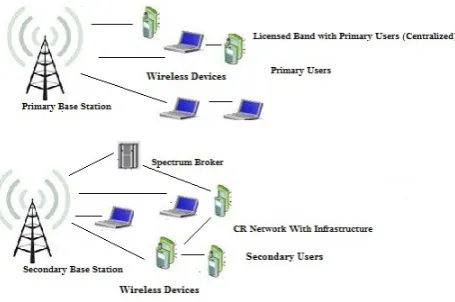
Fig. 1. A Typical Centralized Cognitive Radio Network.
take a collective decision which results in to get high sensing reli-ability [14],[15]. On the other hand, in case of independent sens-ing each CR device performs the senssens-ing individually and make its own sensing decision to use the unoccupied spectrum portion. Although, Cooperative sensing is believed to achieve better results than the non-cooperation one there are some issues involved with it like the cooperation overhead,decision fusion etc[16],[17],[18].In case of cognitive radio network for a non-cooperative model with the knowledge of the modulation schemes of the signal detected the secondary users can take correct decision about the signal presence in the channels and later use it for its own communication
2. RELATED WORK
Many contemporary research attempts have been made to exploit the cyclostationary features [14],[15],[16],[17],[18],[19],[20],[21],[22] of signals as a method for classification, which has been found better than the simple energy detection and matched filtering. The non-coherent method like the Energy detection is quite easy to implement and does not require prior knowledge of signal parameters such as carrier frequency or signal bandwidth,but is highly prone to in-band interference and changing noise levels . Morever, this method cannot distinguish between signal types, but can only determine whether or not one is present. Although,it is able to detect spread spectrum signals, works ineffectively to classify this type of interface.Also, in context of cognitive users the detection of modulation scheme would help to detect the presence of type of signal.Accordingly, it can be concluded whether the com-munication in the channel is of primary or any other secondary user in a cognitive radio network.Modulation classification by spectral corelation analysis has been an active research area for more than two decades.The cyclostationary features extracted by using spectral correlation method has been found more preferable than the conventional sensing methods like energy detection and match filtering.Energy detection which is a blind sensing method doesnot require any prior knowledge of signal parameters such as carrier frequency or signal bandwidth, but it is highly sensitive to in-band interference and changing noise levels[23]. In [22] a novel approach based on mulitlayer linear perceptron network (MLPN) is proposed for classification of signals in cognitive radio.Also, in [23] signal classification based on a binary decision tree is put forwarded.However, it increases the computational complexity and it is very difficult to obtain high detection accuracy.Some classifier
framework have also been proposed in literature by keeping in mind only the classification aspect using only energy level detected as the features [24]. In [25] the author proposed the performance of different classifiers using the cyclostationary features.All cyclo-stationary Features extracted may not be necessary to differentiate the modulation of signals.With a minimal feature subset a range of modulation schemes can be detected easily using supervised learning.Till date in literature there has been no attempt to find the optimal cyclostationary features needed for classifying modulation schemes.
The underline motivation for this work are:
(1) The modulation classification can be modelled as a multi-class classification problem.
(2) The approach is effective in fading channels (low SNR envi-ronment).It can distinguish between the primary user signal and noise.
(3) No prior knowledge of Primary user signal is needed.(Like car-rier frequency, phase, symbol rate etc)
(4) Optimal Feature subtset from the feature space can determine the modulation of a signal by which the secondary users in a cognitive radio network (CRN) can exploit for better sensing decisions.
The contribution of the work are as
follows:-(1) Here, a SVM and Decision Tree (binary classifiers) based hi-erarchical framework for multiclass classification is proposed for detection of weak signals using spectral correlation. (2) Cyclostationary features used for modulation classification of
the signal can tell about whether the signal present is of pri-mary user or any other secondary user communication.It is ro-bust to uncertaininty in noise power and propagation channel. (3) The proposed framework gives an optimal cyclostationary
fea-ture subset from the given feafea-ture space. The optimal feafea-ture set is obtained with the help of feature class coorelation keep-ing the most relevant feature needed to classify the range of modulation schemes.
(4) In case of non-cooperative sensing the communication over-head is less and the modulation detection can help individual nodes in CRN to take a better decision.
In this paper we try to investigate the use of spectral cyclic analy-sis for classifying a group of modulation schemes in a hierachical fashion.The proposed framework will attempt to distinguish some signal of practical interest like AM and digital modulated signals like ASK,BPSK and BFSK. The rest of the paper is organized as follows. In Section 2 the spectrum sensing using cyclostationary approach is discussed In Section 3 the system model and assump-tions are presented. Section 4 describes the simulation and results obtained. Finally, Section 5 gives the conclusion and future work to be done.
3. SPECTRUM SENSING USING CYCLOSTATIONARY APPROACH
Cyclostationary based detection is very effective even in low SNR, since noise is a pure stationary random process and not cyclosta-tionary.
The statistical property autocorrelation is used to characterize cy-clostationary signals. A signal is cycy-clostationary if its autocorrela-tion is periodic in timetfor each time lagτ.
Mathematically, autocorrelation is defined as
Rx(t, τ) =E
n
xt+τ 2
xt−τ
2
o
Mathematically, autocorrelation is defined as
Rx(t, τ) =E
n
x
t+τ 2
x
t−τ
2
o
whereRx is called the periodic autocorrelation function for a
cy-clostationary signalx(t),Eis the expectation operator andτis the time delay.
The Fourier coefficient of the Fourier expansion of the autocorrela-tion funcautocorrela-tion is called the Cyclic Autocorrelaautocorrela-tion Funcautocorrela-tion (CAF). The Fourier transform of CAF is called the Spectral Correlation Function (SCF).
Applying Fourier series decomposition on autocorrelation function,
Ry(t, τ) =
X
α
Rα y(τ)e
−j2παt
whereRα
y(τ)is the CAF and can be defined as,
Rαy(τ) = lim T→ ∞
1
T
Z T /2
−T /2
Ry(t, τ)e−j2παtdt
Here, T is the total time for which a signal was observed,αis the cyclic frequency and it ranges over all integer multiples of funda-mental frequency of the signal andRyis the periodic
autocorrela-tion funcautocorrela-tion.
Spectral Correlation Function (SCF) is the Fourier transform of cyclic autocorrelation function (CAF) of a signal, and is given by
Sαy(f) =
Z ∞
−∞
Rαy(τ)e
−j2πf τ
dτ
The SCF at a given cycle frequency represents the density of cor-relation between two spectral components of the process which are separated by an amount equal to the cyclic frequencyα, that isf+α2 andf− α
2. The SCF with the spectral components of a signal at
these frequencies is given by
Sα
y(f) = lim
∆t→∞Tlim→∞ 1 ∆t
1
T
Z ∆t/2
−∆t/2 XT
t, f+α 2
XT∗ t, f− α
2
dt
where,
XT(t, f) =
Z t+ T2
t−T 2
x(t)e−j2πfdt
The Spectral Correlation Function (SCF) being a function of spec-tral frequency (f) and cyclic frequency (α), is plotted on a plane known asbi-frequency plane. The range of values of f andαfor which value of SCF exists is called as ‘region of support’ on the plane. The values of f andαrange from−fs/2tofs/2and−fsto
fsrespectively.
The features used for classification are based on Spectral Correla-tion FuncCorrela-tion (SCF). Six cyclostaCorrela-tionary features is calculated for the proposed classification framework :
F1:Ratio of maximum value and second maximum value of SCC for spectral frequencyf = fc(wherefcis that spectral frequency at
which have a peak in f-domain (α= 0))
max(Sα x(fc))
secondmax(Sα x(fc))
F2:Mean of SCF atα-domain (f = 0)
mean(Sα x(0))
F3:Variance of SCF atα-domain (f = 0)
variance(Sα x(0))
F4:Variance of SCF at f = fc
variance(Sα x(fc))
F5:Spectral Coherence Coefficient (Normalized SCF)
S2fc
x (0)
p
S0
x(fc)Sx0(−fc)
F6: Maximum of pair wise difference between adjacent elements of normalized f-domain
max(dif f
S0
x(f)
max (S0
x(f))
)
4. SYSTEM MODEL AND ASSUMPTIONS
Consider a non- cooperative spectrum sensing scenario in a PU-SU network which comprises of one or more than one secondary users (K≥1).Each secondary users (SU) senses the spectral band under observation to look for an opportunity for its own transmission in-dividually. This SU devices are operating in the coverage areas of ‘P’PU transmitters.
A modulated signal as received by the secondary user can be mod-eled as
y(t) =x(t) +n(t)
x(t)is the transmitted signal,n(t)is additive white Gaussian noise, and
x(t) =s(t)e2πfctejϕ
wherefcis the carrier frequency,ϕis the carrier phase,s(t)is the
time varying message signal. For digital signals,
x(t) = e2πfctejϕ
8
X
k=−8
skP(t−kTs)
whereP(t)is the pulse shape,Ts is the symbol period andskis
the digital symbol transmitted at timet.
Each secondary user collect the raw signal samples and calculates the SCF by using FFT Accumulation method (FAM) . The cyclo-stationary features are determined using SCF features and fed to the hierarchical classifier framework which is in-built with the sec-ondary users.
that assigns new examples into one category or the other, making it a non-probabilistic binary linear classifier. In the case of support vector machines, a data point is viewed as a p-dimensional vec-tor, and it is checked whether it can separate such points with a p-dimensional hyper plane. This is called a linear classifier. The lineHdividing the two classes is represented asd.Si+ b = p,
where dandbrepresent the weighting vector, bias andprepresent the constant for dividing the two hyper planes. TheSCFi is the
feature vectorFiof the test sample in the ithtime slot.
FiMj={M1,M2,. . . Mn}whereMi represent the modulation
class.
The maximum-margin hyper-planes that divide the samples belong to one of the modulation vector classMi.
There are many hyper planes that might classify the data. One rea-sonable choice as the best hyper plane is the one that represents the largest separation, or margin, between the two classes. Linear classifiers are not complex enough to represent all features. So in non-linear SVM all data are mapped into a richer feature space including nonlinear features and then a hyper plane is con-structed in that space. The polynomial kernel is a kernel function that represents the similarity of training samples vectors in a feature space over polynomials of the original variables, thereby allowing learning of non-linear models.
On the other hand the principle criteria of decision tree is to select attribute to test at each node and choosing the most useful attribute for classifying examples. Tee information gain which measures how well a given attribute separates the training examples accord-ing to their target classification This measure is used to select among the candidate attributes at each step while growing the tree.
For a decision tree given a training set ‘S’the probability vector given by ‘Py(S)’of the target attribute‘y’the entropy is calculated
by following :
Entropy (y,S) =-P
( Py(S) * log2Py(S) )
Information gain measures the expected reduction in entropy, or uncertainty. It is simply the expected reduction in entropy caused by partitioning the examples according to this attribute. At each node, the attribute with the largest information gain is chosen The stopping rule used is for every attribute has already been in-cluded along this path through the tree, or the training examples as-sociated with this leaf node all have the same target attribute value (i.e., their entropy is zero).Each non-leaf node is a test, its edge partitioning the attribute into subsets.
Here, Multiclass Binary Classifier Hierarchical Framework is pro-posed for modulation classification. The CR devices can develop the cognition capability to learn from the unknown environment with the help of supervised learning.
5. SIMULATION AND RESULTS
The simulation signals were generated in MATLAB for 1000, 2000, 5000, 10000 samples for AM, ASK, BFSK, QPSK modulated sig-nals were generated with SNR range values for -15, -10, -5, 5, 10, 15 dB. SVM and Decision Tree is used as the binary Classifiers. The training is done in high SNR values and the classification is performed in low SNR.
Other parameters used are as follows:
[image:4.595.316.569.69.328.2]Different SCF plots obtained for different modulation are: Figure 3 To Figure 6 Shows the SCF Plots of different Modulation Schemes.
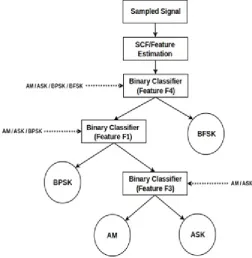
[image:4.595.327.537.364.545.2]Fig. 2. Proposed Multi Class Binary Classifier Hierarchical Framework
Table 1. Simulation Parameters Used. Channel Model AWGN Sampling Frequency 8192 Hz
Carrier Frequency 2048 Hz Spectral Frequency Resolution 512 Hz
Cyclic Frequency Resolution 16 Hz
Fig. 3. SCF Plot of AM modulation.
Figure 7 To Figure 12 Shows the range of values of all the cyclosta-tionary features obtained (F1-F6) for all the modulation for differ-ent SNR. From the simulation results above, it can be observed that the features extracted from the spectral correlation function have distinct values for different modulation and can be used for mod-ulation classification. From Figure 7. it can be seen that feature F1 which is the ratio of maximum value and the second maximum value of SCC for BPSK modulation is totally distinct than the rest of the schemes.
Fig. 4. SCF Plot of ASK modulation.
Fig. 5. SCF Plot of BFSK modulation.
Fig. 6. SCF Plot of BPSK modulation.
Fig. 7. Variation of Feature F1 values for Different SNR
ASK the feature F3 which is Spectral Coherence Coefficient (Nor-malized SCF) feature is applied.
Different comparisons are made for both SVM and Decision clas-sifiers using the one-against-all approach.
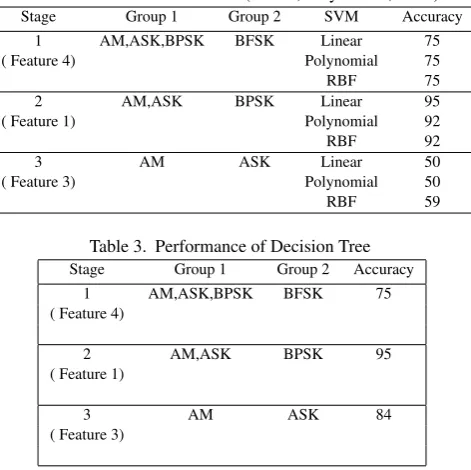
Table 2. and Table 3. shows the classification accuracy of both the classifiers used in the hiearchical framework for multi-class classi-fication.
Fig. 8. Variation of Feature F2 values for Different SNR
Fig. 9. Variation of Feature F3 values for Different SNR
Fig. 10. Variation of Feature F4 values for Different SNR
Fig. 11. Variation of Feature F5 values for Different SNR
Fig. 12. Variation of Feature F6 values for Different SNR
Table 2. Performance of SVM (Linear, Polynomial, RBF.)
Stage Group 1 Group 2 SVM Accuracy
1 AM,ASK,BPSK BFSK Linear 75
( Feature 4) Polynomial 75
RBF 75
2 AM,ASK BPSK Linear 95
( Feature 1) Polynomial 92
RBF 92
3 AM ASK Linear 50
( Feature 3) Polynomial 50
RBF 59
Table 3. Performance of Decision Tree Stage Group 1 Group 2 Accuracy
1 AM,ASK,BPSK BFSK 75
( Feature 4)
2 AM,ASK BPSK 95
( Feature 1)
3 AM ASK 84
( Feature 3)
features (SCF) is severely affected due to noise in low SNR which results that the training of the neural network is not complete with small training data. Also, the binary tree based classifier only uses limited information of the spectral correlation features which re-sults in lower probability of correct classification. The proposed framework show high performance based on the spectral correla-tion features and also an optimal feature set can be obtained for modulation detection of signals.
6. CONCLUSION AND FUTURE WORK
[image:6.595.329.573.79.271.2]In this paper a novel approach combining the spectral correlation features and the application of two binary classifiers for multi-class modulation classification is proposed. A multi class hierarchical bi-nary classifier framework is presented for modulation type detec-tion if signal is present and a optimal feature set is obtainied to clas-sify a group of modulation schemes of some real time signals. The optimal feature set could be obtained with the the most relevant fea-ture differentiating the modulation class among the group. Both the binary classifiers SVM and decision tree have good performance in low SNR and detection of the modulation scheme of the signal. Classification Accuracy is high in case of Decision Tree compared to SVM and optimal feature subet from the feature space is ob-tained for classification.The major advantage of this framework is
Fig. 13. Comparison between MLPN,BDT and Proposed Framework (PRP)
that it does not require any prior knowledge of signal parameters, channel and noise variance.So, with this kind of framework the rel-evant feature set can be obtained for classifying a wide range of signals.
Here, the classification is performed in a stationary noise environ-ment such as AWGN(Additive White Gaussian Noise).In, future the proposed framework should be tested in other fading channel environment with noise uncertainty and for more modulation schemes. Also, other binary classifiers can be used to improve the accuracy. Here, only three features is obtained to distinguish the four modulation schemes. Including more modulation schemes others features mightl be useful for classification. An optimal feature set may be obtained to classify different modulation schemes.
7. REFERENCES
[1] S. Haykin, Cognitive radio: brain-empowered wireless com-munications IEEE J. Select. Areas Communication, vol. 23,(2005), 201-220.
[2] S. D. Cabric, S. M. Mishra and R. W. Brodersen, Imple-mentation issues in spectrum sensing for cognitive radios,(in Proc. of Asilomar Conf. on Signals, Systems, and Computers ), vol. 1 (2004), pp. 772 776.
[3] I. F. Akyildiz, W.Y. Lee, M. C. Vuran and S. Mohanty NeXt generation/dynamic spectrum access/cognitive radio wireless networks: A survey, (Computer Networks) (2006). vol.50, no.13 pp.2127-2159
[4] R. Brodersen, A. Wolisz, D. Cabric, S. Mishra, and D. Willkomm, Corvus: A cognitive radio approach for usage of virtual unlicensed spectrum, available at http://bwrc.eecs.berkeley.edu/Research/MCMA/.
[image:6.595.58.294.210.445.2][6] C. Spooner, Automatic radio frequency environment anal-ysis,in Proceedings on the Thirty-Fourth Asilomar Confer-ence, 2000.
[7] On the utility of sixth-order cyclic cumulants for rf signal classification, in Conference Record of the Thirty-Fifth Asilo-mar Conference on(Signals, Systems and Computers), vol. 1, (2001), pp. 8907.
[8] Q. Zhao and B. M. Sadler, A survey of dynamic spectrum access, (IEEE Signal Process. Mag.)vol.24, no.3, (2007), pp. 79-89.
[9] C. Cortes and V. Vapnik, Support-vector networks,vol. 20, no. 3,(Machine Learning Journal.)(1995),pp. 273297.
[10] R. O. Duda, P. E. Hart, and D. G. Stork, Pattern Classification, Wiley,2nd Edition,( 2001).
[11] J. S. Taylor and N. Cristianini, Kernel Methods for Pattern Analysis,Cambridge University Press, Cambridge, UK. [12] A. Cormiejols and M. Moulet Machine Learning : A
Sur-vey ,Knowledge-Based Systems: Advanced Concepts, Tech-niques and Applications. (World Scientific Press, Athens) (1997) pp.61-86.
[13] M.Sun, J. A multi class Support vector Machine: Theory and Model, (World Scientific Press, 2013)vol. 12, No.6, pp.11751199.
[14] A. Ghasemi, E. Sousa,Collaborative spectrum sensing for op-portunistic access in fading environments, IEEE DySPAN (2005) pp. 131136.
[15] S. Mishra, A. Sahai, R. Brodersen, Cooperative sensing among cognitive radios,(Proc. of IEEE ICC 2006),(vol. 4, 2006,) pp. 16581663.
[16] J. Unnikrishnan, V.V. Veeravalli,Cooperative sensing for pri-mary detection in cognitive radio,
( IEEE Journal of Selected Topics in Signal Processing), (2008) ,(2(1)) 1827.
[17] T. Yucek, H. Arslan,A survey of spectrum sensing algorithms for cognitive radio applications
(IEEE Communications Surveys Tutorials,(2009) 116130. [18] I. F. Akyildiz, B.F Lo, and R. Balakrishnan, Cooperative
Spectrum Sensing in Cognitive Radio Networks: A survey, (Physical communication 4.1, (2011)), 40 - 62.
[19] W. Gardner, Statistical Spectral Analysis: A Nonprobabilistic Theory. New Jersey: Prentice Hall, (1987).
[20] W.A.Gardner, An Introduction to Cyclostationary Signalsl (IEEE Press, Piscataway, NJ.)vol. 12, No.6, (1993) [21] W. A. Gardner,Measurement of Spectral Correlation (IEEE
Transaction on Acoustics, Speech, and Signal Processing) vol. ASSP-34, No. 5,(Oct.1986).
[22] A. Fehske, J. Gaeddert and J. H. Reed, A New Approach to Signal Classification Using Spectral Correlation and Neural Networks,IEEE International Symposium on New Frontiers in DySpan, (2005).
[23] B. Le, T. Rondeau, D. Maldonado, and C. Bostian, Modu-lation identification using neural networks for cognitive ra-dios,(SDR Forum Technical Conf.), (2005).
[24] A. Swami and B. Sadler, Hierarchical digital modulation classification using cumulants, vol. 48, no. 3,IEEE Transac-tions on Communication,2000), pp. 416429.
[25] Hao Hu, Cyclostationary Approach to signal detection and Classification in Cognitive radio systems, (Beijing University of Posts and Telecommunications, P.R.China.)(2009).
[26] P.Sutton et.al Cyclostationary Signatures in Practical Cogni-tive Radio Applications, vol. 26,No. 1,(IEEE Journal on se-lected areas in communications,(2008.)
[27] K.Kim,et.al Cyclostationary Approaches to Signal Detection and Classification in Cognitive Radio,(In 2nd IEEE Inter-national Symposium on New Frontiers in Dynamic Spectrum Access Networks), 17-20 April 2007,Page(s):212 - 215. [28] M.Bkassiny,Y.Li, and S.K. Jayaweera, A survey on machine
Learning techniques in Cognitive radios,IEEE Communica-tions Surveys and Tutorials, vol.15,no.3 (2013), pp. 1136-1159.
[29] K.M Thilina, K.W. Choi, N. Saquib and E. Hossain Machine Learning Techniques for Cooperative Spectrum Sensing in Cognitive Radio Networks,(IEEE J. Selected areas in com-munications, vol.31. no.11., (2013).