RESEARCH ARTICLE
PROGRESS OF SCIENTIFIC PROCESSING AND ESTIMATED LOSSES DUE TO
TRADITIONAL PROCESSING OF COTTONSEED
1
Savanam Chandra Sekhar and
1
Department of Business Administration, St. Ann's College of Engineering & Technology,
Chirala, Vetapalem - 523 187, Prakasam District, Andhra Pradesh, INDIA
2
Post Graduate Department of Commerce and Management Studies,
V.R.S. & Y.R.N. College, Chirala - 523 157, Prakas
ARTICLE INFO ABSTRACT
Cottonseed is considered as ‘Golden Goose’. Besides yielding wholesome oil, branded as ‘Heart Oil’, it yields other valuable by
cottonseed extraction. However, a fairly large portion of oil and almost the entire quantity of by-products like linters, hulls are lost due to processing of cottonseed through the traditional method. It is palpable that India loses average worth about Rs. 30000 million every year due to the traditional processing of cottonseed. It is therefore, considered essential to shift from traditional to scientific processing of cottonseed in the larger interest of the Nation. This article elevates the amount of losses of valuable cottonseed by
of scientific processing and provides possible remedies to curb glitches therein.
Purpose: This part of research work highlights the facts about the estimated losses due to traditional processing of cottonseed and progress of scientific processing in the light of valuable cottonseed by
Design/methodology/approach:
adopted cottonseed processing data from different sources specifically AICOSCA Annual Reports and AICOSCA News Letters for the period 2000
precisely analyzed with necessary tables and cha
Findings: This article finds that 96% of the cottonseed in India is being processed simply by traditional crude method which causes huge loss average worth about Rs. 30000 million every year. Scientific processing facilitates controlling of these losses and make use at the larger interest of the Nation.
Originality/value: This article provides useful information to the people who involved in the cottonseed processing industry with a concise analysis of progress of scientific processing of cottonseed and estimated losses
of cottonseed.
INTRODUCTION
Cottonseed processing season generally
commences in the month of November and ends in the following October. Feeding traditionally prepared UD cake to cattle with oil content as high as 7% virtually amounts wastage of more than 3
lakh tonnes of cottons
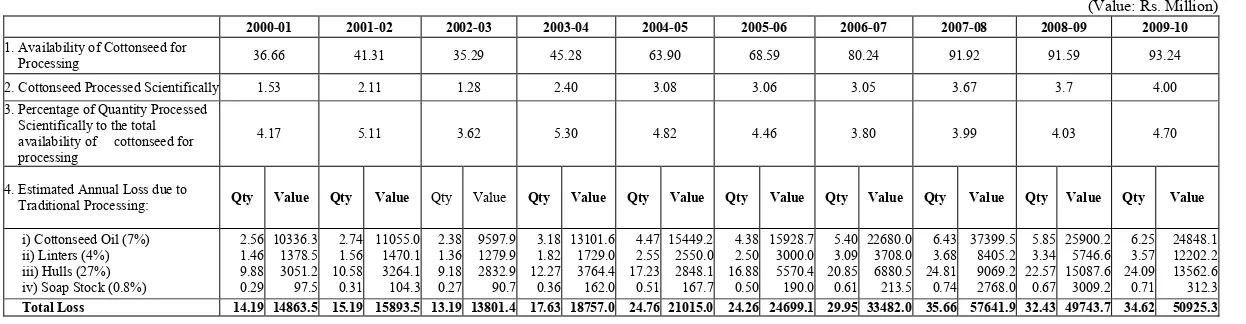
loses linters average worth about Rs. 3250 million and hulls average valued at about Rs. 5800 million every year during the past decade. These losses have been quantified in Table 1.
ISSN:
0975-833X
Available online at http://www.journalcra.com
International Journal of Current Research Vol. 33, Issue, 4, pp.213-222, April,
Key words:
Cottonseed, Cottonseed extraction, Cottonseed hulls, Cottonseed oil, Domestic sale,
Scientific processing, Traditional processing.
Article History:
Received 11th January, 2011 Received in revised form 24th February, 2011
Accepted 13th March, 2011
Published online 27th April 2011
*Corresponding author:
ARTICLE
PROGRESS OF SCIENTIFIC PROCESSING AND ESTIMATED LOSSES DUE TO
TRADITIONAL PROCESSING OF COTTONSEED
Savanam Chandra Sekhar and
2Bhaskara Rao, V.K.
Business Administration, St. Ann's College of Engineering & Technology,
523 187, Prakasam District, Andhra Pradesh, INDIA
Post Graduate Department of Commerce and Management Studies,
523 157, Prakasam District, Andhra Pradesh, INDIA.
Cottonseed is considered as ‘Golden Goose’. Besides yielding wholesome oil, branded as ‘Heart Oil’, it yields other valuable by-products like linters, hulls and cottonseed extraction. However, a fairly large portion of oil and almost the entire products like linters, hulls are lost due to processing of cottonseed through the traditional method. It is palpable that India loses average worth about Rs. 30000 million every year due to the traditional processing of cottonseed. It is , considered essential to shift from traditional to scientific processing of cottonseed in the larger interest of the Nation. This article elevates the amount of losses of valuable cottonseed by-products due to traditional processing and progress
ific processing and provides possible remedies to curb glitches therein. This part of research work highlights the facts about the estimated losses due to traditional processing of cottonseed and progress of scientific processing in
valuable cottonseed by-products.
Design/methodology/approach: To make this paper more precise, the authors have adopted cottonseed processing data from different sources specifically AICOSCA Annual Reports and AICOSCA News Letters for the period 2000-01 to 2009-10 and precisely analyzed with necessary tables and charts.
This article finds that 96% of the cottonseed in India is being processed simply by traditional crude method which causes huge loss average worth about Rs. 30000 million every year. Scientific processing facilitates controlling of these huge losses and make use at the larger interest of the Nation.
This article provides useful information to the people who involved in the cottonseed processing industry with a concise analysis of progress of scientific processing of cottonseed and estimated losses due to traditional processing
lakh tonnes of cottonseed oil every year. It also loses linters average worth about Rs. 3250 million and hulls average valued at about Rs. 5800 million every year during the past decade. These losses have been quantified in Table 1.
Available online at http://www.journalcra.com
ternational Journal of Current Research 222, April, 2011
INTERNATIONAL JOURNAL OF CURRENT RESEARCH
[image:2.684.25.648.89.251.2]
Table 1. Progress of Scientific Processing of Cottonseed and Estimated Losses due to Traditional Processing of Cottonseed for the period 2000-01 – 2009-10
(Unit: Qty. Lakh tonnes)
(Value: Rs. Million)
2000-01 2001-02 2002-03 2003-04 2004-05 2005-06 2006-07 2007-08 2008-09 2009-10
1. Availability of Cottonseed for
Processing 36.66 41.31 35.29 45.28 63.90 68.59 80.24 91.92 91.59 93.24
2. Cottonseed Processed Scientifically 1.53 2.11 1.28 2.40 3.08 3.06 3.05 3.67 3.7 4.00
3. Percentage of Quantity Processed Scientifically to the total availability of cottonseed for processing
4.17 5.11 3.62 5.30 4.82 4.46 3.80 3.99 4.03 4.70
4. Estimated Annual Loss due to
Traditional Processing: Qty Value Qty Value Qty Value Qty Value Qty Value Qty Value Qty Value Qty Value Qty Value Qty Value
i) Cottonseed Oil (7%) ii) Linters (4%) iii) Hulls (27%) iv) Soap Stock (0.8%)
2.56 1.46 9.88 0.29
10336.3 1378.5 3051.2 97.5
2.74 1.56 10.58 0.31
11055.0 1470.1 3264.1 104.3
2.38 1.36 9.18 0.27
9597.9 1279.9 2832.9 90.7
3.18 1.82 12.27 0.36
13101.6 1729.0 3764.4 162.0
4.47 2.55 17.23 0.51
15449.2 2550.0 2848.1 167.7
4.38 2.50 16.88 0.50
15928.7 3000.0 5570.4 190.0
5.40 3.09 20.85 0.61
22680.0 3708.0 6880.5 213.5
6.43 3.68 24.81 0.74
37399.5 8405.2 9069.2 2768.0
5.85 3.34 22.57 0.67
25900.2 5746.6 15087.6 3009.2
6.25 3.57 24.09 0.71
24848.1 12202.2 13562.6 312.3
Total Loss 14.19 14863.5 15.19 15893.5 13.19 13801.4 17.63 18757.0 24.76 21015.0 24.26 24699.1 29.95 33482.0 35.66 57641.9 32.43 49743.7 34.62 50925.3
[image:2.684.122.579.334.428.2](Source: AICOSCA, Mumbai)
Table 2. Progress of Scientific Processing of Cottonseed for the period 2000-01 - 2009-10
(Quantity in tonnes)
2000-01 2001-02 2002-03 2003-04 2004-05 2005-06 2006-07 2007-08 2008-09 2009-10
1.Cottonseed Scientifically
Processed 153484 211000 128000 240000 308000 306000 305000 367000 370000 400000
2. Cottonseed Extraction
Produced 77604 103486 80509 121060 148596 151344 131944 180000 185000 200000
3. Domestic Sale of
Cottonseed Extraction 77718 100206 88707 118091 148625 157008 155368 163306 151666 165225
4. Export of Cottonseed
Extraction --- --- --- --- --- 5529 9398 1098 --- ---
(Source: AICOSCA, Mumbai)
0 20 40 20 0 0 -01 20 0 1 -02 20 0 2 -03 20 0 3 -04 20 0 4 -05 20 0 5 -06 20 0 6 -07 20 0 7 -08 20 0 8 -09 20 0 9 -10 Q uant ity (In Lak h Tonnes) Year
Estimated Losses of Cottonseed By-products due to Traditional Processing (In Quantity)
Cottonseed Oil (7%) Linters (4%)
Figure 1. Estimated Losses of Cottonseed By-products due to Traditional Processing for the period 2000-01 – 2009-10 (In
Quantity 0 20000 40000 60000 80000 2 00 0 -0 1 2 00 1 -0 2 2 00 2 -0 3 2 00 3 -0 4 2 00 4 -0 5 2 00 5 -0 6 2 00 6 -0 7 2 00 7 -0 8 2 00 8 -0 9 2 00 9 -1 0 Va lue (Rs. In M illion) Year
Estimated Losses of Cottonseed By-products due to Traditional Processing (In Value)
Cottonseed Oil (7%) Linters (4%)
Figure 2. Estimated Losses of Cottonseed By-products due to Traditional Processing for the period 2000-01 – 2009-10 (In Value)
Q
uant
it
y (In
Tonnes)
“Insert Table 1 about here” “Insert Figure 1 about here” “Insert Figure 2 about here”
Cottonseed available for processing during the year 2000 lakh
through traditional (crude) method by simply crushing seeds as such without undergoing the process of delinting, decortications, dehulling etc., and the remaining 4.17 percent (1.53 lakh tonnes) proc scientifically. The traditional process is primitive and yields only 12 13 percent crude oil which is inferior in quality and dark in colour. It produces about 80
high fibre content. The process also
oil in oilcake which virtually considered as wastage. The country loses around 4 to 5 lakh tonnes of cottonseed oil this way every year due to wrong feeding of undecorticated cottonseed oil cake to the cattle.
215 International Journal of Current Research, Vol. 3, Issue, 4, pp.
0 100000 200000 300000 400000 500000 2 00 0 -01 2 00 1 -02 2 00 2 -03 2 00 3 -04 2 00 4 -05 2 00 5 -06 2 00 6 -07 2 00 7 -08 2 00 8 -09 2 00 9 -10 Q uant it y (In Tonnes) Year
Progress of Scientific Processing of Cottonseed
1.Cottonseed Scientifically Processed 2. Cottonseed Extraction Produced
Figure 3. Progress of Scientific Processing of Cottonseed for the period 2000-01 - 2009-10
“Insert Table 1 about here” “Insert Figure 1 about here” “Insert Figure 2 about here”
Cottonseed available for processing during the year 2000-01 is 36.66 lakh tonnes out of which 35.13 lakh tonnes (95.83%) processed through traditional (crude) method by simply crushing seeds as such without undergoing the process of delinting, decortications, dehulling etc., and the remaining 4.17 percent (1.53 lakh tonnes) processed scientifically. The traditional process is primitive and yields only 12-13 percent crude oil which is inferior in quality and dark in colour. It produces about 80-85% cottonseed cake which has low nitrogen and high fibre content. The process also results in passing out of about 7% oil in oilcake which virtually considered as wastage. The country loses around 4 to 5 lakh tonnes of cottonseed oil this way every year due to wrong feeding of undecorticated cottonseed oil cake to the cattle.
Furthermore, it also loses other valuable by-products like Linters and Hulls in traditional processing. It is reported that about 1.46 lakh tonnes of linters valued at Rs. 1378.5 million lost due to traditional processing of cottonseed. Besides of this, 2.56 lakh tonnes of cottonseed oil worth about Rs. 10336.5 million lost by way of passing the oil in oilcake which is of little use to the cattle. Hulls are also completely lost due to traditional processing. Loss of cottonseed hulls is 9.88 lakh tonnes valued at Rs. 3051.2 million. The total loss of all by-products of cottonseed due to traditional method during the year 2000-01 is 14.19 lakh tonnes valued at Rs. 14863.5 million.
Cottonseed available to the industry for processing during the year 2001-02 is 41.31 lakh tonnes, of which only 5.11 percent (2.11 lakh tonnes) of cottonseed processed through scientific manner and remaining 39.20 lakh tonnes i.e. 94.89 percent processed through traditional method. Despite gradual improvement in the volume of cottonseed processed scientifically in the country over last 3 years, still it is substantially lower. This underlines the tremendous scope for improvement. About 1.56 lakh tonnes of linters valued at Rs. 1470.1 million; 2.74 lakh tonnes of cottonseed oil worth Rs. 11055 million; and 10.58 lakh tonnes of hulls valued at Rs. 3264.1 million lost due to traditional method. The total loss of all by-products due to traditional method of processing cottonseed during 2001-02 is 15.19 lakh tonnes valued at Rs. 15893.5 million.
“Insert Table 2 about here” “Insert Figure 3 about here”
Production of cottonseed extraction also showed a significant rise to 103486 tonnes in the year 2001-02 as compared to 77604 tonnes during the previous year, a rise of about 33.3 percent. The domestic sale of cottonseed extraction also increased to 100206 tonnes as compared to 77718
tonnes in the previous year. There has not
been any export of cottonseed extraction during the year 2001-02. Cottonseed available for processing during the year 2002-03 is 35.29 lakh tonnes, of which 34.01 lakh tonnes (96.37 percent) processed through traditional method and 1.28 lakh tonnes (3.62 percent) processed scientifically. As far as
losses due to traditional processing of cottonseed is concerned, 1.36 lakh tonnes of linters valued at Rs. 1279.9 million; 2.38 lakh tonnes of cottonseed oil worth Rs. 9597.9 million; and 9.18 lakh tonnes of hulls valued at Rs. 2832.9 million lost. The total loss of all cottonseed by-products during the year is 13.19 lakh tonnes valued at Rs. 13801.4 million. During the year 2002-03, production of cottonseed extraction (an end product of scientific processing) lowered at 80509 tonnes as compared to 103486 tonnes produced in the previous year. Domestic sale of cottonseed extraction also lowered at 88707 tonnes as compared to 100206 tonnes sold in the previous year. Fall in production and sales of cottonseed extraction during the year owes mainly fall in cottonseed production.
Availability of cottonseed for processing to the industry during the year 2003-04 is 45.28 lakh tonnes as compared to 35.29 lakh tonnes in the previous year. It is registered that 2.40 lakh tonnes (5.30 percent) of cottonseed is processed scientifically as compared to 1.28 lakh tonnes processed in the previous year. The substantial rise in processing over previous year owes to bumper crop of cotton during the year 2003-04. Nevertheless, this is the highest quantity processed scientifically over a decade. Losses of cottonseed by-products due to traditional processing registered high. About 1.82 lakh tonnes of linters valued at Rs. 1729 million; 3.18 lakh tonnes of cottonseed oil worth Rs. 13101.6 million; and 12.27 lakh tonnes of hulls valued at Rs. 3764.4 million lost due to traditional processing. The total loss of all by-products of cottonseed is 17.63 lakh tonnes valued at Rs. 18757 million. Production of cottonseed extraction during the year 2003-04 is 121060 tonnes as compared to 80509 tonnes produced in the previous year. Domestic sale of cottonseed extraction is registered high at 118091 tonnes as compared to 88707 tonnes sold in the previous year.
The availability of cottonseed for processing during the year 2004-05 is 63.90 lakh tonnes, of which only 4.82 percent (3.08 lakh tonnes) processed scientifically as compared to 5.30 percent processed in the previous year. This is the first time in the decade that the quantity of cottonseed processed scientifically in the country
crossed 3 lakh tonnes barrier. This is a matter of rejoice. However, there is still long way to go. The losses due to traditional processing of cottonseed are 2.55 lakh tonnes of linters valued at Rs. 2550 million; 4.47 lakh tonnes of cottonseed oil worth Rs. 15449.2 million; and 17.23 lakh tonnes of hulls valued at Rs. 2848.1 million. The total loss of all by-products figured at 24.76 lakh tonnes valued at Rs. 21015 million. Production of cottonseed extraction (decorticated de-oiled highly proteinous cattle feed) during the year 2004-05 is 1.49 lakh tonnes as compared to 1.21 lakh tonnes produced previous year, a rise of about 23%. The domestic sale of cottonseed extraction during the year registered at 1.48 lakh tonnes as compared to 1.18 lakh tonnes sold during previous year, a rise of about 25%.
Cottonseed available for processing during the year 2005-06 is 68.59 lakh tonnes. Emerging golden era for cotton had its impact of cottonseed processing also. In the year 2004-05, cottonseed processed scientifically had crossed a barrier of three lakh tonnes. It has surpassed the barrier again by processing 3.06 lakh tonnes scientifically during the year 2005-06. Although the progress appears encouraging, the situation is far from complacency since only 4.46 percent of the cottonseed is subjected to scientific processing in the year 2005-06. About 2.50 lakh tonnes of linters valued at Rs. 3000 million; 4.38 lakh tonnes of cottonseed oil worth Rs. 15928.7 million; and 16.88 lakh tonnes of hulls valued at Rs. 5570.4 million lost on account of traditional crude method of cottonseed processing. The total loss of all by-products is 24.26 lakh tonnes valued at Rs. 24699.1 million during the year 2005-06. Production of cottonseed extraction (highly proteinous cattle feed with protein content as high as 42 - 44%) during the year 2005-06 is about 1.51 lakh tonnes as compare to 1.48 lakh tonnes in the previous year. The domestic sale of cottonseed extraction also showed a rise with 1.57 lakh tonnes as compared to 1.49 lakh tonnes sold previous year.
Availability of cottonseed for processing during the year 2006-07 is 80.24 lakh tonnes as compared to 68.59 lakh tonnes available in previous year. Out of this only 3.05 lakh tonnes i.e. about 3.80 percent of cottonseed processed scientifically. It
doesn’t mean that 96.20 percent of cottonseed is processed through traditional method which is a causing concern for Indian economy. The losses owing to the traditional processing registered at 3.09 lakh tonnes of linters valued at Rs. 3708 million; 5.40 lakh tonnes of cottonseed oil worth Rs. 22680 million; and 20.85 lakh tonnes of hulls valued at Rs. 6880.5 million. The total loss of all cottonseed by-products during the year 2006-07 is 29.95 lakh tonnes valued at Rs. 33482 million. Production of cottonseed extraction during the year 2006-07 is 131944 tonnes as compared to 151344 tonnes produced in the previous year. Domestic sale of cottonseed extraction registered at 155368 tonnes in the year 2006-07 as compared to 157008 tonnes sold during the previous year.
Cottonseed available for processing to the industry in the year 2007-08 is 91.92 lakh tonnes, of which only 3.67 lakh tonnes (3.99 percent) of cottonseed processed scientifically. The practice of processing as much as 88.25 lakh tonnes (96.01%) of cottonseed by traditional (crude method) is costing country loss of as much as Rs. 57640 million. This huge loss invariably accounted from 3.68 lakh tonnes of linters valued at Rs. 8405.2 million; 6.43 lakh tonnes of cottonseed oil worth Rs.37399.5 million; and 24.81 lakh tonnes of hulls valued at Rs. 9069.2 million. Production of cottonseed extraction during the year 2007-08 is 180000 tonnes as compared to 131944 tonnes
produced in the previous year. Domestic sale
of cottonseed extraction registered at 163306 tonnes in the year 2007-08 as compared to 155368 tonnes sold in the previous year.
The availability of cottonseed for processing during the year 2008-09 is 91.59 lakh tonnes, of which 3.7 lakh tonnes subjected to scientific processing i.e. delinting, dehulling and solvent extraction. Net result is that the country lost cottonseed by-products worth Rs. 49743.7 million. This loss includes 5.85 lakh tonnes of precious cottonseed oil (heart oil) worth Rs.25900.2 million; 3.34 lakh tonnes of linters valued at Rs. 5746.6 million; and 22.57 lakh tonnes of hulls valued at Rs.15087.6 million. What the country loses is a wealth of by-products having ready market both within and outside the country. Production of cottonseed extraction during the year 2008-09 is
185000 tonnes as compared to 180000 tonnes
produced in the previous year. Domestic sale
of cottonseed extraction registered at 151666 tonnes in the year 2008-09 as compared to 163306 tonnes sold in the previous year.
The availability of cottonseed for processing for the year 2009-10 is 93.24 lakh tonnes, of which only 4.70 percent (4.00 lakh tonnes) processed scientifically as compared to 4.03 percent processed in the previous year. This is the first time in the decade that the quantity of cottonseed processed scientifically in the country reached 4 lakh tonnes barrier. This is a matter of exult. The losses due to traditional processing of cottonseed comprises 3.57 lakh tonnes of linters valued at Rs. 12202.2 million; 6.25 lakh tonnes of cottonseed oil worth Rs. 24848.1 million; and 24.09 lakh tonnes of hulls valued at Rs. 13562.6 million.
The total loss of all by-products reckoned at 34.62 lakh tonnes valued at Rs. 50925.3 million. Production of cottonseed extraction during the year 2009-10 is 200000 tonnes as compared to 185000 tonnes produced in the previous year. Domestic sale of cottonseed extraction registered at 165225 tonnes in the year 2009-10 as compared to 151666 tonnes sold in the previous year.
Export of Cottonseed Extraction
International trading of cattle feed generally takes place on the protein content and not on oil content, contrary to general practice followed in India. Cottonseed cake (Undecorticated Cake – UD Cake) obtained by the traditional processing method contains as high as 7% oil which is of little use to the cattle and generally not traded in the international market (Acharya, 1993). However, there is a demand for cottonseed extraction (meal) in the international market due to high protein content (about 40 to 42 percent) with almost nil oil content (Hollon at el., 1958). In fact there is no export of cottonseed extraction after February 1996 except for 10492 tonnes in May, 1997 and 954
tonnes in February, 1998. About 7098 tonnes of
cottonseed extraction was exported during the year 2007-08 as compared to 9398 tonnes in 2006-07 and 5529 tonnes during 2005-06. High internal prices vis-vis international prices and the protein of
Gossypol are limiting the export of cottonseed meal. It seems expedient to evolve a simple less expensive technique operational at the plant level
to reduce gossypol content (Huston at el., 1990).
Once the gossypol content is controlled, cottonseed meal can also be used both as fish and poultry feed
for which there is international demand (Adams et
al., 1960; Baliga and Lyman, 1957). At present
only Soyameal has been brought under Videshi Krishi and Gram Udyog Yojan (VGUY) for financial incentive for export. It is urgently necessary to bring not only cottonseed meal but also other meals under the above scheme. The proposal has already been submitted to the Govt. of India in this respect by oilseed trade and industry. Cottonseed meal is an end product of scientific processing of cottonseed. At present only about 4% of the cottonseed is processed scientifically and as consequence the country is losing by-products worth average about Rs. 30000 million every year. Increase in export of cottonseed meal will provide boast to scientific processing which in turn will reduce the recurring National loss of valuable by-products including precious cottonseed oil.
There is a shortage in domestic requirement of vegetable oil. About fifty percent of Indian requirement of vegetable oil is met through import. India has imported about 44 lakh tonnes of vegetable oil in the year 2004-05. In the year 2007-08 (Nov-Oct), India has imported 56 lakh tonnes of vegetable oil, spending precious foreign exchange worth Rs. 240000 million. In the year 2008-09 the import is about 75 lakh tonnes thanks to the debatable government policy of duty free import of crude vegetable oil. In spite of these heavy imports vegetable oil prices are skyrocketing due to inadequate indigenous production and increasing trend of consumption. Wasting about 5 to 6 lakh tonnes of cottonseed oil from indigenous production in the background of huge import to meet the domestic requirement is a tragic happening which a country like India, can ill-afford. Except All India Cottonseed Crushers’ Association (AICOSCA), there is hardly any effort by the extension agencies whose network is spread right up to the grass root level at the heavy cost to the exchequer, to prevent these losses.
It is a sardonic commentary on nature of people perception that cottonseed oil still, not recognized as an important source of edible oil in India, in spite of the fact that it is contributing about 10 to 11 lakh tonnes cottonseed oil every year to the country’s vegetable oil production. Further, the present level of production can easily be raised by about 40 percent even with available raw material by application of modern processing technology (Chaudhuri and Selvaraj, 1985). Indian import bill is swelling to a whooping Rs.150000 million due to increasing use of vegetable oil for bio-fuel. Palm oil is a major constituent of Indian vegetable oil import. This oil is also being increasing utilized for production of bio-fuel in major producing countries like Malaysia and Indonesia which is driving the prices northwards (Coppock, 1984; Che
Man et al., 1999). Cotton linter is a valuable and
vital by-product for use within the country. Indian Ordnance factories are consuming about 4000 tonnes of cotton linters every year for production of propellants used for gun ammunition and various missiles like Priyanka, Trishul etc. It is understood that some textile units in China are running their plants exclusively using cotton linters (Cheng and John, 2003). In China ginning and delinting is reported followed in the same processing unit where as in India, ginning of cottonseed and processing of cottonseed are two separate entities. Cotton linters are completely lost due to traditional processing of cottonseed. Despite of its domestic consumption, India has exported cotton linters worth about Rs. 74.3 million during the year 2003-04. During the financial year 2005-06 India has exported cotton linters worth more than Rs. 200 million. There is still wide scope for exporting linters at higher quantities.
Factors attributing to slow progress of scientific processing of cottonseed
Apparently it looks that the blame for slow progress of scientific processing should lie on the present cottonseed processors. This is far from truth. The total processing cost of one tonne of cottonseed through the traditional and scientific method comes to Rs. 9110 and Rs. 9460 respectively. The net realization comes to Rs. 301 and (-) 630 respectively. Thus, at present there is
loss of Rs. 329 per tonne of cottonseed processed scientifically. This does not constructed to mean that the modern processing technology, adopted elsewhere in the developed world is not cost effective in India (Alonzo Bettis Cox, 1949). The comparative economics of cottonseed processed through the traditional method and scientific processing is worked out based on the actual plant level operations and comprehend that there is negative return when cottonseed is processed scientifically. This is mainly because cottonseed extraction with 40-42% protein content obtained through the scientific processing is sold cheaper than undecorticated cottonseed oil cake obtained through traditional method contains about 20-22%
protein (Austin, 1959). The negative return from
scientific processing also owes due to the ignorance of cattle feeders. There is wide price difference between Cottonseed Cake – a product of traditional processing and Cottonseed Extraction – an end product of scientific processing. Prices of cottonseed extraction containing protein percentage as high as 40-42% are quoted as Rs. 5800 per tonne whereas cottonseed cake with only 20-22% protein content remained higher about by Rs. 800 per tonne i.e. at Rs. 6600. The cattle feeders in India still prefer undecorticated cottonseed cake since it contains oil in spite of the fact that scientifically it has been proved that oil content in the oil cake has negligible role in either raising the milk yield or increasing fat percentage in the milk (Bath, 1976; Jones and King, 1996). It is the protein content in the cattle feed that contribute to keeping cattle in good health, resulting in higher milk yield. The protein content in the cottonseed extraction is as high as 40 to 42 percent, where as it is only 20 to 22 percent in cottonseed cake which cattle feeders prefer and pay about Rs. 500 to Rs. 800 per tonne more. Where as in developed countries, cattle feed is sold on the basis of protein content, in India, general preference is for oil content in the cake. Indeed, the most important ingredient of cattle feed is protein. International trade on cattle feed takes place on protein content only (Alderks, 1948). This gross ignorance is costing the country a loss of cottonseed by-products worth about Rs. 30000 million every year and depriving the protein starved cattle population of nutritious feed.
Remedial measures for change over from Traditional Method to Scientific Processing
In the year 2004, the Washington based International Cotton Advisory Committee (ICAC) has carried out survey of 30 cotton producing countries. The outcome of the survey reveals:
I. India (along with Argentina) is the least
expensive Cotton Producing Country in the World.
II. Net cost of production of one kilogram of
cotton lint is the lowest in India and the highest in USA.
III. The cost of production in India ranges
from $0.50 to $0.86 per kg in different zones with average $0.70 per kg.
IV. The net cost is lowest in India due to high
value of cottonseed that finds many uses in the country.
In spite of such prominence recognized by a reputed international organization like ICAC, cottonseed is completely out of the ambit of development plan, either of the Government of India or the State Governments. The Technology Mission on Oilseeds and Pulses (TMOP) and the Technology Mission on Cotton (TMC), the two important development arms of the Government have not yet thought it expedient to include cottonseed in their development plans. The TMC, which has embarked an ambitious plan for modernization of Indian ginning factories, would consider adopting Chinese pattern of in-built system of delinting in India on priority basis to save huge loss of cotton linters incurred every year. The Hindu Business Line, a leading economic daily of the country had also written an editorial in this respect. With huge production of cottonseed of over 90 lakh tonnes due to successive bumper cotton crops, country cannot afford such neglect (Bhale, 1999). Therefore, it is urgently necessary to bring cottonseed both under the purview of TMOP and TMC and formulate and execute development plans on priority basis. Wide publicity, especially through powerful media like TV, Radio, the existing Extension Network spread over at the village level needs to be carried out to educate cattle feeders not to feed cottonseed directly to the cattle and select cattle feed on the
basis of protein content and not on the basis of oil content, as is followed rampantly now. Concerted efforts are, therefore, needed to educate cattle feeders to use cottonseed extraction instead of cottonseed cake to raise the milk yield and
maintain healthy growth of the cattle. However,
along with AICOSCA all other organizations including TMOP, TMC, Extension Wings and the Animal Husbandry & Dairy Departments of the State Government, Research Institutes like Central Institute for Research on Cotton Technology (CIRCOT), Indian Council of Agriculture Research (ICAR) etc. have to play a significant role in propagation of scientific processing of cottonseed (Francis Kanoi, 2005).
Use of cottonseed extraction in compound cattle feed
People are passing through a fast changing era when traditional cattle feeds are being replaced by the nutritionally balanced compound cattle feed (Calhoun, 1989). The compound feed manufacture will do a yeoman service to the nation by using
larger quantities of proteinous cottonseed
extraction (Deoiled cake) in manufacture of compound cattle feed, fish feed and also poultry feed, since it would encourage scientific processing of cottonseed and thereby reduce enormous national losses of cottonseed by-products caused by traditional processing (Jones, 1981; Waldroup,
1981; Dorsa at el., 1982). Initially there may be
problem of adequate availability. However, once the demand is generated production would chase the demand automatically. The economist, J.B. Say’s market principle “Supply creates its own Demand” would worthwhile in this respect.
Delinting seed – adoption of China pattern
It is reported that in China there is an in-built system of delinting cottonseed after ginning. This practice not only yields a large quantity of linters-prized raw material but also better quality of oil as well as higher recovery of oil. Bulk density of cottonseed (undelinted) is about 40 percent more than the delinted cottonseed. Thus, about 40 percent more seeds could be transported and stored in the same area if delinted. The cotton linters can also be pressed by the same baling press used for
pressing cotton lint and may thereby provide additional work to the ginning and pressing factories which have a short span of working. Although cotton linters contribute to maximum 5 to 9 percent of the weight of cottonseed, it consumes disproportionately higher power of about 60 to 65% of the total power in the integrated cottonseed processing units. This high cost can be brought down substantially if delinting is resorted to at the ginning factories itself by installing inexpensive small delinting machines in the existing ginning factories. It is urgently necessary to adopt the practice of delinting seed after ginning of cotton to reap the above benefits. This aspect can form an integral part of the existing scheme on modernization of ginning factories being executed by the TMC.
Modernization of Cottonseed Processing
Machinery
Most of the cottonseed processed in the country is through traditional ghani or expeller. Machinery used even where cottonseed is processed in a scientific manner is also quite old and inefficient. Delinting and dehulling are two important steps in processing cottonseed in a scientific manner. Comparative cost of operation of the existing as well as modern machinery for delinting comes to about Rs. 64.01 lakh and 37.42 lakh, respectively. For dehulling machines the comparative costs for traditional and modern machinery of 150 metric tonnes per day capacity comes to about Rs. 24.18 lakh and Rs. 15.30 lakh, respectively. This comparative cost analysis underlines the urgent need for replacing the existing age old processing machinery with modern cost effective machinery which is now easily available abroad. The Department of Food Processing Industries under the Ministry of Agriculture, Government of India is operating several plan schemes for development of processed food sector. The working group constituted by the Planning Commission has recommended, based on the constrained, according priority to modernization of food processing industries. AICOSCA has approached the Additional Industrial Adviser, Department of Food Processing Industries, and Government of India for
inclusion of modernization of cottonseed
processing plant in their scheme for modernization of food processing industry.
Research on Cottonseed
Most of the research work on cotton has so far
been confined to cotton lint which forms only 1/3rd
portion of the seed cotton. The ICAR does not appear to have undertaken any specific programme
for development of cottonseed which forms 2/3rd
portion of the seed cotton. The industry needs to have need based research on cottonseed especially for enhancing the oil content, reducing gossypol contents etc. The specific aspects on which research need to be directed are as follows:
I. Increase in seed yield per hectare
II. Increase in oil percentage
III. Reduction in gossypol content
IV. Increase protein percentage
V. Better resistance to micotoxine
VI. Production of non-shattering seed
It is said that in Cuba, sugar is a by-product of sugarcane. This is a reward to the country which has utilized the by-products of sugarcane so effectively. India needs to learn from this example especially for cotton. By utilizing all the cottonseed by-products effectively, pressure on lint prices would be reduced without loss to the cotton farmers as well as the processors. Besides, about 4 to 5 lakh tonnes of much needed cottonseed oil would be added to the country’s vegetable oil production.
Conclusion
The practice of processing cottonseed by traditional method is costing country on an average loss of as much as about Rs. 30000 million every year in India. It also loses important by-products viz. cottonseed oil, linters and hulls which are of considerable importance in nation’s economy. It is therefore, considered essential to shift from traditional to scientific processing of cottonseed in the larger interest of the Nation.
REFERENCES
Achaya, K.T. 1993. Ghani: The traditional oilmill
of India. Kemblesville, Pennsylvania, USA,
Olearius Editions.
Adams. R., Geissman, T.A. and J.D. Edwards, 1960. Gossypol-a pigment of cottonseed.
Chemical Reviews, 60(1):555.
Alderks, O.K. 1948. Cooking of meats and
recovery of the oil. In A.E. Bailey, ed.
Cottonseed and cottonseed products: their
chemistry and chemical technology, p.615-650.
New York, Interscience Publishers.
Alonzo Bettis Cox, 1949. The Cottonseed Crushing Industry of Texas in its National Setting. Austin: Cotton Research Committee of Texas.
Austin, 1959. Cottonseed and Cottonseed Based Industries: Their Place in the Economy of Texas, Cotton Economic Research, University of Texas, in cooperation with the Cotton Research Committee of Texas.
Baliga, B.P. and C.M. Lyman 1957. Preliminary report on the nutritional significance of bound
gossypol in cottonseed meal. Journal of
American Oil Chemists’ Society, 34:21.
Bath, D.L. 1976. Do cow hate access to by-product
feeds?. Hoard’s Dairy man, 121(20):1200.
Bhale, N.L. 1999. Heterosis Breeding in Cotton”.
Handbook of Cotton in India, Indian Society for
Cotton Improvement, Mumbai.
Calhoun, M.C.1989. Cottonseed meal processing
gossypol toxicit for earl-weaned lambs.
Presented at: Sheep and Goat Field, A & M University, San Angelo, Texas.
Chaudhuri, J.L. and Selvaraj K. 1985.
Technological developments in ghani oil
industry. Khadigramodyog, Oct/Nov.:75-84.
Che Man, YB; Liu; Jamilah, 1999. Quality changes of RBD palm olein, soybean oil and their blends
during deep-fat frying. Journal of Food Lipids,
6(3):181-193.
Cheng, Fang and John C. Beghin, 2003. “Protection and Comparative Advantage of Chinese Agriculture: Implications for Regional and National Specialization.” in D. Sumner and
S. Rozelle eds., Agricultural Trade and Policy in
China: Issues, Analysis and Implications,
Ashgate Press, United Kingdom.
Coppock, C.E, 1984. Cottonseed popularity
spreads north”. Hoard’s Dairyman, 129(7): 492.
Dorsa, W.J., Robinette, H.R., Robinson, E.H. and Poe, W.E. 1982. Effects of dietary cottonseed meal and gossypol on growth of young channel
catfish. Transactions of the American Fisheries
Society, 111(5):651.
Francis Kanoi, 2005. Agri-Inputs Marketing
Research”, Cotton Crop Track, 2004-2005, A
Report on Seeds, Chennai.
Hollon, B.F., Waugh, R.K., Wise, G.H. and Smith, F.H. 1958. Cottonseed meal as the primary protein supplement in concentrate feeds for
young calves. Journal of Dairy Science, 41(2):
286.
Huston, I.E., Calhoun, M.C., Kuhlmann, S.W., Baldwin Jr., B.C., Engdahl, B.S. and Bales, K.W. 1990. Comparative toxicity of gossypol acetic acid and free gossypol in cottonseed meal
and cottonseed to lambs”. Journal of Animal
Science, 68(Suppl.1) in press.
Jones, L.A. 1981. Nutritional Values for cottonseed
meal. Feedstuffs, 53(52):19.
Jones, Lynn A. and King, C. Clay 1996.
Cottonseed oil. In Y.H. Hui (ed.) Bailey’s
Industrial Oil and Fat Products, Edible Oil and
Fat Products: Oils and Oilseeds. New York:
Wiley.
Waldroup, P.W. 1981. Cottonseed meal in poultry
diets. Feedstuffs, 53(52):21.