
Analysis of Freely Swimming
C. elegans
Using
Laser Diffraction
Jenny Magnes1*, Kathleen M. Raley-Susman2, Noureddine Melikechi3, Alicia Sampson1, Rebecca Eells1, Alexandra Bello1, Michael Lueckheide1
1
Physics and Astronomy Department, Vassar College, Poughkeepsie, USA
2
Department of Biology, Vassar College, Poughkeepsie, USA
3
Department of Physics and Pre-Engineering, Delaware State University, Dover, USA Email: *[email protected]
Received May 22, 2012; revised June 28, 2012; accepted July 8, 2012
ABSTRACT
Soil and aquatic multicellular microorganisms play a critical role in the nutrient-cycling and organismal ecology of soil and aquatic ecosystems. These organisms live and behave in a complex three-dimensional environment. Most studies of microorganismal behavior, in contrast, have been conducted using microscope-based approaches, which limit the movement and behavior to a narrow, nearly two-dimensional focal field. We report on a novel analytical approach that provides real-time analysis of freely swimming C. elegans without dependence on microscope-based equipment. This approach consists of tracking the temporal periodicity of diffraction patterns generated by directing laser light onto ne-matodes in a cuvette. We measured oscillation frequencies for freely swimming nene-matodes in cuvettes of different sizes to provide different physical constraints on their swimming. We compared these frequencies with those obtained for nematodes swimming within a small droplet of water on a microscope slide, a strategy used by microscope-based lo-comotion analysis systems. We collected data from diffraction patterns using two methods: video analysis and real time data acquisition using a fast photodiode. Swimming frequencies of nematodes in a droplet of ionic solution on a micro-scope slide was confirmed to be 2.00 Hzwith a variance of0.05 Hz for the video analysis method and 0.03 Hzfor the real time data acquisition using a photodiode; this result agrees with previously published estimates using micro- scope-based analytical techniques. We find the swimming frequency of unconstrained worms within larger cuvettes to be 2.37 Hzwith a variance of 0.02 Hz. As the cuvette size decreased, so did the oscillation frequency, indicating a change in locomotion when physical constraints are introduced.
Keywords: Diffraction; C. elegans; Fourier Transform; Fourier Analysis; Mechanosensation
1. Introduction
C. elegans are free-living soil-dwelling nematodes that
navigate in three dimensions. They move both on a solid matrix like soil or agar in a sinusoidal locomotory pattern called “crawling” and in liquid in a different pattern called “swimming” [1]. While the underlying muscular- ture and nervous innervation are well described, the changes in circuitry and the behavioral mechanisms un- derlying the switch between these locomotory patterns are much less understood. In addition, the roles played by sensory information provided by mechanosensory, che- mosensory, and thermosensory cells that govern plastic changes in locomotory patterns and switches in patterns are only starting to be elucidated [2].
Because of the small size of the organisms, ~1mm × 0.1 mm, these studies have thus far been limited to video
imaging of nematodes on a microscope slide [3]. On a smooth agar surface, nematodes crawl in a sinusoidal pattern on their sides, using repetitive dorsal-ventral waves initiated by the head and propagated by muscles under the control of a central pattern generator neural circuit [4]. The speed of locomotion is equal to the body length (about 1 mm) times the oscillation frequency of the head (about 0.8 Hz) [101]. Genetic analysis of this rather restricted movement has led to the elucidation of the neuromuscular circuitry and the cellular mechanisms of the generation of the movement [5]. More recently, studies of C. elegans locomotion in liquid, usually within small drops on a microscope slide, have revealed aspects of the plasticity of locomotion in the nematode, in par- ticular the ability to switch locomotory styles upon en- countering a different medium [1]. The soil environment of nematodes in their native environment is much more complex than either an agar or a liquid medium. In addi-
worms in microfluidic chambers, made of agar or an elastomeric substance, filled with water [6]. The worms navigate the environment with novel locomotory patterns, so-called “enhanced swimming” that relies on mech- anosensory neuron signal transduction [7]. However, the contribution or influence of the gravitational field and the movement of the worm within three-dimensional space cannot be studied with these microscope-based approa- ches.
There have been other recent studies of real-time ana- lysis of locomotory behavior of single-celled micro-or- ganisms [8-10], but all of those techniques required high-powered microscopy and were limited to unicellular behavior. We were interested in developing an analytical technique that was not dependent on the use of a micro- scope and was able to measure locomotory behavior of a multicellular microorganism while it moves freely in real time. Such an analytical technique would enable real- time dynamic analysis for applications not limited to the focal lengths of microscope objectives. Very recently, microscope-based optomechanical analysis has enabled the real-time tracking of nematodes (Faumont et al., 2011) without relying on time-consuming image-acquisition for the tracking of the animals, but this technique required not only a microscope, but multiple cameras and com- puterized stages for tracking, components that are expen- sive and essentially tailored for a highly specific set of conditions. The approach we report here does not require a microscope, uses a single camera and so is considera- bly less expensive. Further, this approach is not limited to nematodes, but could be utilized to assess real-time three-dimensional behavior of many different organisms, from single-celled microorganisms to larger multicellular organisms. This approach can be automated and adapted for use in high-throughput genetic screens for behavioral mutants. The goal of this work was to develop this ana- lytical approach and to explore locomotory behavior of nematodes while they swim in freely unconstrained con- ditions and compare that behavior with locomotion under conditions usually required for microscope-based tech- niques. This type of diffraction analysis provides a sim- ple, inexpensive diagnostic tool to microscopists and will also provide the community with a deeper understanding
focal planes with a typical depth of field, DoF, on the order of micrometers [16] since the DoF is inversely related to the magnification m. In addition, the f-number
N has a reciprocal relationship with the circle of con-
fusion (c) so that a short focal length is associated with a large c [17,18]:
2
1 DoF 2Ncm
m
. (1)
Typical multiphoton fluorescence microscopes com- pensate for the depth of field on the order of hundreds of microns [19]. Light Field Microscopy (LFM) [20] cor- rects optical aberrations digitally [21] and is still limited to the DoF indicated in Equation (1). This work presents microscopic methods for (a) measuring periodic motion that extends past the DoF in real time and (b) tracking dynamic structural changes of the unconstrained species in three dimensions, as is the case in microscopic studies. Diffraction analysis can provide ways to analyze micro- scopic organism behavior without requiring the animal to remain within a focal plane. In addition, the photo-diode allows for real-time observations of animal behavior.
We demonstrate in this study that physical constraints do alter swimming frequencies in C. elegans. We also demonstrate the feasibility of this analytical technique for exploring the influence of environmental conditions on C.
elegans behavior.
2. Experimental Setup
Figure 1. A green HeNe laser was used to create a dynamic diffraction pattern using live C. elegans. The diffraction pattern was filmed at 120 fps.
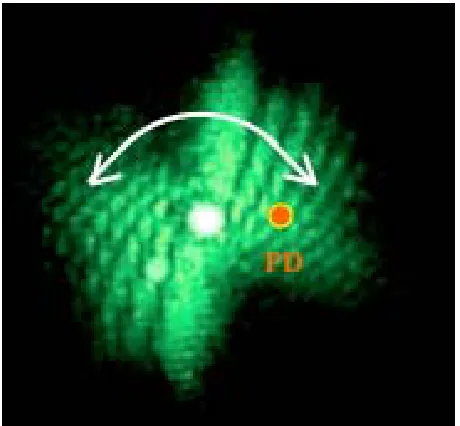
Figure 2. A photodiode with 1ns rise time is placed off cen
ent in the laser beam by itself as shown by the sample
this experiment we used a green HeNe laser
-ter in the oscillating diffraction pat-tern. The image shows the diffraction pattern at one instant in time. The curved arrow indicates the oscillation.
sp
data presented in Figures 3 and 4. These figures reveal that the worms showed 6 - 8 thrashing cycles. The light that passed by the worms was terminated at a screen sev-eral feet after the cuvette. The un-diffracted (transmitted) light passed through a hole in the screen so that only the diffracted light appeared on the screen (Figure 3). The diffraction patterns were filmed at a rate of 120 frames
per second (fps) using the Casio High Speed Exilim
camera. The dynamic diffraction patterns were analyzed using Logger Pro video analysis software. The laser beam used in this experiment had an average power of ~2
[image:3.595.58.288.292.505.2]mW. For
Figure 3. Fitting a sinusoidal function to data obtained us- ing video analysis reveals a thrashing frequency of ~2.7 Hz for one wildtype (WT) C. elegans in a 2 mm thick cuvette.
Figure 4. Fitting a sinusoidal function to data obtained u
elles Griot) operating at a wavelength of 543nm. The
ction patterns, we us
s-ing the automated technique reveals a thrashs-ing frequency of ~2.4Hzfor oneof wildtype (WT) C. elegans in a 5mm wide cuvette.
(M
temperature in the cuvette was stable within 0.1˚C for the duration of the experiment. The temperature of the cu- vette was measured using a Stainless Steel Temperature Probe (TMP-BTA) made by Vernier.
In addition to recording the diffra
[image:3.595.312.535.302.482.2]imming frequen-ci
ompared the
able 1. Swimming frequencies of worms under different physical constraints using video analysis. The errors represent the
ained Constrained
of the cuvette. The diffraction structures of the swim- ming C. elegans varied periodically. Tracking angular variations of the diffraction patterns using video analysis revealed distinct and measurable periodicities (Figure 3). The angular displacement as a function of time is shown in Figure 3. Data runs revealed distinct behavior for va-rying physical constraints. All cuvettes were 1 cm wide and 4cm tall and varied in thickness. Using video analy-sis, 17 worms were observed in a 1 mm thick cuvette, 28 worms were observed in a 2 mm cuvette and 32 worms were observed in a 5mm thick cuvette.
For the 1 mm cuvette, the worm sw
es were distinctly different from the swimming fre-quencies of the worms measured in the larger cuvettes. Tables 1 and 2 show the swimming frequencies in the 2 mm and 5 mm thick cuvettes are consistent with uncon- strained motion; the swimming frequencies for uncon- strained nematodes (2 mm and 5 mm) were significantly faster than for nematodes constrained by the 1 mm cu-vette. As an example, measuring the peak-to-peak time interval in Figures 3 and 4 reveals time periods of about 0.37s and 0.42srespectively. Taking the inverse renders thrashing frequencies of about 2.7 Hzand 2.4Hzfor the 2mm and 5 mm thick cuvettes respectively.
To verify the validity of our method, we c
vette and in the water droplet. While the constraints are similar for a worm moving in a water droplet and a worm moving in a 1 mm cuvette, they are not exactly the same physical situation. This work is providing the community with an experimental tool to explore questions about the fluid dynamics combined with gravitational and Van der Waals effects.
To enhance the data collection process, we monitored swimming frequencies in real time using a modified se-tup (Figure 2). This sese-tup used a photodiode linked to a digital oscilloscope. A sinusoidal curve was then fitted to the intensity fluctuations from the photodiode (Figure 4). The swimming frequencies, which are also shown in Ta-ble 2, were consistent with those using video analysis. Freely swimming worms in 2 mm and 5 mm cuvettes showed an increased frequency of about ~2.4 Hz. A crawling C. elegans typically undulates at 0.8 Hz. An increased undulation frequency of a crawling worm re- sults in increased speed.
The spatial structure of diffraction patterns contains information about the worm’s shape or body position at any instant in time. Given a mathematical description of a diffracting object, the Fourier Transforms (FT) can be used to model the far-field (Fraunhofer) diffraction pat- tern. The intensity distribution I(x,y) of a far-field dif- fraction pattern is proportional to
T
variance of the statistical sample.
Unconstr
Cuvette Thickness (mm) 5.0 2.0 1.0 Water Droplet on Microscope Slide
Number of Worms 32 28 17 13
Thrashing Frequencies (Hz) 2.37 0.05 2.34 0.04 1.97 0.05 2.00 0.05
able 2. Swimming frequencies of worms under different physical constraints using real time diffraction tracking. The errors
ained Constrained
T
represent the variance of the statistical sample. Unconstr
Cuvette Thickness (mm) 5.0 2.0 1.0 Water Droplet on Microscope Slide
Number of Worms 15 19 13 14
Thrashing Frequencies (Hz) 2.37 0.02 2.40 0.03 2.04 0.07 2.00 0.03
[image:4.595.65.542.568.626.2] [image:4.595.57.538.665.733.2]
2, ,
I x y A p q , where A(p,q) is the modulus of the
[22]. This relationship introduces symmetrical properties (2) Fourier transform
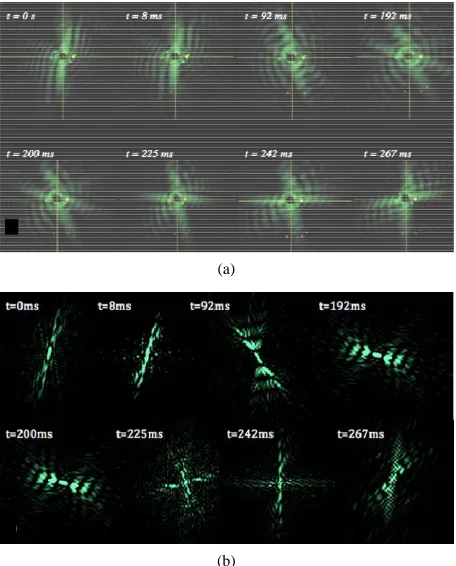
in all diffraction patterns. As a worm changes its shape, the symmetries of the worm itself and the corresponding diffraction pattern contain information about the worm’s spatial structure at any time. Diffraction symmetries (Figure 5) are results of changing structures as a worm goes through a swim cycle (Figure 6). Images of actual nematodes shown in Figure 6 were used to model pre- viously recorded diffraction patterns (Figure 5(a)). In accordance with Equation (2), the phase information gets lost in the diffraction pattern when the magnitude of the modulus is squared so that a direct calculation of the ac- tual worm shape from a diffraction pattern is not possible. It should be noted that comparison of the modeled and recorded diffraction patterns give clues about the worm symmetries of freely moving (unconstrained) worms. The modeled diffraction patterns have been matched with the actual diffraction patterns to indicate the original worm shapes. The original worm shapes correspond to the actual diffraction patterns. The diffraction patterns in
(a)
(b)
Figure 5. Worm diffraction terns: (a) About half of a recorded swimming cycle is s n above. The times
pat how
[image:5.595.311.537.86.233.2]spond to the different stages of a swim cycle that starts at time t = 0ms. Angular changes in the diffraction patterns are traced. The diffraction pattern does not rotate rigidly but changes its symmetries; (b) Modeled diffraction pa- tterns using images of actual worms shown in Figure 6.
Figure 6. C. elegans images used to model diffraction pat-terns in Figure 5(b). The orientation of the worms has been arranged to align the worms to fit the image panels.
atrix
havior of freely rganisms can be quantitatively deter-
ion analysis without relying on a Figure 5(b) were obtained by converting the worm im- ages in Figure 6 to binary matrices. The matrix was then
st Fourier transformed and the modulus of the m fa
was squared. The resulting matrix is then converted in to an image and represents the intensity distribution of the diffraction pattern.
We used two different methods to analyze diffraction patterns of freely swimming C. elegans. This diffraction method is not meant to serve as a replacement for all microscopic techniques. Rather, it serves as a compli- mentary technique. The user will not be able to obtain a real time image of the nematodes. Video analysis was the first method and served as a proof of concept showing that the oscillation of the diffraction pattern does corre- spond to the thrashing frequency of the C. elegans. The diffraction patterns were filmed and the periodic motion was analyzed using Logger Pro. This method is time consuming, however, the entire diffraction pattern is re- corded and is therefore available for additional analysis later on. The second method involves placing a photodi- ode off-center in the oscillating diffraction pattern. The intensity fluctuations are then recorded through a digital oscilloscope. In this case, the oscillations appear on the computer screen in real time. The errors in undulation frequencies for the real time automated data acquisition using a photodiode is more precise than for the video analysis. The results in Tables 1 and 2 show that mini- mal constraints can result into swimming frequencies of up to 2.37Hzfor wildtype C. elegans.
4. Conclusion
We demonstrated that swimming be swimming microo
mined using diffract
[image:5.595.59.287.372.655.2]ing these changes in locomotory behavior and the influ- ence of other stimuli like gravity (Kim et al., 2007) [23].
5. Acknowledgements
We thank Julie Park, Tzlil Rozenblat, Karl Spuhler and Rahul Khakurel for technical assistance. This work was supported by the Vassar College U
search Summer Institute (UR
ndergraduate Re- SI), Lucy Maynard Salmon
. Mun, R. H Sarkis and S. L. McIntire, “Genetic Analysis of Crawling
and Swimming C. elegans,”
Pro-ceedings of N ces of the USA
Research Fund and the NASA award # NX09AU90A, National Science Foundation Center for Research Excel- lence in Science and Technology (NSF-CREST) award # 0630388 and the NSF award # 1058385.
REFERENCES
[1] J. T. Pierce-Shimomura, B. L. Chen, J. J o, R.
, Locomotory Patterns in
ational Academy of Scien Vol. 105, No. 52, 2008, pp. 20982-20987. doi:10.1073/pnas.0810359105
[2] W. Li, Z. Feng, P. W. Sternbert and X. Z. S. Xu, “A C. elegans Stretch Receptor Neuron Revealed by a Mecha- nosensitive TRP Channel Homologue,” Nature, Vol. 440, No. 7084, 2006, pp. 684-687. doi:10.1038/nature04538
[3] J. Korta, D. A. Clark, C. V. Gabel, L. Mahadevan and A. D. T. Samuel, “Mechanosensation and Mechanical Load Modulate the Locomotory Gait of Swimming C. elegans,” Journal of Experimental Biology, Vol. 210, No. 13, 2007, pp. 2383-2389.
[4] D. L. Riddle, T. Blumenthal, B. J. Meyer and J. R. Priess, “C. elegans II,” Cold Spring Harbor Laboratory Press, New York, 1997.
[5] M. Chalfie, J. E. Sulston, J. G. White, E. Southgate, J. N. Thomson and S. Brenner, “The Neural Circuit for Touch Sensitivity in Caenorhabditis elegans,” Journal of Neu-roscience, Vol. 5, No. 4, 1985, pp. 956-964.
[6] S. R. Lockery, K. J. Lawton, J. C. Doll, S. Faumont, S. M. Coulthard, T. R. Thiele, N. Chronis, K. E. McCormick, M. B. Goodman and B. L. Pruitt, “Artificial Dirt: Microflui- dic Substrates for Nematode Neurobiology and Beha- vior,” Journal of Neurophysiology, Vol. 99, No. 6, 2008, pp. 3136-3143. doi:10.1152/jn.91327.2007
[7] S. Park, H. Hwang, S.-W. Nam, F. Martinez, R. H. Austin and W. S. Ryu, “Enhanced Caenorhabditis elegans Loco-
[10] G. Corkidi, B. Taboada, C. D. Wood, A. Guerrero and A.
8.05.189
Darszon, “Tracking Sperm in Three-Dimensions,” Bio-chemical and Biophysical Research Communications, Vol. 373, No. 1, 2008, pp. 125-129.
doi:10.1016/j.bbrc.200
. 67, No. 3, 1996, pp. [11] D. Noever, H. Matsos, A. Brittain, D. Obenhuber, R. Cronise and S. Armstrong, “Microbial Diffraction Gra- tings as Optical Detectors for Heavy Metal Pollutants,” Review of Scientific Instruments, Vol
828-832. doi:10.1063/1.1146817
.2000.4614
[12] H. Kimura, F. Nagao, A. Kitamura, K. Sekiguchi, T. Kitamori and T. Sawada, “Detection and Measurement of a Single Blood Cell Surface Antigen by Thermal Lens Microscopy,” Analytical Biochemistry, Vol. 283, No. 1, 2000, pp. 27-32. doi:10.1006/abio
[13] D. Lapotko and V. Zharov, “Photothermal Images of Live Cells in Prescence of a Drug,” Journal of Biomedical Optics, Vol. 7, No. 3, 2002, pp. 425-434.
doi:10.1117/1.1481902
[14] S. W. Hell, “Increasing the Resolution of Far-Field Fluo-
Photon-Induced ress, New York, 1997.
rescence Microscopy by Point-Spread-Function Engi- neering,” In: J. Lakowicz, Ed., Topics in Fluorescence Spectroscopy. Vol. 2: Nonlinear and
Two-Fluorescence, Plenum P
[15] M. Dyba and S. W. Hell, “Focal Spots of Size λ/23 Open up Far-Field Fluorescence Microscopy at 33 nm Axial Resolution,” Physical Review Letters, Vol. 88, No. 16, 2002, Article ID: 163901.
doi:10.1103/PhysRevLett.88.163901
[16] H. E. Keller, “Objective Lenses for Confocal Micro- scopy,” In: J. B. Pawley, Ed., Handbook of Biological Confocal Microscopy, 3rd Edition, Springer, New York, 2006. doi:10.1007/978-0-387-45524-2_7
[17] J. Conrad, “Depth of Field in Depth,” 2011.
Matrix Composition by Multiphoton Laser Tomogra- www.largeformatphotography.info/articles/DoFinDepth.p df
[18] L. C. Martin, “Technical Optics, Vol. II,” Pitman Publi- shing Corporation, London, 1950.
[19] M. Kaatz, A. Sturm, P. Elsner, K. König, R. Bückle and M. J. Koehler, “Depth-Resolved Measurement of the Der- mal
phy,” Skin Research and Technology, Vol. 16, No. 2, 2010, pp. 131-136.
doi:10.1145/1141911.1141976
[21] M. Levoy, Z. Zhang and I. McDowall, “Recording
3195.x
and Controlling the 4D Light Field in a Microscope Using Microlens Arrays,” Journal of Microscopy, Vol. 235, No. 2, 2009, pp. 144-162.
doi:10.1111/j.1365-2818.2009.0
5.
NaC Channel
[22] J. F. James, “A Student’s Guide to Fourier Transforms with Applications in Physics and Engineering,”
Cam-bridge University Press, CamCam-bridge, 199
[23] N. Kim, C. M. Dempsey, C.-J. Kuan, J. Zoval, E. O’Rour- ke, G. Ruvkun, M. J. Madou and J. Y. Sze, “Gravity Force Transduced by the MEC-4/MEC-10 DEG/E

![1,28-Di[(cholest-5-en-3 -yl)disulfanyl]-4,25-dioxo-3,8,](data:image/gif;base64,R0lGODlhAQABAIAAAP///wAAACH5BAEAAAAALAAAAAABAAEAAAICRAEAOw==)