Creative Education, 2018, 9, 1258-1276 http://www.scirp.org/journal/ce
ISSN Online: 2151-4771 ISSN Print: 2151-4755
DOI: 10.4236/ce.2018.98094 Jun. 29, 2018 1258 Creative Education
Special Educational Needs and the Study at the
Field of Medicine
Hana Sochorova, Ivona Zavacka
Department of Biomedical Sciences, Faculty of Medicine, University of Ostrava, Ostrava, Czech Republic
Abstract
The study and the profession at the field of medicine involve high demands on mental and physical capabilities. The objective of this study is the following issue: in what ways mainly healthy students evaluate opportunities of students with special educational needs (SEN) to study medicine. It is based primarily on their experience of the studies and on their medical practice. To meet the above objective, a questionnaire survey method has been used. The results of the survey could be concluded with general recommendations: the study of general medicine is fully manageable for students with certain SEN such as slight visual or hearing impairments, specific learning disabilities, and internal diseases, while it is manageable in a limited way for students with physical disability of legs. The study of students with SEN such as severe visual or hearing impairment, locomotor disability of the upper limbs and disability of fine motoric skills and mental illness, will be very difficult and complicated even if the university considerably adapts to these conditions. In the case of students with SEN, making the decision regarding future profession in health care should always be realistic and based on individuals and with respect to their future employability.
Keywords
Special Educational Needs, General Medicine, Paramedical Professions, Questionnaire Survey
1. Introduction
The study of general medicine has always been one of the most prestigious and most demanding university studies. The amount of information and skills that must be mastered by the future doctor during the course of the study is constantly increasing. The best secondary school graduates have always been How to cite this paper: Sochorova, H., &
Zavacka, I. (2018). Special Educational Needs and the Study at the Field of Medicine. Crea-tive Education, 9, 1258-1276.
https://doi.org/10.4236/ce.2018.98094
Received: March 7, 2018 Accepted: June 26, 2018 Published: June 29, 2018
Copyright © 2018 by authors and Scientific Research Publishing Inc. This work is licensed under the Creative Commons Attribution-NonCommercial International License (CC BY-NC 4.0).
DOI: 10.4236/ce.2018.98094 1259 Creative Education enrolled to the study area of General Medicine, however, a high percentage of them do not complete their study (Rosebraugh, 2000). One can just guess, which students do not complete the study because the mismanagement of the actual curriculum and how many of unsuccessful students would have been successful if a required support for students with special educational needs (SEN), due to health impairment or disability, had been provided to them (Kleňhová & Vojtěch, 2011; Faigel, 1998). In this sense, these special educational needs are further understood in the text.
The process of widening access to students with special educational needs cannot be understood as their prioritizing but as the creation of supportive measures during the study, which will enable them to complete the study in full extent (Zezulková & Krhutová, 2009) and strengthen their personal autonomy
(Krhutová, 2013) and help them to reduce social barriers (Cook, Griffin,
Hay-den, Hinson, & Raven, 2012). There are, however, fields of study, where even the maximum degree of adjustment of learning environment does not allow the student to complete all obligations in full extent and thus comply the require-ments for the profession performance.
Non-medical healthcare fields and medical professions occupy a special posi-tion among other fields of study; there are known as professional fields and their content is strictly defined by legal standards. In the process of equalization of opportunities for college students with special educational needs, the university (institution) has only limited possibility to modify education as strict accredita-tion requirements and applicable health legislaaccredita-tion must be fully met.
The study focuses on the issue in what ways mainly healthy students evaluate opportunities of students with special educational needs to study medicine. It is mainly based on their experience of the studies they have already completed or their medical practice.
2. Research Method
The main objective of our survey was to determine how the students of general medicine, evaluate opportunities of students with special educational needs to study general medicine, based on their experience. In order to meet the stated goal, the survey method was chosen, the respondents of the target group were offered the opportunity to answer questions about the given issue. Participation in the survey was voluntary, the students participated in the survey based on their decision (Chráska, 2007).
2.1. Target Group
The target groups of the questionnaire survey were students of all years of gen-eral medicine at the Ostrava University in Ostrava.
2.2. Data Collection
sur-H. Sochorova, I. Zavacka
DOI: 10.4236/ce.2018.98094 1260 Creative Education
veys were realized at the end of the academic year 2013/2014 (Sochorová &
Závacká, 2014) and again in the academic year 2015/1016. During the first
ques-tionnaire survey, 370 students of general medicine were addressed through the university e-mails while 418 students were addressed two years later. In the in-troductory text, students learned the target of the survey and that the participa-tion is voluntary.
The data were collected electronically through an online form, in which res-pondents selected from the available answers, but they also had an opportunity to add free-text comments.
2.3. Categories of the Specific Education Needs
For the purpose of assessing the student’s functional abilities in relation to study duties, students with specific needs are divided into categories according to the potential need to modify the study conditions. When creating categories, the methodology of the Ministry of Education Youth and Sports (MEYS) has been
used (MEYS, 2014). The methodology distinguishes typology of disabilities for
the purposes of financing the increased costs associated with the provision of studies for students with special needs.
For the purposes of the survey, this typology has been modified into the cate-gory of students with internal diseases where chronic somatic diseases and men-tal disorders with regard to psychological demands of the study and profession were separated.
Categorizations of specific needs in our survey are as follows: (A) Students with vision disabilities.
(A1) Slightly visually impaired students/eyesight users (Students work with common document formats; image editing involves enlarging optical character or other changes).
(A2) Severely visually impaired/touch/voice users (Student work with tactile printed documents or screen readers, requiring editable format text document or content and form adapted document).
(b) Students with hearing impairments.
(b1) Hard of hearing/user of verbal language (student receives information and communicate through verbal language, Czech language).
(B2) Deaf/sign language users (student receives information and communi-cates through sign language, Czech sign language).
(C) Students with physical disabilities.
(C1) Lower limb disability, paraplegia (for independent movement, students need and use other personal devices, supporting sticks, mechanical or electric wheelchair).
DOI: 10.4236/ce.2018.98094 1261 Creative Education (D) Students with specific learning disabilities (dyslexia, dysgraphia, ortho-graphy, dyscalculia, dyspraxia).
(E) Student with internal diseases (illness objectively disables the student to fulfil study requirements in a standard way or requires special organizational demands from the school).
(E1) students with chronic somatic diseases. (E2) students with mental disorder.
The questions of the form
In the introduction, the respondent was acquainted with the aim of the survey and with specific educational needs. Then it was followed by questions that as-certained all the information concerning the respondent. In the next part, the respondents were asked to express their views according to their experience and answer how the student is able to handle the study of general medicine in each category of specific needs, namely:
Theoretical part of study usually in the form of monologue or dialogue of the teacher with the student with the support of audio-visual equipment,
Practical education led at school, at school laboratories takes place in
specia-lized classrooms and is usually implemented through practical exercises where students practice their skills on each other or simulation models or special software support are used,
Guided and individual practice where students improve their skills under the supervision of a mentor or in the case of individual practice under the super-vision of a contact person responsible,
Clinical placement in medical institutions, bedside students. Students apply their knowledge and skills in the contact with patients under the supervision of the guarantor of practical training.
The chosen classification into four main units affects main teaching methods. Each of the four sections has a different nature regarding the way of study obli-gations fulfilment and, therefore, there was assessed separately. The last two units in the survey were optional, because not all of the students involved in the survey had previously completed all four units. To record the answers, students selected boxes arranged in a grid (Figure 1).
2.4. Characteristics of Respondents
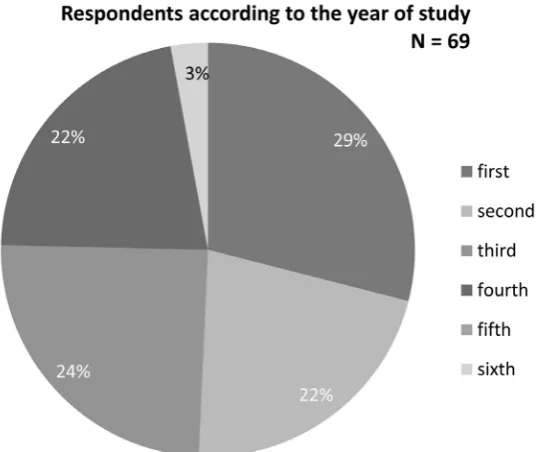
A total of 83 respondents completed the survey, i.e. 10.5% of the total number of respondents, where 69 respondents participated the survey for the first time and 14 respondents repeatedly. A total of 47 women and 22 men from the total number of respondents participated in the first survey that corresponds to the ratio of surveyed students. In the second survey, the answers of 14 students who participated in the initial investigation were there collected and analyzed inde-pendently, see below.
H. Sochorova, I. Zavacka
[image:5.595.66.536.121.438.2]DOI: 10.4236/ce.2018.98094 1262 Creative Education
Figure 1. Poll grid to fill opinions of students on mastering theoretical part of the study.
[image:5.595.241.512.473.699.2]DOI: 10.4236/ce.2018.98094 1263 Creative Education which is due to the fact that in this year students participate in their clinical in-ternships outside the faculty. Survey questions focused on clinical, guided and individual practices that are the part of the curriculum of higher years of studies, were answered by 24 students (in the third and fourth year of study). Six stu-dents out of the total number of responstu-dents were stustu-dents with special educa-tional needs.
3. Results of the Survey
Outcomes of the survey can be presented from two perspectives by categorizing specific educational needs or by division into units according crucial methods of teaching (theory, practical instruction, clinical internship, practical placement). In terms of career decisions for applicants with special educational needs, the first option will be used, and according to various categories of students with special educational needs, it is shown which crucial part of instruction, accord-ing to respondents’ opinions, could be a major obstacle to successful completion of the study.
3.1. Visual Impairment
Student typology A1 (light visual impairment), according to the above typology, works with common document formats and adjustment of image is based on the enlargement of the images and other optical changes The results show that light visual impairment is not considered a major obstacle to manage the study of general medicine, only 2 respondents out the total of 69 students take the view that this type of special needs would be a barrier to complete the practical in-struction conducted at school (work laboratory, etc.). The reason could be the fact that within the first three years of study curriculum, practical subjects that require working with a microscope and simulation of processes via PC are in-cluded.
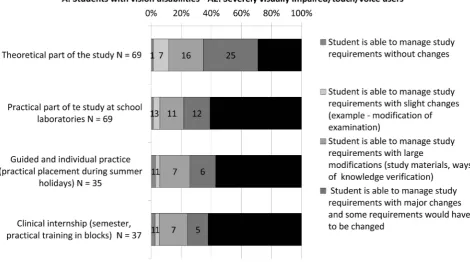
Completely different situation arises in the case of a student with severe visual impairment, who works with tactile printed documents or screen readers and requires an editable text document format, and content and form adapted doc-uments if necessary. These results are presented in Figure 3, the majority of students considers unrealistic to complete required lessons in the full extent even when the learning materials, teaching and evaluation methods are modified.
3.2. Hearing Impairment
The opinions of respondents concerning students with a hearing impairment B1 are similar to those of students with mild visual impairment that is illustrated in the diagram, where visually dominates light areas, a view that the student with such a kind of disability is able to manage the studies without modification or with some occasional modifications, as confirmed by a particular situation at the Faculty of Medicine.
H. Sochorova, I. Zavacka
[image:7.595.62.533.79.341.2]DOI: 10.4236/ce.2018.98094 1264 Creative Education
Figure 3. The degree of management of study obligations of a student with typology A2 (severely visually impaired).
users), it will be very difficult to manage all the study obligations even if possible modifications are used. As shown in Figure 4, 15 respondents from 37 considers unrealistic for such students to master fundamental part of practical training, clinical internships and guided practice, and 11 respondents consider these learning units to be manageable only in the case of significant modifications, which could be very difficult with regard to above mentioned mandatory stan-dards. It should be kept in mind that a doctor must be able to communicate with patients, and it could be a fundamental problem in this profession, a communi-cation barrier between a doctor and a patient could affect the speed while deter-mining diagnoses and appropriate treatment. Nevertheless respondents can see complications to manage the curriculum at school courses (theory and practice).
3.3. Physically Handicapped
Also respondents’ views on managing the course requirements by students with physical disabilities, with lower limb disabilities, paraplegia (for independent movement they need and use other personal devices, supporting sticks, mechan-ical or electric wheelchair) were assessed. Respondents do not evaluate positively the possibility of managing practical courses, although it must be noted that, es-pecially in this case, it strongly depends on the degree of disadvantage.
DOI: 10.4236/ce.2018.98094 1265 Creative Education
Figure 4. The degree of management of study obligations of a student with typology B2.
be able to handle the theoretical part of instruction even at maximum possible adaptation. In Figure 5 presenting these opinions, prevailing dark fields (such student is not able to complete some obligations in full range and some obliga-tions would need to be eventually changed) in all four learning units can be seen.
3.4. Students with Specific Learning Disabilities
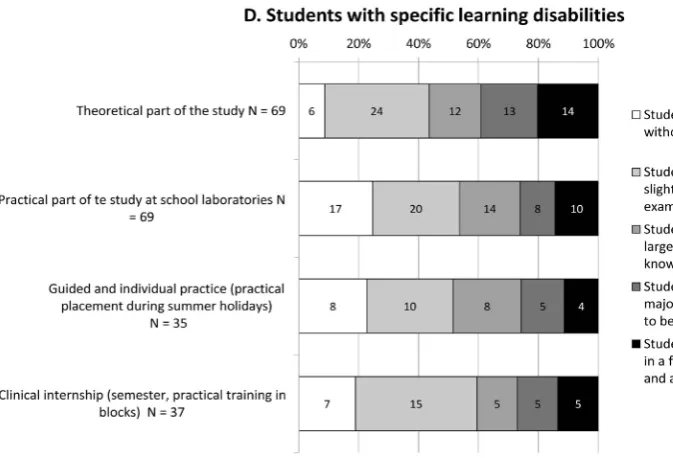
Respondents’ opinions on fact how a student with a specific learning disabilities (typology D) will handle obligations arising from study plan are presented in
Figure 6. From the outside view, the most difficult for such students seems to be completing the theoretical part of instruction. However, previous experience with the students of general medicine at the Faculty of Medicine of University of Ostrava indicate that in this case the handicap was significantly outweighed by a high motivation and diligence and those students were most successful ones. This fact was, in the case of students with dyslexia, also confirmed by interna-tional studies (McKendree & Snowling, 2011).
3.5. Students with Internal Diseases
H. Sochorova, I. Zavacka
[image:9.595.61.536.69.342.2]DOI: 10.4236/ce.2018.98094 1266 Creative Education
Figure 5. The degree of management of study obligations of a student with typology C2.
Figure 6. The degree of management of study obligations of a student with typology D.
[image:9.595.62.399.372.601.2]DOI: 10.4236/ce.2018.98094 1267 Creative Education
Figure 7. The degree of management of study obligations of a student with typology E1.
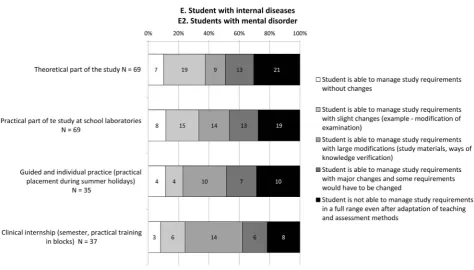
Figure 8. The degree of management of study obligations of a student with typology E2.
4. The Development of Respondents’ Opinions during the
Study
[image:10.595.61.536.357.627.2]com-H. Sochorova, I. Zavacka
DOI: 10.4236/ce.2018.98094 1268 Creative Education
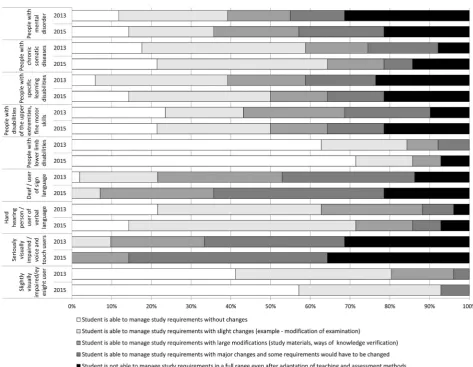
pared with the outputs of the first survey. It turns out that during the course of medical studies (in two years’ interval), there was a slight shift in opinions on this issue, as shown in Figure 9 and Figure 10.
Figure 9 shows the shift in opinions of students on mastering theoretical part of instruction. You cannot clearly say in which direction has the opinion shifted. For various types of specific needs, shift varies. For example, in the category with a slight visual impairment or motoric disability of lower limbs, a shift in favor of management of study obligation has been detected while a different shift has been detected in the case of disability of upper limbs and severe visual impair-ment where the opinions incline more to the inability of mastering the curricu-lum in its full range. Figure 10 shows a similar comparison for clinical practice.
In 2013, a similar poll survey was carried out, where the target group con-sisted of students studying in fields of paramedical professions in all grades and forms of study at the Faculty of Medicine of University of Ostrava (Sochorová & Závacká, 2013).
[image:11.595.58.532.335.702.2]There were contacted 1005 students, 164 of whom were involved in the sur-vey. Those students represented 16.3% of the addressed students (18 men, 146
DOI: 10.4236/ce.2018.98094 1269 Creative Education
Figure 10. Shift in opinion during the study—clinical internships.
women) that is about 3% more than the total number of respondents among students of medicine. In the study there were included students from all the study fields, types and years of the study. The poll was conceived in a similar way, the core part of the questionnaire consisted of questions in which respon-dents considered if the student with specific needs would be able to handle study duties. These duties were divided into four separate areas—the theoretical part of teaching and three different ways of practical teaching—in the view of the prevailing teaching methods.
Respondents considered that the least difficult would be to master theoretical instruction mainly for students with a low visual impairment and motor im-pairment of the lower limbs. Mastering studies with great support and modified teaching methods were attributed to students with severe visual and hearing impairments. On the other hand, 41 respondents (25%) considered psychologi-cal disorder to be a major barrier to master theoretipsychologi-cal instruction.
rou-H. Sochorova, I. Zavacka
DOI: 10.4236/ce.2018.98094 1270 Creative Education
tine skills) the smallest problem was seen among students with light vision pairment, 42 respondents i.e. 25.6%. Than in students with a slight hearing im-pairment, where 11.6% of respondents expects problems. On the other hand, the greatest difficulty in mastering the basic practical activities was seen among res-pondents with motor disorders. 50% of resres-pondents are of the opinion that a student with this disability is not able to complete most of the practical lessons. This handicap is a major barrier especially in mastering manual skills (health technician, physiotherapist and others).
After practicing basic skills in school laboratories and models, students of non-medical professions continue to practice their studies directly in the health facility. The teacher or the mentor is still present in the classroom, and the stu-dent is under constant supervision. In this part of the course, the stustu-dent is in-volved in regular medical care, and in most fields there is direct contact with pa-tients. In all categories of specific needs, here significantly increased the number of respondents, who believe that a student with specific educational needs is un-able to handle the training. Similar results were detected in the case of upper ex-tremity and soft motor skills impairment, which were found to be the biggest problems according to the respondents. It was followed with severe visual and hearing impairment, lower limb disorder and mental disorders. 12 respondents (7%) believed that even a visually impaired student would not be able to com-plete all practical exercises. For example, in the physiotherapist’s profession, the primary examination of the patient is based on a visual evaluation of the condi-tion and any visual impairment makes this initial examinacondi-tion more difficult.
Further degree of practical instruction is a continuous individual practice. It usually occurs during holiday periods when the student is fully involved in the activities that take place in a health facility. Students usually seek such facility at their hometowns. Here, the student has to demonstrate almost full professional knowledge and ability to work independently, in accordance with Act No. 105/2011 Coll., On conditions for acquiring and recognizing competence to perform non-medical healthcare professions and performing activities related to providing health care, as amended, to perform a profession without professional supervision. Similarly as in previous types of practice, respondents saw the greatest complications in students with upper limb disabilities, motor impair-ment, and students with severe visual impairment. On the contrary, the smallest complications were seen in students with a slight visual or auditory disability, 38 respondents (23%) assumed that the student was able to complete the practice in case of light visual impairment.
DOI: 10.4236/ce.2018.98094 1271 Creative Education
Table 1 compares the individual teaching units (there are always four
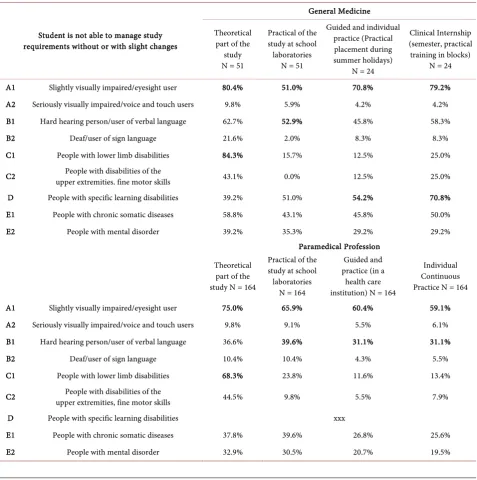
theo-retical parts of the general and non-medical branches, the theotheo-retical and prac-tical lessons at school at the same) in the situation when the respondents ex-pressed the opinion that the student would be able to handle the duties without modification or only with small modifications, such as modification of the test method. From the table it is clear that the outcomes of the surveys are similar, where the highest percentage of respondents leaning towards specific learning needs based on light visual impairment, light hearing impairment, and specific learning disorders (general medicine only).
Table 1. Summary table of assessment of the manageability of lessons without modification or less modification from the point of
view of students, comparison of the study of general medicine and non-medical fields according to the nature of the teaching me-thods.
Student is not able to manage study requirements without or with slight changes
General Medicine
Theoretical part of the
study N = 51
Practical of the study at school laboratories
N = 51
Guided and individual practice (Practical placement during summer holidays)
N = 24
Clinical Internship (semester, practical training in blocks)
N = 24
A1 Slightly visually impaired/eyesight user 80.4% 51.0% 70.8% 79.2%
A2 Seriously visually impaired/voice and touch users 9.8% 5.9% 4.2% 4.2%
B1 Hard hearing person/user of verbal language 62.7% 52.9% 45.8% 58.3%
B2 Deaf/user of sign language 21.6% 2.0% 8.3% 8.3%
C1 People with lower limb disabilities 84.3% 15.7% 12.5% 25.0%
C2 upper extremities. fine motor skills People with disabilities of the 43.1% 0.0% 12.5% 25.0%
D People with specific learning disabilities 39.2% 51.0% 54.2% 70.8%
E1 People with chronic somatic diseases 58.8% 43.1% 45.8% 50.0%
E2 People with mental disorder 39.2% 35.3% 29.2% 29.2%
Paramedical Profession Theoretical
part of the study N = 164
Practical of the study at school laboratories
N = 164
Guided and practice (in a
health care institution) N = 164
Individual Continuous Practice N = 164
A1 Slightly visually impaired/eyesight user 75.0% 65.9% 60.4% 59.1%
A2 Seriously visually impaired/voice and touch users 9.8% 9.1% 5.5% 6.1%
B1 Hard hearing person/user of verbal language 36.6% 39.6% 31.1% 31.1%
B2 Deaf/user of sign language 10.4% 10.4% 4.3% 5.5%
C1 People with lower limb disabilities 68.3% 23.8% 11.6% 13.4%
C2 upper extremities, fine motor skills People with disabilities of the 44.5% 9.8% 5.5% 7.9%
D People with specific learning disabilities xxx
E1 People with chronic somatic diseases 37.8% 39.6% 26.8% 25.6%
H. Sochorova, I. Zavacka
[image:15.595.67.538.262.739.2]DOI: 10.4236/ce.2018.98094 1272 Creative Education
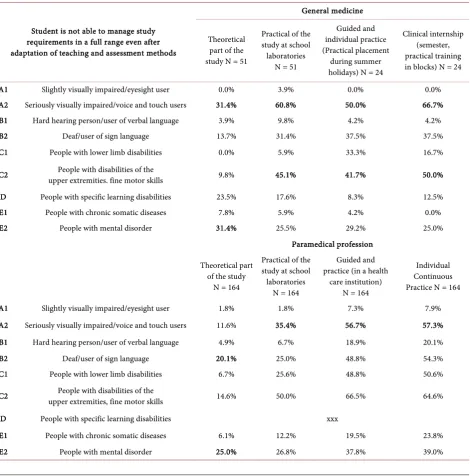
Table 2, on the other hand, shows which specific educational needs, in the
opinion of the respondents, would probably be the reason for not meeting full-time study requirements. Even here the comparison of the study of general medicine and paramedical professions is similar the highest percentage of res-pondents considered unrealistic to fulfill study duties in the case of specific edu-cational needs based on severe visual impairment, fine motor impairment and psychological illness.
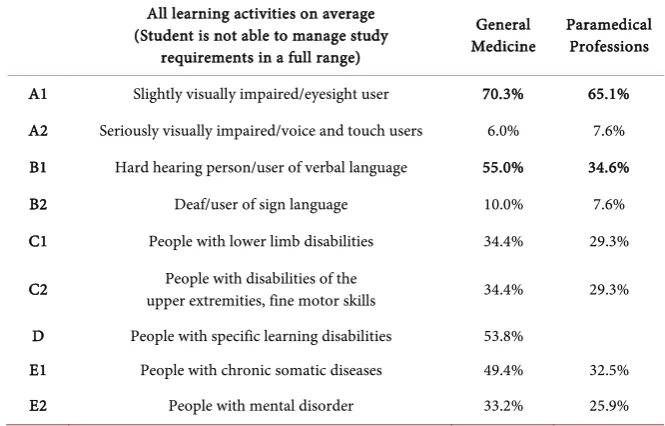
Table 3 and Table 4 then present the results collectively for all four units on average (i.e., how many percent of respondents consider all study duties for a given category of specific needs to be manageable/unmanageable).
Table 2. Summary table of full-time exclusion assessment, comparison of general medicine and non-medical fields by the nature
of teaching methods.
Student is not able to manage study requirements in a full range even after adaptation of teaching and assessment methods
General medicine
Theoretical part of the study N = 51
Practical of the study at school laboratories
N = 51
Guided and individual practice (Practical placement during summer holidays) N = 24
Clinical internship (semester, practical training in blocks) N = 24
A1 Slightly visually impaired/eyesight user 0.0% 3.9% 0.0% 0.0%
A2 Seriously visually impaired/voice and touch users 31.4% 60.8% 50.0% 66.7%
B1 Hard hearing person/user of verbal language 3.9% 9.8% 4.2% 4.2%
B2 Deaf/user of sign language 13.7% 31.4% 37.5% 37.5%
C1 People with lower limb disabilities 0.0% 5.9% 33.3% 16.7%
C2 upper extremities. fine motor skills People with disabilities of the 9.8% 45.1% 41.7% 50.0%
D People with specific learning disabilities 23.5% 17.6% 8.3% 12.5%
E1 People with chronic somatic diseases 7.8% 5.9% 4.2% 0.0%
E2 People with mental disorder 31.4% 25.5% 29.2% 25.0%
Paramedical profession
Theoretical part of the study
N = 164
Practical of the study at school laboratories
N = 164
Guided and practice (in a health
care institution) N = 164
Individual Continuous Practice N = 164
A1 Slightly visually impaired/eyesight user 1.8% 1.8% 7.3% 7.9%
A2 Seriously visually impaired/voice and touch users 11.6% 35.4% 56.7% 57.3%
B1 Hard hearing person/user of verbal language 4.9% 6.7% 18.9% 20.1%
B2 Deaf/user of sign language 20.1% 25.0% 48.8% 54.3%
C1 People with lower limb disabilities 6.7% 25.6% 48.8% 50.6%
C2 upper extremities, fine motor skills People with disabilities of the 14.6% 50.0% 66.5% 64.6%
D People with specific learning disabilities xxx
E1 People with chronic somatic diseases 6.1% 12.2% 19.5% 23.8%
DOI: 10.4236/ce.2018.98094 1273 Creative Education Table 3 and Table 4 clearly show that although the percentages differ, the highest values in both cases are the same. Divergence can be found in Table 3
[image:16.595.206.539.264.477.2]for the category of B2 specific needs (sign language use) where respondents ex-pect lower percentage of mastering study duties in non-medical professions, which is probably due to the higher need for direct communication with the patient. In Table 4, this difference was also shown for category B1 (hear-ing-impaired) here is the percentage of respondents with the view that study is not manageable, more than twice as high. A significantly high percentage of non-medical respondents also exclude full-time studies in the category of
Table 3. Compilation table of assessment of the manageability of lessons without
modifi-cation or less modifimodifi-cation from the point of view of students Comparison of study of general medicine and non-medical fields.
All learning activities on average (Student is not able to manage study
requirements in a full range)
General
Medicine Paramedical Professions
A1 Slightly visually impaired/eyesight user 70.3% 65.1% A2 Seriously visually impaired/voice and touch users 6.0% 7.6% B1 Hard hearing person/user of verbal language 55.0% 34.6%
B2 Deaf/user of sign language 10.0% 7.6%
C1 People with lower limb disabilities 34.4% 29.3%
C2 upper extremities, fine motor skills People with disabilities of the 34.4% 29.3%
D People with specific learning disabilities 53.8%
E1 People with chronic somatic diseases 49.4% 32.5%
[image:16.595.189.539.521.734.2]E2 People with mental disorder 33.2% 25.9%
Table 4. Summary table of full-time exclusion assessment comparison of general medical
and paramedical studies.
All learing activities on average (Student is not able to manage study
requirements in a full range)
General
Medicine Paramedical Professions
A1 Slightly visually impaired/eyesight user 1.0% 4.7% A2 Seriously visually impaired/voice and touch users 52.2% 40.2% B1 Hard hearing person/user of verbal language 5.5% 12.7%
B2 Deaf/user of sign language 30.0% 37.0%
C1 People with lower limb disabilities 14.0% 32.9%
C2 upper extremities, fine motor skills People with disabilities of the 36.6% 48.9%
D People with specific learning disabilities 15.5%
E1 People with chronic somatic diseases 4.5% 15.4%
H. Sochorova, I. Zavacka
DOI: 10.4236/ce.2018.98094 1274 Creative Education
specific educational needs based on lower limb disabilities. This fact can be at-tributed to the respondents from individual non-medical fields of study, which are very physically demanding (e.g. physiotherapist, rescue ranger).
5. Discussion
Graphical outcomes from the previous section present answers to the questions from the survey. This survey has several limitations, of course. Its generalization can be problematic because of the low response rate among students. It is likely that the survey was answered only by students who were interested in this issue. And although it is seen that after graduation or during the study, respondents could change their opinion on this issue, certain conclusions can be formulated. Despite the above limitations, this study has particular relevance mainly for educational counseling in choosing a future profession.
In the case that classification of specific needs into categories A to E is kept, the survey can be concluded with the general recommendations: study of general medicine is fully manageable for students with special educational needs based on a lightweight visual or hearing impairment, specific learning disabilities and internal diseases and, in a limited form, for students with lower limb impair-ment. The study for the students with special educational needs based on severe visual or hearing impairment, locomotor impairment of the upper limbs, fine motoric skills and mental illness will be very complicated even after considerable adaptation from the faculty. And there is a high probability that such student will not be able to fulfil all obligations of the curriculum, and therefore the re-quirements for professional qualification. Of course, it always depends on the particular level of specific educational needs, because everyone is individual and everyone with is coping with “the same degree of” handicap in the different way.
Study of general medicine or rather the choice of non-medical ( para-medical) profession?
It is often the case that a secondary school student with specific educational needs considers future applications in health and medicine because he has en-countered more often with the environment of health care facilities. It may then, considering its specific educational needs, consider whether to choose (or, as will be shown below), a “simple” or “less demanding” study of some medical non-medical profession.
DOI: 10.4236/ce.2018.98094 1275 Creative Education This fact may be given by proportion of respondents from individual non-medical fields of study, among which very physically demanding professions (e.g. physi-otherapist, paramedic) were included.
In practice, there could be problems that may arise when teaching students with special educational needs, especially in patient care during clinical exercise, or in interactions with teachers, mentors of clinical practice and communication with a patient and a family (Ikematsu et al., 2014).
6. Conclusion
The issue regarding specific educational needs in healthcare and medicine is a very important topic in every case and it is very disputable. The applicants with special educational needs and their decisions about future professional speciali-zation in health care should always be assessed realistically individually and with respect to future employability in the labor market. Although it is possible to modify the study, to maximally adapt it—of course, while observing all the given legal standards of vocational education—after graduation, the graduate goes into practice. He enters an ordinary medical facility, where he works in shifts is a common practice. Now the following questions arise: Will the employer be helpful and welcoming to the specific needs of a new employee? Will the em-ployer allow the employee to adapt to the environment, for example, by modify-ing workmodify-ing environment or way of communication?
References
Chráska, M. (2007). Metody pedagogického výzkumu: Základy kvantitativního výzku-mu/Methods of Pedagogical Research: The Basics of Quantitative Research. Praha: Grada.
Cook, V., Griffin, A., Hayden, S., Hinson, J., & Raven, P. (2012). Supporting Students with Disability and Health Issues: Lowering the Social Barriers. Medical Education, 46, 564-574. https://doi.org/10.1111/j.1365-2923.2012.04267.x
Faigel, H. C. (1998). Changes in Services for Students with Learning Disabilities in U.S. and Canadian Medical Schools, 1991 to 1997. Academic Medicine, 73, 1290-1293.
http://search.ebscohost.com/login.aspx?direct=true&db=eric&an=EJ579857&scope=site
https://doi.org/10.1097/00001888-199812000-00020
Ikematsu, Y., Mizutani, M., Tozaka, H., Mori, S., Egawa, K., Endo, M., & Yokouchi, M. (2014). Nursing Students with Special Educational Needs in Japan. Nurse Education in Practice, 16, 674-679. https://doi.org/10.1016/j.nepr.2014.08.007
Kleňhová, M., & Vojtěch, J. (2011). Úspěšnost absolventů středních škol ve vysokoškolském studiu, předčasné odchody ze vzdělávání.
http://www.nuov.cz/uploads/Vzdelavani_a_TP/VS_predcasne_odchody_2011_pro_ww
w.pdf
Krhutová, L. (2013) Autonomie v kontextuzdravotníhopostižení/Autonomy in the Con-tects of Health Impairment. Boskovice: Ostravskáuniverzita v Ostravě v nakl. Albert. McKendree, J., & Snowling, M. J. (2011). Examination Results of Medical Students with
Dyslexia. Medical Education, 45, 176-182.
H. Sochorova, I. Zavacka
DOI: 10.4236/ce.2018.98094 1276 Creative Education
MEYS (2014). MŠMT Pravidla pro poskytování příspěvku a dotací veřejným vysokým školám Ministerstvem školství, mládeže a tělovýchovy: Příloha č. 3 Financování zvýšených nákladů na studium studentů se specifickými potřebami./Rules for Subsidy Supplying to Public Universities by the Ministry of Education, Youth and Sports: Annex No. 3 Financing of Increased Costs for the Study of Students with Special Needs. Praha: MŠMT. http://www.msmt.cz/file/33877_1_1/
Rosebraugh, C. J. (2000). Learning disabilities and Medical Schools. Medical Education, 34, 994-1000.
http://search.ebscohost.com/login.aspx?direct=true&db=rzh&an=106095943&scope=si
te
Sochorová, H., & Závacká, I. (2014). Specifickévzdělávacípotřeby a studiummedicíny/SEN and the Study of Medicine. In M. Kaleja (Ed.), Otázkyinkluzivníhovzdělávánístudentů se specifickýmipotřebami v pregraduálnípřípravě/Issues of Inclusive Education of Stu-dents with SEN in Pre-Gradual Preparation (pp. 74-107). Ostrava: Ostravskáuniverzita. Sochorová, H., & Závacká, I. (2013). Specifické vzdělávací potřeby a realita studiave zdravotnických nelékařských oborech na vysoké škole/SEN and the Reality of the Study in Non-Medical Health-Care Study Programmes at a University. In M. Kaleja (Ed.), Budování rovného přístupu v terciárním vzdělávání studentů se specifickými (vzdělávacími) potřebami/Building of an Equal Approach in Tertiary Education of Students with SEN (pp. 101-118). Ostrava: Ostravská univerzita.