RESEARCH ARTICLE
QUALITATIVE AND QUANTITATIVE STUDY OF EPIPELIC ALGAE AND RELATED
ENIVERNOMENTAL PARAMETERS IN AL-HILLA RIVER, IRAQ
1
Jassim M. Salman,
1Abbas T. Kalifa and
2*Fikrat M. Hassan
1
College of Science, University of Babylon
2
Department of Biology,
College of Science for Women, University of Baghdad
ARTICLE INFO ABSTRACT
The present investigation involves the study of qualitative, quantitative study of epipelic algae and some environmental parameters of Al-Hilla River for the period from April 2009-March 2010. Six sites have been chosen along the studied river. The study included measuring some physical and chemical properties of water and sediments, and quality and quantity of epipelic algae as well as the measuring of chlorophyll a and phaeophytin pigments monthly. Results shown the following ranges: (7-40.5 ºC), (10-36.5 ºC), (11-35.5 ºC) for air, water and sediment temperature respectively. Values of pH showed a narrow range, TDS ranged (219-1280 mg/L), TSS ranged (12-75 mg/L), (600-895 μs/cm) and (0.384-0.572‰) for EC , S‰. While (0.15-0.45) m/Sec, (4.8-11) mg/l, (0.6-4.6) mg/l for water flow, DO and BOD5. Light alkalinity, very hardness values were recorded, while the
concentrations of calcium were higher than magnesium. The concentration of nutrients ranged (N.D-9), (N.D.-82), (N .D-39-7) mg/l for nitrite, nitrate, and phosphate respectively. Silicates values varied between (0.35-39.5) μg/l. The sediment texture tended to be silty-clay and high values of TOC in sediments were recorded. Diatoms were the most dominant species among the identified algae followed by chlorophyceae, cyanophyceae and Euglenophyceae. A total of 58 genus with (116) species were recorded in site1, (55) genus, (121) species in site2, and (54) genus with (120) species in site3, (56) genus with (121) species in site4, and (55) genus, (112) species in the fifth place and (56) genus with (112) species in site 6. The most common taxa were Cyclotella, Scendesmus, Oscillatoria, Melosira, Synedra, Cocconeis and Nitzschia. High total number of epipelic algae observed in March 2010 in site 3, while the lowest number was recorded in August 2009 at site 4. Chlorophyll1 and Phaeophytin ranged (0.2-16.6) μg dm-2and (N.D-9.05) μg dm-2respectively. Closely values of Shannon index were recorded in all sites and Chandler scores was used in this study.
Copyright © Jassim M. Salman, et al., This is an open access article distributed under the Creative Commons Attribution License, which permits unrestricted use, distribution, and reproduction in any medium, provided the original work is properly cited.
INTRODUCTION
Benthic algae have a important role in aquatic systems; primary producer, nutrients cycling through water column and sediment. Its role in transformations of inorganic material to organic, transformation of some toxic material to a less toxic or to non toxic materials; moreover, these algae secreted mucopolysaccharides which increase the soil resistance to corrosion (Poulickova et al., 2008; Sigee, 2005; Edgar and Pickett Heaps, 1984). There is a paucity of Limnological information on Euphrates River at its mid region inside Iraq before studies carried out by Hassan and his colleagues (Hassan and Al-Saadi 1985; Hassan, 1997; Hassan et al., 2010) while epipelic and epiphytic algae took less attention in these studies. Other Iraqi's aquatic systems have had considerable attention. Al-Saadi et al. (1979a) studied epipelic algae of Shatt al Arab estuary and Ashar canal, Basrah and they found that presence of Ditoma vulgare was recorded in large
*Corresponding author: Fikrat M. Hassan,
Department of Biology,College of Science for Women, University of Baghdad
numbers in the Shatt al- Arab, while Cyclotella meneghiniana was present in greater numbers in Ashar canal (polluted site). Hadi et al., 1984 identified 116 epipelic, epiphytic algae and phytoplankton taxa. Other studies included identification and productivity of benthic algae ( Hadi and Al-Saboonchi 1989; Handel, 1992; Saboonchi, 1998; Shabban, 1996). Al-Lami et al., 1999a studied epipelic algae at upper region of Euphrates River, and they identified about 144 taxa of algae, where diatoms predominate, followed by cyanophyceae, chlorophyceae and Euglenophyceae. Also the study recorded an increase in the total number of these algae in spring and autumn. In the mid region of Euphrates River, a study on epiphytic algae were recorded also diatoms predominate followed by chlorophyceae, cyanophyceae and Euglenophyceae respectively, Cymbella, Nitzchia were dominat genes (Hassan et al., 2007). The present study aimed at making a contribution to fill the gap of information for epipelic algae flora in this region of Euphrates River, also presenting the related factors that affect seasonal variation of these algae.
ISSN: 0975-833X
International Journal of Current Research Vol. 5, Issue, 11, pp.3318-3327, November, 2013
INTERNATIONAL JOURNAL OF CURRENT RESEARCH
Article History:
Received 14thSeptember, 2013
Received in revised form 19thSeptember, 2013
Accepted 07thOctober, 2013
Published online 19thNovember, 2013
Key words: Algae, Epipelic algae, Limnology, Euphrates River, Hilla River, Iraq.
RESEARCH ARTICLE
QUALITATIVE AND QUANTITATIVE STUDY OF EPIPELIC ALGAE AND RELATED
ENIVERNOMENTAL PARAMETERS IN AL-HILLA RIVER, IRAQ
1
Jassim M. Salman,
1Abbas T. Kalifa and
2*Fikrat M. Hassan
1
College of Science, University of Babylon
2
Department of Biology,
College of Science for Women, University of Baghdad
ARTICLE INFO ABSTRACT
The present investigation involves the study of qualitative, quantitative study of epipelic algae and some environmental parameters of Al-Hilla River for the period from April 2009-March 2010. Six sites have been chosen along the studied river. The study included measuring some physical and chemical properties of water and sediments, and quality and quantity of epipelic algae as well as the measuring of chlorophyll a and phaeophytin pigments monthly. Results shown the following ranges: (7-40.5 ºC), (10-36.5 ºC), (11-35.5 ºC) for air, water and sediment temperature respectively. Values of pH showed a narrow range, TDS ranged (219-1280 mg/L), TSS ranged (12-75 mg/L), (600-895 μs/cm) and (0.384-0.572‰) for EC , S‰. While (0.15-0.45) m/Sec, (4.8-11) mg/l, (0.6-4.6) mg/l for water flow, DO and BOD5. Light alkalinity, very hardness values were recorded, while the
concentrations of calcium were higher than magnesium. The concentration of nutrients ranged (N.D-9), (N.D.-82), (N .D-39-7) mg/l for nitrite, nitrate, and phosphate respectively. Silicates values varied between (0.35-39.5) μg/l. The sediment texture tended to be silty-clay and high values of TOC in sediments were recorded. Diatoms were the most dominant species among the identified algae followed by chlorophyceae, cyanophyceae and Euglenophyceae. A total of 58 genus with (116) species were recorded in site1, (55) genus, (121) species in site2, and (54) genus with (120) species in site3, (56) genus with (121) species in site4, and (55) genus, (112) species in the fifth place and (56) genus with (112) species in site 6. The most common taxa were Cyclotella, Scendesmus, Oscillatoria, Melosira, Synedra, Cocconeis and Nitzschia. High total number of epipelic algae observed in March 2010 in site 3, while the lowest number was recorded in August 2009 at site 4. Chlorophyll1 and Phaeophytin ranged (0.2-16.6) μg dm-2and (N.D-9.05) μg dm-2respectively. Closely values of Shannon index were recorded in all sites and Chandler scores was used in this study.
Copyright © Jassim M. Salman, et al., This is an open access article distributed under the Creative Commons Attribution License, which permits unrestricted use, distribution, and reproduction in any medium, provided the original work is properly cited.
INTRODUCTION
Benthic algae have a important role in aquatic systems; primary producer, nutrients cycling through water column and sediment. Its role in transformations of inorganic material to organic, transformation of some toxic material to a less toxic or to non toxic materials; moreover, these algae secreted mucopolysaccharides which increase the soil resistance to corrosion (Poulickova et al., 2008; Sigee, 2005; Edgar and Pickett Heaps, 1984). There is a paucity of Limnological information on Euphrates River at its mid region inside Iraq before studies carried out by Hassan and his colleagues (Hassan and Al-Saadi 1985; Hassan, 1997; Hassan et al., 2010) while epipelic and epiphytic algae took less attention in these studies. Other Iraqi's aquatic systems have had considerable attention. Al-Saadi et al. (1979a) studied epipelic algae of Shatt al Arab estuary and Ashar canal, Basrah and they found that presence of Ditoma vulgare was recorded in large
*Corresponding author: Fikrat M. Hassan,
Department of Biology,College of Science for Women, University of Baghdad
numbers in the Shatt al- Arab, while Cyclotella meneghiniana was present in greater numbers in Ashar canal (polluted site). Hadi et al., 1984 identified 116 epipelic, epiphytic algae and phytoplankton taxa. Other studies included identification and productivity of benthic algae ( Hadi and Al-Saboonchi 1989; Handel, 1992; Saboonchi, 1998; Shabban, 1996). Al-Lami et al., 1999a studied epipelic algae at upper region of Euphrates River, and they identified about 144 taxa of algae, where diatoms predominate, followed by cyanophyceae, chlorophyceae and Euglenophyceae. Also the study recorded an increase in the total number of these algae in spring and autumn. In the mid region of Euphrates River, a study on epiphytic algae were recorded also diatoms predominate followed by chlorophyceae, cyanophyceae and Euglenophyceae respectively, Cymbella, Nitzchia were dominat genes (Hassan et al., 2007). The present study aimed at making a contribution to fill the gap of information for epipelic algae flora in this region of Euphrates River, also presenting the related factors that affect seasonal variation of these algae.
ISSN: 0975-833X
International Journal of Current Research Vol. 5, Issue, 11, pp.3318-3327, November, 2013
INTERNATIONAL JOURNAL OF CURRENT RESEARCH
Article History:
Received 14thSeptember, 2013
Received in revised form 19thSeptember, 2013
Accepted 07thOctober, 2013
Published online 19thNovember, 2013
Key words: Algae, Epipelic algae, Limnology, Euphrates River, Hilla River, Iraq.
RESEARCH ARTICLE
QUALITATIVE AND QUANTITATIVE STUDY OF EPIPELIC ALGAE AND RELATED
ENIVERNOMENTAL PARAMETERS IN AL-HILLA RIVER, IRAQ
1
Jassim M. Salman,
1Abbas T. Kalifa and
2*Fikrat M. Hassan
1
College of Science, University of Babylon
2
Department of Biology,
College of Science for Women, University of Baghdad
ARTICLE INFO ABSTRACT
The present investigation involves the study of qualitative, quantitative study of epipelic algae and some environmental parameters of Al-Hilla River for the period from April 2009-March 2010. Six sites have been chosen along the studied river. The study included measuring some physical and chemical properties of water and sediments, and quality and quantity of epipelic algae as well as the measuring of chlorophyll a and phaeophytin pigments monthly. Results shown the following ranges: (7-40.5 ºC), (10-36.5 ºC), (11-35.5 ºC) for air, water and sediment temperature respectively. Values of pH showed a narrow range, TDS ranged (219-1280 mg/L), TSS ranged (12-75 mg/L), (600-895 μs/cm) and (0.384-0.572‰) for EC , S‰. While (0.15-0.45) m/Sec, (4.8-11) mg/l, (0.6-4.6) mg/l for water flow, DO and BOD5. Light alkalinity, very hardness values were recorded, while the
concentrations of calcium were higher than magnesium. The concentration of nutrients ranged (N.D-9), (N.D.-82), (N .D-39-7) mg/l for nitrite, nitrate, and phosphate respectively. Silicates values varied between (0.35-39.5) μg/l. The sediment texture tended to be silty-clay and high values of TOC in sediments were recorded. Diatoms were the most dominant species among the identified algae followed by chlorophyceae, cyanophyceae and Euglenophyceae. A total of 58 genus with (116) species were recorded in site1, (55) genus, (121) species in site2, and (54) genus with (120) species in site3, (56) genus with (121) species in site4, and (55) genus, (112) species in the fifth place and (56) genus with (112) species in site 6. The most common taxa were Cyclotella, Scendesmus, Oscillatoria, Melosira, Synedra, Cocconeis and Nitzschia. High total number of epipelic algae observed in March 2010 in site 3, while the lowest number was recorded in August 2009 at site 4. Chlorophyll1 and Phaeophytin ranged (0.2-16.6) μg dm-2and (N.D-9.05) μg dm-2respectively. Closely values of Shannon index were recorded in all sites and Chandler scores was used in this study.
Copyright © Jassim M. Salman, et al., This is an open access article distributed under the Creative Commons Attribution License, which permits unrestricted use, distribution, and reproduction in any medium, provided the original work is properly cited.
INTRODUCTION
Benthic algae have a important role in aquatic systems; primary producer, nutrients cycling through water column and sediment. Its role in transformations of inorganic material to organic, transformation of some toxic material to a less toxic or to non toxic materials; moreover, these algae secreted mucopolysaccharides which increase the soil resistance to corrosion (Poulickova et al., 2008; Sigee, 2005; Edgar and Pickett Heaps, 1984). There is a paucity of Limnological information on Euphrates River at its mid region inside Iraq before studies carried out by Hassan and his colleagues (Hassan and Al-Saadi 1985; Hassan, 1997; Hassan et al., 2010) while epipelic and epiphytic algae took less attention in these studies. Other Iraqi's aquatic systems have had considerable attention. Al-Saadi et al. (1979a) studied epipelic algae of Shatt al Arab estuary and Ashar canal, Basrah and they found that presence of Ditoma vulgare was recorded in large
*Corresponding author: Fikrat M. Hassan,
Department of Biology,College of Science for Women, University of Baghdad
numbers in the Shatt al- Arab, while Cyclotella meneghiniana was present in greater numbers in Ashar canal (polluted site). Hadi et al., 1984 identified 116 epipelic, epiphytic algae and phytoplankton taxa. Other studies included identification and productivity of benthic algae ( Hadi and Al-Saboonchi 1989; Handel, 1992; Saboonchi, 1998; Shabban, 1996). Al-Lami et al., 1999a studied epipelic algae at upper region of Euphrates River, and they identified about 144 taxa of algae, where diatoms predominate, followed by cyanophyceae, chlorophyceae and Euglenophyceae. Also the study recorded an increase in the total number of these algae in spring and autumn. In the mid region of Euphrates River, a study on epiphytic algae were recorded also diatoms predominate followed by chlorophyceae, cyanophyceae and Euglenophyceae respectively, Cymbella, Nitzchia were dominat genes (Hassan et al., 2007). The present study aimed at making a contribution to fill the gap of information for epipelic algae flora in this region of Euphrates River, also presenting the related factors that affect seasonal variation of these algae.
ISSN: 0975-833X
International Journal of Current Research Vol. 5, Issue, 11, pp.3318-3327, November, 2013
INTERNATIONAL JOURNAL OF CURRENT RESEARCH
Article History:
Received 14thSeptember, 2013
Received in revised form 19thSeptember, 2013
Accepted 07thOctober, 2013
Published online 19thNovember, 2013
MATERIALS AND METHODS
Hilla River is a fast flowing river. It is located on latitudes between32º to 33" and longitudes 44º to 45" with water depth 4-4.9 m and 102 Km length (Figure 1). This river is one of the branches of Euphrates River. Hilla River is one of the systems of main irrigation on the Euphrates River, thus it serves an estimated area of 1022489 acres of farmland within the province of Babylon only in addition to the needs of water for civil and industrial consumption. Six sites were chosen along Hilla River for this study (Figure 1). Site 1 was located 1 Km before Euphrates river ramified (upstream), site 2 was 8 Km after ramified region and other three sites (3, 4, and 5) were chosen in the north, center and south of the city, while site 6 was located 17 Km from site 5 (downstream). All physical and chemical parameters were determined according to APHA (2005), Nitrogen (nitrite, nitrate), phosphorus (phosphate) and silicate were determined following methods given by Parson
et al. (1984). Total organic carbon was estimated according to
Gaudette et al. (1974). Sediment texture was calculated according to Folk (1974). Epipelic algae collection method and laboratory examination followed the methods described by Hadi and Al-Saboonchi, (1989), and Kassim et al. (1994). Concentration of chlorophyll-a and phaeophyten-a were determined by the spectrophotometric method of Lorenzen (Vollenweider, 1974). The qualitative study was made with reference to Germain, 1981; Hadi et al., 1984; Hinton and
Maulood, 1979; Pentecost, 1984; Foged, 1976; 1977; Prescott, 1973; Pentecost, 1984; Desikachary, 1959; and Hassan et al.
2012a,b. The Shannon-Weaver species diversity index (
H
) was used to evaluate the diversity of epipelic algae community of Hilla River (Nyakeyaet et al., 2009).N
n
N
n
H
ln
Where N is total number of species in the sample, and n is the individual number. Abundance value of epipelic algae has been identified using Chandler (1970) symbols as shown in the Table below:
No. of species in specimen Level Symbol
1-2 Present P
3-10 Frequent F
11-50 Common C
51-100 Abundant A
100- above Very abundant V
The Statistical Package for the Social Science (SPSS) was used to perform statistical analysis.
RESULTS AND DISCUSSION
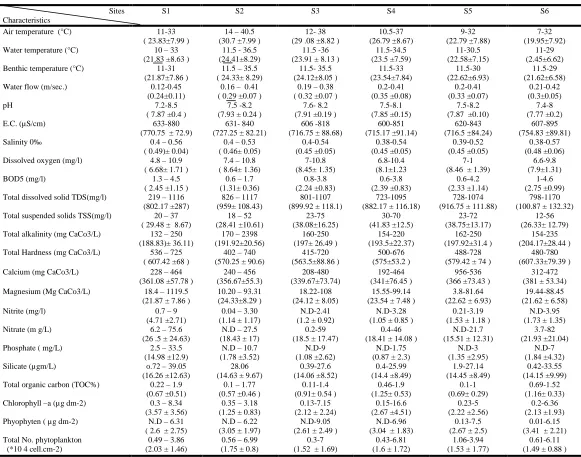
The studied environmental parameters are listed in Table 1. The present study results showed that air temperature ranged Figure1. Map shows the studied sites in Hilla River
1
2 3
4
5 6
Table 1. Range (Mean ± SD) of studied environmental parameters and total cell number of phytoplankton in Hilla river during study period
Sites Characteristics
S1 S2 S3 S4 S5 S6
Air temperature (°C) 11-33
( 23.83±7.99 )
14–40.5 (30.7 ±7.99 )
12- 38 (29 .08 ±8.82 )
10.5-37 (26.79 ±8.67) 9-32 (22.79 ±7.88) 7-32 (19.95±7.92)
Water temperature (°C) 10–33
(21.83 ±8.63 )
11.5 - 36.5 (24.41±8.29)
11.5 -36 (23.91 ± 8.13 )
11.5-34.5 (23.5 ±7.59) 11-30.5 (22.58±7.15) 11-29 (2.45±6.62)
Benthic temperature (°C) 11-31
(21.87±7.86 )
11.5–35.5 ( 24.33± 8.29)
11.5- 35.5 (24.12±8.05 ) 11.5-33 (23.54±7.84) 11.5-30 (22.62±6.93) 11.5-29 (21.62±6.58)
Water flow (m/sec.) 0.12-0.45
(0.24±0.11)
0.16– 0.41 ( 0.29 ±0.07 )
0.19–0.38 ( 0.32 ±0.07 )
0.2-0.41 (0.35 ±0.08) 0.2-0.41 (0.33 ±0.07) 0.21-0.42 (0.3±0.05) pH 7.2-8.5
( 7.87 ±0.4 )
7.5 -8.2 (7.93 ± 0.24 )
7.6- 8.2 (7.91 ±0.19 )
7.5-8.1 (7.85 ±0.15)
7.5-8.2 (7.87 ±0.10)
7.4-8 (7.77 ±0.2)
E.C. (µS/cm) 633-880
(770.75 ± 72.9)
631- 840 (727.25 ± 82.21)
606 -818 (716.75 ± 88.68)
600-851 (715.17 ±91.14) 620-843 (716.5 ±84.24) 607-895 (754.83 ±89.81)
Salinity 0‰ 0.4–0.56
( 0.49)± 0.04)
0.4–0.53 ( 0.46± 0.05)
0.4-0.54 (0.45 ±0.05) 0.38-0.54 (0.45 ±0.05) 0.39-0.52 (0.45 ±0.05) 0.38-0.57 (0.48 ±0.06)
Dissolved oxygen (mg/l) 4.8–10.9
( 6.68± 1.71 )
7.4–10.8 ( 8.64± 1.36)
7-10.8 (8.45± 1.35)
6.8-10.4 (8.1±1.23
7-1 (8.46 ± 1.39)
6.6-9.8 (7.9±1.31)
BOD5 (mg/l) 1.3–4.5
( 2.45 ±1.15 )
0.6–1.7 (1.31± 0.36) 0.8-3.8 (2.24 ±0.83) 0.6-3.8 (2.39 ±0.83) 0.6-4.2 (2.33 ±1.14) 1-4.6 (2.75 ±0.99) Total dissolved solid TDS(mg/l) 219–1116
(802.17 ±287)
826–1117 (959± 108.43)
801-1107 (899.92 ± 118.1)
723-1095 (882.17 ± 116.18)
728-1074 (916.75 ± 111.88)
798-1170 (100.87 ± 132.32) Total suspended solids TSS(mg/l) 20–37
( 29.48 ± 8.67)
18–52 (28.41 ±10.61) 23-75 (38.08±16.25) 30-70 (41.83 ±12.5) 23-72 (38.75±13.17) 12-56 (26.33± 12.79)
Total alkalinity (mg CaCo3/L) 132–250
(188.83)± 36.11)
170–2398 (191.92±20.56)
160-250 (197± 26.49 )
154-220 (193.5±22.37) 162-250 (197.92±31.4 ) 154-235 (204.17±28.44 )
Total Hardness (mg CaCo3/L) 536–725
( 607.42 ±68 )
402–740 (570.25 ± 90.6)
415-720 (563.5±88.86 )
500-676 (575±53.2 )
488-728 (579.42 ± 74 )
480-780 (607.33±79.39 )
Calcium (mg CaCo3/L) 228–464
(361.08 ±57.78 )
240–456 (356.67±55.3) 208-480 (339.67±73.74) 192-464 (341±76.45 ) 956-536 (366 ±73.43 )
312-472 (381 ± 53.34)
Magnesium (Mg CaCo3/L) 18.4–1119.5
(21.87 ± 7.86 )
10.20–93.31 (24.33±8.29 )
18.22-108 (24.12 ± 8.05)
15.55-99.14 (23.54 ± 7.48 )
3.8-81.64 (22.62 ± 6.93)
19.44-88.45 (21.62 ± 6.58)
Nitrite (mg/l) 0.7–9
(4.71 ±2.71)
0.04–3.30 (1.14 ± 1.17)
N.D-2.41 (1.2 ± 0.92)
N.D-3.28 (1.05 ± 0.85 )
0.21-3.19 (1.53 ± 1.18 )
N.D-3.95 (1.73 ± 1.35)
Nitrate (m g/L) 6.2–75.6
(26 .5 ± 24.63)
N.D–27.5 (18.43 ± 17)
0.2-59 (18.5 ± 17.47)
0.4-46 (18.41 ± 14.08 )
N.D-21.7 (15.51 ± 12.31)
3.7-82 (21.93 ±21.04)
Phosphate ( mg/L) 2.5–33.5
(14.98 ±12.9)
N.D–10.7 (1.78 ±3.52)
N.D-9 (1.08 ±2.62)
N.D-1.75 (0.87 ± 2.3)
N.D-3 (1.35 ±2.95)
N.D-7 (1.84 ±4.32)
Silicate (µgm/L) o.72–39.05
(16.26 ±12.63)
28.06 (14.63 ± 9.67)
0.39-27.6 (14.06 ±8.52) 0.4-25.99 (14.4 ±8.49) 1.9-27.14 (14.45 ±8.49) 0.42-33.55 (14.15 ±9.99)
Total organic carbon (TOC%) 0.22–1.9
(0.67 ±0.51)
0.1–1.77 (0.57 ±0.46 )
0.11-1.4 (0.91± 0.54 )
0.46-1.9 (1.25± 0.53) 0.1-1 (0.69± 0.29) 0.69-1.52 (1.16± 0.33)
Chlorophyll–a (µg dm-2) 0.3–8.34
(3.57 ± 3.56)
0.35–3.18 (1.25 ± 0.83)
0.13-7.15 (2.12 ± 2.24)
0.15-16.6 (2.67 ±4.51) 0.23-5 (2.22 ±2.56) 0.2-6.36 (2.13 ±1.93)
Phyophyten ( µg dm-2) N.D–6.31
( 2.6 ± 2.75)
N.D–6.22 (3.05 ± 1.97)
N.D-9.05 (2.61 ± 2.49 )
N.D-6.96 (3.04 ± 1.83)
0.13-7.5 (2.67 ± 2.5)
0.01-6.15 (3.41 ± 2.21) Total No. phytoplankton
(*10 4 cell.cm-2)
0.49–3.86 (2.03 ± 1.46)
0.56–6.99 (1.75 ± 0.8)
0.3-7 (1.52 ± 1.69)
0.43-6.81 (1.6 ± 1.72)
1.06-3.94 (1.53 ± 1.77)
between (7-40.5 ºC) and water temperature (10-36.5 ºC) and sediments (11-35.5 ºC). A positive correlation recorded between temperature of air and both water and sediment temperature (r= 0.869, r= 877 respectively). The values of pH recorded narrow range in all month of study, pH values ranged 7.2 - 8.5; similar results were observed in other Iraqi aquatic systems (Hassan et al., 2010; Hassan, 1997, Al-Kenzawi et al., 2012). These narrow values indicate that the study area have a buffer capacity (Wetzel2001). Electrical conductivity recorded the values that ranged between (600-895 μs/cm). The highest
value in this study was recorded in August, 2009, which was lower than recorded by Hassan (1997) in the same river, which may be due to dilution factors (Al-Mousawi et al., 1995). Salinity varied between (0.384-0.572) part per thousand, (TDS) and (TSS) ranged between (219-1280 mg/L) and (12-75 mg/L) respectively. The high value of TDS in this study may be due to high temperature and throwing of waste from local residents (in site 1) directly. The recorded values of TDS and TSS were high in summer than in winter due to dilution factors (Waziri and Ogugbuaja, 2010; Lasker and Gupta; 2009). Both (TDS and TSS) recorded a positive correlation among the study months. While water flow varied between (0.15-0.45) m/sec. Dissolved oxygen values varied between (4.8-11) mg/l. The lowest values of dissolved oxygen were recorded in summer which were affected by many factors such as increasing of both evaporation and the organic material decomposition and vice versa in the cold months (Hassan, 2004). Appling to Golterman et al. (1978) scale the current study area is not clean because the dissolved oxygen concentration was less than 7 mg/l.
BOD5 values were ranged between (0.6-4.6) mg/L. The high and low values were affected by effluents of agriculture, domestic activities and abilities of self purification of an aquatic system which lead to increasing nutrients and organic material loading in an aquatic system (Wetezel, 2001). The water in the area under investigation is slightly alkaline dominated by bicarbonates ions varied between 154-250 mg CaCO3/l. These results are within the range of natural inland water ((Antonine and Al-Saadi1982). Many authors revealed that Iraqi water systems are alkaline (Hassan 2004, Hassan, 1997, AL-lami et al., 1999; Al-Saadi et al., 2000). Also the study showed that the water is very hard as hardness values ranged between (402-780) mg CaCO3/L. The Hardness values in this study are related to the increasing number of algae and direct municipal waste disposal into the studied river. lower values were recorded in April 2009 due to an increasing in algae at the same month ((De-Fabricius et al., 2003); moreover, a positive correlation with conductivity (r=0.322 P=0.01) indicated that the values of conductivity affected ions that increase the alkalinity. While calcium concentrations are (192-536 mg CaCO3/l) and magnesium are (3.88-119) mg /l. The alkaline properties of the present study area lead to contribution of calcium carbonate that explain the low values of calcium in this study (Wurts and Masser, 2004), While magnesium values affected by many factors such as effluents from agriculture land, biological decomposition and increasing temperatures (Lind1979, Brunson and Hargseaves, 1999). The concentration of nutrients was fluctuated according to the nature of region and time of sample collection, both nitrate and phosphate concentrations were positively correlated to all study sites. The nitrite, nitrate, phosphate ranged between
(N.D-9), (N.D.-82), (N .D-39-7) mg/L respectively. While the silicate values were varied between (0.35-39.5) μg/l, a positive
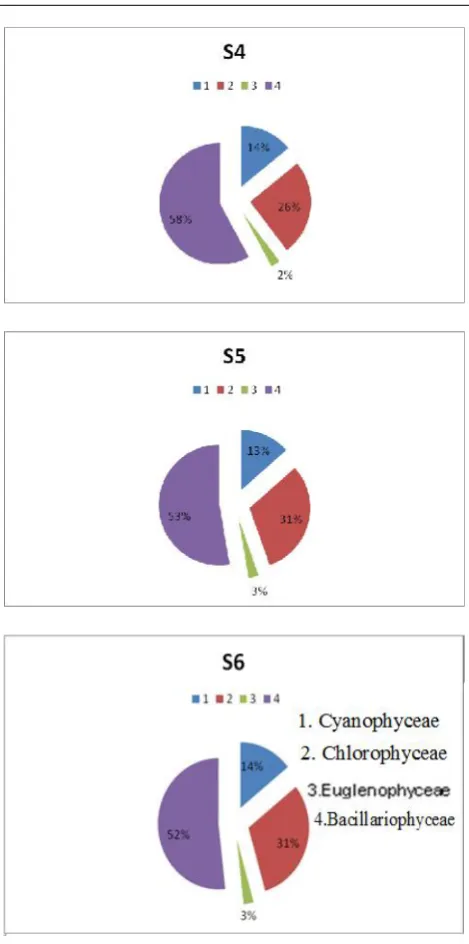
Figure 2. Percentage of epipelic algal classes in the study area sites (S1-S6) during the study period
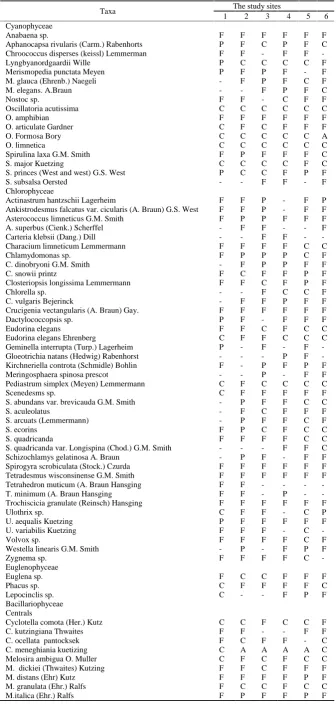
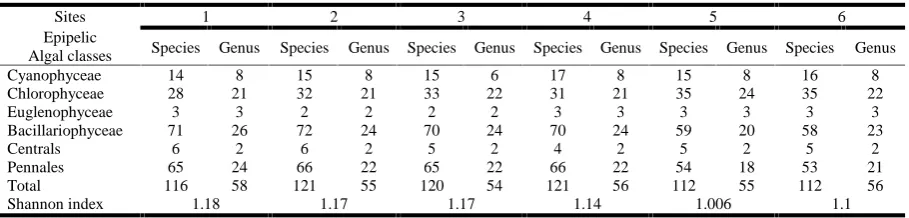
Similar results were obtained in other aquatic systems (Al-Handal, 1992, Hadi and Al-Saboonchi, 1989, Kolayli and Sahin, 2009). This dominancy of Diatoms relates to its ability to live in different seasons and tolerate different environment conditions (Acs et al., 2004). In previous studies on Hilla River, it was revealed that the dominant phytoplankton and epipelic algae are also diatoms (Hassan et al., 2010, Hassan, 1997, Hassan and Al-Saadi 1995, Kadhim et al., 2013). A total of 154 species of epipelic algae were identified in Hilla River in the present study and they are listed in Table 2. Abundance value of epipelic algae was summarized in Table 2 according to symbol's Chandler (Chandler, 1970). The present study recorded 58 genus with (116) species in site 1, 55 genus with 121 species in site 2, 54 genus with 120 species in site 3, 56 genus with 121 species in site 4, 55 genus with112 species in site 5 and 56 genus with 112 species in site 6 (Table 3). The most common taxa are (Cyclotella meneghinina, Melosira, Synedra, Cocconeis pediculus, C. placentula, and Nitzschia, Oscilatoria formosa, O. limnetica, O.articulate, Spirulina
major, S. laxa, S. princeps, Scendesmus, Characium, Eudorina elegans, Pediastrum). Some of these common taxa indicated for oligotrophic environments (C. meneghinina) or organic enrichment (Nitzschia spp., Oscilatoria spp. and Scendesmus spp.). These taxa were recorded as pollution tolerant algae (Bellinger and Sigee 2010). The Pinnate diatom was the predominant among other diatoms throughout the present study, similar results were observed by Hassan et al. (2008). This perdominamce of pinnate diatoms is characteristic features of the rapid flowof the river such as Hilla river. A quantitative study of epipelic algae showed a clear monthly and locally variations during the study period. The highest number of epipelic algae (11.28x10⁴cells. cm-2) was recorded in site 5 in March 2010 (Figure 3), while the lowest values were 6.36.43X104cells. cm-2in August 2009 at site 4.
Diatoms total number was ranged 30.74x10³- 42.12x10³cells. cm-2at sites 1 and 2 respectively, while other groups ranged as follows, blue greens 5.65x 10³- 8.61x 10³cells. cm-2at sites 3 and 6 respectively, green 6.36x 10³- 11.28x 10³cells. cm-2 at sites 2 and 5 respectively, and Euglenophyceae 0.36x 10³ -1.12x 10³cells. cm-2at sites 5 and 1 respectively. Chlorophyll -a ranged 0.2-16.6 μg dm-2, while phaeophyten varied
(N.D-9.05 μg dm-2) during the study period (Figure 3). Two clear
[image:5.595.308.558.238.590.2]peaks were observed in this study: the first peak is in May 2009 (late spring) while the second peak is in October 2009 (fall season), similar results were found in different Iraqi aquatic systems (Hassan 1997, Whitton 1970, Kadhim et al. 2013). The total number showed different
Table 2. Abundance of epipelic algae during the study period
Taxa The study sites
1 2 3 4 5 6
Cyanophyceae
Anabaena sp. F F F F F F
Aphanocapsa rivularis (Carm.) Rabenhorts P F C P F C
Chroococcus disperses (keissl) Lemmerman F F - F F
-Lyngbyanordgaardii Wille P C C C C F
Merismopedia punctata Meyen P F P F - F
M. glauca (Ehrenb.) Naegeli - F P F C F
M. elegans. A.Braun - - F P F C
Nostoc sp. F F - C F F
Oscillatoria acutissima C C C C C C
O. amphibian F F F F F F
O. articulate Gardner C F C F F F
O. Formosa Bory C C C C C A
O. limnetica C C C C C C
Spirulina laxa G.M. Smith F P F F F C
S. major Kuetzing C C C C F C
S. princes (West and west) G.S. West P C C F P F
S. subsalsa Oersted - - F F - F
Chlorophyceae
Actinastrum hantzschii Lagerheim F F P - F P
Ankistrodesmus falcatus var. cicularis (A. Braun) G.S. West F F P - F F
Asterococcus limneticus G.M. Smith F P P F F F
A. superbus (Cienk.) Scherffel - F F - - F
Carteria klebsii (Dang.) Dill - - F F -
-Characium limneticum Lemmermann F F F F C C
Chlamydomonas sp. F P P P C F
C. dinobryoni G.M. Smith - F P P F F
C. snowii printz F C F F P F
Closteriopsis longissima Lemmermann F F C F P F
Chlorella sp. - - F C C F
C. vulgaris Bejerinck - F F P F F
Crucigenia vectangularis (A. Braun) Gay. F F F F F F
Dactylococcopsis sp. P F - F F F
Eudorina elegans F F C F C C
Eudorina elegans Ehrenberg C F F C C C
Geminella interrupta (Turp.) Lagerheim P - F - F
-Gloeotrichia natans (Hedwig) Rabenhorst - - - P F
-Kirchneriella controta (Schmidle) Bohlin F - P F P F
Meringosphaera spinosa prescot - - P - F F
Pediastrum simplex (Meyen) Lemmermann C F C C C C
Scenedesms sp. C F F F F F
S. abundans var. brevicauda G.M. Smith - P F F C C
S. aculeolatus - F C F F F
S. arcuats (Lemmermann) - P F F C F
S. ecorins F P C F C C
S. quadricanda F F F F C C
S. quadricanda var. Longispina (Chod.) G.M. Smith - - - F F C
Schizochlamys gelatinosa A. Braun - P F - F F
Spirogyra scrobiculata (Stock.) Czurda F F F F F F
Tetradesmus wisconsinense G.M. Smith F F F F F F
Tetrahedron muticum (A. Braun Hansging F F - - -
-T. minimum (A. Braun Hansging F F - P -
-Trochiscicia granulate (Reinsch) Hansging F F F F F F
Ulothrix sp. C F F - C P
U. aequalis Kuetzing P F F F F F
U. variabilis Kuetzing F F F - C
-Volvox sp. F F F F C F
Westella linearis G.M. Smith - P - F P F
Zygnema sp. F F F F C
-Euglenophyceae
Euglena sp. F C C F F F
Phacus sp. C F F F F C
Lepocinclis sp. C - - F P F
Bacillariophyceae Centrals
Cyclotella comota (Her.) Kutz C C F C C F
C. kutzingiana Thwaites F F - - F F
C. ocellata pantocksek F C F F - C
C. meneghiania kuetizing C A A A A C
Melosira ambigua O. Muller C F C F C C
M. dickiei (Thwaites) Kutzing F F C F F F
M. distans (Ehr) Kutz F F F F P F
M. granulata (Ehr.) Ralfs F C C F C C
M.italica (Ehr.) Ralfs F P F F P F
M. jurgensii C.A. Agardli P - F F P
-Stephanodiscus tenuis Hustedt F F P - F
-Prennales
Achnathes clevei Grun P F P - P
-A. saxonica Krasske P F - - -
-Amphora ovalis Kutz P - F F -
-Anomoeoneis sphaerophora (Her.) Pfitzer - - F - - F
Bacillaria paradoxa Gmelin F F P P - F
Cocconeis pediculus Ehr. C F F F C F
C. placentula Ehr. C F F C C C
C. pseudomarginata Gregory F F P - F F
Cymatopleura solea (de Brebisson) W. Smith F F F - F F
Cymbella affinis Kutz. C F F F C C
C. aspera (Her.) Cleve. F F P F F F
C. cistula (Hemprich) Grun. F F F - F F
C. cymbiformis (Agardh kutz) Van Heurck. - F - - - F
C. gracilis (Rabh) Cleve. - P - F P
-C. helvetica Kutz P - P - P
-C. hybrid Grun - - F F P
-C. hustedtii Krasske - - - F -
-C. leptoceros (Ehr.) Grun F F F - -
-C. rupicola var. navicula (Grun) - F F - -
-C. ventricosa Kutz - P - - F
-C. tumida (de Brebisson) Van Heure P P P F F
-Diatoma vulgare Bory F F F - - P
D. sp. C F F F F F
D.hiemale (Lyngbye)Heiberg. Var. mesodon (Ehr.) Grun C F F F - F
Diploneis marginestriata Hustedt P - P F -
-D. ovalis (Hilse) Cleve C F F P F F
D. pseudovalis Hust - F P F P F
Eunotia praerupta Ehr. F - F - - P
Fragilaria brevistriata Grun. - F - F P
-F. capucina Demazieres F F F F -
-F. crotonensis Kitton P F P - - F
F. vaucheriae (Kutz) Peters - P F F - F
Gomphonema constrictum Ehr. P - F F F F
G.gracile Ehr. P F F P -
-G. lanceolatum Ehr. P F F - - F
G. obbreviatum F F F F F C
G. olivacea (Lyngbye) Dawson P P F F F F
G. parvulum (Kutz.) Grun F F P - - F
Gyrosigma acuminatum (Kutz) Rabh - F F F - F
G. scalproides (Rabh) Cleve P P - F -
-G. spencerrii (W. Smith) Cleve C F F F F
-Mastogloia elliptica Agardh. C P P F F
-Meridion circulare Agardh - - F P -
-Navicula bacillum Ehr F F - F P F
N. clementis Grun P - F F F F
N. cryptocephala Kutz - F - P - P
N. gracilis Ehr F F P F P F
N. halophila (Grun) Cleve - F - - F F
N. hungarica Grunow - - - P - F
N. jarnefelti Hustedt F F F P P F
N. longirostris Hust - - F P P
-N. parva (Menegh.) Cleve. Euler - F - F - F
N. phyllepta Kutz - P F P P F
N. placentula (Ehr) Grun F P - - -
-N. tripunctata (O.F.Muller) Bory P F - - F
-Neidium affine (Ehr) Cleve P - - - P
-Nitzchia acicularis W. Smith P P F F F P
N. apiculata (Gregory) Grun F F F F F P
N. augustata (W.Sm) Grun F F F - P
-N. dissipata (Kutz) Grun - P - F F F
N. granulate Grun F P - F P
-N. hungarica Grun - - - P F
-N. longissima (Brebisson) Ralfs - - F F F
-N. lorenziana Grun P F F P F C
N. linearis W. Smith P - - P -
-N. obtuse W. Smith P - F - - F
N. palea (Kutz) W. Smith P - F F F
-N. recta Hantzsch F - F P -
-N. sigmoidea (Ehr) W. Smith P F F - F
-N. sigma (Kutz) W. Smith P - F P -
-N. vermicularis (Kutz) Grun - - F - -
-Peronia fibula (de Brebisson et Arnott) Ross F P F F - F
trends. Only one clear peak was observed in March 2010 that may be due to different epipelic algal groups dominated throughout study periods; moreover, the benthic algae influenced by both environmental parameters with river morphology and human activities such as effluent of agricultural waste and direct organic load (Rimet, 2009). Closely values of Shannon index were recorded in the current
study. The Shannon index ranged 1.18 at site 1 and 1.006 at site 5.
Acknowledgments
The authors would like to thank the Department of Biology, College of Science, University of Babylon and College of
Rhopalodia sp. P F F - - F
Rhoicosphenia curvata (Kutz) Grun P P - P F F
Stauroneis sp. P P - P F
-Stenopterobia intermedia Lewis F F - P P F
Surirella biseriata de brebisson F F F F F F
S. ovalis de brebisson F F F F F F
Synedra acus Kutz F F F F P F
S. tabulate Agardh C C C C C A
S. ulna (Nitzsche) Ehr. P - - F -
-Thalassiosira fluviatilis Hustedt P - - F -
-T. weissflogii Grun F F F F
Navicula bacillum Ehr F F - F P F
N. clementis Grun P - F F F F
N. cryptocephala Kutz - F - P - P
N. gracilis Ehr F F P F P F
N. halophila (Grun) Cleve - F - - F F
N. hungarica Grunow - - - P - F
N. jarnefelti Hustedt F F F P P F
N. longirostris Hust - - F P P
-N. parva (Menegh.) Cleve. Euler - F - F - F
N. phyllepta Kutz - P F P P F
N. placentula (Ehr) Grun F P - - -
-N. tripunctata (O.F.Muller) Bory P F - - F
-Neidium affine (Ehr) Cleve P - - - P
-Nitzchia acicularis W. Smith P P F F F P
N. apiculata (Gregory) Grun F F F F F P
N. augustata (W.Sm) Grun F F F - P
-N. dissipata (Kutz) Grun - P - F F F
N. granulate Grun F P - F P
-N. hungarica Grun - - - P F
-N.longissima (Brebisson) Ralfs - - F F F
-N. lorenziana Grun P F F P F C
N. linearis W. Smith P - - P -
-N. obtuse W. Smith P - F - - F
N. palea (Kutz) W. Smith P - F F F
-N. recta Hantzsch F - F P -
-N. sigmoidea (Ehr) W. Smith P F F - F
-N. sigma (Kutz) W. Smith P - F P -
-N. vermicularis (Kutz) Grun - - F - -
-Peronia fibula (de Brebisson et Arnott) Ross F P F F - F
Rhopalodia sp. P F F - - F
Rhoicosphenia curvata (Kutz) Grun P P - P F F
Stauroneis sp. P P - P F
-Stenopterobia intermedia Lewis F F - P P F
Surirella biseriata de brebisson F F F F F F
S. ovalis de brebisson F F F F F F
Synedra acus Kutz F F F F P F
S. tabulate Agardh C C C C C A
S. ulna (Nitzsche) Ehr. P - - F -
-Thalassiosira fluviatilis Hustedt P - - F -
[image:8.595.74.529.562.671.2]-T. weissflogii Grun F F F F
Table 3. Number of species and genus of identifies classes of epipelic algae in the study area
6 5
4 3
2 1
Sites Epipelic
Algal classes Species Genus Species Genus Species Genus Species Genus Species Genus Species Genus 8 16 8 15 8 17 6
15 8 15 8
14 Cyanophyceae
22 35 24 35 21 31 22 33 21 32 21 28 Chlorophyceae
3 3 3 3 3 3 2 2 2 2 3 3 Euglenophyceae
23 58 20 59 24 70 24 70 24 72 26 71 Bacillariophyceae
2 5 2 5 2 4 2 5 2 6 2 6 Centrals
21 53 18 54 22 66 22 65 22 66 24 65 Pennales
56 112 55 112 56 121 54
120 55 121 58
116 Total
1.1 1.006
1.14 1.17
1.17 1.18
Science for Women, University of Baghdad, Iraq for their support to the project.
REFERENCES
Ács, E., Szabó, K., Toth, B. and kiss, K. T. Investigation of Benthic algae communities, Especially Diatoms of some Hungarian streams in connection with Reference condition of the water Frame work Directives. Acta Botanica Hungarica: 46 (3-4), pp.255-277, (2004).
AL – Mousawi, A.H.A, Hussein, N, A. and AL. Arajy: The influence of sewage discharge on the physicochemical properties of some ecosystem at Basrah city, Iraq Basrah. J. Science, 13(1), 135-148, (1995).
Al-Handal, A.Y.: Algae of an organically polluted canal in Basrah south Iraq. The non-diatom flora. Marine Mesopotamica, 7 (2), 167-174. (1992).
Al-Kenzawi, M. A. H., Hassan, F. M. and Al-Mayah, A.A.A. The Distribution of Ceratophyllum demersum L. in Relation to nvironmental Factors in Restored Al-Mashb marsh, Hor Al-Hammar, Southern Iraq.Marsh Bulletin, 7(2), 137-149, (2012).
AL-Lami, A. A., AL-Saadi, H. A., Kassim, T. I. and Farhan, R. K.: Seasonal changes of epipelic algal communities in north port of Euphrates river, Iraq. J. coll. Edu. For women, univ, Baghdad, 10 (2), 236-247, (1999a).
AL-Lami,A.A.; Kassim, T.I. and AL-Dylymei, A. A.: A Limnological study on Tigris river, Iraq. The scientific Journal of Iraqi Atomic Energy Commission, 1, 83-98, (1999 b).
AL-Saadi, H. A. and Antoine, S. E.: Effect of pollution on phytoplankton in the Ashar canal, ahighly pollution canal of the shatt AL-Arab estury at Basrah, Iraq. Hydobiology. 99, 189-196, (1983).
AL-Saadi, H. A; pankow, H. and Huq, M. F.: Algogiccal investigation in the polluted Ashar canal and Shatt AL-Arab in Basrah (Iraq). Int. Rev. Hydrobiol. 64 (4), 527-540, (1979).
Al-Saadi, H.A., T. I. Kassim, A.A. Al-Lami, S.K. Salman: Spatial and seasonal variation of phytoplankton in the upper region of the Euphrates river. Iraq. Limnologica, 30, 83-90, (2000).
Al-Saadi, H.A.; Al-Mousawi, A.H. and Al-Arijy, M.J.: Physico-chemical feature of Al-Hammar marsh, Iraq. J. Coll. Educ. For Women, Univ. Baghdad, 4, 35-40, (1993). Al-Saboonchi, A.A.A.: Benthic algae as bioindicator of
organic pollution in Shatt Al-Arab river and some its channels. Ph.D. thesis, coll. of Agriculture, University of Basrah, Iraq. (1998)
Al-Shaban, A.A.G.: Primary production of the benthic microalgae in the Shatt Al-Arab river. Ph.D. thesis, coll. O Science, Basrah University, Iraq (1996).
Antonine, S. E. and Al-Saadi, H. A.: Limnological studies on the polluted Ashar canal and Shatt Al-Arab river at Basrah (Iraq). Rev.ges. Hydrobiol. 67(3), 405-418, (1982).
APHA: Standard methods for examination of water and wastewater. 21st Edn. APHA, AWWA, WPCF, Washington DC, USA (2005).
Bellinger, E. G. and Sigee, D. C.: Freshwater algae: Identification and use as bioindicators. Wiley-Blackwell Publication, 271pp, (2010).
Brunson, J. W, N Stone and J. Hargreaves: Fertilization of Fish ponds. Southern Regional Aquaculture center. Publication 471, (1999).
Chandler, J.R.: A biological approach to water quality management. Wat. Pollution Control, 4, 415-422, (1970). De-Fabricius, M., Maidana, N., Gouez, N. and Sabater, S.:
Distribution patterns of benthic diatoms in a pampean river exposed to seasonal floods: The cuarto river (Argentina). Biodiversity and Conservation, 12, 2443-2454, (2003). Desikachary, T. V.: Cyanophyta. New Delhi. 686 pp., (1959). Edgar, L.A. and Pickett-Heaps, J.D.: Diatom locomotion.
Progress in Phycological Research, 3, 47-88, (1984). Foged, N.: Fresh water Diatoms in Sprilanka (Ceylon).
Bibilotheca phycologia. Herausgeben Von J. Cramer Bond 23 (1976).
Gaudette, H.E.; Flight, W.R.; Toner, L. and Folger, D.W.: An inexpensive titration method for the determination of organic carbon in recent sediments. J. of Sedimentary Petrology, 44 (1), 249-253, (1974).
Germain, H.: Flora des Diatomèes (Diatomphycèeae) eaux douces et saumàtres du Massif Armoricain et des contrèes voisines d' Europe Occidentale. Boubèe, Paris (1981). Golterman, H. L., Clyma, R. S. and Chustd, M. A. M.:
Methods for physical and chemical analysis of fresh water. 2nd. Ed. Black well scientific pub. 1. Ltd. Oxford, U. K. pp. 60-62, (1978).
Green-Ruiz, C.; Paez-Osuna, F. and Pablo-Galan, L. de: Heavy metals and clay minerals in surface sediments from the Mazatlan Bay, Mexican subtropical pacific coast. Int. J. Environment and Pollution, 26, 201-219, (2006).
Hadi, R.A.; Al-Saboonchi, A.A. and Haroon, A.K.Y.: Diatoms of the Shatt All-Arab river, Iraq. Nova Hed Wigia, 39, 513-557, (1984).
Hadi, R.A.; Al-Saboonchi, A.A.: Seasonal variation of phytoplankton, Epiphytic and epipelic algae in the Shatt Al-Arab river at Basrah, Iraq. Marine Mesopotamica, 4 (2), 211-242, (1989).
Hassan, F. M., Hadi, R.A., Kassim T.I. and Al-Hassany J.S.: Systematic study of epiphytic algal after restoration of Al-Hawizah marshes, southern of Iraq. International Journal of Aquatic Science, 3, (1): 37-57, (2012).
Hassan, F. M., Salah, M. M., Salman, J. M.: Quantitative and qualitative Variability of Epiphytic algae on three aqatic plants Euphrates river, Iraq. J. Aqua 1, 1-16, (2007). Hassan, F. M., Toma, J. J., Ismail, A. M., AlHassany, J. S.,
Hadi, R.A., and Maulood, B. K. : A contribution to algal flora in Baghdad area, Iraq. J. Adv. Lab. Res. Bio., 3 (2): 89-98, (2012b).
Hassan, F.M and AL-Saadi, H. A.: On the seasonal variation of phytoplankton populations in Hilla river. Iraq J. Coll. Educ. For woman. Univ. Baghdad, 6 (2), 55–61, (1995). Hassan, F.M.: Al limnological study on Hilla river.
Al-Mustansiriya J. Sci., 8 (1), 22-330, (1997).
Hassan, F.M.: Limnological features of Diwanyia river, Iraq. J. of Um-Salama for Science, 1 (1), 119-124, (2004).
Hassan, F.M.; Kathim, N.F. and Hussein, F.H.: Effect of chemical and physical properties of river water in Shatt Al-Hilla on phytoplankton communities. E. Journal of Chemistry, 2 (5), 323-330, (2008).
between Al-Hindiya Barrage and Kifil city, Iraq. J. Enivron. Biol., 31, 343-350, (2010).
Hinton, G.C.F. and Maulood, B.K. Fresh water diatoms from Suliamaniya, Iraq Nova - Hedwigia, 31: (1+2): 449-466, (1979).
Kadhim, N.F. Al-Amari, M.J. Hassan, F.M.: The spatial and temporal distribution of Epipelic algae and related environmental factors in Neel stream, Babil province, Iraq. IJAS, 4(1), 2013. (in press)
Kassim, T. I., lami, A. A., Saadi, H. A. and AL-Jobouri, H. K.: On the epiphytic algae in the northern port of Euphrates river, Iraq. J. coll. Educe. For women, univ, Baghdad, 11(1), 138-180, (2000).
Kassim, T.I. and Al-Saadi, H.A.: On the seasonal variation of the epipelic algae in marsh areas (Southern Iraq). Acta Hydrobiol., 36 (2), 191-200, (1994).
Kolayli, S. and B. Sahin: Species composition and diversity of epipelic algae in Balikli dam reservoir, Turkey. J. Environ. Biol., 30, 939-944, (2009).
Laskar, H.S.,&Gupta,S.Phytoplankton diversity and dynamics of Chatla flood plain lake , Barak Valley , Assam, North Est India–Aseasonal study .j.of Environmental Bioligy,30 ( 6) :1007-1012, ( 2009).
Lind, O.T.: Handbook of common method in limnology. C.V. Mosby Co., St. Louis. 199 pp. (1979).
Nyakeya, K.; Okoth, R.P.; Onderi, M.F. and John, Q.: Assessment of pollution impacts on the ecological integrity of the Kisian and Kisat rivers in lake Victoria drainage basin, Kenya. Afri. J. Environ. Sci. and Techno., 103 (4), 97-107, (2009).
Parsons, T.R.; Mait, Y. and Laulli, C.M.: A manual of chemical and biological methods for seawater analysis pergamone press Oxford, (1984).
Pentecost, A.: Introduction to freshwater algae. First edition (1984), Printed in Great Britain by the Richmond Publishing Co. Ltd. England, (1984).
Poulić kova, A., HAŜLER, P; LYSÁ Kova, M; and Spears, B.:
The ecology of Fresh water epipelic algae: an update. Phycologia, 47 (5), 437-450, (2008).
Prescott, G.W.: Algae of the Western Great Lakes area. William, C., Brown Co. Publ. Dubuque, Lowa, USA, (1973).
Rimet, Fre´de´ric: Benthic diatom assemblages and their correspondence with ecoregional classifications: case study of rivers in north-eastern France. Hydrobiologia, 636,137–
151, (2009).
Sigee, D.C.: Freshwater Microbiology (Biodiversity and Dynamic interaction Microorganisms in the Aquatic Environment). John Wiley and Sons, Ltd., (2005).
Vollenwieder, R.A.: A manual on methods measuring primary production in aquatic environment. IBP Hand Book. No. 12. Blakwell, Oxford, 213 pp. (1974).
Wetzel, R.G.: Limnology, Lake and river ecosystem. 3rd. Acadimic pres, AQn Elsevier imprint, Sanfrancisco, New York, London. (2001).
Whitton, B.A.: Biology of Cladophora in fresh waters. Water Res., 4, 457-476, (1970).
Wurts, W.A. and Masser, M.P.: Liming ponds for aquaculture center, SRAC Publication No. 4100. (2004).