Network-conscious Edge Service Adaptation
Abdessalam Elhabbash
∗, Gordon S. Blair
∗, Gareth Tyson
†, and Yehia Elkhatib
∗ ∗MetaLab, School of Computing and Communications, Lancaster University, UK†EECS, Queen Mary, University of London, UK
{i.lastname}@{∗lancaster.ac.uk|†qmul.ac.uk}
Abstract—Unplanned and serendipitous peer discovery is im-portant for emerging Internet applications, particularly in dy-namic environments (e.g.,the IoT, ubiquitous computing and fog domains) where a large number of resources operate different services in any one locality and resource availability varies unpre-dictably over time. The current approach is to select services at design time based on offered providers and their reputation. This obviously has its limitations, particularly in terms of consistency, scalability, and adaptivity, let alone the challenges of crossing vendor and operator divides. In this work, we demonstrate how an application is better able to dynamically adapt to unforeseen changes in its environment through in-network mediation of service requests. In our model, application developers express their service needs using intents. These are mapped to ap-propriate service providers with explicit consideration of the intermediate network. We design a general architecture and associated algorithms to realise intent formulation and processing for mapping application intents to service providers. Our results demonstrate the feasibility of adopting in-network mediation to enable adaptive application deployment using declarative intents. We also show, through a hybrid methodology of quantitative and qualitative assessment, that the proposed implementation of the mediator enables a real service deployment of a collaborative document editing application to seamlessly adapt and to scale in different deployment scenarios.
Index Terms—adaptation, intent driven networking, edge ser-vices, fog computing, iot, internet of things, anti-fragility
I. INTRODUCTION
Networked environments and their requirements have changed significantly during recent years. With the remarkable advancements in integrated sensor-actuator design and low-power WAN technologies, the number of connected devices is expanding at a rapid rate (50 billion expected by 2020 [1]). Advanced virtualisation and containerisation further expands the number of services that can be hosted on such devices, giving rise to both the Internet of Things (IoT) and fog computing paradigms.
Two crucial challenges arise in such environments: (i) better support for changes in the deployment environment [2], [3]; and (ii) controls (especially privacy) for where and how support roles are executed [2]. Currently, most applications limit their consumers to the predetermined deployment en-vironments they were designed for [2]. Consequently, they are brittle and susceptible to suboptimal operation when the context changes, e.g., due to a backhaul network fault or a server outage. Under such conditions, centralised (mainly cloud-based) approaches fall short especially in network-constrained conditions. Instead, applications often need a way to be able to adapt at the edge without prior preparation.
We are motivated to answer these challenges by enabling edge applications to discover services in a network-aware fashion in order to dynamically adapt to changes in their environment. Our philosophy is to allow edge application de-velopers to specify their requirements at a high level that will allow post-deployment adaptation to be both requirements- and context-aware.
We realise this vision through employing the Intent Driven Networking (IDN) paradigm [4]. This paradigm operates as an enabler for the interaction, via high-level declarative state-ments (‘intents’) between the different network components, primarily end user applications and network devices. Using intents allows these players to express what they desire/provide from/to the network in a simple and abstract way without specifying implementation details. For example, one user intent might be to communicate with a particular group of users; another might be to stream a video. A service provider can also issue an intent of providing a service with certain QoS guarantees. The network is then responsible for tending to such requests accordingly.
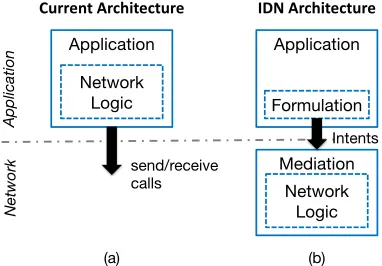
As a consequence, IDN simplifies the development of end-user applications by eliminating the need for including ‘try-all-cases’ logic – Fig. 1a. This is particularly useful in ensuring lightweight end devices remain simple. For instance, IDN can provide a service-based application with an overall picture of the available network services and can support the selection of required services instead of letting the application try all available services, which can be costly, or alternatively a preconfigured set of services, which can be suboptimal. Instead, the application can formulate and declare its intent – Fig. 1b – which the network then processes, selecting a provider to satisfy it (thereby removing such processing from the application logic). In addition, embedding this service-selection functionality into the network has the key benefits of (i)using ground truth network statisticsto be factored into the decision making, i.e., Data-driven Network Engineering; and (ii) allowing the use ofnetwork instrumentation using SDN and NFV to be better aligned with end-user application requirements.
Mediation
Ap
p
lic
at
io
n
Ne
tw
ork
Application
Network Logic
Application
Formulation
Intents Current Architecture IDN Architecture
send/receive
calls Network
Logic
[image:2.612.85.276.50.183.2](a) (b)
Fig. 1: A high level view of an intent driven network.
changes in the network. The parsing of the intents extracts the intent attributes in preparation for processing. The composition of the intents includes integrating different user intents (e.g., composing the individual collaborators’ intents in the collab-orative editing scenario) and/or composing the requirements of a single intent (e.g.,the need for a composite service to satisfy the intent). The satisfaction of the intent is carried out by selecting the required services from the network. This selection should take into consideration things like network conditions, pricing, as well as time constraints associated with the intent. For evaluation, we adopt a hybrid strategy of quantitative and qualitative assessment of mediation effectiveness.
Contributions: Our contributions are as follows:
1) Adesignof the internal components of the mediator as an independent agent in a given subnetwork.
2) Two alternative approaches to realise the selection of services by the mediator in its attempt to satisfy intents. Particularly, we present a scalable genetic algorithm that enables a mediator to serve 100,000s of simultaneous application and service intents.
3) An evaluation of mediator performance and limits using controlled experiments, comparing the two different ap-proaches.
4) A demonstration of mediated service management through areal world case studywhere clients formulate intents to express their need to collaboratively edit a document with specific QoS requirements.
Distinction from state of the art: There is a wide range
of efforts on adapting service management, and particularly on dynamic and late binding of services. However, these challenges are seldom addressed in light of the application’s current deployment environment. Furthermore, there has only been few works trying to integrate awareness of the network into such service selection process. One approach is to in-corporate QoS metrics into an optimisation program, e.g., the shortest path [5] or using latency in an integer linear programming model [6]. Numerous other efforts (e.g., [7], [8]) have focused on optimising placement of VNFs and services based on a network-wide model. Leaving aside the feasibility challenge of acquiring such knowledge and how it changes post-deployment, none of these approaches allows the application to express its runtime requirements.
II. IDN CONCEPT
In this section we give a brief overview of the intents concept we proposed in [4].
A. Definition
Anintent is an abstract declaration of what the application
desires from the network on behalf of the user. It is a compo-sition of a set of primitive ‘verbs’, each describing a specific high-level operation. For example, an application intent could be to prioritise imminent VoIP streams with certain remote peers. In response to this, the network carries out the necessary configuration to best serve such an intent.
In more detail, the primitive elements that comprise intents are expressed as tuples of:
<verb, object, modifiers, subject>
Averbis an operation that describes the intent based on an on-tology (described previously in [4]).Objectidentifies a service, process or item that is the objective of the verb.Modifiersare then used to parameterise this; each modifier can be tagged as either ‘essential’ or ‘desirable’, indicating prioritisation.
Subjectis an optional identifier of another service/process/item
that is to be linked to the defined object. Primitive intents expressed are composed using recursive encapsulation to form a full intent.
B. Mediation
The satisfaction of intents is achieved through mediation. Mediators are responsible for ‘understanding’ intents by pars-ing them and, if necessary, compilpars-ing (i.e.,composing multi-ple intents into a composite one), and realising them. Such realisation involves the mediator taking on any of a range of roles, such as a service broker or a network manager. For instance, in the case of Construct intents with the verb Discover, the mediator finds the required services to satisfy the intent(s) and returns service access information to the intent issuer. In the case of Transfer intent where a content provider might decide to push copies of their contents towards edge points where there is an increase in consumption, the mediator will parse the intent and perform the required content transfer. In a third example utilisingRegulate, a mediator will translate an intent into network configuration, e.g., an intent to block ssh login attempts from a certain address block. The mediators can also satisfy a composition of intents. For instance, the mediator might Discover a cache location and Pushthe contents to that cache. These different cases (among others) call for corresponding algorithms to realise the work carried out by the mediators to satisfy the intents.
III. MEDIATORDESIGN
As mentioned above, intents realisation is achieved thro-ugh deploying mediators that reside in the network. In this paper, we limit ourselves to using IDN for addressing service provider selection,i.e.,theConstructverb. This would involve an intent that requests that the networkfinds aprovider that
offersa given service API. Here, the mediator is responsible
find providers that are able to satisfy the intents, simplifying the client application logic. However, the success of the mediation role calls for achieving the following properties:
• Independence:Mediation should be separated from the
de-tailed logic of the different network users and providers. The declarative intents should be sufficient for the mediator to understandwhatthe intent issuer desires from the network.
• Scalability: The scalability of the mediation arises due to
the increasing number of service providers in addition to the complexity of the intents. The scalability of IDN highly depends on the ability of the mediators to search the space of the provider(s) and to respond to the intent issuer within the specified time constraint.
• Dependability: Dependability is an essential property to
advocate the different network users’ trust and confidence to use IDN. This requires techniques to achieve dependabil-ity through load balancing, replication, fault-tolerance and secure communication, among others.
The work of this paper focuses on the first two properties. We assume that one mediator is deployed in a given subnet-work on a fog device or as a virtual netsubnet-work function (VNF). This would be extended to be a part of a hierarchical structure of mediators deployed in parent and sibling subnetworks. Such structure and the corresponding requirements are to be addressed in future work.
In Fig. 2 we sketch our mediator design, which has the following main components:
• Intent Listeners: These are simply interfaces that are used
by the providers and clients to submit their intents to the mediator.
• Client/Provider Intents Queue:When a client (or a provider)
submits an intent and the mediator is busy, the intent is queued. Once the mediator becomes available and the queue is not empty, an intent will be polled according to a first-come-first-served policy.
• Provider Intents Parser:This receives the providers’ intents
from theProviders Intents Listenerand extracts the intents attributes such as the service type, the service modifier values, and the information needed to access the service (e.g.,URL). This is then passed to theProvider Repository to be stored.
• Services Repository: This repository is simply a database
that stores the service attributes to be used by the Service
[image:3.612.48.299.605.703.2]Selector component.
Fig. 2: The internal components of the mediator.
• Client Intents Compiler: This component fetches client
intents from the queue, extracts the intents attributes such as the required service(s) type(s) and the modifier values and types (i.e.,essential or desirable). In cases where client intents need to be composed (e.g.,the case of required col-laborative services), the compiler forms a composite intent from the corresponding clients intents. Then the compiler passes them to theService Selector component.
• Service Selector:This component implements the selection
algorithm that will use the Services Repository to select a service or a composite service that satisfies the intents. Obviously, this component can be realised through differ-ent search algorithms. In the next section, we realise this component using two different algorithms.
IV. MEDIATORALGORITHMS
This section illustrates the applicability of mediation by presenting two alternatives to realising provider selection.
Let us consider an example involving a user application that needs to use a service or a composition of services. With the increased scale of current computational environments, e.g., the cloud and SOC, the decision of selecting a service provider is challenging to the end user. Alternatively, the users can submit their application requirements to the network, i.e., to the mediator, which will select the required services. Having found a provider, the sends back a response as an XML-based metadata describing the type and modifiers of the service and how to access it. From then onwards, it is the responsibility of the intent issuing application to parse the response and access the service.
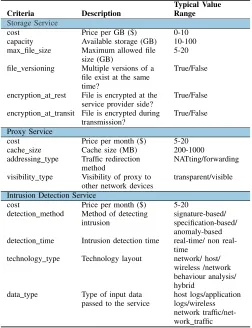
In the following, we consider three types of services that clients may need to use, namely storage services (SS), proxy services (PS), and intrusion detection services (IDS). Each service is represented as a tuple of criteria that characterises the service. Table I summarises such criteria based on relevant literature surveys [9], [10].
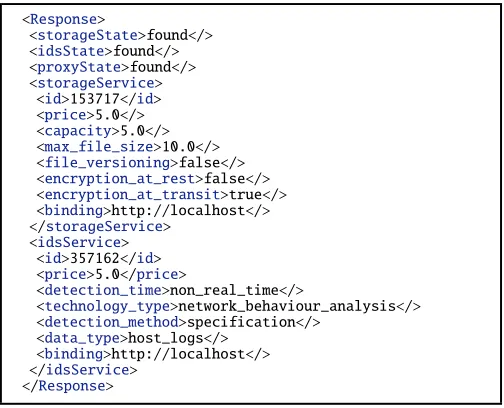
Using IDN, the client application will form an intent that reflects the application requirements and submit the intent to the mediator. The intent can express the need for an elementary or a composite service. Also each intent specifies a deadline for receiving a response from the mediator. Similarly the providers submit their intents advertising the services they provide. Figs. 3-4 show examples of a client intent and a provider intent, respectively. The mediator then compiles the intent to extract the requirements and searches for services that match the client needs. Fig. 5 shows an example mediator response.The selection process used by the mediator can be realised
through different methods. Here, we present two approaches:
Utility-based andGenetic-based selection.
A. Utility-based selection
TABLE I: Characteristic service criteria
Typical Value Criteria Description Range
Storage Service
cost Price per GB ($) 0-10
capacity Available storage (GB) 10-100 max file size Maximum allowed file
size (GB)
5-20
file versioning Multiple versions of a file exist at the same time?
True/False
encryption at rest File is encrypted at the service provider side?
True/False
encryption at transit File is encrypted during transmission?
True/False
Proxy Service
cost Price per month ($) 5-20
cache size Cache size (MB) 200-1000
addressing type Traffic redirection method
NATting/forwarding
visibility type Visibility of proxy to other network devices
transparent/visible
Intrusion Detection Service
cost Price per month ($) 5-20
detection method Method of detecting intrusion
signature-based/ specification-based/ anomaly-based detection time Intrusion detection time time/ non
real-time technology type Technology layout network/ host/
wireless /network behaviour analysis/ hybrid
data type Type of input data passed to the service
host logs/application logs/wireless network traffic/net-work traffic
In order to assign utilities, we use the utility functions shown in Table II, which are adapted from a utility model developed in [11] for quantifying volunteer services. These utility functions assign a maximum utility of1to each service that satisfies the corresponding intent modifier according to what the service provider advertises in their intent. The service modifiers that do not satisfy the intents receive a utility of 0. For the case of the cost modifier, the utility function assigns higher values to lower costs.
After calculating the utilities, services are sorted accordingly in descending order with higher priorities given to the essential utilities first then desirable ones. Then, services with maximum utilities are selected.
B. Genetic-based selection
The utility-based algorithm ensures optimal service selec-tion, but at the expense of computational complexity as the search space grows. As a more scalable alternative, genetic-based selection simulates the evolution process by the Genetic Algorithm (GA) [12]. It starts from a random solution and evolves it iteratively to generate slightly better ones. Each solution is represented as a set of ‘genomes’ that iteratively undergo the evolution operations of selection, crossover, muta-tion and fitness evaluamuta-tion. In each iteramuta-tion, the fittest solumuta-tion will survive, and others will be ignored. Evolution stops when a pre-defined criterion is met, e.g.,a specific fitness value, a
<CompositeIntent> <id>1</id>
<deadline>323</deadline> <intent>
<id>1.1</id>
<verb>discover</verb> <object>storage</object> <modifiers>
<max_file_size,essential,10.0/> <capacity,essential,5.0/> <file_versioning,desirable,true/> <encryption_at_rest,desirable,true/> <encryption_at_transit,desirable,false/> <price,essential,10.0/>
</modifiers> </intent> <intent>
<id>1.2</id>
<verb>discover</verb> <object>ids</object> <modifiers>
<price,essential,5.0/>
<detection_time,desirable,non_real_time/> <technology_type,desirable,wireless/> <detection_method,desirable,specification/> <data_type,desirable,network_traffic/> </modifiers>
</intent>
[image:4.612.49.301.59.387.2]</CompositeIntent>
Fig. 3: An example of a client application intent.
<ProviderIntent> <id>1</id>
<verb>advertise</verb> <object>storage</object> <modifiers>
<modifier max_file_size,20.0/> <modifier capacity,5.0/> <modifier file_versioning,true/> <modifier encryption_at_rest,true/> <modifier encryption_at_transit,false/> <modifier price,10.0/>
</modifiers> </ProviderIntent>
Fig. 4: An example of a service provider intent.
certain number of no-improvement in the fitness value, or a maximum number of iterations.
[image:4.612.316.563.340.455.2]<Response>
<storageState>found</> <idsState>found</> <proxyState>found</> <storageService>
<id>153717</id> <price>5.0</> <capacity>5.0</> <max_file_size>10.0</> <file_versioning>false</> <encryption_at_rest>false</> <encryption_at_transit>true</> <binding>http://localhost</> </storageService>
<idsService> <id>357162</id> <price>5.0</price>
<detection_time>non_real_time</>
<technology_type>network_behaviour_analysis</> <detection_method>specification</>
<data_type>host_logs</> <binding>http://localhost</> </idsService>
</Response>
[image:5.612.49.301.49.253.2]Fig. 5: An example of a mediator’s response.
TABLE II: Utility Functions
Utility Function Used for
Uic= (
1 + ci
V(mc)(δ−1),ifci≥V(mc)
0, otherwise Cost
Uij= (
1,ifV(mj)≥Sij
0, otherwise
Capacity, max file size, cache size
Uij=
0,ifmjis ‘essential’ & V(mj)6=Sij
1,otherwise
file versioning, encryption at rest, encryption at transit, addressing type, visibility type, detection method, detection time, technology type, data type whereUijis the utility of attributejof servicei, Sijis the value of the attributejof servicei, ciis the cost of servicei,
V(mc)is the value of cost modifier, and
V(mj)is the value of the modifier specified in the intent
V. QUANTITATIVEEVALUATION
We first use simulation-based experiments to compare the performance of the mediation selection process using both utility- and genetic-based selection algorithms.
A. Objectives and methods
The objectives of the experiments are to evaluate:
1) Mediation time– the end-to-end time from an application
submitting an intent until receiving the response.
2) Percentage of satisfied intents (PSI)– the number of intents
that the mediator found services/composite services for within the specified deadline divided by the total number of submitted intents.
The experiments are conducted on a very modest desktop PC with Intel Pentium D 3.0GHz, 1GB RAM, Linux Ubuntu, Java SE v1.8.0. We vary the number of clients, the number of services, and the depth of intents i.e.,the number of different services required to be composed to satisfy an intent. As an
TABLE III: Fitness Functions
Service Fitness Function
Storage Qnj=1yj×Ui,c×Ui,capacity×Ui,f ile size Proxy Qnj=1yj×Ui,c×Ui,cache size
Intrusion Detection Qnj=1yj×Ui,c
example, an intent that expresses the need for only one service (e.g., an SS) will have a depth of1; an intent that expresses the need for two services (e.g.,an SS and a PS) will have a depth of2, and so on. The intents arrive according to a Poisson process. The deadlines of the intents are generated randomly between 100ms and 300ms. Also, the values of intent and service modifiers are generated randomly according to the values shown in Table I.
B. Results
[image:5.612.52.297.282.493.2]Fig. 6 portrays the cost of mediation, which includes the transmission time of the intent and the response, the parsing time, and the service selection time, in milliseconds, for a varied number of services and varied depth of intents. Mediation time increases proportionally with increase in either of the dimensions of the number of services and the depth of intents. The increase exhibits a linear trend in the case of utility-based selection, which can be acceptable especially is small networks. In comparison, the figure shows the benefit of reducing the mediation time in the case of genetic-based selection, which makes it a much more suitable option in large networks. Fig. 6(b) shows also that the mediation time exhibits a constant trend with high number of services. The reason refers to the way the genetic algorithm works. As explained in Section IV the stopping condition of the search is either reaching a certain number of iterations or a certain number of no-improvements in the fitness functions. The high number of services means that more offerings that satisfy the intent are available and hence the no-improvements threshold is always reached.
Fig. 6: Mediation time as we increase the number of services, as well as the depth of intents (left) and the number of clients (right).
[image:5.612.313.565.484.599.2]Fig. 7: Percentage of satisfied intents as we increase the number of services, as well as the depth of intents (left) and the number of clients (right).
services is high especially when intent depth equals 3. The PSI is likely to decrease further with higher intent depths. The reason is that the higher the scale of the network the more time needed to rank the utilities and select the services, which results in exceeding deadlines set in intents. Such decrease is significantly reduced in the genetic-based selection compared to the utility-based counterpart where it is almost equal to one. Clearly, the quickness of genetic-based selection enables the meeting of intent deadlines.
VI. CASESTUDY ONADAPTIVEPOST-DEPLOYMENT
SERVICEMANAGEMENT
We now consider a real world application to closely in-spect how IDN helps it adapt to unforeseen deployment circumstances. We study the case of a number of independent application users who want to collaboratively work on a shared document, and where each collaborator has their own QoS requirements. For this case study we use Etherpad1, an open
source collaborative document editing solution analogous to Google Docs and MS Word Online.
This example is only for illustrative purposes but is indica-tive of a whole host of applications and network functions that multiple clients interconnect to. Mediators would be local agents in charge of deciding how to implement a given service chain and where to place it.
Currently, the selection of a collaborative editing service provider is handled in a manual way where collaborators agree on one provider to use. The selection can be arbitrary, based on the provider’s promised QoS, or based on a recommendation. The problem with this lies within the scale and the uncertainty associated with provider performance.
A. Composition of intents
We consider response time as a modifier to parameterise the intent. Each of the collaborator intents should specify the required value of the response time and indicate whether the modifier is essential or desirable. As the mediator should select a provider that satisfies all of the collaborator intents, these intents need to be composed to form a composite intent to be processed by the mediator. For this purpose, the mediator adopts a simple algorithm to aggregate the modifier values.
1http://etherpad.org/
As response time is a negative criterion (i.e., the lower the value, the better), the value of the response time modifier of the composite intent is the minimum essential response time of the intents and it will be tagged as essential. If non of the intent tags response time as essential, then the aggregate will be the minimum desirable response time and will be tagged as desirable.
RSR= (
minRSe,if∃ essential me∈M minRSd,if@ essentialme∈M
(1)
whereRSR is the required response time, RSe andRSd are the essential and desirable response times, andM is the set of all modifiers of the intents. The intent here takes the form of a composition between a set of compositediscover intents to connect clients to one provider, and a series ofadvertiseverbs from available service providers. Having found a provider that matches the intents, the mediator will suggest to bind the collaborators to the provider.
B. Experimental context
We deployed six VirtualBox virtual machines (VMs) repre-senting two providers (P1 and P2) with different QoS levels and four collaborators (C1–C4), each running Etherpad v1.6.1 on top of Ubuntu 16.04, and equipped with 1GB of RAM. The mediator, implemented in Java SE v1.8.0, is deployed separately on a Windows 10 PC.
For the purpose of conducting the experiment, we developed a client GUI through which collaborators issue their intents. Upon receiving intents from collaborators, the mediator com-poses them and processes the composite intent. It then returns the response in XML format that is parsed by the GUI logic. Then the GUI connects to the provider service and displays the shared document. The GUI also monitors the providers’ response to HTTP requests to calculate the respective intent metrics (e.g.,response time and availability) every 5 seconds. In the experiment, three collaborators access the system from three different machines using Google Chrome. The three machines are placed in a local network. The collaborators used the editing service for a period of 6 minutes. An external collaborator joins the editing at minute 2 and leaves at minute 4. The machine of this collaborator is placed in another network. We specify the value of 100ms as the required response time. Also, two Etherpad services are deployed, one on machine in the local network and one on a different machine in a network representing the cloud.
Core P2
Fog ....
Edge ....
C2 C1 C3
P1
[image:7.612.95.252.50.162.2]C4
Fig. 8: The location of two service providers: P1at the edge andP2in the core (cloud data center).
C. Results
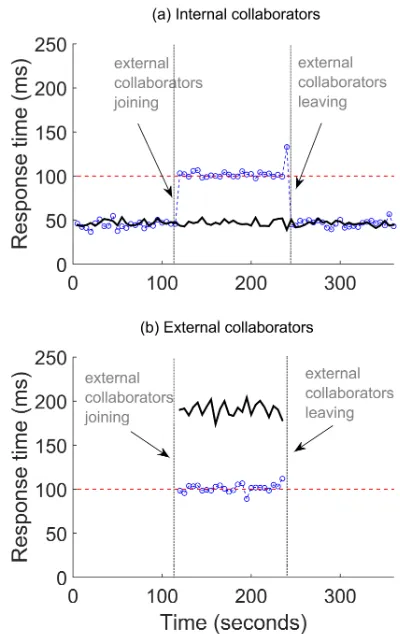
According to the QoS specified in the intent of C1, the mediator selected the local Etherpad service P1 as it best satisfies the intents. This selection does not change when C2 andC3submit their intents as it is still the best setting. When C4joins and submits their intent, the mediator selectsP2as the choice satisfying all intents, and notifies the other collaborator applications so that they adapt accordingly. As Fig. 9a shows, the adaptation results in a raise in the average response time experienced by the C1, C2, and C3. However, all the intents are still satisfied. Fig. 9 also shows the average response time as perceived by the internal and external collaborators when manual provider selection is adopted (i.e., without IDN). In this case, internal collaborators encounter satisfying response times (Fig. 9a) whereas the external collaborator experiences high response time which violates its intent (Fig. 9b). In the latter case, the users’ application will malfunction and be forced to manually seek and bind to another provider, if such logic is implemented.
We also compare the number of lines of code (LoC) required to select a provider assuming the selection logic is implemented as part of the application logic – case 1 – or offloaded to the mediator – case 2. For this comparison, we assume that application developers have a directory of providers to select from, which could be either hard-coded or available through a directory service. In this case study, the number of lines of code is 428 lines in case 1 compared to only 5 in case 2, which constitute the basic code required to create and issue an intent object. This indicates a significant improvement for end-user application developers.
VII. DISCUSSION ANDFUTUREWORK
The presented mediation approach illustrates that through high level specification of user intents, the network can be made aware of the application requirements and consequently involved in satisfying those requirements. Developers who need to integrate services in their applications gain many advantages from using mediators. They just need to replace the development of the logic required for finding (and negotiating) providers in a scalable environment with the simple intents formulation. In such a way, much of the development overhead is mitigated and is addressed at the network level. This in turn simplifies and accelerates application development and reduces
Fig. 9: Client-perceived QoS in the form of application re-sponse time over the experiment time.
application logic errors. However, it should be clear that the task of monitoring services and making adaptation decisions when required are not part of the mediators’ responsibilities.
To reach our goal of in-network mediation, several chal-lenges need to be addressed. We now outline these.
• Negotiation. Mediation is a highly complex task as it is
likely that many conflicts will emerge. For example, a user streaming content would want high quality delivery at low cost, a publisher would wish to have their content viewed as many times as possible, and an ISP would prefer to only have low-cost (locally available) content viewed. Such po-tentially conflicting viewpoints will need to ensure thorough negotiation to ensure that all stakeholders are incentivised to cooperate in the scheme. This requires the development of a negotiation protocol that should be independent of any particular set of verbs and rely on generic notions of utility and priority as derived from intent specification. In addition, we envisage regular reporting of intents, with public mediation logs that could be scrutinised to ascertain performance.
• Mediator interaction. We demonstrated how a mediator
[image:7.612.338.538.71.388.2]• Dependability.The capability of the mediators to satisfy the intents regardless any events that may affect the performance (e.g., hardware/software failures) is essential to ‘convince’ the users to trust and use the IDN. Undoubtedly, introducing mechanisms to achieve dependability (e.g.,replication, load-balancing, and encryption) will affect the performance of the mediation, especially in high-scale environments. This makes the desire of achieving both scalability and depend-ability a substantial challenge that hinders the adoption of IDN.
• Brokerage and reification. Marketplace brokerage is an
area with a lot of potential for reifying spontaneous and strategic intent. Reification is likely to create the need for running in-network services towards the edge. Marketplaces of resources to host such services might benefit from the operation of brokerage and arbitrage agencies. For this, thorough investigation is required to alleviate concerns re-garding trust and security. Efforts are also sought for reifying mediation outcomes in the form of adjusting the network control plane or providing information that could be used for late-binding.
• Realising other intent verbs. We have only implemented
a mechanism for satisfying one type of intents; i.e., the
Constructintents which are used either toAdvertiseservices
by the providers or toDiscoverservices by the users. More work is needed for other intent types; namely Transfer, which allows applications to pull and push content, and Regulate, used to express an application’s desire to have traffic handled in a certain way in the network.
VIII. RELATEDWORK
Bringing application awareness to networks has been a long sought after goal of a number of network architectures.
Clear synergies lie between IDN and existing models of service-centricity, often referred to as Service Oriented Ar-chitectures (SOA) [13] where systems are composed from a number of loosely coupled services that adhere to shared APIs. The technologies used to underpin SOA include SOAP and REST, both of which adopt the narrow network API approach. Thus, they continue to suffer from all of the associated problems discussed in Section I.
Information-centric networking (ICN) [14] proposes to con-vert networks into inherent content delivery systems. Service-centric networking (SCN) [15], [16] extends ICN principles to apply to services. Both ICN and SCN attempt to align the application and the network, which helps to break away from statically binding to specific resources. However, they only partly address the problems we have outlined in the specific cases of accessing content/services: they do not naturally generalise to other scenarios, e.g., those involving switching of networks.
Policy-Based Management (PBM) enables the definition of high level policies that can be refined into actionable and quantifiable network-level targets [17]. PBM is typically constructed around rule-based, goal-driven, or event-driven principles that are mapped to specific operations. Other PBM
work is also emerging under the ‘network synthesis’ subfield, to translate a high-level forwarding policy into confluent network-wide OSPF and BGP rules [18], [19]. Recent ex-tensions to this philosophy include the RFC on autonomic networking [20], which discusses intents as abstract oper-ational goals, but does not indicate how to implement or deploy operations to reach such high-level goals. Recent works provide solutions to quantify such soft goals using Network
Function Virtualization (NFV) chains [21] and SDN-based
topologies [22], [23]. This small but growing body of work is largely about facilitating malleable network management that is driven by QoS objectives or business constraints. As such, they are geared towards those dealing with wholesale traffic (i.e.,network operators). They cannot, for instance, be used for facilitating application-defined opportunistic service binding at the edge.
Closer to our proposal are recent efforts on enabling ap-plications to express their requirements and allowing these to percolate down to the underlying network. Declarative languages like Pyretic [24] and Merlin [25] raise the level of abstraction of writing network policies, enabling the defi-nition of sophisticated network structures through a high-level language. Both Pyretic and Merlin focus on issues relating to unifying network administration rather than identifying and addressing application requirements.
Service discovery solutions have covered a vast problem space, and moved from centralised (e.g.,[26]) to decentralised methods (e.g.,[27]) to facilitate opportunistic bindings. How-ever, awareness and consideration of the capabilities, status, and operations of the network is rarely part of the design of such systems.
IX. CONCLUSION
We have proposed an approach for realising network con-sciousness for service selection and application adaptation through employing Intent Driven Networking (IDN). This is achieved through deploying ‘mediators’, which are trusted middleboxes that reside in the network, receive the client intents, and process them to satisfy their requirements. Apart from enjoying network service levels that better match their intents, applications also benefit from IDN in that some of their selection logic could be pushed to the network. No longer are user applications expected to ship with intricate conditional logic to work around unexpected network behaviour (they still could employ such logic, but they would thereby be limiting their ability to be deployed in foreign environments and handle unforeseen conditions).
REFERENCES
[1] D. Evans, “The Internet of Things: How the next evolution of the internet is changing everything,” Cisco Internet Business Solutions Group, Tech. Rep. IBSG 0411, Apr 2011. [Online]. Available: https://www.cisco. com/c/dam/en us/about/ac79/docs/innov/IoT IBSG 0411FINAL.pdf [2] A. H. Ngu, M. Gutierrez, V. Metsis, S. Nepal, and Q. Z. Sheng, “IoT
middleware: A survey on issues and enabling technologies,”Internet of Things Journal, vol. 4, no. 1, pp. 1–20, Feb 2017.
[3] I. Yaqoob, E. Ahmed, I. A. T. Hashem, A. I. A. Ahmed, A. Gani, M. Imran, and M. Guizani, “Internet of things architecture: Recent advances, taxonomy, requirements, and open challenges,”IEEE Wireless Communications, vol. 24, no. 3, pp. 10–16, June 2017.
[4] Y. Elkhatib, G. Coulson, and G. Tyson, “Charting an intent driven net-work,” inInternational Conference on Network and Service Management (CNSM), Nov 2017.
[5] S. Y. Jeong, H. G. Jo, and S. J. Kang, “Remote service discovery and binding architecture for soft real-time QoS in indoor location-based service,”Journal of Systems Architecture, vol. 60, no. 9, pp. 741 – 756, 2014.
[6] J. Santos, T. Wauters, B. Volckaert, and F. D. Turck, “Resource pro-visioning for iot application services in smart cities,” inInternational Conference on Network and Service Management (CNSM), Nov 2017. [7] C. Sandionigi, D. Ardagna, G. Cugola, and C. Ghezzi, “Optimizing
service selection and allocation in situational computing applications,”
IEEE Transactions on Services Computing, vol. 6, no. 3, pp. 414–428, July 2013.
[8] L. Qu, C. Assi, K. Shaban, and M. Khabbaz, “Reliability-aware service provisioning in nfv-enabled enterprise datacenter networks,” in Interna-tional Conference on Network and Service Management (CNSM), Oct 2016, pp. 153–159.
[9] A. Patel, M. Taghavi, K. Bakhtiyari, and J. C. Jnior, “An intrusion detection and prevention system in cloud computing: A systematic review,”Journal of Network and Computer Applications, vol. 36, no. 1, pp. 25 – 41, 2013.
[10] G. Tziakouris, M. Zinonos, T. Chothia, and R. Bahsoon, “Asset-centric security-aware service selection,” inIEEE International Congress on Big Data, June 2016, pp. 327–332.
[11] A. Elhabbash, R. Bahsoon, P. Tino, and P. R. Lewis, “A utility model for volunteered service composition,” inInternational Conference on Utility and Cloud Computing (UCC). IEEE/ACM, Dec 2014, pp. 337–344. [12] D. Whitley, “A genetic algorithm tutorial,” Statistics and Computing,
vol. 4, no. 2, pp. 65–85, Jun 1994.
[13] E. Ramollari, D. Dranidis, and A. J. Simons, “A survey of service ori-ented development methodologies,” in2nd European Young Researchers Workshop on Service Oriented Computing, vol. 75, 2007.
[14] V. Jacobson, D. K. Smetters, J. D. Thornton, M. F. Plass, N. H. Briggs, and R. L. Braynard, “Networking named content,” in International
Conference on emerging Networking EXperiments and Technologies (CoNEXT), 2009.
[15] M. J. Freedman, M. Arye, P. Gopalan, S. Y. Ko, E. Nordstrom, J. Rexford, and D. Shue, “Service-centric networking with SCAFFOLD,” http://www.dtic.mil/cgi-bin/GetTRDoc?Location= U2&doc=GetTRDoc.pdf&AD=ADA571380, Princeton University, Tech. Rep. 885-10, Sep 2010.
[16] T. Braun, A. Mauthe, and V. Siris, “Service-centric networking exten-sions,” inSymposium on Applied Computing (SAC), 2013, pp. 583–590. [17] R. Boutaba and I. Aib, “Policy-based management: A historical perspec-tive,”Journal of Network and Systems Management, vol. 15, no. 4, pp. 447–480, 2007.
[18] R. Beckett, R. Mahajan, T. Millstein, J. Padhye, and D. Walker, “Don’t mind the gap: Bridging network-wide objectives and device-level configurations,” inAnnual conference of the ACM Special Interest Group on Data Communication (SIGCOMM). ACM, 2016, pp. 328–341. [19] A. El-Hassany, P. Tsankov, L. Vanbever, and M. T. Vechev,
“Network-wide configuration synthesis,” inConference on Computer-Aided Veri-fication (CAV), Jul 2017.
[20] M. H. Behringer, M. Pritikin, S. Bjarnason, A. Clemm, B. Carpenter, S. Jiang, and L. Ciavaglia, “Autonomic Networking: Definitions and Design Goals,” RFC 7575 (Informational), pp. 1–16, Jun 2015. [21] E. J. Scheid, C. C. Machado, M. Franco, R. L. dos Santos, R. Pfitscher,
A. Schaeffer-Filho, and L. Z. Granville, “INSpIRE: Integrated NFV-baSed Intent Refinement Environment,” in IFIP/IEEE International Symposium on Integrated Network Management (IM). IEEE, May 2017. [22] Y. Han, J. Li, D. Hoang, J. H. Yoo, and J. W. K. Hong, “An intent-based network virtualization platform for SDN,” inInternational Conference on Network and Service Management (CNSM), Oct 2016, pp. 353–358. [23] S. Arezoumand, K. Dzeparoska, H. Bannazadeh, and A. Leon-Garcia, “MD-IDN: Multi-domain intent-driven networking in software-defined infrastructures,” in International Conference on Network and Service Management (CNSM).
[24] J. Reich, C. Monsanto, N. Foster, J. Rexford, and D. Walker, “Modular SDN programming with Pyretic,”Technical Report of USENIX, 2013. [25] R. Soul´e, S. Basu, R. Kleinberg, E. G. Sirer, and N. Foster, “Managing
the network with merlin,” in Workshop on Hot Topics in Networks (HotNets). ACM, 2013, pp. 24:1–24:7.
[26] H. Cervantes and R. S. Hall, “Autonomous adaptation to dynamic avail-ability using a service-oriented component model,” in26th International Conference on Software Engineering (ICSE). IEEE Computer Society, 2004, pp. 614–623.