Strapdown Navigation Using Geometric Algebra: Screw
Blade Algorithm
Dimin Wu, Zhengzhi Wang
Institute of Automation, National University of Defense Technology, Changsha, China. Email: [email protected]
Received February 8th, 2012; revised March 15th, 2012; accepted March 25th, 2012
ABSTRACT
The rigid body motion can be represented by a motor in geometric algebra, and the motor can be rewritten as a tri-nometric function of the screw blade. In this paper, a screw blade strapdown inertial navigation system (SDINS) algo- rithm is developed. The trigonometric function form of the motor is derived and utilized to deduce the Bortz equation of the screw blade. The screw blade SDINS algorithm is proposed by using the procedure similar to that of the conven- tional rotation vector attitude updating algorithm. The superiority of the screw blade algorithm over the conventional ones in precision is analyzed. Simulation results reveal that the screw blade algorithm is more suitable for the high-pre- cision SDINS than the conventional ones.
Keywords: Inertial Navigation; Geometric Algebra; Screw Blade; Bortz Equation
1. Introduction
The strapdown inertial navigation system (SDINS) algo- rithm comprises attitude updating, velocity updating, and position updating, among which attitude updating usually utilizes the rotation vector algorithm [1-7]. The procedure of the rotation vector algorithm is: first, divide the attitude updating time interval equally into several segments and calculate the angular increment of each segment respec- tively; then, compute the total angular increment during the entire updating interval; finally, figure out the direc- tion cosine matrix/quaternion of the updating time inter- val from the total angular increment. The theoretical foundation of the rotation vector algorithm is the Euler theorem, i.e., multiple rotations about axes passing through the origin is equivalent to a single rotation about some axis passing through the origin. Recently, a translation vector method, which is similar to the rotation vector algorithm, is proposed for the velocity/position updating [8].
According to the Chasles theorem, the rigid body mo- tion can be represented by a rotation about an axis and a translation along that axis, and on this basis a SDINS algorithm based on dual quaternion (DQ) is presented [9]. The rotation vector and the translation vector are com- bined to construct the screw vector, which is utilized to calculate the DQs representing the vehicle’s motions. All navigation parameters can be extracted from these DQs. The velocity/position updating algorithms in both [8,9]
are related to the rotation vector algorithm which has been commonly used in modern SDINS algorithms. How- ever, the attitude updating is combined with the velocity and position updating in [9], which is different from in [8] or other references, where the attitude updating is gener- ally manipulated separately from the velocity and posi- tion updating. The benefit of the DQ-based SDINS algo- rithm is that the structure of the navigation algorithm can be simplified, and the precision can be promoted.
Geometric algebra (GA), as well as DQ, is a unitary representational tool for the rigid body motion, but it is more general than the latter. Rotations and translations of any dimension can be depicted in GA.
the motor and the Bortz equation of the screw blade. A screw blade algorithm is developed in Section 4, and error analyses of the new algorithm and the conventional ones are presented in Section 5. In Section 6, a variety of simulations are carried out to testify the screw blade al- gorithm. Finally, concluding remarks are provided in Section 7.
2. Geometric Algebra Strapdown Inertial
Navigation System Model
This section reviews the GA SDINS model, for detailed mathematical background please refer to [10] and refer- ences therein.
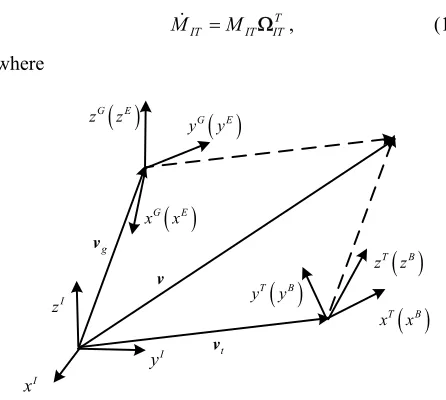
The purpose of inertial navigation is to provide navi- gation parameters through the integration of the angular rate and the total acceleration. The total acceleration con- sists of the specific force acceleration and the gravita- tional acceleration, which can be integrated into the thrust velocity and the gravitational velocity, respectively. Define the thrust velocity frame with its axes aligned with the body frame’s. The difference between the thrust velocity frame and the body frame is that the vector from the origin of the inertial frame to that of the thrust veloc- ity frame is the thrust velocity, rather than the ordinary translation (See Figure 1). Similarly, we can define the gravitational velocity frame and the position frame. The axes of the gravitational velocity frame are aligned with those of the Earth-fixed frame. And the vector from the origin of the inertial frame to that of the gravitational velocity frame is the gravitational velocity. The position frame is attached to the centroid of the vehicle, and its axes are aligned with the Earth-fixed frame’s.
The kinematic equation of the motor that transforms the inertial frame I to the thrust velocity frame can be formulated as
T
T
IT IT I
M M
T, (1)
where
I
x
I
y
T B x x
T B
y y
v
T B
z z
G E
x x
G E
y y
G E
z z
I z
g
v
t
v
Figure 1. Velocity frames.
* *
T T I B B
IT IT RIT tRIT IB s
, (2)
in which T IT
and B
IB
denote the angular rates of the thrust velocity frame T and the body frame with respect to the inertial frame
B I , respectively; I
t
de- notes the thrust velocity; IT represents the rotor that transforms frame
R
I to frame ; T B
s is the specific force acceleration; * is the dual operator; ~ is the reverse operator.
Similarly, the kinematic equation of the motor that transforms the inertial frame I to the gravitational ve- locity frame G can be formulated as
2 G
IG IG I
M M
G, (3)
where
* *
G G I E E
IG IG RIG gRIG IE g
, (4)
in which G IG
and E
IE
denote the angular rates of the gravitational velocity frame and the Earth-fixed frame
with respect to the inertial frame
G
E I, respectively;
I g
denotes the gravitational velocity; IG represents the rotor that transforms frame
R
I to frame G; gE is
the gravitational acceleration.
The kinematic equation of the motor that transforms the inertial frame I to the position frame can be formulated as
P
2 P
IP IP
M M IP, (5)
where
* *
P P I E I I
IP IP RIPr RIP IE RIG vt vg RIG
,
(6)
in which P
IP
denotes the angular rate of frame with respect to frame
P I ; rI denotes the position vector
from the origin of frame I to that of frame P; IP represents the rotor that transforms frame
R I to frame . The mechanism of the GA SDINS model is shown in Figure 2.
P
3. Screw Blade Bortz Equation
As shown in the last section, the kinematic equation of the motor has the unitary form
1 2
M M, (7)
[image:2.595.59.282.521.721.2]
0IT
M
0IG
[image:3.595.100.493.91.282.2]M MIP
0Figure 2. Mechanism of the GA SDINS model.
Define the screw blade to be w Tv
N , we haveBortz equation; therefore, we will build the GA-formed Bortz equation first.
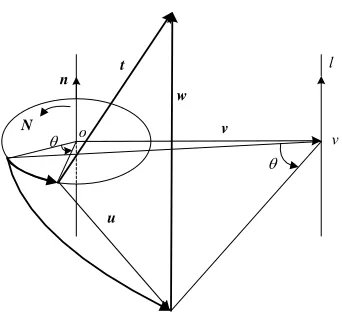
A general rigid body motion can be constructed by a rotation in a plane around the origin, followed by a trans- lation. As shown in Figure 3, the motor which represents the general rigid body motion, can be decomposed into the screw parameters as [11]
1
* *
T
,
T T
d
v v v
w N w N N
N n
v w I v n
(9)
where I is the pseudoscalar; nN*N I 1
d w n wn
*
denotes
the direction of the screw axis; denotes
the magnitude of w. It can be seen that n v n*
l
is the right dual representation of the screw axis . Define
d
I
, it can be shown that
2 T 2 T
M T R T R e v v
w N
t N w N , (8)
where T e 2
and R e 2 represent the trans-
1 2
2 1 2 . (10) lation versor and the rotation versor (or rotor), respec-
tively; T
T
1 represents the versor product; T Therefore, Equation (9) can be simplified as l,
or, l . Considering that to the power of two or more equals zero, the motor can be rewritten as [12]
t denotes the translation; denotes the plane in
which the rotation is resident, and ; N
2 1
N is the
rotation angle; w
t N
N is the translation along2 2 cos sin
2 cos sin ,
2 2
l
M e e l
the rotation (or screw) axis;
1 R2
1
N
v t N N is 2 (11)
the translation of the rotation axis.
o t
v v
u n
N
l
w
where
2 4 2
4 3
2 d
cos 1 1
2! 4! 2!
4 d
cos d sin , 4!
I
I
I
(12)
3 5
sin sin d cos
3! 5!
I . (13) It is seen that the motor M is determined by the screw blade ; therefore, M can be obtained if is known. Differentiating Equation (11) with respect to time gives
[image:3.595.309.538.517.684.2] [image:3.595.87.258.563.720.2]2
sin sin 2sin cos
2 2 2 2 2 2
M
. (14) Substituting Equation (11) into the right side of Equa- tion (7), yields
1 1 cos sin
2 2 2 4
1
sin cos sin ,
4 2 2 2 2
M
2 2 (15)
where
2
is the cross product of two blades [11-13].
With Equations (7), (14), and (15), considering that terms of the same grade on one side of the equation should equal to those on the other side, it gives
2
, (16)
2
1
sin 2sin cos cos
2 2 2 2 2
sin . 2 2
2 (17)
Substituting Equations (10) and (16) into Equation (17) gives
2 1 1 cot 2 2 2 . (18)
In fact, when t0 and 0, it follows that 0
d , l *,
n , *. (19) Define n, we have
*
l
n
*. (20) Introducing Equations (19) and (20) into Equation (18), and multiplying the resultant equation with the pseudo- scalar I, Equation (18) can be simplified as
2
1 1 cot
2 2 2
, (21)
which is the Bortz equation of the rotation vector [1]. Therefore, Equation (18) can be considered as an exten- sion of the Bortz equation, i.e., the Bortz equation of the screw blade.
4. Screw Blade Algorithm
Since the updating time interval is very short, and are small. Neglecting the second and higher orders of and , Equation (18) can be simplified as
1 2
Therefore, the screw blade increment of a time interval can be computed as
h
0 d h c t t
. (23) in which c is the integral of the cross product, and it can be approximated as a noncommutative rate vector of the rotation vector [2,6]:
0 1 d 2 hc t t
t, (24)where
t 0t
d
.On the other hand, the solution of Equation (22) in Taylor series is given by
h
0 h
0 . (25)
Assume that the screw velocity can be represented by a third-order polynomial
20 d
t
t
A t Bt , 0 t h, (26)
where A and are constant blades. The 2-sample screw blade formula can be acquired by the following proce- dure:
B
1) Compute the differentiations of , and substi-
tute them into Equation (25);
0
2) Divide the time interval evenly into 2 sub-intervals, and calculate the screw blade increment of each sub- interval by integral of the screw velocity;
3) Compute the coefficients of the polynomial using the screw blade increments of the sub-intervals, and then substitute them into Equation (25).
It is found that
1
2 3
c 2
, (27)
where 1 and 2 denote the screw blade incre- ments of the sub-intervals. Other multiple samples screw blade formulae can be set up similarly. A general N- sample screw blade algorithm can be formulated as
1 1
K
N N
c ij i
i j i
j, (28)where the constant coefficients are the same as those in the rotation vector algorithms.
Kij
The motor of the updating interval can thus be calcu- lated as
cos sin
2 2
M
, (29)
where . The total motor can be updated as . (22)
1
n n
in which Mn and n1 represent the previous and current motors, respectively.
M
5. Algorithm Error Analysis
Since is the integral of , we can assume , where
* s
dt
, ds
t. It follows that
2 1 2
2
1 22 d
s I I , (31)
where
2 1 2 is the magnitude of the rotation angle, and d s is the magnitude of the translation along the screw axis. Therefore, Equation (11) can be expanded as* *
2
cos sin cos sin
2 2 2 2 2
sin cos cos sin
d 2 2 2 2
2 2d
d sin sin cos sin .
2 2 2 2
d M d d 2 2 I s I I s I (32)
On the other hand, the motor increment of the interval can be formulated as [11,12]
2
M R R
t . (33) Therefore, the translation increment of the updating interval can be calculated as
2 * 2 * 2 * 22 d 2d
d sin sin cos sin
2 2 2
sin cos sin sin
2 2 2
d d d
1 cos sin 1 cos
2 2
1 cos sin 1 cos 2
d 1 sin sin
d
d d
2
1 cos .
s t I I s s I I s s (34) The relationship
** d
s s I s I s I I s
is utilized in the above derivation.
Approximating the trigonometric functions by second- order Taylor expansion, Equation (34) can be reduced to be
*1 1
2 2
t s s s s. (35)
With Equations (22) and (28), the screw blade incre- ment of the updating interval can be computed as
1 1 1
*
1 1 1
*
1 1 1
K
K
K ,
N N N
i ij i j
i i j i
N N N
i ij i j
i i j i
N N N
i ij i j i j
i i j i
s
s s * (36)
where ii si is the screw blade increment of the
sub-interval. Substituting (36) into (35) gives
*
1 1 1
* *
1 1 1
*
1 1 1
1 1 1
1 1 1
K 1 K 2 K K 1 K 2
N N N
i ij i j i j
i i j i
N N N
i ij i j
i i j i
N N N
i ij i j i
i i j i
N N N
i ij i j i j
i i j i
N N
i ij i j
i i j i
t s s s
s s s
s s s
1 1 1
K .
N
N N N
i ij i j i
i i j i
s
s s j
j
(37)
Its second-order approximation is
1 1 1 1 1
1 K
2
N N N N N
i ij i j i j i
i i j i i i
it s s s s .
(38) The last two terms in the above Equation are the scull- ing and rotation compensation terms in the conventional velocity integration [14,15]. Therefore, the error for the conventional algorithm includes: 1) approximation of the screw blade during the updating time interval in Equation (36); 2) truncation of trigonometric series to the second order in Equation (35); 3) approximation to second-order accuracy in Equation (38). On the other hand, the error for the screw blade algorithm comes from: 1) approxima- tion of the screw blade in Equation (36); and 2) trunca- tion of trigonometric functions in calculating Equation (34). Therefore, if the error in Equation (36) is small enough, the precision of the screw blade algorithm will be higher than that of the conventional ones. The error arisen from the approximation of the screw blade can be reduced by choosing high-precision inertial sensors to decrease measurement error, or by using big sample screw blade algorithms, or by shortening updating time intervals, etc.
6. Numerical Simulation
presented in this paper, a variety of experiments are car- ried out.
The navigation parameters and the gyro/accelerometer outputs are produced by an ideal trace generator. The inputs of the generator are the ground speed rate and the Euler angle rate, and the inputs for each channel are the same, which are 20sin 2
πft (m/s2) for the former, and
2πf cos 2πft
(rad/s) for the latter. The frequencies aref = 0.01, 0.02, 0.04, 0.06, 0.08, 0.1, 0.2, 0.4, 0.6 and 0.8 (Hz). At the beginning, the vehicle stands still on the ground of the Earth at latitude 30˚ and longitude 110˚, and the attitude angles are all 0. The runtime is set to be 300 (s).
The coordinate transformation between the Earth fixed frame coordinate and the geodetic coordinate is achieved by an iterative algorithm proposed in [16]. To increase the precision, the gravitational acceleration is computed using the information of real time position of the vehicle. Since the position is calculated only once per updating
interval, a third-order algorithm [17] is utilized in com- puting the screw blades of the gravitational velocity frame motor and the position frame motor.
In this test, the 2-sample screw blade algorithm is cho- sen to solve the GA SDINS model. For the conventional algorithm, 2-sample formulae are applied in attitude/ve- locity updating [4,18], and the trapezoidal integration is utilized in position updating.
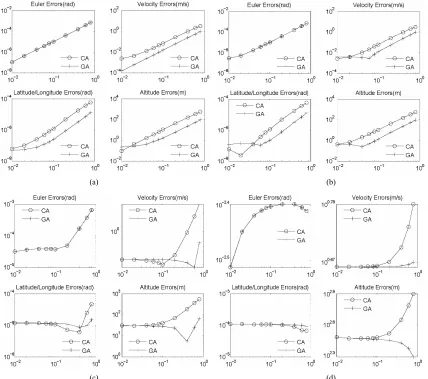
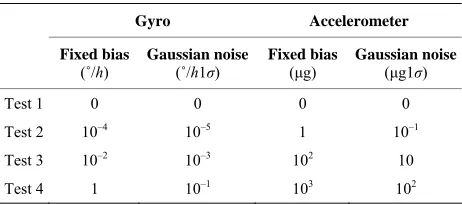
Here the measurement errors of the inertial sensors are simplified as a compound effect of the fixed bias and the Gaussian random noise. Four typical SDINS configura- tions used in the test are listed in Table 1. The maximum absolute errors (MAE) of both algorithms are illustrated in Figure 4 as a function of the varying input signal fre- quency. “CA” and “GA” stand for the conventional algo- rithm and the geometric algebra screw blade algorithm, respectively. The updating time interval is 0.02 (s).
It can be seen that:
1) The attitude errors of both algorithms are the same,
(a) (b)
[image:6.595.85.513.325.704.2](c) (d)
Figure 4. MAEs of algorithms with variant measurement errors as a function of varying input signal frequency. (a) Test 1; (b) est 2; (c) Test 3; (d) Test 4.
Table 1. Inertial sensor configuration.
Gyro Accelerometer Fixed bias
(˚/h) Gaussian noise(˚/h1σ)
Fixed bias
(μg) Gaussian noise(μg1σ)
Test 1 0 0 0 0
Test 2 10–4 10–5 1 10–1
Test 3 10–2 10–3 102 10
Test 4 1 10–1 103 102
but the velocity and position errors have been remarkably reduced due to the combination of the attitude updating and the velocity/position updating, which utilizes the high- precision attitude updating algorithm.
2) When there is no measurement error (Figure 4(a)), or the measurement error is minor (Figure 4(b)), the su- periority of the GA over the CA is quite obvious. How- ever, as the measurement error grows, the superiority loses gradually, as shown in Figure 4(d), in which the MAEs of both algorithms are almost the same. This is because the measurement error becomes the main error source of the algorithms as it grows.
3) There are some turning frequency points around which the MAEs of the CA are smaller than those of the GA. However, in most cases, the precision of the GA is better than that of the CA.
7. Conclusions
A screw blade algorithm is proposed to solve the GA SDINS model. At first, the trigonometric function form of the motor is derived by using the screw decomposition. The Bortz equation of the screw blade is deduced in succession. And then, the screw blade SDINS algorithm is developed similar to the conventional rotation vector attitude updating algorithm. The errors of the screw blade algorithm and the conventional ones are analyzed as well.
The performances of the screw blade algorithm are testified by a variety of simulations. The results reveal that the screw blade algorithm is a better choice than the conventional ones when the measurement error is small, and it is more suitable for the SDINS with high-precision requirement.
8. Acknowledgements
This project is supported by the National Natural Science Foundation of China (60835005). We appreciate Dr. Dan- feng Zhou for his constructive suggestions in scientific writing.
REFERENCES
[1] J. E. Bortz, “A New Mathematical Formulation for Strap-
down Inertial Navigation,” IEEE Transactions on Aero- space and Electronic Systems, Vol. AES-7, No. 1, 1971, pp. 61-66.doi:10.1109/TAES.1971.310252
[2] M. B. Ignagni, “Optimal Strapdown Attitude Integration Algorithms,” Journal of Guidance, Vol. 13, No. 2, 1990, pp. 363-369.doi:10.2514/3.20558
[3] M. B. Ignagni, “Efficient Class of Optimized Coning Com- pensation Algorithm,” Journal of Guidance, Control, and Dynamics, Vol. 19, No. 2, 1996, pp. 424-429.
doi:10.2514/3.21635
[4] J. W. Jordan, “An Accurate Strapdown Direction Cosine Algorithm,” NASA TN-D-5384, 1969.
[5] J. G. Lee, Y. J. Yoon, J. G. Mark and D. A. Tazartes, “Ex- tension of Strapdown Attitude Algorithm for High-Fre- quency Base Motion,” Journal of Guidance, Vol. 13, No. 4, 1990, pp. 738-743.doi:10.2514/3.25393
[6] R. B. Miller, “A New Strapdown Attitude Algorithm,” Journal of Guidance, Vol. 6, No. 4, 1983, pp. 287-291. doi:10.2514/3.19831
[7] P. G. Savage, “Strapdown Inertial Navigation Integration Algorithm Design Part 1: Attitude Algorithms,” Journal of Guidance, Control, and Dynamics, Vol. 21, No. 1, 1998, pp. 19-28.doi:10.2514/2.4228
[8] P. G. Savage, “A Unified Mathematical Framework for Strapdown Algorithm Design,” Journal of Guidance, Con- trol, and Dynamics, Vol. 29, No. 2, 2006, pp. 237-249. doi:10.2514/1.17112
[9] Y. Wu, X. Hu, D. Hu, T. Li and J. Lian, “Strapdown Iner- tial Navigation System Algorithms Based on Dual Qua- ternion,” IEEE Transactions on Aerospace and Electronic Systems, Vol. 41, No. 1, 2005, pp. 110-132.
doi:10.1109/TAES.2005.1413751
[10] D. Wu and Z. Wang, “Strapdown Inertial Navigation Sys- tem Algorithm Based on Geometric Algebra,” Advances in Applied Clifford Algebras, Vol. 22, No. 1, 2012, pp. 1- 17.
[11] L. Dorst, D. Fontijne and S. Mann, “Geometric Algebra for Computer Science: An Object-Oriented Approach to Geometry,” 2nd Edition, Morgan Kaufmann Publishers, San Francisco, 2007.
[12] E. Bayro-Corrochano, “Geometric Computing for Wave- let Transforms, Robot Vision, Learning, Control and Ac- tion,” Springer Verlag, London, 2010.
[13] D. Hestenes, “New Foundations for Classical Mechan- ics,” 2nd Edition, Kluwer Academic Publishers, Dordrecht, 1999.
[14] M. B. Ignagni, “Duality of Optimal Strapdown Sculling and Coning Compensation Algorithms,” Journal of the In- stitute of Navigation, Vol. 45, No. 2, 1998, pp. 85-95. [15] P. G. Savage, “Strapdown Inertial Navigation Integration
Algorithm Design Part 2: Velocity and Position Algo- rithms,” Journal of Guidance, Control, and Dynamics, Vol. 21, No. 2, 1998, pp. 208-221. doi:10.2514/2.4242 [16] Y. Wu, P. Wang and X. Hu, “Algorithm of Earth-Cen-
tered Earth-Fixed Coordinates to Geodetic Coordinates,” IEEE Transaction on Aerospace and Electronic Systems, Vol. 39, No. 4, 2003, pp. 1457-1461.
[17] R. A. McKern, “A Study of Transformation Algorithms for Use in a Digital Computer,” M.S. Thesis, MIT, Cam- bridge, 1968.