Measurement of Unique Pupillary Distance using
Modified Circle Algorithm
A. F. M. Saifuddin Saif
Assistant Professor, Department of Computer Science American International University-Bangladesh
Dhaka, Bangladesh
Md. Shahadat Hossain
M Scholar, Department of Computer Science American International University-Bangladesh
Dhaka, Bangladesh
Khandaker Tabin Hasan
Associate Professor, Department of Computer Science American International University-Bangladesh
Dhaka, Bangladesh
Mashiour Rahman
Associate Professor, Department of Computer Science American International University-Bangladesh
Dhaka, Bangladesh
ABSTRACT
This research investigated several equations and calculated the pupillary distance using pupils center coordinate. The prior re-search has provided two conceptual frameworks which may give a unique distance to all human. As Pupillary distance provides a core and unique information as like bio-metric for every human. The researcher did not explore the equation or pattern yet. This re-search proposed a framework called as Pixellary Pupil Distance and analyze the result. This research use pixel to calculate the pupillary distance where subtracts left pupil pixel with the right pupil and sum up with its distance pixel. Finally, the research sum all the pixel subtraction and its distance what this research called pupil-lary distance. This research builds and describes a custom dataset for test purpose because the pupil is the core element of eyes and this research did not find any precise dataset of it. The result shows the unicity of pupillary distance. This research also shows the com-putational time, false alarming rate, noise reduction which is de-scribed the performance of the purposed framework.
Keywords
Pixellary pupil distance, Pupillary Distance, Bio-metrics, Eyes, Distance Equation, Pupil Detection, Pupil Measurement, Edge De-tection
1. INTRODUCTION
Pupillary distance is unique. This research has explored the unique measurement of Pupillary Distance. There are many problems which are not defined by the mathematical equation. Researchers are trying to identify mathematical equations which are not defined yet. The unique measurement of Pupillary Distance is one of them. The most popular distance equations of two-point cannot solve the problem. As a result, The research proposed two conceptual frame-works [1] which have been presented distance equation of Pupillary Distance. The research proposed the equation from the perspec-tive of computer vision. The research use pixel instead of point to describe the second framework which called Pixellary Pupil Dis-tance [1] wherepixellaryintroduces as a new word. The
experi-ment of the Pixellary Pupil Distance proved that pixel equation can measure the unique Pupillary Distance for all human being.
Pixellary Pupil Distance is using pixel to measure unique distance because a pixel is the smallest unit of an image. It used RGB value. The red, green and blue use 8 bits each, which have integer values from 0 to 255 [2]. As A biometric information is an asset for ev-ery human [3] and The Euclidean Equation deals with two points which did not define any unique distance as a biometric informa-tion for pupillary distance [4]. Cartesian, Manhattan, vector pro-jection equations are the most important equations to measure the distance between two points which did not give a unique distance of Pupils. After getting the failure result of the basic equation, This research investigated the proposed conceptual models and equa-tions. This research has experimented a new biometric information as pupillary distance. This research is showing the experimentation of Pixellary Pupil Distance which calculated by the smallest unit of an image. This research also shows the Task description, dataset de-scription, Comparison of Computation Time, Detection Rate, False Alarm Rate and Noise Reduction as Result.
The rest of the paper is organized as follows. The following section discusses literature review. Section 3 contains task description of the experiment. Section 4 discusses dataset. Section 5 discusses the result. Section 6 discusses Analysis and Discussion of the result. Section 7 discusses the Limitation and Future Work. Finally, This research concludes in section 8.
2. LITERATURE REVIEW
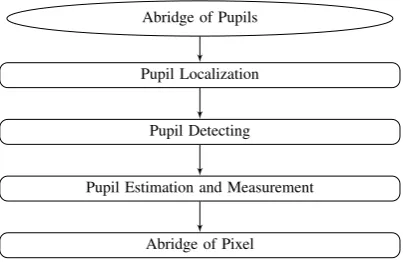
The pupil is one of the smallest units of eyes. The pupil is located at the center of Irish. It was presented that there are two types of pupil according to its color [5]. They have studied several eye track-ing systems such as E-learntrack-ing, Irish recognition, Eye Control for Accessible and assistive, Car Assistant System and Field of View Estimation and they did not describe any experimental result.
Abridge of Pupils
Pupil Localization
Pupil Detecting
Pupil Estimation and Measurement
[image:2.595.54.256.67.198.2]Abridge of Pixel
Fig. 1: A Block Diagram for Current Challenges of Pupils
used to localized pupil using Ada boosting eye classifier [6]. The Algorithm showed 47% accuracy for eye region detection in face region where the precision rate of detection in face region is 92%. The accuracy of Ensembles Regression Tree [7] measured 85.75% with 5% error rate and 99.7% accuracy recorded at 25% error rate after reinvestigation. On the other hand, Adaptive GBDT [8] recorded 99.89% accuracy at 25% error rate after reinvestigation where It localized pupil coordinate at 91.54% at 5% error rate.The Starburst model [9] has localized pupil center at the average frame rate of 196.76(ms) where It recorded 91.92% accuracy.
Pupil detection is required to measure the accurate pupil distance using pixel value. The curvature algorithm [10] detect pupil center. The accuracy rate is 40% which is detected pupil boundary in an error of less 0.1 degrees. The detection of pupil sized is identified at 91% accuracy where 90% is the correct differentiation between narcoleptic and control subjects using The Modified Adaptive Res-onance Theorem using NNs [11]. The Canny Algorithm [12] [13] able to detect pupil contour and edge at 10% error rate. Pupil con-tour is detected by Morphology algorithm [14] where the error rate is 10% on left pupil and 6% of right pupil. The Support Vector Ma-chine(SVM) [15] is able to detect the coordinate of the area in eyes with approximately 1.73% error rate. On the other hand, Correla-tion matching and SVM are time consuming [15]. Although it had the highest accuracy.
The measurement and estimation are highly needed for accurate calculation of Pupil distance. It is the way to discover the pupil center and diameter and area. Pupil size and blink rate used to dis-cover pupil boundary point by Dual Ellipse Fitting Method [16] in 2014. Novel self-tuning threshold method used for segmenting the pupil from background images where Blink detection accuracy is 99.7%. The Eyelink system [7] estimated the gaze position and area is using the tracking of the eye data. The second order regres-sor of PA varied ranging from 0.02% to 95.4%in the left eye where it is 1.0% to 87.1% in the right eye. Transform [6], The Circle Area Equation [17] and Ellipse Equation [17] used to measure the diam-eter, center of the pupil in 2016. It was grated to use the Transform in measuring Pupil diameter and center point due to the accuracy level of Circle Area equation.
There are three major types of image which are Grayscale, Binary and RGB [18]. Pixel is the smallest unit of an image. Every pixel coincides with any one value. The value of the pixel between 0 and 255 in an 8-bit Grayscale image where zero is taken to be black, and 255 is taken to be white. The value of the pixel between 0 and 1 in a binary image where zero is taken to be black, and one is taken to be white. The value of the pixel between 0 and 255 in an RGB image.
RGB color space constructs all the colors from the combination of the Red, Green and Blue colors. The red, green and blue use 8 bits each, which have integer values from 0 to 255 [2]. The value of a pixel at any point corresponding to the intensity of the light photons striking at that point. Each pixel store a value proportional to the light intensity at that particular location. This research have used RGB color space to calculate the Pupillary Distance.
3. TASK DESCRIPTION
The measurement of Pupillary Distance experiment is the core task of this research. The experimental justification was the tough-est challenge of this research. Although This research has exper-imented the system using MATLAB. This research has divided the experiment part into 7 sub-sections for describing convenience. Before This research is going to analyze the result of the exper-iment, it describes the experiment under section headline. The 7 sub-sections are:
(3.1) Face Detection (3.2) Face Straighten (3.3) Eye Detection (3.4) Pupil Detection (3.5) Pixel Extraction
(3.6) Pixel Distance Calculation (3.7) Pupillary Distance Calculation
Besides that, This research describes dataset onDatasetSection. This research tested the proposed research and come up with pupil-lary distance which discusses atResultsection. Then,Analysis and Discussioncontains Comparison of Computation Time, De-tection Rate, False Alarm Rate and Noise Reduction.
3.1 Face Detection
Face detection is the first step of purposed experiment. When pro-posed research get an image, it read the image. After reading the image, the proposed research will detect the face from the image. The Algorithm of face detection has been well established. SVM, Template Matching, Eigenvector, distributing based using Gaussian distribution and multilayer perceptron are the common and well performance algorithms [19]. The proposed research has divided the image into two halves for better detection. Proposed research used the existing algorithm of face detection with the help of Mat-lab. Cascade Object Detector is used to detect the face which is experimented on Viola-Jones algorithm [20].
3.2 Face Straighten
The SURF Operator is the local feature detector and descriptor. It has given invariance of scaling and rotation, strong robustness, and prominent separating capacity between different features [21]. Pro-posed research experiment face straightens for removing the initial noise. The Image which takes as input, those may not be center cap-tured. Proposed research do face straighten for getting the accurate result.
3.3 Eye Detection
template matching [21]. Although, Support vector machine used to classify the images of an eye or non-eye patterns. As eyes are not symmetrical like as faces, one classifier of each eye used to train said by Yu Shiqi [20]. Cascade Object Detector is used to detect the eyes which are experimented according to Yu Shiqi algorithm.
3.4 Pupil Detection
Pupil detection is most important part of the paper. Several frame-works have been discussed pupil detection [19]. Those algorithms accuracy is not effective. As Proposed research need to pupil cen-ter and contour, its used Circle Equation Algorithm to detect the pupil. It has given low accuracy to detect pupil diameter [17]. The proposed research found that object polarity is dark. So, it modified the algorithm according to the sensitivity of darkness. Proposed re-search observed that pupil size is 6 pixel to 8 pixels. The proposed research found that the algorithm is better than exiting algorithm which is tested using Matlab.
3.5 Pixel Extraction
Pixel Extraction is one of the cores for features for distance calcula-tion. The proposed research has found the pupil center co-ordinate and pupil size from pupil detection step. After getting the center coordinates of pupils, this research did average the value of x-axis for removing pixel noise. Because x-axis coordinate is not same. As a result, this research found same pupils size most of the cases which are reduced size and noise. Proposed research extracted the pupil contour using modified Circle Equation Algorithm. Proposed research also extracted the intermediate pixel of pupils which has set the value to zero.
3.6 Pixel Distance Calculation
The proposed research analyzes the only pixel of pupils and its in-termediate. First, Proposed research calculates the no of rows. This research finds the first row of the left pupil of first non zero column and subtracts with the right pupil of first non zero column. This re-search also calculates a number of the pixel from the left pupil of first non zero column to right pupil of first non zero column in the same matrix. which this research called the pixel distance for a spe-cific pixel of two pupils. This research carried the same calculation for all rows and column of left pupil to right pupil. when this re-search get any two zero column at the intermediate of a calculation, this research stop calculation for that row. because it’s the finishing pixel of left pupil. This research also stores pixel co-ordinate of the right pupil for calculation.
In this step, this research has solved below equation [1]:
Pij=Lji−Rji+Distanceof LjitoRji
3.7 Pupillary Distance Calculation
This research calculates work with the calculating result of Pixel Distance. This research sum the subtracted value of all specific pixel with its distance value. Then this research reorganizes the value as per subtracted value. Finally, this research sum all value which this research called pupillary distance.
In this step, this research experimented below equation [1]:
P upilDistance=
j X
i P
4. DATASET
This research used several databases. That dataset is not perfect for pupil detection. Some datasets used for face recognition. Specific datasets are used for Irish recognition. Since pupil is the smallest unit of an eye that’s why those datasets are not given any significant result. For this reason, this research constructed a database with 20 peoples of multiple images. This research did not change the light effect. This research inspired the audience to make shocking eyes. So that this research can clearly capture the image of full Irish. As a result, the purposed framework detected the pupil from that image easily.
5. RESULT
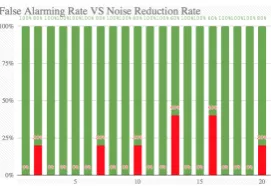
This research has measured 20 subjects pupillary distance, each of 5 images. This research provides the information in the tabular for-mat. This research shows the PD as pupillary distance, CT as com-putational time, FAR as False Alarming Rate and NRR as Noise Reduction Rate. The highest PD is 32432 and lowest is PD 18933 which is the average of 5 images without false recognition. The computational time shows an average time of 5 images where it defers from 1500ms to 2100ms. As this research experiments 5 im-ages of each subject which is 100% for a subject. False Alarming Rate is 20% when an image has been miscalculated of that sub-ject, 40% means two images of that subject and so on. On the other hand, this research let 100% noise reduction if no false alarming has not occurred.
In Table 1, this research called ‘subject‘ to one individual image, PD as pupillary distance, CT as Computational Time, FAR as False Alarming Rate and NRR as Noise Reduction Rate.
6. ANALYSIS AND DISCUSSION
[image:3.595.367.503.534.627.2]The experimental result of the purposed framework has shown in tabular format in the immediate upper section where this research has shown the pupillary distance, computational time, False alarm-ing rate and Noise Reduction. This research has shown the average pupillary distance of each individual. The lowest pupillary distance is 18933 and highest is 32432. The average computational time of all subjects is 1813ms where the lowest computational time is 1560 and highest is 2100ms. The False Alarming Rate occurred in 30% subjects. But the impact rate is 8% among all images. The noise reduction rate has been increased to 70% which is impact 92% im-ages of the dataset which is shown in Fig-2.
Fig. 2: The graph shows False Alarming Rate Vs Noise Reduction Rate
Table 1. : Result of 20 subjects each of 5 images
Sub. No PD CT/Image FAR NRR
1 26983 1700 0% 100%
2 20021 1600 20% 80%
3 23002 1750 0% 100%
4 25983 1850 0% 100%
5 24029 1750 0% 100%
6 23094 1800 0% 100%
7 27128 2010 20% 80%
8 30943 2050 0% 100%
9 18933 1680 0% 100%
10 32432 1930 20% 80%
11 29123 1750 0% 100%
12 22923 1980 0% 100%
13 27452 1780 40% 60%
14 21523 1920 0% 100%
15 20329 1840 0% 100%
16 19021 2100 40% 60%
17 27392 1560 0% 100%
18 23458 1660 0% 100%
19 25123 1750 0% 100%
20 23843 1800 20% 80%
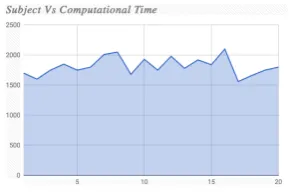
[image:4.595.100.245.389.485.2]the false alarming rate is 0%. On the other hand, The highest pupil-lary distance is 32432 at 10th subject where computational time is 1930ms which is greater than the average computational time of the dataset. The false alarming rate is 20% where the noise reduction rate is 80%.
Fig. 3: The graph shows subject vs computational time
If this research looks the subject vs computational time graph, this research observed that computational time is in between 1560ms to 2100ms, once a number of images are remaining same. The com-putational time is proportional to the pupillary distance where the False Alarming Rate or Noise Reduction Rate does not depend on pupillary distance. The pupillary distance is different of every in-dividual at the same light intensity where it will be different for an individual if the light intensity change.
7. LIMITATION AND FUTURE WORK
This research has experimented pixellary pupil distance to calcu-late the pupillary distance which is given a unique result. This re-search has a scope to experiment with the biggest data set. On the other hand, this research did not provide any comparison with the millimeter scale. It is also a scope for further research improve-ment.This research did not distinguish between gender or age us-ing the research output. This research did not consider with focal
length, the light intensity which is biggest opportunity to research on pixellary pupil distance. Although, the proposed research will suggest you a new path to research on pupillary distance.
8. CONCLUSION
Pupillary distance is bio-metric information which is not proved by any researcher yet. But this research has shown a path to make it as biometric information. The challenge of pupil detection solved by the purposed framework and dataset. This research has also exper-imented pupillary distance according to the purposed framework which is the biggest milestone for computer vision. This research has shown that Modified Circle Algorithm can detect pupil bet-ter than all other algorithms to proposed framework. This research modified the object polarity, pupil size, and sensitivity to detect it more accurately. This research did not consider light intensity, fo-cal length, age, gender. Finally, this research fo-calculates the pupil-lary distance using pixel which has shown a straight path to the researcher to discover more about pupillary distance and there is the biggest scope to study about pupillary distance.
9. REFERENCES
[1] A. S. Saif, M. S. Hossain, and K. T. Hasan, “A descrip-tive conceptual framework to measure distance of pupil us-ing pixel value,”6th International Conference on Informatics, Electronics , Vision, 2017.
[2] M. Popescu and R. T. Ionescu,Knowledge Transfer between Computer Vision and Text Mining::Similarity-based Learning Approaches. Springer, 2016.
[3] R. Bhatia, “Biometrics and face recognition techniques,” In-ternational Journals of Advanced Research in Computer Sci-ence and Software Engineering (IJARCSSE), vol. 3, no. 2, 2013.
[5] V. Roselin.E.Chirchi, Dr.L.M.Waghmare, and E.R.Chirchi, “Iris biometric recognition for person identification in secu-rity systems,” International Journal of Computer Applica-tions, pp. 0975 – 8887, 2011.
[6] G. Zhang, J. Chen, G. Su, and J. Liu, “Double-pupil location of face images,”Pattern Recognition, vol. 46, pp. 642–648, 2013.
[7] K. W. Choe, R. Blake, and S.-H. Lee, “Pupil size dynamics during fixation impact the accuracy and precision of video-based gaze estimation,”Vision Research, 2015.
[8] D. Tian, G. He, J. Wu, H. Chen, and Y. Jiang, “An accurate eye pupil localization approach based on adaptive gradient boost-ing decision tree,” inVisual Communications and Image Pro-cessing (VCIP). IEEE, 2016.
[9] Y. Zhao, Z. Qu, H. Han, and L. Yuan, “An effective and rapid localization algorithm of pupil center based on starburst model,” in Advanced Information Management, Communi-cates, Electronic and Automation Control Conference (IM-CEC). IEEE, 2016.
[10] D. Zhu, S. T. Moore, and T. Raphan, “Robust pupil center de-tection using a curvature algorithm,”Computer Methods and Programs in Biomedicine, vol. 59, pp. 145–157, 1999. [11] D. Liu, Z. Pang, and S. R. Lloyd, “A neural network method
for detection of obstructive sleep apnea and narcolepsy based on pupil size and eeg,”IEEE TRANSACTIONS ON NEURAL NETWORKS, vol. 19, no. 2, pp. 308–318, 2008.
[12] G. Xin, C. Ke, and H. Xiaoguang, “An improved canny edge detection algorithm for color image,” inIndustrial Informat-ics (INDIN), 2012 10th IEEE International Conference on, 2012.
[13] C. Jayachandra and H. Reddy, “Iris recognition based on pupil using canny edge detection and kmeans algorithm,” in In-ternational Journal Of Engineering And Computer Science, vol. 2, no. 1, 2013, pp. 221–225.
[14] A. B. Roiga, M. Moralesb, J. Espinosaa, J. Pereza, D. Masa, and C. Illueca, “Pupil detection and tracking for analysis of fixational eye micromovements,”Optik, vol. 123, pp. 11–15, 2012.
[15] C. Yan, Y. Wang, and Z. Zhang, “Robust real-time multi-user pupil detection and tracking under various illumination and large-scale head motion,”Computer Vision and Image Under-standing, vol. 115, pp. 1223–1238, 2011.
[16] S. Chen and J. Epps, “Efficient and robust pupil size and blink estimation from near-field video sequences for human– machine interaction,” IEEE Transactions on Cybernetics, vol. 44, no. 12, pp. 2356–2367, 2014.
[17] J. N. Sari, H. A. N, L. E. N, P. I. Santosa, and R. Ferdiana, “A study on algorithms of pupil diameter measurement,” in Sci-ence and Technology-Computer (ICST), International Con-ference on, 2016.
[18] S. Birchfield, Image Processing and Analysis. Cengage Learning, 2016.
[19] A. S. Saif and M. S. Hossain, “A study of pupil orientation and detection of pupil using circle algorithm::a review,” In-ternational Journal of Engineering Trends and Technology (IJETT), vol. 54, no. 1, 2017.
[20] Mathworks, “vision.cascadeobjectdetector system object.” [21] M.-H. Yang, D. J. Kriegman, and N. Ahuja, “Detecting faces
in images: A survey,”IEEE Transactions on Pattern Analysis and Machine Intelligence, vol. 24, no. 1, pp. 34–58, 2002.