
Local climate changes and the spread of malaria in
Rwanda
Sascha M. Henninger
Department of Physical Geography, University of Kaiserslautern, Kaiserslautern, Germany; [email protected]
Received 8 February 2013; revised 18 March 2013; accepted 2 April 2013
Copyright © 2013 Sascha M. Henninger. This is an open access article distributed under the Creative Commons Attribution License, which permits unrestricted use, distribution, and reproduction in any medium, provided the original work is properly cited.
ABSTRACT
A population’s health makes it possible to draw conclusions about a country’s general devel- opment level. In connection with local climatic changes, for example, we can assess how well a society adjusts to the new conditions. To that effect, it has been observed during the last few years that global climate change can also affect human health in various ways. We can differen- tiate direct health impacts (e.g. extreme weather events, natural catastrophes caused by the wea- ther) from indirect ones. However, the indirect consequences cause by far the greater damages to health. They are being spread increasingly by vectors (mosquitoes, ticks, etc.). Especially when a vector-carried infectious disease (e.g. malaria) migrates into areas where it is not endemic, con- siderable societal problems can result. The peo- ple living there would be immunologically un- prepared.
Keywords:Rwanda; Climate Change; Malaria; Vectors; Central Africa
1. INTRODUCTION
Rwanda, a mountainous tropical country in sub-Sa- haran Africa, is commonly regarded as a potential ma- larial region because of its location. However, viewed from the perspective of malaria’s incidence rate, the country’s pronounced terrain relief, with elevations rang- ing from 900 meters to over 4500 meters above sea level (a.s.l.), confers a decided advantage. Because of their elevations large parts of Rwanda must be regarded too cold to prevent the anopheles mosquito from spreading to the fullest extent (that would allow it to exploit its epidemiological potential). Nevertheless, an analysis of a series of Rwandan climate measurements now reveals
that an increase in average annual temperatures has been observed throughout the past 40 years [1]. Now it is worth a serious consideration that as a direct conse- quence, vectors could advance to higher elevations. The Rwandan government still reports 1000 m a.s.l. as the epidemiological ceiling elevation for malaria cases in its territory comparable to other countries with an analogue relief and climatic conditions [2]. However, there is evi- dence of malarial infections spreading up to elevations of 2500 m a.s.l., not only because of Rwanda’s changing local climate conditions. The rate of infection is climbing steadily in these regions, also because their population lack widespread immunity.
demonstrable temperature changes will also favour the spread of the anopheles mosquito in Rwanda. Not least, the lack of widespread immunity among the population would pose severe challenges to social life in some areas [2]. The investigation focuses on regional or local modi- fications especially caused by temperature and rainfall changes. For today’s Rwanda, as for many other malarial regions, an already mentioned altitude limit of 1000 m a.s.l. is still considered valid. This would mean that the epidemiological potential of vectors at higher altitudes should considerably diminish. Presumably, based on this theoretical foundation, the government of Rwanda still estimates the danger of being infected with malaria very low, except for some areas in the sparsely populated south. However, since it is presumed that the data base rests on information outdated as the depiction of Rwan- da’s regional climate zones, it behoves us to pursue how this problem is linked to the regional climate changes of recent decades.
2. CLIMATE AND MALARIA—THE
RECCIR PROJECT
As it is described in [1], an analysis of climate meas- urement series from Rwandan weather stations revealed that the division into four Rwandan climate zones could not hold water against a more detailed analysis based on currently available data. This led to the initiation of the ReCCiR project (Recent Climate Change in Rwanda) in 2009. So first of all, the primary project’s aim was to conduct a regional climatic analysis covering all of Rwanda and visualizing it on new maps [1].
For these purposes, the climate records from a total of 51 weather stations were accessed covering the country’s entire territory. As the project began an evaluation of Rwanda’s climate situation was made based on local cli- mates, not regarding the fact that the weather stations (mainly temperature and rainfall readings, for the most part) were distributed throughout the country. Up until the early 1990’s a majority of the recorded data was based on the “Mannheim hours”. That meant having to assume a certain degree of inaccuracy in the results comparing manually derived data with continuous digi- tally recorded values. In order to be able to quantify this inaccuracy, a location was selected being able to record daily average temperature readings over a six-month time horizon with representative data collection methods using both “Mannheim hours” as well as continuous readings. This showed that the manual values differed from the digitally-logged ones by 3%. This difference was then factored into subsequent analyses, knowing well that it could not be considered as representative for all of Rwanda’s weather stations by 100%, but this find- ing was regarded as a correction value [1].
The time-consuming manual transfer of data from the measurement books into a usable digital form enabled to filter out transcription errors or inconsistencies, such as ones caused by faulty recording (such as 379.5˚C instead of 37.95˚C). That meant eventually discarding 19% of the entire data collection [1].
In order to safeguard the statistical reproducibility of the climate measurement results, a cluster analysis was conducted, which allowed separating the measurement station data into partial collectives or groups. The basis of the cluster analysis is a comparison of temporal pat- terns for the temperature curves. Group membership was assigned by Euclidean distance mapping. Data was com- pared using single-linkage cluster analysis. This involves comparing paired values and aggregating each most similar pair in a cluster (nearest neighbour technique) [1, 19]. The first result to be drawn from this analysis was that the climate measurement series of the remaining stations fit very well into differentiated groups corre- sponding to relevant regional climate zones. This result was subjected to a hypothesis test using a student’s t-test, which answered the question if there were significant differences between the individual measurement stations or if there was a null hypothesis in the case of the calcu-lated clusters, as mapped in this form [1,19].It showed that the weather stations not being grouped in clusters of specific weather stations, with α < 0.05 (Si = 95%) were also not correlated, confirming the results of the cluster analysis [1].
Regarding the observed rising annual average tem- perature trends manifested by all of Rwanda’s climate zones, it was further decided to investigate the potential possible spread of various vectors, particularly of the anopheles mosquito, as a function of changing local cli- matic conditions. The question to be explored was whe- ther such modifications can be demonstrated for the country of Rwanda and, if so, how they impact the po- pulation?
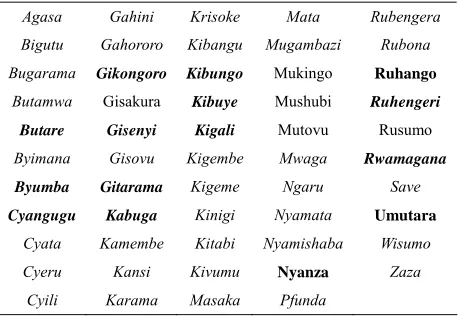
Since no data on malaria infections was forthcoming from the Rwandese side, it was fallen back on direct on- site capture of patient data. Accordingly, information re- lating to the evaluation of malaria infections and out- breaks of the disease were collected from the respective district hospitals or local clinics (Table 1). This yielded a
Table 1. Location of the meteorological stations (italic) and the district hospitals or local clinics respectively (bold).
Agasa Gahini Krisoke Mata Rubengera
Bigutu Gahororo Kibangu Mugambazi Rubona Bugarama Gikongoro Kibungo Mukingo Ruhango
Butamwa Gisakura Kibuye Mushubi Ruhengeri Butare Gisenyi Kigali Mutovu Rusumo
Byimana Gisovu Kigembe Mwaga Rwamagana
Byumba Gitarama Kigeme Ngaru Save
Cyangugu Kabuga Kinigi Nyamata Umutara
Cyata Kamembe Kitabi Nyamishaba Wisumo
Cyeru Kansi Kivumu Nyanza Zaza
Cyili Karama Masaka Pfunda
growth numbers collected since 1996.
As mentioned in [1] the area-wide development of the climatic changes was visualized as well as the malaria’s spread by resorting a method of geostatistical interpola- tion. Specifically, the kriging technique was used. Be- sides applying distance-based weights to neighbouring points, it also weights them by the value of the neigh- bouring point; i.e. a value that is to be interpolated is more influenced by points that lie closer to it than ones farther away. This prevents falsification through cluster- ing as well as through the so-called “trained eye” effect. The kriging technique recommends itself as the optimal technique for geographical interpolation of diverse mea- surements. A sub-technique known as local ordinary kri- ging was used to present a picture of reality as accurate as possible. Thus, trend elimination by means of a linear function was not necessary, but the twelve measurement points lying closest to the interpolation point were in- corporated in the calculation. The technique minimizes the likelihood of errors [1,20,21].
3. RECCIR PROJECT RESULTS
3.1. Local Climate Modifications
The analysis of the climate measurement series for the Rwandan weather stations began with evaluating the time series by decades, above all in order to understand the spatial changes in the regional and local climatic situation. The first minor local changes within the re- spective climate regions already showed up in the com- parison of values (1931-1960) with the time series from 1960 to 1970. But the changes in annual average tem- peratures and rainfall amount became even clearer based on data between 1970 and 1990, which also manifested itself eventually in the spatial distribution of the various climate regions [1].
The modification in rainfall totals during this meas- urement period was comparable, with a trend toward a
decrease in the rainfall amount (−240 mm). It ploted a new, regional climatic division for the country based on 1996-2011 data. The manifest local climatic changes im- plied that Rwanda’s old, four-part climate zone scheme no longer reflects the current situation. It was replaced by a new, six-part local or regional climatic breakdown [1].
As seen in Figure 1 compared to Figure 2, the “East-
Rwandan dry and hot lowland zone” spreaded farther west. The 1000-meter isohyet moved far beyond the me- tropolitan area of the capital city, Kigali. The rainfall amount for Kigali now went down to 900 mm [1].
The capital city, Kigali, occupies a special position. For a long time, Kigali was inside the 1000 mm isohyet in the transition zone between the temperate highland cli- mate in the west and the savannah climate in the east. In the present day, the city’s entire catchment area must be assigned to the “East-Rwandan dry and hot lowland zone”. Just the decline in rainfall amount of 110 mm shows that the 1000 mm isohyet has shifted to the west. Moreover, an urban climate effect can be detected even for this rustic capital city with temperatures rising by an average of 1.5 K above the surrounding countryside. Added to this is the highly polluted city air [1,22-24]. Consequently, Kigali was taken into the new classifica- tion as a local climate zone (Figure 2) [1].
In the entire climate zone (“East-Rwandan dry and hot lowland zone”), the rainfall reaches maximum values of around 900 mm and the annual average temperature is 21˚C. Because of the west-moving dryness, the climatic features of the “Temperate zone of the central highlands” are shifting east and to higher elevations. Comparable with the “East-Rwandan dry and hot lowland zone”, rain- fall is evidently decreasing in these areas as well (−160 mm), while, on the other hand temperatures are increas-ing (+1.2 K) (comp. Figures 1 and 2) [1].
The most significant modification within the temper- ate climate zone can be observed in the high mountain- ous region around Rewere (comp. Figures 1 and 2). Ini-
Figure 1. The climate zones of Rwanda, based on data from 1931-1960 [1].
Figure 2. The new climatic classification of Rwanda, based on data from 1996-2011 [1].
with great effort [1].
Rwanda’s mountain climate had experienced the most far-reaching climatic changes, which used to be concen- trated in the regions of the Virunga volcano chain in the north and the Nyungwe mountain rain forest in the south. This simple division can no longer be maintained in light of the current data. In fact the local climates of the two regions must be demarcated from each other (comp.
Figures 1 and 2). While the area in southern Rwanda, es-
pecially around the Nyungwe rainforest, exhibits modest temperature changes (+0.5 K) and continues to register
rainfall amount of >1400 mm, around the Virunga vol- canos the temperature ranges about 2 K higher while total rainfall has clearly dropped (−250 mm). This calls for a new division of the Rwandan “Mountain climate” into the “South-Rwandan humid mountain climate” and the “North-Rwandan dry mountain climate” [1].
Nearly unchanged physically as a regional climate zone is the area along Lake Kivu (comp. Figures 1 and 2).
The locale climate peculiarity arising from the prevailing land-lake-wind circulation continues to cause climatic conditions that remain roughly the same, with slightly rising temperatures (+0.5 K) and a decrease in rainfall of about 50 mm.
3.2. Local Malaria Modifications
Along with rising temperatures throughout the country the risk that the anopheles mosquito will spread as a function of temperature and rainfall grows as well. This may result in a higher risk for transmission of the infec- tious disease malaria [14]. Equally significant, a likely consequence is that the insect might be able to advance to higher elevations [2]. For a highland country like Rwanda, where many parts of the country fell below the epidemiological relevant line in the past, a rise in tem- peratures may now lead to the increased probability of malaria transmission. It was Loevinson who already pointed to this problem back in the early 1990’s [25]. Especially in areas, in which malaria hardly appeared, chances are that the trend will be especially pronounced, because the population’s immunity in this area is limited. However, it is not only the temperature that regulates which space the anopheles mosquito occupies, but also the presence of rain. Vectors like the anopheles mosquito spend part of their life cycle in water habitats. Hence, their range also strongly depends on hydrological changes. An expansion of the population is adapted to the change from rainy to dry seasons with the decisive criterion for the insect’s development being the intertwining of the wet phase’s duration with the intervening dry period. On the one hand, high humidity values stimulate the vector dynamic or the metabolic system of the anopheles mos- quito. On the other hand, a lasting dry spell or low hu- midity clearly raises their bite frequency. Since an analy- sis of Rwanda‘s climate measurement series can demon- strate both an increase in dry phases but also noticeable more intense, heavy rains during recent decades, we could also expect more frequent outbreaks of water- and vector-borne diseases. In addition, wet paddy rice culti- vation in many parts of the country no doubt is a factor not to be ignored in the anopheles mosquito’s spread [26]. This problem should not be discussed here.
Comparing Figures 3 and 4 provides an overview of
ure 3 shows the geographic spread of malaria in Rwanda
as well as the probability of becoming infected. For this depiction information from the individual district hospi- tals of the year 1990 were taken as the base, although the numbers were not complete, as for the years after 1990 (see Table 1 with the situation of the district hospitals).
What emerges from the vector-induced illnesses is that there were two areas in Rwanda being described as en- demic where the probability to be infected was >70%: the tropical wet southwest border area with the Democ-ratic Republic of Congo in the Bugarama Rift Country and the south-eastern area bordering Burundi on Lake Rweru (Figure 3). The latter was discarded as not sig-
nificant due to the extremely low population density of the area. Furthermore, a uniform picture emerges of the almost malaria-free area between the Virunga volcano chain in the north, the western Central Highlands up to Lake Kivu and the Nyungwe rainforest in the south. The eastern Central Highlands between Butare and Gitarama and the area east of Kigali present a minimal risk of ma- laria (5% to 15%). Akagera’s risk is also at 15%. Solely, the capital Kigali exhibits a 30% higher reading (Figure 3). However, this is not necessarily due to local climatic
changes in this area, but also especially owing to the fact that this area exhibits the highest population density in the country [27].
A changed picture presents itself evaluating data for the years 1990 to 2011 (Figure 4). It is no longer abso-
lutely necessary to differentiate between more or less endangered malaria risk areas. At present, there is a clear bifurcation of the country. Ruanda’s high mountain re- gions along the Rift Valley and in the northern or south- ern mountain country are still largely free. Otherwise, it seems that an increase in the incidence rate to 70% must be expected for the entire remaining country. Interalia, malaria has spread strongly along Lake Kivu. It can be surmised that the anopheles mosquito was able to invade this area from the west or the east and found ideal condi- tions in a few locations. Designating potentially endemic areas might be a problem. Whereas Rwanda was nearly free of malaria twenty years ago or certainly not to be designated as an endemic area, aside from a few small border areas fulfilling the climatic and hydrologic pre- requisites for formation of the anopheles mosquito, now there are three large areas which have a nearly 90% in- cidence rate: the areas around Burgarama have expanded in the direction of Lake Kivu; malaria infection risk, originating from Lake Rweru, has expanded west, north and south and already includes large areas in southwest Rwanda all the way to the Akagera (Figure 4). This
evaluation and assessment of the current situation coin- cides very well with the findings by [18]. The use of the Liverpool Malaria Model for validating malaria’s spread potential on the African continent forecasts an extant
Figure 3. Spatial development and spread of malaria inci- dences within the territory of Rwanda for the time period till 1990 (based on data from the district hospitals of Table 1).
Figure 4. Spatial development and spread of malaria inci- dences within the territory of Rwanda for the time period till 1990 (based on data from the district hospitals of Table 1).
increase in the disease’s incidence rate with rising alti- tude especially for the highland expanses of Ethiopia and Rwanda. Certainly a cause for concern is what is hap- pening in the Kigali metropolitan area, which now also has the status of an endemic area (Figure 4). What
rica’s urbanization is that the likelihood of infections goes down in cities. Inter alia, this is attributed to infra- structure and medical care being better than in rural areas, but also to improved hygiene. This is not yet the case in Kigali, presumably because, on the one hand, the city is changing enormously, on the other hand, large parts of Kigali cannot be called urban, because its conditions are more like those prevailing in the countryside.
Except for the malaria-free high areas, the annual oc- currence of malaria illnesses shows that, local anomalies excepted, the entire country is to be classified as a risk area for at least ten months of the year, if not all year round. This means that October and November mark the onset of the malaria season, then gradually diminishing or suspending entirely between May and July.
4. CONCLUDING REMARKS
At present it is still difficult to account for the modifi- cations that climate change brings, particularly trying to explain for them on a regional or local scale. The ques- tion to what extent such climatic changes can be assigned responsibility for the spread of vector-caused infectious diseases cannot be answered solely by changes in the climate. Nonetheless, we have to assume—and this much at least we owe to climate change—that, for example, the geographical manifestation of areas at risk for malaria will shift. For some regions, this can be an advantage, but in all probability for others the transmission of the infectious disease will have a negative impact on the incidence rate. Particularly in sub-Saharan Africa, as pointed out in some publications, parallels can be seen between the length of rainy seasons and the changed rainfall amount and their effects on the length of the ma- laria transmission season (e.g. [5]). The example of Rwanda has shown that this development can also be observed there. With the increase and decrease of rainfall and intensification of dry phases in different regions im- portant changes come in geographic transmission pat- terns [6].
Nevertheless, it bears repeating here that it is not only climate change that should be assigned responsibility for the situation in Rwanda of increasing incidence rates. Naturally, the modifications in temperature and rainfall have lasting effects on the vector dynamic, but a con- cluding assessment of the development of malaria in Rwanda must take additional factors into account. Above all, it calls for bringing the development of the country’s population structures into the analysis. In particular, the increasing population density, fostered by a high popu- lation growth rate and internal migration, changed and improved settlement structures as well as land use lead to a changed quality of life compared to 30 or 40 years ago. Certainly since the genocide ended, Rwanda has re- corded a rapid increase in population and continual ur-
banization [22]. The primary effect of this was to have a reduced probability of getting malaria [28,29]. However, the country’s infrastructure, especially outside Kigali and even in the larger cities like Butare or Gitarama, can only be described as urban within limits. Most notably, sani- tation measures resemble rural conditions. An additional partial modernization of agriculture and the related changes on the land (e.g. [30]) expressed above all in expansion of irrigated surfaces and in some region actually is salu- tary for the anopheles mosquito [26]. This of course ac- commodates vector development, because what happens, for example, on rice paddies in concert with local climate changes is exactly what the World Health Organization among others has been warning against for many decades: the creation of additional breeding grounds for the ano- pheles mosquito. Each of these cited determinants in its own way will affect the risk of transmission of the vec- tor-induced disease of malaria and must therefore be re-garded as interacting with all the others, especially with changes in the climate.
REFERENCES
[1] Henninger, S. (2013) Does the global warming modify
the local Rwandan climate? Natural Science, 5, 124-129. doi:10.4236/ns.2013.51A019
[2] Kappas, M. (2009) Klimatologie. Klimaforschung im 21.
Jahrhundert: Herausforderung für Natur- und Sozialwis- senschaften. Spektrum Akademischer Verlag, Heidelberg.
[3] Guerra, C., Gikandi, P., Tatem, A., Noor, A., Smith, D.,
Hay, S. and Snow, R. (2008) The limits and intensity of
Plasmodium falciparum transmission: Implications for
malaria control and elimination worldwide. PLoS Medi-
cine, 5, 2. doi:10.1371/journal.pmed.0050038
[4] Hay, S., Guerra, C., Gething, P., Patil, A., Tatem, A., Noor,
A., Kabaria, C., Manh, B., Elyazar, I., Brooker, S., Smith, D., Moyeed, R. and Snow, R. (2009) A world malaria
map: Plasmodium falciparum endemicity in 2007. PLoS
Medicine, 6, 39. doi:10.1371/journal.pmed.1000048
[5] Sinka, M., Bangs, M., Manguin, S., Coetzee, M., Mbogo,
C., Hemingway, J., Patil, A., Temperley, W., Gething, P., Kabaria, C., Okara, R., Boeckel, T., Godfray, H., Harbach, R. and Hay, S. (2010) The dominant Anopheles vectors of human malaria in Africa, Europe and the Middle East: Occurrence data, distribution maps and bionomic précis.
Parasites & Vectors, 3, 117. doi:10.1186/1756-3305-3-117
[6] Sherman, I. (1998) Malaria: Parasite biology, pathogene-
sis, and protection. ASM Press, Washington DC.
[7] DFID (2004) Department for international development-
climate change in Africa, East Anglia. DFID, Norwich, 1-8.
[8] Hay, S., Guerra, C., Tatem, A., Noor, A. and Snow, R.
(2004) The global distribution and population at risk of
malaria: Past, present and future. Lancet Infection Dis-
eases, 4.
and disease vector dispersal. PNAS, 103, 16. doi:10.1073/pnas.0508391103
[10] Yohannes, M. and Petros, B. (1996) Urban malaria in Na-
zareth, Ethiopia: Parasitological studies. Ethiopian Medi-
cal Journal, 34, 2.
[11] Omumbo, J., Guerra, C., Hay, S. and Snow, R. (2005)
The influence of urbanisation on measures of
Plasmo-dium falciparum infection prevalence in East Africa. Acta Tropica, 93,5. doi:10.1016/j.actatropica.2004.08.010
[12] Drakeley, C., Schellenberg, D., Kihonda, J., Sousa, C.,
Arez, A., Lopes, D., Lines, J., Mshinda, H., Lengeler, C., Armstrong, Schellenberg, J., Tanner, M. and Alonso, P. (2003) An estimation of the entomological inoculation rate for Ifakara: A semi-urban area in a region of intense
malaria transmission in Tanzania. Tropical Medicine &
International Health, 8.
[13] Coene, J. (1993) Malaria in urban and rural Kinshasa: The
entomological input. Medical and Veterinary Entomology,
7, 127-137. doi:10.1111/j.1365-2915.1993.tb00665.x
[14] Harvell, C.D., Mitchell, C.E., Ward, J.R., Altizer, S.,
Dobson, A.P., Ostfeld, R.S. and Samuel, M.D. (2002) Cli- mate warming and disease risks for terrestrial and marine biota. Science, 296, 2158-2162.
[15] Henninger, S. (2011) Lokalklimatische Veränderungen und
die Ausbreitung von Malaria in Ruanda. Zentralblatt für
Geologie und Paläontologie, 1, 77-96.
[16] Nchinda, T.C. (1998) Malaria: A reemerging disease in
Africa, 4, 398-403.
[17] Lozán, J.E. (2008) Warnsignal klima. Gesundheitsrisiken,
gefahren für pflanzen, tiere und menschen. Wissensch- aftliche Auswertungen, Hamburg.
[18] Ermert, V., Fink, A., Jones, A. and Morse, A. (2011) De-
velopment of a new version of the Liverpool Malaria Model. I. Refining the parameter settings and mathe- matical formulation of basic processes based on a litera- ture review. Malaria Journal, 10, 35.
doi:10.1186/1475-2875-10-35
[19] Schönwiese, C.D. (2006) Praktische statistik für meteo-
rologen und geowissenschaftler. Gebrüder Bornträger, Ber-
lin Stuttgart.
[20] Stoyan, D. and Jansen, U. (1997) Umweltstatistik: Statis-
tische verarbeitung und analyse von umweltdaten. Teu- bner Verlag, Leipzig.
[21] Siebertz, K., van Bebber, D. and Hochkirchen, T. (2010)
Statistische versuchsplanung. Springer Verlag, Berlin. doi:10.1007/978-3-642-05493-8
[22] Henninger, S. (2009) Urban climate and air pollution in
Kigali, Rwanda. ICUC’07, Yokohama, 29 June-3 July 2009,
1038-1041.
[23] Henninger, S. (2009) Urbane luftverschmutzung am beis-
piel einer afrikanischen Großstadt. Umweltchemie und
Ökotoxikologie, 3, 58-60.
[24] Henninger, S. (2010) Modifikationen des lufthygienischen
Wirkungskomplexes in der ruandischen Hauptstadt Kigali.
Berichte des Meteorologischen Instituts der Albert-Lud- wigs-Universität Freiburg, 20, 422-427.
[25] Loevinsohn, M.E. (1994) Climatic warming and increased
malaria incidence in Rwanda. The Lancet, 343, 714-718.
[26] Teklehaimanot, A. and Pushpa, R.J. (1999) The mosquito:
Public enemy No. 1. World Health Organization,Geneva.
doi:10.1016/S0140-6736(94)91586-5
[27] Adimola, B., Gahima, C., Kivuva, M. and Mmbando, J.S.
(2006) Atlas for East Africa. Pearson Longman Press, Es- sex.
[28] Hay, S., Guerra, C., Tatem, A., Atkinson, P. and Snow, R.
(2005) Urbanization, malaria transmission and disease burden in Africa. Nature Reviews: Microbiology, 3.
[29] Davis, J., Clark, T., Kemble, S., Talemwa, N., Njama-
Meya, D., Staedke, S. and Dorsey, G. (2006) Longitudinal study of urban malaria in a cohort of Ugandan children:
Description of study site, census und recruitment. Mala-
ria Journal, 5, 18. doi:10.1186/1475-2875-5-18
[30] Guerra, C., Snow, R. and Hay, S. (2006) A global assess-
ment of closed forests, deforestration and malaria risk.
![Figure 2. The new climatic classification of Rwanda, based on data from 1996-2011 [1]](https://thumb-us.123doks.com/thumbv2/123dok_us/7757554.711483/4.595.55.285.343.562/figure-new-climatic-classification-rwanda-based-data.webp)
