Munich Personal RePEc Archive
Letting the briber go free: an experiment
on mitigating harassment bribes
Abbink, Klaus and Dasgupta, Utteeyo and Gangadharan,
Lata and Jain, Tarun
Monash University, Franklin and Marshall, Indian School of Business
16 October 2012
Online at
https://mpra.ub.uni-muenchen.de/42176/
Letting the Briber Go Free:
An Experiment on Mitigating Harassment Bribes
KLAUS ABBINK*,UTTEEYO DASGUPTA†,LATA GANGADHARAN*,TARUN JAIN‡
October 16, 2012
Abstract
This paper examines the effectiveness of using asymmetric liability to combat harassment bribes. Basu (2011) advocates legal immunity for bribe-givers, while retaining culpability for bribe-takers. Results from our experiment indicate that while this policy has the potential to significantly reduce corrupt practices, weak economic incentives for the bribe-giver, or retaliation by bribe-takers can mitigate the positive disciplining effect of such an implementation. As a result, asymmetric liability on its own may face challenges in the field.
Keywords: Harassment bribes, Experiment, Asymmetric Penalty, Retaliation.
JEL Classification: C91, K42.
*Department of Economics, Monash University. †
Department of Economics, Franklin and Marshall.
‡ Finance, Economics and Public Policy Area, Indian School of Business.
1. Introduction
Bribes (or, speed money) are not limited to situations where a citizen pays them to receive contracts or services faster from public officials.1 Often officials demand bribes even for delivering citizens their entitled services such as an admission to the hospital or a swift approval of a passport. Basu (2011) characterizes the latter situation as harassment bribes. In this case although the official cannot deny the service legally, he can aggravate delivery or threaten to delay the service to a point where it becomes useless to the citizen. As a result even though such bribes are non-distortionary, harassment bribes are arguably welfare reducing since they need to be paid to receive entitled goods and services (Basu 2011).2 This paper examines the impact of different policy scenarios on those who initiate and respond to harassment bribes.
Different countries have taken different legal approaches to curbing bribery. While in the United States, United Kingdom, France, Germany and India the bribe-giver and recipient are both equally culpable and face penalties (we refer to this as symmetric liability), prescribed legal punishment for the bribe-giver is comparatively mild in China, Japan and Russia (see Engel, Görg and Yu 2012 for a discussion). Harassment bribery is reported to be particularly rampant in public services. Using data collected over 21 months from an Indian anti-graft website (www.ipaidabribe.com), a recent report estimates about half a billion rupees paid in bribes to lodge a police complaint or receive land purchase documents, marriage certificates, electricity connections, registration documents for home purchases and even admissions to preferred colleges. 3 Transparency International’s Corruption Perception Index (2004) reports that citizens pay bribes in 15 percent of cases when dealing with the health and tax sectors, and in almost 100 percent of cases when dealing with the courts and the police. The current legal environment in many countries, which features symmetric liability for both the bribe-giver and receiver, seems to further exacerbate this situation. The typical bribe-giver, who is an ordinary citizen, is in a dilemma. When faced with a bribe demand from a public official, refusal to pay implies considerable inconvenience
1 Since the seminal work by Rose-Ackerman (1978) on corruption, economists have been
interested in this area (Shleifer and Vishny 1993, Mauro 1995, Bardhan 1997, van Rijkeghem and Weder 2001, Rose-Ackerman 2006, Rose-Ackerman and Soreide 2011).
2 “A novel way to combat corruption: Who to punish”, The Economist, May 5th 2011. 3
or loss due to a certain delay in receiving the service, while succumbing to bribe-giving makes her legally culpable should the transaction be discovered.
To remedy this situation, Basu (2011) suggests a punishment system with
asymmetric liability, prosecuting and punishing only the public official (bribe-taker) and imposing no legal liability for the ordinary citizen seeking the service (bribe-giver). He hypothesises that offering the citizen legal impunity for whistle-blowing even if she has paid a bribe can encourage more frequent reporting. This in turn should discourage officials from demanding bribes in anticipation of the whistle-blowing. Consequently, Basu predicts reduced incidence of harassment bribery in equilibrium.4
Critics of Basu’s proposal argue that legal immunity for bribe-givers would make bribe-giving an attractive option and perhaps morally acceptable as well. As a result, legalising bribe-giving might in effect increase its incidence instead of reducing it (Drèze 2011). From a more practical point, Drèze also points out that refunding bribes can be complicated and difficult, if not completely impossible as a policy. Another resistence against implementing Basu’s proposal is that only a change in culpability might not increase bribe-reporting on its own in a country festered with feeble prosecution rates and notoriously slow delivery of justice. This observation becomes particularly important for developing countries such as India.5 Bribe-givers in this lax enforcement environment will be apprehensive of future harassment by the official still in office, and refrain from whistle-blowing.
This paper uses experiments to examine the effectiveness of the proposed asymmetric culpability rule in combating harassment bribes. Our experimental approach offers an alternative to traditional survey or field data analysis. We present a typical harassment bribe scenario in a stylised game played by participants in the laboratory. By varying the institutional environment across treatments we can identify conditions under which policy measures may or may not work. The laboratory allows us to observe corrupt decisions empirically, an
4 Policymakers in other countries have attempted such asymmetric liability rules in contexts other
than corruption. For example, the United States outlawed distribution and sale of alcohol during the Prohibition era (1920-33), while consumption remained legal. As a result, customers could testify against their suppliers, which would have been difficult had consumption also been illegal (Miron 1999). Sweden, followed by Iceland and Norway, introduced anti-prostitution laws with a similar spirit of asymmetric impunity.
5
endeavour that is notoriously difficult in the field since everybody involved in such decisions has good reasons to remain silent.
The effect of leniency programs has previously been studied in the context of antitrust policies (Apesteguia et al. 2007; Bigoni et al. 2012). Only recently has this idea captured the attention of the anti-corruption literature. Dufwenberg and Spagnolo (2011) introduce a theoretical model to evaluate Basu’s proposition of asymmetric punishments and propose further modifications to the underlying idea.
The growing experimental literature on corruption, starting with Abbink et al. (2002), deals mainly with collusive bribery, i.e., when citizens and officials exchange favours at the cost of the public. Subsequent work uses this basic structure to answer corruption related questions and test policy instruments such as staff rotation (Abbink 2004), top-down vs. bottom-up monitoring (Serra 2012), four-eye principle (Schickora 2011), and the use of bribes to motivate inspections (Lowen and Samuel 2012). There has also been research on the impact of framing, subject background and culture on behaviour in the context of corruption (Abbink and Hennig-Schmidt 2006; Alatas et al. 2009; Barr and Serra 2009; Cameron et al. 2009; Banuri, Eckel, and Wilson 2011). For surveys relating to the experimental literature on corruption see Abbink (2006) or more recently Banuri and Eckel (2012) and Serra and Wantchekon (2012).
The paper most akin to ours is the study by Engel, Görg, and Yu (2011), who also compare symmetric versus asymmetric punishment regimes, albeit in the context of collusive bribery, i.e., bribes that are paid to obtain a favourable service that the briber is not entitled to. In their bribery game a citizen can offer a bribe to an official, who can reciprocate by manipulating his decision in the citizen’s favour. In this framework the results show that asymmetric punishment
increases the frequency of corrupt exchanges. However, collusive and harassment bribery fundamentally differ from one another. Under symmetric punishment, citizen and official both have an interest that their bribe-payment stays undetected. Letting the briber go free breaks this common interest. In collusive bribery the common interest stems from the exchange of favours, and this common interest still exists even if liability is not symmetric anymore. Hence, the results from Engel, Görg, and Yu (2011) cannot necessarily be transferred to harassment bribes.
extortionary corruption). Second, in contrast to most of the literature, our experimental design helps us examine citizens’ behaviour when faced with a distribution of bribe amounts providing a better understanding of decision-making in the context of corruption. Finally, the treatments examined in the paper allow us to evaluate the impact of monetary and non-monetary factors that can influence the propensity for whistle-blowing.
Our findings provide qualified support for Basu’s asymmetric liability scheme. When bribe-giving is legalised, reporting increases and demands for bribes decrease; however, Drèze’s concerns are relevant as reporting decreases when the official has the option to retaliate. Our results indicate further that refunding bribes after prosecution might not be necessary for the success of a leniency program – intrinsic motivation is what drives citizens to report. Overall, our experimental findings suggest that although asymmetric impunity schemes are a promising avenue to consider, they ought to be complemented with other measures to have the desired disciplining effect.
2. The Harassment Game
Consider a simple sequential-decision game between an official and a citizen for the delivery of a service that the latter is entitled to. The official is obliged to grant the service, but de facto has the discretion to deny it, or delay it indefinitely. This gives him the opportunity to demand a bribe for speedy delivery. The citizen can refuse to pay, but this is very costly, often prohibitively so. For example, refusing to pay a bribe for admission to a hospital may lead to delays with fatal consequences.
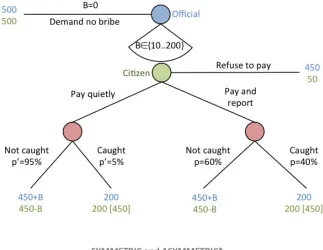
Figure 1 describes the harassment game. In stage 1, the official can opt out of bribe taking (𝐵= 0) and provide the service to the citizen, or choose to specify a bribe amount (𝐵) to ask from the citizen. In stage 2, if the official asks for a bribe, then the citizen can choose any of the three actions: (1) refuse to pay the bribe, (2) pay quietly, or (3) pay and report the bribe. Actions (2) and (3) lead to a probabilistic discovery of bribery and the final payoffs in these two cases depend on whether the act was discovered or not. The act of bribery is more likely to be discovered if the citizen has reported the demand.
treatment, both citizen and official are fined if caught. This represents the legal status quo in most countries, including India where our study was conducted. In a contrasting asymmetric liability treatment, only the official gets prosecuted and pays a fine while the briber enjoys impunity and gets her bribe-money back. Clearly, in the latter case, the bribe-giver is no longer discouraged from reporting a bribe demand, and in fact has a strictly positive incentive to report. This, in turn, should deter the official from asking for bribes.
To examine potential obstacles in the way to a successful implementation of the impunity scheme above we conduct two additional treatments. To address the concern about spiteful retaliation from the official’s side, the first of our additional treatments introduces retaliation in the asymmetric liability scenario; now officials who escape conviction even after being reported can retaliate and reduce the citizen’s payoff. In our game although retaliation is costly to the official, its mere availability might dissuade citizens from reporting bribe demands if they anticipate spiteful actions from the official. The second of our additional treatments addresses the practicality of bribe-returns to the citizen. We implement the asymmetric liability framework with bribes no longer returned, while officials continue to have the option of retaliating if conviction fails after whistle blowing. Since monetary incentives to report bribe demands are removed, this last treatment poses the toughest behavioural challenge to Basu’s proposal among the four situations.
We next describe the four games (Symmetric, Asymmetric, Retaliation and
No-Refund) in detail along with the payoffs and experiment parameters.
SYMMETRIC
Figure 1 presents the extensive form of the game. First, the official decides whether or not to demand a bribe. If he does not demand a bribe, the game ends and both players receive a payoff of 500 Indian rupees (Rs.). This outcome is the most efficient (in terms of joint payoff for the citizen and the official) and also equitable. Hence, it is salient that this is the socially preferred outcome.
If the official asks for a bribe, he also needs to specify how much to ask for in multiples of Rs. 10 up to a maximum of Rs. 200.6 The citizen has three
6 The upper bound on the bribe-ask cannot be determined independent of all other experimental
options: “Refuse to pay”, “Pay quietly”, or “Pay and report”. Refusing to pay the bribe is extremely costly for the citizen. In particular, the citizen’s payoff drops to Rs. 50, while the official retains 450 rupees, and the game ends. The decrease in the official’s payoff is motivated by detrimental effects that bribery has on social efficiency, which we wanted to capture in our design. Negative externalities have been previously captured in bribery experiments by imposing payoff reductions on other players in the lab (Abbink et al. 2002; Barr and Serra 2009; Cameron et al. 2009) or charities (Frank and Lambsdorff 2010). For our game, that did not seem appropriate since in contrast to collusive bribes, harassment bribes have no immediate effect on economic efficiency. If a service is delivered after a payment, then the bribe constitutes a mere redistribution from the citizen to the official. Yet we wanted to model the long-run detrimental effects of bribery, such as the loss of trust in good governance. Each act of bribery contributes to those damages, and everybody including those participating in bribery, suffers from them. We further wanted to keep the game as simple as possible, hence we chose this way of implementing the harmful effects of corruption.7
If the citizen chooses to either pay quietly or pay and report the bribe, the game enters the next stage. Then a lottery determines whether the act of bribery is detected and fines are imposed. The probability of detection and prosecution depends on whether the citizen has reported the bribe exchange. If the citizen has paid quietly, then there is only a small chance that the act is discovered which we set to 5 percent. Paying and reporting increases this probability to 40 percent.8 Note that even if a bribe payment is reported, detection and punishment are far from certain.
If prosecuted, the fines that citizens have to pay are the only difference between the symmetric and subsequent asymmetric treatments. For the experiment to be meaningful, we needed to parameterise such that behavioural effects can show up in either direction in each treatment. We conjectured that a monetary fine of Rs. 250, leading to a final payoff of Rs. 200 for each player in case of prosecution, would achieve this. We chose the level of fine such that we expected it to be high enough to serve as a deterrent, and yet not so high that
7 Since our experiment is one-shot, simplicity is of particular value in our design.
8 The probability of detection chosen is conservative but realistic as empirical estimates suggest
expected payoffs become so trivial that no one would consider engaging in bribery.
[image:9.612.152.475.200.450.2]A simple backward induction analysis of the game suggests that the monetary incentives are such that the citizen faced with a bribe demand will always pay quietly. The official anticipates this and chooses his best response -demand the maximum possible bribe.
Figure 1. The game tree – treatments without retaliation
ASYMMETRIC
This treatment introduces the briber leniency approach proposed by Basu (2011), and differs from the symmetric treatment only in the treatment of the citizen in case of detection. Here, only the official is fined (the same amount as in the symmetric treatment).9 The citizen is not held responsible and the bribe she has
9 Basu (2011) originally proposed that the fines for the official be doubled to keep the overall fine
paid is returned to her. Consequently, monetary incentives change now in a way that the citizen would always like to report if she is asked for a bribe. The backward induction logic in turn predicts that officials will shy away from demanding bribes, since not asking for a bribe is his best response to the citizen’s “pay-and-report” choice. Hence, we should observe no bribes demanded in equilibrium. Figure 1 above summarises the extensive form of the above two treatments.
RETALIATION
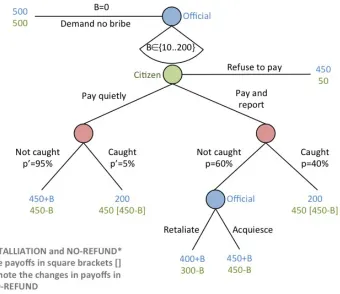
The analysis above provides sufficient optimism on the deterrent effect of the leniency program, at least in theory. In reality, however, a relatively low conviction rate might discourage whistle-blowing considerably, especially if the citizen is apprehensive of further harassment from the official in the future. In this case, the prospect of getting the bribe back after successful prosecution must be weighed against potential retaliation if the prosecution is unsuccessful, leading to the official to remain in office. We consider such a situation in the retaliation
treatment where the official has the option to be spiteful and reduce the citizen’s payoff if whistle blowing is unsuccessful. We assume though that the official needs to incur costs to do so. In particular, the official has to spend Rs. 50 to reduce the citizen’s final payoff by Rs. 150. This ratio (1:3) of cost to damages is consistent with previous experiments in which punishment options were studied (Gächter et al. 2008).
Since it is costly, an official would never retaliate in the sub-game on the basis of monetary payoff gains alone. Hence, the theoretical money-maximising equilibrium prediction remains as before, no-bribery in equilibrium. A plethora of previous experiments however suggest that retaliation even if costly, is carried out often; sometimes to encourage socially desirable outcomes (Gächter et al. 2008), sometimes to enforce outcomes that are socially inefficient (Abbink et al. 2010). Hence, we conjecture that even though not a part of the sub-game perfect equilibrium, a behavioural threat of retaliation can be credible and possibly diffuse the deterrent effects of the leniency program.
NO REFUND
creates the positive incentive to self-report. However, this feature of Basu’s proposal has been criticised as rather naïve. In reality, bribers rarely get a receipt for their payment, so it will be hard enough to prove the corrupt act as such, let alone the exact amount that changed hands. Hence, in practice a leniency program is more likely to rely on the citizen’s intrinsic motivation to report a bribe. Such motivations can exist, and in fact a citizen who is sufficiently upset about the unfairness and immorality of the situation might be willing to report even without the incentive of material benefits.10 The victim can also consider taking action if she believes to be serving a greater societal benefit.11
Figure 2. The game tree – treatments with retaliation
The no-refund treatment allows us to examine whether the leniency policy can work in the absence of monetary incentives. The treatment differs from the
10
See for example, citizen efforts in reporting bribes in India through the web portal www.ipaidabribe.com.
retaliation treatment only in the payoff for the citizen in case of the successful prosecution of the official. We introduce payoffs for the citizen such that it is not strictly better for the citizen to report a bribe as she does not get back the bribe even if whistle blowing turns out to be successful. The equilibrium prediction is now indeterminate. The citizen is indifferent between paying quietly and reporting the bribe payment.12As a result, multiple sub-game perfect Nash equilibria are possible, and behaviour in the experiment can offer some insight on preferred equilibrium behaviour. Figure 2 describes the extensive form of the above two treatments.13 Table 1 summarises the design features and predictions of the four treatments.
3. Procedure
All experimental sessions were conducted in Hyderabad, India, with undergraduate and graduate (Masters) students. Three hundred and sixty subjects participated in the experiment. Subjects were recruited by sending email invitations to the student association listservs in each of three prominent institutes in the city - BITS Pilani’s Hyderabad Campus, NALSAR Law University and the University of Hyderabad. We selected these institutions since they enrol students from all over India allowing us to recruit a subject group with a range of backgrounds. All four treatments were conducted in each institution. Each subject participated in only one of the treatments.
None of the institutions has had economic experiments before, so contamination from one session to another was a potential concern. Since anonymous recruiting systems were not in place, participants in later sessions could potentially be influenced by what they heard from participants in earlier sessions. To rule out such effects, the experiment was conducted in a single afternoon at each location. We held two large sessions with 60 subjects back-to-back, with the second session starting while the participants of the first session were still in the classroom. All subjects first met in a large lecture theatre and
12 It may even be costly for the citizen to report, in which case the citizen would have a strict
incentive not to report. We abstracted from such costs, assuming a situation where reporting facilities are put in place that make reporting costs trivial. Our goal was to study the effectiveness of leniency out of pure intrinsic motivation, where there are no incentives for or against reporting.
13 While several alternative policy treatments would be interesting to examine, we restricted our
were given general instructions. They were then divided into two groups of 30 subjects and led to one of two classrooms where we had prepared visual separation between the desks. The two groups participated in different treatments, which we conducted simultaneously. Detailed instructions were given by an instructor and to avoid possible experimenter effects, which might stem from the inevitable use of different instructors for the different groups, we made sure that the assignment of instructors to treatments was as balanced as possible.
Subjects within each group were randomly assigned to the role of an official or a citizen. The experimenter read the instructions aloud. Our objective was to simulate the context of a corrupt transaction and evoke associated emotional and moral responses. Therefore, we used in-context language consistently throughout the instructions (see the experimental instructions in the appendix). Barr and Serra (2009) find that bribes are less likely to be offered and accepted in the laboratory when the experimental instructions explicitly describe a bribery scenario instead of a more abstract description.14 Consequently, we can claim that if decisions were instead made under a more abstract description or under a greater social distance, then our experiment results can be looked upon as setting the lower bounds of corrupt behaviour. The use of context-specific instructions also improves the external validity of our results. Furthermore, we used real currency in the experiments ensuring that participants could comprehend and relate to the decision making more easily.
Subjects were asked to fill in their decision sheet where they made decisions for every situation in which they could be during the game. We chose to elicit complete strategies for two reasons. First, this method allows us to gather decisions for all possible decision nodes, including those that are not reached in the realised play. This increases data-effectiveness dramatically. Second, strategy elicitation compresses the multi-stage game into one with a single simultaneous move for each player. Our time-constrained setting did not allow us to shift decisions back and forth between the players.15
After the experiment was over, subjects completed a survey questionnaire first before collecting their experiment earnings. To compute earnings, the
14
Abbink and Hennig-Schmidt (2006) and Krajcova and Ortmann (2008) however find no significant differences between neutral and bribery frames.
15 Brandts and Charness (2009) survey experiments that have been conducted with both strategy
decision sheet for each official was randomly matched with a citizen who participated in the same treatment at the same location. Based on the decisions of each player, the payoffs were calculated and distributed to participants in a sealed envelope. The subjects earned an average of Rs. 493. At the time of the experiment, the exchange rate to other major currencies was approximately 1.95 US dollars, 1.54 euro and 12.50 Chinese yuan for 100 Indian rupees.
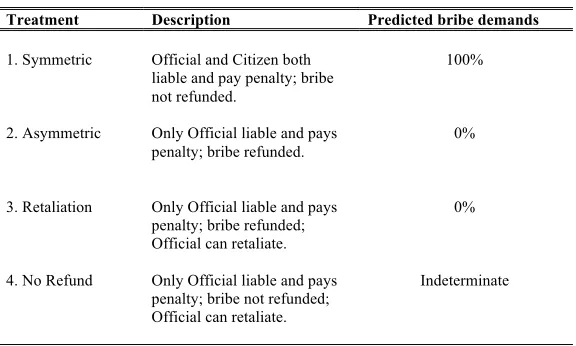
Table 1. Treatments
Treatment Description Predicted bribe demands
1. Symmetric Official and Citizen both liable and pay penalty; bribe not refunded.
100%
2. Asymmetric Only Official liable and pays penalty; bribe refunded.
0%
3. Retaliation Only Official liable and pays penalty; bribe refunded; Official can retaliate.
0%
4. No Refund Only Official liable and pays penalty; bribe not refunded; Official can retaliate.
Indeterminate
4. Results
4.1 Survey Results
that subjects answered these questions at the end of the experiment after all experiment decisions had been made.
4.2 Experimental Results
[image:15.612.113.499.277.531.2]We organise our results below in terms of the two players and their behaviour. Citizens’ actions are reported first, since leniency proposals are directly aimed at changing their behaviour. Officials’ anticipatory behaviour is reported next. Table 1 provides an overview of the treatments, along with the predicted equilibrium behaviour of officials.
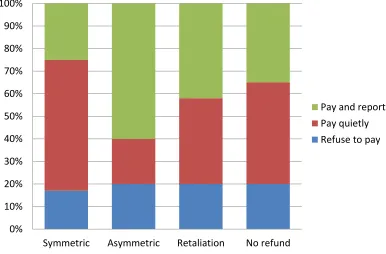
Figure 3. Citizens’ decisions – all bribe offers
Do Citizens report under impunity?
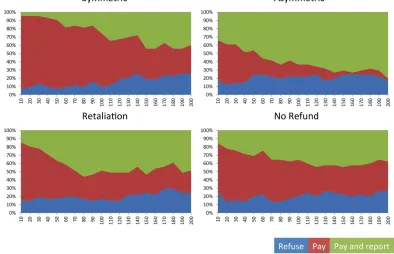
Figures 3 and 4 show the percentage of subjects who “Pay and report”, “Pay quietly” and “Refuse to pay”, respectively, in each of the four treatments. We find that consistent with Basu’s conjecture, the percentage of citizens who pay and then report the bribe-demand jumps from 25% to 59% under the asymmetric liability policy (a Mann-Whitney test rejects the null of equal means with p-value=0.001). Note that the increase in this percentage is not due to any
0% 10% 20% 30% 40% 50% 60% 70% 80% 90% 100%
Symmetric Asymmetric Retaliation No refund
perceptible change in the percentage of subjects who refuse to pay the bribe (see Figure 4). Rather it is caused by the decrease in the percentage of citizens who pay quietly (58% to 19%).
The increase in reporting behaviour however, goes down significantly from the
[image:16.612.119.513.289.543.2]asymmetric to the no-refund treatment where officials are allowed to retaliate and strict financial incentives from reporting are removed (a Mann-Whitney test rejects the null of equal means with p-value=0.01). In fact, we find that the average percentage of citizens “paying and reporting” slides back towards the mean of the symmetric treatment (a Mann-Whitney test fails to reject the null of equal means with p-value=0.65). These results suggest that allowing the possibility of retaliation by officials deters citizens’ reporting behaviour.
Figure 4. Citizens’ decisions conditional on bribe demanded
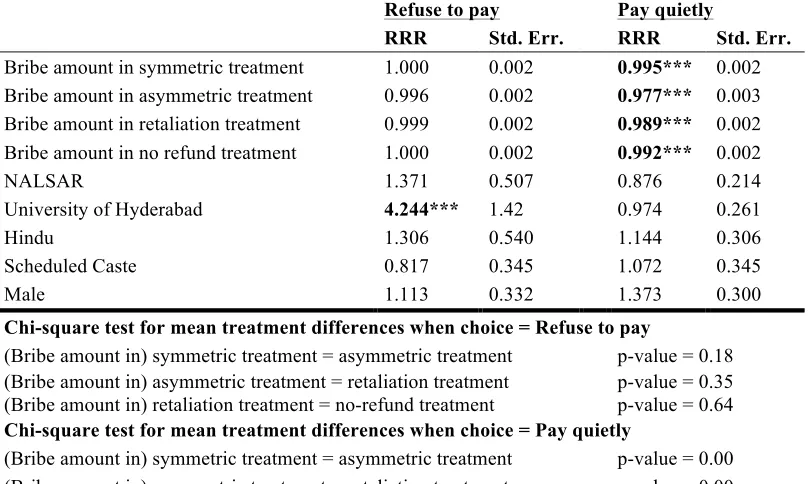
To investigate citizens’ behaviour in more detail, we estimate a multinomial logit model where citizens’ choices are a function of the amount of bribe demanded, controlling for the education institutions as well as some of the demographic characteristics of the participants. Results of this estimation are reported in Table 2. We find that irrespective of the treatment, a one-rupee increase in the bribe-demand significantly decreases the relative-risk-ratio of being in the “pay quietly” group compared to being in the base comparison group of “pay and report”. For example, in the symmetric treatment, a rupee increase in the bribe-ask leads to a decrease in the relative risk of the subject being in the “pay quietly” group compared to the “pay and report” group by a factor of 0.995 (see row 1 and column 3 of Table 2), and similarly for all the other three treatments.
Table 2: Multinomial logit estimates of citizen decisions
Notes: RRR is Relative risk ratio. “Pay and report” is the base outcome from the dependent variables. “BITS” is the omitted category from the independent variables. Standard errors clustered by participant. ***p<0.01.
The results confirm our observation that across treatments, as the size of the bribe demand increases it is more likely to be reported. Put alternatively, a
Refuse to pay Pay quietly
RRR Std. Err. RRR Std. Err. Bribe amount in symmetric treatment 1.000 0.002 0.995*** 0.002 Bribe amount in asymmetric treatment 0.996 0.002 0.977*** 0.003 Bribe amount in retaliation treatment 0.999 0.002 0.989*** 0.002 Bribe amount in no refund treatment 1.000 0.002 0.992*** 0.002
NALSAR 1.371 0.507 0.876 0.214
University of Hyderabad 4.244*** 1.42 0.974 0.261
Hindu 1.306 0.540 1.144 0.306
Scheduled Caste 0.817 0.345 1.072 0.345
Male 1.113 0.332 1.373 0.300
Chi-square test for mean treatment differences when choice = Refuse to pay
(Bribe amount in) symmetric treatment = asymmetric treatment p-value = 0.18 (Bribe amount in) asymmetric treatment = retaliation treatment
(Bribe amount in) retaliation treatment = no-refund treatment
p-value = 0.35 p-value = 0.64 Chi-square test for mean treatment differences when choice = Pay quietly
(Bribe amount in) symmetric treatment = asymmetric treatment p-value = 0.00 (Bribe amount in) asymmetric treatment = retaliation treatment p-value = 0.00 (Bribe amount in) retaliation treatment = no-refund treatment p-value =0.26
Pseudo R sqr. 0.102
small amount of bribe demand is less likely to be reported. The latter observation reveals that subject behaviour seems to indicate an established norm amongst the subject population where a large bribe demand is considered to be unfair, while a small bribe demand is acceptable and does not violate subjects’ fairness perceptions. Consequently, we observe an element of reciprocity in citizens’ choices where high bribe demands may be seen as unkind and trigger reporting. This is also observed in the symmetric treatment where reporting bribe demand is actually costly for the citizen. In contrast, low demands are possibly perceived as a relatively kind act from the official, and tolerated even in the asymmetric
treatment where the subject has only to gain monetarily should she decide to report.
The pairwise mean tests of treatment differences in Table 2 show that for the “pay quietly” option, behaviour is significantly different across treatments for the first two comparisons, but not for the comparison between the retaliation and no-refund treatment. These tests also indicate that consistent with Figure 4, the percentage of subjects who “refuse to pay” remain unaltered across treatments. This suggests that at least in our experiment, citizens on an average do not change their behaviour due to the introduction of leniency programs that might signal moral acceptability.
Do officials demand fewer bribes?
We next examine whether giving immunity to citizens induces any anticipatory change in bribe demands by officials. Recall that Basu’s hypothesis was that the asymmetric liability ought to not only change citizens’ behaviour, but also discipline officials’ bribe demands. Accordingly, the backward induction analysis in our asymmetric and retaliation games predicts that in the unique sub-game perfect Nash equilibrium, officials do not demand any bribes. Overall, in our experiment the officials seem to show a weaker response to variations across treatments compared to citizens. One possibility is that they might not be thinking in a backwardly inductive manner. Officials might also face an additional level of strategic uncertainty compared to citizens, as they have to foresee the citizens’ response while citizens can condition their choice on the official’s demand. This additional level of uncertainty can possibly dilute some of the treatment effects.
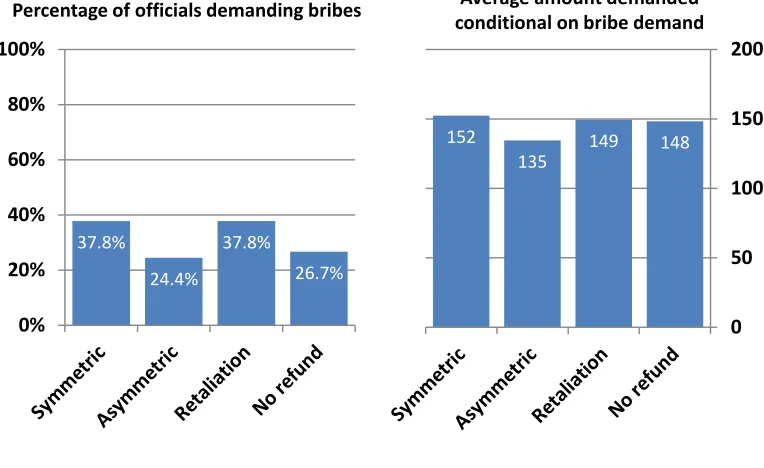
situation (a Mann-Whitney test rejects the null of equal means with p-value=0.08). The average bribe amount demanded by the officials also goes down from Rs. 152 to Rs. 135 rupees, although this is not statistically significant.16 The drop stems from fewer bribe demands, not the amount that is asked for. Figure 5 describes the average bribes asked in each treatment, here conditional on there being a positive bribe demand. These averages are very similar across all treatments and no difference is statistically significant. One might hypothesise that officials may try to compensate for the higher risk of being reported under asymmetric liability by demanding higher bribes, but our data do not provide any indication for this.
[image:19.612.116.498.391.625.2]When officials are allowed to retaliate, 44% chose to pay money (Rs. 50) to reduce the citizen’s payoff (by Rs. 150) in the retaliation treatment and 33% in the no-refund treatment (this difference is not statistically significant). The proportion of officials demanding bribes increases as anticipated. In fact, behaviour in the retaliation and no-refund treatments suggests that the disciplinary effects of briber impunity dissipate away considerably for officials. Figure 5 shows that 38% and 27% of officials demand bribes in the two treatments. The average amount of bribes demanded are Rs. 149 and Rs. 148 respectively, lower than in the symmetric treatment but higher than the asymmetric treatment.
Figure 5. Officials’ behaviour
16
Despite the high bribe amount, the overall level of bribes is low, with at least 62% of officials not demanding bribes. This might indicate either aversion to corruption or risk aversion.
Percentage of officials demanding bribes
37.8%
24.4%
37.8%
26.7%
0% 20% 40% 60% 80% 100%
152
135
149 148
0 50 100 150 200
Table 3: Probit estimates of Official behaviour
Notes: “Asymmetric” treatment, “Female” and “BITS” are the omitted categories from the independent variables. Robust standard errors reported in parentheses. Specification includes a religion dummy along with a set of interaction dummies between treatment dummies and the religion dummy. These are not reported here for ease of exposition. **p<0.05 and ***p<0.01.
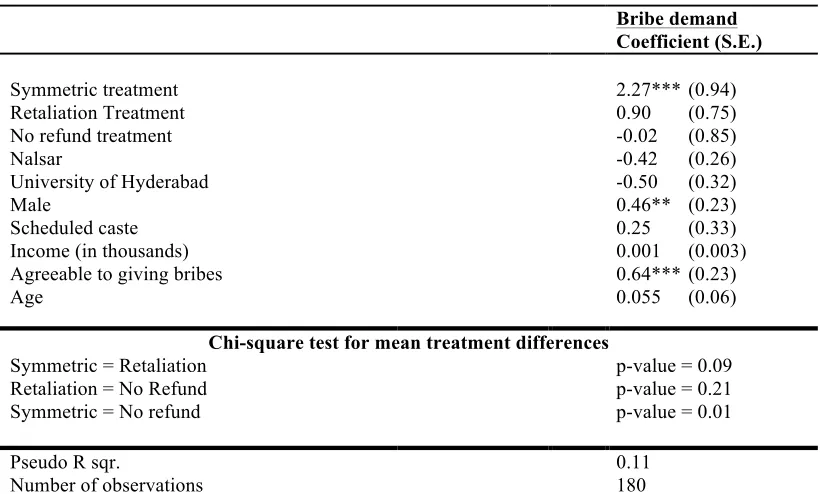
We next report results from a probit regression with robust standard errors (see Table 3) that examine the determinants of official behaviour, controlling for variables from our post-experiment survey.17 Results confirm our earlier observation that asymmetric liability decreases bribe demand compared to the baseline situation of symmetric liability. Interestingly, we find that subjects who report that they are agreeable to giving bribes on the post-experiment survey are significantly more likely to ask for bribes. Also, male subjects seem to ask for more bribes than female students, a finding consistent with previous experimental findings (Alatas et al. 2009; Frank, Lambsdorff and Boehm 2011) as well as other empirical findings (Lambsdorff and Fink 2006). Chi-square tests for mean differences in treatments indicate further that official’s behaviour is only marginally different between the symmetric and the retaliation treatment;
17 In our specification we included controls for religion (Hindu or non-Hindu), as well as
interaction terms of the religion dummy with the treatment. Although our results seem to suggest that Hindus ask for bribes significantly more often, we realise that our total sample is relatively small (49 out of 147 Hindus ask for a bribe in all the four treatments together, and 8 out of 33 non-Hindus ask for a bribe in all the four treatments together) to convincingly conclude whether religion affects the propensity to engage in bribe-taking behaviour. Accordingly, we have not reported the dummies related to religion and its interaction with the treatments.
Bribe demand Coefficient (S.E.)
Symmetric treatment 2.27*** (0.94)
Retaliation Treatment 0.90 (0.75)
No refund treatment -0.02 (0.85)
Nalsar -0.42 (0.26)
University of Hyderabad -0.50 (0.32)
Male 0.46** (0.23)
Scheduled caste 0.25 (0.33)
Income (in thousands) 0.001 (0.003)
Agreeable to giving bribes 0.64*** (0.23)
Age 0.055 (0.06)
Chi-square test for mean treatment differences
Symmetric = Retaliation p-value = 0.09
Retaliation = No Refund p-value = 0.21
Symmetric = No refund p-value = 0.01
Pseudo R sqr. 0.11
official’s behaviour is also not significantly different between the retaliation and the no-refund treatments.
Between the symmetric and the no-refund treatment, there are three features that are different; namely, addition of the asymmetric liability, official’s ability to retaliate, and removal of strict monetary incentives for the citizens. Therefore, we cannot discern causality in the difference in officials’ behaviour between the two treatments. However, the chi-square tests of mean differences establish that officials demand significantly lower bribes compared to the
[image:21.612.118.504.293.540.2]symmetric treatment. We infer from this result that even in the strongest test of Basu’s policy, the disciplinary effect remains present.
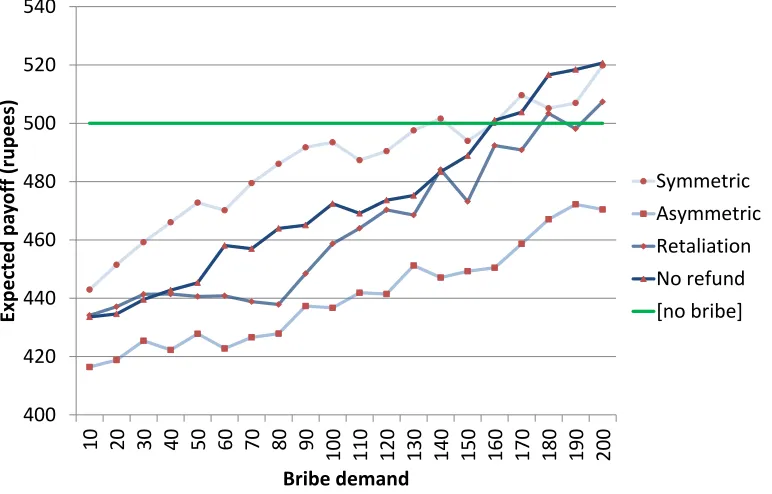
Figure 6. Expected official payoff conditional on bribe demand
The question arises whether asymmetric liability affects the profitability of bribe demands. Since we elicited complete strategies from the citizens, we can calculate the expected empirical payoff from each bribe level. The results are depicted in Figure 7, not including money officials may spend on retaliation. It can be seen that expected payoffs generally increase with the bribe demand. Thus,
400 420 440 460 480 500 520 540
10 20 30 40 50 60 70 80 90
1 00 1 10 1 20 1 30 1 40 1 50 1 60 1 70 1 80 1 90 2 00 Ex pect
ed
pa y off (r up ees)
Bribe demand
the citizens’ higher propensity to report high bribes does not compensate for the extra income generated by them. In three of the four treatments the most profitable strategy for officials is to demand the maximum bribe. Only in the asymmetric treatment without retaliation expected payoffs for all bribe levels remain below the payoff of Rs. 500 that an official obtains if he does not demand a bribe. Note, however, that this payoff is sure, while payoffs after demanding a bribe are uncertain. For risk-averse officials not demanding a bribe may still be an attractive proposition, even if they are motivated by own payoff considerations alone.
5. Conclusion
Motivated by Basu’s (2011) policy proposal of providing legal immunity to bribe-givers in the case of harassment bribes and the ensuing debate, we evaluate the effectiveness of an asymmetric liability policy using laboratory experiments. We incorporate two extensions to the basic policy prescription by Basu to provide behavioural evidence on the effectiveness of the policy when bribe-takers have the option to retaliate on whistle-blowers if the prosecution is not successful, and the impact of non-monetary incentives in reporting bribe demands.
We find that compared to symmetric liability, allowing legal immunity to the bribe-givers increases reporting of bribe-demands and reduces the demand for bribes. We also find that a substantial minority of citizens refuse to pay bribes, across treatments despite significant monetary costs of doing so. This is not surprising, since refusals to pay may be driven more by principles rather than incentives. An implication of this is that Basu’s proposal does not change the moral authority of the law on citizens’ behaviour and consequently the proposed change in the liability does not have to be interpreted as a “licence to bribe”.
Comparing behaviour in the retaliation and no-refund treatments shows that strict financial incentives do not necessarily drive reporting behaviour. Non-monetary factors can motivate reporting behaviour as well This could be beneficial in the field as often monetary incentives (such as return of the bribe money) are difficult to operationalize.
demands and reporting return closer to the original levels of the symmetric liability case.
Our finding suggests that Basu’s proposal should be implemented along with complementary measures such as policies to rotate officials in different posts to mitigate the effectiveness of retaliation against citizens who report bribe demands (see, for example, Abbink, 2004). In addition, to protect citizens’ vulnerability, whistle blowers may need to be given protection such as anonymity for reporters. Finally, policymakers could aim to increase the probability of successful prosecution after whistle blowing.
We conclude that bolstering the institutional set-up is important to realise the full benefits of this leniency policy. Basu’s policy proposal can be a credible step towards fighting harassment bribes as long as care is taken to introduce additional measures that reduce the power of officials, improve the protection of whistle blowers and promote better prosecution of the accused.
References
1. Abbink, K. (2004). Staff rotation as an anti-corruption policy: An experimental study. European Journal of Political Economy, 20(4), 887-906.
2. Abbink, K. (2006). Laboratory experiments on corruption. In: S. Rose-Ackerman (ed.), International Handbook on the Economics of Corruption. Cheltenham: Edward Elgar.
3. Abbink, K., Brandts, J., Herrmann, B., and Orzen, H. (2010). Inter-group competition and intra-group punishment in an experimental contest game. American Economic Review, 100(1), 420-447.
4. Abbink, K., and Hennig-Schmidt, H. (2006). Neutral versus loaded instructions in a bribery experiment. Experimental Economics, 9(2), 103-121.
5. Abbink, K., Irlenbusch, B., and Renner E. (2002). An experimental bribery game. Journal of Law, Economics, and Organization, 18(2), 428-454.
6. Alatas, V., Cameron, L., Chaudhuri, A., Erkal, N., and Gangadharan, L. (2009). Gender, culture, and corruption: Insights from an experimental analysis. Southern Economic Journal, 75(3), 663-680.
7. Alatas, V., Cameron, L., Chaudhuri, A., Erkal, N., and Gangadharan, L. (2009). Subject pool effects in a corruption experiment: A comparison of Indonesian public servants and Indonesian students. Experimental Economics, 12(1), 113-132.
8. Apesteguia, J., Dufwenberg, M., and Selten, R. (2007). Blowing the whistle. Economic Theory, 31(1), 143-166.
9. Banuri, S., and Eckel, C. (2012). Experiments in culture and corruption: A review. Policy Research Working Paper Series 6064, The World Bank.
10. Banuri, S., Eckel, C., and Wilson, R. (2010). Experimental bribery in context: Comparing the U.S. and Pakistan. Center for Behavioural and Experimental Economic Science, working paper #09-01.
11. Bardhan, P. (1997). Corruption and development: A review of issues. Journal of Economic Literature, 35(3), 1320-1346.
13. Basu, K. (2011). Why, for a class of bribes, the act of giving a bribe should be treated as legal. Ministry of Finance Working Paper.
14. Bigoni, M., Fridolfsson, S., Le Coq, C. and Spagnolo, G. (2012). Fines, leniency and rewards in antitrust: An experiment. RAND Journal of Economics, 43(2), 368-390.
15. Cameron, L., Chaudhuri, A., Erkal, N. and Gangadharan, L. (2009). Propensities to engage in and punish corrupt behaviour: Experimental evidence from Australia, India, Indonesia and Singapore. Journal of Public Economics, 93(7-8), 843-851.
16. Dreze, J. (2011). The bribing game. Indian Express, April 23, 2011.
17. Dufwenberg, M. and Spagnolo, G. (2011). Legalizing bribes. Mimeo, Stockholm School of Economics.
18. Engel, C., Görg, S., and Yu, G. (2012). Symmetric vs. asymmetric punishment regimes for bribery. Legal Studies.
19. Frank, B., and Lambsdorff, J. (2010). Bribing versus gift-giving - An experiment, Journal of Economic Psychology, 31(3), 347-357.
20. Frank, B., Lambsdorff, J., and Boehm, F. (2011). Gender and corruption: Lessons from laboratory corruption experiments. The European Journal of Development Research, 23(1), 59-71.
21. Frey, B. and Oberholzer-Gee, F. (1997) The cost of price incentives: An empirical analysis of motivation crowding-out. American Economic Review, 87(4), 746-755.
22. Gächter, S., Renner, E. and Sefton, M. (2008). The long-run benefits of punishment. Science, 5 December, 322. 1510.
23. Krajcova, J. and Ortmann, A. (2008). Testing leniency programs experimentally: The impact of “natural” framing. CERGE-EI Working Paper Series No. 372.
24. Lambsdorff, J., and Fink, H. (2006). Combating corruption in Colombia: Perceptions and achievements. Passauer Diskussionspapiere No. V-44-06
25. Lowen, A. And Samuel, A. (2012). Bribery and endogenous monitoring effort: An experimental study. Eastern Economic Journal, 38(3), 356-380.
26. Mauro, P. (1995). Corruption and growth. Quarterly Journal of Economics, 110(3), 681-712. 27. Miron, J. (1999). The effect of alcohol prohibition on alcohol consumption. Retrieved from
http://www.nber.org/papers/w7130
28. National Crime Records Bureau (2010) Crime in India: Statistics, Ministry of Home Affairs, New Delhi.
29. Rose-Ackerman, S. (1978). Corruption: A Study in Political Economy, New York: Academic Press.
30. Rose-Ackerman, S. (2006). The International Handbook on the Economics of Corruption. Cheltenham: Edward Elgar.
31. Rose-Ackerman, S., and Soreide, T. (2011). The International Handbook on the Economics of Corruption. Volume 2. Cheltenham: Edward Elgar.
32. Schickora, J. (2011). Bringing the four-eye-principle to the lab. Munich discussion paper. 33. Serra, D. (2012) Combining top-down and bottom-up accountability: Evidence from a bribery
experiment. Journal of Law, Economics and Organization, 28(3), 569-587.
34. Serra, D. and Wantchekon, L., eds. (2012). New Advances of Experimental Research on Corruption. Research in Experimental Economics, Vol. 15.
35. Shleifer, A., and Vishny, R. (1993). Corruption. Quarterly Journal of Economics, 108(3), 599-617.
Appendix
The experimental Instructions
(For the Retaliation treatment, other treatments are analogous)
Player No. _________
You have been randomly assigned the role of Citizen/Official in today’s experiment.
General
Welcome to today’s economics experiment. This is an experiment in decision making which will provide you an opportunity to earn money. The amount of money you earn depends on your decisions and a randomly matched participant’s decisions in the experiment. Your earnings in the experiment will be paid to you in cash privately, at the end of the experiment. Please do not talk to each other during the experiment.
In the experiment you will be matched with another player in the room for the rest of the experiment. You will not know who you are matched with, either during or after the experiment. You and the matched player will be presented with an economic decision-making situation that resembles a real-life situation. One of you will be randomly assigned a role as a Government Official, and the other as a Citizen. You will be provided with a Personal Record Sheet that will state the role you have been assigned in the experiment.
Overview of the Experiment
In this experiment, the Official can decide to ask the Citizen for a bribe or can decide not to ask the citizen for a bribe.
If the Official decides to ask for a bribe, then the Official has to choose the amount he wants as bribe from the Citizen. The Citizen then has three options. S/he can refuse to pay the bribe, pay the bribe, or pay the bribe and report the bribe demand. Reporting the bribe makes it much more likely that the Official is caught and fined.
If the Citizen has reported the bribe, but the authorities have not found sufficient evidence to fine the Official, then the game moves to another stage, in which the Official can reduce the Citizen’s income by incurring a cost.
Though the game has up to three stages in which one player needs to make a decision, everybody needs to fill in the decision sheet only once. You will make decisions for every situation in which you can be during the game. We will then collect your decision sheets and pay you according to your decision and the decisions of the other participant you are matched with.
Attached is a Figure which summarizes the structure of the experiment. The sheet labelled “Questions” provides some examples that might help you in understanding the payoffs associated with different decisions. However, before looking at the examples, let us first look at the detailed instructions for each participant.
Detailed Instructions for Officials
If you are assigned the role of the Official in today’s experiment, you have to first decide whether to ask the Citizen for a bribe or not. If you decide not to ask for a bribe, then you get Rs. 500, and the Citizen gets Rs. 500.
If instead, you decide to ask for a bribe, you have to decide how much to ask for. You can ask any amount (B) between 10 and 200 in multiples of Rs. 10.
After the Citizen has decided, a random draw determines whether there is sufficient evidence that you are fined. If there is not sufficient evidence, then you receive Rs. 450 plus the bribe you have asked for. The Citizen receives Rs. 450 less the bribe s/he has paid to you. If there is sufficient evidence, then you receive a fine and you must return the bribe and in addition pay a fine. Your payoff after this stage is then Rs. 200. The Citizen gets the bribe back; hence his/her payoff is Rs. 450.
If the Citizen has reported the bribe, but there has not been sufficient evidence, then the game enters a third decision stage. You can spend Rs. 50 from your final earnings to reduce the Citizen’s payoff by Rs. 150; in that case, you will receive as your final payments Rs. 400 plus the amount of bribe you had asked for earlier; the Citizen will end up receiving Rs. 300 less the amount of bribe s/he paid to you. If you choose not to reduce the Citizen’s payoff, then the final payoffs are the payoffs after stage 2: You receive Rs. 450 plus the bribe, the Citizen receives Rs. 450 less the bribe.
As an Official you make decisions at up to two stages. In the beginning you decide on whether you ask for a bribe and if so, how much you demand. If you decide to ask for a bribe, then it is possible that you need to make another decision at the third stage. In case that the Citizen reports the bribe but you do not get fined you can choose whether or not to reduce the Citizen’s payoff. We ask you to make this decision already in the beginning. It is possible that your decision for the third stage is not carried out, depending on the decisions of the Citizen and the outcome of the random draw. We nevertheless ask you to make a decision for this case beforehand, such that we do not need to return the decision sheet to you until the game is completed.
Detailed Instructions for Citizens
If you are randomly assigned the role of the Citizen in today’s experiment, it will be the Official who makes a decision first and you respond to it. First the Official decides whether or not to ask for a bribe. If s/he does not ask for a bribe, then you get Rs. 500, and the Official gets Rs. 500.
If instead, the Official decides to ask for a bribe, you are told how much the Official asks for.
If the Official asks for a bribe, you have the following options. First, you can refuse to pay the bribe. In this case the game ends and your payoff is Rs. 50; the Official’s payoff is Rs. 450. If you decide to pay the bribe, you can decide whether or not to report the Official’s bribe demand. Your decision to report determines the probability with which the Official is fined. If you do not report the bribe, then the probability of the Official being fined is 5%. If you report the bribe, then this probability increases to 40%.
After you have decided to pay the bribe, a random draw determines whether there is sufficient evidence that the Official is fined. If there is not sufficient evidence, then you receive Rs. 450 minus the bribe you paid out. The Official receives Rs. 450 plus the bribe you have paid to him/her. If there is sufficient evidence, then you get back the bribe you have paid and your payoff after this stage is Rs. 450. The Official receives a fine, his/her payoff after this stage is then Rs. 200.
If you have reported the bribe, but there has not been sufficient evidence, then the game enters a third decision stage. The Official can spend Rs. 50 from his/her final earnings to reduce your payoff by Rs. 150; in that case, you will receive as your final payments Rs. 300 less the amount of bribe you paid to the Official. The Official receives Rs. 400 plus the amount of bribe you have paid to him/her. If the Official chooses not to reduce your payoff, then the final payoffs are the payoffs after stage 2: You receive Rs. 450 less the bribe, the Official receives Rs. 450 plus the bribe.
As a Citizen you make decisions at the second stage, after the Official has decided on the bribe demand. The Official can either not demand a bribe, in which case you do not make a decision. If the Official demands a bribe, s/he can ask for twenty different amounts of bribe from 10 to 200 (in steps of 10). We ask you to make a decision for each bribe amount asked from you beforehand. Your decision sheet comprises a table with all twenty possible amounts. For each amount you tick a box whether you want to refuse to pay the bribe, pay without reporting, or pay and report the bribe demand if the Official demands this amount. We will then collect the Official’s decision sheets together with yours, and carry out the decision you specified for the amount the Official has chosen (if any).
Control Questions
(These questions aim to help you understand the experiment better and should not be used as a guide for decision-making in the experiment.)
1. Assume that the Official asks for a bribe of Rs. 150. Suppose that the Citizen he is matched with decides to report the bribe and the Official is caught and fined. What will be the earnings of the Official and the Citizen in this group?
a. Official: Rs b. Citizen: Rs
2. Suppose that the Official asks for a bribe of Rs. 80. The Citizen reports the bribe demand. The Official is not caught however and he decides to spend Rs. 50 to reduce the payoffs of the Citizen. What will be the earnings of the Official and the Citizen in this group?
a. Official: Rs b. Citizen: Rs
3. What will be the earnings of the Official and the Citizen in the group, if the Official does not ask for a bribe?
a. Official: Rs b. Citizen: Rs
4. Suppose that the Official asks for a bribe of Rs. 200. The Citizen does not report the bribe demand. The Official is not caught. What will be the earnings of the Official and the Citizen in this group?
a. Official: Rs b. Citizen: Rs
5. Suppose that the Official asks for a bribe of Rs. 100. The Citizen refuses to give the bribe. What will be the earnings of the Official and the Citizen in this group?
Post-Experiment Survey
Instructions: Please answer ALL of the questions on this survey as accurately as you can. All
responses will be kept confidential by the researchers and will not be revealed to any authorities within the university or outside. Leave blank if you do not wish to answer.
1. What is your date of birth? Month: ___________ Year: __________
2. What is your gender?
€ Male € Female
3. What is your religion?
€ Hindu
€ Muslim
€ Christian
€ Sikh
€ Other (Please specify__________________)
€ Don’t know
4. What is your caste?
€ Scheduled caste
€ Scheduled tribe
€ Other backward classes
€ Upper caste
€ Other (Please specify _________________)
€ Don’t know
5. What is your program and year of study at the University or Institute? (Mark only one )
€ Bachelor’s student (BA, BSc, BE, etc.)
• Circle Year 1/2/3/4/5
€ Master’s student (MPhil, MA, MSc, MTech, MBA, LLB etc.)
• Circle Year 1/2/3/4/5
€ Other (Please specify _________________ )
6. What is your field of study (specialization) in the program? ______________________________
7. Last year, what were your average marks/ grades in the program? _____ out of _________
8. How much work experience do you have? (Mark all that apply)
€ None
€ Internship __________ months. Employer(s):_________________________
€ Full-‐time work __________ years. Employer(s):_________________________
9. In the last year, how much did you earn? Include all sources. Rs. ______________
10. What were the source(s) of this income? (Mark all that apply)
€ Employment (part time/ full time job)
€ Scholarships
€ Other (Please specify _________________ )
11. How do you most hear about corrupt behaviour? (Mark only one) Through personal experience.
Through the experiences of family or friends By reading magazines or the newspaper By listening to the news on TV or radio Through an academic course
Other (Please specify _________ ________)
12. In what context do you most hear about corrupt behaviour? (Mark only one) Corruption scandals involving politicians and bureaucrats
Corruption scandals involving companies and rich individuals Harassment of ordinary people for basic services
Other (Please specify _________________ )
13. In what context do you most experience corrupt behaviour? (Mark only one) I receive poorer quality public infrastructure because of corruption Other people get ahead in education and career because of corruption I have to give bribes frequently for basic government services
I have to give bribes frequently for services by private service providers I have to give bribes occasionally for basic government services
I have to give bribes occasionally for services by private service providers Other (Please specify ________________ )
14. In which contexts have you ever given a bribe? (Mark all that apply)
To get household services such as electricity, water or telephone connection To get services in a bank, post office, insurance company or transport office To get educational services at a school, college or for a scholarship
Other (Please specify _________________ ) I have never given a bribe
15. Which of the following best describes the anti-‐corruption law in India? (Mark only one) If caught, both the bribe giver and taker are committing an illegal act
If caught, the bribe taker is committing an illegal act, but the bribe giver is not responsible
If caught, the bribe giver is committing an illegal act, but the bribe taker is not responsible
If caught, neither the bribe giver nor taker are committing an illegal act I don’t know anything about the anti-‐corruption law in India
16. Do you think that it is useful to have a system where there is a way to get what you want even if you have to bribe? (Mark only one)
Yes No
17. In which of the following situations have you jumped or cut a queue? (Mark all that apply)
€ While waiting to buy a ticket
€ Boarding a bus
€ Boarding a train
€ In government offices