The Method Exploration for Measuring the Strain of the
Intervertebral Disc
Qinghua Xue1, Weiqiang Liu1, Zhenhua Liao2
1Department of Precision Instrument and Mechanology, Tsinghua University, Beijing, China 2Research Institute of Tsinghua University in Shenzhen, Shenzhen, China
Email: [email protected]
Received February 17, 2013; revised March 20, 2013; accepted April 1,2013
Copyright © 2013 Qinghua Xue et al. This is an open access article distributed under the Creative Commons Attribution License, which permits unrestricted use, distribution, and reproduction in any medium, provided the original work is properly cited.
ABSTRACT
Many researches point out that intervertebral pressure and transformation are key parameters for evaluating interverte- bral disc degeneration. Aiming at avoiding the damage caused by direct and indirect measuring methods, this research proposes a cylindroid hypothesis and measuring method, which can monitor the strain condition of the intervertebral disc in vivo and real-time without being damaged.
Keywords: Cylindroid Hypothesis; Intervertebral Strain; Degeneration
1. Introduction
According to incomplete statistical analysis, around 7% - 10% of the 1.3 billion people in China have some kind of cervical disease. It shows a growing trend. After some kind of treatment, the motion function of the fused seg- ments is lost forever and the adjacent level becomes de- generate easily [1]. Both biochemical and mechanical fac- tors are thought to deal with the cascade of events caused by degeneration [2,3]. Many researches have pointed out that intervertebral pressure and transformation were the key parameters for evaluating degeneration. Monitoring the intervertebral strain in vivo was very important for evaluating the long-term result of surgery and checking the degeneration of the adjacent levels [4,5]. Many ana- lytic or geometric and finite element models have been developed to describe the structural response of interver- tebral discs [6]. At present, direct measurement can’t be done nondestructively [7], indirect measurement and simu- lation can’t reach an agreement [8-10].
Based on the physiology structure and properties of the intervertebral disc, this study raised a solution that could monitor the intervertebral strain in vivo without being damaged. It can solve the intervertebral disc strain meas- ure dilemma that direct measure methods can only be executed on a few healthy volunteers and other simulation or indirect measures are too hard to achieve an agreement. Aiming at getting the strain condition of the interverte- bral disc, a mathematic model and a measurement system based on strain gauges was built. In our hypothesis, the
complete strain condition and the dimension of the disc can be calculated by only fixing 6 strain gauges on the front side of an intervertebral disc.
2. Description of the Intervertebral Disc
Strain Measurement Model
2.1. Definition of Initial Condition
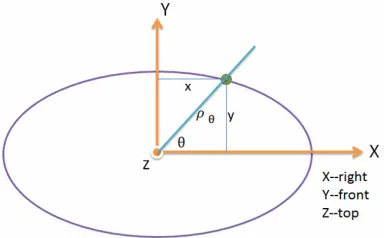
[image:1.595.328.521.599.718.2]In some imaging measurement about intervertebral disc, we can easily find out that the transverse section of the disc is an axialsymmetrypolygonwith a smooth border. At first, the study assumes the geometric shape of the inter- vertebral disc as a cylindroid, sets the origin at the geo- metric center and establishes a coordinate in the vertical view. As Figure 1 shown, the right side is set as the X axis, the front side is set as the Y axis, and the top side is set as the Z axis.
According to the result of actual measurement, the length in the coronal plane is longer than the length in the sagittal plane, the expression of the side face of the disc in Cartesian coordinates is:
2 2
1
x y
A B
A is the long axis of the ellipse, B is the short axis of the ellipse, and A > B. As the dimension of the ellipse can’t be measured in vivo, A and B are both unknown. With the help of the transfer equation between Cartesian coordi- nates and polar coordinates:
cos
x (2)
sin
y (3) We can rewrite (1) as:
2 2
cos sin 1
A B
(4)
Link a certain point on the ellipse’s angle with the ori- gin, the angle between the X axis and it is , is the distance between from the point to the origin. Any point on the ellipse can be described as
,
.2.2. Equation of Geometric Condition
In order to realize the nondestructive measurement, only a bit of arc symmetric with Y axis is available.
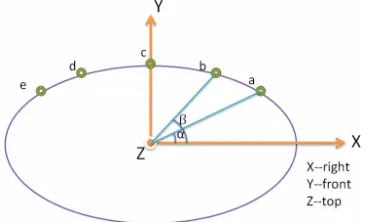
[image:2.595.63.287.237.317.2] [image:2.595.82.264.480.574.2]As Figures 2 and 3 show, 6 strain gauges were pack- aged in flexible PCB and fixed on the front surface of the intervertebral disc, symmetrical with YZ plane. ab = de and bc = cd.
Figure 2. Front view of the strain gauges’ location.
Figure 3. Top view of the strain gauges’ location.
a, for
th
in
b, c, d, e are tensile strain gauges and sensitive e tension in Z direction. f is a shear strain gauge and sensitive for the in torsion Z direction. The measuring result of f is independent to others’ equation, we focus on the geometric equation and strain equation of a, b, c, d, e.
After fixing the flexible PCB right in the front of the tervertebral disc, there are only 4 independent parame- ters: , , , .
The location of a, b, c, d, e are respective:
,
,
,
,
π 2,B
,
π ,
,
π ,
. We can get 2 independent equations:2
cos sin
2 1
A B
(5)
2 2
cos sin
1
A B
(6)
Add the arc length formula of plane curve:
2 2ds dx dy (7)
We can get:
π2 2 2 2 2
sin cos d
a
l ac
A B (8)π2 2 2 2 2
sin cos d
b
l bc
A B (9)In the equation above: la and lb are known quantity, , ,
,
are unknown quantity.
2.3. Equation of Physical Condition
In the normal stress analysis theory, the entire deforma-
patibility, the st
tion of the intervertebral disc can be resolved into 4 kinds: 1) Bending deformation in X direction;
2) Bending deformation in Y direction; 3) Bending deformation in Z direction; 4) Torsional deformation in Z direction. According to the equation of strain com rain at a, b, c, d, e can be described as below:
sin cos
a x y N
(10)
sin cos
b x y N
(11)
c B x N
(12)
sin cos
d x y N
(13)
sin cos
e x y N
(14)
2.4. Model Summary
including 7 known quantities: In summary, the model
, , , , , , a b a b c d e
l l , details are shown in Table 1. ntities: A B, , , , , , N, x,
9 unknown qua y
.
[image:2.595.79.263.486.664.2] [image:2.595.81.264.608.719.2]Table 1. Description of known quantity.
Name Unit Description
a
l mm gDistaauge ance between st and strain gauge rain c
b
l mm gDistance between strain auge b and strain gauge c
a
non-dimension Output value of strain gauge a
b
non-dimension Output value of strain gauge b
c
non-dimension Output value of strain gauge c
d
non-dimension Output value of strain gauge d
e
[image:3.595.341.541.216.476.2] non-dimension Output value of strain gauge e
Table 2. Description of unknown quantity.
Name Unit Description
A mm Long axis radius of the intervertebral disc
B mm Short axis radius of the intervertebral disc
A rad The angle between point a and the X axis
B rad The angle between point b and the X axis
mm The distance between point a and the origin
mm The distance between point b and the origin
N
non-dimension Strain caused by the axial load
x
mm The intervertebral disc’s radius of curvature in plane YZ
y
mm The intervertebral disc’s radiof curvature in plane XZ us
9 independent equations: 2 cos
sin 2
1
A B
(5)
2 2 cos sin 1 A B
(6)
π2 2 2 2 2
sin cos d
a
l ac A B
(8)π2 2 2 2 2
sin cos d
b
l bc
A B (9)sin cos
a x y N
(10)
sin cos
b x y N
(11)
c B x N
(12)
sin cos
d x y N
(13)
sin cos
e x y N
After solving the equation system above, we B
(14)
can bring and f into the shear strain equation:
d B d f z
(15)
Then we can get the parame st
ter describing torsional rain in Z direction: d
z
d
.
3. Solution
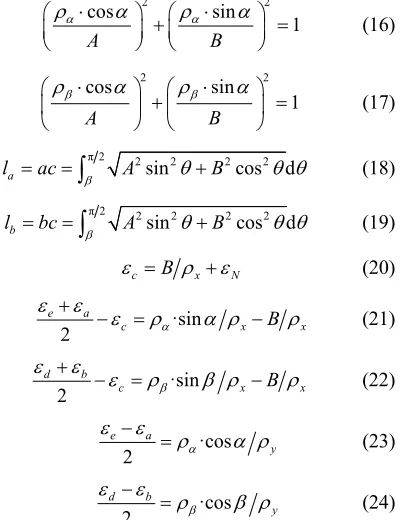
uation system can be described as For convenience, the eq
below: 2 2 cos sin 1 A B
(16)
2 2 cos sin 1 A B
(17)
π2 2 2 2 2
sin cos d
a
l ac A B
(18)π2 2 2 2 2
sin cos d
b
l bc
A B (19)c B x N
(20)
·sin 2
e a
c x B
x
(21)
·sin 2
d b
c x B
x
(22)
·cos 2 e a y (23) ·cos 2 d y b
(24)
Because the elliptic integral exists in Equations (18) an
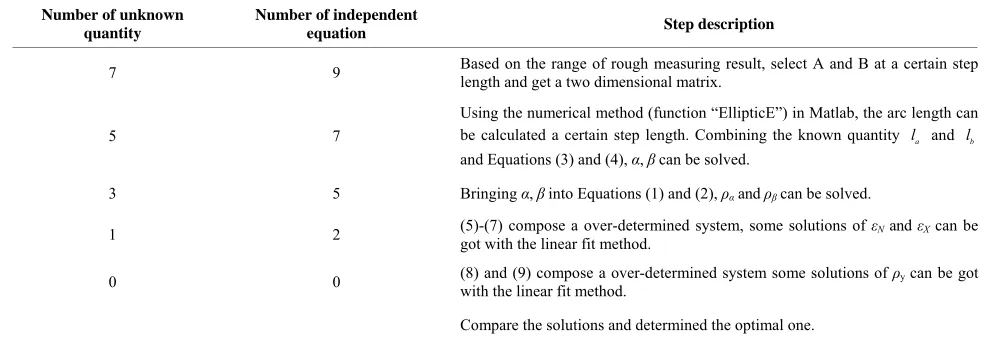
sed. d (19), the equation system is hard to be solved directly. So we assume the long axis radius, short axis radius and angle of the measure point at first and then select the fit-ting answer. The specific steps were presented in Table 3.
4. Model Modification and Improvement
The model above is theoretical and hypothesis ba Some modification and improvement will make the model more effective and accurate.
Firstly, the error the cylindroid simply introduced into the model needs to be calculated and modificated. Some imaging research tells that the front height of the in- tervertebral disc is longer than the back height, so an an- gle about 3˚ - 6˚ exists between the top and bottom sur- face of the intervertebral disc naturally.
of the quation system.
[image:4.595.50.543.103.272.2]quantity eq tep description
Table 3. Solving step
Number of unknown Number o
e
f independent
uation S
7 9 Based on the range of rough mlength and get a two dimensional matrix. easuring result, select A and B at a certain step
5 7
Using the numerical method (function “EllipticE”) in Matlab, the arc length can be calculated a certain step length. Combining the known quantity and
β
and εXcan be
a
l lb
and Equations (3) and (4), α, βcan be solved.
Bringing α, β into Equations (1) and (2), ρα and ρ can be solved. 3 5
1 2 (5)-(7) compose a over-determined system, some solutions of got with the linear fit method. εN
0 0 (8) and (9) compose a over-determined system some solutions of ρy can be got
with the linear fit method.
Compare the solutions and determined the optimal one.
board’s properties especially the thic ess will bri me error to the result.
en specificity, installation error, m
ral pressure or strain measurement method will m
e strain condition of the intervertebral model and a measurement system
nd can be operated on th
iment stage and further modify and adjust
ngelo and K. T. Foley, “Motion Compensation Associated with Single-Level Cervical Fu- sion: Where Does the Lost Motion Go,” Spine, Vol. 31, No. 21, 2006,
kn ng the model accordingly. so
Thirdly, it is hard to modify the model in vivo because
of the unavoidable specim
REFERENCES
[1] J. S. Schwab, D. J. Dia odel simplification error and follow-up circuit error. It
will also lose the real-time advantage. A more effective method is to practice the experiment on cadaveric cervical with both the ellipsoid hypothesis method and the direct pressure measure method. The data of ellipsoid hypothe-sis method will be adjusted by taking the data from pres-sure meapres-surement method into consideration. It will en-able this new model more convincing when it was taken in vivo.
Last but not least, comparison study with other in-terverteb
pp. 2439-2448.
doi:10.1097/01.brs.0000239125.54761.23
[2] A. Nachemson and G. Elfstrom, “Intravital Dynamic Pressure Measurements in Lumbar Discs: A Study of Com- mon Movements, Maneuvers and Exercises,” Scandina- vian Journal of Rehabilitation Medicine-Supplement, Vol.
N. Weinstein, “Time Dependent Bio- 1, 1970, pp. 1-40.
[3] O. Perey, “Fracture of the Vertebral End-Plate in the Lumbar Spine,” Acta Orthopaedica Scandinavica-Supple- mentum, Vol. 25, 1957, pp. 1-101.
[4] V. K. Goel and J. ake our model more persuasive. Before the whole
model and hypothesis can be taken into practice, a good number of experimental data on cadaveric cervical should be studied and parameter in the model should be adjusted.
5. Conclusions
mechanical Response of the Spine,” In: V. K. Goel and J. N. Weinstein, Eds., Biomechanics of the Spine: Clinical and Surgical Perspective, CRC Press, Boca Raton, 1990, pp. 35-37
[5] S. Gracovetsky, H. F. Farfan and C. Lamy, “The Mecha- nism of the Lumbar Spine,” Spine, Vol. 16, No. 3, 1981, pp. 249-262. doi:10.1097/00007632-198105000-00007
[6] R. N. Nata Aiming at getting th
disc, a mathematic
based on strain gauges were built. In our hypothesis, by only fixing 6 strain gauges on the front side of aninterver- tebral disc, the complete strain condition and the dimen- sion of the disc can be calculated.
Compared with the former method, the model in this paper is without being damaged a
rajan, J. H. Ke and G. B. J. Andersson, “A Model to Study the Disc Degeneration Process,” Spine, Vol. 19, No. 3, 1994, pp. 259-265.
doi:10.1097/00007632-199402000-00001
[7] H. J. Wilke, P. Neef, M. Caimi, T. Hoogland and L. E. Claes, “New in Vivo Measurements of Pressures in the Intervertebral Disc in Daily Life,” Spine, 1999, Vol. 24, No. 8, pp. 775-762.
e adjacent disc incidentally when a treatment is exe- cuted on a patient. It can solve the intervertebral disc strain measure dilemma that direct measure methods can only be executed on a few healthy volunteers and other simulation or indirect measure is too hard to achieve an agreement.
So far, the hypothesis is in exploring stage. We will move to exper
[8] J. Calisse, A. Rohlmann and G. Bergmann, “Estimation of Trunk Muscle Forces Using the Finite Element Method and in Vivo Loads Measured by Telemeterized Internal Spine Fixation Devices,” Journal of Biomechanics, Vol. 32, No. 7, 1999, pp. 727-731.
doi:10.1016/S0021-9290(99)00052-4
System as Revealed by Mathematical Analysis of the Lumbar Spine: An Assay,” Spine, Vol. 20, No. 13, 1995, pp. 1462-1474. doi:10.1097/00007632-199507000-00004
ics
[10] E. Y. S. Chao, K. N. An and W. P. Cooney, “Instru-mented Devices for Joint and Muscle Force