© 2019, IRJET | Impact Factor value: 7.211 | ISO 9001:2008 Certified Journal
| Page 1392
NUMERICAL ANALYSIS OF DIESEL ENGINE COMPONENT UNDER
THERMAL LOADING
Anthony Kpegele Le-ol
1, Charles B. Kpina
21
Department of Mechanical Engineering, Rivers State University, Port Harcourt, Nigeria.
2Department of Mechanical Engineering, Nigeria Maritime University Okerenkoro Delta State.
---***---Abstract - This research is intended to numerically analyze the thermal stress on marine diesel engine piston crown. It analyzes the basic stress form and distribution on the piston crown. Engine pistons are one of the most complex components amongst all internal combustion engine components and the piston crown which is subjected to pressure fluctuation and thermal stress during normal engine operation. Damage mechanisms have different origins and are mainly wear, thermal and fatigue related. Among the fatigue damaged, thermal stress and mechanical stress either at room temperature, play a prominent role. In this research, analytical model and solid works were integrated to modeled and simulate the piston crown, analyzing the basic stress form and distribution on the piston crown. Two materials were used to demonstrate the model of the piston, such as the Aluminium Alloy and Malleable Cast Iron. Applying a pressure of 5MPa, the result of Malleable Cast Iron gives best performance than the result of Aluminium Alloy.
Key Words: Marine Engine, Thermal stress, loading, Piston
1. INTRODUCTION
Thermal stresses on marine engine components in the combustion chamber of marine diesel engine are the main factors limiting the performance and durability of Marine engines. One of the most loaded elements is the piston head/crown, exceeding the permit set temperature of the piston causes various types of material losses and leads to an excessive increase in diameter of the piston, resulting in its galling. In turn temperature fluctuations may cause formation of crakes, leading to development of leakages and even preventing further work of the engine [1]. The effect of the heat during the engine operation causes reversible and irreversible dimensional changes in the piston which determines the valve of the clearance of the piston-cylinder assembly, the clearance of the tightness of the combustion chamber and thus on the side of the change losses. This is particularly important for marine engines, where the loss of charge during compression reduces the real excess air ratio in the engine combustion chamber. An improper class of the piston cylinder assembly has a negative impact on oil consumption, the capability to start the engine and the noise. The piston temperature is significantly affected by the proper position of engine rings. From 60 to 80% of the heat
acquired by the piston from the working medium is required through the rings into the cylinder. Requirements for the location of the rings are incompatible. In order to reduce the thermal load of the rings they should be located as far away from the piston head as possible and in order to reduce the thermal load of the piston they must be placed possibly higher [1].
For all engine speed and loads, a distinct reduction in the piston temperature is achieved in all of its points by reducing the distance between the ring and the piston head. Changing the number and heights of rings also causes a change in the piston temperature due to changes in this surface via which the heat exchange occurs. Apart from the design conditions of marine engines, also the service conditions also affect the thermal loads of piston, the conditions of the engine operation include a change in the effective pressure, assuming that mechanical efficiency is constant, and increase in the average effective pressure is equivalent to a higher heat emission, which leads to an increase in the piston temperature.
Thermal stresses are difficult to simulate because there are in piston two types of stress
Thermal stress due to the vertical distribution of the homogenous and regular gradient of temperature at the top and lower temperature at the bottom. There is a homogenous and regular gradient of temperature on the radial direction along the head of the component. It is observed that the bowl rim area is the areas where temperatures are higher thermal deformations under the operating bowl rim temperature are contained by the surrounding material. After creep relaxation of the high compression stresses and when the piston gets cold creep effect gives rise to tensile residual stress on the bowl rim. This cycle origins cracks distributed all around the rim area.
© 2019, IRJET | Impact Factor value: 7.211 | ISO 9001:2008 Certified Journal
| Page 1393
In an engine transfer of heat takes place due to differencein temperature, from higher temperature to lower temperature. Thus there is heat transfer to the gasses during intakes stroke, but then during combustion and expansion process the heat transfer takes place from the gasses to the walls, so the piston head/crown, and some other components like the piston ring, and the piston skirt the valves, the cylinder head etc. are affected resulting to their deformations [3]. The engine is referred to as the heart of a vessel and the piston is considered the most important part of the engine and it's one of the most complex components amongst all internal combustion engine components and there are lots of research works proposing for engine pistons, new geometries, materials and manufacturing techniques and this evolution has undergone with continuous improvement over the last decades and requires thorough examination of smallest details. Notwithstanding all these studies there are huge numbers of damaged Pistons. Damage mechanisms have different origins and are mainly wear, temperature and fatigue related. But more than wear and fatigue, damaged piston is mainly due to stress development, namely thermal stress, mechanical stress. The piston is only subjected to pressure, but temperature plays a vital role, due to high temperature and overheating of the piston severe damages takes place. Furthermore, a thermal stress analysis was carried out and the result revealed that the stress generated is more than the stress obtained while performing analysis considering pressure only. Hence, they considered the temperature difference (T) at the center of the piston head and at the edge of the piston head. Due to the effective combination of temperature and pressure the resultant stress was obtained with the valve having allowable stress of 124.4 MPa which is much closer to the allowable stress when only pressure was considered. They further worked on the piston to have enough stiffness to reduce the deformation, so it was necessary to decrease the piston temperature through structure improvement.
An optimized piston which is lighter and stronger is coated with zirconium for bio-fuel. The coated piston undergone a Von Mises test by using ANSYS for load applied on the top. Analysis of the stress distribution was done on various parts of the coated Pistons for finding the stress due to the gas pressure and thermal variations. Von Misses Stress is increased by 16% and optimization of piston which is stronger, lighter with minimum cost and with less time since the design and weight of the piston influences the engine performance. Analysis of the stress distribution in the various part of the piston to know the stress due to the gas pressure and thermal variation using ANSYS was carried out [4]. A three-dimensional definite-element analysis has been carried out to the gasoline engine piston, considering the thermal boundary conditions of the reference for design improvement. Result showed that the main cause of the piston safety, the piston deformation and the great stress is the
temperature, so it is feasible to further decrease the piston temperature with structure optimization. The work involves simulation of a 2-stroke 6S35ME marine Diesel engine piston to determine its temperature field, thermal, mechanical and coupled thermal-mechanical stress [3]. (Bhagat, et al., 2013). The distribution and magnitudes of the afore-mentioned strength parameters are useful in design, failure analysis and optimization of the engine piston. The piston model was developed in solid-works and imported to ANSYS for processing, loading and post processing. Material model chosen was 10-node tetrahedral thermal solid 87. The simulation parameters used were piston material, combustion pressure, inertial effects and temperature. The work describes the stress distribution of the piston by using finite element method (FEM). FEM is performed by using computer aided engineering (CAE) software. The main objective of the project was to investigate and analyze the stress distribution of piston at the actual engine condition during combustion process. The report describes the mesh optimization by using FEM technique to predict the higher stress and critical region on the component. The impact of crown thickness, of barrel and piston top land height on stress distribution and total deformation is monitored during the study of actual four stroke engine piston. The entire optimization is carried out based on statistical analysis FEA analysis is carried out using ANSYS for optimum geometry. The work describes the stress distribution and thermal stress of three different alloys piston by using finite element method (FEM). The parameters used for the simulations are operating gas pressure, temperature and material properties of piston. The specifications used for the study of these pistons belong to four stroke single cylinder engine [3].
© 2019, IRJET | Impact Factor value: 7.211 | ISO 9001:2008 Certified Journal
| Page 1394
distribution of the seizure on piston four stroke engines byusing FEA. The finite element analysis was performed by using computer aided design (CAD) software. The main objectives were to investigate and analyze the thermal stress distribution of piston at the real engine condition during combustion process. That paper describes the mesh optimization with using finite element analysis technique to predict the higher stress and critical region on the component. The optimization is carried out to reduce the stress concentration on the upper end of the piston i.e. (piston head/crown and piston skirt and sleeve). With using computer aided design (CAD), Pro/ENGINEER software the structural model of a piston will be developed. Furthermore, the finite element analysis performed with using software ANSYS.
Rakopoulos and Mavropoulosused a piston model for the calculation of the temperature field and heat flow field under steady and transient engine operating conditions. Three-dimensional finite-element analyses were implemented for the representation of the complex geometry metal components and found a satisfactory degree of agreement between theoretical predictions and experimental measurements [7]. Muhammet determined the temperature and the stress distributions in a partial ceramic coated spark ignition (SI) engine piston. Effects of coating thickness and width on temperature and stress distributions were investigated including comparisons with results from an uncoated piston. It was observed that the coating surface temperature increase with increasing the thickness in a decreasing rate. Surface temperature of the piston with 0.4 mm coating thickness was increased up to 82 °C. The normal stress on the coated surface decreases with coating thickness, up to approximately 1 mm for which the value of stress was the minimum. However, it rises when coating thickness exceeds 1 mm. As for bond coat surface, increasing coating thickness, the normal stress decreases steadily, and the maximum shear stress rises in a decreasing rate. The optimum coating thickness was found to be near 1 mm under the given conditions [8]. Li,used a three-dimensional finite element model of an aluminum diesel engine piston to calculate operating temperatures. He showed that skirt contours played an important part in the reduction of scuffing and friction [9]. Prasad and Samariaused thermally insulating material, namely partially stabilized zirconia (PSZ), on the piston crown face and reported a 19% reduction in heat loss through the piston [10]. Pierz investigated the thermal barrier coating development for diesel engine aluminum piston he found that the resulting predicted the temperatures and stresses on the piston, together with material strength information, the primary cause of coating failure is proposed to be low cycle fatigue resulting from localized yielding when the coating is hot and in compression [11].
There are lots of research works proposing for engine pistons new generation, materials and manufacturing
techniques as presented, Notwithstanding, all these studies there are a huge number of damaged pistons and none considered comparative based analysis of material characteristic to thermal effect and performance deterioration. This work seeks to integrated analytical and numerical framework to evaluate the thermal loading effects and the point of failure of the compare materials.
2. METHODOLOGY
2.1 Data of the engine specification
[image:3.595.312.554.300.518.2]The demonstrated of the numerical analysis is based on the engine characteristic of a marine diesel engine under various thermal loading in a voyage. The particulars of the experimental engine is shown in Table 1.
Table 1. Specifications of the engine
Description Value
Configuration Two-stroke diesel engine cooled by air Max pressure ‘pmax’ 5 MPa
Temperature in
combustion chamber ‘T’ 900 K
Bore ‘D’ 300 mm
Rotation speed ‘n’ 750 rpm Specific fuel
consumption ‘ge’ 0.3 kg/kWh Power ‘Ne’ 300 kW per one cylinder Calorific value(gasoline
and oil) ‘Wd’ 42000 kJ/kg Piston cooling By oil maximum
temperature500K
2.2 Thickness crown calculation
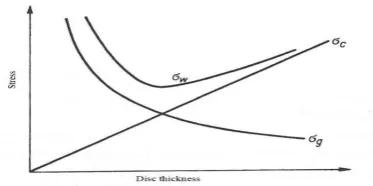
First calculation of the stresses applied in the piston based on the thickness of the piston crown. It is important to note that the thickness marks how the stresses work in the piston. A first approach is to calculate the thickness without taking into account the possible ribs that can be added afterwards.
[image:3.595.342.529.638.731.2]© 2019, IRJET | Impact Factor value: 7.211 | ISO 9001:2008 Certified Journal
| Page 1395
There is an optimal thickness where the least stress in thecrown is given. In this first calculation the objective is to find an indicative value of it. To start with, support diameter is needed. It should be:
.
258
)
86
.
0
8
.
0
(
D
mm
D
It is taken 0.86 as it isthe worst case.
Pressure acting on the piston crown:
[image:4.595.305.555.253.444.2](1)
Figure 2. Application of the maximum pressure ‘X’ and reaction applied in ‘Y’
(2)
(3)
Bending moment value combining (1), (2) and (3):
(4)
The minimum thickness of the crown:
(5)
Tanking 𝐾𝑔 as the maximum an allowable bending stress of aluminum is equal 80 MPa.
It must be defined W:
(6)
It is said minimum because pressure stress acts as following:
(7)
This thickness is only acceptable if there no thermal component. But as real piston there is the heat part that also affects the piston and causes stresses on it.
Radial stress on the bottom of the crown:
(8)
Shear stress at the bottom of the crown:
(9)
In large pistons appear stresses because of the difference in temperature between the two faces of the piston crown. Thermal stress is calculated by:
(10)
Defining the heat transfer q as:
(11)
Using equations (10) and (11) and fixing = 85𝑀𝑃𝑎as the
maximum stress given by Aluminum, this gives us a maximum thickness of the crown of g. Both thicknesses obtained from pressure and thermal stresses are not compatible. With that conclusion it must be thought of another source of cooling the piston crown so that we can achieve our working conditions.
2.3 Length of the Piston Carrier Evaluation Formulation
The calculation considers the normal force pushing the piston to the cylinder liner. Maximum value takes place when the crank is deflected from the axis of the cylinder 35ᵒ. Pressure corresponding to this position is 0.75 of the maximum pressure:
(12)
Normal pressure :
𝑃 𝑎 (13)
Where: angle of the connecting rod α=35ᵒ
© 2019, IRJET | Impact Factor value: 7.211 | ISO 9001:2008 Certified Journal
| Page 1396
(14)Tanking l as the length of the connecting rod and ras the radius of the crank.
l=0,8m and r=0,2m. Is obtained an angle = 8oC, 24oC
Normal pressure is then using (13): Nmax = 0,037MPa
Length of the guiding part:
(15)
Being 𝐾 permissible ground pressure [0.5÷0.8] MPa
2.4Numerical Software Demonstration
In this research SOLIDWORKS 2016 CAD was use for the modeling and the simulation of the piston to check its deformation and necessary adjustment will be made on the Model. SolidWorks is a computer-aided design [CAD] and computer-aided engineering [CAE] software that runs on Microsoft Windows use in the modeling, designing, evaluation and simulation of mechanical equipment’s.
3. RESULTS AND DISCUSSION
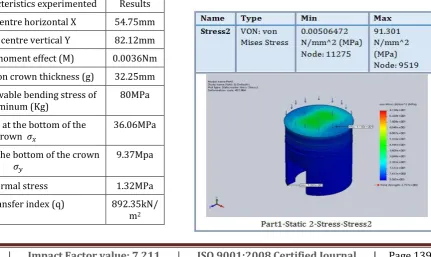
[image:5.595.317.551.381.508.2]The results show that there is an optimal thickness where the least stress in the crown is given. This was built from the analytical solution to estimate the needed diameter. The result of the analytical solution is shown in Table 2, which describe the critical parameter that define the characteristic of the piston crown under thermal loading.
Table 2. Result of the analytical analysis of the component
Material characteristics experimented Results Centroid centre horizontal X 54.75mm
Centroid centre vertical Y 82.12mm Bending moment effect (M) 0.0036Nm Minimum piston crown thickness (g) 32.25mm Maximum allowable bending stress of
Aluminum (Kg) 80MPa
Radial stress at the bottom of the crown
36.06MPa
Shear stress at the bottom of the crown
9.37Mpa
Thermal stress 1.32MPa
Heat transfer index (q) 892.35kN/ m2
The research shows diversity in thickness of the component from pressure and thermal stresses analytic perspective. Effective cooling mechanism was also observed as key factor in minimize thermal stress of the component, especially in varying loading scenario. The result also show that the allowable stress was not exceeded in the cast of malleable cast iron. The calculation also considers the normal force pushing the piston to the cylinder liner. Maximum value takes place when the crank is deflected from the axis of the cylinder 35oC outward. The bending stress due to the deflection of the pin gave a value of 182 MPa and that due to localization of the pin gave 125.5MPa. The total bending stress base on the thermal loading gave 161.64MPa, showing greatest shear stress occurring between the piston hub and the small end of the connecting rod.
3.1 Analysis of the piston crown numerically using Malleable Cast iron and Aluminum
The analysis was demonstrated numerically using SOLIDWORKS software with Aluminum and malleable cast-iron materials. The screen demonstration of the result is shown in Figures 3 to 5 at different pressure loads.
[image:5.595.116.548.531.788.2]© 2019, IRJET | Impact Factor value: 7.211 | ISO 9001:2008 Certified Journal
| Page 1397
[image:6.595.21.306.310.378.2]Figure 4. Pressure of 5MPa being applied to the Piston Crown
Table 3. Reaction Forces Analysis
Selection
set Units Sum X Sum Y Sum Z Resultant
Entire
Model N -23.1301 353447 -15.7031 353447
Table 4. Comparison of Results of Malleable Cast Iron and Aluminum at applied Pressure 5Mpa
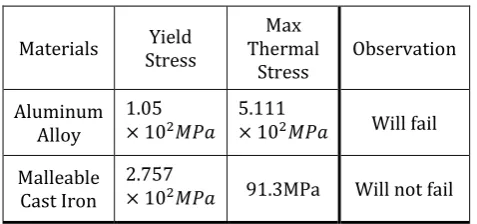
The analysis further shows as indicated in Table 5, that at pressure loading of 5MPa, the Aluminum alloy show a
maximum and minimum stresses of
𝑀𝑃𝑎 𝑎 𝑀𝑃𝑎 respectively
with yield strength of 𝑀𝑃𝑎. This indicate that the yield strength is lesser than the maximum stress of the material indicating a possible failure of the piston crown during operation under the pressure load of 5MPa. In the case of the malleable cast iron, the yield strength is greater than the maximum stress, making it suitable under the loading condition. The result further explains that the Malleable Cast Iron Piston can withstand more thermal stress than that of the Aluminum Alloy. Therefore, material selection and classification is critical in area of higher thermal load like the combustion chamber of a power system.
4. CONCLUTIONS
Using both the analytical and Solid-Works methodology, the analyze of the stress distribution acting on the Piston Crown, under two materials consideration (Aluminum Alloy and Malleable Cast iron) have been presented. The analysis revealed the material characteristics that could the susceptible to the loading scenario testing in the Solid works environment. That is the cast iron is a better material for the piston based on the stress distribution values from the simulation than the Aluminum alloy. And it was observed also that Malleable Cast Iron sustains more temperature gradient than Aluminium Alloy. Each metal has its yield strength and when the maximum stress is greater than the yield strength it means that there will be thermal induced failure (Fracture, cracks) from the analysis carried out applying a pressure of 5Mpa on the Piston with different materials. The piston that is made of Aluminium Alloy is going to fail, while that of Malleable Cast Iron will not fail, under the same loading condition.
The analysis conclusively provides the loading characteristic of these materials and the point of maximum loading effect on their performance and failure. It is clear that the Aluminum alloy is critical susceptible to thermal loading at the critical value of 5MPa. This provide a technical and monitoring framework for operation of the plant under critical loading condition in rough weather sea condition for marine vessels.
REFERENCE
1) Gustof, P. and Hornik, A. (2016). Analysis of thermal stress of the piston during non-stationary heat flow in a turbocharged Diesel engine. Journal of IOP Science.
2) Dilip, K., Sonar, and Madhura C. (2015). Theoritical Analysis of Stress and Design of Piston Head using CATIA & ANSYS. International Journal of Engineering Science Invention, (6) 4.
3) Bhagat, A. R. and Jibhakate, Y. M. (2013). Thermal analysis and Option of I. C. Engine Piston using Finite Element Method. Internal Journal of Mordern Engineering Research (IJEM), (4), 2.
4) Rajam, V. P. and Muthy, V. K. (2013). Linear Static Structural Analysis of Optimised Piston for Bio-Fuel using ANSYS. Journal of Mechanical and Prodution Engineering research and development (IJMPERD), (2), 3.
5) [5] Uzum, A. (1999). Effects of Thermal Barrier Coating on a Turbocharged Diesel Engine Performance. Journal of Surface and Coating Technology.
Materials Stress Yield Thermal Max
Stress Observation Aluminum
Alloy
𝑀𝑃𝑎
𝑀𝑃𝑎 Will fail
Malleable Cast Iron
[image:6.595.43.282.432.544.2]
© 2019, IRJET | Impact Factor value: 7.211 | ISO 9001:2008 Certified Journal
| Page 1398
6) Buyukkaya, E. and Cerit, M. (2012). ThermalAnalysis of a Ceramic Coating Diesel Engine Piston using Finite Element Method. Internal Journal of Mordern Engineering Research (IJMER), (4), 2.
7) Rakopoulos, C. D. and Mavropoulos, G. C. (1996). Study of a Steady and Transidient Temperature field and Heat flow in the Combustion Chamber Components of a medium Speed Diesel Engine Using finite element asnalysis. Internal Jounal of Energy Research.
8) Li, C. H. (1986). Thermoelastic Behaviour of an Aluminium Diesel Engine Piston. General Motors Research labs. Warren SAE paper.
9) Muhammet, C. (2011). Thermo Mechanical Analysis of a Partially Ceramic Coated Piston used in an SI Engine. Surface & Coating technology.
10)Prasad, R. and Samaria, N. K. (1990). Comput Struct.