warwick.ac.uk/lib-publications Manuscript version: Author’s Accepted Manuscript
The version presented in WRAP is the author’s accepted manuscript and may differ from the published version or Version of Record.
Persistent WRAP URL:
http://wrap.warwick.ac.uk/115992
How to cite:
Please refer to published version for the most recent bibliographic citation information. If a published version is known of, the repository item page linked to above, will contain details on accessing it.
Copyright and reuse:
The Warwick Research Archive Portal (WRAP) makes this work by researchers of the University of Warwick available open access under the following conditions.
Copyright © and all moral rights to the version of the paper presented here belong to the individual author(s) and/or other copyright owners. To the extent reasonable and
practicable the material made available in WRAP has been checked for eligibility before being made available.
Copies of full items can be used for personal research or study, educational, or not-for-profit purposes without prior permission or charge. Provided that the authors, title and full
bibliographic details are credited, a hyperlink and/or URL is given for the original metadata page and the content is not changed in any way.
Publisher’s statement:
Please refer to the repository item page, publisher’s statement section, for further information.
1
What is integration and why is it important for internationalisation?
A multidisciplinary review
Helen Spencer-Oatey and Daniel Dauber
Journal of Studies in International Education, 2019, Online first, 8 April 2019 https://doi.org/10.1177/1028315319842346
Abstract
Integration is a concept that is referred to very widely in relation internationalisation, yet its meaning is rarely explored and its benefits are often assumed. In this article we start by reviewing the conceptualisation of ‘integration’ across different fields, notably education and the
internationalisation of education; intercultural communication; health psychology; and
organisational studies. We propose that the varying interpretations within and across these fields can be synthesised by considering the different levels at which integration can be analysed – individual level, community level and institutional level. We then review the multiple benefits that integration can bring at these different levels, while acknowledging their interconnections, and noting the potential risks from ignoring integration. We end by proposing a framework to help universities and all of their members (staff and students) develop their own strategies and priorities for enhancing integration.
Keywords
Social integration; academic integration diversity; internationalisation student well-being; learning gain; employability
1.
Introduction
The term ‘integration’ is frequently used in connection with internationalisation. For example, De Wit, Hunter, Howard, and Egron-Polak (2015) make integration a core element of their working definition of internationalisation. In their revision of Knight’s (2003, 2004) well-known definition, they define internationalisation as follows: 'the intentional process of integrating an international, intercultural or global dimension into the purpose, functions and delivery of post-secondary
education, in order to enhance the quality of education and research for all students and staff, and to make a meaningful contribution to society’ (De Wit et al., 2015, p.29, emphasis in the original). They explain that they have made this adjustment in order to stress the importance of
internationalisation being more inclusive and less elitist. This suggests the importance of the human (as compared with procedural) angle to internationalisation. This is an aspect that is also stressed by the British Council (2014, p. 4), when they argue that “Integration of all students is an elemental factor in the expanding concept of internationalisation not only due to immediate student outcomes of comprehensive learning and cultural awareness but also due to long term benefits for the
2
In this paper we focus on this human or personal aspect of integration and explore what it really means. More than thirty years ago, Hutnick (1986, p. 151) commented that “The terms
'assimilation', 'acculturation', 'integration', etc., are used often but with a great imprecision.” Eight years later, de Alcántara (1994), in an important briefing paper for a world summit for social development, said that “social integration is a complex idea, which means different things to different people.”The same is still true to today. The word ‘integration’ is used in a number of different fields, but often with different meanings. More explicit unpacking of the meaning(s) of the concept is needed, partly to avoid confusion and partly to enrich our understanding of
internationalisation processes in the higher education (HE) sector.
So, given the widespread use of the term ‘integration’ in relation to internationalisation, the aim of this article is twofold. The first is to review the ways in which integration is conceptualised in different fields. The second aim is to review research into the benefits of integration so that those engaged in the internationalisation of higher education can gain an even clearer understanding of its importance and the dangers of not maximising it.
2.
Conceptualising ‘integration’: multidisciplinary perspectives
Theoretical and empirical research into integration over the last 30 years has taken place in a number of fields, including social policy, education, intercultural communication, health psychology, and organisational studies. There are both similarities and differences in these fields as to how integration is conceptualised. Here we review that latter four.1
2.1
Conceptualisations of
‘integration’
within the Education field
Within the education field as a whole, work on integration is often associated with Vincent Tinto (1997, 1998). Tinto was particularly interested in the impact of integration on persistence in study (i.e. how it affects drop-out rates) and on academic achievement. Yet his definition of integration was brief. He simply treated it as synonymous with involvement, as can be seen from the quotations below:
If academic and social involvement or integration is to occur, it must occur in the classroom. (Tinto, 1997, p. 599)
The more academically and socially involved individuals are – that is, the more they interact with other student and faculty – the more likely they are to persist. … We also know that there are many different pathways to integration, that involvement or integration may take place inside and/or outside the classroom. (Tinto, 1998, pp. 168, 169)
There was usually little explicit discussion of how the concept was being interpreted. This is equally true of much work within the internationalisation of higher education literature. In many cases the authors simply do not discuss the concept of integration at all (e.g. Hou & McDowell, 2014; Tatar, 2005; Turner, 2009) and the following type of comment is relatively common:
[international students have high expectations to] integrate with the people in the host country, especially making friends with home students on campus. (Hou & McDowell, 2014, p. 224)
3
From a slightly different angle Hudzik (2011, p. 35) identifies the integration of all international students as an important ‘stretch goal’ for comprehensive internationalisation, and unpacks this as follows:
Every international student and scholar is encouraged and supported to contribute measurably to campus understandings and appreciation for global diversity, to
internationalizing the on-campus environment, and to maximizing the contact and cross-learning of both domestic and international populations.
Interestingly, he seems to be saying that international students should contribute to the
internationalisation agenda, thereby seemingly putting much of the responsibility for integration onto international students.
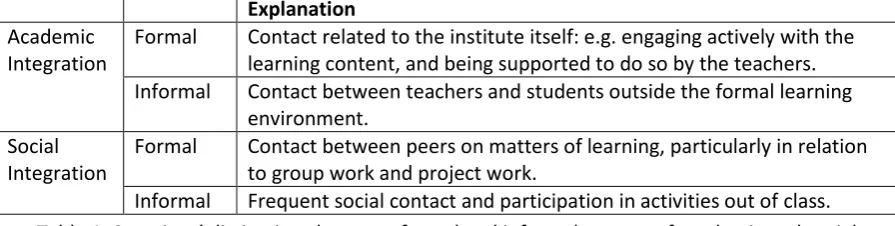
Nevertheless, a small number of researchers have explored the meaning of integration more deeply. For instance, Sabine Severiens (e.g. Severiens & Schmidt, 2009; Severiens, ten Dam, & Blom, 2006; Severiens & Wolff, 2008), building on Tinto’s focus on integration and exploring its impact on study progress for students from different backgrounds, extended his distinction between academic and social integration to include formal and informal integration, giving a fourfold framework as shown in Table 1.
Explanation Academic
Integration
Formal Contact related to the institute itself: e.g. engaging actively with the learning content, and being supported to do so by the teachers. Informal Contact between teachers and students outside the formal learning
environment. Social
Integration
Formal Contact between peers on matters of learning, particularly in relation to group work and project work.
[image:4.595.74.522.339.452.2]Informal Frequent social contact and participation in activities out of class. Table 1: Severiens’ distinctions between formal and informal aspects of academic and social
integration
Yet other researchers have adopted a very different interpretation of integration. Zepke and Leach (2005, p. 47), for example, regard it as synonymous with assimilation, in which students are required to adapt to the institution. They argue that the concept of integration should be modified “to include adaptation, where institutions change to accommodate diverse students” (Zepke & Leach, 2005, p. 47).
As we shall see in the next section, though, integration, adaptation and assimilation are each regarded within the core intercultural communication field as referring to very different processes.
Overall, then, there is very little explicit, in-depth discussion within the education field as to what is meant by integration, with occasional exceptions. This is very different from the intercultural field, where researchers typically discuss the notion very explicitly, often making it a labelled element of their theory. We turn to that next.
2.2
Conceptualisations of
‘integration’ within the Intercultural field
4 2.2.1 Berry’s acculturation model
John Berry (e.g. Berry, 1974, 2006) first developed his acculturation model in the 1970s and since then it has been a major source of inspiration for numerous researchers, especially in the
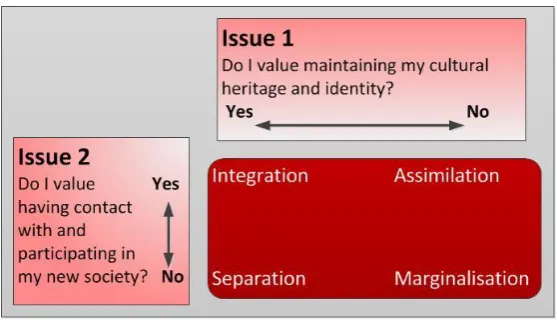
[image:5.595.158.437.215.376.2]intercultural field. He developed it with respect to immigration and argued that immigrants face two fundamental questions: how much they want to maintain their heritage culture and identity, and how much they want to have contact with other ethnocultural groups and participate in the broader society. He proposed that immigrants thus have four fundamental strategic options, depending on their preferences, with respect to these fundamental questions. He labelled these Integration, Separation, Assimilation, and Marginalisation, as shown in Figure 1 below.
Figure 1: Berry’s Acculturation Strategies2
As can be seen from Figure 1, integration in Berry’s model means that individuals or groups of individuals are interested in both maintaining their heritage culture AND having contact with people from other groups and participating actively in the broader community. This is contrasted with assimilation where people again want to participate actively in the broader community but are not interested in maintaining their heritage culture and identity, and with separation where the reverse is the case.
Berry (2006) also made it clear that integration is not just dependent on the newcomers (or immigrants, in Berry’s original research), but rather needs to be a two-way process. He argues that non-dominant groups can only integrate successfully if the dominant society is open in its attitude towards cultural diversity; in other words that mutual accommodation is required.
Others theorists, as Snauwaert, Soenens, Vanbeselaere, and Boen (2003) point out, have suggested different versions of Issue 2, the dimension that deals with newcomers’ relationship with the host society. For example, Bourhis, Moise, Perreault, and Seneca (1997) propose revising it to say “Is it considered to be of value to adopt the cultural identity of the host community?”; in other words, not just to mix with the new society but to adjust one’s behaviour and sense of belonging. Snauwaert et al. (2003) identify yet another variation of Berry’s original model, in which both dimensions are modified: Hutnik’s (1986) identification model. In this model, the key issue is people’s sense of identification and belonging. Hutnik equates integration and acculturation and describes an acculturative (integrative) orientation as one in which a person identifies with (and feels a sense of
5
belonging to) both the original ethnic group as well as the host group. This brings us closer to a rather different interpretation of the concept of integration that is proposed by Milton Bennett.
2.2.2 Bennett’s Developmental Model of Intercultural Sensitivity (DMIS)
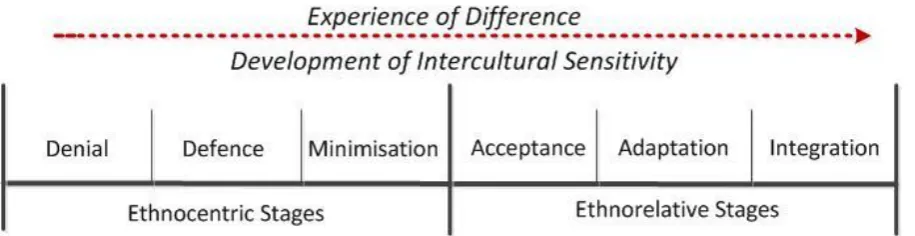
Milton Bennett, a specialist in intercultural communication, put forward his Developmental Model of Intercultural Sensitivity (DMIS) in the mid 1980s and this model is now extremely well-known in the intercultural field. Bennett (1986, 1993) identifies a trajectory of development in terms of
[image:6.595.72.530.376.494.2]intercultural sensitivity, the endpoint of which he labels integration. Bennett argues that the key component that influences people’s level of intercultural sensitivity is their attitude towards differences. He maintains that people move through different phases as they become more interculturally sensitive, and that there are two broad stages: ethnocentrism and ethnorelativism (see Figure 2). By ethnocentrism he means that people interpret differences from an egocentric perspective; by ethnorelativism he means that people’s judgements and interpretations are more relative and contextual. Each broad stage has several component stages, and Bennett labels the end point (i.e. the highest stage that one can reach ) integration.. J. M. Bennett and Bennett (2004, p. 157) explain this final stage as a “metalevelthat provides a sense of coherence to one’s experience”. In this final stage, one might have lost the sense of belonging to a specific cultural group; instead, individuals transcend to an overarching identity which appreciates the cultural diversity experienced.
Figure 2: Bennett’s Developmental Model of Intercultural Sensitivity (based on M. J. Bennett, 1986, p. 182)
Other researchers have challenged this interpretation of integration and called for a more dynamic, context-sensitive interpretation. For example, Sparrow (2000) argues that if social identity theories are taken into account, a reconnection to real communities is the ultimate stage of development, rather than the marginality that Bennett indicates. (For discussion of other critiques of Bennett's model, see Shaules, 2007.)
2.3
Conceptualisations of
‘integration’
from a health and well-being perspective
Researchers who take a health and welfare/well-being perspective have yet further interpretations of the concept of integration. House, Umberson, and Landis (1988) in their review of social support and health, propose that social relations need to be conceptualised from three different
perspectives: social integration/isolation; social network structure, and relational content. They explain social integration as follows:
6
contact. A person's degree of social integration/isolation is a function only of the number of relationships s/he has with other people or the frequency of interaction with those people. It says nothing about the structure of those relationships or their functional content. (House et al., 1988, p. 302)
So while social integration refers to aspects such as the size of someone’s network and frequency of contact with the various people, social network structure refers to “relational properties such as density, reciprocity, sex composition, durability or homogeneity of one’s network.” (Schwartzer & Leppin, 1991, p. 100) Relational content refers to the function and nature of social relationships, such as social support, relational demands and conflicts, and social regulation or control.
This interpretation of (social) integration has been adopted by a number of researchers, including not only those with a health focus (e.g. Schwartzer & Leppin, 1991), but also those working within higher education interested in the adaptation of first year students (e.g. Wilcox, Winn, & Fyvie‐ Gauld, 2005). It is also compatible with a conceptualisation provided by mental health professionals (Ware, Hopper, Tugenberg, Dickey, & Fisher, 2008) who define integration as follows:
We define social integration as a process through which individuals with psychiatric disabilities develop and increasingly exercise capacities for interpersonal connectedness and citizenship. (Ware et al., 2008, p. 2)
Spencer-Oatey (2018) draws on that definition in relation to the higher education context and identifies two important elements of it: that integration is an ongoing process, and that social connections develop between (and among) both individuals and groups.
2.4
Conceptualisations of integration from an Organisation Studies perspective
Since Higher Education institutions (HEIs) also classify as organisations, we now examine how ‘integration’ functions in the field of Organisation Studies. Here it is used most frequently in relation to M&A (merger and acquisition) research. M&As are by far the most popular internationalisation strategy for corporations. In M&As, two organisations undergo substantial changes to become one coherent unit; however, bringing two independent organisations together requires some form of integration. Berry’s (e.g. 1974, 2006) acculturation model (see above) is widely used in this field and was further adapted to fit organisational contexts (Nahavandi & Malekzadeh, 1988). Nevertheless, ‘integration’ later became more of an umbrella term covering all acculturation strategies, and more recently a different approach has emerged, categorising ‘integration’ into structural integration and human/social integration (Dauber, 2012). While structural integration focuses on harmonising the general working processes of two organisations, for example reorganising two R&D departments into one, human/social integration is more concerned with the ways in which staff members relate to and engage with each other.
In recent years, human/social integration in M&A settings has become a major concern compared with structural integration, with most studies reporting considerable challenges in managing people during the processes of change (e.g. Dauber, 2011; Harrison, Hitt, Hoskisson, & Ireland, 2001; Slangen & Hennart, 2008; Vaara, Tienari, & Säntti, 2003).These concerns and challenges clearly apply to institutions that are keen to internationalise. .
2.5
Synthesising the perspectives
7
integration can take place at different levels: the individual, the community and the institutional. This may be one way in which the different perspectives described above can be (partially) synthesised.
The individual level focuses on the personal needs and aspirations of students, both in terms of health and welfare (such as the stress they are experiencing) and in terms of learning and growth (such as the development of competence in intercultural teamworking). Bennett’s (1986, 1993) DMIS model clearly takes this approach by focusing on the personal development of individuals, with the ultimate aim of fostering ‘multicultural personhood’ (cf. Kim, 2001). Similarly, Ware et al. (2008) hint at this personal developmental angle by referring to people increasing their capacities for interpersonal connectedness. In order to develop in these ways, Ware et al. (2008) refer explicitly to the role of social integration, and Bennett (1986, 1993) includes it implicitly through his concept of engagement with difference. In fact, a number of researchers (e.g. Anderson, 1994; Molinsky, 2013; Spencer-Oatey, 2018; Taylor, 1994) argue that it is unsettling encounters that frequently act as the stimuli for growth and it is through mixing with people from different backgrounds that these can occur. However, it might be necessary to motivate students to engage with differences, since it is not an automatic process (cf. Gardner's, 2010, concept of integrative motivation in his socio-educational model).
This then brings us naturally to the community level. This level is complementary to the individual level in two ways. On the one hand, it is an extension, because people need that engagement with others in order to grow, as explained above. On the other hand, we all need a sense of belonging for identity reasons (e.g. Simon, 2004), and integration, in the sense of building social ties and
relationships with staff and other group members such as classmates, is a key element that facilitates this. Here the focus is on interaction with others, and since interaction is a dynamic, co-constructive process, this inevitably requires mutual attention and accommodation by all concerned, both students and staff. So, for example, when a diverse class of students divide into mixed groups to discuss an issue, they may find that their communication styles and patterns of turn-taking are different. In this context, integration requires all members to be sensitive to the styles and patterns of others, for all to make whatever adjustments are needed for them to be able to work together fruitfully, and for academics/teaching staff to help manage this process. Berry’s (e.g. 1974, 2006) acculturation model would count as a community level model of integration.
At the institutional level, the way in which integration plays out is different again. If we take Berry’s (2006) perspective, the host society (in this case, the HEI) needs to be as willing to adapt to students’ needs as vice versa. On the one hand, if students are to participate effectively in the university environment, they need to adapt to the institutions’ procedures and requirements. For example, if they are required to submit assignments in a particular way or to be able to interpret the rather eccentric British percentage marking scale, they will need to adapt to the university’s requirements, because these are institutional level procedures that cannot be adjusted immediately. On the other hand, the university would be wise to consider its processes and regulations very carefully and make conscious decisions as to the extent to which they adjust and how. In making these decisions they will need to balance the often stated desire by international students to have a ‘local education’ experience (and hence make minimal adjustments) and the need to help students to integrate into the university and build a sense of belonging to it.
8
3.
The multilevel benefits of integration
3.1
Integration and individual level benefits
3.1.1 Integration and student welfare/well-being
Studying at university can be a stressful experience for a variety of reasons, including the challenges of adapting to new ways of studying and living and building a new network of friends. This can affect all groups of students, but it can be particularly disorienting for international students because of the scope of the changes. For example, Sawir, Marginson, Deumert, Nyland, and Ramia (2008) report that in their study of 200 international students at an Australian university, two thirds had
experienced loneliness and/or isolation, including ‘social loneliness’ because of the loss of their network of friends, and ‘cultural loneliness’ because of the absence of a familiar and comfortable linguistic and/or cultural environment. These authors conclude that it is important to create stronger bonds between international and local students.
This is in line with psychological research into culture shock and adaptation, where it has repeatedly been found that culture shock and social integration are closely interlinked. For example, classic work by Bochner (1977) and by C. Ward and Kennedy (1993) has drawn attention to the importance of friendships in the adaptation of international students. The latter found that the more
international students interacted with local students and staff, the better was their overall adaptation to life in the foreign country, including fewer social difficulties and improved
communicative competence. Nevertheless, where there are large numbers of international students from the same country, students may find compatriot friendships to be more ‘comfortable’ and a greater support for their well-being (e.g. see Spencer-Oatey, Dauber, Jing, & Wang, 2017). While this is good in certain respects, it has significant downsides. On the one hand, it can lead to a ghetto mentality, which not only undermines a sense of community (see below), but also makes it even more isolating for students from minority countries or backgrounds. Moreover, it reduces students’ opportunities for personal growth, as the next sub-section explains.
3.1.2 Integration and study persistence/academic achievement/learning gain
Tinto (1997, 1998) explored the impact of integration on student persistence in study, i.e. on student retention. He found that the more students interacted, socially and academically, with other
students/staff, the more likely they were to persist in their studies. Such students took part in more extra-curricular activities, mixed more actively with other students, participated more actively in learning communities, and overall felt more at home.
Other researchers have explored whether levels of integration not only affect retention but also academic achievement. Westwood and Barker (1990) explored the impact of a peer-pairing programme on both academic achievement and drop-out rates. They conclude:
… the differences in achievement and drop-out rates between the comparison groups, suggest that contact with certain host national individuals is positively correlated with academic success and lowered probability of dropping out of academic programs for international students.
(Westwood & Barker, 1990, p. 260)
9
3.1.3 Integration, employability and ‘global graduate’ skills
Employability is increasingly linked with internationalisation (De Wit et al., 2015, p. 35), largely because of its potential to foster the skills that employers are looking for. However, the latest CBI/Pearson (2017) education and skills survey reports that 39% of graduate employers are dissatisfied with the ‘international cultural awareness’ of applicants from UK universities as intercultural awareness crucially contributes to improved team working, communication and reduction in workplace conflicts.
In line with this, a British Council (2013, p. 2) report stresses the importance of intercultural skills “not just in smoothing international business transactions, but also in developing long term relationships with customers and suppliers”. This report also identifies the rankings given by
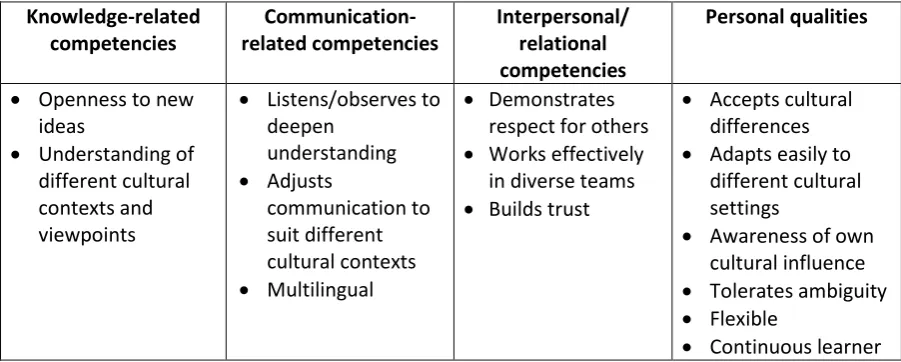
employers for the degree of importance of different technical and intercultural skills; key ones relate to working and communicating effectively with people from diverse backgrounds. Using the Global People framework of competency clusters (Spencer-Oatey & Stadler, 2009), these can be
[image:10.595.72.523.301.482.2]summarised as shown in Table 2.
Table 2: Intercultural skills identified by employers (British Council, 2013, p. 11), grouped according to the Global People Competency Framework (Spencer-Oatey & Stadler, 2009)
How, then, can such skills and qualities be fostered in students? Intercultural research indicates that experiences of difference and discomfort are important pre-requisites, i.e. “the annoyance of being lost”, as the famous anthropologist, Edward T Hall (1976, p. 46), commented. Several theorists (e.g. Anderson, 1994; Lilley, Barker, & Harris, 2015; Taylor, 1994) have pointed to the importance of some kind of disorienting experience. Lilley et al. (2015) refer to this as ‘moving out of the comfort zone’ and in their study they found that this was facilitated through interpersonal encounters,
interpersonal relationships, and cosmopolitan role models. Social and academic integration across different sociocultural groups are vital for this, as they provide the stimulation needed for
behavioural change. For instance, a recent case study by Spencer-Oatey (2018) reports the learning gain that was achieved when students focused on a particular communication behaviour that they felt uncomfortable with. Inspired by Molinsky’s (2013) concepts of zones of appropriateness and personal comfort zones, they were asked to make conscious attempts to mix with students of other nationalities, reflect on their experiences in relation to their chosen ‘challenging communication behaviour’, and then make attempts to adjust their own communication. All students found it a very positive experience and felt they had developed significantly through the process. In this case, the interaction with ‘different others’ provided the facilitating contexts for them to develop several of
Knowledge-related competencies Communication-related competencies Interpersonal/ relational competencies Personal qualities
• Openness to new ideas
• Understanding of different cultural contexts and viewpoints
• Listens/observes to deepen understanding • Adjusts communication to suit different cultural contexts • Multilingual • Demonstrates respect for others • Works effectively
in diverse teams • Builds trust
• Accepts cultural differences • Adapts easily to
different cultural settings
• Awareness of own cultural influence • Tolerates ambiguity • Flexible
10
the intercultural competences identified in the British Council (2013) study. However, more process-oriented studies of this kind are needed in order to research more fully the nature and level of learning gain when students come face-to-face with different viewpoints, different practices, different ways of communicating and different ways of relating. These ‘out of the comfort zone’ experiences can then act as valuable stimuli for personal growth and the development of
intercultural skills. As Beelen and Jones (2015) point out, diversity ‘at home’ can provide such diverse experiences; international students may enrich that diversity but are not actually crucial for it.
It should always be remembered, however, that interaction per se is insufficient; active attempts at learning through observation, reflection and ongoing behavioural adjustments are also needed, as indicated in Spencer-Oatey’s (2018) intercultural growth model. Nevertheless, engagement with difference, such as through social and academic integration, are valuable pre-requisites for such growth.
3.1.4
Integration and global citizenship
Jones and Killick (2007, p. 111) maintain that internationalisation can either be pragmatically based or values-based. The former relates to the skills and understandings needed to work, live or perform in a globalising world and hence particularly to the employability agenda discussed in the previous sub-section. The latter relates to notions of “global citizenship, responsibility, ethics and justice, and are likely to include references to global issues such as poverty reduction, human rights and
sustainable futures” (p.111). They point out that in practice the competencies that each aims to foster may be very similar, although a focus on global citizenship tends to place a greater emphasis on underpinning attitudes, including most of those identified as ‘interpersonal/relational
competencies’ and ‘personal qualities’ in Table 2 above. Once again, ‘out of one’s comfort zone’ experiences, such as participation in activities involving people from different social and academic groupings, are important stimuli for the development of these attitudes and orientations.
3.2
Integration and community-level benefits
The community-level benefits of integration are closely associated with the individual-level benefits; or put another way, the individual-level benefits are to a large extent dependent on integration at the community level. There is also likely to be an interaction effect between community-level integration and individual-level benefits: the greater the extent and depth of community-level integration (in other words, of mutual engagement and involvement), the greater the likelihood of an increase in individual-level benefits. This in turn will help students feel a greater sense of belonging and commitment to the community, which in turn will have a positive impact on their personal welfare, achievements and growth. Numerous studies within cross-cultural psychology offer support for this. For instance, C. Ward, Bochner, and Furnham (2001, p. 149) report the following studies (see also Spencer-Oatey & Xiong, 2006):
Frequent contact [by international students] with host students has been associated with greater sojourn satisfaction (Rohrlich & Martin, 1991); social integration and having local friends have been linked to lower levels of stress (Redmond & Bunyi, 1993); spending more time with host national students is related to fewer psychological adjustment problems (Pruit, 1978); and satisfaction with host national relations predicts better psychological adjustment among international students (Searle & Ward, 1990).
11
sense of connection with one’s university, a strong support network, and a balance of academic challenge and support” (p.106). They found that a greater sense of belongingness was associated with increased interaction between international and home students and also with higher average grades. This was particularly true for international students. The authors conclude by recommending that universities take steps to promote greater intercultural interaction. This brings us, therefore, to the next level of integration benefits – the institutional level.
3.3
Integration and university-level benefits/risk mitigation
From a strategic point of view, universities are concerned about a range of issues, including quality of education, financial stability and international reputation. Many are aiming to recruit more international students to help achieve these goals, yet without effective social and academic integration, problems may arise, as Garrett (2014, p. 4) argues:
There is no question that greater international student numbers can enhance the
experience for all students, as well as the bottom line; but in a high-growth environment, without careful planning, “internationalization” can backfire, undermining the academic experience and social integration. Institutions that fail to heed these lessons risk a negative spiral of low satisfaction, weak referrals and ambivalent word-of-mouth, driving up
recruitment costs and tarnishing brand.
Empirical support for this claim is offered by C. Ward, Masgoret, and Gezentsvey (2009) and Spencer-Oatey and Dauber (2015).
C. Ward et al. (2009) found a curvilinear relationship between the proportion of international enrolments and attitudes towards international students. They report that increasing enrolments were associated with more positive attitudes up to a ‘tipping point’, beyond which increasing enrolments were associated with more negative attitudes.
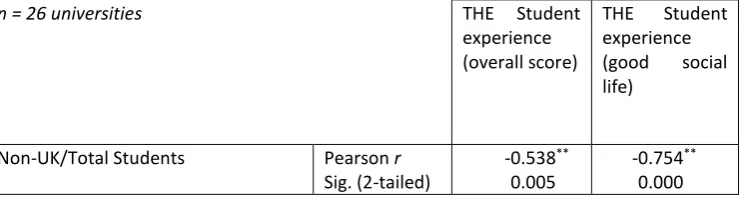
Spencer-Oatey and Dauber (2015) report other concerning findings following statistical analyses of publicly available UK data (Times Higher Education, THE, student experience surveys and National Student Survey) (see Table 3).
n = 26 universities THE Student
experience (overall score)
THE Student experience (good social life)
Non-UK/Total Students Pearson r
Sig. (2-tailed)
-0.538** 0.005
-0.754** 0.000
Table 3: Correlations between diversity, student experience and international outlook in UK universities
As can be seen from Table 3, the greater the proportion of non-UK students in the total student population, the less positive the student experience ratings are.3 This is even more evident when looking at one of the sub-categories of the THE student experience rating: Good social life (r= -0.754**).
[image:12.595.79.453.516.616.2]
12
These correlations could be interpreted as indicating that growth in ‘structural internationalisation’ has a negative impact on student satisfaction, and especially social integration (see also the negative correlation between ‘international outlook’ and ‘good social life’, r=-0.676**). Yet that could be too deterministic an interpretation. We would argue that the key is effective management of social and academic integration, and that not only will that help prevent negative attitudes, including an undesirable ‘tipping point’, but that it can actually provide valuable pre-requisite conditions for personal growth, as argued above.
So the university-level benefits of integration are closely related to the well-being and satisfaction of students. Universities have an obligation to ensure that all students, whatever their background or personal characteristics (e.g. ethnicity, gender, socio-economic status, nationality), experience equally effective educational experiences and achieve maximum and equivalent learning gain. In other words, integration is vital because it affects students’ experiences and perceptions of the quality of their education. From a purely institutional point of view, it can also directly affect their attractiveness to future students.
Universities are now increasingly assessed not only on their research and teaching quality, but also on the experience of students, including minority groups (e.g. via the UK’s Teaching Excellence Framework4). Given the interconnections that this has with integration, the stakes are thus raised even higher. What then can be done? It is not feasible within one article to review the numerous initiatives that have been taken (but see, for example, Spencer-Oatey et al., 2014; H. W. Ward, 2016). Rather, in the next section we propose a framework to help institutions plan how to frame their own strategies for addressing their integration needs.
4.
Implications and concluding comments
At the beginning of this article, we drew attention to the British Council’s (2014, p. 4) argument that the “Integration of all students is an elemental factor in the expanding concept of
internationalisation not only due to immediate student outcomes of comprehensive learning and cultural awareness but also due to long term benefits for the individual, the institution and the UK.” We have reviewed the various ways in which integration can be interpreted and have suggested that one way of (partially) integrating the various perspectives is to analyse integration at different levels: individual, community and institutions. We have outlined the benefits that can occur at these different levels, while also pointing to the potential risks of ignoring the issue.
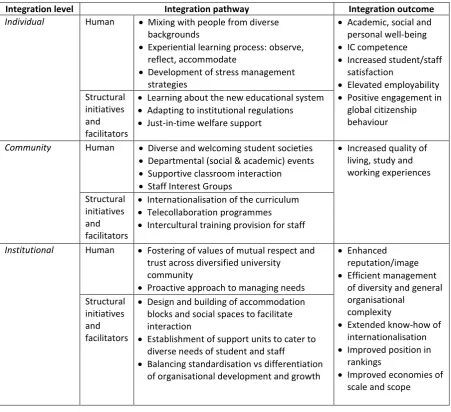
We have explored all this primarily from a human integration perspective. However, the human cannot be completely separated from the structural, as the latter can facilitate (or hamper) the former. We suggest then that it is helpful to consider integration from these multiple angles and suggest some indicative integration pathways and outcomes in Table 4.
4 For more details, see
https://assets.publishing.service.gov.uk/government/uploads/system/uploads/attachment_data/file/658490/ Teaching_Excellence_and_Student_Outcomes_Fram
13
Integration level Integration pathway Integration outcome
Individual Human • Mixing with people from diverse backgrounds
• Experiential learning process: observe, reflect, accommodate
• Development of stress management strategies
• Academic, social and personal well-being • IC competence
• Increased student/staff satisfaction
• Elevated employability • Positive engagement in
global citizenship behaviour Structural initiatives and facilitators
• Learning about the new educational system • Adapting to institutional regulations • Just-in-time welfare support
Community Human • Diverse and welcoming student societies • Departmental (social & academic) events • Supportive classroom interaction • Staff Interest Groups
• Increased quality of living, study and working experiences
Structural initiatives and facilitators
• Internationalisation of the curriculum • Telecollaboration programmes • Intercultural training provision for staff
Institutional Human • Fostering of values of mutual respect and trust across diversified university
community
• Proactive approach to managing needs
• Enhanced reputation/image • Efficient management
of diversity and general organisational
complexity
• Extended know-how of internationalisation • Improved position in
rankings
• Improved economies of scale and scope Structural
initiatives and facilitators
• Design and building of accommodation blocks and social spaces to facilitate interaction
• Establishment of support units to cater to diverse needs of student and staff
[image:14.595.73.525.70.482.2]• Balancing standardisation vs differentiation of organisational development and growth
Table 4: Examples of pathways and outcomes associated with an integration strategy for HEIs
We recommend that all university members, both students and staff at all levels, including management and academic/teaching staff, start developing strategies for integration, at the level relevant to them. The pathway column of Table 4 suggests some possible ways this could occur, including the structural initiatives/facilitators that need to complement the human initiatives. Moreover, the different levels are interconnected, in that they impact on each other, and this means that to achieve maximum benefits from integration, all levels need to be addressed.
Evaluation of progress will also be needed. The EAIE Barometer (2015) probes policy initiatives on internationalisation, so comparable data needs to be collected on integration. The Global Education Profiler, offered by the student survey company, i-graduate5, provides insights into human
integration, but to the best of our knowledge, the sector is currently lacking a tool that covers both structural and human integration. There is evidently much work that still needs to be done if we are to achieve Hudzik’s (2011, p. 35) ‘stretch goal’ of integrating “all international students and scholars into the campus living and learning environment” !
14 References
Anderson, L. E. (1994). A new look at an old construct: cross-cultural adaptation. International Journal of Intercultural Relations, 18(3), 293-328.
Beelen, J., & Jones, E. (2015). Redefining internationalization at home. In A. Curaj, L. Matei, & P. Remus (Eds.), The European Higher Education Area. Between Critical Reflections and Future Policies (pp. 59–72). Amsterdam: Springer.
Bennett, J. M., & Bennett, M. (2004). Developing intercultural sensitivity. An integrative approach to global and domestic diversity. In D. Landis, J. M. Bennett, & M. Bennett (Eds.), Handbook of Intercultural Training. 3rd edition (pp. 147–165). Thousand Oaks: Sage.
Bennett, M. J. (1986). A developmental approach to training for intercultural sensitivity.
International Journal of Intercultural Relations, 10, 179–186.
Bennett, M. J. (1993). Towards ethnorelativism: a developmental model of intercultural sensitivity. In R. M. Paige (Ed.), Education for the Intercultural Experience (pp. 21-71). Yarmouth, ME: Intercultural Press.
Berry, J. W. (1974). Psychological aspects of cultural pluralism: unity and identity reconsidered.
Topics in Culture Learning, 2, 17–22. Available at https://eric.ed.gov/?id=ED100159. Berry, J. W. (2006). Contexts of acculturation. In D. L. Sam & J. W. Berry (Eds.), The Cambridge
Handbook of Acculturation Psychology (pp. 27–42). Cambridge: CUP.
Bochner, S. (1977). Friendship patterns of overseas students: A functional model. International Journal of Psychology, 12(4), 277-294.
Bourhis, R. Y., Moise, L. C., Perreault, S., & Seneca, S. (1997). Towards an interactive acculturation model: A social psychological approach. International Journal of Psychology, 32(6), 369–386. British Council. (2013). Culture at Work. The Value of Intercultural Skills in the Workplace. London:
British Council. Available at
https://www.britishcouncil.org/organisation/policy-insight-research/research/culture-work-intercultural-skills-workplace [Accessed 15 April 2017].
British Council. (2014). Integration of International Students - a UK Perspective. London: British Council. Retrieved from
https://www.britishcouncil.org/education/ihe/knowledge-centre/student-mobility/report-integration-international-students [Accessed 30 December
2017].
CBI/Pearson. (2017). Helping the UK thrive. CBI/Pearson Education and Skills Survey. Retrieved from http://www.cbi.org.uk/insight-and-analysis/helping-the-uk-thrive/
Dauber, D. (2011). Hybridization in mergers and acquisitions. Unpublished PhDl thesis, Vienna University of Economics and Business (WU), Vienna. Available at SSRN:
https://ssrn.com/abstract=1743962 or http://dx.doi.org/10.2139/ssrn.1743962.
Dauber, D. (2012). Opposing positions in M&A research: culture, integration and performance. Cross Cultural Management: An International Journal, 19(3), 375–398.
de Alcántara, C. H. (1994). Social Integration: Approaches and Issues. UNRISD Briefing Paper No. 1, World Summit for Social Development. Geneva: United Nations Research Institute for Social Development (UNRISD). Available at
http://www.unrisd.org/80256B3C005BCCF9/(httpAuxPages)/510920DA18B35A6880256B65
004C6A7B/$file/bp1.pdf.
De Wit, H., Hunter, F., Howard, L., & Egron-Polak, E. (2015). Internationalisation of Higher Education. Brussels: Policy Department, Directorate General for Internal Policies, European Parliament. EAIE. (2015). The EAIE (European Association for International Education) Barometer. Report
available from http://www.eaie.org/community/projects-advocacy/barometer.html. Gardner, R. C. (2010). Motivation and Second Language Acquisition. The Socio-Educational Model.
15
Garrett, R. (2014). Explaining international student satisfaction: Insights from the International Student Barometer: International Graduate Insight Group. Available at
http://igraduate.dev.ingelby.com/assets/Explaining-Satisfaction-ISB-2014.pdf.
Glass, C. R., & Westmont, C. M. (2014). Comparative effects of belongingness on the academic success and cross-cultural interactions of domestic and international students. International Journal of Intercultural Relations, 38, 106-119.
Hall, E. T. (1976). Beyond Culture. New York: Doubleday.
Harrison, J. S., Hitt, M. A., Hoskisson, R. E., & Ireland, R. D. (2001). Resource complementarity in business combinations: Extending the logic to organizational alliances. Journal of Management, 27(6), 679–690.
Hou, J., & McDowell, L. (2014). Learning together? Experiences on a China–U.K. Articulation Program in Engineering. Journal of Studies in International Education, 18(3), 223–240.
House, J. S., Umberson, D., & Landis, K. R. (1988). Structures and processes of social support. Annual Review of Sociology, 14, 293–318.
Hudzik, J. K. (2011). Comprehensive Internationalization. From Concept to Action. Available at
http://www.nafsa.org/_/File/_/downloads/cizn_concept_action.pdf. Washington: NAFSA,
Association of International Educators.
Hutnick, N. (1986). Patterns of ethnic minority identification and modes of social adaptation. Ethnic and racial studies, 9(2), 150–167.
Jones, E., & Killick, D. (2007). Internationalisation of the curriculum. In E. Jones & S. Brown (Eds.),
Internationalising Higher Education (pp. 109–119). London: Routledge.
Kim, Y. Y. (2001). Becoming Intercultural. An Integrative Theory of Communication and Cross-Cultural Adaptation. Thousand Oaks: Sage.
Knight, J. (2003). Updating the definition of internationalization. International Higher Education, 33(2), 2–3.
Knight, J. (2004). Internationalization remodeled: Definition, approaches, and rationales. Journal of Studies in International Education, 8(1), 5–31.
Lilley, K., Barker, M., & Harris, N. (2015). Exploring the process of global citizen learning and the student mind-set. Journal of Studies in International Education, 19(3), 225–245. Molinsky, A. (2013). Global Dexterity. Boston: Harvard Business Review Press.
Nahavandi, A., & Malekzadeh, A. R. (1988). Acculturation in mergers and acquisitions. Academy of Management Review, 13(1), 79–90.
Pruit, F. J. (1978). The adaptation of AFrican students to American society. International Journal of Intercultural Relations, 21, 90–118.
Redmond, M. V., & Bunyi, J. M. (1993). The relationship of intercultural communication competence with stress and the handling of stress as reported by international students. International Journal of Intercultural Relations, 17, 235–254.
Rohrlich, B. F., & Martin, J. N. (1991). Host country and re-entry adjustment of student sojourners.
International Journal of Intercultural Relations, 15, 163–182.
Sawir, E., Marginson, S., Deumert, A., Nyland, C., & Ramia, G. (2008). Loneliness and international students: An Australian study. Journal of Studies in International Education, 12(2), 148–180. Schwartzer, R., & Leppin, A. (1991). Social support and health: A theoretical and empirical overview.
Journal of Social and Personal Relationships, 8, 99–127.
Searle, W., & Ward, C. (1990). The prediction of psychological and sociocultural adjustment during cross-cultural transitions. International Journal of Intercultural Relations, 14, 449–464. Severiens, S. E., & Schmidt, H. G. (2009). Academic and social integration and study progress in
problem based learning. Higher Education, 58, 59–69.
16
Severiens, S. E., & Wolff, R. (2008). A comparison of ethnic minority and majority students: social and academic integration, and quality of learning. Studies in Higher Education, 33(3), 253– 266.
Shaules, J. (2007). Deep Culture. The Hidden Challenges of Global Living. Clevedon, UK: Multilingual Matters.
Simon, B. (2004). Identity in Modern Society. A Social Psychological Perspective. Oxford: Blackwell. Slangen, A. H. L., & Hennart, J.-F. (2008). Do foreign greenfields outperform foreign acquisitions or
vice versa? An institutional perspective. Journal of Management Studies, 45(7), 1301–1328. Snauwaert, B., Soenens, B., Vanbeselaere, N., & Boen, F. (2003). When integration does not
necessarily imply integration: Different conceptualizations of acculturation orientations lead to different classifications. Journal of Cross-Cultural Psychology, 34(2), 231–239.
Sparrow, L. (2000). Beyond multicultural man: complexities of identity. International Journal of Intercultural Relations, 24, 173–201.
Spencer-Oatey, H. (2018). Transformative learning for social integration: Overcoming the challenge of greetings Intercultural Education, 29(2), 301–315. doi:10.1080/14675986.2018.1425828 Spencer-Oatey, H., & Dauber, D. (2015). How internationalised is your university? From structural
indicators to an agenda for integration. UKCISA Occasional paper 09.2015. Available at https://www.ukcisa.org.uk/Research--Policy/Resource-bank/resources/84/How-internationalised-is-your-university. .
Spencer-Oatey, H., Dauber, D., Jing, J., & Wang, L. (2017). Chinese students' social integration in the university community: hearing the students' voices. Higher Education, 74, 739–756.
doi:10.1007/s10734-016-0074-0
Spencer-Oatey, H., Dauber, D., & Williams, S. (2014). Promoting integration on campus: Principles, practice and issues for further exploration. UCKISA with the University of Warwick. Available at
https://warwick.ac.uk/fac/cross_fac/globalpeople2/knowledgeexchange/papers/workingpa
pers/occasionalpapers/.
Spencer-Oatey, H., & Stadler, S. A. (2009). The Global People Competency Framework.
Competencies for effective intercultural interaction. : Warwick Occasional Papers in Applied Linguistics, #3. Available online at
https://warwick.ac.uk/fac/cross_fac/globalpeople2/knowledgeexchange/papers/workingpa
pers/gppublications/.
Spencer-Oatey, H., & Xiong, Z. (2006). Chinese students' psychological and sociocultural adjustments to Britain: An empirical study. Language, Culture and Curriculum, 19(1), 37–53.
Tatar, S. (2005). Classroom participation by international students: The case of Turkish graduate students. Journal of Studies in International Education, 9(4), 337–355.
Taylor, E. W. (1994). Intercultural competency: A transformative learning process. Adult Education Quarterly, 44(3), 154–174.
Tinto, V. (1997). Classrooms as communities. Exploring the educational character of student persistence. Journal of Higher Education Policy and Managmeent, 68(6), 599–623.
Tinto, V. (1998). Colleges as communities. Taking research on student persistence seriously. Review of Higher Education, 21(2), 167–177.
Turner, Y. (2009). "Knowing me, knowing you," is there nothing we can do? Pedagogic challenges in using group work to create an intercultural learning space. Journal of Studies in International Education, 13(2), 240–255.
Vaara, E., Tienari, J., & Säntti, R. (2003). The international match: Metaphors as vehicles of social identity-building in cross-border mergers. Human Relations, 56(4), 419–451.
Ward, C., Bochner, S., & Furnham, A. (2001). The Psychology of Culture Shock. (2nd ed.). Cambridge: CUP.
17
Ward, C., Masgoret, A.-M., & Gezentsvey, M. (2009). Investigating attitudes toward international students: Program and policy implications for social integration and international education.
Social Issues and Policy Review, 3(1), 79–102.
Ward, H. W. (2016). Internationalzing the Co-Curriculum: Part 1. Integrating International Students Washington: American Council in Education. Available at
http://www.acenet.edu/news-room/pages/Intlz-in-Action-2015-March.aspx.
Ware, N. C., Hopper, K., Tugenberg, T., Dickey, B., & Fisher, D. (2008). A theory of social integration as quality of life. Psychiatric Services, 59(1), 27–33. Public access version [Accessed 15 April 2017] available here:
http://www.ncbi.nlm.nih.gov/pmc/articles/PMC2784672/pdf/nihms2143178.pdf
Westwood, M. J., & Barker, M. (1990). Academic achievement and social adaptation among international students: a comparison groups study of the peer-pairing program.
International Journal of Intercultural Relations, 14, 251-263.
Wilcox, P., Winn, S., & Fyvie‐Gauld, M. (2005). ‘It was nothing to do with the university, it was just the people’: the role of social support in the first‐year experience of higher education.
Studies in Higher Education, 30(6), 707–722.