
October, 1965
CD
,
No problem
Bell System data communications services
can move your business data at a wide range
of speeds; speeds that are compatible with
your data processing equipment.
Transmission can be over regular or
pri-vate-line telephone circuits, across town or
nation, by day or by night.
Data communications services can add
new scope and usefulness to your present
EDP system, or to one you may be planning.
Discuss it with one of our Communications
Consultants. He's a trained specialist in data
communications. Just call your Bell
Tele-phone Business Office and ask for his services.
Designate No. 3 on Readers Service Card Designate No. 5 on Readers Service Card - -. . ~
I
t
START
NO
Get a
free 1966
Milwaukee Braves
Schedule. Write:
"Take Me Off Your EDP
Mailing list" Dept.
W. H. Brady Co.
7431
W. Glendale Ave.
Milwaukee, Wis.
53209
AD NO. 1~5
NO
You should be!
Write:
"I promise to
re-form by looking
into this Total
Utilization bit"
fifty times.
YES
Return it to
your nearby
computer store
for credit.
NO
YES
Please tell us why. Is
it somethhlg we've
said? Write:
"Reconciliations Div."
W. H. Brady Co.
743
W. Glendale Ave.
Milwaukee, Wis.
53209
Write for big, FREE, half-pound package of literature,
samples, technical data and other surprises:
W. H.
[3rn(Jill[J
CO. 743 W. Glendale Ave., Milwaukee, Wis. 53209
Est.1914Manufacturers of Quality Pressure-Sensitive Tape Products, Identification and Labeling Systems, Self-Bonding Nameplates, Automatic Machines for Dispensing Labels, Nameplates, Masks and Tape.
Designate No. 4 on Readers Sorvico Card
COMPUTERS and AUTOMATION-for October, 1965
3
4
AN OFF-BIT HISTORY OF MAGNETIC TAPE ... #8 of a series
by
Computape*
Did the Vikings introduce computer tape to our shores as early as 789 A.D. ?
Dr. Jerome B. Dewdrop believes they did. According to Dr. Dewdrop, the occasion was the landing in Narra-gansett Bay of a group of Norse singers bound for the first Newport Jazz Festival. The group included, in addi-tion to the Vikings, such long-maned attracaddi-tions as Erik and the Reds, The Four Norsemen, and one Bea Strice-land, who sang"Melancholy Baby"accompanied by lyre.
As for the view that data processing equipment was
not introduced until much later, as a result c: the work of the 17th century mathematical wizard Descartes, Dr. Dewdrop poo-poohs it.
·Reg. T.M. Computron Inc.
© Computron Inc. 1965
"An interesting theory," scoffs Dr. Dewdrop in his classic study entitled 'The Vikings and All That Jazz', "but just one more case of putting Descartes before the Norse I"
One of a series of documentaries made possible by COMPUTRON INC., a company even more interested in making history than fracturing it. Our Computape is so carefully ,made that it delivers 556, 800 or 1,000 bits per inch - with no dropout. Available with 7, 8, 9, 10, 16 channel or full-width certification to meet your systems requirements.
Now - if Computape can write that kind of computer tape history - shouldn't you be using it?
(+J
CDMPUTRDN INC.
MEMBER OF THE !ID!A\~Ir GROUP
122 CALVARY STREET, WALTHAM, MASSACHUSETTS
COMPUTAPE - product of the first company to manufacture magnetic tape for computers and instrumentation, exclusively.
Designate No. 6 on Readers Service Card
OCTOBER, 1965 Vol. 14, No. 10
editor and publisher
EDMUND C. BERKELEY
auistant editors
MOSES M. BERLIN LINDA LADD LDVETT NEIL D. MACDONALD
contributing editors
JOHN BENNETT ANDREW D. BOOTH DICK H. BRANDON JOHN W. CARR, III NED CHAPIN ALSTON S. HOUSEHOLDER PETER KUGEL
advisory committee
T. E. CHEATHAM, JR. JAMES J. CRYAN GEORGE E. FORSYTHE RICHARD W. HAMMING ALSTON ~ HOUSEHOLDER HERBERT F. MITCHELL, JR. VICTOR PASCHKIS
auociate publisher
PATRICK J. MCGOVERN
production manager
ANN B. BAKER
art director
RAY W. HASS
fulfilment manager
WILLIAM J. MCMILLAN, 815 Washington st. Newtonville, Mass. 02160, 617-DEcatur 2-5453
advertising representatives
New York 10018, BERNARD LANE 37 West 39 St., 212-BRyant 9-7281 Chicago 60611, COLE, MASON AND DEMING 737 N. Michigan Ave., 312-SU 7-6558 Los Angeles 90005, WENTWORTH F. GREEN 300 S. Kenmore Ave., 213-DUnkirk 7-8135 San Francisco 94105, A. S. BABCOCK 605 Market St., 415-YUkon 2-3954
The front cover shows a computer being explained to a group
0/
pre-school children. George C. Heller0/
IBM used some pieces0/
candy and other small objects to teach the children how a computer counts in the binary system.computers and data processors: the design, applications, and implications
0/
information processing systems.
In This Issue
Special Issue on Real-Tilne Conzputing and
Super-visory Monitor Programs
14 THE ECONOMICS OF ON-LINE SYSTEMS: SOME ASPECTS
by Walter F. Bauer
For the convenience and efficiency of on-line systems what increased costs may we expect to pay and how should they be allocated? 18 THE EVOLUTION OF REAL-TIME EXECUTIVE ROUTINES
by Hal B. Becker
The development of a practical philosophy for controlling a computer to service many users in real time
22 REAL-TIME PROGRAMMING IN THE SIXTIES: A STUDY IN BUSINESS ALIENATION
by Robert V. Head
The widening gulf between programmers and management could eventu-ally lead to a paralyzing work stoppage, if programmers were organized in a labor union led by a "John l. lewis."
25 SUPERVISORY SYSTEMS FOR THE DARTMOUTH TIME·SHARING SYSTEM
by Thomas Kurtz and Kenneth Lochner
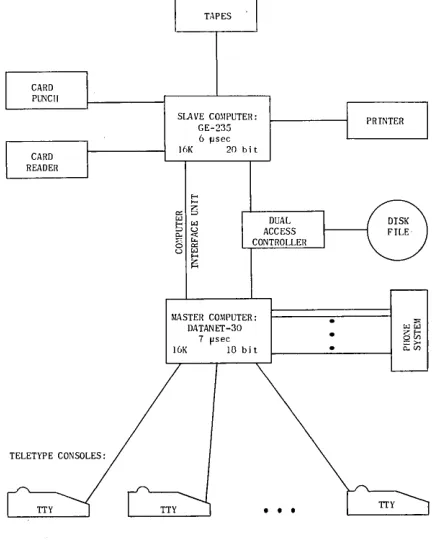
A simple time·sharing system, using a master and a slave computer, and
simplified man/machine interfaces, can play an important role in edu· cation, industry, and government.
28 REAL· TIME COMPUTING WHILE TIME SHARING
by Thomas N. Hastings
Real·time applications can operate in the environment of an on-line time-shared computer system.
In Every Issue
across the editor's desk
35 COMPUTING AND DATA PROCESSING NEWSLETTER 7
9
32
33 10 10 10 10
34
54
50
56
57
editorial
The Social Responsibilities of Computer People
market report
Computers North of the Border
tbroughput
Standardizing Computer Selection
capital report
readers' and editor's forum
1966 Spring Joint Computer Conference - Call for Papers Education, as Ruthless as Evolution
Canadian Engineering
Portion of Statement Before Subcommittee No. 3 of the House Judiciary Com-mittee (Part 2), by John F. Banzhaf, III
Coordinated Operations Calendar of Coming Events
reference information
Computer Census
New Patents, by Raymond R. Skolnick
Books and Other Publications, by Moses M. Berlin
index of notices
Elsewhere, THE PUBLISHER 58 Advertising Index 815 Washington St., 617-DEcatur 2-5453 58 Classified Advertisements
Newtonville, Mass. 02160 2B Who's Who in the Computer Field
:~:
COMPUTERS AND AUTOMATION IS PUBLISHED MONTHLY AT 815 WASHINGTON ST., NEWTONVILLE, MASS. 02160, BY BERKELEY ENTERPRISES, INC. ADDITIONAL OFFICE OF PUBLICATION: 165; WASHINGTON ••••••••• ~~sT~~i~I~~~~;G~~DDP;;~~E~ ~~AURSF~·R SpU~;i:~:.I~~~~~;S~L~N~b~~oil:~T~SND$~5u~~C~~P~16~E~~IL$~~0~E~~:LE2Y ~~T~~P~~S~~~~~NC~ ~~~ ~UA~~I~I~~;~~~.,I;;EU~~~~~I~~E~'M~~.,5g~I~O.Y~~~6~~CLASS POSTAGE PAID AT HOLLISTON, MASS.
Introducing:
A standard integrated-circuit core memory
system with "off-the-shelf" economy!
Standard relay-rack packaging.
Interlaces with either integrated
or discrete circuits • Far
less interconnections and
components lor increased
reliability - Lower power
dissipation, lower cost, and
laster delivery than any previous
coincident-current core memory system.
If you're looking for an optimized, standard
mem-ory system that can be ordered out of a catalog
without lengthy specifications, tiresome telephone
discussions, and several months of waiting-and
have been looking for the economies of
integrated-circuits to show up in core memory systems, then
this is your answer!
The Fabri-Tek Series MLA5 Integrated-circuit Core
Memory System:
Memory-type-coincident-current, random access,
ferrite core
Cycle time-5 microseconds
Capacities available-128, 512, 2048 words with
from 2 to 26 bits per word in increments of 2 bits.
Relay rack packaging-All capacities are packaged
in one relay rack size (5- 7/32" high by 19" wide)
Circuitry-Integrated circuits used in memory
logic, decoding, timing and interface circuits.
Standard options available-address register,
power supply, current-accepting input interface,
high-power drive output interface.
A separate portable exerciser is available to check
out Series MLA5 systems.
The Fabri-Tek Series MLA5 memory system has
been engineered to provide maximum reliability
and economy for a particular set of standard
re-quirements. If you want faster, larger, or more
versatile memories, just ask us. There is a
Fabri-Tek core memory system to meet every memory
problem.
For complete operational, data and ordering inlormation on the
Fabri-Tek Series MLAS Integrated-circuit core memory system:
Call, wire, or write Fabri-Tek Incorporated, Amery, \Visconsin.
Phone: COngress 8-7155 (Area 715). TWX: 510-376-1710.
FABRI-TEK
INCORPORATED
Designate No. 7 on Readers Service Card
" )
c&a
EDITORIAL
The Social Responsibilities of Computer People
One of the most ,,,'orId-changing developments of the 20th century is the Second Industrial Revolution: the electronic revolution in the handling of information, processing data, and computing.
The speed alone, of operating in reasonable ways on infor-mation, has increased a million times in 20 years.
What does this great change imply about what computer people ought to do? What about their social responsibilities as computer people?
Several computer people were discussing this with me a few weeks ago. We looked up the report to the Council of the Association for Computing Machinery, made by the Com-mittee on the Social Responsibilities of Computer People, which was presented to the Council in December, 1958, almost seven years ago. Using that report as a starting point, we arrived at a current "position paper," and here it is.
Part 1. RESPONSIBILITIES
1. Basic Responsibilities. Each human being shares in a basic social responsibility - a duty towards society. This duty is in part enforced legally and in part assumed ethically.
2. Special Responsibilities. Each individual involved in computer activities has in addition to his other social re-sponsibilities some special social rere-sponsibilities placed upon him by his computer activites - his knowledge, position, and experience in the computer field.
3. Ignoring. He cannot rightly ignore his responsibilities. He should consider what they are.
4. Delegating. He cannot rightly delegate his responsibili-ties to any other person or organization. He needs to assume them himself.
5. C onfiicts. Where conflicts occur between different du-ties, each individual should face and resolve these conflicts for himself. He cannot rightly avoid deciding; he should think how to choose.
6. Direction. He cannot rightly neglect to think about how his special position as a computer person can be directed to benefit society and not harm it. He should consider how his special capacities can help advance socially desirable appli-cations of computers and can help prevent socially undesir-able applications.
COMPUTERS and AUTOMATION for October, 1965
7. Action. He cannot rightly do no work, spend no time, contribute no resources, devote no effort - towards pro-moting the use of computers for the greater advantage of society. He should translate his special social responsibility in the computer field into at least some kind of positive, continuing, significant action.
Part 2. AREAS
Among the areas where computer people can particularly help in the use of computers to the greater advantage of society, thus fulfilling their special social responsibilities, are the following:
1. Education - the use of computers to improve and benefit education
2. Employment - the stimulation of employment by the use of computers, and the mitigation of unemploy-ment as a result of the computer
3. World Peace and World Law - the application of computers to increase the degree of world peacefulness, to promote the settlement of conflicts, and to develop international law and order
4. Underdeveloped Countries - the economic applica-tions of computers in underdeveloped countries; the transmission of skills by means of computers
5. Public Understanding - increasing the degree of un-derstanding by the public of what computers can do and will do; encouraging the better utilization of com-puters
6. Health - the use of computers in applications directed towards increasing health and mitigating disease
You as a reader of this magazine are invited to discuss this position paper. Do you think it makes sense? Do you think it should be changed? How?
c.~
EDITOR
8
NOW PATTERNS CAN BE
REPEATED AUTOMATICALLY
WITH DIGITAL ACCURACY
CalComp's new Model 471 Incremental Curve Follower
permits you to trace any silhouette pattern and record
it digitally on magnetic tape.
Process the tracer tape by digital computer and you
can reproduce the pattern off-line on any CalComp
Magnetic Tape Plotting System.
The same CalComp plotter used to record the pattern
on tape can be used to return it to graphic form. Just
replace the pen assembly with a Model 471 photocell
tracer head to trace and record the pattern, then
restore the pen assembly to draw the pattern
auto-matically and accurately-in any quantity and any scale
MODEL 471
INCREMENTAL
CURVE FOLLOWER
• Automatic tracing and digital recording of graphic data • IBM 729 tape format
• Compatible with both character and word oriented computers • Resolution .01 inch, lineal speed up to 45 inches-per-minute
Write "Marketing" for additional features and specifications
Designate No. 8 on Readers Service Card
COMPUTERS NORTH OF THE BORDER
The Computer Society of Canada issued recently
its second annual census of computers installed or on or-der in their country. The report provides some inter-esting statistics on the use of computers by our northern neighbor.
One striking feature of the new census is that in the fifteen months since the publication of the previous census the number of computers reported as being in-stalled in Canada increased by over 50%, from 538 re-ported on March 31, 1964, to 820 rere-ported on June 30, 1965. Whether this increase is due to a booming mar-ket for computers in Canada or to more thorough cover-age of the total installation population by contributing members of the installation survey team of the Computer Society of Canada is not clear.
The quantity of computers on order (reported as 69 Systems) is artificially low due to the fact that many organizations in Canada did not wish to report their plans for new computers for publication in the Computer Society of Canada report.
MARKET
REPORT
The report, called the Census of Computers in Canada, is a supplementary issue of the Quarterly Bulletin of the Computer Society of Canada, issued June 30, 1965. Among the information included in the report is:
(1) A table showing the number of computers by prime shift monthly rental, subdivided by industry (reproduced below);
(2) A listing of computers by user, subdivided by computer model and location;
(3) A listing of computers by province and city, subdivided by user and computer model; (4) An alphabetical listing of the names and
add-resses of computer users in Canada; and (5) A listing of the numbers of computers by their
manufacturer, subdivided by province.
A copy of the Census of Computers in Canada can be obtained for $2. 00 each from: The Book Department, University of Toronto Press, University of Toronto, Toronto 5, Ontario, Canada.
COMPUTERS INSTALLED (OR ON ORDER) IN CANADA AS OF JUNE 30, 1965 DISTRIBUTION BY INDUSTRY BY COMPUTER SIZE
(IN TERMS OF PRIME SHIFT RENT PER MONTH)
$2000 $5000 $10,000 $20,000
UP TO to to to to over
INSTALLED $1999 $4999 $9999 $19,999 $49, 999 $50,000 TOTAL
MANUF ACTURING 72 78 34 50 7 241
DISTRIBUTION 9 18 9 8 44
FINANCE (BANKS, TRUST COS. 15 24 20 30 11 100
INSURANCE)
TRANSPORT & COMMUNICATION 7 27 12 14 2 1 63
UTILITIES 1 18 5 7 3 34
PETROLEUM 7 17 5 20 3 52
SERVICE BUREAU 8 36 4 13 5 66
INSTITUTIONS (UNIVERSITIES, 34 32 7 6 7 1 87
SCHOOLS, HOSPITALS)
GOVERNMENTS 22 21 15 9 7 1 75
OTHERS 13 29 5 11 58
TOTAL INSTALLED 188 300 116 168 45 3 820
TOTAL ON ORDER 5 21 25 16 2 69
GRAND TOTAL 193 321 141 184 47 3 889
1966 SPRING JOINT COMPUTER CONFERENCE
-
CALL FOR PAPERS
The 1966 Spring Joint Computer Conference of the Amer-ican Federation of Information Processing Societies will be held at the new Boston War Memorial Auditorium, Boston, Mass., April 26 to 28, 1966. You are invited to help create an interesting and informative technical program. Papers from all corners of the information processing field will be wel-come. Sessions covering computer systems, hardware, soft-ware, and applications are planned. Papers describing orig-inal research, development, engineering design, software de-sign, system selection and installation problems, state-of-the-art surveys, etc., are all appropriate. Every attempt will be made to achieve a balanced program.
Your contribution is cordially invited. If you plan to send a paper please fill out the attached card and return it imme-diately. Returning the card does not imply a commitment; however, it will be helpful in general planning. The deadline for papers is November 1, 1965. Send five complete copies together with a 150-word abstract to J. L. Mitchell, Chair-man, Program Committee, 1966 SJCC, Post Office Box 460, Lexington, Massachusetts, 02173.
EDUCATION, AS RUTHLESS AS EVOLUTION
Mrs. Helen Solem
Hillsboro, Oregon 97123
In regard to Professor Galbraith's article on unemployment in your August issue: Professor Folkert Wilken in West Ger-many sees that more and better education is required, but he also sees that many people cannot or will not measure up to the new demands; and so he asks how can the wealth produced by machines be equitably distributed?
Since in all mankind's history there never has been an equitable distribution of any sort of wealth be it money, brains or health, it seems highly unlikely that things will change now.
The day is not far off when a great many people will have much more leisure time due either to direct unemployment or just shorter work weeks. It was reported recently in "The Wall Street Journal" that big steel doesn't care that unions are demanding the biggest share of profits ever: on the drawing boards are plans to automate as never before.
Education is undoubtedly the ultimate solution to the social problems automating creates. However, it seems to me that it will be as ruthless as evolution.
CANADIAN ENGINEERING
MANPOWER STUDY
Andrew C. Gross, P .E.
Centre for Community Studies Univ. of Saskatchewan
Saskatoon, Sask.
Currently I am working on a research project which will deal with engineering manpower in Canada. This study will
10
c&a
READERS'
&
EDITOR'S FORUM
focus especially on graduate Canadian electrical engineers, whether they reside in Canad<l, the U.S.A. or elsewhere. This project is to become a doctoral dissertation.
I would be most grateful if you could insert the following in your next issue:
A Study of Engineering Manpower in Canada
Mr. Andrew C. Gross, P.E., of the University of Saskat-chewan and The Ohio State University is conducting a study of engineering manpower in Canada. His work will form the basis of a doctoral thesis. The research will focus on certain patterns of education, employment, and utiliza-tion among young electrical engineers. Personal interviews in three large establishments have been completed. Mail questionnaires will be sent to electrical engineers who graduated with a B.Sc.-E.E. or a B.Eng.-E.E. from Ca-nadian universities in 1954, 1959 and 1964, regardless whether engineers reside in Canada, the U.S.A. or else-where.
The reason Jor my request is that a number of electrical engineers read your journal and their finding of such a para-graph would help greatly in increasing the response rate.
PORTION OF STATEMENT BE.FORE
SUBCOMMITTEE NO.3 OF THE
HOUSE JUDICIARY COMMITTEE
JUNE 17, 1965
John F. Bans.zhaf, III
Computer Program Library
New York, N. Y. 10017 (Continued from September issue, page 27)
I have heard several proposals for dealing with this prob-lem. Reed Lawlor, an attorney very active in this field, has argued that an otherwise legitimate use of a copyrighted work should not be stigmatized simply because a computer was used to accomplish the same result. He has briefly stated his view as follows:
When the Copyright Law is revised, the copyright owner should continue to have the right to prevent the use of his copyrighted work in the printed output of the computer beyond the bounds of fair use, but he should not have the right
w
prevent the feeding of the work into a computer, since normally {he output will be of a kind which would be fair use if no computer were used. (See letter to Hon. Edwin E. Willis, May 18, 1965.)The Electronic Industries Association, in a letter May 8, 1965 has taken a very similar position.
I think their position is a sound one and I urge this sub-committee -to give it careful consideration. If it is not a violation of the law to assign an assistant researcher to look through a series of articles to see if they are pertinent to a particular topic, why should it be a viola,tion for a computer to do it? Are we to punish efficiency and compel scholars to waste valuable time wandering around the library look-ing for relevant material? It is already becomlook-ing plain that scholars cannot hope to keep up in their fields and that the traditional tools of library research are already be-coming inadequate for the rapid recovery of all relevant
information. If a junior librarian could lawfully write a one-sentence summary of a copyrighted work to guide re-searchers, why can't a computer do it also if it is able?
Authors and publishers have argued that such unbridled use of copyrighted works would put them out of business. I respectfully suggest that the copyright owner has adequalte protection in his ability to control the printed output of the retrieval system. If ilt is illegal to reproduce a substan-tial portion of an author's article, k should be equally un-lawful if done by hand, by photocopy machine, or as the output of a retrieval system. By controlling the output, it seems that the copyright owner can prevent all but a fair use of his work. By giving him control over the input as well, he can completely strangle a new and rapidly develop-ing field which holds the only real hope of allowdevelop-ing schol-ars to continue to be aware of and draw upon the work of others. Notice also that the consti,tutional purpose of the copyright grant is to "promote the Progress of Science and useful Arts." I think it is clear that computer retrieval sys-tems 'tend to promote the interchange and use of informa-tion which is the very lifeblood of science and the useful arts.
If the proposal I have just mentioned is not satisfactory, perhaps I can offer a compromise position. Under the bill, a magnetic tape reproduction of a copyrighted work is an illegal copy. This protection is necessary for copyrighted computer programs. Perhaps it should apply equally for all works. Perhaps it should make no difference, from the standpoint of protection, whether t~e tape contains a com-puter program, a learned article, or a James Bond story.
If the computer owner makes a copy on magnetic tape of a copyrighted work, he has made a copy for his own use just as if he had microfilmed it. He possesses a permanent copy from which other copies can easily be made. Let that act constitute an infringement.
But contrast this with the case in which the computer only scans the written work lawfully obtained. During that scanning, "copies" of the work are created momentari}y in the computer's memory. Consider also the case in which the computer examines material on a magnetic tape where the magnetic tape was obtained lawfully from the copy-right holder. Once again there are momentary images of the work created within the computer's memory. These· consist of brief electrical or magnetic changes within the machine which usually are rapidly erased to make room for new information. Nevertheless, they seem to fall within the new definition of "copies." By what reasoning can this be considered a violation? Yet, under the new bill they appear to be. Moreover, there would be a separate violation every time the work or tape was scanned. The sale of magnetic tape does not necessarily imply the right to create new copies within the memory of the computer. I therefor,e respectfully suggest that the defiriition of "copies" be changed so as to exclude all works of a strictly transitory nature. If the issue is left to a later court deci-sion, I suggest that needless doubt will becrea'ted and that the natural result will be that computer users will be hesitant to expend the very large sums of money necessary to establish a workable retrieval system.
Wi,th respect to works created by a computer, I think copyright owners need have no fear. The same standards will probably be applied as are applied to works created by human beings. If the derivative work would be a fair use if done by a man, it should be fair use when created by a computer. By the way, the bill seems to make no ex-press provision for the day when the first computer-created work, be it a ,translation or an original musical composition, is offered for copyright registration. I hope that the word "author," as used in Section 201, will be deemed to include computers as well as people.
COMPUTERS and AUTOMATION for October, 1965
VP- EDP
in
MAGAZINE SUBSCRIPTION
FULFILLMENT SERVICE
ORGANIZATION
We are an expanding Boston-based organ-ization in the field of specialized services to the publishing industry. To the individual who meets our requirements we offer a position with an excellent income and future, and at-tractive benefits including stock options.
•
RESPONSIBILITIES
•
D.P.
MANAGEMENT:
will assume responsibil-ity for existing systems and operations; de-velop operation methods, standards, controls, and scheduling; and conduct continuing re-search of management information systems for magazine subscription fulfillment and reader inquiry processing applications.SYSTEMS/PROGRAMMING:
must be capable of independent system and program design utilizing IBM 1400 series systems. Responsibil-ity in this area ranges from the creation and programming of computer systems to plan-ning their implementation at account and in-ternal levels.BUSINESS MANAGEMENT:
will assist in gen-eral business administration functions such as personnel, purchasing, etc.This is an unlimited growth opportunity for a competent individual with a subscription fulfillment background, who is SERVICE ori-ented, takes a shirtsleeve approach to his job, and possesses executive abilities.
To arrange a personal interview please send your resume and salary requirements in con-fidence to:
Mr. Wm.
J.
McMillanCOMPUTER FULFILLMENT
225 East Street
Winchester, Mass. 01890
To make
com~uters
as goon as these
you've got
to be simple-minded.
People ask us how it is possible for SDS computers to be faster, more reliable, and cheaper than other com-panies'machines.
The answer is simple.
SDS comput-ers are simpler than other people's. They do the job with fewer circuits. Not nearly as many parts.
Fewer circuits make them faster. Fewer parts make them more reliable. Both make them cheaper.
It's hard to design simple computers. Much harder than designing complicated ones.
It's so hard that nobody will try to do it without a strong incentive.
Our incentive is greed. We believe that if we can make better machines than anybody else, and sell them for a lot less money, we can get rich in the computer business.
So far we're doing very well.
We've found a lot of people who are will-ing to pay less money for computers that do more work.
We make these six real-time computers and a lot of stuff to go with them:
SDS 9300 is our biggest. It has a basic core memory of 4096 words, expandable to 32,768 words, all directly addressable. One standard and any number of optional buf-fered input/output channels with rates to 572,000 words per second. Input/output simultaneous with computation up to 1024 levels of priority interrupt. Memory cycle time 1.75 p.sec. Execution times, including all addressing and indexing: Fixed point (24 bits plus a parity bit): add 1.75 p'sec, double precision add 3.5 p'sec, multiply 7.0 p'sec,
shift (24 positions) 5.25 p.sec. Floating point (39-bit frac., 9-bit exp.): add 14.0 p'sec, mUltiply 12.25 p.sec.
SDS 930 is next. Same memory and
gen-Ii
eral description as the 9300. Only the execu-tion times are different: Fixed point (24 bits plus a parity bit): add 3.5 !-,-sec, multiply 7.0 !-,-sec.
SDS 925's basic core memory of 4096 words is expandable to 16,384. From there on the specs are the same as the 9300 and 930, except the execution times: Fixed point (24 bits plus a parity bit): add 3.5 !-,-sec, multiply 54.25 !-,-sec.
.J,...._ ...
[
I
I
SDS 920 has the same memory capacity and priority interrupt as the 925. One stand-ard and one buffered
I/O channel with rates to 62,500 words per second.
Memory h~~
cycle time 8.0 . ... 'I !-,-sec. Execu- ~. ~~ tion times: Fixed point (24 bits plus a parity bit):
add 16.0 !-,-sec, multiply 32.0 !-,-sec.
SDS 910 has a basic core memory of 2048 words, expandable to 16,384, all directly addressable.
Every-thing else is the same as the 920 except the execu tion times: Fixed point I ;"."fl'
(24 bits plus
W
a parity bit):~
add 16.0 !-,-sec, multi-ply 248.0 !-,-sec.SDS 92 is our integrated circuit baby. It has a basic core memory of 2048 words: expandable to 32,768, all directly address-able. Memory "scratch pad" reduces both program size and execution time. Hardware index register; indexing requires no addi-tional time. One standard and any number of optional buffered I/O channels with rates to 572,000
words per sec-ond. Up to 256 levels of prior-ity interrupt. Memory cycle time 1.75 !-,-sec. Execution times, including all accesses and
And here's some of the stuff that goes with them:
Fortran IV for all SDS computers (it's ASA Fortran IV, and then some).
SDS Rapid Access Disc Files (we call them RAD Files) which store from 528,000 to 8,000,000 characters, with access times as low as 500 !-,-sec and transfer rates as high as 480,000 characters per second. RAD Files give the speed and capacity of drums at the price of discs.
SDS new high-reliability magnetic tape drive. Single capstan and full-vacuum col-umns eliminate tape wear and skew, main-tain uniform tension. IBM-identical tape format and guide path assures compatibility. SDS Business Programming Package per-mits SDS computers to perform decimal and character operations with the same ease as standard arithmetic.
Scientists and engineers have snapped these machines up. We have more computers working on line in real-time systems than any other company.
Some of them use their leisure to run pay-rolls. It's a nice change of pace after the hard work of real time.
How much do SDS computers cost?
If you ask us we'll tell you. indexing: Fixed point (12
bits plus a parity bit): add 3.5 !-,-sec, multiply 8.75 !-,-sec, divide 22.75 !-,-sec.
Scientific Data Systems
1649 Seventeenth Street. Santa Monica. California Offices in principal cities throughout the world.
THE ECONOMICS OF ON-LINE SYSTEMS:
SOME ASPECTS
Walter F. Bauer Informatics Inc.
Sherman Oaks, Calif. 91401
An amazing fact about on-line or time-sharing systems is that very little writing - and apparently thinking - has been carried out on the subject of system economics and cost vs. effectiveness. Some possible reasons for this are: these systems are new; they are regarded as research and de-velopment tools; they lack definition and structure. Some critics have suggested - perhaps facetiously - that some users desire to protect their projects by not exploring the facts. Many of the writings - both formal and informal - on the subject have come from System Development Corpora-tion, and are not specifically oriented toward cost vs. effec-tiveness but touch upon these matters in the discussion of design of the systems.
The objective of this article is to provide an introduction, to define the problem, and to discuss a number of aspects and considerations which are invoked in the solution.
Why Make Cost-Effectiveness Analyses?
Some people might argue that cost-effectiveness analyses are irrelevant and unnecessary because the convenience of the user is the important factor. They could point out that our culture is oriented toward convenience, and that, for example, the automobile automatic transmission would never have come into use if there had been a prior requirement for a cost-effectiveness analysis.
The economic development of "convenience" items in our culture would probably disclose the following: The item was first a luxury item - no more than a convenience factor for which some people were willing to pay a substantial price. Later, the economics of manufacture and of application be-came such that the cost of the convenience item began to approach the cost of the "conventional" approach.
This kind of development will undoubtedly be the situation in on-line computing. Eventually, it will not be significantly more expensive to obtain a computer which has the special hardware features for efficient on-line use than to obtain one without these features. Also, eventually, we will learn to produce on-line system software almost as inexpensively as batch-processing software. Indeed, as discussed below, there may be little difference in the costs and complexity of the batch-processing system and the on-line system.
One cannot "prove" once and for all the economic
ad-14
vantages of on-line systems. In general, the parameters and factors involved in the application environment are so many and varied that one cannot arrive at a quantitative overall proof. However, for a given environment and a given set of application parameters, one can provide a set of powerful arguments which build a strong case for on-line systems. The principles involved can be examined carefully. The parameters and factors can be isolated and their impli-cations understood. Furthermore, examples can be provided for certain cases which prove (or disprove) the efficacy of the system.
Some Systems Must Be On-Line
In many cases, the objectives of the user and the require-ments for the system are such that an on-line system is mandatory: there is no other way of meeting the require-ments. Examples of such systems are travel reservation systems, command and control systems, and stock quotation systems. These systems require that the user have ready access to the data in the machine; the answers would be of little use if he had to wait the minutes or hours required for batch processing. Therefore, in these cases, the question is not whether batch processing or on-line processing is better. Rather the question immediately becomes, what is the best design of the on-line system?
However, many systems allow a choice. Many early systems were designed to solve sophisticated problems of mathe-matics and physics. If a system were designed, for example, to be of specific help in the solution of non-linear integro-differential equations, the question immediately arises as to what percentage of the time the computer is to be used for the solution of such equations. Another question which arises is the importance of the timeliness of such solutions in view of the fact that batch systems can - given enough time -provide the answers.
User Efficiency vs. Cost Increase
The conclusion is inescapable, however, that costs for on-line systems will be greater than costs for batch-processing systems. It is true that programming costs for complex batch-processing systems will be nearly as high as those for on-line systems. It is likewise true that in the very near future COMPUTERS and AUTOMATION for October, 1965
Dr. 'Valter F. Bauer founded Informatics, Inc., in 1962 and has since been its President. He received a Ph.D. in mathematics from the University of Michigan in 1951. He supervised the Computation and Data Re-duction Center of Space Technology Laboratories of Ramo-Wooldridge from 1954 to 1958, while it grew from a staff of 10 to a staff of 250. From 1958 to 1962, he was Manager of the Information Systems Depart-ment of Thompson Ramo Wooldridge Inc. He has published numerous papers in digital computers, nu-merical analysis, programming, and other subjects.
the computer hardware required for on-line systems will become closer to that required for the batch systems.
However, the hardware costs for on-line systems will still exceed those for batch processing. Certainly the most clearcut increase in costs of on-line over batch lies in the user consoles and in the communication networks for remote control use often connected with on-line computer use. These increased costs, whether they be substantial or marginal, must be balanced against the increase in user efficiency. Unfortu-nately, the increase in user efficiency is hard to reduce to quantitative terms to make an appropriate analysis of cost-effectiveness.
Increased Programming Costs
An important factor which leads to increased programming cost is increased system complexity. Increased complexity of the system comes from these factors:
1. The programmer must make allowances for the multi-tude of "simultaneous" occurrences. Part of this is a design problem and part of this is a programming exe-cution problem. It involves building the proper networks to react to the various random occurrences in the com-puter system which result from human inputs which, in
turn, provide a multitude of interrupts to the system operation.
2. The computer works in one of two basic modes. In the "privileged instruction" mode the computer is per-forming computations on behalf of the system; in the "non-privileged instruction" mode, the computer is exe-cuting instructions on behalf of the individual user. The problem here again is to make sure that the complex ,programming system is properly responsive to the user's needs and that the various user operations are properly anticipated.
3. There is a basic problem of working storage overlay in such a system since there is a very large amount of programming data swapping between working storage and auxiliary storage. The system must be properly de-veloped to enable this swapping with a maximum of user efficiency or program execution productivity while, at the same time, it gives all users a sufficient number of time slices within a given period of time to allow the system to be responsive.
4. The problem of management of memory becomes far more complex, since there will be many levels of data storage depending upon the frequency of usage .. Also communication is needed among the various storage levels, and a logic of describing the data is needed which is consistent from the point of view of the many users and consistent from the point of view of the many storage levels.
The proponents of on-line systems, however, point out that many of these problems exist in sophisticated batch-processing systems as well.
Increased Computer Hardware Costs
Some of the factors in increased computer hardware costs are:
1. Working storage features such as memory protection, re-locatability, and privileged instructions.
2. Multi-access capability to working storage. This in-volves increased circuitry to allow a great deal of free-dom in overlapping the process of memory swapping with internal computation.
3. Increased storage capacity of medium-speed random-access equipment such as large-scale cores, magnetic drums, and disc files. In on-line systems a large amount of data must be readily accessible to the system. There can be no waiting for the location and transfer of programming pieces such as might be required in the case of sequential memory devices such as magnetic tapes.
Here again, the advocates of on-line systems point out that many of these increased computer hardware costs were being paid in the case of batch-processing systems. They also maintain that these computer hardware features were becoming more and more prevalent and in ever increasing use.
Increased Peripheral Equipment Costs
The main cost item here is the user station. This may vary from a teletypewriter station costing in the neighborhood of $1000 to an elaborate console costing in the neighborhood of $100,000. Whatever the cost, the increased costs here are clearly in excess of those required for batch-processing systems. Furthermore, it has become increasingly clear that typewriter user stations do not and will not provide the flexibility and speed required. The minimum-capability user station is a full keyboard plus a cathode-ray tube with the ability to "print out" approximately one page worth of in-formation. This raises the question of whether hard-copy print-out stations will be necessary and whether they will cost more than the cathode-ray-tube user station. Any costs of buffering and communicating with the user station are again extra costs.
Increased User Effi~iency
Balanced against the increased costs described above is the increase in efficiency which accrues to systems users. This increase in efficiency is seen in the reduction in turn-around time for the users. This applies whether the user is a pro-grammer, who is checking out a computer program, or a data consumer, who is using the information stored and generated by the computer.
Increased efficiency in programming is easy to prove. In most installations, the programming costs are well known. A certain number of programmers do programming full time, and a certain number of programmers work part time; each one has salary plus employee overhead costs. It is easy to argue that "an increase in programming efficiency of n
%
saves s dollars".The case for reduction in turn-around time or increase in convenience for the data consumer is different, and harder to defend. The case is like the difference between the execu-tive who can see his staff only periodically as compared with the executive who can see his staff at any time he wishes.
Cost Accounting Procedures
As usual, there are two types of cost: "Overhead" and "Direct Charge". The former are not attributable to a given
user, but benefit all users. The latter are directly attributable to the user. Although most of the identifiable costs, clearly fit into one category or the other, yet many fit in either category, depending on accounting philosophy. As with all accounting systems, the question is whether keeping track of small costs and attributing them to specific users is worth the extra cost of the required monitoring and accounting. On one hand, it would be desirable to give the customer a com-plete accounting of just what system capability he used and thereby reduce the overhead costs down to an absolute mInImum. However, clearly, cost accounting can be excessive if carried to very low level of data processing function.
Overhead and Direct Charges
Certain costs are readily identifiable as overhead. One of these clearly is programming cost to implement the system initially or to maintain it. These costs are amortized over a given period of time and "written off" at periodic accounting periods. Swapping time is overhead since the individual user has little or no control over total system efficiency and the amount of swapping to be accomplished. The main-frame time required to switch from one computer user to the other and to react to the various console occurrences is again clearly overhead. At the other end of the spectrum, the main-frame time used in carrying out the user's data processing is clearly a direct charge. Debatable costs are: auxiliary memory costs, both with respect to data transfer and data retention, printer usage, and magnetic tape usage for final results. The computer's physical environment, the operator cost, and the cost of any consoles used for the system alone, are clearly overhead.
Customer Charges
Clearly, as stated above, main-frame computer use is direct-ly chargeable to the customer. Similardirect-ly, he may be charged for the number of cells used and the amount of time used in the case of auxiliary memory. Some specialized on-line systems allow a charge per transaction. A common way of charging a customer in an on-line system is to charge him according to the amount of time his user consoles are in use. Interestingly, the resulting charge may bear little relation to the main-frame time used. This method of charging, in fairness, requires that the customer be supplied a good indi-cation of how much main-frame time he can obtain if he is extremely efficient, or how much main-frame time he is likely to obtain per hour of console time.
The Future of Cost-Effectiveness Analyses
Considerably more work should be done in cost-effectiveness analyses. Many designers and investigators of on-line systems have leapt to the defensive when asked about cost-effectiveness of their systems. Many have replied, "The question is out of
order."
Everybody recognizes that we are in the early stages of such systems. Quantitative, precise conclusions with support-ing facts are not now available and possibly are not likely to be for the near future. However, cost-effectiveness analyses give many advantages:
1. Better systems will bf' developed, better balanced be-tween design features and user capabilities;
2. Investor confidence will increase; and
3. The confidence of the system developer and the customer will also increase.
Thi.s is not an offering of these shares for sale, or an offer to buy, or a solicitation of an offer to buy, any of such shares.
16
The offering is made only by the Prospectus.
250,000
Shares
University Computing Company
Common Stock
(no par value)
Price
$4.50
per Share
Copies of the Prospectus may be obtained from such of the undersigned as are registered or licensed dealers or brokers in
securities in this State.
A. G. Edwards & Sons
Boettcher and Company
Piper, JaHray
&
Hopwood
Rauscher Pierce
&
Co., Inc.
B. C. Christopher & Co.
Dallas Rupe & Son, Inc.
Doolittle & Co.
Schneider, Bernet & Hickman, Inc.
September 9, 1965
Designate No. lOon Readers Service Card
Since the ink usually wears out
befor
0why not choose a ribbon
made with longer-lasting ink?
Like anyone of our
customized Roytype™
Computer Ribbons. We
even make the
long~wearingink for it, from our own secret
formulas. 0 And we make a fetish
of quality control when we mix the
ink. We test the pigment powders and
selected oils. Then, after we blend them, we test
again. All to make sure that Roytype inks have the
correct viscosity-for even spread through the
rib-bon-and the desired optical density. And to make
certain that they will last as long as possible. 0 We
don't stop there, either. 0 We custom design your
computer ribbon. Just give us the specifications and
we make it. Width. Length. Core diameter.
Revers-ing bar. Fabric. And so on. All with the same
obses-sive absolute quality control we use in mixing ink.
o
Control. Control. Control. Just to give you the
COMPUTERS and AUTOMATION for October, 1965
longest-lasting computer ribbons around. 0 For
de-tails on how you can get reduced "down time,"
bet-ter "write," and custom quality from economical
Roytype Computer Ribbons, mail the coupon below.
r---.
Royal Typewriter Company, Inc., Dept. 40JTRoytype Division
1031 New Britain Avenue, West Hartford, Conn. Gentlemen:
Please send me full information on Roytype Com-puter Ribbons.
Name ______________________________ __ Company ____________________________ _ Address ____________________________ _ City _ _ _ _ _ _ Zone _ _ _ State _ _ _ _
ROYTYPE~rn
ROYAL TYPEWRITER COMPANY. INC.
L ______ ~~~~~~I~~~~s~~ _ _ _ _ _ _ _
.J
Designate No. 11 on Readers Service Card
THE EVOLUTION OF
REAL-TIME EXECUTIVE ROUTINES
Hal B. Becker Computer Department General Electric Company Phoenix, Arizona
A growing portion of computer systems installed today involve a communications element or other real-time inter-face. In keeping with this trend, increasingly effective execl:l-tive or supervisory monitor routines to control the systems have evolved.
How well the system operates in the real-time environment, and how efficiently the manmachine interface -when present - is accomplished, depends on the philosophy underlying these routines.
As computers capable of operating in a real-time environ-ment are applied in ever-increasing numbers to a rapidly expanding list of applications, it has become evident that many of these applications do not involve the man-machine interface problem to as great a degree as message-switch-ing or time-sharmessage-switch-ing systems do.
It is the function of this article to illuminate the evolution of one practical philosophy for an executive control system or routine that has functioned successfully in a variety of systems involving the man-machine interface problem.
This evolution has occurred in three general phases: (1) Pure Teletype message switching systems; (2) Message-switching systems coupled to batch-processing computers; and, as a further refinement of the second, (3) Time-sharing
~ystems.
The Pure Message Switching Environment
To design an executive routine for a message switching
18
system, one must first consider types of terminal devices and their operating speeds and characteristics. The transmission lines may be half duplex, capable of sending and receiving in only one direction at a time, or full duplex, capable of sending and receiving simultaneously. The transmission rate may be 5-channel, 75 bits per second, as in some Model 28 Teletype equipment, or 8-channel, 110 bits per second, as in Model 35 Teletype equipment, or a combination of the two.
Consideration must also be given to the arrangement of terminals on the lines. Is there one terminal device. per line or several? Must the terminals be polled before they can transmit to the computer? Are answerbacks required to verify the operational status of the equipment before a transmission is initiated? Are the terminal devices all ca-pable of sending and receiving? Are the terminals trans-mitting to the computer directly from the keyboard at operator typing speed or from perforated tape at a constant rate? These and other aspects of the configuration must be considered if an executive is to provide effective control of the system and efficient service to the people using and oper-ating it.
Real-Time Clocks
tively small increments, normally microseconds to a few milli-seconds. The executive routine will then use this time indica-tion to maintain synchronizaindica-tion between the incoming and outgoing data and the programs responsible for these func-tions. In the General Electric Datanet*-30 Data Communi-cations Processor - the real-time computer referred to in this and the following configurations - this timing information is obtained through the use of an addressable register which can be loaded, by the executive routine, with any value from a few microseconds to several hundred milliseconds.
The value chosen for this clock register is a function of the communications facilities used in the system. If the entire system uses one kind of equipment, such as Model 28 Teletype terminals operating at 75 bits per second, then the value chosen would be one that would provide the executive routine, via an interrupt, with a signal every bit time. In this example, a bit time would be 13.3 milliseconds. Since it is possible, however, for the communications facili-ties to run slightly faster than 75 bits per second, a value is chosen which provides allowance for this. An often-used value in this configuration is 12.0 milliseconds, which will allow a lO-per cent increase in the operating speed of the communications facilities.
Sending and Receiving Characters
When the clock register has counted down, it initiates a hardware interrupt. The instruction being executed" at this instant will be completed and control is transferred to the first instruction of the executive routine. After reloading the clock register and capturing other register information neces-sary to restore the interrupted program, the executive will issue a "hardware scan" command. This command re-quires 3 word times (21 microseconds) for each Teletype line terminated in the computer. During this time it presents the next outgoing bit or accepts the next incoming bit, de-pending on the direction of the line.
It .will be noted that when a line is operating at exactly 75 bIts per second, a 12.0-millisecond interrupt cycle will periodically result in two interrupts within the same bit time. This presents no problem, as logic in the hardware scan command prevents the same bit from being sent or received twice within a bit time.
Upon completion of the hardware scan command the next task of the executive is to determine if any lines' have just received the last bit of an incoming character or just transmitted the last bit of an outgoing character. For this purpose, two bits in the words used by the hardware scan command are designated "character flags" and are turned on by the hardware scan command on completion of a character. One bit is the receive character flag and the other is the transmit character flag.
The executive initiates a subroutine which will examine these character flags and, when it detects one of them on will take the appropriate action. An important point
her~
is that not every line is checked for character flags every bit time. At 75 bits per second, it required 7.5 bit times for a comp~ete charac~er. Therefore, to avoid wasting time bycheckt~g ev.ery lme for a character flag every bit time, the executIve wIll select only a portion of the lines each bit time and, by rotating its selection, assure that all lines are charac-ter-serviced at least once per character time.
. For example, assume a configuration of 21 lines operat-mg at 75 bIts per second. On the first cycle, the executive would select lines 1, 2 and 3 for character-servicing. The second cycle would service lines 4, 5 and 6, and so on. At the completion of the seventh bit time, all lines would have been character-serviced once, and the cycle repeats.
"*Registered Trademark of General Electric Company
Hal B. Becker is a Communications Specialist for General Electric Company's Computer Department, Phoenix, Ariz. He is responsible for analysis and devel-opment of communications applications, and consulta-tion on systems designs and hardware configuraconsulta-tions.
He joined General Electric in 1959 as a program-ming analyst for the Metallurgical Products Depart-ment, Detroit, Mich~, and later he transferred to the Computer Department at Phoenix. He attended Michigan State and \Yayne State Universities.
It should be pointed out that the sending and receiving of bits to make up characters is a hardware function under control of the master executive. Program action on any given line is not required until the executive decides that it is time to character-service the line.
Again, it will be noted that, like the hardware scan situ-ation mentioned earlier, a line will periodically be character-serviced twice within a character time. By virtue of the logic which prevents a bit from being sent or received twice, it is not possible for a character flag to be set twice for the same character.
Processing of Incoming Traffic
As the incoming characters are accumulated and placed in buffer areas, the executive's next task is to initiate periodi-cally a routine that will examine these buffers to determine whether any of them are full enough to require that they be captured and written to the auxiliary storage unit, a disc or drum-storage unit.
Two approaches have evolved for this function. The first, or earliest, involved the periodic initiation by the executive of a storing routine. This routine examines all the incom-ing buffer areas. When one is found which contains traffic, the last random access record used for this line on the pre-vious cycle is called in and as much of the new or contin-uing traffic packed into it as possible before it is written back to the storage device.
As records in the storage device are filled, additional records are linked or chained to them, thus providing a con-tinuous character stream representing the incoming data. Once the buffer is emptied and the data stored in the storage device, the entire buffer area is again available for the accumulation of additional incoming traffic.
This time cycle chosen by the executive for this operation is such that an incoming line operating at full speed cannot exceed the capacity of the buffer area before the next cycle.
\Vith the evolution of advanced queueing and core allo-cation techniques it was no longer necessary to perform a read-update-write operation on the mass-storage device to capture incoming data. It could now be accomplished with a single write and only at such time as there was present sufficient data or other cause, such as an end-of-message indication or emergency condition, to justify this scheduling of a mass storage unit operation by the executive.
In either of the above techniques, the executive's main objective is to capture the incoming data and remove it from the real-time environment. Once this is accomplished, the data can be further processed for delivery to its ultimate destination in what essentially amounts to a non-real-time mode. This allows the executive to schedule among the remaining processing routines all the real-time not required for the actual communication function.
These non-real-time functions will examine the data determine its ultimate destination or destinations, verify i; for correct format, establish its priority if necessary and place it in the proper outbound storage queues. The executive, either on a cyclic or an as-required basis, will initiate a
![Crystal structure of (+) N [(1R,5S,6S,9S) 5 hydroxymethyl 3,3,9 trimethyl 8 oxo 2,4,7 trioxabicyclo[4 3 0]nonan 9 yl]acetamide](data:image/gif;base64,R0lGODlhAQABAIAAAP///wAAACH5BAEAAAAALAAAAAABAAEAAAICRAEAOw==)