warwick.ac.uk/lib-publications
A Thesis Submitted for the Degree of PhD at the University of Warwick
Permanent WRAP URL:
http://wrap.warwick.ac.uk/105972
Copyright and reuse:
This thesis is made available online and is protected by original copyright. Please scroll down to view the document itself.
Please refer to the repository record for this item for information to help you to cite it. Our policy information is available from the repository home page.
iii
NURTURING PARTICIPATION OF DEVELOPING COUNTRIES IN
THE MULTILATERAL APPROACH TO THE NUCLEAR FUEL CYCLE
A CASE STUDY: MALAYSIA
by
BASHILLAH BAHARUDDIN
A thesis submitted in partial fulfilment of the requirements for the
degree of
Doctor of Philosophy in Politics and International Studies
University of Warwick, Department of Politics and International Studies
iv I hereby declare that this thesis has not been, and will not be, submitted
in whole or in part to another University for the award of any other
degree.
The views expressed in this thesis are entirely the author’s own and not
that of the Malaysian Nuclear Agency or the Government of Malaysia.
Signature:
Date: 04 June 2018
v
Table of Contents
List of Tables
List of Diagrams
Glossary of Terms
Acknowledgements
Abstract
Table of Contents
Part 1: The Approach
Chapter 1
Towards an Understanding of Malaysian Policy on the Nuclear Fuel
Cycle
1.1 Research Contribution ... 1
1.2 Objectives of the Study ... 12
1.3 The Key Research Questions ... 13
1.4 Research Framework and Design ... 14
1.5 The Research Methodology ... 16
1.6 The Thesis Structure ... 24
vi
Chapter 2
Towards Successful Nuclear Cooperation: Building Trust through
Multilateralism
2.1 Introduction ... 28
2.2 Normative and Analytical Definition of Multilateralism... 29
2.3 The Basic Principles of Multilateralism and the Relationship with
International Order... 32
2.4 The Conceptualisation of Multilateralism and the MNA from A
Theoretical Viewpoint ... 37
2.5 Understanding the Concept of Multilateralism in Southeast Asia and
the Difference in the Trends of Regionalism and Regionalisation in
Europe ... 50
2.6 The Effectiveness of the ‘ASEAN Way’ in Solving Disputes and
Conflicts in ASEAN ... 58
2.7 Multilateralism: Putting Trust into Nuclear Cooperation ... 65
2.8 Relationship Between Multilateralism, Trust and Modern National
Security ... 71
vii
Part 2: Four Potential Pathways
Chapter 3
The Foundation of Euratom and the Evolution of the Multilateral Approach to the Nuclear Fuel Cycle
3.1 Introduction ... 83
3.2 The Relations between Nuclear Fuel Cycle and the Non-Proliferation
of Nuclear Weapons (NPT): An Introduction ... 86
3.3 The Changing Geopolitics of Nuclear Programmes ... 89
3.4 The Challenges of Nuclear Civilian Programmes: Dual Use of
Technology ... 90
3.5 The History of Multilateral Approaches to the Nuclear Fuel Cycle . 92
3.6 The Multilateral Approach to the Nuclear Fuel Cycle (MNA):
Supporting the Non-Proliferation of Nuclear Activities ... 106
3.7 Modern Efforts towards a Multilateral Approach to the Nuclear Fuel
Cycle ... 111
3.8 Impact of the MNA Regime on Countries with Nuclear Power
Programmes That Do Not Have Reprocessing or Enrichment
Technology ... 119
3.9 The European Atomic Energy Community (Euratom): A Case Study
of a Successful Multilateral Nuclear Institution ... 121
viii
Chapter 4
The Nuclear Supplier Group and Recipient States: A Focus on Iran and the United Arab Emirates
4.1 Introduction ... 142
4.2 The Nuclear Supplier Group (NSG): The Background ... 147
4.3 The Influence of the United States in International Nuclear Cooperation ... 153
4.4 Case Study 1: United Arab Emirates (UAE) ... 163
4.5 Case Study 2: Iran ... 182
4.6 Conclusion ... 203
Chapter 5 Prospects for ASEANTOM: A Focus on Indonesia and Vietnam 5.1 Introduction ... 213
5.2 Methodology and Research Framework ... 224
5.3 Research Hypothesis ... 226
5.4 Research Questions ... 227
5.5 Nuclear Security And Non-Proliferation in ASEAN ... 227
5.6 Case Study 1: Indonesia ... 230
5.7 Case Study 2: Vietnam ... 243
ix
Chapter 6
Malaysia’s Best Option: A Multilateral Approach to the Nuclear Fuel Cycle
6.1 Introduction ... 261
6.2 Country Profile and Nuclear Power Programme ... 266
6.3 Malaysia’s Policy on the Development of a Nuclear Power
Programme for Peaceful Purposes... 269
6.4 Malaysia and Multilateralism ... 273
6.5 Malaysia’s Foreign Policy and Policy on Multilateral Cooperation 275
6.6 Malaysia’s Relationship with Big Nuclear Supplier States: China and
the United States ... 278
6.7 Malaysia’s perspective ... 283
6.8 Malaysia’s Position to the Multilateral Approach to the Nuclear Fuel
Cycle (MNA) ... 286
6.9 Conclusion ... 291
Part 3: Conclusion
Chapter 7
Malaysian Nuclear Policy and the Multilateral Nuclear Approach
7.1 Southeast Asia and the MNA ... 295
7.2 Multilateralism: An Advantage for Malaysia’s Nuclear Program ... 300
7.3 Factors to Be Considered for the Malaysian Nuclear Fuel Cycle
Policy ... 306
7.4 Future Research: Euratom – An Example Of A Regional Nuclear
x
References……… 322
LIST OF TABLES
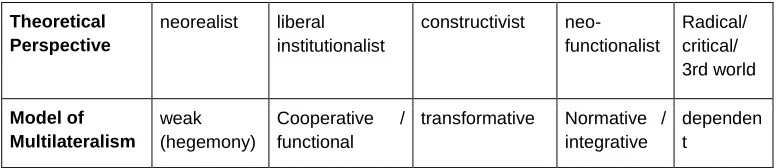
Table 1: Theoretical Models of Multilateralism (Bouchard & Peterson, 2010:17)
…….. 43
Table 2: Summary of MNA initiatives during the Post-Cold War (Tazaki & Kuno, 2012)
…… 104
LIST OF DIAGRAMS
Diagram 1: Gap Analysis for Malaysia’s security of nuclear fuel and sustainability of its nuclear power program. Source: Constructed by the author
……. 12
Diagram 2: Shows the combination of institutional systems, supply side approaches and demand side approaches, as suggested by Yusuke Kuno (Kuno, 2013)
……. 75
Diagram 3: The summary of P5+1 and Iran Agreement (White House, 2015)
…… 201
Diagram 4: ACE in the ASEAN Energy Sector (ASEAN Centre for Energy, 2017c)
…… 219
GLOSSARY OF TERMS
ADA Atomic Development Authority
ADPC Abu Dhabi Port Company
AEA U.S. Atomic Energy Act
AELB Atomic Energy Licensing Board
xi AMEM ASEAN Ministers of Energy Meetings
AMMST ASEAN Ministerial Meetings on Science and Technology
AMS ASEAN Member States
ANENT Asian Network for Nuclear Education and Training
ANSN Asian Nuclear Safety Network
ANTEP Asian Nuclear Training and Education Programme
APEC the Asia-Pacific Economic Cooperation
APSC ASEAN Political Security Community
ARF ASEAN Regional Forum
ASA the Association of Southeast Asia
ASEAN The Association of Southeast Asian Nations
ASEAN COST
ASEAN Committee on Science and Technology
ASEANTOM ASEAN Network of Regulatory Bodies on Atomic Energy
BTWC Biological and Toxin Weapons Convention
CAS the IAEA´s Committee on Assurances of Supply
CCSSRS the Code of Conduct on the Safety and Security of
Radiological Sources
CFE-DMHA Center for Excellence in Disaster Management & Humanitarian Assistance
COC the Code of Conduct in the South China Sea
CPPNM the Convention on the Physical Protection of Nuclear Material
CSCAP The Council for Security Cooperation in the Asia Pacific
CSANT Convention on the Suppression of Acts of Nuclear Terrorism
CSI Container Security Initiative
CTBT The Comprehensive Nuclear-Test-Ban Treaty
xii EBP IAEA Extra-Budgetary Programme
EC European Commission
ECSC European Coal and Steel Community
EDC European Defence Community
EEC the European Economic Community
ENEC Emirates Nuclear Energy Corporation
ESA The Euratom Supply Agency
EU the European Union
Euratom European Atomic Energy Community
FMCT Fissile Material Cut-off Treaty
FNCA Forum on Nuclear Cooperation in Asia
G8 Group of Eight
G20 Group of Twenty
G33 Group of Thirty-Three
GCC Gulf Cooperation Council
GDP Gross Domestic Product
GHG green-house gas
GICNT the Global Initiative to Combat Nuclear Terrorism
GNEP US Global Nuclear Energy Partnership
HEU highly enriched uranium
HLW high-level waste
HVDC High Density Voltage Cable
IAEA the International Atomic Energy Agency
IMRSS International Monitored Storage System
IPS International Plutonium Storage
IR International Relation
IUEC the International Uranium Enrichment Center
LEU Low Enriched Uranium
xiii MNA Multilateral/Multinational Approach to the Nuclear Fuel
Cycle
MNPC Malaysia Nuclear Power Corporation
MP3EI The Masterplan for Acceleration and Expansion of Indonesia's Economic Development
MTCR the Missile Technology Control Regime
9th MP the Ninth Malaysia Plan
NAM Non-Alignment Movement
NEPIO Nuclear Programme Implementation Organization
NATO the North Atlantic Treaty Organization
NCRI National Council of Resistance of Iran
NES-SSN Nuclear Energy Safety Sub-Sector Network
NNWS non-Nuclear Weapon Countries
NPT The Non-Proliferation of Nuclear Weapon
NSG Nuclear Supply Group
NTI the Nuclear Threat Initiative
Nuclear Malaysia
Malaysian Nuclear Agency
NWC Nuclear Weapons Convention
NWFZ nuclear-weapons-free zone
NWS Nuclear Weapon Countries
OPEC the Organisation of the Petroleum Exporting Countries
PSI Proliferation Security Initiative
PTP the Port of Tanjung Pelepas
PUSPATI the Tun Dr. Ismail Atomic Research Centre
RCA Regional Cooperative Agreement for Research, Development and Training relating to Nuclear Science and Technology in Asia and the Pacific
RNFC Regional Nuclear Fuel Cycle Centres
xiv SEA South East Asia
SEANWFZ the Treaty on South-East Asia Nuclear Weapons-Free Zone
SEATO the Southeast Asian Treaty Organization
SNF spent nuclear fuel
SOME the Senior Officials Meetings on Energy
TACP IAEA Technical Assistance and Cooperation Programme
TNRC Tehran Nuclear Research Center
TWG-NPP the Technical Working Group on Nuclear Power Plants
UAE United Arab Emirates
UN United Nations
UNSC United Nation Security Council
U.S. United States
VAEC the Vietnam Atomic Energy Commission
VPA Virginia Port Authority
WMD weapons of mass destruction
xv
Acknowledgements
Before flying to England for my PhD, I had mix feelings, not knowing
whether I could survive a student life after almost 20 years leaving it
behind. No doubt, it was indeed a rough journey for me, but I came to
appreciate it as I learned how to develop discipline and overcome
mental breakdown. Even though I survived the journey, it could never
happen without the support and love from my family. Thus, my heartfelt
goes to my beloved husband, Zain, two children Asyraaf Danial, and
Wahida Daniela, umi, ayah, Alimi, Syahinaz and Inarah. I am also
thankful for the support I received from friends and Malaysian
community in Coventry (MCS) who had always been part of my survival,
especially Syazwani, Azhan, Misrah, Khairul Adly, Zahidfullah, Kak Idah
and Abang Fuad. My supervisors, Peter Ferdinand and Kelly Dominic
have also been very helpful, and they are like my encyclopaedia and I
could not have asked for more from them. I aspire to their
professionalism, integrity and academic insight. I also owe a huge
amount of gratitude to staff of PAIS office who have provided me with
information and helped me with administration matters. My gratitude
also goes to my Director - Dr. Noriah Jamal, Director General Dato Dr.
Muhamad Lebai Juri, AELB Director General Hamrah Ali, IAEA officer YM Raja Dato’ Abdul Aziz Raja Adnan and last but not least Indonesian
officers- who were very supportive and provided me with their precious
time for the interviews. It was so much help that it assisted the writing of
this thesis. There is a long list of others who, through informal chats,
offered for help and good luck wishes that serve to support and inspire
this work. Not forgetting Mazleha, Marina, Zack and Rohaizah who were
never tired helping me.
xvi
Abstract
The Malaysian government has recently decided to consider nuclear
energy as an option for electricity generation post-2030. In this light,
Malaysia needs to develop a National Nuclear Fuel Cycle Policy to
ensure the sustainability of its nuclear power programme. Due to the
nature of dual use nuclear technology, this policy debate touches a very
sensitive political topic in the context of the ongoing ‘war on terror’. To
prevent newcomer states from misusing sensitive technology facilities
such as the enrichment and reprocessing of nuclear materials, the
international system employs multilateral nuclear arrangements (MNA).
However, the MNA has come under criticism, especially from the
developing countries, since it contradicts their rights for peaceful use of
nuclear technology, as stipulated under Article IV of the Treaty on the
Non-Proliferation of Nuclear Weapons (NPT). Without a doubt, the
central issue in the implementation of MNA is about trust and
trustworthiness. Through a historical analysis and policy study, this
thesis identifies the factors that influence nuclear cooperation in the framework of multilateralism. It also explores Malaysia’s participation in
the MNA, contributes to the debate on the most appropriate option for its nuclear fuel cycle and provides information for developing Malaysia’s
Nuclear Fuel Cycle Policy. The arguments made in this thesis are based
on consultations and analysis of a range of primary documents (white
papers, acts, reports and formal interviews, etc.) and secondary
materials (presentations by policy-makers and analysts, a wide-range of
secondary literature). These materials have been crosschecked against
a limited number of unstructured interviews with policymakers, analysts
and Malaysian Government officials. The thesis is also underpinned by
information from relevant academic, media and historical literature. The
xvii can secure a fuel supply and maintain the sustainability of its national
1
Part 1: The Approach
Chapter 1
Towards an Understanding of Malaysian Policy on
the Nuclear Fuel Cycle
1.1 Research Contribution
When Malaysia decided to pursue the development of a civil nuclear
energy capability, one of the important components to be considered
was a nuclear fuel cycle policy. This policy would help Malaysia:
i. to guarantee the security of nuclear fuel supply and sustainability
of its environment when Malaysia is ready to develop a nuclear
power programme;
ii. to identify technologies that are available and accessible for
Malaysia; and
iii. to strategize and position Malaysia among nuclear powers to be ‘up-to-date’ on developments in nuclear technology and in nuclear
management.
This thesis, which is the first and only academic study on Malaysia’s
policy on the nuclear fuel cycle, was carried out to outline strategies that would protect Malaysia’s right to access nuclear technology. This right is
stipulated under the 1968 Treaty on the Non-Proliferation of Nuclear
Weapon (NPT). The focus of this thesis is to identify available options
2 capability without being seen as a threat regionally or globally. For this
reason, this study also thoroughly examines the system and mechanism
of Multilateral Approaches to the Nuclear Fuel cycle (MNA). Such an analysis, I argue, can assist the development of Malaysia’s own nuclear
fuel cycle policy.
The nuclear fuel cycle may be broadly defined as the set of processes
and operations needed to manufacture nuclear fuel, its irradiation in
nuclear power reactors and storage, reprocessing, recycling or waste
disposal (IAEA TECDOC 1613, 2009). Thus, stages in nuclear power
system include facilities that mine and mill uranium ore, facilities that
enrich uranium to create fuel, fuel fabrication facilities, reactors that burn
that fuel to generate electricity, possibly facilities to reprocess the spent
fuel, and waste storage sites (the Nuclear Energy Study Group of the
American Physical Society Panel, 2005). There are two types of fuel
cycle, namely an open nuclear fuel cycle and a closed nuclear fuel
cycle. During an open nuclear fuel cycle, either used fuel is not
reprocessed or the cycle does not involve the uranium enrichment
process. Advantages of having a closed fuel cycle for a country with no
uranium mines come from reprocessing: the chemical process of
separating plutonium and uranium out of used nuclear fuel, which
creates reusable nuclear materials. This is a strategy for some countries
to secure a fuel supply because reprocessing extends the life of
available uranium, and in some countries that declared they have a
closed fuel cycle such as the United States (U.S.) (enrichment facility),
Russia (enrichment and reprocessing facility) and China (enrichment
facility), it is seen as a very efficient use of energy. For example, one
gram of recycled plutonium can produce the same amount of electricity
as one ton of oil (Eureka County, 2011). Another advantage is that the
3 reduced through the reprocessing technology. After reprocessing, only
about three percent of the original quantity of nuclear material remains
unusable, high-level waste (Eureka County, 2011).
A closed nuclear fuel cycle would give Malaysia, a country with no
uranium reserves, an advantage because a capability to reprocess spent nuclear fuel (SNF) would secure Malaysia’s nuclear fuel supply if
there is shortage of nuclear fuel from the supply side.
1.1.1 Research Problem and Puzzle
When Malaysia decided to develop nuclear power as an alternative for
its electricity generation after 2020, a need emerged to choose the best
option for the country in terms of nuclear fuel cycle. This decision will
determine whether nuclear suppliers will support Malaysia’s desire for
nuclear energy without imposing any additional conditions, as has
happened with some countries, such as Iran.
In civilian nuclear activities, such as nuclear power programme, the
main concern is about SNF, which involves the most difficult and
controversial field of nuclear power policy. These issues include not only
environment and health, but also security since separated plutonium
and/or depleted uranium from the SNF could be misused as a nuclear
weapon (Högselius, 2009). These materials are produced from two
stages in the nuclear fuel cycle namely, uranium enrichment and the
reprocessing of SNF. While this study was carried out, Malaysia had no
uranium reserves that potentially could be explored for the nuclear
power industry. Thus, if the country is ready for its nuclear power program in the future, Malaysia’s fuel is fully dependant on foreign
4 to be a promising measure that could benefit Malaysia. Enrichment
technology would not only be advantageous from the perspective of fuel
supply but also could help sustain the environment since the technology
can lessen the volume, radiotoxicity and decay heat of the final
High-Level Waste (HLW). Subsequently, the final repository volume is
reduced, which also decreases the cost and area for waste disposal
(Rodríguez-Penalonga & Soria, 2017; see also Widder, 2010).
Malaysia, as a signatory state to the NPT, has a legal right to develop a complete nuclear fuel cycle, subject to IAEA’s guidelines and
inspections. This is clearly guaranteed in the Article IV of the NPT,
which states that all non-nuclear weapon countries (NNWS) that sign
the treaty, are given an inalienable right to develop research, produce
and use nuclear energy for peaceful purposes without discrimination.
These countries also have the right to participate in the fullest possible
exchange of equipment, materials and scientific and technological
information for the peaceful uses of nuclear energy. Unfortunately, the
spread of enrichment and reprocessing technologies can increase the
risk of proliferation of nuclear weapons (Goldschmidt, 2003). The NNWS’s right, as specified in the NPT, has raised concerns from many
countries, in particular developed countries, primarily due to the
possibility of dual use of nuclear technology. This means that its
diffusion has become a very sensitive political question in the context of the ongoing ‘war on terror’. From the standpoint of nuclear
non-proliferation, enrichment and reprocessing technology is a sensitive
technology that is subject to strict international control. If not controlled,
these technologies could be used to produce nuclear weapon-grade
materials, namely highly enriched uranium (HEU) and separated
5 Although the NPT is a treaty that was created to govern nuclear
activities, Article IV of the treaty represents a loophole in controlling the
development of nuclear weapons. Nuclear political analysts believe that
with such knowledge, a state could revoke its non-proliferation
commitments and give them an open opportunity to develop nuclear
weapons (Shenasaei & Shirvani, 2014). It is undeniable that the NPT is
a successful security regime, but at the same time it is vulnerable. A
member state could spend many years taking advantage of its Article IV
rights, and then, as it passes the threshold needed to create a nuclear weapon, the state can withdraw and evade its Article II obligations ‘not
to manufacture or otherwise acquire nuclear weapons or other nuclear explosive devices’ (Burke, 2017). This was demonstrated when North
Korea announced that it would no longer be bound by the NPT. This decision poses questions about the North Korea’s status within the NPT, the adequacy of the NPT’s provisions for treaty withdrawal and the
ability of existing international institutions to govern treaty obligations
related to nuclear non-proliferation and disarmament (Carrel-Billiard &
Wing, 2010). Thus, the legal ability to acquire enrichment and
reprocessing facilities by a Member State of the NPT, is a decision that
carries with it a high degree of risk.
On the other hand, the three other nuclear states – namely Israel, India
and Pakistan - are excluded from joining the NPT as NWS because that
category is limited to those states which manufactured and exploded a
nuclear weapon prior to 1 January 1967. Consequently, they are not
bound legally by NPT obligations, being neither NNWS nor NWS. This
also means that these states can produce fissile material without being
6 Having an enrichment or a reprocessing capability would increase the
interest among state leaders inclined to develop nuclear weapons and,
in the worst-case scenario, the technology and its products could be
targeted by terrorists or other non-state actors (McGoldrick, 2011). This
concern was intensified after incidents such as the nuclear test by India in 1974, which eventually led to the discovery of A.Q. Khan’s illegitimate
network that supplied sensitive nuclear technologies and equipment to so-called ‘rogue states’, and allegations that North Korea offered
sensitive nuclear technology to other states. For these reasons, major
nuclear suppliers exercise substantial restrictions in the transfer of
sensitive nuclear technologies to countries that lack or do not have such
capabilities (McGoldrick, 2011).
During preliminary stage of nuclear power program, this should not be
an issue because undertaking fuel preparation for reactors with less
than four units would not be economical for newcomers like Malaysia (Symon, 2008). However, this might change if Malaysia’s nuclear power
develops on a much larger scale. Malaysia may want to have this
capability to achieve the effect of the economy of scale and less
dependency from foreign resources, considering the country has no
source of uranium. This interest may also occur in other developing
countries interested in developing a nuclear power program. Hence,
multilateral approaches should be the method of choice for countries
hoping to develop a commercial nuclear power industry, and especially
so when the intention is to develop enrichment and reprocessing
facilities. MNA is also a solution for managing global nuclear fuel cycles
to make available the benefits of peaceful applications to all countries on
an equitable and non-discriminatory basis (Yudin, 2011). However, MNA
is facing criticism especially among developing countries. They
7 access any nuclear technology as long it is for peaceful use. Developing
countries also fear that if they engage in this kind of approach, the
nuclear fuel supply could be disrupted for political reasons; or it could
serve as a red herring for denying their rights to construct and operate
fuel cycle facilities domestically (Goldschmidt, 2010). Another factor that
makes some countries not confident in MNA is that the effectiveness
and reliability of the MNA is still at the exploration stage, both in political
and technical aspects. That is why, among other core concerns that
have been raised by many states, including Malaysia, the MNA should
not form a monopoly of suppliers. The right of states to use nuclear
energy for peaceful purposes must be respected and this initiative must
be non-discriminatory, transparent and inclusive (Yudin, 2010). On the
other side of the debate, nuclear supplier states fear that this provision
could be misused for nuclear weapon development purposes. So,
nuclear suppliers could be more confident that by accepting the MNA, a
country like Malaysia would gain a level of trustworthiness because the
state demonstrated their genuine intent to develop only civil applications
of nuclear technology. In fact, this leaves no choice for a country like
Malaysia because nuclear supplier states have the right to not transfer
any technology that they consider may be misused to develop weapons
of mass destruction (WMD). If newcomers decide not to take the deal, it
would be a major drawback to a country like Malaysia.
The research puzzle for this study is, accordingly, to explore the best option for Malaysia’s nuclear fuel cycle. The shape and substance of
8 Given scenarios that were mentioned above, Malaysia has only one
option, which is an open nuclear fuel cycle implemented through a
multilateral arrangement such as MNA. If Malaysia still maintained its
decision to go for a closed fuel cycle, it may be suspected of having an
interest in developing nuclear weapons. This is what Iran encountered
when it announced the interest in developing reprocessing facilities for
peaceful use, to secure its nuclear fuel supply.
However, to enjoy the benefits of multilateralism, Malaysia needs to
consider the long-term effects, especially if any crisis were to occur. As
suggested by Newman, a crisis in multilateral organisation/institutions
may happen if:
The attitude of a powerful country turns against a multilateral organisation/institution for ideological reasons, for example, a
change of government, and such a country refuses to give
diplomatic and material support.
The constitutive principles upon which the organisation or regime was founded and operates are challenged by changing norms or the
breakdown of norms. For example, the growing prominence of
terrorist organisations and the perceived threats of weapons of mass destruction in the hands of terrorists or ‘aggressive country’
might change the constitutive principles (Newman, 2007).
A decision for selecting MNA as a mechanism for securing fuel supply
would also be in line with the international tendency towards nuclear
cooperation. For example, during the IAEA General Conference in
September 2003, the IAEA Director General shared his view that
international cooperation, in the context of the design and operation of
9 over the years. He suggested that MNA should be given serious
consideration in the effort to cope with the ever-increasing challenges of
non-proliferation, safety, security and technology (ElBaradei, 2003).
These efforts should include limiting the use of weapon-grade materials
such as highly enriched uranium (HEU) and plutonium in civilian nuclear
programmes, by permitting it only under multilateral control. Any
exploration of this option has to be governed by the appropriate rules of
transparency, control and, above all, assurance of supply of nuclear fuel
cycle services (ElBaradei, 2003). Igor Shuvalov, in his statement during
the G8 meeting 2006, cited that energy security "should be based on
market mechanisms that will open a lengthy cycle of investments, and
prevent a negative impact by possible political decisions" (Sunderland,
2006).
As a growing country that needs to keep its energy options open,
Malaysia needs to constantly follow-up and maintain its keen interest in
the development of MNA. In this context, Malaysia should hold its
national position that any proposals should be a potential mechanism to
improve supply assurances of fuel material, technology and services,
and not serve as a mechanism for controlling the nuclear fuel market. In
this regard, this study was undertaken to provide an analysis on the
factors that influence nuclear cooperation surrounding the nexus of multilateralism that could be used to explore Malaysia’s participation in
the MNA, to select an option for its nuclear fuel cycle and to assist
Malaysia in developing its Nuclear Fuel Cycle Policy.
Unfortunately, so far, there are few examples of the decision-making of
developing countries that are contemplating a nuclear power
10 country that has been said to be a good example for nuclear power
programme is the United Arab Emirates (UAE). From observation, many
proposals on MNA are from states that already have a nuclear power
industry, such as the USA that proposed Global Nuclear Energy
Partnership (GNEP), or the IAEA Standby Arrangement System (SAS)
that was proposed by Japan. The latest proposal is the IAEA Nuclear
Fuel Bank proposed by the Nuclear Threat Initiative (NTI). Furthermore,
there is not yet an academic study, at least during this study’s
preparation, which discusses the perspectives on MNA from developing
countries or newcomer states, which include Malaysia, and how it would impact Malaysia’s nuclear power planning. Most of the studies on MNA
take the angle of nuclear safety, security, technology and economy that
could be gained from the proposed initiatives. Following this, most
current proposals are targeted at the energy-security arguments for
national fuel-cycle capabilities. Against this background, several
proposals seek to strengthen existing market mechanisms, usually
through (in one form or another) assurances of fuel supply or fuel-cycle
services. These proposals are generally based on the underlying
assumption that the current system of fuel and enrichment suppliers is
adequately diverse, and that new suppliers are not needed (Glaser,
2009:2).
Subsequently, not much literature exists on how developing countries
should approach challenges to nuclear programmes and their
acceptance in MNA. In addition, whilst this research was being carried
out, most discussions on MNA focused on the technology and the
economy of the initiatives but none focused on the concept of
multilateralism itself. This is bearing in mind that the implementation and
employment of the multilateralism concept is slightly different between
11 declared by SEA leadership, ASEAN was implemented based on an indigenous concept, the ‘ASEAN Way’, emerging from four key
principles: open regionalism, cooperative security, soft regionalism and
consensus (Acharya, 1997). This will be discussed further in Chapter 2,
but sufficient to say here that this research was carried out through the
prism of the principles, norms and general concepts of multilateralism
surrounding the MNA from the perspective of ASEAN. For that reason,
the originality of this dissertation is partly determined by the following
aspects:
i. there has been no previous study of these issues where Malaysia
is concerned;
ii. this dissertation analyses a broader range of issues than have
previously been addressed; and
iii. information obtained from Malaysia’s experiences in this study
will be relevant to other countries that are considering MNA.
Subsequently, this policy-oriented research is important and could offer
a contribution to the academic knowledge of nuclear policy studies,
12 Diagram 1: Gap Analysis for Malaysia’s security of nuclear fuel and
sustainability of its nuclear power program. Source: Constructed by the
author.
1.2 Objectives of the Study
The main puzzle of this study is to identify which nuclear fuel cycle
option fits best the needs of Malaysia. In the contemporary situation,
cooperation through multilateral agreements appears the best way
forward, and this thesis therefore focuses on MNA from the perspective
of multilateralism, trust and confidence building. Hence, this
policy-Status quo of Malaysia’s Nuclear Power Program
No major uranium
reserves
No reprocessing
technology
No enrichment
technology
Fuel supply totally depends on supplier (single supply)
Needs of Malaysia’s Nuclear Power
Program Secure fuel supply for
its nuclear fuel in case of supply disruption by supplier
Achieve sustainability for the operation of the nuclear power
program and environment
Gain support from
nuclear supplier states Gap Analysis
No technology transfer:
reprocessing and enrichment
Available approach for Malaysia:
multilateral cooperation
Approach proposed by many
nuclear suppliers – MNA
the implementation of MNA - Issue
of trust
Malaysia’s Fuel Cycle Policy – a
strategy for ensuring security of nuclear fuel and sustainability of its nuclear power program
Research Puzzle
13 based research aims to achieve three objectives. First, to explore the
influences of the MNA proposal on Malaysian Nuclear Fuel Cycle Policy.
Second, to examine the academic literature on multilateral cooperation,
which has been accepted by the international community as a tool in
implementing international order. Third, to identify (i) what are the
factors that need to be considered by suppliers that would gain trust
from recipient states to join MNA, and (ii) factors that need to be addressed by the recipient states to gain suppliers’ trust during the
negotiations of nuclear cooperation.
This research will approach MNA through the concept and principles of
multilateralism and how trust plays a vital role in nuclear cooperation.
Data from this research then will be utilized to investigate and analyse
features that influence trust and trustworthiness among nuclear
suppliers and newcomers. This information will provide the basis for designing Malaysia’s nuclear fuel cycle policy. Wide-ranging nuclear fuel
cycle policy would guide Malaysia to access nuclear technology and fuel
services within the context of the international nuclear system of
governance. Information gathered from this study could also be used to
examine the extent to which the policies and practices in this field
illustrate theories of international order.
1.3 The Key Research Questions
As mentioned previously, this study seeks to add knowledge about the
processes surrounding the operation of the multilateral nuclear fuel cycle, and to contribute to the development of Malaysia’s Policy on the
Nuclear Fuel Cycle. Information gained from this research also could
provide data for nuclear power planning in Southeast Asia. This study
14 i. What is the best option for Malaysia to guarantee the security of
nuclear fuel supply and sustainability of its environment when
Malaysia is ready to develop a nuclear power programme?
ii. How can MNA ensure that nuclear fuel and its services are
accessible at competitive market prices on an equitable and
non-discriminatory basis?
iii. What are the key issues surrounding MNA that should be
addressed before Malaysia designs its national nuclear fuel cycle
policy?
iv. What are the factors that will encourage and maintain the trust of:
a. The international community for the implementation and
sustainability of multilateralism of nuclear fuel cycle
cooperation?
b. Developing countries to participate in the multilateral
approach to the nuclear fuel cycle cooperation?
1.4 Research Framework and Design
There are three stages in this study. The first stage is to understand the
conceptualization of multilateralism underpinning MNA using analytical
frameworks developed within the academic literature on International
relations: namely Liberal Institutionalism, Constructivism and
Neo-functionalism. Then, the study will examine the historical evolution of
MNA, which is closely related to questions of nuclear security and
non-proliferation. The analysis explores factors and issues that influenced
participation in previous MNA and compares them to the modern
multilateral organisation in nuclear energy, such as Euratom. The study
uses historical analysis carried out on previous MNA proposals primarily
15 as a case study because it was recognised as one of the success
stories of multilateral cooperation on nuclear energy.
The second stage of this study will explore factors that influence levels
of trust, i.e. linkages between economics, military power and regulatory
frameworks. This section aims to explore the dynamics of how and
under what conditions trust can be built, maintained or regained. The analysis will examine factors used to design a state’s foreign policy,
previous and current economic cooperation, previous and current
strategic partnerships, policy on nuclear technology for peaceful
purposes and previous or current nuclear cooperation. This information
is significant for the study in order to identify the factors that nurture trust
between a nuclear supplier country and a newcomer country. In this
Thesis, the methodological approach deployed is chiefly that of historical
analysis. The information garnered through this process could be used
as a basis for the development of nuclear fuel cycle policy appropriate to
the contemporary international environment.
The third stage involves investigation of multilateral cooperation through Asian and, more specifically, Malaysia’s, perspective. The study focuses on ASEAN and its ‘ASEAN Way’ approach to diplomacy and
policymaking. These views could help explain the interest of developing
countries as perceived from the Asian perspective and how they
implement their foreign policy on multilateral cooperation. This study
supports the argument that different states and regions approach the
challenges of international governance differently. Data from all these
analyses will later be used to identify factors and features on how trust
can be developed, shaped and maintained between nuclear supplier
16 decision on whether to join the MNA and whether the current MNA
initiative applies the principles of multilateralism.
1.5 The Research Methodology
This study focuses on two variables that are related to the
implementation of MNA, namely multilateralism and trust. For this
reason, the study employs a combination of two types of qualitative
research methodology: comparative historical analysis and case study
analysis. Comparative historical analysis was used to identify the
strengths and weaknesses of MNA by looking at lessons learned from
previously proposed MNA regimes since 1946, and modern MNA
regimes. MNA is, in essence, a strategy to optimize the management of
the nuclear fuel cycle that would benefit all states without a need to
develop new facilities, especially in case of sensitive technology such as
enrichment or reprocessing. According to Chandler, "Historians have
provided social scientists with little empirical data on which to base
generalizations or hypotheses concerning the administration of great
enterprises. Nor have the historians formulated many theories or
generalizations of their own" (Chandler 1962: 1). The impact of Chandler’s study is not limited to business and management only; as exemplified by Rose (2008) and Wilkins (2008), Chandler’s work also
had a strong influence in the fields of economics, sociology, business
history, management, and political studies (Asifa, Chaudhryb & Shafic,
2015). Knowledge of the history of any discipline is essential to an
understanding of the origin, evolutionary process and destination of that particular subject (Kipping & Üsdiken, 2007). Therefore, historical
analysis is used in this Thesis to identify motivations for the
development of nuclear energy technology, whether it is genuinely for
17 previously have produced a series of influential studies to answer some
important questions concerning state formation, regime change, and the
international order (Moller, 2016).
Meanwhile, case studies were carried out to identify factors that
influence nuclear cooperation, and how a state could attempt to build
trust amongst other members of the international nuclear community;
and to study a success story of a current multilateral organisation in
nuclear energy, Euratom, and to compare it with other previous MNA
proposed since 1946.
1.5.1 Historical Analysis
Historical analysis involves interpretation and understanding of various
historical events, documents and processes, which aim to answer
questions of how or why something happened the way it did (Wesleyan
University, 2011). Comparative historical analysis often helps to derive
lessons from previous experiences that are relevant to the concerns of
the present (Mahoney & Rueschemeyer, 2003). Hence, qualitative
methods were chosen in this study, and the preferred method is
historical analysis.
Historical analysis is used in social research as an initial strategy for
establishing a context or background, against which a substantive
contemporary study may be structured (Jóhannesson, 2010).
Correspondingly, many social scientists use this method to understand
both the dynamics of the contemporary world and the processes that
created it. For example, it is used in the studies of state building,
nationalism, capitalist development and industrialization, technological
18 democratization, imperialism, secularization, and globalization (Lange,
2013).
1.5.2 Methodology for the Historical Analysis
Historical analysis is carried out using documents and other texts, such
as official reports and newspaper articles because it offers insights into
the reasoning behind social practices and institutional structures.
Newspaper articles reveal the contradictions in the social and political
struggles about the practices and political interests at stake. Analysis of
interview transcripts and observation protocols also offer an important
avenue to study practices and the reasoning behind them
(Jóhannesson, 2010). There are several steps used by social scientists
in historical analysis. Charles Busha and Stephen Harter have detailed
six steps for conducting historical research (Busha & Harter, 1980)
which are identify historical problem or need for certain historical
knowledge; gather relevant information about the problem or topic; if
applicable, design research hypothesis that tentatively explain
relationships between historical factors; collect and organize the
evidence and verify the authenticity and veracity of information and its
sources; select, organize, and analyse the most pertinent collected
evidence; and conclusion of the study.
Similarly, Jóhannesson (2010) also points out six steps for conducting
historic research. Step 1 is to identify the (controversial) issue.
Jóhannesson stated that the first stage in historical analysis is selection
of issues or events that is controversial among professionals or widely
discussed. This study was selected based on the scenario that Malaysia
is interested in developing a nuclear power programme. Among other
19 towards this programme, there is Malaysia‘s position on nuclear fuel
cycle policy. The issues are widely discussed among the nuclear
community relating to the technology itself and knowledge transfer. In
the entire cycle, only two stages (the uranium enrichment and nuclear
spent fuel reprocessing) pose risk of being misused/abused to produce
highly-enriched uranium or plutonium as blasting material for nuclear
weapons. In response to this growing concern, countries with the
technology for uranium enrichment and spent nuclear fuel reprocessing
have refused to transfer these technologies to other countries that do
not have them. This act by the technology holders contradicts what has
been promised to the newcomer countries in the Article IV of NPT.
Developing countries are certain that the NPT is the most fundamental
document that prohibits the possession of nuclear weapons.
Step 2 is the selection of documents. Once the issue has been
identified, the next step is to determine the materials that are considered
relevant to the study. Jóhannesson argues that there is no right or
wrong way of doing it, the most important is to find what the key
documents are. For example, if the researcher wants to analyse
government policy as the issue, he or she needs to find out which are
the key documents; if the researcher wants to analyse ideas among
professionals about the discipline, he or she needs to find the event that
ignited such debates and discussions or information from newspapers in
the aftermath or reports about the issue. Materials for historical
discourse analysis can also be found from journals of professional
organisations. For the purposes of this study, information and evidence
were collected through library-based research from journals, articles,
treaties, historical records, reports, databases, country reports, national
20 was also gained from several interviews that were carried out with
officials from Malaysia and Indonesia.
Step 3 is the analysis of the documents that are selected for the study.
After identifying the documents and materials for research and analysis,
the next stage is the actual analysis of the documents. At this point, the
researcher should formulate questions to guide the search for additional
or missing documents that are needed in the study. At this stage also,
study hypothesis would be formed. Based on this suggestion, the
following questions guided this study in the quest for additional documents: What are Malaysia‘s policies on nuclear activities,
particularly on the nuclear fuel cycle? How do the views in the
documents relate to genuine principles in the MNA regime and to the
principles of multilateralism?
Next step, which is step 4 is the stage for analyses the arguments.
Analyse the contradictions and tensions in the discourse, whether they
are obvious or not, so as to analyse the patterns of arguments to identify
the legitimating principles. One of the main patterns found in the study of
MNA regime documents is that most of the documents present the
features and benefits of the proposed MNA regime from the perspective
of supplier states and less from newcomer states. Then, step 5 is the
historical conjuncture of discourse. This step distinguishes historical
analysis from the other types of discourse or text analysis. The historical
conjuncture is to capture what happens in the circumstances of
relationship between historical and political conditions to develop a good
argument. For example, Indonesia demonstrated interest in developing nuclear weapons during President Sukarno’s time in office in the 1960s;
21 presidential power to General Suharto in 1966. And finally, is step 6, the
conclusion of the analysis and thesis writing.
1.5.3 The Case Study
The case study method is the method that focusses on one particular
case in more detail (Thomas, 2014). The case study selected should
represent a significant issue/issues and must have an adequate fact
base to make possible reasonable conclusions, even if it does not
directly state any conclusions. Ellet (2007) suggests that when carrying
out a case study analysis, the researcher must be able to construct
conclusions based on information given in the text; need to filter out
irrelevant or less important facts/data of the text; the furnish missing
information through cross-reference/ inferences; and combine evidence
from different parts of the case and incorporate it into a conclusion.
In this study, several interviews were carried out for the purpose of obtaining data on Malaysia’s nuclear activities in addition to information
gathered from country statements, journals and policy documents. The
interviews were carried out among high ranking officials and former
officials from the Malaysian Nuclear Agency (Nuclear Malaysia), the
Malaysia Atomic Energy Licensing Board (AELB) and National Nuclear
Energy Agency of Indonesia (BATAN):
i. Dato’ Muhamad Lebai Juri, Dr. Director General of the Malaysian
Nuclear Agency;
ii. Mr. Hamrah Ali. Director General of the Malaysia Atomic Energy
22 iii. Mr. Totti Tjiptosumirat, Head of Bureau for Legal, Public Relation
and Cooperation, National Nuclear Energy Agency of Indonesia
(BATAN).
At first, the researcher was able to get appointments for interviews with
high ranking officials at the International Atomic Energy Agency (IAEA).
Unfortunately, these interviews were cancelled at the very last minute
due to the sensitivity of the topic. This may be because the MNA is still
under negotiation and there are no agreements in place yet. Also, this
proposal was rejected by many Member States of the IAEA, which they
considered as a tool to deny their rights under the Article IV of the NPT.
The only proposal that is being negotiated during this study is the
establishment of a Nuclear Fuel Bank between the government of
Kazakhstan and the International Atomic Energy Agency. This fuel bank
was established as a reserve in the event of the failure of nuclear fuel
provision by the suppliers.
Then, the IAEA had suggested to interview experts from NGOs involved
in nuclear non-proliferation. However, due to the focus of this project on
the implementation policy of MNA, interviews for this study should only
have been carried out with policy makers, representatives of
international organisations or states. Therefore, a decision was made
that information needed for this study will be gathered from country
statements, policies and websites of relevant entities, such as the IAEA
and Nuclear Supplier Group.
The decision to limit the number of interviews was also based on the
fact that the information gathered from the interviews with the IAEA
officers was likely to be the same as what was communicated in the
23 from Malaysia and Indonesia. Vietnam officials were contacted for
interviews but refused to discuss nuclear power development, keeping
the issue closed to speculations from the public, including international
community.
The main focus of this study is the Malaysian Nuclear Fuel Cycle Policy.
Hence, information gathered from interviews with selected agencies in
Malaysia are important and sufficient for this study. Interview
participants are or were directly involved in national nuclear activities as
policy decision makers. Any discussions about nuclear issues that
involve Malaysia will refer to them for consultation and advice. Nuclear
Malaysia is also a liaison agency for the IAEA, while AELB is a nuclear
regulatory agency in Malaysia.
Meanwhile, data and facts to identify factors involved in establishing
trust in nuclear cooperation were collected based on the analysis of
previous nuclear agreements and nuclear programme issues. Three
examples – or potential pathways - of cooperation were selected,
namely:
The European Atomic Energy Community (Euratom), which is
responsible for the European nuclear power programme and
nuclear cooperation under the European Commission (EC). This
case is selected because Euratom is one of the successful
multilateral organisation in nuclear activities and cooperation,
which gained trust from its Member States for it success.
the nuclear programme of the UAE as a country from the Middle East that was trusted by the supplier group to build a nuclear
24 Fukushima Daiichi accident, both events of great impact on
nuclear power programmes globally.
Iranian nuclear cooperation with P5+1.
1.6 The Thesis Structure
There are three parts to this thesis, divided into seven chapters. Part 1
establishes the theoretical approach; Part 2 examines four potential
pathways towards a nuclear fuel cycle that Malaysia might adopt; and
Part 3 provides a summary and conclusion to the Thesis.
Part 1 contains two chapters. Chapter 1, Towards an Understanding of
Malaysian Policy on the Nuclear Fuel Cycle, discusses the novelty of this research project, the only existing policy study of Malaysia’s Nuclear
Fuel Cycle Policy, and the gap analysis that needs to be conducted.
Chapter 2, Towards Successful Nuclear Cooperation: Building Trust
through Multilateralism, presents a literature review focusing on
multilateralism as the optimal solution for nuclear security and
non-proliferation. This chapter explores the notion of multilateralism through
four theoretical lenses: Realism, Constructivism, Liberal Institutionalism,
and Neo-functionalism. Chapter 2 explains further the differences
between the implementation of multilateralism by western states and by
ASEAN.
Part 2 of this thesis consists of four chapters that explore and discuss
the four potential pathways of this study. Chapter 3, The Foundation of
Euratom and the Evolution of the Multilateral Approach to the Nuclear
Fuel Cycle, explores the evolution of efforts to overcome issues that
25 chapter analyses the factors that contributed to the failure of nuclear
initiatives proposed since 1946. Past mistakes should not be repeated in
modern multilateral nuclear cooperation. The study looks at three
historical periods, the Cold War, Post-Cold War, and the contemporary
era marked by more complex trans-national issues such as terrorism
and modern nuclear proliferation. The chapter also explains how the
MNA impacted newcomer states, and developing countries in particular,
as well nuclear supplier states with open fuel cycles (with no
reprocessing or enrichment facility). Chapter 3 moves on to analyse in
greater depth the establishment and evolution of Euratom. Euratom was
selected for this study because of its success in handling nuclear
matters in Europe. These findings are linked to the structure of the
proposed MNA and the concept of multilateralism to see if key features
of Euratom may be used in implementing MNA.
When discussing multilateralism, debating the nature of trust is
unavoidable because it involves multinational cooperation and different
national policies. Trust, briefly introduced in Chapter 2, is explored in
more detail in Chapter 4 through two case studies: the United Arab Emirates (UAE) and Iran. The former has a reputation as a ‘trusted’
member of the international community, while the reverse is true for
Iran: making a comparison potentially very useful in determining what
elements are necessary in building a relationship of trust.
Research on the relationship of Iran and the UAE countries with the US
is important for Malaysia to understand the factors that would establish
trust with the supplier states such as the USA. The USA is the point of
reference because it influences nuclear politics and international
relations more than any other single state. The study also includes
26 and Iran. It is expected that these studies would provide knowledge about the state leader’s notion with regards to their state’s identity that
drives their choices for nuclear technology; whether for energy or
weapons.
After recognising the lessons learned from previous MNA and
understanding the notion of multilateralism and trust within it, Chapter 5,
Prospects for ASIANTOM: A Focus on Indonesia and Vietnam, explores
the ASEAN perspective on the idea of multilateral institution /
organisation and Asian views on the implementation of MNA. Two
countries that explicitly have announced their readiness to build nuclear
power programmes, Indonesia and Vietnam, were selected as case studies. The case studies focused on the country’s foreign policy and
policy on multilateral cooperation. This analysis offers insights into the state’s motivation for developing a nuclear program. This chapter also
closely focused on the idea of developing trust between supplier and
consumer states.
Chapter 6, Malaysia’s Best Option: A Multilateral Approach to the
Nuclear Fuel Cycle, presents the Malaysian perspective on the implementation of the MNA. The study’s approach is the same as in Chapter 5, by focussing on the country’s foreign policy and policy on multilateral cooperation, country’s policy on Nuclear Programme for
Peaceful Purposes and the MNA. Results from this chapter are used to compare Malaysia’s position in nuclear activities with other ASEAN
countries, which, indirectly, would offer a picture of the ASEAN’s views
towards MNA.
Part 3 of this Thesis presents the main findings of the study. It discusses
27 multilateral nuclear cooperation such as the MNA. Factors from Chapter
3, 4, 5 and 6 are taken into account to construct a foundation for Malaysia’s decision on joining MNA and designing Malaysia’s Nuclear
Fuel Cycle Policy to assure its fuel security and sustainability.
1.7 Expectation of the Study
Findings and information from this study are expected to form strategies for Malaysia’s national policy on the nuclear fuel cycle, if and when the
country decides to utilize nuclear energy, as well as how it can in turn influence Malaysia’s decision about MNA. This is important because
Malaysia has very little experience in the arena of nuclear energy and
wishes to gain access to nuclear technology and essential nuclear
material on terms that constrain its sovereignty as little as possible.
28
Part 1: The Approach
Chapter 2
Towards Successful Nuclear Cooperation:
Building Trust through Multilateralism
2.1 Introduction
As explained in Chapter 1, this thesis focuses on two variables in
nuclear cooperation, multilateralism and trust. In analysing
multilateralism theoretically, two assumptions were made. First, regional
and intergovernmental cooperation is in a way subordinate to
multilateral arrangements; therefore, discussions around the notion of
multilateral cooperation include regionalism and intergovernmental
cooperation. Second, nuclear cooperation occurs primarily among
sovereign states or intergovernmental organisations, but it does not
include non-governmental organisations. These assumptions are the
foundation for a literature review to establish a theoretical framework for
this thesis. This thesis aims to identify factors that are at play to design Malaysia’s policy on the best option for accessing the nuclear fuel cycle
without jeopardising nuclear security and states’ rights in nuclear
technology. The results will consequently resolve the dilemma regarding
whether Malaysia should either:
i. Accept the initiative of the multilateral approach to the nuclear
fuel cycle, even though this means that Malaysia will pass up the
29 to choose this option, this means that the country will fully depend
on foreign nuclear fuel sources. Moreover, this option will commit
Malaysia to solely civil applications in the NPP; or
ii. Decline the initiative and dispute the right as stipulated under
Article IV of 1968 Treaty on the Non-Proliferation of Nuclear
Weapons (NPT), although this will limit Malaysia’s access to the
nuclear fuel cycle programme. However, this option may raise
questions in the international community as to why Malaysia is
interested in enrichment or reprocessing technology at this early
stage of its nuclear power programme.
As mentioned in the previous chapter, the gap analysis of this study is
the challenge of strict access to some technology in the nuclear fuel
cycle, such as reprocessing and enrichment. Although Article IV of the
NPT has secured the rights of its Member States to nuclear technology
transfer, the solution for security of Malaysia’s nuclear fuel supply is
through multilateral cooperation; specifically, through the mechanism of
the MNA. In most forms of cooperation, trust is the main issue. This is
especially true in multilateral cooperation because it involves various
national policies with multiple national interests. Based on the gap
analysis as discussed in Chapter 1, the only option that is available to
Malaysia to secure and sustain its fuel supply is through the
implementation of an MNA. Therefore, this study inquires deeper into
the notion of multilateralism and trust within it.
2.2 Normative and Analytical Definition of Multilateralism
It is important to clarify the definition and the concept of multilateralism
before studying the MNA and the politics of nuclear cooperation.