Direct Observation of Ion Dynamics in
Supercapacitor Electrodes using in situ
Diffusion NMR Spectroscopy
Alexander C. Forse,1,2 John M. Griffin,1,3 Céline Merlet,1 Javier Carretero-Gonzalez,1 Abdul-Rahman O. Raji,1,4 Nicole M. Trease,1 Clare P. Grey1,*
1Department of Chemistry, University of Cambridge, Lensfield Road, Cambridge, CB2 1EW, U.K.
2Current Address: Department of Chemistry, Department of Chemical and Biomolecular Engineering, and Berkeley Energy and
Climate Institute, University of California, Berkeley, USA.
3Current Address: Department of Chemistry, Lancaster University, Lancaster, LA1 4YB, U.K. 4Cambridge Graphene Centre, University of Cambridge, Cambridge CB3 0FA, U.K.
*Corresponding author: [email protected]
Ionic transport inside porous carbon electrodes underpins the storage of energy in supercapacitors and the rate at which they can charge and discharge, yet few studies have elucidated the materials properties that influence ion dynamics. Here we use in situ pulsed field gradient NMR spectroscopy to measure ionic diffusion in supercapacitors directly. We find that confinement in the nanoporous electrode structures decreases the effective self-diffusion coefficients of ions by over two orders of magnitude compared to neat electrolyte, and in-pore diffusion is modulated by changes in ion populations at the electrode-electrolyte interface during charging. Electrolyte concentration and carbon pore size distributions also affect in-pore diffusion and the movement of ions in and out of the nanopores. In light of our findings we propose that controlling the charging mechanism may allow the tuning of the energy and power performances of supercapacitors for a range of different applications.
As renewable energy and green technologies such as electric vehicles become prevalent, we must develop new ways to store and release energy on a range of timescales. Rechargeable batteries are ideal for timescales of minutes or hours (electric cars, portable electronic devices, grid storage etc.), while supercapacitors are more promising for second or sub-second timescales and are increasingly being used for transport applications where rapid charging and discharging are required. The superior power handling and cycle lifetime of supercapacitors comes at the expense of energy density, with recent materials-driven research aiming to address this issue by fine-tuning the nanoporous structure of the carbon electrodes,1,2 and by using ionic liquid electrolytes that are stable at higher voltages.3,4 Both approaches have afforded some increases in energy density, though not without sacrificing power density. The delicate balance between energy and power density must be understood if supercapacitors are to be used in a wide range of applications.
depending on the choice of electrode and electrolyte, and the electrode polarisation.21,22 For
example, charging often proceeds via the exchange of counter-ions and co-ions (co-ions are defined as having charge of the same sign as the electrode in which they are located), while charging by co-ion desorptco-ion alone is also a possibility. We introduced the charging mechanism parameter, X, to quantify these different processes, with X taking values of +1, 0 and –1, for the extreme cases of charging by counter-ion adsorption, counter-ion – co-ion exchange, and co-ion desorption, respectively, while intermediate X values indicate contributions from more than one mechanism.21
An understanding and control of the charge storage mechanism (X value) may hold the key to optimising the energy and power performance of supercapacitors for different applications. However, a crucial missing part of our understanding is how the electrolyte ions diffuse and migrate in supercapacitor electrodes. Theoretical studies based on molecular dynamics (MD) and mean-field theories have shown that ion-ion interactions, ion-carbon interactions and the electrode pore size all influence the rates of ionic diffusion in supercapacitor electrodes,16,18,23,24 though there is not yet a clear consensus on which factors are most important, nor the order of magnitude by which diffusion is influenced by confinement and by charging. Experimental methods to directly probe in-pore motion in an ion-selective and electrode-selective way have until now been lacking.
Results
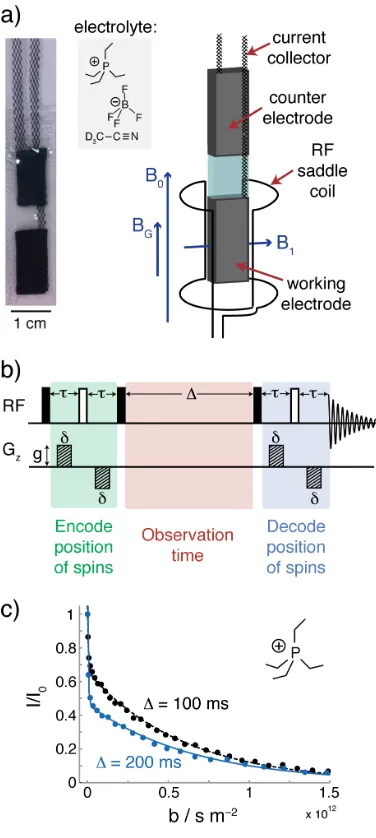
Two sets of pouch cell supercapacitors25 constructed with electrodes fabricated from two different commercial activated carbons (YP50F and YP80F) with different porosities and 1.5 M tetraethylphosphonium tetrafluoroborate (PEt4BF4) electrolyte (in deuterated
acetonitrile, D3CCN) were studied by PFG NMR. In the
experiments the cell working-electrode is detected (Figure 1a). Uniquely, NMR allows the separate signals from ions that are inside the carbon nanopores, “in-pore”, and ions that are outside the nanopores in electrolyte reservoirs, “ex-pore”, to be resolved.19,26,27 Cations and anions were studied using 1H and 19F NMR, respectively (see SI for example spectra).
In PFG NMR experiments magnetic field gradient pulses are used to encode and decode the positions of the nuclear spins, with ionic diffusion probed over a given observation time, Δ (Figure 1b). For each diffusion
measurement, a series of NMR spectra are acquired with different magnetic field gradient strengths, g, and the normalised signal intensity (I/I0) is plotted against a
parameter, b, that is proportional to g2 (see Figure 1 caption).28,29 Self-diffusion coefficients, D, are then obtained by exponential fits of the form (I/I0) = exp(–
D b). For in-pore ions biexponential decays were observed (Figure 1c), indicating the presence of two sets of in-pore ions with different D values. The initial steep decay (large D) arises from ions that undergo in-pore ↔
ex-pore exchange processes during the observation time (see SI). 2D exchange NMR measurements confirmed the presence of such exchange (see later). The more gradually decaying component in Figure 1c (small D), on the other hand, arises from ions that remain in the nanopores during the observation time, with a
self-Figure 1: Introducing Pulsed Field Gradient NMR of Supercapacitors. a) Photograph of pouch cell, electrolyte, and schematic of in situ PFG set-up showing the orientation of the magnetic field, B0, magnetic field gradients, BG, and the radiofrequency (RF) field, B1 (see SI for discussion of field orientations). b) 13-interval sequence used for PFG NMR experiments, radiofrequency (RF) and magnetic field gradient (Gz) pulses are shown. c) Example decays of normalised in-pore cation signal intensity against b for a YP50F supercapacitor (cell voltage = 0 V) with 1.5 M PEt4BF4 in deuterated acetonitrile electrolyte. The parameter b is given by: b =
g2 (γ2δ)2t
[image:3.595.58.246.90.509.2]diffusion coefficient, Din-pore, and mole fraction, Ain-pore. By performing PFG measurements with
different Δ times, in-pore diffusion and in-pore ↔ ex-pore exchange processes can be probed on
different timescales (and therefore different lengthscales).
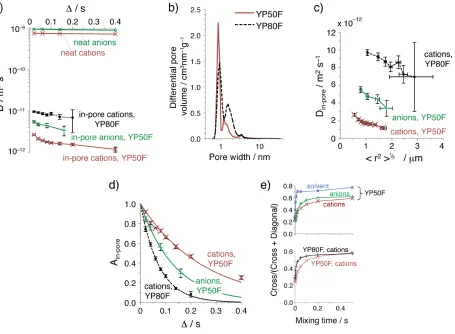
For the YP50F supercapacitor at 0 V, Din-pore is reduced by over two orders of magnitude compared
to neat electrolyte, for all observation times, Δ (Figure 2a). For example, for a relatively short
observation time of Δ = 20 ms, Din-pore is reduced by a factor of 300 for cations and 180 for anions.
These marked reductions could arise from a number of factors: (i) the local reduction in in-pore diffusion due to collisions with the rigid pore walls,30,31 (ii) tortuosity arising from the disordered
arrangement of pores32–34 in the carbon particles such that ions diffuse in an indirect way, and (iii) the structure and composition of the electrolyte in the pores may differ from neat electrolyte, our previous studies having shown that ions are partially desolvated in the pores.6 The difference in diffusion coefficients between anions and cations is amplified upon confinement in the pores (Figure 2a), highlighting the important role of ion size, with the larger cations presumably taking more indirect pathways through the pore network (as the smallest pores are inaccessible).30 For a
second activated carbon, YP80F, Din-pore for cations is ~ 4 to 5 times larger compared to YP50F
depending on the observation time, showing the crucial influence of carbon structure on in-pore diffusion. This increase in Din-pore is ascribed to the additional porosity with pore widths between 1
Our experiments measure in-pore diffusion on relatively long timescales (20 – 400 ms), with corresponding lengthscales of several hundreds of nanometres to micrometres (Figure 2c). Root mean square displacements, <r2>½, were determined using Din-pore values measured at different Δ
times; <r2>½ = (6Din-poreteff)½, with teff = Δ – 1/6 δ – 1/2 τ≈Δ. Din-pore decreases as larger root mean
square displacements, <r2>½, are probed (Figure 2c), indicative of restricted diffusion,28 with ions becoming more likely to encounter the smallest pores and bottlenecks for longer observation times (longer <r2>½). This shows that the structure of the carbon particles is heterogeneous to ionic motion on lengthscales as large as 2 microns, i.e. on the order of the carbon particle sizes (see SI). This is consistent with a recent NMR study of solvents in a nanoporous carbon,35 and helps to explain why we observe greater reductions of effective diffusion upon confinement than in MD simulations where much smaller observation times were studied.23
PFG NMR experiments provide additional dynamic information about the exchange (or swapping) of ions between in- and ex-pore environments (Figure 2d). Ain-pore gives the mole fraction of in-pore
ions that have remained in the nanopores during the observation time, Δ. For YP50F, the anions Figure 2: Diffusion measurements on supercapacitors at 0 V. a) Diffusion measurements as a function of Δ, for
YP50F and YP80F supercapacitors, with 1.5 M PEt4BF4 in deuterated acetonitrile electrolyte. Measurements on neat electrolyte are also shown. b) Pore size distributions of the two carbons. c) Din-pore as a function of root mean square displacement. d) Ain-pore as a function of Δ. Exponential fits allow the mean lifetime of an in-pore ion, τin-pore, to be determined. e) Intensity ratios from 2D exchange NMR spectroscopy experiments with different mixing times, 1H, 19F and 13C NMR were used to probe cations, anions and isotopically labelled solvent, respectively (see SI). Error bars in a), c) and d) represent 95% confidence bounds (see Methods).
[image:5.595.69.524.57.391.2]undergo significantly more rapid exchange than the cations, with mean in-pore lifetimes, τin-pore,29,36
of 135 ± 14 and 252 ± 26 ms, respectively. This suggests that in-pore diffusion limits in-pore ↔ ex-pore exchange, with the faster anion diffusion resulting in more rapid exchange. Indeed, the larger in-pore cation diffusion coefficient in YP80F electrodes results in even more rapid exchange, with
τin-pore = 74 ± 3 ms. A measure of the mean carbon particle radius is obtained by (6Din-poreτin-pore)½,
giving 1.5 µm and 1.7 µm, for YP50F (probed by the cations and anions, respectively) and 1.9 µm for YP80F (cations), with the values consistent with typical carbon particle dimensions (see SI). The build up of cross peak intensity in 2D exchange NMR experiments offer a second probe of in-pore ↔ ex-pore exchange (Figure 2e),7,9 and corroborate the results from PFG NMR. The exchange of the smaller, neutral, acetonitrile solvent molecules (as probed by 13C NMR experiments on isotopically enriched acetonitrile) is more rapid than for the ions, indicating that their in-pore diffusion coefficients are larger. This is unsurprising since diffusion measurements on neat electrolyte showed that the solvent diffuses 2.0 times faster than the anions, and 2.5 times faster than the cations. MD simulations have also shown that (de)solvation of in-pore ions with acetonitrile takes place as quickly as ~1 ps,23 and a recent study of dimethyl carbonate showed a relatively modest reduction of effective diffusion (by a factor of ~ 0.2) upon confinement in a nanoporous carbon.35 Overall, the slower diffusing ions move through a highly dynamic solvent medium in the nanopores.
In situ pulsed field gradient NMR measurements allow the direct measurement of in-pore diffusion
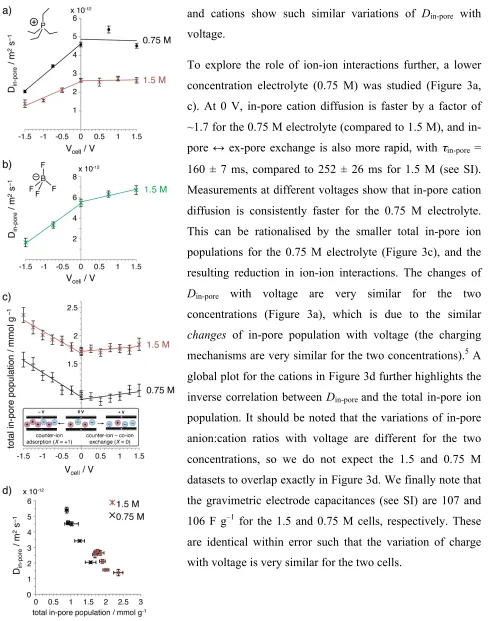
in supercapacitors during charging (Figure 3a, b). Measurements were made under equilibrium conditions at different fixed cell voltages. For negative polarisations, marked decreases of Din-pore
are observed for anions and cations, while for positive polarisations only minor changes are observed, with only slight increases in Din-pore for anions. For the 1.5 M electrolyte, comparing
between 0 and –1.5 V, Din-pore decreases by a factor of 3.6 for the anions (averaged across
observation times, see SI), while the cations show a similar, but slightly smaller, reduction factor of 2.9.
The variations of Din-pore with voltage may be understood by examining the changes of in-pore ionic
populations at different voltages (Figure 3c). We previously showed that charging in the positive electrode takes place by swapping of anions and cations (counter-ion – co-ion exchange mechanism, X = 0), while charging in the negative electrode occurs by counter-ion adsorption (X = +1, see Figure 3c inset).5 As a result, for positive polarisations the total in-pore ion population shows only minor changes with voltage, while for negative polarisation a marked increase is observed (Figure 3c). This increase of in-pore ion population correlates with the reduction of Din-pore
7
voltage for negative polarisations. In principle ion-carbon interactions may also influence Din-pore,23
though these appear to be a minor factor, since the anions and cations show such similar variations of Din-pore with
voltage.
To explore the role of ion-ion interactions further, a lower concentration electrolyte (0.75 M) was studied (Figure 3a, c). At 0 V, in-pore cation diffusion is faster by a factor of ~1.7 for the 0.75 M electrolyte (compared to 1.5 M), and in-pore ↔ ex-pore exchange is also more rapid, with τin-pore =
160 ± 7 ms, compared to 252 ± 26 ms for 1.5 M (see SI). Measurements at different voltages show that in-pore cation diffusion is consistently faster for the 0.75 M electrolyte. This can be rationalised by the smaller total in-pore ion populations for the 0.75 M electrolyte (Figure 3c), and the resulting reduction in ion-ion interactions. The changes of
Din-pore with voltage are very similar for the two
concentrations (Figure 3a), which is due to the similar
changes of in-pore population with voltage (the charging
mechanisms are very similar for the two concentrations).5 A global plot for the cations in Figure 3d further highlights the inverse correlation between Din-pore and the total in-pore ion
population. It should be noted that the variations of in-pore anion:cation ratios with voltage are different for the two concentrations, so we do not expect the 1.5 and 0.75 M datasets to overlap exactly in Figure 3d. We finally note that the gravimetric electrode capacitances (see SI) are 107 and 106 F g–1 for the 1.5 and 0.75 M cells, respectively. These are identical within error such that the variation of charge with voltage is very similar for the two cells.
Figure 3: In situ measurements of ionic diffusion in supercapacitors. a) Cation and b) anion diffusion in YP50F – PEt4BF4 (1.5 M) in acetonitrile supercapacitors, at different cell voltages. In a) data for a supercapacitor with 0.75 M electrolyte are also shown c) Total in-pore ion populations at different potentials, determined from data in Ref. [5]. Inset shows schematic of charge storage mechanism for this system. d) Inverse correlation between Din-pore (cations) and total in-pore ion population. All data are for Δ = 20 ms (data with Δ = 40 ms show very similar trends, see SI). Error bars in a), b) and d) represent 95% confidence bounds (see Methods). Error bars in c) represent the range of values obtained from four independent fits of each dataset (see Ref. 5).
[image:7.595.57.550.92.713.2]Discussion
Our in situ results strongly suggest that changes of in-pore ion populations, and the resulting changes in the number of ion-ion interactions, dominate the variations of in-pore ionic diffusion observed during charging. The ion-ion interactions have at least two contributions: (i) steric effects, with the increased number of ions sterically hindering diffusion, (ii) electronic effects, whereby associations between oppositely charged ions can reduce ionic self-diffusion.37–39 The latter effect will vary in a complex way as the proportions of anions and cations vary during supercapacitor charging, and may explain the small increases in Din-pore for the anions, observed for positive
polarisations. The apparent dominance of ion-ion interactions on the voltage dependence of Din-pore
is consistent with a recent MD study of an ionic liquid inside slit-pore electrodes.18 A further MD
study on disordered electrode structures revealed changes of Din-porewith voltage on the same order
of magnitude as those observed here (though the charging mechanism, and thus in-pore populations differed for their system).23 The dependence of Din-pore on the in-pore ion population has important
consequences for supercapacitor charging rates. Depending on the mechanism that operates (ion exchange, counter-ion adsorption, co-ion desorption etc.) the charging dynamics will vary. This offers new opportunities to improve charging dynamics in supercapacitors if the charging mechanism (X value) can be controlled. If X > 0, then the in-pore ion population will increase with voltage and Din-pore is expected to decrease. On the other hand, if X < 0 (net ion desorption), Din-pore
would be expected to decrease with voltage. For the case of initially filled pores, charging purely by co-ion desorption (X = –1) may offer the fastest charging rates at high voltages, though this mechanism has not yet been observed.21 Kondrat et al. have suggested that ideally the carbon pores would be initially empty of ions (ionophobic pores) to facilitate fast charging,16,24,40 though in practice ionophobic pores have not yet been realised experimentally. Ionic liquids with activated carbons represent the opposite extreme as the pores are densely packed with ions in the absence of an applied potential,6,15 and our results help to explain their poor power performances.
Our measurements on carbons with different pore sizes help to explain previous electrochemical studies of charging dynamics.1,41–43 For carbons with smaller average pore sizes and fewer
Conclusion
In conclusion, our in situ PFG NMR experiments reveal new insights into ionic diffusion and exchange processes in supercapacitors. Confinement of the ions inside YP50F nanoporous electrodes leads to a large (more than two orders of magnitude) reduction in their effective diffusion coefficients. The important role of ionic size has also been demonstrated, with the larger cations showing the largest reductions of diffusion upon confinement. Our measurements also allow the mean lifetime of in-pore ions to be determined (τin-pore), and indicate that in-pore diffusion limits the
in-pore ↔ ex-pore exchange process. We have also shown that the structure of the carbon particles is heterogeneous to ionic motion on lengthscales as large as microns.
In situ diffusion measurements at different electrolyte concentrations have shown that ion-ion
interactions dominate the observed variations of Din-pore with voltage, with the different charging
mechanisms (X values) in the two electrodes resulting in drastically different dynamic behaviour. Charging by counter ion adsorption (X = +1) results in decreases of Din-pore for negative
polarisations, while charging by counter-ion – co-ion exchange (X = 0) results in much smaller changes of Din-pore for positive polarisations. Our findings demonstrate the important interplay
between charging mechanisms and dynamics, and should offer new opportunities to control the power performance of supercapacitors. One simple way to improve charging rates may be to use lower electrolyte concentrations as this results in faster in-pore diffusion. However, this must be balanced with the availability of electrolyte ions for charging processes, and efforts must also be made to probe any electrolyte concentration gradients45 formed during charging. Achieving truly ionophobic pores, or alternatively charging by co-ion desorption, may enhance charging rates. Furthermore, we have shown how the nanoporous structure of the electrode has a significant effect on in-pore ion diffusion and exchange, with the incorporation of a relatively small amount of additional pore volume in the 1 – 3 nm range resulting in a large increase of Din-pore and decreases of
τin-pore. Further PFG NMR measurements on a range of different porous carbons will further our
understanding and could enable precise control over power and energy performance.
Methods
Freestanding carbon film electrodes (95 wt. % carbon, thickness ~250 µm) were prepared by mixing YP50F (or YP80F) activated carbon (Kuraray Chemical) with polytetrafluoroethylene (Sigma Aldrich, 60 wt. % dispersion in water), as previously described.19 Film electrodes were
dried for at least 15 hours at 200 ºC in vacuo, with supercapacitor devices then prepared in an Ar glovebox (<0.1 ppm H2O and O2) in plastic pouch cells, with a design adapted from our previous
work.25 These pouch cells were positioned inside either 10 mm or 5 mm NMR tubes for PFG NMR experiments. Electrode masses were equal within 0.2 mg for all cells, and were typically ~20 mg for cells in 10 mm NMR tubes, and ~7 mg for cells in 5 mm tubes. All devices used either 1.5 or 0.75 M tetraethylphosphonium tetrafluoroborate (>97% purity, Toyko Chemical Industries) in deuterated acetonitrile (D3CCN, 99.8 atom %, Euroisotop) as the electrolyte, with the exception of carbon
NMR experiments where H3C13CN (99 atom %, Isotech) was used. Carbon pore size distributions
were obtained from quenched solid density functional theory analysis (assuming slit-pores) of N2
gas sorption measurements carried at 77 K.49
Diffusion NMR experiments were carried out using a Bruker Avance spectrometer and a Diff-50 probehead at a magnetic field strength of 7.1 T (1H larmor frequency at 300 MHz). Saddle coils (10 mm inner diameter for 1H, 5 mm for 19F and 13C) were used for radiofrequency excitation and detection, with the working electrode positioned in the detection area, with the B1 field and
electrode orientated as indicated in the SI. The 13-interval pulse sequence50 with bipolar pulsed field gradients was used for diffusion measurements to minimise the effects of any magnetic field gradients inherent to the sample. The maximum g used was 17 T⋅m–1, and the effective gradient
pulse duration, δ, (as defined in Figure 1b) was 0.5 ms. The in situ PFG NMR methodology is
similar to our previous in situ NMR studies of supercapacitors, with spectra acquired under equilibrium conditions during the application of constant cell voltages.25 For determination of D
and A values, in-pore intensities were first determined by integration in Topspin software and the variation of intensity with the parameter b was analysed using a Matlab script and the curve fitting tool. Plotted error bars in the diffusion parameters represent upper and lower bounds at 95% confidence limits, as determined using the curve-fitting tool. 2D exchange spectroscopy measurements were performed as in our previous work.7 Spectra are referenced as; 1H - methyl group of ethanol at 1.2 ppm, 19F – hexafluorobenzene at –164.9 ppm, and 13C – ethylene group of
ethanol at 58.0 ppm. RF excitation pulses were calibrated on the supercapacitor cells, with powers of between 22-30 kHz used for all nuclei. Recycle delays were set to ~1.2 T1 to maximise the signal
and RF pulses such that eddy currents did not influence diffusion measurements. Experiments on neat electrolytes were performed in 5 mm NMR tubes.
References
1. Chmiola, J. et al. Anomalous increase in carbon capacitance at pore sizes less than 1 nanometer. Science 313, 1760–1763 (2006).
2. Raymundo-Piñero, E., Kierzek, K., Machnikowski, J. & Béguin, F. Relationship between the nanoporous texture of activated carbons and their capacitance properties in different electrolytes. Carbon 44, 2498–2507 (2006).
3. Balducci, A. Electrolytes for high voltage electrochemical double layer capacitors: A perspective article. J. Power Sources 326, 534–540 (2016).
4. Zhong, C. et al. A review of electrolyte materials and compositions for electrochemical supercapacitors. Chem. Soc. Rev. 44, 7484–7539 (2015).
5. Griffin, J. M. et al. In Situ NMR and Electrochemical Quartz Crystal Microbalance Reveal the Structure of the Electric Double-Layer in Supercapacitor Electrodes. Nat. Mater. 14, 812–819 (2015).
6. Forse, A. C. et al. NMR study of ion dynamics and charge storage in ionic liquid supercapacitors. J. Am. Chem. Soc. 137, 7231–7242 (2015).
7. Griffin, J. M. et al. Ion Counting in Supercapacitor Electrodes using NMR Spectroscopy. Faraday Disc. 176, 49–68 (2014).
8. Luo, Z.-X. et al. Dehydration of Ions in Voltage-Gated Carbon Nanopores Observed by in Situ NMR. J. Phys. Chem. Lett. 6, 5022–5026 (2015).
9. Deschamps, M. et al. Exploring electrolyte organization in supercapacitor electrodes with solid-state NMR.
Nat. Mater. 12, 351–358 (2013).
10. Tsai, W.-Y., Taberna, P.-L. & Simon, P. Electrochemical Quartz Crystal Microbalance (EQCM) Study of Ion Dynamics in Nanoporous Carbons. J. Am. Chem. Soc. 136, 8722–8728 (2014).
11. Levi, M. D., Salitra, G., Levy, N., Aurbach, D. & Maier, J. Application of a quartz-crystal microbalance to measure ionic fluxes in microporous carbons for energy storage. Nat. Mater. 8, 872–875 (2009).
12. Prehal, C. et al. Tracking the structural arrangement of ions in carbon supercapacitor nanopores using in-situ small-angle X-ray scattering. Energy Environ. Sci. 8, 1725–1735 (2015).
13. Richey, F. W., Tran, C., Kalra, V. & Elabd, Y. A. Ionic Liquid Dynamics in Nanoporous Carbon Nanofibers in Supercapacitors Measured with in Operando Infrared Spectroelectrochemistry. J. Phys. Chem. C 118, 21846– 21855j (2014).
14. Boukhalfa, S. et al. In-Situ Small Angle Neutron Scattering Revealing Ion Sorption in Microporous Carbon Electrical Double Layer Capacitors In-Situ Small Angle Neutron Scattering Revealing Ion Sorption in Microporous Carbon Electrical Double Layer Capacitors. ACS Nano 8, 2495–2503 (2014).
15. Merlet, C. et al. On the molecular origin of supercapacitance in nanoporous carbon electrodes. Nat. Mater. 11, 306–310 (2012).
16. Kondrat, S., Wu, P., Qiao, R. & Kornyshev, A. A. Accelerating charging dynamics in subnanometre pores. Nat. Mater. 13, 387–393 (2014).
17. Fedorov, M. V & Kornyshev, A. A. Ionic Liquids at Electrified Interfaces. Chem. Rev. 114, 2978–3036 (2014). 18. He, Y. et al. Importance of Ion Packing on the Dynamics of Ionic Liquids during Micropore Charging. J. Phys.
Chem. Lett. 7, 36–42 (2016).
19. Forse, A. C. et al. Nuclear magnetic resonance study of ion adsorption on microporous carbide-derived carbon.
Phys. Chem. Chem. Phys. 15, 7722–7730 (2013).
20. Borchardt, L., Oschatz, M., Paasch, S., Kaskel, S. & Brunner, E. Interaction of electrolyte molecules with carbon materials of well-defined porosity: characterization by solid-state NMR spectroscopy. Phys. Chem. Chem. Phys. 15, 15177–84 (2013).
21. Forse, A. C., Merlet, C. M., Griffin, J. M. & Grey, C. P. New Perspectives on the Charging Mechanisms of Supercapacitors. J. Am. Chem. Soc. 138, 5731–5744 (2016).
22. Salanne, M. et al. Efficient storage mechanisms for building better supercapacitors. Nat. Energy 1, 16070 (2016).
23. Pean, C. et al. Confinement, Desolvation, And Electrosorption Effects on the Diffusion of Ions in Nanoporous Carbon Electrodes. J. Am. Chem. Soc. 137, 12627–32 (2015).
24. Kondrat, S. & Kornyshev, A. A. Pressing a spring: what does it take to maximize the energy storage in nanoporous supercapacitors? Nanoscale Horiz. 1, 45–52 (2016).
25. Wang, H. et al. In situ NMR spectroscopy of supercapacitors: insight into the charge storage mechanism. J. Am. Chem. Soc. 135, 18968–80 (2013).
27. Merlet, C., Forse, A. C., Griffin, J. M., Frenkel, D. & Grey, C. P. Lattice simulation method to model diffusion and NMR spectra in porous materials. J. Chem. Phys. 142, 094701 (2015).
28. Callaghan, P. T. Translational Dynamics & Magnetic Resonance. (2011).
29. Karger, J., Ruthven, D. M. & Theodorou, D. N. Diffusion in Nanoporous Materials. (2012).
30. Dubinin, M. M., Vartapetian, R. S., Voloshchuk, A. M., Karger, J. & Pfeifer, H. NMR Study of Translational Mobility of Molecules Adsorbed on Active Carbons. Carbon 26, 515–520 (1988).
31. Kalugin, O. N., Chaban, V. V, Loskutov, V. V & Prezhdo, O. V. Uniform Diffusion of Acetonitrile inside Carbon Nanotubes Favors Supercapacitor Performance 2008. Nano Lett. 8, 2126–2130 (2008).
32. Oschatz, M. et al. Nanostructure characterization of carbide-derived carbons by morphological analysis of transmission electron microscopy images combined with physisorption and Raman spectroscopy. Carbon 105, 314–322 (2016).
33. Forse, A. C. et al. New Insights into the Structure of Nanoporous Carbons from NMR, Raman, and Pair Distribution Function Analysis. Chem. Mater. 27, 6848–6857 (2015).
34. Harris, P. J. F. Fullerene-like models for microporous carbon. J. Mater. Sci. 48, 565–577 (2013). 35. Alam, T. M. & Osborn Popp, T. M. In-pore exchange and diffusion of carbonate solvent mixtures in
nanoporous carbon. Chem. Phys. Lett. 658, 51–57 (2016).
36. Stallmach, F. et al. NMR studies on the diffusion of hydrocarbons on the metal-organic framework material MOF-5. Angew. Chem. Int. Ed. Engl. 45, 2123–6 (2006).
37. Noda, A., Hayamizu, K. & Watanabe, M. Pulsed-Gradient Spin - Echo 1H and 19F NMR Ionic Diffusion Coefficient, Viscosity, and Ionic Conductivity of Non-Chloroaluminate Room-Temperature Ionic Liquids. J. Phys. Chem. B 105, 4603–4610 (2001).
38. Every, H. A., Bishop, A. G., Macfarlane, D. R., Ora, G. & Forsyth, M. Transport properties in a family of dialkylimidazolium ionic liquids. Phys. Chem. Chem. Phys. 6, 1758–1765 (2004).
39. Hou, J., Zhang, Z. & Madsen, L. A. Cation / Anion Associations in Ionic Liquids Modulated by Hydration and Ionic Medium. J. Phys. Chem. B 115, 4576–4582 (2011).
40. Kondrat, S. & Kornyshev, A. Charging Dynamics and Optimization of Nanoporous Supercapacitors. J. Phys. Chem. C 117, 12399–12406 (2013).
41. Korenblit, Y. et al. High-Rate Electrochemical Capacitors Based on Ordered Mesoporous Silicon Carbide-Derived Carbon. ACS Nano 4, 1337–1344 (2010).
42. Péan, C. et al. On the Dynamics of Charging in Nanoporous Carbon-Based Supercapacitors. ACS Nano 8, 1576–1583 (2014).
43. Redondo, E., Carretero-González, J., Goikolea, E., Ségalini, J. & Mysyk, R. Effect of pore texture on
performance of activated carbon supercapacitor electrodes derived from olive pits. Electrochim. Acta 160, 178– 184 (2015).
44. Itoi, H., Nishihara, H., Kogure, T. & Kyotani, T. Three-Dimensionally Arrayed and Mutually Connected 1.2-nm Nanopores for High-Performance Electric Double Layer Capacitor. J. Am. Chem. Soc. 20, 1165–1167 (2011).
45. Krachkovskiy, S. a et al. Visualization of Steady-State Ionic Concentration Profiles Formed in Electrolytes during Li-Ion Battery Operation and Determination of Mass-Transport Properties by in Situ Magnetic Resonance Imaging. J. Am. Chem. Soc. 138, 7992–9 (2016).
46. Hayamizu, K. et al. Studies on the translational and rotational motions of ionic liquids composed of N-methyl-N-propyl-pyrrolidinium (P13) cation and bis(trifluoromethanesulfonyl)amide and bis(fluorosulfonyl)amide anions and their binary systems including lithium salts. J. Chem. Phys. 133, 194505 (2010).
47. Zhang, Z. & Madsen, L. A. Observation of separate cation and anion electrophoretic mobilities in pure ionic liquids. J. Chem. Phys. 140, 084204 (2014).
48. Gouverneur, M., Kopp, J., Wüllen, L. Van & Schönhoff, M. Direct determination of ionic transference numbers in ionic liquids by electrophoretic NMR. Phys. Chem. Chem. Phys. 17, 30680–30686 (2015).
49. Neimark, A. V., Lin, Y., Ravikovitch, P. I. & Thommes, M. Quenched solid density functional theory and pore size analysis of micro-mesoporous carbons. Carbon 47, 1617–1628 (2009).
50. Cotts, R. M., Hoch, M. J. R., Sun, T. & Markert, J. T. Pulsed Field Gradient Stimulated Echo Methods for Improved NMR Diffusion Measurements in Heterogeneous Systems. J. Magn. Reson. 266, 252–266 (1989).
Acknowledgements
Advanced Fellowship to C.P.G.) for financial support. This work was also supported as part of the NorthEast Center for Chemical Energy Storage (NECCES), an Energy Frontier Research Center funded by the U.S. Department of Energy (DOE), Office of Science, Basic Energy Sciences, under Award #DE-SC0012583 (N.M.T.). We thank Paul Bayley for assistance with PFG NMR
experiments and the engineering of in situ apparatus, and Andrew Sederman for assistance with initial PFG NMR experiments.
Contributions
A.C.F prepared supercapacitor cells, performed PFG NMR experiments and analysed the data. J.M.G. recorded and analysed NMR experiments to determine total in-pore ion populations. N.M.T. performed initial PFG NMR experiments. A.-R.O.R. recorded SEM images and gas sorption
isotherms. All authors contributed to design of the research, the discussion of the data and the writing of the paper.
Additional Information
Supplementary information is available in the online version of the paper. Reprints and permissions information is available online at www.nature.com/reprints. Correspondence and requests for materials should be addressed to C.P.G.
Competing financial interests