© 2019, IRJET | Impact Factor value: 7.211 | ISO 9001:2008 Certified Journal | Page 4067
Non Destructive Testing of Old R.C.C. Framed Structure
Dipali M. Kukade
1, Apoorva Kitey
2, Dr. Dilip P.Mase
31
M. Tech. Student, Department of Civil Engineering, Gurunanak Institute of technology, Nagpur, India.
2Assistant Professor, Department of Civil Engineering, Gurunanak Institute of technology, Nagpur, India.
3
Chartered Engineer, Nagpur, India.
---***---Abstract -
In India there are various old structures that areat the verge of damage. With due course of time the structure becomes weak as the strength of concrete gets reduced. The reasons that can be considered for this reduced strength are poor quality of construction, improper maintenance, improper design mix, unskilled workmanship etc. Therefore the condition and performance of building must be checked from time to time. Non Destructive Testing is the appropriate solution to this issue. It enhances the performance of any existing structure. Non Destructive testing help to assess the health of structure & how much repairs, rehabilitation & retrofitting is required to bring back the structure in safe stable condition. In this case study non destructive testing is adopted to assess the condition and quality of concrete for 30 years old R.C.C. framed structure which is situated Nagpur. Various NDT methods such as Rebound Hammer Test, Ultrasonic pulse velocity test and Half cell potentiometer test have been performed. Based on all test results & visual inspections it is found that the structure needs to be repair & retrofit.
Key Words
:
Non Destructive Testing, Rebound Hammer
Test, Ultrasonic Pulse Velocity Test, Half Cell Potentiometer Test.1.INTRODUCTION
1.1 Non Destructive Testing of Structure
The Non Destructive Testing (NDT) is a technique that are used to find out the defects in structure with or without destroying any part of the structure.
As we know concrete reduced strength due to over age of structure, poor quality of construction material, unskilled workmanship, improper maintenance, improper design mix etc. therefore it is necessary to check the condition, quality of concrete & performance of structure from time to time. The Non Destructive testing offers proper solution for these issues.
Non destructive testing offers significant advantages like, defects can be detected without damaging or destroying the part of structural components, the equipments are easy to handle and it gives appropriate results with the help of NDT. It requires to understand the various methods available, their capabilities and limitations, knowledge of the relevant standard and specification for performing the test. These techniques can be used to monitor the reliability of the item of structure throughout its design life.
1.2 Objective of the Case Study
The objective of present case study is to obtained the Non Destructive Testing of 30 years old R.C.C. Framed structure with Rebound Hammer Test to know the probable Compressive Strength, Ultrasonic Pulse Velocity Test for access the condition of structure & Half cell Potentiometer Test to know the availability of corrosion in reinforcement and visual inspection.
2. METHODOLOGY
2.1 Visual Inspection
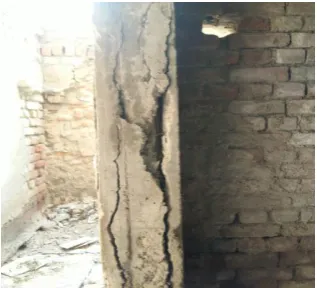
© 2019, IRJET | Impact Factor value: 7.211 | ISO 9001:2008 Certified Journal | Page 4068 Fig -1: Reinforcement exposed, corrosion, cracks observed
in Column.
Fig -2: Reinforcement exposed, corrosion, cracks observed in Column.
2.2 Rebound Hammer Test
Rebound hammer test is the surface hardness test when the plunger of rebound hammer pressed against the concrete surface it gives the probable compressive strength of concrete.
In 1948 Ernst Schmidt a Swiss Engineer develop a device for testing concrete. The device measures the rebound value R. There is a specific relation between this value and the hardness and strength of concrete.
The rebound numbers are influenced by a number of factors like types of cement and aggregate, surface condition and moisture content, age of concrete and extent of carbonation of concrete. The impact direction of hammer are horizontal, vertically upward or vertically downward. As per IS:13311 Part-2, the probable accuracy of prediction of concrete strength in a structure by rebound hammer test is +/-25%.
TABLE -1:rebound criteria for quality of concrete grading
Average Rebound Quality of Concrete
>40 Very Good hard layer
30-40 Good
Average Rebound Quality of Concrete
20-30 Fair
<20 Poor concrete
[image:2.595.76.251.116.247.2]0 Delaminated
[image:2.595.311.556.119.344.2]Fig -3: Rebound Hammer Test.
Fig -4: Rebound Hammer Test.
2.3 Ultrasonic Pulse Velocity Test
Ultrasonic Pulse Velocity Test is used to established the quality of concrete, presence of cracks, voids and other imperfections in structure.
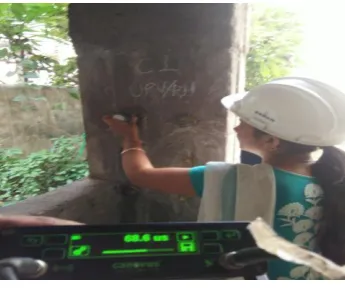
This is one of the most commonly used method in which the ultrasonic pulses generated by electro-acoustical transducer are transmitted through the concrete & measuring the time taken. Distance of path length divided by the transit time gives the pulse velocity of concrete member being tested. The ultrasonic pulse velocity is influenced by path length, lateral dimension of specimen tested, presence of reinforcing steel, and moisture content of the concrete.
The methods of measurements of ultrasonic pulse velocity through concrete are
a) Direct Transmission (Cross Probing). b) Semi-Direct Transmission
[image:2.595.82.241.284.428.2] [image:2.595.335.531.356.498.2]© 2019, IRJET | Impact Factor value: 7.211 | ISO 9001:2008 Certified Journal | Page 4069 The instrument used for testing is Pundit Lab (30610001)
UPV Instrument (Proceq) (Made in Switzerland).
TABLE -2:Velocity Criteria for Quality of Concrete Grading
Pulse Velocity Quality of Concrete
Above 4.5 Km/Sec Excellent
3.5 - 4.5 Km/Sec Good
3.0 - 3.5 Km/Sec Satisfactory
Below 3.0 Km/Sec Doubtful
[image:3.595.310.536.115.225.2]Fig -5 Ultrasonic Pulse Velocity Test Machine.
Fig -6 Ultrasonic Pulse Velocity Test.
2.4 Half Cell Potentiometer Test
Half cell potentiometer test is used determine the probability of corrosion associated with steel in concrete. The apparatus given by ASTM C876 which include copper/Copper Sulphate electrode or silver / silver chloride electrode for half cell test.
[image:3.595.39.284.164.425.2]Half cell makes electrical contact with concrete by means of
porous plug and sponge. One end of wire is connected to steel reinforcement and other end is connected to standard electrode and readings are noted as seen on voltmeter. More negative value indicated the higher is the bar corrosion.Fig -7 Schematic View of Half Cell Potentiometer
[http://civilonline2010.blogspot.com/2010/09/half-cell-electrical-potential-method.html]
TABLE -3:Corrosion Condition of Reinforcing Bar
Copper / Copper Sulphate Corrosion Condition
> -200 mV
Low ( 10% chances )
-200 to -350 mV
Intermediate
< -350 mV
High ( <90 % )
< -500 mV
[image:3.595.311.557.288.503.2]Severe Corrosion
Fig -8 Half Cell Potentiometer Test.
3. TEST RESULTS
3.1 Rebound Hammer Test Results
Sr.
No. Description No. of
Points
Rebound Hammer Test
Max. Min. Average
Ground Floor
1. Column 114 31.67 15 23.33
2. Beam 18 30.33 27 28.66
3. Slab 12 29.66 29.33 29.49
First Floor
[image:3.595.312.557.290.502.2] [image:3.595.75.248.452.598.2] [image:3.595.309.561.571.750.2]© 2019, IRJET | Impact Factor value: 7.211 | ISO 9001:2008 Certified Journal | Page 4070
Second Floor
5. Column 14 32.57 31.71 32.14
Third Floor
6. Column 12 33.66 32 32.83
Fourth Floor
7. Column 12 36 32 34
As per Rebound Hammer Test results it is observed that maximum readings are confirming to M10 to M15 grade of concrete that indicated the poor quality of concrete.
3.2 Ultrasonic Pulse Velocity Test Results
Sr.
No. Description No. of
Points
Ultrasonic Pulse velocity Test (Km/SEC)
Max. Min. Average
Ground Floor
1. Column 98 3.53 1.4 2.46
2. Beam 20 1.98 1.13 1.55
3. Slab 17 2.3 1.4 1.85
First Floor
4. Column 7 2.3 1.87 2.08
Second Floor
5. Column 12 2.3 1.33 1.81
6. Beam 4 1.94 1.87 1.90
Third Floor
7. Column 10 3.3 2.47 2.88
Fourth Floor
8. Column 14 3.3 2.83 3.06
As per Ultrasonic Pulse Velocity test results it is observed that maximum readings are below 3.0 Km/sec that indicated the quality of concrete is doubtful.
3.3 Half Cell Potentiometer Test Results
Sr.
No. Description
Half Cell Potentiometer Test
Half Cell Readings (mV)
Average
(mV)
1. Column No..-C1
355, 346, 321, -272, -241, -232, -223, -216, -168
-263
2. Column No..-C2
319, 317, 315, -250, -247, -240, -238,
-224, -212
-262
3. Column No..-C8
-341, -333,-321,-308, -302,-291,-279,-269,
-263
-300
4. Column No..-C9
360, 359, 341, -332, -258, -245, -235,
-218, -217
-285
5. Column No..-C12
501, 499, 418, -400, -397, -357, -348,
-345, -343
-400
6. Column No..-C16
-399, -320, -318, -305, -242, -237,
-236,-211, -209
-275
7. Column No..-C17
339, 321, 315, -301, -297, -295, -287,
-279, -277
-301
8. Column No..-C21
458, 441, 435, -408, -397, -391, -383,
-380, -371
-407
As per Half cell Potentiometer Test results maximum readings are in between -262 and -407 that indicate there is severe corrosion at most of the locations.
4. CONCLUSIONS
In this paper various Non Destructive Tests have been performed on existing structure such as Rebound Hammer Test, Ultrasonic Pulse Velocity Test and Half cell Potentiometer Test including visual inspection.
As per the visual inspection, Rebound Hammer test & Ultrasonic Pulse velocity test results it is observed that various columns readings whose strength and quality of concrete is doubtful for such columns jacketing should be done.
According to the half cell potentiometer test results severe corrosion are observed at most of the location.
© 2019, IRJET | Impact Factor value: 7.211 | ISO 9001:2008 Certified Journal | Page 4071
ACKNOWLEDGEMENT
I would like to express my sincere thanks to the Assistant Pofessor Apporva Kitey and Dr. Dilip Mase, Director, P. T. Mase & Associates to give me this opportunity to work for this project and technical support on “Non Destructive Testing of Old R.C.C. Framed Structure" It would have been possible to the kind support and help of them.
REFERENCES
[1] Prof. Dr. D. K. Kulkarni, Mr. Teke Sudhakar S., "Health Assessment of Reinforced Concrete Structures - A Case Study" IOSR Journal of Mechanical & Civil Engineering (IOSR-JMCE), ISSN:2278-1684, PP:37-42.
[2] Namita R. Jain, Mr. K. N. Vishwanath., "Strength Assessment & Restoration of RC Structure by Structural Health Evaluation -Case Study". International Journal of Engineering Research & Technology (IJERT), ISSN:2278-0181, Vol.2 Issue 7, 2013.
[3] Kondapalli Harshda, K. Sundara Kumar. "Non Destructive Evaluation of Structural Health of a Building Using Rebound Hammer" International Research Journal of Engineering & Technology (IRJET), e-ISSN:2395-0056, p-ISSN:2395-0072, Vol.2 Issue:09,2015.
[4] Dhananjay Mangrulkar, Manoj Chauhan, Shubham Kadam, Saurabh Likhare. "Case Study of RCC Structure with the help of Non Destructive Testing". International Research Journal of Engineering & Technology (IRJET) , e-ISSN: 2395-0056, p-ISSN: 2395-0072 Vol.5 Issue:03, 2018.
[5] Nikhil L. Jagtap, Prof. P. R. Mehetre, "Study on Retrofitted R.C.C. Building by Different NDT Methods". IOSR Journal of Mechanical & Civil Engineering (IOSR-JMCE) e-ISSN:2278-1684, p-ISSN:2320-334X, Vol.12, Issue: 3 Ver-I,2015.
[6] Mrs. L. Chandrakanthamma M>E., Deepashree A.B., Madhan ISP, Mohommad Habil.N, Vishvanathan.R.C, "Assessment of Concrete Strength on structure using Non Destructive Testing" IOSR Journal of Mechanical & civil Engineering (IOSR-JMCE) e-ISSN:2278-1684, p-ISSN:2320-334X, PP 01-04.
[7] Indian Standards, IS 13311:1992 (Part-I), "Non Destructive Testing of Concrete-Methods of Tests, Ultrasonic Pulse Velocity".
[8] Indian Standards, IS 13311:1992 (Part-II), "Non Destructive Testing of Concrete-Methods of Tests, Rebound Hammer Test".