© 2019, IRJET | Impact Factor value: 7.211 | ISO 9001:2008 Certified Journal
| Page 1760
Design and Implementation of LNS based Approximate Multiplier using
Mitchell’s Algorithm and Operand Decomposition
G. Mohanapriya
1, M. Nagiga Nasirin
2, Mrs. J. Mary Suji Mol
31,2
Department of Electronics and Communication Engineering, Jeppiaar SRR Engineering College,
Tamil Nadu, India
3
Assistant professor, Dept. of Electronics and Communication Engineering, Jeppiaar SRR Engineering College,
Tamil Nadu, India
---***---Abstract - In this project we study the approximatelogarithmic multiplier which is implemented via low power. It is mainly used to improve the consumption of convolutional neural networks for image classification. The main advantage of logarithmic multiplier is intrinsic tolerance to error. It converts multiplications into additions. Hence this paper shows improvement in accuracy and efficient logarithmic approach.
Key Words: Convolutional Neural Networks, Logarithm, Antilogarithm
1. INTRODUCTION
Mitchell algorithm (MA) is used along with Operand Decomposition (OD) in order to increase the accuracy and decrease the error percentage. First the inputs are divided into four using some basic logic operations. This is the main reason for the increase in accuracy of the existing system compared to Operand Decomposition. This method does not give the accurate output but gives the nearest result value compared to Mitchell Algorithm alone. Hence it is very much useful for applications like Convolutional Neural Networks (CNN), embedded systems, Digital Image Processing (DIP), Digital Signal Processing (DSP) and datacenters.
These applications needs low time delays and they don’t need accurate exact values. So, Mitchell Algorithm is used here but near accurate values are needed in some applications of digital image processing. Hence Operand Decomposition adds some accuracy to the same applications by combining with Mitchell Algorithm. Mitchell Algorithm and Mitchell Algorithm with Operand Decomposition involves the same process but few steps may vary due to the increase in accuracy. The comparison of MA and MA with OD is clearly revealed in this project.
1.1 LOGARTHMIC NUMBER SYSTEM
Many applications like Digital Image Processing (DIP), Digital Signal Processing requires multiplication for calculations. Fixed point number systems gives multiplication but with circuit complexity. Logarithmic Number System (LNS) will overcome this circuit complexity by introducing some errors. These errors will makes the results less accurate.
Operand Decomposition will increase the accuracy level of results by performing logical operations of the input before performing the algorithm.
1.2 MITCHELL ALGORITHM
Mitchell algorithm is done by taking logarithm for the two binary inputs, adding them and finally taking antilogarithm for the added result. Thus, the multiplication is converted to addition.
2. DESIGN AND IMPLEMENTATION
Fig -1: OD block
DESCRIPTION-Two inputs with n numbers of bits are taken and directed towards OD block for and the two inputs are divided into four for further process.
LOGARITHM-Here multiplication is the main process. Logarithm is used for converting multiplication into addition so the hardware complexity is being reduced.
© 2019, IRJET | Impact Factor value: 7.211 | ISO 9001:2008 Certified Journal
| Page 1761
ZERO DETECTOR-Zero detector is used to detect whetherthe inputs are zero.
ANTILOGARITHM-After applying MA the result is concatenated with 1 and number of zeros is appended based on MSB position.
PROCESS
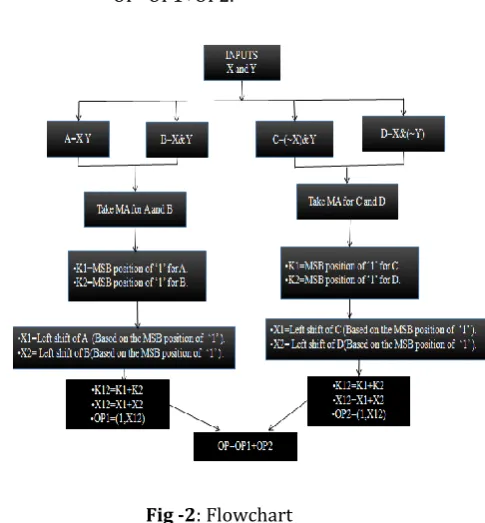
Two binary inputs X and Y are given in binary form. X and Y are divided into A, B, C, and D. Taking MA separately for A, B and C, D. LOD detects the leading bit position. If the leading ‘1’ is in 7th position the inputs are directly entered to the barrel shifter else ENC and NOT gate will decide the shifting count. L-Barr shift will then do the left shifting operation. Adder will do the further adding operation of the inputs. Is Zero block is used to check the two input values. So, if any one of the input is zero it will directly give the result as zero instead of doing all the operation. Here multiplication is converted as addition. The results are added and concatenated with 1 and number of zeros is appended based on MSB position.
PROCEDURE
Step1: X, Y: n-bit binary multiplicands, OP=0:2n-bits approximate product.
Step 2: Calculate A, B, C, D value using X and Y.
Step 3: Calculate A using the equation A=X|Y.
Step 4: Calculate B using the equation B=X&Y.
Step 5: Calculate C using the equation C= (~X) &Y.
Step 6: Calculate D using the equation D=X& (~Y).
Step 7: To take MA for A and B.
A, B: n-bit binary multiplicands, OP1= 0: 2n-bits approximate product.
Determine K1, leading ‘1’ position of 1st number, A
Determine K2, leading ‘1’ position of 1st number, B
Evaluate X1 by shifting A by N-K1 bits towards left
Evaluate X2 by shifting B by N-K2 bits towards left
Calculate K12=K1+K2
Calculate X12=X1+X2
Decode K12 and insert ‘1’ in that position
of OP1
Append X12 immediately after this one in
OP1
A.B= OP1
Step 8: To take MA for C and D.
C, D: n-bit binary multiplicands, OP2= 0: 2n-bits approximate product.
Determine K1, leading ‘1’ position of 1st number, C
Determine K2, leading ‘1’ position of 1st number, D
Evaluate X1 by shifting C by N-K1 bits towards left
Evaluate X2 by shifting D by N-K2 bits towards left
Calculate K12=K1+K2
Calculate X12=X1+X2
Decode K12 and insert ‘1’ in that position
of OP2
Append X12 immediately after this one in
OP2
C.D= OP2
Step 9: Adding OP1 and OP2 we get OP
OP=OP1+OP2.
Fig -2: Flowchart
ERROR PERCENTAGE-It can be obtained by the following formula
Error %= ((Original value-Obtained value)/Original value)*100
EXAMPLE
Step 1: Inputs
X=10001100(140), Y=00100101(37).
[image:2.595.324.567.339.601.2]© 2019, IRJET | Impact Factor value: 7.211 | ISO 9001:2008 Certified Journal
| Page 1762
Step 3: A=X|YA= (10001100) | (00100101)
A=10101101
Step 4: B=X&Y
B= (10001100) & (00100101)
B=00000100
Step 5: C= (~X) &Y
C= (01110011) & (00100101)
C=00100001
Step 6: D=X& (~Y)
D= (10001100) & (11011010)
D=10001000
Step 7: Take MA for A and B
Inputs
A=10101101,
B=00000100.
MSB position of ‘1’ for K1 in binary form
MSB of A is ‘7’
K1=111
MSB position of ‘1’ for K2 in binary form
MSB of B is ‘2’
K2=010
After left shifting A
MSB of A is 7. So left shift by 0 (~ (K1))
X1=0101101
After left shifting B
MSB of B is 2. So left shift by 5 (~ (K2))
X2=0000000.
Adding K1 and K2
K12=K1+K2
K12=111+010=1001.
Adding X1 and X2
X12=X1+X2
X12=0101101+0000000
X12=0101101.
Concatenate 1 an X12
OP1= (1, X12)
OP1=1010110100
Step 8: Take MA for C and D
Inputs
C=00100001,
D=10001000.
MSB position of ‘1’ for K1in binary form
MSB of C is ‘5’
K1=101
MSB position of ‘1’ for K2in binary form
MSB of D is ‘7’
K2=111
After left shifting C
MSB of C is 5. So left shift by 2 (~ (K1))
X1=00001
After left shifting D
MSB of D is 7. So left shift by 0 (~ (K2))
X2=00010
Adding K1 and K2
K12=K1+K2
K12=101+111=1001.
Adding X1 and X2
X12=X1+X2
X12=00001+00010
X12=00011
© 2019, IRJET | Impact Factor value: 7.211 | ISO 9001:2008 Certified Journal
| Page 1763
OP2= (1, X12)OP2=1000110000000
Step 9: Adding OP1 and OP2
OP=OP1+OP2
OP=0000001010110100+001000110000000
OP=0010110000110100(5172)
Error %= ((5180-5172)/5180)*100
[image:4.595.53.270.298.391.2]Error %= 0.15
Table-1: Comparison between Mitchell Algorithm and
Operand Decomposition
X Y MA ERROR% OD ERROR%
140 37 1.15 0.15
117 157 5.92 1.57
203 183 10.41 0.76
The above table shows the comparison of errors between Mitchell Algorithm and Operand Decomposition. From this we came to know the efficiency of Operand Decomposition.
SOFTWARE REQUIREMENTS
Synthesis tool- Xinlinx ISE 14.5.
Verification tool-ModelSim 6.4c.
SNAPSHOTS
Picture tells everything. The below snapshots are very much helpful for us in understanding about this paper. The snapshots of output waveform, Look Up Tables (LUT) and blocks are listed below.
Fig -3: Output waveform
Fig -4: Block diagram
This output and the block diagram clearly shows the two inputs and the output.
The above diagram shows the several blocks inside the main block which are responsible several operations.
Fig-5 LUT
APPLICATIONS
Digital Image Processing.
Digital Signal Processing.
Embedded systems and data centres.
3. CONCLUSION
[image:4.595.371.486.394.583.2] [image:4.595.38.276.590.730.2]© 2019, IRJET | Impact Factor value: 7.211 | ISO 9001:2008 Certified Journal
| Page 1764
REFERENCES[1] Z. Babic’, A. Avramovic’, P. Bulic’ (2010) An iterative logarithmic multiplier.
[2] DurgeshNandan, JitendraKanungo, Anurag Mahajan
(2017) An efficient VLSI architecture for Iterative Logarithmic Multiplier.
[3] John n. Mitchell, jr. t associate, ire (1962) Computer Multiplication and Division Using Binary Logarithms.
[4] UrosLoric, PatricioBulic (2012) Applicability of
approximate multipliers in hardware neural networks.
[5] ZdenkaBabic, AleksejAvramovic, PatricioBulic (2008) An