1
Validation of Course Ontology Elements for Automatic
Question Generation
N.H. Ibrahim Teo
1,*, and M.S. Joy
21University of Warwick, Coventry, CV4 7AL, UK 2
University of Warwick, Coventry, CV4 7AL, UK
Abstract
Recent research has led to the emergence of ontology-based question generation and aims to benefit instructors by providing support and intelligent assistance for the automatic generation of questions. However, existing ontologies are not designed mainly for this purpose, and the concern is that an ontology will not be competent enough to act as a semantic source for the question generation process. Therefore, the aim of this work is to validate how well the elements represented in course ontology can be used for the purpose of automatic question generation. In this work, we choose to validate Operating System ontologies and identify related question sources from textbooks on this subject as competency questions. Finally, the result shows that the evaluated ontologies can provide knowledge for generating useful assessment questions. Furthermore, the list of categorized question templates and their variations are generated using a strategy based on the validated ontology.
Keywords: Competency question, Course ontology, Question generation.
Received on 23 November 2016, accepted on 13 August 2017, published on 29 November 2017
Copyright © 2017N.H. Ibrahim Teo and M.S. Joy, licensed to EAI. This is an open access article distributed under the terms of the Creative Commons Attribution licence (http://creativecommons.org/licenses/by/3.0/), which permits unlimited use, distribution and reproduction in any medium so long as the original work is properly cited.
doi: 10.4108/eai.29-11-2017.153392
*Corresponding author. Email:[email protected]
1. Introduction
Ontologies have been widely used in educational environments and the number of evaluations of them is increasing. Various techniques for ontology evaluation have been already proposed, comprising validation and verification of ontologies taxonomies as well as of their content. To develop a complete ontology is almost impossible in practice, but as long as an ontology can be use to solve a particular problem, it is considered to be sufficient. A course ontology is a subject domain ontology that represents knowledge of educational learning content and, like other ontologies, it contains concepts and the relationships that exist between those concepts. A course ontology can be used to automatically generate questions related to course content. Therefore, evaluation of existing course ontologies is crucial to determine their coverage, and validation of concepts presented in the ontologies
towards real world assessment questions will help to achieve this purpose.
Course ontologies can be categorized as domain ontologies where the scope is limited to delivering educational learning content. There are some course ontologies found in the literature such as Object Oriented Programming [1], Operating Systems [2][3], Mathematical Logic [4] and Networking [5], but the competency of each ontology to be used as a source of semantic information for automatic question generation is not known. Therefore, we consider validation of a course ontologies which are used as a source of information for automatic question generation later in this paper. Since validation needs real world examples, real assessment questions will be used as competency questions. The definition of competency question in this paper is slightly different from the one that typically uses in other literature. Competency question is defined as a question stated in natural language and containing required terms
on e-Learning
Research Article
for the particular context. We will discuss the validation of course ontology elements relating to particular concepts and relations, using competency questions to determine the sufficiency of the information represented in the ontology to be used for automatic question generation.
An Operating System course from the Computer Science domain was chosen, to begin with, due to the availability of this course ontology on the web and the nature of the test questions being mainly factual. ONKI Library [2] and Operating System ontologies from Kent University Library [3] were chosen to be validated and have been named as OntoA and OntoB respectively throughout this paper. An illustrative example in the next section will give an overview of how an ontology can be used for question generation. A set of competency questions related to this subject is chosen and discussed in section 3.Section 4 discusses the validation process undertaken and the result is discussed in section 5. Validated ontology concepts relations have also been further investigated in order to create suitable question templates.
2
.
Ontology for question generation
In this section, we present an illustrative example of question generation using an ontology. We begin with a simple example to show how this idea will work. The following is part of the concept representation of the “Operating System” subject ontology.
Simple questions can be generated using any concepts in the ontology such as:
Define Operating System.
Define Memory Management.
Give the definition of demand paging.
Differentiate between segmentation and paging.
Explain virtual memory in memory management.
The underlined words are keywords that can be extracted from a concept in the ontology. These keywords can be removed from the sentences and replaced with a placeholder to create a question template. The idea of having a question template is to generate as many questions as possible, given a question template.
3. Competency questions
Gruninger and Fox [6] had used competency questions as a means to evaluate whether an ontology is sufficient for its intended purposes. These questions are not only used for categorizing an ontology but also to drive the development of new ontologies to fit certain purposes. The use of competency questions is a well-known technique for determining the requirements the ontology should fulfill.
Competency questions used in this research are collected from Operating System review questions in Silberschatz et al.’s textbook [7]. The competency questions used for this ontology evaluation will be used to determine the coverage of concepts in the chosen ontology, as well as to enrich the ontology with missing concepts and relations. These competency questions cover 15 chapters and these are good for identifying which chapters have fewer concepts represented in the ontology.
The list of competency questions is used as an input for this validation, where a string similarity algorithm will be executed to extract any terms in the questions that match a given concept in the course ontology. The detailed discussion about the validation process will be discussed in the following section.
4. Ontology concepts validation process
The evaluation was conducted using Operating System review question in [7]. A total of 259 questions from 15 chapters, which contain short answers and true/false question types, were analyzed. The two ontologies used are OntoA containing 97 triples and 97 concepts, and OntoB, which contains 1041 triples and 980 concepts. Both ontologies use only hierarchical types of relation. The main task for this validation is to match the extracted terms in each question against the concepts represented in both ontologies.
3
combination of words from each sentence. The first word for each question will have an empty string as a pair and under-score will be added between two words. For example: the question “What is an Operating System?” is tokenized into a pairwise string as [“ “-What, What-is, is-an, an-Operating, Operating-System?] and stored in an array. Later, each of these tokens will be mapped to the concept in the ontology. DSC is calculated as follows:
(1)
[image:3.595.315.548.127.269.2]The similarity between strings WP1 and WP2 will give a similarity score of 1 when both strings have all their bigrams intersecting or matching and 0 if there is no intersection at all. Otherwise, it will have a score that varies between 0 and 1. Figure 1 shows the algorithm for matching terms in a question with the concept in the ontology.
Figure 1. Percentage of Questions with Different Matching Levels
5. Result and discussion
This section will discuss the results obtained for two evaluations. Concept validation analysis will first give an input to how well the ontology concepts can be used for question generation, and secondly the numbers of questions that can be generated from both ontologies by considering existing concepts and relations.
5.1. Concepts validation analysis
This evaluation analyses the numbers of questions that contain terms that matched the concepts present in the ontologies. After running the experiment, we found most terms in both ontologies were not matched with the concepts in the ontologies as the algorithm only detects pairwise terms. We investigate this problem further manually and found the result as in Figure 2 We classify the result found into three matching levels which are M1, M2 and M3 that represent ‘Concept is exactly matched with the term in the questions’ , ‘Concept is partially
matched with the term in the questions’, and ‘Concept does not exist in the ontology’ respectively.
Figure 2. Percentage of Questions with Different Matching Levels
[image:3.595.48.274.321.464.2]The analysis results in Figure 2 shows that 78.7 percent of terms in the questions exist in OntoB and 54.82 percent of terms in questions exist in OntoA. The figure is calculated by the total percentage of categories M1 and M2 combined. M1 is meant for the pairwise terms that have the similarity score of 0.9 with the concept existing in the ontology, which is nearly half of the questions with the terms detected in OntoB but it appears less than a quarter were detected in OntoA. This category calculates similarity scores using methods discussed in the previous section. M2, representing partial matches, gave the highest percentage for both ontologies, which is nearly half of the questions. This level has included single terms, triple terms, multi terms, terms with suffices, terms with a combination of noun and verb phrases, and acronyms. Table 1 shows the numbers of ways of naming concepts and the numbers of each occurrence. The evaluation has been able to identify 9 categories under the M2 level of term pattern that may be useful information to be analyzed for developing more useful course ontology. The example of all categories in M2 is shown in Table 2.
Table 1. Categories of concepts naming and their occurrences
15.4
39.42 44.8
40.5 38.2
21.6
0 10 20 30 40 50
M1 M2 M3
OntoA OntoB
[image:3.595.314.557.637.732.2]Table 2. Term pattern examples in M2 categories.
M3 shows the numbers of terms that do not exist in the ontology, and the number is higher in OntoA compared to OntoB with a difference of 26.3 percent. This may be due to two reasons which are (i) that the number of concepts in OntoB is much higher than OntoA, and (ii) that the concept representation in OntoB was mainly developed for the textbook which provided the questions used for this validation.
From the experimental evaluation, several important observations have been made. The first relates to the scope of the ontology that has been evaluated using concept completeness. Concept completeness in this work is defined as whether all important concepts in each course within the syllabus are represented in the ontology – if they are, the ontology is concept complete. Second, the result for OntoB has shown to have a better representation compared to OntoA. OntoB has shown that more than three-quarter of the terms in questions exist in the ontology with half of them identical and another half would need some minor modification. This would mean that the ontology needs only minor effort to be enriched and make it concept complete with only a quarter of new concepts needing to be added to the ontology.
5.2. Number of questions that can be
generated from ontology
This evaluation discussed the number of questions that can be generated from both ontologies. The evaluation is classified into 4 categories and the following is an example to show how the questions are categorized. We assume a question contains ‘question word’, ‘noun’ and ‘action verb’ where noun will be represented as concept and action verb will be represented as a relation in the ontology.
Assume we have triples ‘[Y] is-a [X]’ and ‘[Z] is-a [X]’, ‘question word’ are [what, define, explain] and ‘action verb’ are [the purpose of, the advantage of]. A: Complete
All terms match the concepts in the ontology. Examples: “What is [X]?” and “Define [X]”.
B1: Nearly Complete
Only some terms in question matched the concepts in the ontology.
Example: “Explain [X] in [Q]”. B2: Incomplete
The question contains an action verb which does not exist in the ontology but all terms match the concepts in the ontology.
Example: “Explain the purpose of [X]”. C: Cannot be generated
The question contains an action verb which does not exist in the ontology and no term matches any concept in the ontology.
Example: “Explain the advantage of [Q]”.
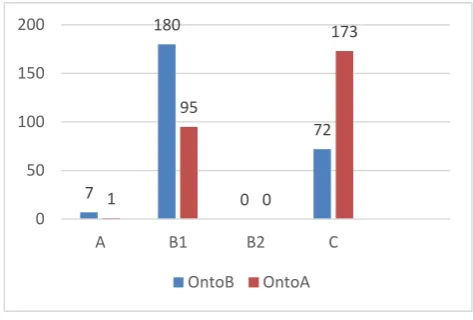
The result in Figure 3 shows the outcome of the mapping process between questions and ontology elements, in particular, the concepts and relations in the course ontologies.
Figure 3. Number of question generated
The result shows that less than 5 percent of the questions can be generated using the ontology and all are questions that only need the existence of a concept and a template question such as "What is X?' to support question generation. Most of the questions can be partly generated from a hierarchical type of ontology. This shows that the ontology needs to have certain kinds of a predicate to relate two concepts for it to be able to generate meaningful questions. Category B1 contributes the largest number of cases for both ontologies where each question cannot be generated as the question has not enough concepts. Category B1 shows that significant effort can be made to add concepts to enable the ontology to generate questions. This effort will contribute to the larger number of questions that can be generated. However, for category B2, since both ontologies are hierarchical, adding object property relationships between concepts in ontology is troublesome. Varieties of words need to be considered for relationships, and this is quite a tedious task.
7
180
0
72
1
95
0
173
0 50 100 150 200
A B1 B2 C
[image:4.595.315.552.322.482.2]5
Besides, many of the concepts in OntoA did not exist, and significant numbers in OntoB as well. Most of the concepts used in these two ontologies intersect and there is no need for combining the two ontologies to make it complete. The ideal way would be to use OntoB as a basic ontology for use with automatic question generation.
Furthermore, about the relationship, ‘is-a’ type of relation alone might contribute to just a small percentage of questions generated. Missing appropriate relations between concepts may not generate semantically correct questions. For example, in the question ‘What are three components of an Operating System’, and when we remove the word ‘components-of’ that act as a relationship in ontology, the question becomes ‘What are three Operating Systems’ and now has a different meaning. The result has shown that more than half of the question cannot be generated due to the absence of relations that link between two concepts.
Finally, although not all keywords from questions exist in the ontologies, most of the keywords that exist in ontologies could generate useful assessment questions, and the questions are from different question taxonomies and include definition, concept completion and comparison questions. The evaluation has lead to another interesting analysis, which is how the relations between concepts in an ontology could be used to create categories of question templates. The next section will discuss further how questions templates can be generated based on semantic interpretation conducted using reviewed questions and OntoB.
6. Categorized Question template
generation
The objectives are to generate categorized question templates and to identify any possible question templates’ variations. The Operating System review questions have been analyzed and validated using an ontology to identify how keywords in the questions relate to concepts in the ontology. The experiment has been conducted to show the number of keywords that match a concept from the ontology as reported in section 5.1. Here, the experiment did not check how complete the ontology is for the purpose of question generation. Instead it is to investigate whether there is a high possibility of the questions having been generated using the ontology and the results are discussed in section 5.2.
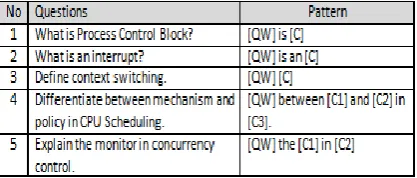
After investigating the possibility of question generation using the ontology, the next step is to formalize the questions using predicate logic to obtain a pattern for categorizing the questions used for generating question templates. The experiment has been conducted to analyze real-world assessment questions and transforms them into templates as shown in Table 3. Here, the question words and the keywords of question sentences are replaced with a placeholder which are labelled as [QW] and [C] respectively. The next subsections discuss the steps to generate question templates and the lists of
[image:5.595.321.530.176.265.2]question template variations which have been identified. In the subsequent discussion, [C1], [C2] and [C3] indicate different keywords used in questions.
Table 3. Example of question templates
6.1 Question templates generation
A question can be classified as a sentence that consists of a question word or action verb from the revised Bloom’s taxonomy [8], such as “define”, “explains”, “how” and a keyword which usually a noun or noun phrase. Normally, in a question bank, many questions have the same structure, and the amount of the questions will keep on increasing each time new questions supplied.
A semantic interpretation technique using simple predicate logic would be able to solve this problem by representing the same structure of questions in a single representation. In this case, a set of the same structure of questions can be represented by a single question template. For example, the first, second and third questions described in section 2 can be formalized and represented as [Question word] [keyword] which later can be instantiated. However, the single representation will not be able to represent all questions since there are many ways of writing questions. For instance, comparison type of question would require different template such as [Question word]
between [keyword] and [keyword].Therefore,
one possible way to solve this problem is by categorizing those questions and having a template for each category.
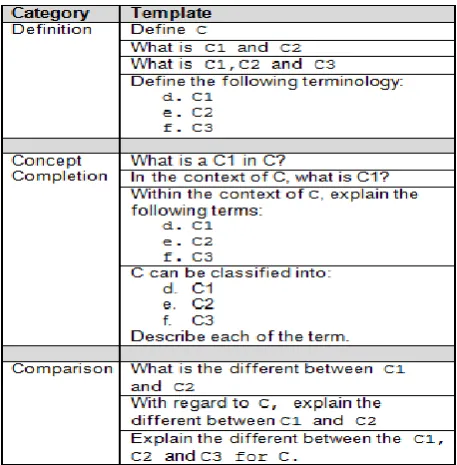
For the purpose of this work, the question taxonomy proposed by Graesser[9] is applied due to its categorization that meets the purpose of this work. There are three categories from the taxonomy have been adopted which are definition, comparison and concept completion due to their suitability to be used in forming simple factual questions. Each review questions was categorized accordingly into these categories. The next step is to replace the keyword with an appropriate placeholder. Table 4 shows the categorized question templates collected.
Table 4. Example of categorized question templates
At the same time, we also identify how the keywords in questions are represented in an ontology especially in terms of how one keyword relates to another in the ontology. Identifying the relation is useful in deciding the strategy for question generation based on the template that we have. The experiment has further identified variations of question templates which are discussed in the next subsection.
6.2 Variation of question templates
To assist identification of variation, this work looks into the structure of the questions and how keywords are mapped inside the ontology. The number of keywords in each question can range from one to many keywords. If it only contains one keyword, the generation of question from a question template and the ontology concept will be quite direct. However, if there is more than one keyword in each question, a decision should be made to select the suitable pair of concepts in the ontology to be inserted into question template.
[image:6.595.319.550.128.497.2]Since OntoB has a higher number of concepts existing in ontology and could produce a higher number of questions, OntoB is used to identify a relation between keyword in question. OntoB has 1041 triples and 980 concepts and is used as an input to analyze the relations between concepts, and the outcome is used to design question templates. Table 5 shows the variation of question templates created from the relations between ontology concepts.
Table 5. Question templates variations
7. Conclusion
7
Acknowledgements.
This research was supported by Universiti Teknologi MARA and Ministry of Education, Malaysia.
References
[1] ABUHASSAN, I. and AL MASHAYKHI, A. (2012) Web based OOP domain ontology (WOOPDO). LAP Lambert Academic Publishing, 1st ed. (Deutschland).
[2] FINNISH ONTOLOGY LIBRARY SERVICES.
Operating System ontology.
https://onki.fi/en/browser/overview/operating-system. [3] KHAN, J., and HARDAS, M.S. (2007) A technique for
representing course knowledge using ontologies and assessing test problems. In: 5th Atlantic Web Intelligence Conference. France, pp. 174-179.
[4] BOYATT, R. and JOY, M. (2010) Developing an ontology of Mathematical Logic. In: Scientific Journal of the Technical University of Civil Engineering. Volume(6): 6 – 11.
[5] JIANG, L., ZHAO, C., WEI, H.92008) The development of ontology-based course for Computer Networks. In: International Conference on Computer Science and Software Engineering,Wuhan, 487-490.
[6] GRUNINGER, M. and FOX, M.S. (2009) The role of competency questions in enterprise engineering. In: Proceedings of the IFIP WG5.7 Workshop on Benchmarking – Theory and Practice, Trondheim, Norway.
[7] SILBERSCHATZ, A., GALVIN, P.B., GAGNE, G. (2012) Operating System concepts.9th ed. ( New Jersey: John Wiley & Sons, Inc,).
[8] ANDERSON, L.W., SOSNIAK, L.A. (1994). Bloom’s taxonomy: A forty-year perspective. Ninety-third Yearbook of the National Society for the Study of Education. Chicago: University of Chicago Press.
[9] GRAESSER, A. C. & PERSON, N. K. 1994. Question asking during tutoring. American educational research journal, volume(31):104-137.