warwick.ac.uk/lib-publications Manuscript version: Published Version
The version presented in WRAP is the published version (Version of Record).
Persistent WRAP URL:
http://wrap.warwick.ac.uk/125716
How to cite:
The repository item page linked to above, will contain details on accessing citation guidance from the publisher.
Copyright and reuse:
The Warwick Research Archive Portal (WRAP) makes this work of researchers of the University of Warwick available open access under the following conditions.
This article is made available under the Creative Commons Attribution 4.0 International license (CC BY 4.0) and may be reused according to the conditions of the license. For more details see: http://creativecommons.org/licenses/by/4.0/.
Publisher’s statement:
Please refer to the repository item page, publisher’s statement section, for further information.
Proceedings of the 2019 Conference on Empirical Methods in Natural Language Processing 5618
A Knowledge Regularized Hierarchical Approach for Emotion Cause Analysis
Chuang Fan1,5, Hongyu Yan1,5, Jiachen Du1,5, Lin Gui2, Lidong Bing3 Min Yang4, Ruifeng Xu1,5,6∗, Ruibin Mao7
1Harbin Institute of Technology (Shenzhen), China 2University of Warwick, UK
3R&D Center Singapore, Machine Intelligence Technology, Alibaba DAMO Academy
4Shenzhen Institutes of Advanced Technology, Chinese Academy of Sciences
5Joint Lab of Harbin Institute of Technology and RICOH 6Peng Cheng Laboratory, China
7Shenzhen Securities Information Co.,Ltd, China
Abstract
Emotion cause analysis, which aims to iden-tify the reasons behind emotions, is a key topic in sentiment analysis. A variety of neural network models have been proposed recently, however, these previous models mostly focus on the learning architecture with local tex-tual information, ignoring the discourse and prior knowledge, which play crucial roles in human text comprehension. In this paper, we propose a new method to extract emo-tion cause with a hierarchical neural model and knowledge-based regularizations, which aims to incorporate discourse context infor-mation and restrain the parameters by senti-ment lexicon and common knowledge. The experimental results demonstrate that our pro-posed method achieves the state-of-the-art per-formance on two public datasets in different languages (Chinese and English), outperform-ing a number of competitive baselines by at least 2.08% in F-measure.
1 Introduction
Sentiment analysis has gained increasing popular-ity in recent years due to many useful applications
(Pang and Lee,2007). The goal of sentiment
anal-ysis is to classify the sentiment polarity of a given text as positive, negative, neutral, or more fine-grained classes (Kim,2014;Li et al.,2015;Yang
et al.,2016;Zhou et al.,2016;Chen et al.,2017;
Qian et al.,2017;Li et al.,2018b;Yu et al.,2018).
Most of these researches have assumed that emo-tion expressions are already observed and try to identify the emotion categories from text. How-ever, in practice, such as in product comments or political reviews, we may care more about the rea-son why the customers or critics hold the emotion rather than a simple category label. Because they can improve the quality of the products or services
∗ ∗
Corresponding Author: [email protected]
according to the emotion cause provided by users. Emotion cause analysis (ECA) aims to identify the reasons behind a certain emotion expression in an event text, for example:
Ex.1 When the children saw the gifts I prepared carefully,(c−2)|they cheered happily and hugged me.(c−1)|I was full of happiness. (c0)
Here, Ex.1shows a document with three clauses
marked as (c−2), (c−1), and (c0). The goal of
ECA is to determine which clause contains emo-tion cause (e.g., (c−1)) for an emotion word (e.g., happinessin (c0)).
Previous approaches for emotion cause analysis mostly depend on rule-based methods (Lee et al.,
2010; Chen et al., 2010) and machine learning
algorithms (Ghazi et al., 2015; Gui et al., 2016;
Xu et al., 2019). Most of them rely heavily on
complicated linguistic rules or feature engineer-ing, which is time-consuming and labor-intensive. Recent studies have focused on solving the task using neural models (Gui et al., 2017; Li et al.,
2018a;Chen et al.,2018;Li et al.,2019) with well
em-ploy a hierarchical learning structure to capture the mutual impacts of semantic expression among the discourse context, to help produce better clause representation. Secondly, in emotion events, emo-tion causes usually express a certain sentiment po-larity by some sentiment words. For example, in the emotion cause of Ex.1, the sentiment words
cheered and happily express a positive polarity, also play a crucial role to provoke the emotion
happiness. Therefore, capturing these sentiment words can enhance the causal connection between learned features and predictions. We approach this issue by designing a regularizer that incorporates linguistic knowledge (e.g., sentiment lexicon) to enlarge the margin of attention weights of senti-ment words and non-sentisenti-ment words. Besides, it is often the case that humans usually write im-portant points in different sections. For emotion events, emotion causes generally occur on posi-tions very close to the emotion word and occur fre-quently. Ex.1 shows an anecdotal example illus-trating this behavior that the emotion cause clause
c−1 adjoins the emotion wordhappiness. To
ben-efit from this phenomenon, we introduce a regu-larizer biased by relative position information to supervise the representation learning of text and further to revise thepredictive position distribu-tion of emodistribu-tion causes relative to the emodistribu-tion word(in brief, predictive distribution).
To sum up, our contribution includes:
• We propose a novel discourse-aware
learn-ing structure with knowledge-based regular-izations for emotion cause analysis.
• We empirically evaluate the proposed model
on two public datasets in different languages (Chinese and English) and show statistically significant improvements compared to the state-of-the-art methods.
• To make the mechanism of our model clear,
we also compare the performance of different combinations by ablation experiments. Ex-tensive analysis on both datasets confirms the feasibility of incorporating discourse infor-mation and restraining the parameters by sen-timent lexicon and common knowledge.
2 Our Framework
In this section, we first give the task definition. Then, our proposed regularized hierarchical neural
Position Regularizer
---Position Regularizer Sentiment
Regularizer
Sentiment Regularizer
-position Embedding
---position
[image:3.595.315.517.61.234.2]Embedding
Figure 1: The architecture of our model.
network (RHNN), as shown in Fig1, will be de-scribed. The two auxiliary regularizers of RHNN will be introduced in the next section.
2.1 Task Definition
The formal definition of emotion cause analysis is given in (Gui et al.,2016). Formally, for a docu-mentd={c1, c2, . . . , cn}consisting ofnclauses,
it contains an emotion wordeand at least an emo-tion cause clause corresponding to this emoemo-tion word. Each clauseci = {wi1, wi2, . . . , wik}
con-sists ofkwords and is labeled with emotion cause-oriented labels∈ {0,1}. We regard ECA as a bi-nary classification task and aim to identify which clause contains emotion cause.
2.2 Hierarchical Attention Network
Documents exhibit discourse structure which can serve as useful information for clause representa-tion generarepresenta-tion. One simple but effective approach is to adopt a hierarchical attention network to sim-ulate this structure. Our hierarchical attention net-work consists of several parts: a word encoder, a word attention layer, a clause attention layer and a clause encoder. The details of each component will be described in the following paragraphs.
Word Encoder Gated Recurrent Unit (GRU) has been widely adopted for text processing (Cho
et al., 2014). In this work, we first map each
bidirec-tional GRU to exploit two parallel passes:
−→
hit=
−−−−→
GRUw(xit), t∈[1, k] (1)
←−
hit=
←−−−−
GRUw(xit), t∈[k,1] (2)
wherexitis embedding vector for the wordwitin
clauseciat time steptandkis the length of clause
ci. Then we concatenate hidden states of the two
directionshit = [
−→
hit,
←−
hit]as the representation of
each word.
Word Attention We introduce an attention mechanism to extract such words that are impor-tant to the meaning of the clause and aggregate the representation of these informative words to con-struct the clause vector. Specifically,
git=wmT(hit⊕eE) (3)
αit=
exp(git)
P
t0exp(git0) (4)
oci = X
t
αithit (5)
where wm is the parameter for computing
atten-tion signals and⊕ is concatenate operation. The embedding of emotion word eis denoted by eE.
αit is the emotion-specific attention signal
show-ing the importance of wordwit.ociis the weighted
sum of word representation based on weights.
Clause Attention Intuitively, different clauses of a document are different informative and should be labeled with different importance. Targeting this problem, we design a clause attention mech-anism to indicate the importance of each clause. See it differently, the attention signals can be re-garded as some ”prior” information to bias the clause encoder toward some content that is more important to extracting the emotion cause.
As for details, we adopt a one-layer MLP to get the attention signals. Apparently, position infor-mation plays an important role in capturing the rel-ative distance of the clause to emotion word. Thus, we concatenate the clause vectoroci and its
posi-tion embedding as the feature to obtain the atten-tion signal, this yields:
αi = sigmoid(wv(oci⊕li)) (6)
o0ci =oci·αi (7)
where wv is a parameter vector, li is the
ran-domly initialized position embedding and keeps unchanged in the training stage, αi is the weight
of clause ci. Then the clauses with different
im-portance (e.g.,o0ci) are fed into a clause encoder.
Clause Encoder Just as the meaning of a word is determined by its context, the semantic expres-sion of a clause is usually impacted by its dis-course context. Based on this observation, we in-troduce a clause encoder to model the latent se-mantic relations among different clauses. Analo-gously, we also append the relative position infor-mation to enhance the relations between the clause and its position. Formally,
− →
hi =
−−−→
GRUc(o0ci⊕li), i∈[1, n] (8)
←−
hi =
←−−−
GRUc(o0ci⊕li), i∈[n,1] (9)
wherenis the number of clauses in a document. Also, the two directional hidden state−→hi and
←−
hi
are concatenated as the final emotion-specific rep-resentationoi= [
− →
hi,
←−
hi].
2.3 Model Training
The emotion-specific representationoiwith its
po-sition embeddinglias the final feature for emotion
cause prediction and the model is trained by mini-mizing the cross entropy:
yi = softmax(Wm(oi⊕li)) (10)
Lce=−
X
i
b
yilogyi (11)
whereWmis a parameter matrix,ybiandyiare
tar-get class distribution and predictive class distribu-tion respectively.
3 Regularizers Based on Sentiment Lexicon and Relative Position
One crucial emotion cause cue is sentiment words since emotion causes usually express a certain
sen-timent polarity by sensen-timent words. However,
there is no effective mechanism to guarantee that the above module indeed attends the words with sentiment polarity. Beyond this, a straightforward solution to inject position information is to di-rectly incorporate relative word position embed-ding, which is a weak representation of the rela-tive distance between the emotion word and each clause. To ease these problems, we introduce two auxiliary regularizers:
• Position Regularizer (PR.): Relative posi-tion is a critical emoposi-tion cause indicator: in general the closer a clause is to the emotion word, the higher emotion cause probability it should be assigned. We approach this is-sue by introducing a proxy distribution and an auxiliary cross entropy function.
Formally, we disassemble the joint loss of emo-tion cause detecemo-tion into an original cross entropy loss, a sentiment regularization loss, and a position regularization loss. The new training objective is revised as:
J(θ) =Lce+λ1∗ Lsr+λ2∗ Lpr (12)
whereLceis the original cross entropy loss (§2.3).
λ1andλ2 are hyper-parameters. Lsr andLpr are
two auxiliary regularization losses (§3.1and§3.2).
θis the parameter set.
3.1 Sentiment Regularizer
The weak causal connection between learned fea-tures and predictions is a major issue in emotion cause analysis. Even though sentiment words are key to clause representation generation, most ex-isting models do not focus on sentiment words or place less emphasis on them when producing clause representation. In other words, attention is distracted by irrelevant words with less sentiment polarity. To address this issue and sufficiently befit from linguistic resources, we explicitly en-courage the larger margin of attention weights be-tween sentiment words and non-sentiment words using a sentiment lexicon. For sentiment words, the average attention weight is calculated by:
Avgs=
1 ls
k
X
t=1
Swit (13)
Swit =
αit if wit∈ci∩ S
0 otherwise (14)
where wit is the t-th word of clause ci, k is the
length of ci and ls is the number of sentiment
words inci. αit is the calculated attention weight
in§2.2andS is a sentiment lexicon. Correspond-ingly, for non-sentiment words:
Avgns=
1 lns
k
X
t=1
N Swit (15)
N Swit =
αit if wit∈ci− S
0 otherwise (16)
Our training objective is to lead the model to pay more attention to sentiment words. Thus, the regularization term is formally expressed as:
Lsr=
X
i
max(0, m−(Avgs−Avgns)) (17)
wheremis a hyper-parameter for margin.
3.2 Position Regularizer
Empirically, emotion causes usually occur at the positions which are very close to the emotion word. However, another main issue is that the pre-dictive distribution may locates the clauses that are distant from and irrelevant to the emotion word. The goal of this regularizer is to narrow the dif-ference between the predictive distribution and the
true position distribution of emotion causes rel-ative to the emotion word(in brief, true distribu-tion). Obviously we can not obtain the true distri-bution. Hence, we assume that it should satisfy the following conditions: (1) It should be a normed function within[0,1]; (2) It should be a symmetric function of a certain value. Based on these condi-tions, we employ a function defined as follows:
qi=
1−|ri|
n if−b≤ri ≤b
0 otherwise (18)
where ri is the relative distance of clause ci to
emotion word,nis the number of clauses in a doc-ument, andbis the left and right boundary which limits the scope of emotion cause. Then we apply
q = (q1, q2, . . . , qn) as the proxy distribution to
simulate the true distribution.
Simultaneously, from section 2.3, we get the predictive class distributionyi of clauseci. Then,
the probability for the emotion cause at positioni
can be calculated as:
pi=yi(label= 1) (19)
Similarity, we can obtain the predictive distribu-tion of emodistribu-tion causes relative to the emodistribu-tion word by:
p= (p1, p2, . . . , pn) (20)
The goal is to enforce the model to constrain the difference between thepandq, thus, we use cross entropy to measure the difference:
Lpr =−X
i
qilog(pi) (21)
Note that the two introduced regularizers work
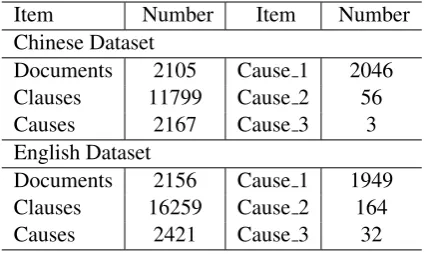
Item Number Item Number Chinese Dataset
Documents 2105 Cause 1 2046
Clauses 11799 Cause 2 56
Causes 2167 Cause 3 3
English Dataset
Documents 2156 Cause 1 1949
Clauses 16259 Cause 2 164
[image:6.595.75.288.62.189.2]Causes 2421 Cause 3 32
Table 1: Details of the two datasets. Cause 1, Cause 2 and Cause 3 represent the documents with 1, 2 and 3 cause clauses, respectively.
any new parameters and only influence the train-ing of the standard model parameters. The hyper-parametersλ1 andλ2 guide the model to achieve
the best trade-off among three types of losses.
4 Datasets and Implementation Details
4.1 Datasets
We select two public datasets from different lan-guages to evaluate the proposed model: Chinese Dataset (Gui et al., 2016) collected from SINA city news1 and English Dataset (Gao et al.,2017) collected from English novels. Each document of both datasets has only one emotion word and one or more emotion causes. It has been ensured that the emotion and the causes are relevant. The docu-ments are segmented into several clauses manually for emotion cause analysis. The details about the two datasets are summarized in Table1.
4.2 Implementation Details
For the Chinese dataset, there is no training/test split, we randomly divide the documents into a training/development/test set in a ratio of 8:1:1 and partition the clauses by Jieba2. For the English dataset, we randomly select 10% from the original training set as the development set and lowercase, lemmatize all the tokens by NLTK3. We evaluate our method 25 times with different splits and then perform one samplet-test on the experimental re-sults by following (Gui et al.,2017). The precision (P), recall (R) and F-measure (F) are employed to measure the performance in this task.
The sentiment lexicon adopted for the Chinese dataset consists of two parts. The first part is
se-1
http://news.sina.com.cn/society/ 2
https://github.com/fxsjy/jieba 3http://nltk.org
lected from HowNet (Dong et al.,2006) sentiment analysis lexicon set4 and the second part comes from NTUSD (Ku et al.,2006). The combination of the two parts serves as the Chinese sentiment lexicon of this research. The English sentiment lexicon comes from MPQA (Wilson et al.,2005) and we only select the words with high sentiment polarity, because they are less sensitive to contex-tual information and usually express consistence sentiment polarities from their prior polarity. For both sentiment lexica, we filter out the words that are not in the datasets. Ultimately, 2022 and 1348 sentiment words are selected for the Chinese and English dataset respectively.
Online learning is performed with the Adam op-timizer (Kingma and Ba, 2015) and initial learn-ing rate 0.001 is adopted. The number of layers in Bi-GRU is set to 2 and dropout rate 0.5 is used to avoid overfitting. The word vectors are pre-trained by word2vec (Mikolov et al.,2013) and keep un-changed during training stage. We perform grid search over the hyper-parametersm({0.10, 0.15, 0.20}), the boundaryb({2, 3, 4}), the dimension-ality of the Bi-GRU ({64, 128}),λ1 andλ2 (both {0.25, 0.5, 0.75 }). For each corpus, the highest F-measure combination of these hyper-parameters is selected using development set.
5 Experiments
In this section, we will compare our RHNN model with the following groups of methods:
• Rule-based and commonsense-based
meth-ods: Rule-based method (RB) is a traditional
rule-based method proposed by Lee et al.
(2010). Commonsense-based methods (CB)
is a knowledge-based method proposed by
Russo et al.(2011). It uses Chinese Emotion
Cognition Lexicon (Xu et al.,2013) as com-monsense knowledge.
• Machine learning method: SVM is a
SVM classifier trained on unigrams,
bi-grams and tribi-grams features (Li and Xu,
2014). Word2vec is a SVM classifier trained on word representations pre-trained by Word2vec (Mikolov et al.,2013). Multi-kernel represents a document by a syntac-tic structure and utilizes a modified convolu-tion kernel method to determine which clause contains the emotion cause (Gui et al.,2016).
Method P R F
RB∗ 0.6747 0.4287 0.5243
CB∗ 0.2672 0.7130 0.3887
SVM∗ 0.4200 0.4375 0.4285
Word2vec∗ 0.4301 0.4233 0.4136
Multi-kernel∗ 0.6588 0.6972 0.6752
LambdaMART∗ 0.7720 0.7499 0.7608
CNN∗ 0.6472 0.5493 0.5915
ConvMS-Memnet∗ 0.7076 0.6838 0.6955
CANN 0.7721 0.6891 0.7266
HCS 0.7388 0.7154 0.7269
MANN 0.7843 0.7587 0.7706
[image:7.595.305.526.61.159.2]RHNN 0.8112 0.7725 0.7914
Table 2: Experimental results on the Chinese dataset. Superscript∗indicates the results are reported in (Gui et al.,2017) and the rest are reprinted from the corre-sponding publications (p <0.001).
LambdaMARTextracts emotion causes us-ing learnus-ing to rank methods which based on the independent and emotion-dependent features (Xu et al.,2019).
• Deep learning method: CNN is a
convolu-tional neural network for sentence
classifica-tion (Kim,2014).ConvMS-Memnet
consid-ers emotion cause analysis as a reading com-prehension task and designs a multiple-slot deep memory network to model context in-formation (Gui et al., 2017). CANN uses a co-attention neural network to identify emo-tion causes (Li et al., 2018a). HCS is pro-posed byYu et al. (2019) using a multiple-level hierarchical network to detect the
emo-tion causes. MANN is the current
state-of-the-art method employing a multi-attention-based model for emotion cause extraction (Li
et al.,2019).RHNNis our proposed model.
5.1 Main Results
The experimental results on both datasets are
shown in Table 2 and Table 3, respectively. RB
yields high precision but with low recall. CB has an opposite scenario from RB. A possible reason is that these linguistic-based methods depend on some cue words to identify the emotion cause, dif-ferent rules or common sense may contain differ-ent cue words.
For the machine learning methods, SVM and Word2vec have similar performance on the
Chi-Method P R F
Word2vec 0.1651 0.8673 0.2774
SVM 0.2757 0.6416 0.3856
CNN 0.7218 0.2628 0.3390
ConvMS-Memnet 0.4605 0.4177 0.4381
MANN 0.7933 0.4081 0.5328
[image:7.595.73.294.62.243.2]RHNN 0.6901 0.5267 0.5975
Table 3: Experimental results on the English dataset, we follow the results that are implemented in (Li et al.,2019), the only available results on this dataset (p <0.001).
nese dataset, but SVM outperforms Word2vec on the English dataset. The main reason is that the polysemantic phenomenon is more obvious in En-glish expressions. Multi-kernel has better perfor-mance by capturing context information through a syntactic tree. LambdaMART, which is based on ranking strategy and global emotion features, per-forms best among feature-based methods. How-ever, both Multi-kernel and LambdaMART rely on expensive human-based features and lack of ex-pandability on different dataset.
Compared with CNN, ConvMS-Memnet mod-els the context of each word and obtains better per-formance on both datasets. The co-attention based CANN captures the mutual relations between the emotion clause and each candidate clause, which has a comparable result with hierarchical-based HCS. MANN considers the interaction between the emotion clause and candidate clauses by de-signing a multi-attention mechanism and achieves the best performance among baselines.
The proposed RHNN model further improves the performance on both datasets as shown in the tables. The improvement is significant with
sen-Method Applying with F F
H. SR. PR. Chinese English
Base × × × 0.7152 0.5199
H X × × 0.7553 0.5668
SR × X × 0.7570 0.5765
PR × × X 0.7483 0.5683
HSR X X × 0.7860 0.6154
HPR X × X 0.7659 0.5777
SPR × X X 0.7600 0.5878
RHNN X X X 0.7914 0.5975
Table 4: Effect of different components, i.e., hierar-chical structure (H.), sentiment regularizer (SR.) and position regularizer (PR.). The leftmost column is the abbreviation for corresponding sub-models (e.g., SPR denotes the sub-model with SP. and PR. except H.).
Method Chinese English
Sub. All. Sub. All.
SR 0.7650↑ 0.7570 0.6713↑ 0.5765
HSR 0.7934↑ 0.7860 0.7084↑ 0.6154
SPR 0.7741↑ 0.7600 0.6904↑ 0.5878
[image:8.595.323.512.60.184.2]RHNN 0.7997↑ 0.7914 0.6849↑ 0.5975
Table 5: The F-measure on sub-dataset (Sub.) that only selects the clauses which contain sentiment words, and all-dataset (All.) that experiments on the whole dataset.
timent words) information to optimize the model extracting emotion causes more exactly.
5.2 Detailed Analysis
Ablations of RHNN Model The proposed RHNN model consists of three components, in-cluding hierarchical structure (H.), sentiment reg-ularizer (SR.) and position regreg-ularizer (PR.). We conduct ablation experiments to reveal the effect of each component. As illustrated in Table4, all models with the proposed component consistently improve upon the Base model, verifying the ef-fectiveness of the proposed approach. Compare with H. and PR. model, the SR. improve the per-formance most. The main reason is that there are 55.24% and 66.49% of emotion causes which con-tain sentiment words on the Chinese dataset and English dataset respectively, enforcing the model to pay more attention to sentiment words can en-hance the causal connection between learned fea-tures and predictions.
On the Chinese dataset, the RHNN achieves the best performance with a 7.62% improvement on
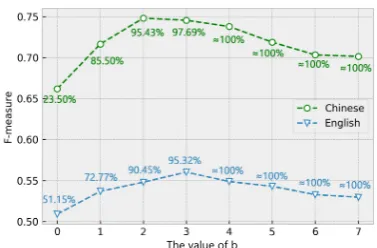
[image:8.595.73.292.61.205.2]The value ofb
Figure 2: The F-measure of different limited scopes of emotion cause on two datasets.
the F score compared with the baseline.
How-ever, on the English dataset, the HSR model per-forms better than the RHNN model. It may be caused by the overlapping between components. Besides, the performance on the English dataset always lower about 20% in F-measure than that on the Chinese dataset, one possible explanation for this phenomenon is that there are more clause structures in English expressions which is difficult for the model to capture this information without discourse tree.
Effect of Sentiment Regularizer To gain more insights into our proposed model, we conduct fur-ther experiments to examine the effectiveness of sentiment regularizer on the subset of two datasets. The experiment results in Table 5 show that: 1) RHNN and HSR model achieve the best perfor-mance on the subset of two datasets respectively, similar observations can be found regarding on whole dataset; 2) With sentiment regularizer, the performance is boosted on both subsets compared to that on the whole dataset. This is consistent with our intuition because sentiment regularizer con-tributes much to pick up the words with sentiment polarity and these words are important causal indi-cators in clauses. Meanwhile, each clause contains sentiment words in the subsets, resulting in a better performance on the subsets. 3) The performance improvement on the English subset is remarkably higher than that on the Chinese subset, one possi-bility is that there are more explicit emotion terms in English expression than in Chinese.
[image:8.595.72.295.296.380.2]com plaine
d A
fello w cam
e to storeasking Xiao
Mei
Xiao Mei ’s
situa tion
DaXi
ong She hear
d it then felt both and not
[image:9.595.307.530.61.309.2]good angr y sad
Figure 3: Comparison of attention distribution with or without sentiment regularizer.
model on this experiment. The results are shown in Fig 2, the percentages denote the coverage of emotion cause in datasets. For instance, 72.77% represents that there are 72.77% emotion causes adjoining the emotion word in English dataset.
From Fig 2, we can see that the performance
trends for the two datasets are similar, and the performance improves with the expanding limited scope of emotion cause. However, when the lim-ited scope of emotion cause is larger than a certain value (2 or 3), the performance decreases. This may be due to the reason that the larger of lim-ited scope, the higher coverage of emotion cause in datasets. Nevertheless, when the limited scope is too large, the model is forced to allocate higher probability to these clauses which are distant from and irrelevant to the emotion word, and then leads to the performance degradation.
5.3 Case Study
Essentially, sentiment regularizer (SR.) aims to enlarge the margin between sentiment words and non-sentiment words. The question is, will the model focus on the words with sentiment polarity?
We randomly choose one example (Ex.2) from
Chinese dataset to visualize its attention distribu-tion and compare the difference between plusing sentiment regularizer or not.
Ex.2 一 个老乡来到店里问起小美的情况,
(c−2)|大熊抱怨小美不好. (c−1)|她听到后感
到既伤心又生气.(c0)
Ex.2 A fellow came to store asking XiaoMei’s sit-uation, (c−2)|DaXiong complained XiaoMei not good. (c−1)|She heard it then felt both sad and angry.(c0)
In this example, the cause of emotion wordsad
is in(c0). The visualization results are shown in
Fig3, we can observe that the model without sen-timent regularizer most focus on non-sensen-timent
words such as XiaoMei, she and heard it which
are inessential to provoke the emotion. However, when we plus the SR. into model, we can see an obvious weights shift on attention distribution.
Emotion cause events RHNN results
Event 1 I was immedi-ately *ashamed* of my-self for my vanity, for having assumed that he wanted me to stay with him forever. I’m sorry, that was a little arrogant
for having assumed that he wanted me to stay with him forever
Event 2 He hopes of being *admitted* to a sight of the young ladies, of whose beauty he had heard much. But he saw only the father.
of whose beauty he had heard much
Event 3 I didn’t know where in the hell you was, said Ennis, four years, I about *give up* on you.
Null
Table 6: The error instances of RHNN model for emo-tion cause analysis.
More clearly, the model captures the sentiment
wordscomplainedandnot goodwhich are crucial
to identify the emotion cause. This shows that our model with sentiment regularizer is more effective in extracting the most important keywords relat-ing to the emotion cause. Also, better results are obtained using sentiment regularizer, this is con-sistent with what we observed in Table4.
Finally, we perform error analysis to understand what types of errors are introduced with the pro-posed model, focusing on three cases from the En-glish dataset. The results are listed in Table 6, where the first column depicts the content of the emotion cause events and the second column de-picts the emotion causes identified by RHNN. As shown in Table6, the emotion causes appear with red color and emotion word is labeled between *.
From Table 6, we can find that there are two
clauses contain the emotion cause in Event 1.
[image:9.595.75.292.65.120.2]cues with knowledge-based regularizations. How-ever, it also introduces some noisy into emotion cause analysis.
6 Related Work
Emotion classification is an important fundamen-tal aspect of sentiment analysis. Going one step further, emotion cause analysis (ECA) which aims to discover the reason behind emotions, can be constructive to guide the direction of future work, i.e., improving the quality of products or services according to the emotion causes of comments pro-vided by users. In this section, we describe the related work on emotion cause analysis.
Lee et al. (2010) first gave the formal
defini-tion of emodefini-tion cause analysis and manually con-structed a dataset from the Academia Sinica
Bal-anced Chinese Corpus. Based on this corpus,
Chen et al. (2010) designed two sets of features
built on six groups of linguistic cues to detect emotion cause. Support vector machines (SVMs) and conditional random fields (CRFs) were in-vestigated to detect cause or non-cause text with extended rule-based features in existing methods
(Gui et al.,2014;Ghazi et al.,2015). Other than
rule-based methods,Russo et al.(2011) proposed a crowdsourcing method to construct a common-sense knowledge base for emotion cause extrac-tion in Italian newspaper articles. But it is chal-lenging to extend the common-sense knowledge base automatically. Recently, Gui et al. (2016) proposed a multi-kernel based method to iden-tify the emotion cause from a manually annotated emotion cause corpus. Xu et al.(2019) proposed a method based on learning to re-rank candidate emotion cause clauses with extracting a number of emotion-dependent and emotion-independent fea-tures. However, these methods are heavily depen-dent on the expensive human-based features and are too difficult in a real-world application.
Inspired by the success of neural network meth-ods, deep neural models and attention mechanisms have been widely used in emotion cause
analy-sis. Gui et al.(2017) proposed a novel deep
neu-ral network which regarded emotion cause anal-ysis as a question-answering task. In this study, a convolution-based memory network was intro-duced to store the context information. Li et al.
(2018a) considered the context around the
emo-tion word as a query instead of only emoemo-tion word to model the mutual impacts between each
candidate clause and the emotion clause. Cheng
et al.(2017) constructed a corpus based on
Chi-nese microblog and proposed to detect emotion cause using multiple-user structures. Besides,Yu
et al. (2019) proposed a multiple-level
hierarchi-cal network-based clause selection strategy. Li
et al.(2019) proposed a multi-attention-based
neu-ral model to capture the mutual influences between the emotion clause and each candidate clause, and then generate the representations for the above two clauses separately. This method achieves the cur-rent best performance. However, the existing ap-proaches usually focus on the local textural infor-mation, ignoring the discourse structure (Zubiaga
et al., 2018), and prior knowledge such as
senti-ment lexicon (Qian et al., 2017) and relative po-sition information, which can provide important emotion cues for emotion cause analysis task.
7 Conclusion and Future Work
In this paper, we provide a regularized hierarchical neural network (RHNN) for emotion cause anal-ysis. The proposed model aggregates discourse context information through a hierarchical learn-ing structure and restrains the parameters with knowledge-based regularizations. We evaluate the proposed model on two public datasets in differ-ent languages. The experimdiffer-ental results demon-strate that our proposed method achieves the state-of-the-art performance on both datasets and exten-sive analysis confirms the feasibility of incorpo-rating the discourse context and knowledge-based regularizations.
To preserve the simplicity of the proposed model, we do not consider document as a tree structure. In the future, we will exploit how to incorporate discourse parse tree or discourse re-lations into emotion cause analysis task to further improve the performance.
8 Acknowledgements
This work was supported by National Natu-ral Science Foundation of China U1636103, 61632011, 61876053, Shenzhen Foundational
Research Funding JCYJ20180507183527919,
JCYJ20180507183608379, Key Technologies
References
Peng Chen, Zhongqian Sun, Lidong Bing, and Wei Yang. 2017. Recurrent attention network on mem-ory for aspect sentiment analysis. InProceedings of the 2017 Conference on Empirical Methods in Nat-ural Language Processing, EMNLP 2017, Copen-hagen, Denmark, September 9-11, 2017, pages 452– 461.
Ying Chen, Wenjun Hou, Xiyao Cheng, and Shoushan Li. 2018. Joint learning for emotion classification and emotion cause detection. InProceedings of the 2018 Conference on Empirical Methods in Natural Language Processing, Brussels, Belgium, October 31 - November 4, 2018, pages 646–651.
Ying Chen, Sophia Yat Mei Lee, Shoushan Li, and Chu-Ren Huang. 2010. Emotion cause detection with linguistic constructions. In COLING 2010, 23rd International Conference on Computational Linguistics, Proceedings of the Conference, 23-27 August 2010, Beijing, China, pages 179–187.
Xiyao Cheng, Ying Chen, Bixiao Cheng, Shoushan Li, and Guodong Zhou. 2017. An emotion cause corpus for chinese microblogs with multiple-user structures. ACM Transactions on Asian and Low-Resource Language Information Processing (TAL-LIP), 17(1):6.
Kyunghyun Cho, Bart van Merrienboer, C¸ aglar G¨ulc¸ehre, Dzmitry Bahdanau, Fethi Bougares, Hol-ger Schwenk, and Yoshua Bengio. 2014. Learning phrase representations using RNN encoder-decoder for statistical machine translation. InProceedings of the 2014 Conference on Empirical Methods in Nat-ural Language Processing, EMNLP 2014, October 25-29, 2014, Doha, Qatar, A meeting of SIGDAT, a Special Interest Group of the ACL, pages 1724– 1734.
Zhendong Dong, Qiang Dong, and Changling Hao. 2006. Hownet and the computation of meaning.
Qinghong Gao, H Jiannan, X Ruifeng, G Lin, Y He, KF Wong, and Q Lu. 2017. Overview of ntcir-13 eca task. InProceedings of the NTCIR-13 Conference.
Diman Ghazi, Diana Inkpen, and Stan Szpakowicz. 2015.Detecting emotion stimuli in emotion-bearing sentences. In Computational Linguistics and In-telligent Text Processing - 16th International Con-ference, CICLing 2015, Cairo, Egypt, April 14-20, 2015, Proceedings, Part II, pages 152–165.
Lin Gui, Jiannan Hu, Yulan He, Ruifeng Xu, Qin Lu, and Jiachen Du. 2017. A question answering ap-proach for emotion cause extraction. In Proceed-ings of the 2017 Conference on Empirical Meth-ods in Natural Language Processing, EMNLP 2017, Copenhagen, Denmark, September 9-11, 2017, pages 1593–1602.
Lin Gui, Dongyin Wu, Ruifeng Xu, Qin Lu, and Yu Zhou. 2016. Event-driven emotion cause extrac-tion with corpus construcextrac-tion. InProceedings of the 2016 Conference on Empirical Methods in Natural Language Processing, EMNLP 2016, Austin, Texas, USA, November 1-4, 2016, pages 1639–1649.
Lin Gui, Li Yuan, Ruifeng Xu, Bin Liu, Qin Lu, and Yu Zhou. 2014. Emotion cause detection with lin-guistic construction in chinese weibo text. In Nat-ural Language Processing and Chinese Computing, pages 457–464. Springer.
Yoon Kim. 2014. Convolutional neural networks for sentence classification. In Proceedings of the 2014 Conference on Empirical Methods in Natural Lan-guage Processing, EMNLP 2014, October 25-29, 2014, Doha, Qatar, A meeting of SIGDAT, a Special Interest Group of the ACL, pages 1746–1751.
Diederik P. Kingma and Jimmy Ba. 2015. Adam: A method for stochastic optimization. In 3rd Inter-national Conference on Learning Representations, ICLR 2015, San Diego, CA, USA, May 7-9, 2015, Conference Track Proceedings.
Lun-Wei Ku, Yu-Ting Liang, and Hsin-Hsi Chen. 2006.
Opinion extraction, summarization and tracking in news and blog corpora. In Computational Ap-proaches to Analyzing Weblogs, Papers from the 2006 AAAI Spring Symposium, Technical Report SS-06-03, Stanford, California, USA, March 27-29, 2006, pages 100–107.
Sophia Yat Mei Lee, Ying Chen, and Chu-Ren Huang. 2010. A text-driven rule-based system for emotion cause detection. InProceedings of the NAACL HLT 2010 Workshop on Computational Approaches to Analysis and Generation of Emotion in Text, pages 45–53. Association for Computational Linguistics.
Shoushan Li, Lei Huang, Rong Wang, and Guodong Zhou. 2015. Sentence-level emotion classification with label and context dependence. In Proceed-ings of the 53rd Annual Meeting of the Association for Computational Linguistics and the 7th Interna-tional Joint Conference on Natural Language Pro-cessing of the Asian Federation of Natural Language Processing, ACL 2015, July 26-31, 2015, Beijing, China, Volume 1: Long Papers, pages 1045–1053.
Weiyuan Li and Hua Xu. 2014. Text-based emotion classification using emotion cause extraction. Ex-pert Syst. Appl., 41(4):1742–1749.
Xiangju Li, Shi Feng, Daling Wang, and Yifei Zhang. 2019. Context-aware emotion cause analysis with multi-attention-based neural network. Knowl.-Based Syst., 174:205–218.
Processing, Brussels, Belgium, October 31 - Novem-ber 4, 2018, pages 4752–4757.
Xin Li, Lidong Bing, Wai Lam, and Bei Shi. 2018b.
Transformation networks for target-oriented senti-ment classification. InProceedings of the 56th An-nual Meeting of the Association for Computational Linguistics, ACL 2018, Melbourne, Australia, July 15-20, 2018, Volume 1: Long Papers, pages 946– 956.
Tomas Mikolov, Ilya Sutskever, Kai Chen, Gregory S. Corrado, and Jeffrey Dean. 2013. Distributed rep-resentations of words and phrases and their com-positionality. In Advances in Neural Information Processing Systems 26: 27th Annual Conference on Neural Information Processing System, pages 3111– 3119.
Bo Pang and Lillian Lee. 2007. Opinion mining and sentiment analysis. Foundations and Trends in In-formation Retrieval, 2(1-2):1–135.
Qiao Qian, Minlie Huang, Jinhao Lei, and Xiaoyan Zhu. 2017. Linguistically regularized LSTM for sentiment classification. InProceedings of the 55th Annual Meeting of the Association for Computa-tional Linguistics, ACL 2017, Vancouver, Canada, July 30 - August 4, Volume 1: Long Papers, pages 1679–1689.
Irene Russo, Tommaso Caselli, Francesco Rubino, Es-ter Boldrini, and Patricio Mart´ınez-Barco. 2011.
Emocause: An easy-adaptable approach to extract emotion cause contexts. InProceedings of the 2nd Workshop on Computational Approaches to Subjec-tivity and Sentiment Analysis, pages 153–160.
Theresa Wilson, Janyce Wiebe, and Paul Hoffmann. 2005. Recognizing contextual polarity in phrase-level sentiment analysis. InHLT/EMNLP 2005, Hu-man Language Technology Conference and Confer-ence on Empirical Methods in Natural Language Processing, Proceedings of the Conference, 6-8 Oc-tober 2005, Vancouver, British Columbia, Canada, pages 347–354.
Bo Xu, Hongfei Lin, Yuan Lin, Yufeng Diao, Liang Yang, and Kan Xu. 2019. Extracting emotion causes using learning to rank methods from an information retrieval perspective.IEEE Access, 7:15573–15583.
Ruifeng Xu, Chengtian Zou, Yanzhen Zheng, Xu Jun, Lin Gui, Bin Liu, and Xiaolong Wang. 2013. A new emotion dictionary based on the distinguish of emo-tion expression and emoemo-tion cogniemo-tion. Journal of Chinese Information Processing, 27(6):82–90.
Zichao Yang, Diyi Yang, Chris Dyer, Xiaodong He, Alexander J. Smola, and Eduard H. Hovy. 2016. Hi-erarchical attention networks for document classifi-cation. InNAACL HLT 2016, The 2016 Conference of the North American Chapter of the Association for Computational Linguistics: Human Language Technologies, San Diego California, USA, June 12-17, 2016, pages 1480–1489.
Jianfei Yu, Lu´ıs Marujo, Jing Jiang, Pradeep Karu-turi, and William Brendel. 2018. Improving multi-label emotion classification via sentiment classifica-tion with dual attenclassifica-tion transfer network. In Pro-ceedings of the 2018 Conference on Empirical Meth-ods in Natural Language Processing, Brussels, Bel-gium, October 31 - November 4, 2018, pages 1097– 1102.
Xinyi Yu, Wenge Rong, Zhuo Zhang, Yuanxin Ouyang, and Zhang Xiong. 2019. Multiple level hierarchical network-based clause selection for emotion cause extraction.IEEE Access, 7:9071–9079.
Deyu Zhou, Xuan Zhang, Yin Zhou, Quan Zhao, and Xin Geng. 2016. Emotion distribution learning from texts. In Proceedings of the 2016 Conference on Empirical Methods in Natural Language Process-ing, EMNLP 2016, Austin, Texas, USA, November 1-4, 2016, pages 638–647.