EVEX in ST’13: Application of a large-scale text mining resource
to event extraction and network construction
Kai Hakala1, Sofie Van Landeghem3,4, Tapio Salakoski1,2, Yves Van de Peer3,4and Filip Ginter1
1. Dept. of Information Technology, University of Turku, Finland 2. Turku Centre for Computer Science (TUCS), Finland
3. Dept. of Plant Systems Biology, VIB, Belgium
4. Dept. of Plant Biotechnology and Bioinformatics, Ghent University, Belgium [email protected], [email protected], [email protected],
[email protected], [email protected]
Abstract
During the past few years, several novel text mining algorithms have been de-veloped in the context of the BioNLP Shared Tasks on Event Extraction. These algorithms typically aim at extracting biomolecular interactions from text by in-specting only the context of one sen-tence. However, when humans inter-pret biomolecular research articles, they usually build upon extensive background knowledge of their favorite genes and pathways. To make such world knowl-edge available to a text mining algorithm, it could first be applied to all available lit-erature to subsequently make a more in-formed decision on which predictions are consistent with the current known data. In this paper, we introduce our participation in the latest Shared Task using the large-scale text mining resource EVEX which we previously implemented using state-of-the-art algorithms, and which was applied to the whole of PubMed and PubMed Cen-tral. We participated in the Genia Event Extraction (GE) and Gene Regulation Net-work (GRN) tasks, ranking first in the for-mer and fifth in the latter.
1 Introduction
The main objective of our entry was to test the usability of the large-scale text mining resource EVEX to provide supporting information to an existing state-of-the-art event extraction system. In the GE task, EVEX is used to extract addi-tional features for event extraction, capturing the occurrence of relevant events in other documents across PubMed and PubMed Central. In the GRN task, EVEX is the sole source of information, i.e.
our entry consists of a modified subset of EVEX, rather than a new text mining system specifically trained for the task.
In the 2011 GE task, the majority of partici-pating systems used features solely extracted from the immediate textual context of the event candi-date, typically restricted to a single sentence (Kim et al., 2012; McClosky et al., 2012; Bj¨orne et al., 2012b; Vlachos and Craven, 2012). Several stud-ies have subsequently incorporated coreference re-lations, capturing information also from surround-ing sentences (Yoshikawa et al., 2011; Miwa et al., 2012). However, no prior work exists on extend-ing the event context to the information extracted from other documents on a large scale. The moti-vation for this entry is thus to test whether a gain can be obtained by aggregating information across documents with mutually supporting evidence.
In the following sections, we first introduce EVEX as the underlying text mining resource, and then describe the methods developed specifically for the GRN and GE task entries. Finally, a de-tailed error analysis of the results offers insight into the performance of our systems and provides possible directions of future development.
2 EVEX
EVEX1 is a text mining resource built on top of events extracted from all PubMed abstracts and PubMed Central Open-Access full-text doc-uments (Van Landeghem et al., 2013a). The ex-traction was carried out using a combination of the BANNER named entity detector (Leaman and Gonzalez, 2008) and the TEES event extraction system as made publicly available subsequent to the last Shared Task (ST) of 2011 (Bj¨orne et al., 2012a). Specifically, this version of TEES was trained on the ST’11 GE data.
1http://www.evexdb.org
On top of the individual event occurrences, EVEX provides event generalizations, allowing the integration and summarization of knowledge across different articles (Van Landeghem et al., 2011). For instance, the canonicalization algo-rithm deals with small lexical variations by re-moving non-alphanumerical characters (e.g. ‘Esr-1’ to ‘esr‘Esr-1’). The canonical generalization then groups those events together with the same event type and the same canonicalized arguments. Addi-tionally, gene normalization data has recently been integrated within the EVEX resource, assigning taxonomic classification and database identifiers to gene mentions in text using the GenNorm sys-tem (Wei and Kao, 2011). Finally, the assignment of genes to homologous families allows a more coarse-grained generalization of the textual data. For each generalized event, a confidence score is automatically calculated based upon the original TEES classification procedure, with higher values representing more confident predictions.
Finally, the EVEX resource provides a network interpretation which transforms events into pair-wise gene/protein relations to represent a typed, directed network. The primary advantage of such a network, as compared to the complex, recursive event structures, is that a network is more eas-ily analysed and integrated with other external re-sources (Kaewphan et al., 2012; Van Landeghem et al., 2013b).
3 GRN Task
The Gene Regulatory Network subtask of the ST’13 aims at evaluating the ability of text min-ing systems to automatically compile a gene regu-lation network from the literature. The task is fo-cused specifically on sporulation inBacillus sub-tilis, a thoroughly studied process.
3.1 Challenge definition
The primary goal of our participation in this task was assessing the ability to reconstruct regulatory networks directly from the EVEX resource. Con-sequently, we have applied the EVEX data as it is publicly available. This decision has two major consequences. First, we have used the predicted BANNER entities rather than the gold-standard entity annotation, artificially rendering the chal-lenge more difficult. Second, we did not adapt the EVEX events, which follow the ST’11 GE formal-ism, to the novel annotation scheme of the GRN
EVEX type GRN type
Binding Binding
[image:2.595.322.509.61.135.2]Regulation* of Transcription Transcription Regulation* of Gene expression Transcription Positive regulation of Any* Activation Negative regulation of Any* Inhibition Regulation of Any* Regulation
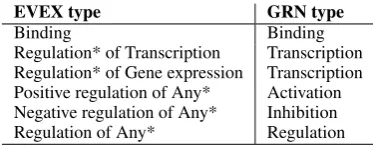
Table 1: Conversion of EVEX event types to the GRN types. The table is traversed from top to bottom, and the first rule that matches is applied. Regulation* refers to any type of regulatory event, and Any* refers to any other non-regulatory event type.
challenge, but rather derived the network data di-rectly from the EVEX interactions. For example, given these trigger annotations
T1 Protein 37 43 sigmaB T2 Gene 54 58 katX
T3 Transcription 59 69 expression
a GE Transcription event looks like
E1 Transcription:T3 Theme:T2 Cause:T1
while the GRN annotation is given by
R1 Transcription Target:E1 Agent:T1 E1 Action_Target:T3 Target:T2
However, both formalisms can easily be trans-lated into the required GRN network format:
sigB Interaction.Transcription katX
where ‘sigB’ is annotated as theGene identifier of ‘sigmaB’. These gene identifiers are provided in the gold-standard entity annotations. Note that in this context, “gene identifiers” are standardized gene symbols rather than numeric identifiers, and full gene normalization is thus not required.
3.2 From EVEX to GRN data
GRN event type Possible target types Possible agent types
Interaction.Binding Protein Gene
Interaction.Transcription Protein, PolymeraseComplex Gene, Operon Interaction.Regulation
Protein, PolymeraseComplex Gene, Operon, Protein, ProteinComplex Interaction.Activation
[image:3.595.112.490.63.125.2]Interaction.Inhibition
Table 2: Entity-type filtering of event predictions. Only those events for which the arguments (the target as well as the agent) have the correct entity types, are retained in the result set.
all EVEX articles in which at least one event was found (4,107,953 articles).
To match the canonicalized BANNER entities from EVEX to the standardized gene symbols required for the GRN challenge, we have con-structed a mapping based on the GRN data. First, we have scanned all gold-standard entities and removed non-alphanumerical characters from the gene symbols as tagged in text. Next, these canon-ical forms were linked to the corresponding stan-dardized gene symbols in the gold-standard anno-tations. From the EVEX data, we then only re-tained those relations that could be linked to two gene symbols occurring together in a sentence.
Finally, it was necessary to convert the origi-nal EVEX event types to the GRN relation types. This mapping is summarized in Table 1. Because EVEX Binding events are symmetrical and GRN Bindings are not, we add both possible directions to the result set. Note that some GRN types could not be mapped because they have no equivalent within the EVEX resource, such as the GRN type ‘Requirement’ or ‘Promoter’.
3.3 Filtering the data
After converting the EVEX pairwise relations to the GRN network format, it is necessary to fur-ther process the set of predictions to obtain a co-herent network. One additional filtering step con-cerns the entity types of the arguments of a specific event type. From the GRN data, we can retrieve a symbol-to-type mapping, recording whether a specific symbol referred to e.g. a gene, protein or operon in a certain article. After careful in-spection of the GRN guidelines and the training data, we enforced the filtering rules as listed in Table 2. For example, this procedure success-fully removes protein-protein interactions from the dataset, which are excluded according to the GRN guidelines. Even though these rules are oc-casionally more restrictive than the original GRN guidelines, their effectiveness to prune the data was confirmed on the training set.
Further, the GRN guidelines specify that a set of edges with the same Agent andTarget should be resolved into a single edge, giving preference to a more specialized type, such as Transcription in favour of Regulation. Further, contradictory types between a specific entity pair (e.g. Inhibition and Activation) may occur simultaneously in the GRN data. For the EVEX data however, it is more beneficial to try and pick one single correct event type from the set of predictions, effectively reduc-ing the false positive rate. To this end, the EVEX confidence values are used to determine the single most plausible candidate. Further analyses on the training data suggested that the best performance could be achieved when only retaining the ‘Mech-anism’ edges (Transcription and Binding) in cases when no regulatory edge was found. Finally, we noted that the EVEX Binding events more often correspond to the GRN Transcription type, and they were thus systematically refactored as such (after entity-type filtering). We believe this shift in semantics is caused by the fact that a promoter binding is usually extracted as a binding event by the TEES classifier, while it can semantically be seen as a Transcription event, especially in those cases where the Theme is a protein name, and the Cause a gene symbol (Table 2).
3.4 Results
Table 3 lists the results of our method on the GRN training data, which was primarily used for tun-ing the parameters described in Section 3.3. The highest recall (42%) could be obtained when using all EVEX data, without restrictions on entity types and without restricting toBacillus subtilisarticles. As a result, this set of predictions may contain re-lations between homologs in related species which have the same name. While the relaxed F-score (41%) is quite high, the Slot Error Rate (SER) score (1.56) is unsatisfying, as SER scores should be below 1 for decent predictions.
Dataset ETF SER F Rel. P Rel. R Rel. F Rel. SER
All EVEX data no 1.56 8.86 39.29% 41.98% 40.59% 1.23 All EVEX data yes 1.15 11.53 59.74% 35.11% 44.23% 0.89 B. subtilisPMIDs yes 0.954 20.81 71.43% 22.90% 34.68% 0.86
[image:4.595.132.471.63.114.2]GRN PMIDs yes 0.939 17.39 80.00% 18.32% 29.81% 0.86
Table 3: Performance measurement of a few different system settings, applied on the training data. The SER score is the main evaluation criterion of the GRN challenge. The relaxed precision, recall, F and SER scores are produced by scoring the predictions regardless of the specific event types. ETF refers to entity type filtering.
to 60%, the relaxed F-score obtains a maximum score of 44%, and the SER score improves to 1.15. The SER score can further be improved when restricting the data to Bacillus subtilis arti-cles (0.954). The optimal SER score is obtained by further limiting the prediction set to only those re-lations found in the articles from the GRN dataset (0.939), maximizing at the same time the relaxed precision rate (80%).
The final run which obtained the best SER score on the training data was subsequently applied on the GRN test data. It is important to note that the parameter selection of our system was not overfit-ted on the training data, as the SER score of our final submission on the test data is 0.92, i.e. higher than the best run on the training data.
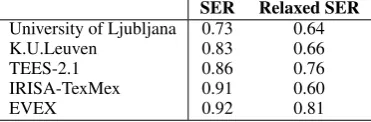
Table 4 summarizes the official results of all participants to the GRN challenge. Interestingly, the TEES classifier has been modified to retrain itself on the GRN data and to produce event annotations in the GRN formalism (Bj¨orne and Salakoski, 2013), obtaining a final SER score of 0.86. It is remarkable that this score is only 0.06 points better than our system which needed no re-training, and which was based upon the original GE annotation format and predicted gene/protein symbols rather than gold-standard ones. Addition-ally, the events in EVEX have been produced by a version of TEES which was maximized on F-score rather than SER score, and these measurements are not mutually interchangeable (Table 3). We conclude that even though our GRN system ob-tained last place out of 5 participants, we believe that its relative close performance to the TEES submission demonstrates that large-scale text min-ing resources can be used for gene regulatory net-work construction without the need for retraining the text mining component.
3.5 Error analysis
To determine the underlying reasons of our rela-tively low recall rate, we have analysed the 117
SER Relaxed SER
University of Ljubljana 0.73 0.64
K.U.Leuven 0.83 0.66
TEES-2.1 0.86 0.76
IRISA-TexMex 0.91 0.60
EVEX 0.92 0.81
Table 4: Official GRN performance rates.
false negative predictions of our final run on the training dataset. We found that 23% could be at-tributed to a missing or incompatible BANNER entity, 59% to a false negative TEES prediction, 15% to a wrong GRN event type and 3% to incor-rectly mapping the gene symbol to the standard-ized GRN format. Analysing the 16 false positives in the same dataset, 25% could be attributed to an incorrectly predicted event structure, and 62.5% to a wrongly predicted event type. One case was cor-rectly predicted but from a sentence outside the GRN data, and in one case a correctly predicted negation context was not taken into account. In conclusion, future work on the GRN conversion of TEES output should mainly focus on refining the event type prediction, while general performance could be enhanced by further improving the TEES classification system.
4 GE Task
Our GE submission builds on top of the TEES 2.1 system2as available just prior to the ST’13 test pe-riod. First applying the unmodified TEES system, we subsequently re-ranked its output and enforced a cut-off threshold with the objective of removing false positives from the TEES output (Section 4.1). In the official evaluation, this step results in a mi-nor 0.23pp increase of F-score compared to unpro-cessed TEES output (Table 5). This yields thefirst rankin the primary measure of the task with TEES ranking second.
The main motivation for the re-ranking
ap-2https://github.com/jbjorne/TEES/wiki/
[image:4.595.324.510.195.256.2]P R F
EVEX 58.03 45.44 50.97 TEES-2.1 56.32 46.17 50.74 BioSEM 62.83 42.47 50.68 NCBI 61.72 40.53 48.93 DlutNLP 57.00 40.81 47.56
Table 5: Official precision, recall and F-score rates of the top-5 GE participants, in percentages.
proach was the ability to incorporate external in-formation from EVEX to compare the TEES event predictions and identify the most reliable ones. Further, such a re-ranking approach leads to an in-dependent component which is in no way bound to TEES as the underlying event extraction system. The component can be combined with any system with sufficient recall to justify output re-ranking.
4.1 Event re-ranking
The output of TEES is re-ranked using SVMrank, a formulation of Support Vector Machines which is trained to optimize ranking, rather than classifi-cation (Joachims, 2006). It differs from the basic linear SVM classifier in the training phase, when a query structureis defined as a subset of instances which can be meaningfully compared among each other — in our case all events from a single sen-tence. During training, only instances within a single query are compared and the SVM does not aim to learn a global ranking across sentences and documents. We also experimented with polyno-mial and radial basis kernels, feature vector nor-malization and broadening the ranking query sets to whole sections or narrowing them to only events with shared triggers, but none of these settings were found to further enhance the performance.
The re-ranker assigns a numerical score to each event produced by TEES, and all events below a certain threshold score are removed. To set this threshold, a linear SVM regressor is applied with the SVMlight package (Joachims, 1999) to each sentence individually, i.e. we do not apply a data-wide, pre-set threshold. Unlike the re-ranker which receives features from a single event at a time, the regressor receives features describing the set of events in a single sentence.
Re-ranker features
Each event is described using a number of fea-tures, including the TEES prediction scores for triggers and arguments, the event structure, and the EVEX information about this as well as
simi-lar events. Events can be recursively nested, with the root event containing other events as its ar-guments. The root event is of particular impor-tance as the top-most event. A number of fea-tures are thus dedicated specifically to this root event, while other features capture properties of the nested events.
Features derived from TEES confidence scores:
• TEES trigger detector confidence of the root event and its difference from the confidence of the negative class, i.e. the margin by which the event was predicted by TEES.
• Minimum and maximum argument confi-dences of the root event.
• Minimum and maximum argument confi-dences, including recursively nested events (if any).
• Minimum and maximum trigger confidences, including recursively nested events (if any).
• Difference between the minimum and max-imum argument confidences compared to other events sharing the same trigger word.
Features describing the structure of the event:
• Event type of the root trigger.
• For each path in the event from the root to a leaf argument, the concatenation of event types along the path.
• For each path in the event from a leaf argu-ment to another leaf arguargu-ment, the concate-nation of event types along the path.
• The event structure encoded in the bracketed notation with leaf (T)heme and (C)ause argu-ments replaced by a placeholder string, e.g.
Regulation(C:_, T:Acetylation(T:_)).
Features describing other events in the same sen-tence:
• Event counts for each event type.
• Event counts for each unique event structure given by the bracketed structure notation.
All event counts extracted from EVEX are rep-resented as their base-10 logarithm to compress the range and suppress differences in counts of very common events.
The following features are generated in two ver-sions, one by grouping the events according to the EVEX canonical generalization and one for the Entrez Genegeneralization (Section 2)3.
3The generalizations based on gene families were
[image:5.595.111.253.62.124.2]• All occurrences of the given event in EVEX.
• For each path from root to a leaf gene/protein, all occurrences of that exact path in EVEX.
• For each pair of genes/proteins in the event, all occurrences of that pair in the network in-terpretation of EVEX.
• For each pair of genes/proteins in the event, all occurrences of that pair with a different event type in the network interpretation of EVEX.
For each event, path, or pair under considera-tion, features are created for the base-10 logarithm of the count in EVEX and of the number of unique articles in which it was identified, as well as for the minimum, maximum, and average confidence values, discretized into six unique categories.
Regressor features
While the re-ranker features capture a single event at a time, the threshold regressor features aggre-gate information about events extracted within one sentence. The features include:
• For each event type, the average and mini-mum re-ranker confidence score, as well as the count of events of that type.
• For each event type, the count of events shar-ing the same trigger.
• For each event type, the count of events shar-ing the same arguments.
• Minimum and maximum confidence values of triggers and arguments in the TEES out-put for the sentence.
• The section in the article in which the sen-tence appears, as given in the ST data.
4.2 Training phase
To train the re-ranker and the regressor, false itive events are needed in addition to the true pos-itive events in the training data. We thus apply TEES to the training data and train the re-ranker using the correct ranking of the extracted events. A true positive event is given the rank 1 and a false positive event gets the rank -1. A query structure is then defined, grouping all events from a sin-gle sentence to avoid mutual comparison of events across sentences and documents during the train-ing phase.
The trained re-ranker is then again applied to the training data. For every sentence, the optimal threshold is set to be the re-ranker score of the last event which should be retained so as to maximize
# P R F
Simple events 833 -0.08 -0.36 -0.23 Protein mod. 191 +0.09 -2.09 -1.12 Binding 333 +0.43 -1.20 -0.44 Regulation 1944 +2.38 -0.67 +0.36
All 3301 +1.71 -0.73 +0.23
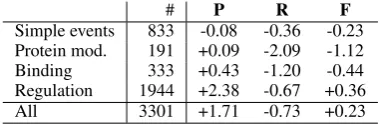
Table 6: Performance difference in percentage points against the TEES system in the official test set results, shown for different event types.
the F-score. In case the sentence only contains false positives, the highest score is used, increased by an empirically established value of 0.2. A sim-ilar strategy is applied for sentences only contain-ing true positives by uscontain-ing the lowest score, de-creased by 0.2.
In both steps, the SVM regularization parameter
Cis set by a grid search on the development set. Applying TEES and the re-ranker back to the training set results in a notably smaller propor-tion of false positives than would be expected on a novel input. To obtain a fully realistic train-ing dataset for the re-ranker and threshold regres-sor would involve re-training TEES in a cross-validation setting, but this was not feasible due to the tight schedule constraints of the shared task, and is thus left as future work.
4.3 Error analysis
Although the re-ranking approach resulted in a consistent gain over the state-of-the-art TEES sys-tem on both the development and the test sets, the overall improvement is only modest. As sum-marized in Table 6, the gain over the TEES sys-tem can be largely attributed to regulation events which exhibit a 2.38pp gain in precision for a 0.67pp loss in recall. Regulation events are at the same time by far the largest class of events, thus affecting the overall score the most.
In this section, we analyse the re-ranker and threshold regressor in isolation to understand their individual contributions to the overall result and to identify interesting directions for future research.
[image:6.595.321.513.62.124.2]All events P R F
B-C oracle (re-ranked) 81.32 39.61 53.27 W-C oracle (re-ranked) 54.92 39.61 46.02 W-C oracle (random) 51.06 39.19 44.34 Current system 47.15 39.61 43.05
TEES 45.46 40.39 42.77
Single-arg. events
B-C oracle (re-ranked) 81.37 50.58 62.38 W-C oracle (re-ranked) 56.09 50.58 53.19 W-C oracle (random) 52.73 50.00 51.33 Current system 48.66 50.44 49.53
TEES 47.16 51.09 49.04
Multiple-arg. events
B-C oracle (re-ranked) 81.02 16.83 27.87 W-C oracle (re-ranked) 48.61 16.83 25.00 W-C oracle (random) 42.66 16.75 24.05 Current system 39.64 17.12 23.91
[image:7.595.84.281.59.244.2]TEES 37.57 18.17 24.50
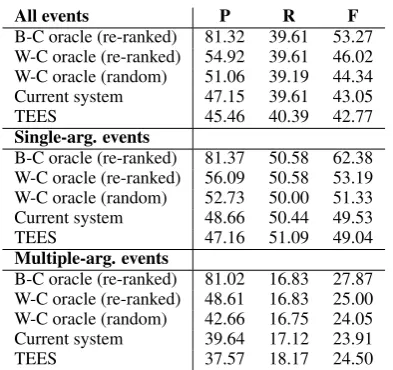
Table 7: Performance comparison of the best case (B-C) and worst case (W-C) oracles, the current system with the re-ranker and threshold regressor, and TEES. As an additional baseline, the worst case oracle is also calculated for randomly ranked output. All results are reported also separately for single and multiple-argument events.
decisions from the gold standard and the rank-ing itself is irrelevant. This effect is particu-larly pronounced in sentences where only a sin-gle, false positive event is predicted (15.9% of all sentences with at least one event). Therefore, in addition to thisbest caseoracle score, we also de-fine a worst case oracle score, where no events are removed from sentences containing only false-positives. This error analysis is carried out on the development set using our own implementation of the performance measure to obtain per-event cor-rectness judgments.
The results are shown in Table 7. Even for the worst case oracle, the re-ranked output has the po-tential to provide a 9.5pp increase in precision for a 0.8pp loss in recall over the baseline TEES sys-tem. How much of this potential gain is realized depends on the accuracy of the threshold regres-sor. In the current system, only a 1.7pp precision increase for a 0.8pp recall loss is attained, demon-strating that the threshold regressor leaves much room for improvement.
The best case oracle precision is 26.4pp higher than the worst case oracle, indicating that substan-tial performance losses can be attributed to sen-tences with purely false positive events. Indeed, sentences only containing one or two incorrect events account for 26% of all sentences with at least one predicted event. Due to their large impact
TEES 1-arg N-arg Full
Simple events 64.43 +0.07 ±0.00 +0.07 Protein mod. 40.47 +0.06 ±0.00 +0.06 Binding 82.03 ±0.00 ±0.00 ±0.00 Regulation 30.34 +0.70 -0.14 +0.53 All events 45.04 +0.66 ±0.00 +0.64
Table 8: Performance of the system on the de-velopment set when applied to single-argument events only (1-arg), to multiple-argument events only (N-arg), and to all events (Full).
on the overall system performance, these cases may justify a focused effort in future research.
To establish the relative merit of the re-ranker, we compare the worst-case oracle scores of the re-ranked output against random ranking, averaged over 10 randomization runs. While the difference between TEES output and the random ranking re-flects the effect of using an oracle to optimize per-sentence score, the difference between the ran-dom ranking and the re-ranker output shows an actual added value of the re-ranker, not attained from the use of oracle thresholds. Here it is of particular interest to note that this difference is more pronounced for events with multiple argu-ments (5.95pp of precision) as opposed to single-argument events (3.36pp of precision), possibly due to the fact that such events have a much richer feature representation and also employ the EVEX resource. To assess the contribution of EVEX data, a re-ranker was trained solely on features de-rived from EVEX. This re-ranker achieved an F-score of 1.26pp higher than randomized ranking, thus suggesting that these features have a positive influence on the overall score.
To verify these results and measure their im-pact on the official evaluation, Table 8 summa-rizes the performance on the development set us-ing the official evaluation service. To study the effect on single-argument events (column1-arg), the re-ranker score for multiple-argument events is artificially increased to always fall above the threshold. A similar strategy is used to study the effect on multiple-argument events (column N-arg). These results confirm that the overall performance gain of our system on top of TEES is obtained on single-argument events. Further, multiple-argument events have only a negligible effect on the overall score, demonstrating that, due to their low frequency, little can be gained or lost purely on multiple-argument events.
[image:7.595.307.511.62.124.2]Table 7 suggest that the re-ranker is more effec-tive on multiple-argument events where it receives more features including external information from EVEX. On the other hand, the results in Table 8 clearly demonstrate that the system is overall more effective on single-argument events. This would suggest a “mismatch” between the re-ranker and the threshold regressor, each being more effective on a different class of events. One possible expla-nation is the fact that the threshold regressor pre-dicts a single threshold for all events in a sentence, regardless of their type and number of arguments. If these cannot be distinguished by one threshold, it is clear that the threshold regressor will optimize for the largest event type, i.e. a single-theme regu-lation. Studying ways to allow the regressor to act separately on various event types will be important future work.
4.4 Discussion and future work
One of the main limitations of our approach is that it can only increase precision, but not recall, since it removes events from the TEES output, but is not able to introduce new events. As TEES utilizes separate processing stages for predicting event triggers and argument edges, recall can be adjusted by altering either of these steps. We have briefly experimented with modifying TEES to over-generate events by artificially lowering the prediction threshold for event triggers. However, this simple strategy of over-generating triggers leads to a number of clearly incorrect events and did not provide any performance gain. As future work, we thus hope to explore effective ways to over-generate events in a more controlled and ef-fective fashion. In particular, a more detailed eval-uation is needed to assess whether the rate of trig-ger over-generation should be adjusted separately for each event type. Another direction to explore is to over-generate argument edges. This will en-tail a deen-tailed analysis of partially correct events with a missing argument in TEES output. As in the case of triggers, it is likely that each event type will need to be optimized separately.
A notable amount of sentences include only false positive predictions, severely complicating the threshold regression. In an attempt to over-come this issue, we trained a sentence classifier for excluding sentences that should not contain any events. This classifier partially utilized the same features as the threshold regressor, as well
as bag of words and bag of POS tags. This method showed some promise when used together with trigger over-generation, but the gain was not enough to surpass the lost precision caused by the over-generation. If the event over-generation can be improved, the feasibility of this method should be re-evaluated.
5 Conclusions
We have presented our participation in the latest BioNLP Shared Task by mainly relying on the large-scale text mining resource EVEX. For the GRN task, we were able to produce a gene reg-ulatory network from the EVEX data without re-training specific text mining algorithms. Using predicted gene/protein symbols and the GE for-malism, rather than gold standard entities and the GRN annotation scheme, our final result on the test set only performed 0.06 SER points worse as compared to the corresponding TEES submis-sion. This encouraging result warrants the use of generic large-scale text mining data in network bi-ology settings. As future work, we will extend the EVEX dataset with information on the entity types to enable pruning of false-positive events and more fine-grained classification of event types, such as the distinction between promoter binding (Protein-Gene Binding) and protein-protein inter-actions (Protein-Protein Binding).
In the GE task, we explored a re-ranking ap-proach to improve the precision of the TEES event extraction system, also incorporating fea-tures from the EVEX resource. This approach led to a modest increase in the overall F-score of TEES and resulted in the first rank on the GE task. In the subsequent error analysis, we have demonstrated that the re-ranker provides an oppor-tunity for a substantial increase of performance, only partially realized by the regressor which sets a per-sentence threshold. The analysis has identi-fied numerous future research directions.
Acknowledgments
References
Jari Bj¨orne and Tapio Salakoski. 2013. TEES 2.1: Au-tomated annotation scheme learning in the BioNLP 2013 Shared Task. In Proceedings of BioNLP Shared Task 2013 Workshop. In press.
Jari Bj¨orne, Filip Ginter, and Tapio Salakoski. 2012a. Generalizing biomedical event extraction. BMC Bioinformatics, 13(suppl. 8):S4.
Jari Bj¨orne, Filip Ginter, and Tapio Salakoski. 2012b. University of Turku in the BioNLP’11 Shared Task.
BMC Bioinformatics, 13(Suppl 11):S4.
Thorsten Joachims. 1999. Making large-scale SVM learning practical. InAdvances in Kernel Methods -Support Vector Learning.
Thorsten Joachims. 2006. Training linear SVMs in linear time. InProceedings of the ACM Conference on Knowledge Discovery and Data Mining (KDD).
Suwisa Kaewphan, Sanna Kreula, Sofie Van Lan-deghem, Yves Van de Peer, Patrik Jones, and Filip Ginter. 2012. Integrating large-scale text mining and co-expression networks: Targeting NADP(H) metabolism in E. coli with event extraction. In Pro-ceedings of the Third Workshop on Building and Evaluating Resources for Biomedical Text Mining (BioTxtM 2012).
Jin-Dong Kim, Ngan Nguyen, Yue Wang, Jun’ichi Tsu-jii, Toshihisa Takagi, and Akinori Yonezawa. 2012. The Genia event and protein coreference tasks of the BioNLP Shared Task 2011. BMC Bioinformatics, 13(Suppl 11):S1.
Robert Leaman and Graciela Gonzalez. 2008. BAN-NER: an executable survey of advances in biomedi-cal named entity recognition.Pacific Symposium on Biocomputing. Pacific Symposium on Biocomputing, pages 652–663.
David McClosky, Sebastian Riedel, Mihai Surdeanu, Andrew McCallum, and Christopher Manning. 2012. Combining joint models for biomedical event extraction. BMC Bioinformatics, 13(Suppl 11):S9.
Makoto Miwa, Paul Thompson, and Sophia Ana-niadou. 2012. Boosting automatic event ex-traction from the literature using domain adapta-tion and coreference resoluadapta-tion. Bioinformatics, 28(13):1759–1765.
Sofie Van Landeghem, Filip Ginter, Yves Van de Peer, and Tapio Salakoski. 2011. EVEX: a PubMed-scale resource for homology-based generalization of text mining predictions. InProceedings of the BioNLP 2011 Workshop, pages 28–37.
Sofie Van Landeghem, Jari Bj¨orne, Chih-Hsuan Wei, Kai Hakala, Sampo Pyysalo, Sophia Ananiadou, Hung-Yu Kao, Zhiyong Lu, Tapio Salakoski, Yves Van de Peer, and Filip Ginter. 2013a. Large-scale event extraction from literature with multi-level gene normalization. PLoS ONE, 8(4):e55814.
Sofie Van Landeghem, Stefanie De Bodt, Zuzanna J. Drebert, Dirk Inz´e, and Yves Van de Peer. 2013b. The potential of text mining in data integration and network biology for plant research: A case study on Arabidopsis. The Plant Cell, 25(3):794–807.
Andreas Vlachos and Mark Craven. 2012. Biomedical event extraction from abstracts and full papers using search-based structured prediction. BMC Bioinfor-matics, 13(Suppl 11):S5.
Chih-Hsuan Wei and Hung-Yu Kao. 2011. Cross-species gene normalization by Cross-species inference.
BMC Bioinformatics, 12(Suppl 8):S5.