A model of generalization in distributional learning of phonetic categories
Bozena Pajak Brain & Cognitive Sciences
University of Rochester Rochester, NY 14627-0268
Klinton Bicknell Psychology UC San Diego La Jolla, CA 92093-0109
Roger Levy Linguistics UC San Diego La Jolla, CA 92093-0108
Abstract
Computational work in the past decade has produced several models accounting for phonetic category learning from distri-butional and lexical cues. However, there have been no computational proposals for how people might use another powerful learning mechanism: generalization from learned to analogous distinctions (e.g., from /b/–/p/ to /g/–/k/). Here, we present a new simple model of generalization in phonetic category learning, formalized in a hierarchical Bayesian framework. The model captures our proposal that linguis-tic knowledge includes the possibility that category types in a language (such as voiced and voiceless) can be shared across sound classes (such as labial and velar), thus naturally leading to generalization. We present two sets of simulations that reproduce key features of human perfor-mance in behavioral experiments, and we discuss the model’s implications and di-rections for future research.
1 Introduction
One of the central problems in language acqui-sition is how phonetic categories are learned, an unsupervised learning problem involving mapping phonetic tokens that vary along continuous di-mensions onto discrete categories. This task may be facilitated by languages’ extensive re-use of a set of phonetic dimensions (Clements 2003), be-cause learning one distinction (e.g., /b/–/p/ vary-ing along the voice onset time (VOT) dimension) might help learn analogous distinctions (e.g., /d/– /t/, /g/–k/). Existing experimental evidence sup-ports this view: both infants and adults general-ize newly learned phonetic category distinctions to untrained sounds along the same dimension (Mc-Claskey et al. 1983, Maye et al. 2008, Perfors
& Dunbar 2010, Pajak & Levy 2011a). However, while many models have been proposed to account for learning of phonetic categories (de Boer & Kuhl 2003, Vallabha et al. 2007, McMurray et al. 2009, Feldman et al. 2009, Toscano & McMur-ray 2010, Dillon et al. 2013), there have been no computational proposals for how generalization to analogous distinctions may be accomplished. Here, we present a new simple model of gener-alization in phonetic category learning, formal-ized in a hierarchical Bayesian framework. The model captures our proposal that linguistic knowl-edge includes the possibility that category types in a language (such as voiced and voiceless) can be shared across sound classes (defined as previ-ously learned category groupings, such as vowels, consonants, nasals, fricatives, etc.), thus naturally leading to generalization.
One difficulty for the view that learning one dis-tinction might help learn analogous disdis-tinctions is that there is variability in how the same distinc-tion type is implemented phonetically for differ-ent sound classes. For example, VOT values are consistently lower for labials (/b/–/p/) than for ve-lars (/g/–/k/) (Lisker & Abramson 1970), and the durations of singleton and geminate consonants are shorter for nasals (such as /n/–/nn/) than for voiceless fricatives (such as /s/–/ss/) (Giovanardi & Di Benedetto 1998, Mattei & Di Benedetto 2000). Improving on our basic model, we imple-ment a modification that deals with this difficulty by explicitly building in the possibility for analo-gous categories along the same dimension to have different absolute phonetic values along that di-mension (e.g., shorter overall durations for nasals than for fricatives).
In Section 2 we discuss the relevant background on phonetic category learning, including previ-ous modeling work. Section 3 describes our ba-sic computational model, and Section 4 presents simulations demonstrating that the model can
produce the qualitative patterns shown by adult learners in cases when there is no phonetic vari-ability between sound classes. In Section 5 we describe the extended model that accommodates phonetic variability across sound classes, and in Section 6 we show that the improved model qual-itatively matches adult learner performance both when the sound classes implement analogous dis-tinction types in identical ways, and when they dif-fer in the exact phonetic implementation. Section 7 concludes with discussion of future research.
2 Background
One important source of information for unsuper-vised learning of phonetic categories is the shape of the distribution of acoustic-phonetic cues. For example, under the assumption that each phonetic category has a unimodal distribution on a particu-lar cue, the number of modes in the distribution of phonetic cues can provide information about the number of categories: a unimodal distribution along some continuous acoustic dimension, such as VOT, may indicate a single category (e.g., /p/, as in Hawaiian); a bimodal distribution may sug-gest a two-category distinction (e.g., /b/ vs. /p/, as in English); and a trimodal distribution implies a
three-category distinction (e.g., /b/, /p/, and /ph/,
as in Thai). Infants extract this distributional infor-mation from the speech signal (Maye et al. 2002, 2008) and form category representations focused around the modal values of categories (Kuhl 1991, Kuhl et al. 1992, Lacerda 1995). Furthermore, in-formation about some categories bootstraps learn-ing of others: infants exposed to a novel bimodal distribution along the VOT dimension for one place of articulation (e.g., alveolar) not only learn that novel distinction, but also generalize it to an analogous contrast for another (e.g., velar) place of articulation (Maye et al. 2008). This ability is preserved beyond infancy, and is potentially used during second language learning, as adults are also able to both learn from distributional cues and use this information when making category judgments about untrained sounds along the same dimensions (Maye & Gerken 2000, 2001, Perfors & Dunbar 2010, Pajak & Levy 2011a,b).
The phonetic variability in how different sound classes implement the same distinction type might in principle hinder generalization across classes. However, there is evidence of generalization even in cases when sound classes differ in the exact
phonetic implementation of a shared distinction type. For example, learning a singleton/geminate length contrast for the class of voiceless fricatives (e.g., /s/–/ss/, /f/–/ff/) generalizes to the class of sonorants (e.g., /n/–/nn/, /j/–/jj/) even when the ab-solute durations of sounds in the two classes are different – overall longer for fricatives than for sonorants (Pajak & Levy 2011a) – indicating that learners are able to accomodate the variability of phonetic cues across different sound classes.
Phonetic categorization from distributional cues has been modeled using Gaussian mixture mod-els, where each category is represented as a Gaus-sian distribution with a mean and covariance ma-trix, and category learning involves estimating the parameters of each mixture component and – for some models – the number of components (de Boer & Kuhl 2003, Vallabha et al. 2007, Mc-Murray et al. 2009, Feldman et al. 2009, Toscano
& McMurray 2010, Dillon et al. 2013).1 These
models are successful at accounting for distribu-tional learning, but do not model generalization. We build on this previous work (specifically, the model in Feldman et al. 2009) and implement gen-eralization of phonetic distinctions across different sound classes.
3 Basic generalization model
The main question we are addressing here con-cerns the mechanisms underlying generalization. How do learners make use of information about some phonetic categories when learning other categories? Our proposal is that learners expect category types (such as singleton and geminate, or voiced and voiceless) to be shared among sound classes (such as sonorants and fricatives). We implement this proposal with a hierarchical Dirichlet process (Teh et al. 2006), which allows for sharing categories across data groups (here, sound classes). We build on previous computa-tional work in this area that models phonetic cate-gories as Gaussian distributions. Furthermore, we follow Feldman et al. (2009) in using Dirichlet processes (Ferguson 1973), which allow the model to learn the number of categories from the data, and implementing the process of learning from distributional cues via nonparametric Bayesian in-ference.
1In Dillon et al. (2013) each phoneme is modeled as a
H
G0
γ
Gc
α0
zic
dic
i∈ {1..nc}
[image:3.595.310.522.60.277.2]c∈C
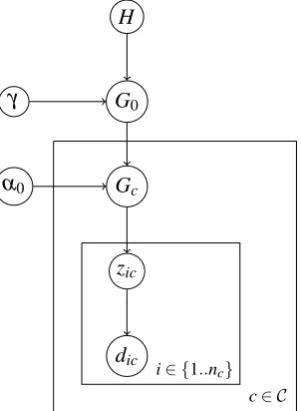
Figure 1: The graphical representation of the basic model.
H: µ ∼ N(µ0,σ
2
κ0)
σ2 ∼ InvChiSq(ν0,σ02)
G0 ∼ DP(γ,H)
Gc ∼ DP(α0,G0)
zic ∼ Gc
dic ∼ N(µzic,σ
2
zic)
fc ∼ N(0,σ2f)
dic ∼ N(µzic,σ
2
zic) +fc
Figure 2: Mathematical description of the model. The variables below the dotted line refer to the ex-tended model in Figure 6.
3.1 Model details
As a first approach, we consider a simplified sce-nario of a language with a set of sound classes, each of which contains an unknown number of phonetic categories, with perceptual token defined as a value along a single phonetic dimension. The model learns the set of phonetic categories in each sound class, and the number of categories inferred for one class can inform the inferences about the other class. Here, we make the simpli-fying assumption that learners acquire a context-independent distribution over sounds, although the model could be extended to use linguistic con-text (such as coarticulatory or lexical information; Feldman et al. 2009).
Figure 1 provides the graphical representation of the model, and Figure 2 gives its mathematical
Variable Explanation
H base distribution over means and
variances of categories
G0 distribution over possible
categories
Gc
distribution over categories in
classc
γ,α0 concentration parameters
zic category for datapointdic
dic datapoint (perceptual token)
nc number of datapoints in classc
C set of classes
fc offset parameter
[image:3.595.108.259.63.269.2]σf standard deviation of prior on fc
Table 1: Key for the variables in Figures 1, 2, and 6. The variables below the dotted line refer to the extended model in Figure 6.
description. Table 1 provides the key to the model variables. In the model, speech sounds are
pro-duced by selecting a phonetic categoryzic, which
is defined as a mean µzic and variance σ
2
zic along
a single phonetic dimension,2 and then sampling
a phonetic value from a Gaussian with that mean and variance. We assume a weak prior over cat-egories that does not reflect learners’ prior lan-guage knowledge (but we return to the possible role of prior language knowledge in the discus-sion). Learners’ beliefs about the sound inventory (distribution over categories and mean and vari-ance of each category) are encoded through a hier-archical Dirichlet process. Each category is
sam-pled from the distributionGc, which is the
distri-bution over categories in a single sound class. In order to allow sharing of categories across classes,
theGcdistribution for each class is sampled from a
Dirichlet process with base distributionG0, which
is shared across classes, and concentration
param-eterα0(which determines the sparsity of the
dis-tribution over categories).G0, then, stores the full
set of categories realized in any class, and it is sampled from a Dirichlet process with
concentra-tion parameter γ and base distribution H, which
is a normal inverse chi-squared prior on category
2Although we are modeling phonetic categories as having
[image:3.595.107.257.337.452.2]means and variances.3The parameters of the
nor-mal inverse chi-squared distribution are:ν0andκ0,
which can be thought of as pseudo-observations,
as well as µ0 and σ02, which determine the prior
distribution over means and variances, as in Fig-ure 2.
3.2 Inference
The model takes as input the parameters of the
base distributionH, the concentration parameters
α0 and γ, and the data, which is composed of a
list of phonetic values. The model infers a poste-rior distribution over category labels for each data-point via Gibbs sampling. Each iteration of Gibbs sampling resamples the assignments of each
data-point to a lower-level category (inGc) and also
re-samples the assignments of lower-level categories
to higher-level categories (inG0). We marginalize
over the category means and variances.
4 Simulations: basic model
The first set of simulations has three goals: first, to establish that our model can successfully per-form distributional learning and second, to show that it can use information about one type of class to influence judgements about another, in the case that there is no variability in category structure between classes. Finally, these simulations reveal a limitation of this basic model, showing that it cannot generalize in the presence of substantial between-class variability in category realizations. We address this limitation in Section 5.
4.1 The data
The data we use to evaluate the model come from the behavioral experiments in Pajak & Levy (2011a). Adult native English speakers were ex-posed to novel words, where the middle conso-nant varied along the length dimension from short (e.g., [ama]) to long (e.g., [amma]). The distri-butional information suggested either one cate-gory along the length dimension (unimodal distri-bution) or two categories (bimodal distridistri-bution), as illustrated in Figure 3. In Experiment 1, the training included sounds in the sonorant class (4 continua: [n]-...-[nn], [m]-...-[mm], [j]-...-[jj], [l]-...-[ll]) with the duration range of 100–205msec. In Experiment 2 the training included sounds in
3In the case of categories defined along multiple
di-mensions, the base distribution would be a normal inverse-Wishart.
● ●
● ●
0 4 8 12 16
0 4 8 12 16
Expt1:sonor
ants
Expt2:fr
icativ
es
100 120 140 160 180 200 220 240 260 280
Stimuli length continuum (in msec)
F
amiliar
ization frequency
[image:4.595.308.526.65.220.2]bimodal unimodal
Figure 3: Experiment 1 & 2 training (Pajak and Levy 2011a). The y axis reflects the frequency of tokens from each training continuum. The four points indicate the values of the untrained data-points.
the voiceless fricative class (4 continua:
[s]-...-[ss], [f]-...-[ff], [T]-...-[TT], [S]-...-[SS]) with the
du-ration range of 140–280msec. The difference in duration ranges between the two classes reflected the natural duration distributions of sounds in these classes: generally shorter for sonorants and longer for fricatives (Greenberg 1996, Giovanardi & Di Benedetto 1998, Mattei & Di Benedetto 2000).
Subsequently, participants’ expectations about the number of categories in the trained class and another untrained class were probed by asking for judgments about tokens at the endpoints of the continua: participants were presented with pairs of words (e.g., sonorant [ama]–[amma] or frica-tive [asa]–[assa]) and asked whether these were two different words in this language or two rep-etitions of the same word. As illustrated in Ta-ble 2, in the test phase of Experiment 1 the du-rations of both the trained and the untrained class were identical (100msec for any short consonant and 205msec for any long consonant), whereas in the test phase of Experiment 2 the durations were class-specific: longer for trained fricatives (140msec for a short fricative and 280msec for a long fricative) and shorter for untrained sonorants (100msec for a short sonorant and 205msec for a long sonorant).
Expt1−trained Expt1−untrained
Propor
tion of '
diff
erent' responses
0.0
0.2
0.4
0.6
0.8
1.0
Bimodal Unimodal
Expt2−trained Expt2−untrained
Propor
tion of '
diff
erent' responses
0.0
0.2
0.4
0.6
0.8
1.0
[image:5.595.91.487.61.169.2]Bimodal Unimodal
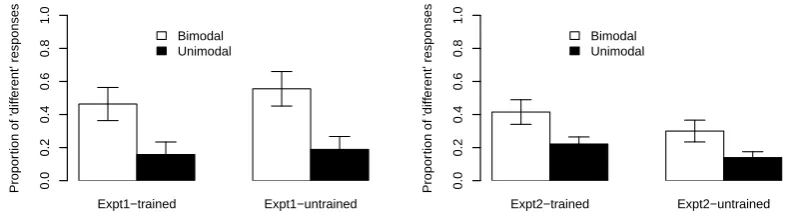
Figure 4: Experiment 1 & 2 results: proportion of ‘different’ responses on ‘different’ trials (Pajak and Levy, 2011a).
Expt. 1 Expt. 2
trained (sonorants) (fricatives)
100ms – 205ms 140ms – 280ms
untrained (fricatives) (sonorants)
100ms – 205ms 100ms – 205ms
Table 2: Experiment 1 & 2 test (Pajak and Levy, 2011a).
likely to posit two categories (i.e., respond ‘dif-ferent’ on ‘dif‘dif-ferent’ trials) when the distribution was bimodal than when the distribution was uni-modal. In addition, as demonstrated by the ‘un-trained’ condition, learners used the information about the trained class to make inferences about the untrained class: they were more likely to ac-cept length-based category distinctions for frica-tives after learning the distinction for sonorants (Expt. 1), and vice versa (Expt. 2). This general-ization occurred both (a) when each class imple-mented the distinction in exactly the same way (with the same absolute durations; Expt. 1), and (b) when the classes differed in how the shared dis-tinction type was implemented (the absolute dura-tions of the untrained class were shifted relative to the trained class; Expt. 2).
The model simulations described below at-tempt to replicate the key features of human per-formance: distributional learning and generaliza-tion. We model both experiments of Pajak & Levy (2011a): (a) ‘same durations’ across classes (Expt. 1), and (b) ‘different durations’ across classes (Expt. 2). Thus, the datasets we used were closely modeled after their experimental de-sign: (1) Expt. 1 bimodal, (2) Expt. 1 unimodal, (3) Expt. 2 bimodal, and (4) Expt. 2 unimodal. In each dataset, the data consisted of a list of pho-netic values (duration in msec), where each
data-point was tagged as belonging to either the sono-rant or the fricative class. The frequencies of the ‘trained’ class were as listed in Figure 3 (simu-lating a single training continuum). In addition to the ‘trained’ class, each dataset included two dat-apoints from the ‘untrained’ class with the values as listed in Table 2 in the ‘untrained’ condition. These two datapoints were included in order to evaluate the model’s categorization of sounds for which no distributional evidence is available, thus assessing the extent of generalization. We sim-ulated weak perceptual noise by adding to each datapoint normally-distributed error with standard deviation of 0.3 times the distance between adja-cent continuum steps.
4.2 Methodology
We ran the basic model on each of the four datasets. For each, we performed 1,000,000 iter-ations of Gibbs sampling, and analyzed the re-sults for the second half. To assess convergence, we ran four Markov chains for each dataset, us-ing two overdispersed initializations: (1) assignus-ing one category label to all datapoints, and (2) as-signing a different label to each datapoint. We
used a weak prior base distributionH(κ0=.001;
ν0=.001;σ02=1;µ0was set to the overall mean
of the data), and set the concentration parameters γ=α0=1.
4.3 Results and discussion
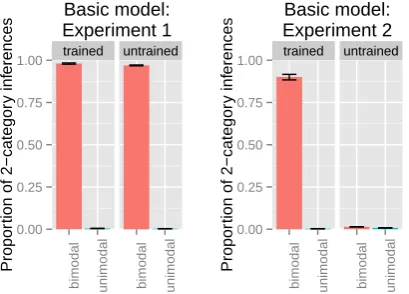
The simulation results are illustrated in Figure 5,4
plotting the proportion of samples on which the model assigned the datapoints to two different
cat-egories, as opposed to a single category.5Note that
4All variables we report in all simulations appear to have
converged to the posterior, as assessed by ˆRvalues of 1.1 or less, calculated across the 4 chains (Gelman & Rubin 1992).
5No models we report assign the trained category
trained untrained
0.00 0.25 0.50 0.75 1.00
bimodal unimodal bimodal unimodal
Propor
tion of 2−categor
y inf
erences
Basic model: Experiment 1
trained untrained
0.00 0.25 0.50 0.75 1.00
bimodal unimodal bimodal unimodal
Propor
tion of 2−categor
y inf
erences
[image:6.595.79.284.63.210.2]Basic model: Experiment 2
Figure 5: Simulation results for the basic model. Error bars give 95% binomial confidence intervals, computed using the estimated number of effec-tively independent samples in the Markov chains.
in the ‘trained’ condition, this means categoriza-tion of all datapoints along the continuum. In the ‘untrained’ condition, on the other hand, it is cat-egorization of two datapoints: one from each end-point of the continuum.
The results in the ‘trained’ conditions demon-strate that the model was able to learn from the distributional cues, thus replicating the success of previous phonetic category learning models.
Of most interest here are the results in the ‘un-trained’ condition. The figure on the left shows the results modeling the ‘same-durations’ exper-iment (Expt. 1), demonstrating that the model cat-egorizes the two datapoints in the untrained sound class in exactly the same way as it did for the trained sound class: two categories in the bimodal condition, and one category in the unimodal con-dition. Thus, these results suggest that we can suc-cessfully model generalization of distinction types across sound classes in phonetic category learning by assuming that learners have an expectation that category types (such as short and long, or voice-less and voiced) may be shared across classes.
The figure on the right shows the results model-ing the ‘different-durations’ experiment (Expt. 2), revealing a limitation of the model: failure to gen-eralize when the untrained class has the same cat-egory structure but different absolute phonetic val-ues (overall shorter in the untrained class than in the trained class). Instead, the model categorizes both untrained datapoints as belonging to a single category. This result diverges from the experimen-tal results, where learners generalize the learned distinction type in both cases, whether the
abso-lute phonetic values of the analogous categories are identical or not. We address this problem in the next section by implementing a modification to the model that allows more flexibility in how each class implements the same category types.
5 Extended generalization model
The goal of the extended model is to explicitly al-low for phonetic variability across sound classes. As a general approach, we could imagine func-tions that transform categories across classes so that the same categories can be “reused” by be-ing translated around to different parts of the pho-netic space. These functions would be specific op-erations representing any intrinsic differences be-tween sound classes. Here, we use a very simple function that can account for one widely attested type of transformation: different absolute phonetic values for analogous categories in distinct sound classes (Ladefoged & Maddieson 1996), such as longer overall durations for voiceless fricatives than for sonorants. This type of transformation has been successfully used in prior modeling work to account for learning allophones of a single phoneme that systematically vary in phonetic val-ues along certain dimensions (Dillon et al. 2013).
5.1 Model details
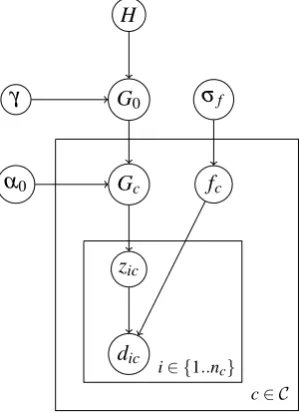
We implement the possibility for between-class variability by allowing for one specific type of idiosyncratic implementation of categories across classes: learnable class-specific ‘offsets’ by which the data in a class are shifted along the phonetic dimension, as illustrated in Figure 6 (the key for the variables is in Table 1).
5.2 Inference
Each iteration of MCMC now includes a Metropolis-Hastings step to resample the offset
parameters fc, which uses a zero-mean Gaussian
proposal, with standard deviationσp=range of data5 .
6 Simulations: extended model
H
G0
γ
Gc
α0
zic
dic
fc
σf
i∈ {1..nc}
[image:7.595.107.257.64.271.2]c∈C
Figure 6: The graphical representation of the ex-tended model.
6.1 Methodology
We used the same prior as in the first set of sim-ulations, and used a Gaussian prior on the offset
parameter with standard deviationσf =1000.
Be-cause only the relative values of offset parameters are important for category sharing across classes, we set the offset parameter for one of the classes to zero. The four Markov chains now crossed cate-gory initialization with two different initial values of the offset parameter.
6.2 Results and discussion
The simulation results are illustrated in Fig-ure 7. The figFig-ure on the left demonstrates that the extended model performs similarly to the ba-sic model in the case of no variability between classes. The figure on the right, on the other hand, shows that – unlike the basic model – the extended model succeeds in generalizing the learned distinction type to an untrained sound class when there is phonetic variability between classes. These results suggest that allowing for variability in category implementations across sound classes may be necessary to account for human learning. Taken together, these results are consistent with our proposal that language learn-ers have an expectation that category types can be shared across sound classes. Furthermore, learn-ers appear to have implicit knowledge of the ways that sound classes can vary in their exact phonetic implementations of different category types. This
trained untrained
0.00 0.25 0.50 0.75 1.00
bimodal unimodal bimodal unimodal
Propor
tion of 2−categor
y inf
erences
Extended model: Experiment 1
trained untrained
0.00 0.25 0.50 0.75 1.00
bimodal unimodal bimodal unimodal
Propor
tion of 2−categor
y inf
erences
[image:7.595.313.519.64.209.2]Extended model: Experiment 2
Figure 7: Simulation results for the extended model. Error bars give 95% binomial confidence intervals, computed using the estimated number of effectively independent samples in the Markov chains.
type of knowledge may include – as in our ex-tended generalization model – the possibility that phonetic values of categories in one class can be systematically shifted relative to another.
7 General discussion
In this paper we presented the first model of gen-eralization in phonetic category learning, in which learning a distinction type for one set of sounds (e.g., /m/–/mm/) immediately generalizes to an-other set of sounds (e.g., /s/–/ss/), thus reproduc-ing the key features of adult learner performance in behavioral experiments. This extends previous computational work in phonetic category learn-ing, which focused on modeling the process of learning from distributional cues, and did not ad-dress the question of generalization. The basic premise of the proposed model is that learners’ knowledge of phonetic categories is represented hierarchically: individual sounds are grouped into categories, and individual categories are grouped into sound classes. Crucially, the category struc-ture established for one sound class can be di-rectly shared with another class, although differ-ent classes can implemdiffer-ent the categories in id-iosyncratic ways, thus mimicking natural variabil-ity in how analogous categories (e.g., short /m/ and /s/, or long /mm/ and /ss/) are phonetically imple-mented for different sound classes.
very similar to that for the trained class. Note, however, that there are clear quantitative dif-ferences between the two in learning perfor-mance: the model learns almost perfectly from the available distributional cues (‘trained’ condi-tion), while adult learners are overall very conser-vative in accepting two categories along the length dimension, as indicated by the overall low num-ber of ‘different’ responses. There are two main reasons why the model might be showing more extreme categorization preferences than humans in this particular task. First, humans have cogni-tive limitations that the current model does not, such as those related to memory or attention. In particular, imperfect memory makes it harder for humans to integrate the distributional information from all the trials in the exposure, and longer train-ing would presumably improve performance. Sec-ond, adults have strong native-language biases that affect learning of a second language (Flege 1995). The population tested by Pajak & Levy (2011a) consisted of adult native speakers of American En-glish, a language in which length is not used con-trastively. Thus, the low number of ‘different’ re-sponses in the experiments can be attributed to participants’ prior bias against category distinc-tions based on length. The model, on the other hand, has only a weak prior that was meant to be easily overridden by data.
This last point is of direct relevance for the area of second language (L2) acquisition, where one of the main research foci is to investigate the effects of native-language knowledge on L2 learning. The model we proposed here can poten-tially be used to systematically investigate the role of native-language biases when learning category distinctions in a new language. In particular, an L2 learner, whose linguistic representations include two languages, could be implemented by adding a language-level node to the model’s hierarchical structure (through an additional Dirichlet process). This extension will allow for category structures to be shared not just within a language for different sound classes, but also across languages, thus ef-fectively acting as a native-language bias.
As a final note, we briefly discuss alternative ways of modeling generalization in phonetic cat-egory learning. In the model we described in this paper, whole categories are generalized from one class to another. However, one might imagine an-other approach to this problem where
generaliza-tion is a byproduct of learners’ attending more to the dimension that they find to be relevant for distinguishing between some categories in a lan-guage. That is, learners’ knowledge would not in-clude the expectation that whole categories may be shared across classes, as we argued here, but rather that a given phonetic dimension is likely to be reused to distinguish between categories in multiple sound classes.
This intuition could be implemented in differ-ent ways. In a Dirichlet process model of category
learning, the concentration parameterα might be
learned, and shared for all classes along a given phonetic dimension, thus producing a bias to-ward having a similar number of categories across classes. Alternatively, the variance of categories along a given dimension might be learned, and also shared for all classes. Under this scenario, learning category variance along a given dimen-sion would help categorize novel sounds along that dimension. That is, two novel datapoints would be likely categorized into separate categories if the in-ferred variance along the relevant dimension was smaller than the distance between the datapoints, but into a single category if the inferred variance was comparable to that distance.
Finally, this model assumes that sound classes are given in advance, and that only the categories within each class are learned. While this assump-tion may seem warranted for some types of per-ceptually dissimilar sound classes (e.g., conso-nants and vowels), and also may be appropriate for L2 acquisition, it is not clear that it is true for all sound classes that allow for generalization in infancy. It remains for future work to determine how learners may generalize while simultaneously learning the sound classes.
We plan to pursue all these directions in fu-ture work with the ultimate goal of improving our understanding how human learners represent their linguistic knowledge and how they use it when ac-quiring a new language.
Acknowledgments
References
de Boer, Bart & Patricia K. Kuhl. 2003. Inves-tigating the role of infant-directed speech with
a computer model. Acoustic Research Letters
Online4(4). 129–134.
Clements, George N. 2003. Feature economy in
sound systems. Phonology20. 287–333.
Dillon, Brian, Ewan Dunbar & William Idsardi.
2013. A single-stage approach to learning
phonological categories: Insights from
Inukti-tut. Cognitive Science37. 344–377.
Feldman, Naomi H., Thomas L. Griffiths & James L. Morgan. 2009. Learning phonetic
cat-egories by learning a lexicon. In Proceedings
of the 31st Annual Conference of the Cognitive
Science Society, 2208–2213. Austin, TX:
Cog-nitive Science Society.
Ferguson, Thomas S. 1973. A Bayesian
analy-sis of some nonparametric problems. Annals of
Statistics1. 209–230.
Flege, James E. 1995. Second-language speech
learning: theory, findings and problems. In
Winifred Strange (ed.), Speech perception and
linguistic experience: issues in cross-language
research, 229–273. Timonium, MD: York Press.
Gelman, Andrew & Donald B. Rubin. 1992. In-ference from iterative simulation using multiple
sequences. Statistical Science7. 457–511.
Giovanardi, Maurizio & Maria-Gabriella
Di Benedetto. 1998. Acoustic analysis of
singleton and geminate fricatives in Italian. The European Journal of Language and Speech
(EACL/ESCA/ELSNET)1998. 1–13.
Greenberg, Steven. 1996. The Switchboard
tran-scription project. Report prepared for the
1996 CLSP/JHU Workshop on Innovative Tech-niques in Continuous Large Vocabulary Speech Recognition.
Kuhl, Patricia K. 1991. Human adults and human infants show a “perceptual magnet effect” for the prototypes of speech categories, monkeys
do not. Perception and Psychophysics 50(2).
93–107.
Kuhl, Patricia K., Karen A. Williams, Francisco Lacerda, Kenneth N. Stevens & Bj¨orn Lind-blom. 1992. Linguistic experience alters pho-netic perception in infants by 6 months of age.
Science255. 606–608.
Lacerda, Francisco. 1995. The perceptual magnet-effect: An emergent consequence of
exemplar-based phonetic memory. In K. Ellenius &
P. Branderud (eds.), Proceedings of the 13th
International Congress of Phonetic Sciences,
140–147. Stockholm: KTH and Stockholm Uni-versity.
Ladefoged, Peter & Ian Maddieson. 1996. The
sounds of the world’s languages. Oxford, UK;
Cambridge, MA: Blackwell.
Lisker, Leigh & Arthur S. Abramson. 1970. The voicing dimensions: Some experiments in
com-parative phonetics. InProceedings of the Sixth
International Congress of Phonetic Sciences,
Prague: Academia.
Mattei, Marco & Maria-Gabriella Di Benedetto. 2000. Acoustic analysis of singleton and
gemi-nate nasals in Italian. The European Journal of
Language and Speech (EACL/ESCA/ELSNET) 2000. 1–11.
Maye, Jessica & LouAnn Gerken. 2000. Learning phonemes without minimal pairs. In S. Cather-ine Howell, Sarah A. Fish & Thea Keith-Lucas
(eds.), Proceedings of the 24th Annual Boston
University Conference on Language
Develop-ment, 522–533. Somerville, MA: Cascadilla
Press.
Maye, Jessica & LouAnn Gerken. 2001. Learn-ing phonemes: how far can the input take us? In A. H-J. Do, L. Dom´ınguez & A. Johansen
(eds.), Proceedings of the 25th Annual Boston
University Conference on Language
Develop-ment, 480–490. Somerville, MA: Cascadilla
Press.
Maye, Jessica, Daniel J. Weiss & Richard N.
Aslin. 2008. Statistical phonetic learning in
infants: facilitation and feature generalization.
Developmental Science11(1). 122–134.
Maye, Jessica, Janet F. Werker & LouAnn Gerken. 2002. Infant sensitivity to distributional
infor-mation can affect phonetic discrimination.
Cog-nition82. B101–B111.
McClaskey, Cynthia L., David B. Pisoni & Thomas D. Carrell. 1983. Transfer of training
of a new linguistic contrast in voicing.
Percep-tion and Psychophysics34(4). 323–330.
McMurray, Bob, Richard N. Aslin & Joseph C. Toscano. 2009. Statistical learning of phonetic categories: insights from a computational
ap-proach. Developmental Science 12(3). 369–
378.
In Proceedings of the 47th Annual Meeting of
the Chicago Linguistic Society, Chicago, IL:
University of Chicago.
Pajak, Bozena & Roger Levy. 2011b.
Phono-logical generalization from distributional evi-dence. In L. Carlson, C. H¨olscher & T.
Ship-ley (eds.),Proceedings of the 33rd Annual
Con-ference of the Cognitive Science Society, 2673–
2678. Austin, TX: Cognitive Science Society. Perfors, Amy & David Dunbar. 2010. Phonetic
training makes word learning easier. In S.
Ohls-son & R. Catrambone (eds.),Proceedings of the
32nd Annual Conference of the Cognitive
Sci-ence Society, 1613–1618. Austin, TX:
Cogni-tive Science Society.
Teh, Yee Whye, Michael I. Jordan, Matthew J.
Beal & David M. Blei. 2006. Hierarchical
Dirichlet processes. Journal of the American
Statistical Association101(476). 1566–1581.
Toscano, Joseph C. & Bob McMurray. 2010. Cue integration with categories: Weighting acoustic cues in speech using unsupervised learning and
distributional statistics. Cognitive Science 34.
434–464.
Vallabha, Gautam K., James L. McClelland, Fer-ran Pons, Janet F. Werker & Shigeaki Amano.
2007. Unsupervised learning of vowel
cate-gories from infant-directed speech.Proceedings
of the National Academy of Sciences 104(33).