Hidden Markov Tree Model for Word Alignment
Shuhei Kondo Kevin Duh Yuji Matsumoto Graduate School of Information Science Nara Institute of Science and Technology 8916-5, Takayama, Ikoma, Nara, 630-0192, Japan
{shuhei-k,kevinduh,matsu}@is.naist.jp
Abstract
We propose a novel unsupervised word alignment model based on the Hidden Markov Tree (HMT) model. Our model assumes that the alignment variables have a tree structure which is isomorphic to the target dependency tree and models the dis-tortion probability based on the source de-pendency tree, thereby incorporating the syntactic structure from both sides of the parallel sentences. In English-Japanese word alignment experiments, our model outperformed an IBM Model 4 baseline by over 3 points alignment error rate. While our model was sensitive to poste-rior thresholds, it also showed a perfor-mance comparable to that of HMM align-ment models.
1 Introduction
Automatic word alignment is the first step in the pipeline of statistical machine translation. Trans-lation models are usually extracted from word-aligned bilingual corpora, and lexical translation probabilities based on word alignment models are also used for translation.
The most widely used models are the IBM Model 4 (Brown et al., 1993) and Hidden Markov Models (HMM) (Vogel et al., 1996). These mod-els assume that alignments are largely monotonic, possibly with a few jumps. While such assump-tion might be adequate for alignment between sim-ilar languages, it does not necessarily hold be-tween a pair of distant languages like English and Japanese.
Recently, several models have focused on in-corporating syntactic structures into word align-ment. As an extension to the HMM alignment, Lopez and Resnik (2005) present a distortion model conditioned on the source-side dependency
tree, and DeNero and Klein (2007) propose a distortion model based on the path through the source-side phrase-structure tree. Some super-vised models receive syntax trees as their input and use them to generate features and to guide the search (Riesa and Marcu, 2010; Riesa et al., 2011), and other models learn a joint model for pars-ing and word alignment from word-aligned par-allel trees (Burkett et al., 2010). In the context of phrase-to-phrase alignment, Nakazawa and Kuro-hashi (2011) propose a Bayesian subtree align-ment model trained with parallel sampling. None of these models, however, can incorporate syntac-tic structures from both sides of the language pair and can be trained computationally efficiently in an unsupervised manner at the same time.
The Hidden Markov Tree (HMT) model (Crouse et al., 1998) is one such model that sat-isfies the above-mentioned properties. The HMT model assumes a tree structure of the hidden vari-ables, which fits well with the notion of word-to-word dependency, and it can be trained from un-labeled data via the EM algorithm with the same order of time complexity as HMMs.
In this paper, we propose a novel word align-ment model based on the HMT model and show that it naturally enables unsupervised training based on both source and target dependency trees in a tractable manner. We also compare our HMT word alignment model with the IBM Model 4 and the HMM alignment models in terms of the stan-dard alignment error rates on a publicly available English-Japanese dataset.
2 IBM Model 1 and HMM Alignment
We briefly review the IBM Model 1 (Brown et al., 1993) and the Hidden Markov Model (HMM) word alignment (Vogel et al., 1996) in this section. Both are probabilistic generative models that
tor as
p(f|e) = X a
p(a,f|e)
p(a,f|e) =
J
Y
j=1
pd(aj|aj)pt(fj|eaj)
wheree={e1, ..., eI}is an English (source)
sen-tence and f = {f1, ..., fJ} is a foreign (target) sentence. a = {a1, ..., aJ} is an alignment vec-tor such thataj =iindicates thej-th target word aligns to thei-th source word andaj = 0 means thej-th target word is null-aligned.j is the index of the last non null-aligned target word before the indexj.
In both models,pt(fj|eaj)is the lexical transla-tion probability and can be defined as conditransla-tional probability distributions. As for the distortion probabilitypd(aj|aj), pd(aj = 0|aj = i0) = p0
where p0 is NULL probability in both models.
pd(aj = i|aj = i0) is uniform in the Model 1 and proportional to the relative countc(i−i0) in
the HMM for i 6= 0. DeNero and Klein (2007)
proposed a syntax-sensitive distortion model for the HMM alignment, in which the distortion prob-ability depends on the path from thei-th word to
thei0-th word on the source-side phrase-structure
tree, instead of the linear distance between the two words.
These models can be trained efficiently using the EM algorithm. In practice, models in two di-rections (source to target and target to source) are trained and then symmetrized by taking their in-tersection, union or using other heuristics. Liang et al. (2006) proposed a joint objective of align-ment models in both directions and the probability of agreement between them, and an EM-like algo-rithm for training.
They also proposed posterior thresholding for decoding and symmetrization, which take
a={(i, j) :p(aj =i|f,e)> τ}
with a thresholdτ. DeNero and Klein (2007)
sum-marized some criteria for posterior thresholding, which are
• Soft-Union
q
pf(aj =i|f,e)·pr(ai=j|f,e)
• Soft-Intersection
pf(aj =i|f,e) +pr(ai =j|f,e)
2
• Hard-Union
max(pf(aj =i|f,e), pr(ai =j|f,e))
• Hard-Intersection
min(pf(aj =i|f,e), pr(ai=j|f,e))
wherepf(aj = i|f,e) is the alignment probabil-ity under the source-to-target model andpr(ai =
j|f,e)is the one under the target-to-source model.
They also propose a posterior decoding heuris-tic calledcompetitive thresholding. Given aj×i
matrix of combined weightscand a thresholdτ, it
choose a link(j, i)only if its weightcji≥τ and it is connected to the link with the maximum weight both in rowjand columni.
3 Hidden Markov Tree Model
The Hidden Markov Tree (HMT) model was first introduced by Crouse et al. (1998). Though it has been applied successfully to various applications such as image segmentation (Choi and Baraniuk, 2001), denoising (Portilla et al., 2003) and biol-ogy (Durand et al., 2005), it is largely unnoticed in the field of natural language processing. To the best of our knowledge, the only exception is ˇZabokrtsk`y and Popel (2009) who used a variant of the Viterbi algorithm for HMTs in the transfer phase of a deep-syntax based machine translation system.
An HMT model consists of an observed random treeX = {x1, ..., xN}and a hidden random tree S = {s1, ..., sN}, which is isomorphic to the ob-served tree.
The parameters of the model are
• P(s1 =j), the initial hidden state prior
• P(st=j|sρ(t)=i), transition probabilities
• P(xt=h|st=j), emission probabilities, where ρ() is a function that maps the index of a
hidden node to the index of its parent node. These parameters can be trained via the EM algorithm.
The “upward-downward” algorithm proposed in Crouse et al. (1998), an HMT analogue of the forward-backward algorithm for HMMs, can be used in the E-step. However, it is based on the de-composition of joint probabilities and suffers from numerical underflow problems.
based on the decomposition of smoothed probabil-ities and immune to underflow. In the next section, we will explain this variant in the context of word alignment.
4 Hidden Markov Tree Word Alignment
We present a novel word alignment model based on the HMT model. Given a target sentencef =
{f1, ..., fJ}with a dependency treeFand a source sentencee = {e1, ..., eI}with a dependency tree
E, an HMT word alignment model factors as
p(f|e) = X a
p(a,f|e)
p(a,f|e) =
J
Y
j=1
pd(aj|aj)pt(fj|eaj).
While these equations appear identical to the ones for the HMM alignment, they are different in that 1) e, f and a are not chain-structured but tree-structured, and 2)j is the index of the non
null-aligned lowest ancestor of the j-th target word1,
rather than that of the last non null-aligned word preceding thej-th word as in the HMM alignment.
Note thatA, the tree composed of alignment vari-ablesa={a1, ..., aJ}, is isomorphic to the target dependency treeF.
Figure 1 shows an example of a target depen-dency tree with an alignment tree, and a source dependency tree. Note that English is the target (or foreign) language and Japanese is the source (or English) language here. We introduce the fol-lowing notations folfol-lowing Durand et al. (2004), slightly modified to better match the context of word alignment.
• ρ(j)denotes the index of the head of thej-th
target word.
• c(j)denotes the set of indices of the
depen-dents of thej-th target word.
• Fj = fj denotes the target dependency sub-tree rooted at thej-th word.
As for the parameters of the model, the initial hidden state prior described in Section 3 can be defined by assuming an artificial ROOT node for both dependency trees, forcing the target ROOT node to be aligned only to the source ROOT
1This dependence ona
j can be implemented as a
first-order HMT, analogously to the case of the HMM alignment (Och and Ney, 2003).
node and prohibiting other target nodes from be-ing aligned to the source ROOT node. The lexi-cal translation probabilitypt(fj|eaj), which corre-sponds to the emission probability, can be defined as conditional probability distributions just like in the IBM Model 1 and the HMM alignment.
The distortion probabilitypd(aj = i|aj = i0), which corresponds to the transition probability, depends on the distance between the i-th source
word and thei0-th source word on the source
de-pendency tree E, which we denote d(i, i0)
here-after. We model the dependence of pd(aj =
i|aj =i0)ond(i, i0)with the countsc(d(i, i0)). In our model, d(i, i0) is represented by a pair
of non-negative distances (up, down), where up
is the distance between the i-th word and the
lowest common ancestor (lca) of the two words,
down is the one between the i0-th word and the lca. For example in Figure 1b, d(0,2) = (0,4), d(2,5) = (2,2)andd(4,7) = (3,0). In practice,
we clip the distance by a fixed window sizewand
storec(d(i, i0)) in a two-dimensional (w+1) × (w +1) matrix. Whenw = 3, for example, the
distanced(0,2) = (0,3)after clipping.
We can use the smoothed variant of upward-downward algorithm (Durand et al., 2004) for the E-step of the EM algorithm. We briefly explain the smoothed upward-downward algorithm in the context of tree-to-tree word alignment below. For the detailed derivation, see Durand et al. (2004).
In the smoothed upward-downward algorithm, we first compute the state marginal probabilities
p(aj =i)
=X
i0
p(aρ(j) =i0)pd(aj =i|aρ(j)=i0)
for each target node and each state, where
pd(aj =i|aρ(j)=i0) =p0
if thej-th word is null-aligned, and
pd(aj =i|aρ(j)=i0)
= (1−p0)·
c(d(i0, i)) P
i006=0c(d(i0, i00))
if thej-th word is aligned. Note that we must
ar-tificially normalizepd(aj =i|aρ(j) =i0), because
unlike in the case of the linear distance, multiple words can have the same distance from the j-th
a0 a1 a2 a3 a4 a5
↓ ↓ ↓ ↓ ↓ ↓
−ROOT−f0 Thatf1 wasf2 Mountf3 Kuramaf4 .f5
(a) Target sentence with its dependency/alignment tree. Target words{f0, ..., f5}are emitted from
alignment variables{a0, ..., a5}. Ideally,a0= 0, a1= 1, a2= 7, a3= 5, a4= 4anda5= 9.
−ROOT−e0 そのe1 山e2 がe3 鞍馬e4 山e5 でe6 あっe7 たe8 。e9
that mountain Kurama mountain be .
[image:4.595.136.469.85.175.2](b) Source sentence with its dependency tree. None of the target words are aligned toe2, e3, e6ande8.
Figure 1: An example of sentence pair under the Hidden Markov Tree word alignment model. If we ignore the source words to which no target words are aligned, the dependency structures look similar to each other.
In the next phase, the upward recursion, we computep(aj =i|Fj = fj)in a bottom-up man-ner. First, we initialize the upward recursion for each leaf by
βj(i) = p(aj =i|Fj =fj)
= pt(fj|ei)p(aj =i) Nj
,
where
Nj =p(Fj =fj) =
X
i
pt(fj|ei)p(aj =i).
Then, we proceed from the leaf to the root with the following recursion,
βj(i) = p(aj =i|Fj = fj)
= {
Q
j0∈c(j)βj,j0(i)}pt(fj|ei)p(aj =i)
Nj
,
where
Nj =
p(Fj = fj)
Q
j0∈c(j)p(Fj0 = fj0)
= X
i
{ Y
j0∈c(j)
βj,j0(i)}pt(fj|ei)p(aj =i) and
βρ(j),j(i) =
p(Fj = fj|aρ(j)=i)
p(Fj = fj)
= X
i0
βj(i0)pd(aj =i0|aρ(j) =i)
p(aj =i0)
.
After the upward recursion is completed, we compute p(aj = i|F0 = f0) in the downward
recursion. It is initialized at the root node by
ξ0(i) =p(a0 =i|F0 = f0).
Then we proceed in a top-down manner, comput-ing
ξj(i) =p(aj =i|F0 = f0)
= βj(i) p(aj =i)·
X
i0
pd(aj =i|aρ(j)=i0)ξρ(j)(i0)
βρ(j),j(i0)
.
for each node and each state. The conditional probabilities
p(aj =i, aρ(j)=i0|F0= f0)
= βj(i)pd(aj =i|aρ(j) =i 0)ξ
ρ(j)(i0)
p(aj =i)βρ(j),j(i0)
which is used for the estimation of distortion prob-abilities, can be extracted during the downward re-cursion.
In the M-step, the lexical translation model can be updated with
pt(f|e) =
c(f, e) c(e) ,
just like the IBM Models and HMM alignments, wherec(f, e) andc(e) are the count of the word
pair (f, e) and the source word e. However, the
update for the distortion model is a bit compli-cated, because the matrix that stores c(d(i, i0))
does not represent a probability distribution. To approximate the maximum likelihood estimation, we divide the counts c(d(i, i0))calculated during
the E-step by the number of distortions that have the distanced(i, i0)in the training data. Then we
normalize the matrix by
c(d(i, i0)) = Pw c(d(i, i0))
i=0
Pw
i0=0c(d(i, i0))
.
Given initial parameters for the lexical trans-lation model and the distortion counts, an HMT aligner collects the expected counts c(f, e), c(e)
and c(d(i, i0)) with the upward-downward
algo-rithm in the E-step and re-estimate the parameters in the M-Step. Dependency trees for the sentence pairs in the training data remain unchanged during the training procedure.
5 Experiment
We evaluate the performance of our HMT align-ment model in terms of the standard alignalign-ment er-ror rate2 (AER) on a publicly available English-Japanese dataset, and compare it with the IBM Model 4 (Brown et al., 1993) and HMM alignment with distance-based (HMM) and syntax-based (S-HMM) distortion models (Vogel et al., 1996; Liang et al., 2006; DeNero and Klein, 2007).
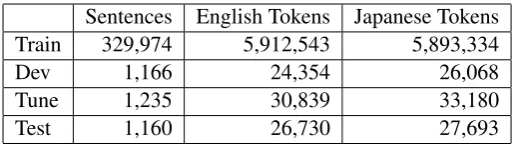
We use the data from the Kyoto Free Transla-tion Task (KFTT) version 1.3 (Neubig, 2011). Ta-ble 1 shows the corpus statistics. Note that these numbers are slightly different from the ones ob-served under the dataset’s default training proce-dure because of the difference in the preprocessing scheme, which is explained below.
2Given sure alignmentsSand possible alignmentsP, the alignment error rate of alignmentsA is 1− |A∩|SA||++||AS∩|P|
(Och and Ney, 2003).
The tuning set of the KFTT has manual align-ments. As the KFTT doesn’t distinguish between sure and possible alignments, F-measure equals
1−AERon this dataset.
5.1 Preprocessing
We tokenize the English side of the data using the Stanford Tokenizer3and parse it with the Berkeley Parser4 (Petrov et al., 2006). We use the phrase-structure trees for the Berkeley Aligner’s syntactic distortion model, and convert them to dependency trees for our dependency-based distortion model5. As the Berkeley Parser couldn’t parse 7 (out of about 330K) sentences in the training data, we re-moved those lines from both sides of the data. All the sentences in the other sets were parsed suc-cessfully.
For the Japanese side of the data, we first con-catenate the function words in the tokenized sen-tences using a script6 published by the author of the dataset. Then we re-segment and POS-tag them using MeCab7 version 0.996 and parse them using CaboCha8 version 0.66 (Kudo and Matsumoto, 2002), both with UniDic. Finally, we modify the CoNLL-format output of CaboCha where some kind of symbols such as punctuation marks and parentheses have dependent words. We chose this procedure for a reasonable compromise between the dataset’s default tokenization and the dependency parser we use.
As we cannot use the default gold alignment due to the difference in preprocessing, we use a script9 published by the author of the dataset to modify the gold alignment so that it better matches the new tokenization.
5.2 Training
We initialize our models in two directions with jointly trained IBM Model 1 parameters (5 itera-tions) and train them independently for 5 iterations
3http://nlp.stanford.edu/software/ 4We use the model trained on the WSJ portion of Ontonotes (Hovy et al., 2006) with the default setting.
5We use Stanford’s tool (de Marneffe et al., 2006) with options -conllx -basic -makeCopulaHead -keepPunctfor conversion.
6https://github.com/neubig/ util-scripts/blob/master/ combine-predicate.pl
7http://code.google.com/p/mecab/ 8http://code.google.com/p/cabocha/ 9https://github.com/neubig/
Sentences English Tokens Japanese Tokens
Train 329,974 5,912,543 5,893,334
Dev 1,166 24,354 26,068
Tune 1,235 30,839 33,180
[image:6.595.170.430.61.134.2]Test 1,160 26,730 27,693
Table 1: Corpus statistics of the KFTT.
Precision Recall AER
HMT (Proposed) 71.77 55.23 37.58
IBM Model 4 60.58 57.71 40.89
HMM 69.59 56.15 37.85
[image:6.595.73.291.180.252.2]S-HMM 71.60 56.14 37.07
Table 2: Alignment error rates (AER) based on each model’s peak performance.
with window sizew= 4for the distortion model.
The entire training procedure takes around 4 hours on a 3.3 GHz Xeon CPU.
We train the IBM Model 4 using GIZA++ (Och and Ney, 2003) with the training script of the Moses toolkit (Koehn et al., 2007).
The HMM and S-HMM alignment models are initialized with jointly trained IBM Model 1 pa-rameters (5 iterations) and trained independently for 5 iterations using the Berkeley Aligner. We find that though initialization with jointly trained IBM Model 1 parameters is effective, joint train-ing of HMM alignment models harms the perfor-mance on this dataset (results not shown).
5.3 Result
We use posterior thresholding for the HMT and HMM alignment models, and the grow-diag-final-andheuristic for the IBM Model 4.
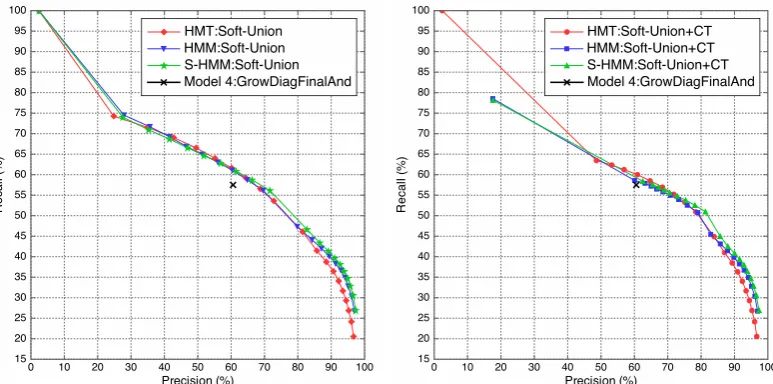
Table 2 and Figure 2 show the result. As the Soft-Union criterion performed best, we don’t show the results based on other criteria. On the other hand, as the peak performance of the HMT model is better with competitive thresholding and those of HMM models are better without it, we compare Precision/Recall curves and AER curves both between the same strategy and the best per-forming strategy for each model.
As shown in Table 2, the peak performance of the HMT alignment model is better than that of the IBM Model 4 by over 3 point AER, and it was somewhere between the HMM and the S-HMM. Taking into account that our distortion model is
simpler than that of S-HMM, these results seem natural, and it would be reasonable to expect that replacing our distortion model with more sophisti-cated one might improve the performance.
When we look at Precision/Recall curves and AER curves in Figures 2a and 2d, the HMT model is performing slightly better in the range of 50 to 60 % precision and 0.15 to 0.35 posterior thresh-old with the Soft-Union strategy. Results in Fig-ures 2b and 2e show that the HMT model performs better around the range around 60 to 70 precision and it corresponds to 0.2 to 0.4 posterior thresh-old with the competitive threshthresh-olding heuristic. In addition, results on both strategies show that per-formance curve of the HMT model is more peaked than those of HMM alignment models.
We suspect that a part of the reason behind such behavior can be attributed to the fact that the HMT model’s distortion model is more uniform than that of HMM models. For example, in our model, all sibling nodes have the same distortion probability from their parent node. This is in contrast with the situation in HMM models, where nodes within a fixed distance have different distortion probabili-ties. With more uniform distortion probabilities, many links for a target word may have a consider-able amount of posterior probability. If that is true, too many links will be above the threshold when it is set low, and too few links can exceed the thresh-old when it is set high. More sophisticated distor-tion model may help mitigate such sensitivity to the posterior threshold.
6 Related Works
as-(a) Precision/Recall Curve with Soft-Union. (b) Precision/Recall Curve with Soft-Union + Competi-tive Thresholding.
(c) Precision/Recall Curve with the Best Strategy. (d) Alignment Error Rate with Soft-Union.
(e) Precision/Recall Curve with Soft-Union +
[image:7.595.106.493.91.283.2]Competi-tive Thresholding. (f) Alignment Error Rate with with the Best Strategy.
sume a chain structure for hidden variables (align-ment) as opposed to a tree structure as in our model, and condition distortions on the syntactic structure only in one direction.
Nakazawa and Kurohashi (2011) propose a dependency-based phrase-to-phrase alignment model with a sophisticated generative story, which leads to an increase in computational complexity and requires parallel sampling for training.
Several supervised, discriminative models use syntax structures to generate features and to guide the search (Burkett et al., 2010; Riesa and Marcu, 2010; Riesa et al., 2011). Such efforts are orthog-onal to ours in the sense that discriminative align-ment models generally use statistics obtained by unsupervised, generative models as features and can benefit from their improvement. It would be interesting to incorporate statistics of the HMT word alignment model into such discriminative models.
ˇZabokrtsk`y and Popel (2009) use HMT mod-els for the transfer phase in a tree-based MT sys-tem. While our model assumes that the tree struc-ture of alignment variables is isomorphic to tar-get side’s dependency tree, they assume that the deep-syntactic tree of the target side is isomorphic to that of the source side. The parameters of the HMT model is given and not learned by the model itself.
7 Conclusion
We have proposed a novel word alignment model based on the Hidden Markov Tree (HMT) model, which can incorporate the syntactic structures of both sides of the language into unsupervised word alignment in a tractable manner. Experiments on an English-Japanese dataset show that our model performs better than the IBM Model 4 and com-parably to the HMM alignment models in terms of alignment error rates. It is also shown that the HMT model with a simple tree-based distortion is sensitive to posterior thresholds, perhaps due to the flat distortion probabilities.
As the next step, we plan to improve the dis-tortion component of our HMT alignment model. Something similar to the syntax-sensitive distor-tion model of DeNero and Klein (2007) might be a good candidate.
It is also important to see the effect of our model on the downstream translation. Apply-ing our model to recently proposed models that
directly incorporate dependency structures, such as string-to-dependency (Shen et al., 2008) and dependency-to-string (Xie et al., 2011) models, would be especially interesting.
Last but not least, though the dependency struc-tures don’t pose a hard restriction on the align-ment in our model, it is highly likely that parse errors have negative effects on the alignment ac-curacy. One way to estimate the effect of parse errors on the accuracy is to parse the input sen-tences with inferior models, for example trained on a limited amount of training data. Moreover, preserving some ambiguities usingk-best trees or shared forests might help mitigate the effect of 1-best parse errors.
Acknowledgments
We thank anonymous reviewers for insightful sug-gestions and comments.
References
Peter F. Brown, Vincent J. Della Pietra, Stephen A. Della Pietra, and Robert L. Mercer. 1993. The Mathematics of Statistical Machine Translation: Pa-rameter Estimation. Computational linguistics, 19(2):263–311.
David Burkett, John Blitzer, and Dan Klein. 2010. Joint Parsing and Alignment with Weakly Synchro-nized Grammars. In Proceedings of NAACL HLT 2010, pages 127–135.
Hyeokho Choi and Richard G. Baraniuk. 2001. Mul-tiscale Image Segmentation Using Wavelet-Domain Hidden Markov Models. IEEE Transactions on
Im-age Processing, 10(9):1309–1321.
Matthew S. Crouse, Robert D. Nowak, and Richard G. Baraniuk. 1998. Wavelet-Based Statistical Signal Processing Using Hidden Markov Models. IEEE Transactions on Signal Processing, 46(4):886–902.
Marie-Catherine de Marneffe, Bill MacCartney, and Christopher D. Manning. 2006. Generating Typed Dependency Parses from Phrase Structure Parses. In
Proceedings of LREC’06, pages 449–454.
John DeNero and Dan Klein. 2007. Tailoring Word Alignments to Syntactic Machine Translation. In
Proceedings of ACL 2007, pages 17–24.
J.-B. Durand, Y. Gu´edon, Y. Caraglio, and E. Costes. 2005. Analysis of the plant architecture via tree-structured statistical models: the hidden Markov tree models. New Phytologist, 166(3):813–825.
Eduard Hovy, Mitchell Marcus, Martha Palmer, Lance Ramshaw, and Ralph Weischedel. 2006. OntoNotes: The 90% Solution. InProceedings of
HLT-NAACL 2006, Short Papers, pages 57–60.
Philipp Koehn, Hieu Hoang, Alexandra Birch, Chris Callison-Burch, Marcello Federico, Nicola Bertoldi, Brooke Cowan, Wade Shen, Christine Moran, Richard Zens, Chris Dyer, Ond˘rej Bojar, Alexandra Constantin, and Evan Herbst. 2007. Moses: Open Source Toolkit for Statistical Machine Translation.
In Proceedings of ACL 2007, Demonstration
Ses-sion, pages 177–180.
Taku Kudo and Yuji Matsumoto. 2002. Japanese De-pendency Analysis using Cascaded Chunking. In
Proceedings of CoNLL-2002, pages 63–69.
Percy Liang, Ben Taskar, and Dan Klein. 2006. Align-ment by AgreeAlign-ment. InProceedings of HLT-NAACL 2006, pages 104–111.
Adam Lopez and Philip Resnik. 2005. Im-proved HMM Alignment Models for Languages with Scarce Resources. InProceedings of the ACL
Workshop on Building and Using Parallel Texts,
pages 83–86.
Toshiaki Nakazawa and Sadao Kurohashi. 2011. Bayesian Subtree Alignment Model based on De-pendency Trees. InProceedings of IJCNLP 2011, pages 794–802.
Graham Neubig. 2011. The Kyoto Free Translation Task. http://www.phontron.com/kftt.
Franz Josef Och and Hermann Ney. 2003. A System-atic Comparison of Various Statistical Alignment Models.Computational linguistics, 29(1):19–51.
Slav Petrov, Leon Barrett, Romain Thibaux, and Dan Klein. 2006. Learning Accurate, Compact, and Interpretable Tree Annotation. In Proceedings of
COLING/ACL 2006, pages 433–440.
Javier Portilla, Vasily Strela, Martin J. Wainwright, and Eero P. Simoncelli. 2003. Image Denoising Using Scale Mixtures of Gaussians in the Wavelet Domain. IEEE Transactions on Image Processing, 12(11):1338–1351.
Jason Riesa and Daniel Marcu. 2010. Hierarchical Search for Word Alignment. InProceedings of ACL 2010, pages 157–166.
Jason Riesa, Ann Irvine, and Daniel Marcu. 2011. Feature-Rich Language-Independent Syntax-Based Alignment for Statistical Machine Translation. In
Proceedings of EMNLP 2011, pages 497–507.
Libin Shen, Jinxi Xu, and Ralph Weischedel. 2008. A new string-to-dependency machine translation algo-rithm with a target dependency language model. In
Proceedings of ACL-08: HLT, pages 577–585.
Stephan Vogel, Hermann Ney, and Christoph Tillmann. 1996. HMM-Based Word Alignment in Statisti-cal Translation. In Proceedings of COLING 1996, pages 836–841.
Jun Xie, Haitao Mi, and Qun Liu. 2011. A Novel Dependency-to-String Model for Statistical Machine Translation. In Proceedings of EMNLP 2011, pages 216–226.