Improvements to Syntax-based Machine Translation using Ensemble
Dependency Parsers
Nathan David Green and Zdenˇek ˇZabokrtsk´y
Charles University in Prague
Institute of Formal and Applied Linguistics Faculty of Mathematics and Physics
Prague, Czech Republic
{green,zabokrtsky}@ufal.mff.cuni.cz
Abstract
Dependency parsers are almost ubiqui-tously evaluated on their accuracy scores, these scores say nothing of the complex-ity and usefulness of the resulting struc-tures. The structures may have more com-plexity due to their coordination structure or attachment rules. As dependency parses are basic structures in which other systems are built upon, it would seem more reason-able to judge these parsers down the NLP pipeline.
We show results from 7 individual parsers, including dependency and constituent parsers, and 3 ensemble parsing tech-niques with their overall effect on a Ma-chine Translation system, Treex, for En-glish to Czech translation. We show that parsers’ UAS scores are more correlated to the NIST evaluation metric than to the BLEU Metric, however we see increases in both metrics.
1 Introduction
Ensemble learning (Dietterich, 2000) has been used for a variety of machine learning tasks and recently has been applied to dependency parsing in various ways and with different levels of suc-cess. (Surdeanu and Manning, 2010; Haffari et al., 2011) showed a successful combination of parse trees through a linear combination of trees with various weighting formulations. To keep their tree constraint, they applied Eisner’s algo-rithm for reparsing (Eisner, 1996).
Parser combination with dependency trees has been examined in terms of accuracy (Sagae and Lavie, 2006; Sagae and Tsujii, 2007; Zeman and ˇZabokrtsk´y, 2005; Holan and ˇZabokrtsk´y, 2006). Other methods of parser combinations have shown to be successful such as using one
parser to generate features for another parser. This was shown in (Nivre and McDonald, 2008), in which Malt Parser was used as a feature to MST Parser. The result was a successful combination of a transition-based and graph-based parser, but did not address adding other types of parsers into the framework.
We will use three ensemble approaches. First a fixed weight ensemble approach in which edges are added together in a weighted graph. Sec-ond, we added the edges using weights learned through fuzzy clustering based on POS errors. Third, we will use a meta-classifier that uses an SVM to predict the correct model for edge using only model agreements without any linguistic in-formation added. Parsing accuracy and machine translation has been examined in terms of BLEU score (Quirk and Corston-Oliver, 2006). How-ever, we believe our work is the first to examine the NLP pipeline for ensemble parsing for both de-pendency and constituent parsers as well as exam-ining both BLEU and NIST scores’ relationship to theirUnlabeledAccuracyScore(UAS).
2 Methodology
2.1 Annotation
To find the maximum effect that dependency pars-ing can have on the NLP pipeline, we annotated English dependency trees to form a gold standard. Annotation was done with two annotators using a tree editor, Tred (Pajas and Fabian, 2011), on data that was preprocessed using MST parser. For the annotation of our gold data, we used the stan-dard developed by the Prague Dependency Tree-bank (PDT) (Hajiˇc, 1998). PDT is annotated on three levels, morphological, analytical, and tec-togrammatical. For our gold data we do not touch the morphological layer, we only correct the ana-lytical layer (i.e. labeled dependency trees). For machine translation experiments later in the paper
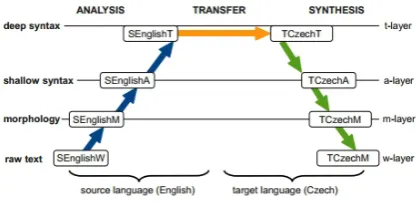
we allow the system to automatically generate a new tectogrammatical layer based on our new an-alytical layer annotation. Because the Treex ma-chine translation system uses a tectogrammatical layer, when in doubt, ambiguity was left to the tec-togrammatical (t-layer in Figure 1) to handle.
2.1.1 Data Sets
For the annotation experiments we use data pro-vided by the 2012 Workshop for Machine Trans-lation (WMT2012). The data which consists of 3,003 sentences was automatically tokenized, tagged, and parsed. This data set was also chosen since it is disjoint from the usual dependency train-ing data, allowtrain-ing researchers to use it as a out-of-domain testing set. The parser used was an imple-mentation of MST parser. We then hand corrected the analytical trees to have a “Gold” standard de-pendency structure. Analytical trees were anno-tated on the PDT standard. Most changes involved coordination construction along with prepositional phrase attachment. We plan to publicly release this data and corresponding annotations in the near fu-ture1.
Having only two annotators has limited us to evaluating our annotation only through spot checking and through comparison with other base-lines. Annotation happened sequentially one after another. Possible errors were additionally detected through automatic means. As a comparison we will evaluate our gold data set versus other parsers in respect to their performance on previous data sets, namely the Wall Street Journal (WSJ) section 23.
2.2 Translation
2.2.1 Data Sets
All the parsers were trained on sections 02-21 of the WSJ, except the Stanford parser which also uses section 01. We retrained MST and Malt parsers and used pre-trained models for the other parsers. Machine translation data was used from WMT 2010, 2011, and 2012. Using our gold standard we are able to evaluate the effective-ness of different parser types from graph-base, transition-based, constituent conversion to ensem-ble approaches on the 2012 data while finding data trends using previous years data.
1When available the data and description will be at
www.nathangreen.com/wmtdata
2.2.2 Translation Components
[image:2.595.311.520.226.327.2]To examine the effects of dependency parsing down the NLP pipeline, we now turn to syntax based machine translation. Our dependency mod-els will be evaluated using the Treex translation system (Popel and ˇZabokrtsk´y, 2010). This sys-tem, as opposed to other popular machine transla-tion systems, makes direct use of the dependency structure during the conversion from source to tar-get languages via a tectogrammatical tree transla-tion approach.
Figure 1: Treex syntax-based translation scenario (Popel and ˇZabokrtsk´y, 2010)
We use the different parsers in separate trans-lation runs each time in the same Treex parsing block. So each translation scenario only differs in the parser used and nothing else. As can be seen in Figure 1, we are directly manipulating the An-alytical portion of Treex. The parsers used are as follows:
• MST: Implementation of Ryan McDonald’s Minimum spanning tree parser (McDonald et al., 2005)
• MST with chunking: Same implementation as above but we parse the sentences based on chunks and not full sentences. For instance this could mean separating parentheticals or separating appositions (Popel et al., 2011)
• Malt: Implementation of Nivre’s Malt Parser trained on the Penn Treebank (Nivre, 2003)
• Malt with chunking: Same implementation as above but with chunked parsing
• ZPar: Yue Zhang’s statistical parser. We used the pretrained English model (en-glish.tar.gz) available on the ZPar website for all tests (Zhang and Clark, 2011)
the results using the Pennconverter (Johans-son and Nugues, 2007)
• Stanford: Another constituent based parser (Klein and Manning, 2003) whose output is converted using Pennconverter as well (wsjPCFG.ser.gz model)
• Fixed Weight Ensemble: A stacked en-semble system combining five of the parsers above (MST, Malt, ZPar, Charniak, Stan-ford). The weights for each tree are as-signed based on UAS score found in tun-ing data, section 22 of the WSJ (Green and
ˇ
Zabokrtsk´y, 2012)
• Fuzzy Cluster: A stacked ensemble system as well but weights are determined by a clus-ter analysis of POS errors found in the same tuning data as above (Green and ˇZabokrtsk´y, 2012)
• SVM: An ensemble system in which each in-dividual edge is picked by a meta classifier from the same 5 parsers as the other ensemble systems. The SVM meta classifier is trained on results from the above tuning data (Green et al., 2012a; Green et al., 2012b).
2.2.3 Evaluation
For Machine Translation we report two automatic evaluation scores, BLEU and NIST. We examine parser accuracy using UAS. This paper compares a machine translation system integrating 10 differ-ent parsing systems against each other, using the below metrics.
The BLEU (BiLingualEvaluationUnderstudy) and NIST(from theNationalInstitute ofStandards and Technology), are automatic scoring mecha-nisms for machine translation that are quick and can be reused as benchmarks across machine translation tasks. BLEU and NIST are calculated as the geometric mean of n-grams multiplied by a brevity penalty, comparing a machine translation and a reference text (Papineni et al., 2002). NIST is based upon the BLEU n-gram approach how-ever it is also weighted towards discovering more “informative” n-grams. The more rare an n-gram is, the higher the weight for a correct translation of it will be.
Made a standard in the CoNLL shared tasks competition, UAS studies the structure of a depen-dency tree and assesses how often the output has
the correct head and dependency arcs (Buchholz and Marsi, 2006). We report UAS scores for each parser on section 23 of the WSJ.
3 Results and Discussion
3.1 Type of Changes in WMT Annotation
Since our gold annotated data was preprocessed with MST parser, our baseline system at the time, we started with a decent baseline and only had to change 9% of the dependency arcs in the data. These 9% of changes roughly increase the BLEU score by 7%.
3.2 Parser Accuracy
As seen in previous Ensemble papers (Farkas and Bohnet, 2012; Green et al., 2012a; Green et al., 2012b; Green and ˇZabokrtsk´y, 2012; Zeman and
ˇ
Zabokrtsk´y, 2005), parsing accuracy can be im-proved by combining parsers’ outputs for a variety of languages. We apply a few of these systems, as described in Section 2.2.2, to English using mod-els trained for both dependencies and constituents.
3.2.1 Parsers vs our Gold Standard
On average our gold data differed in head agree-ment from our base parser 14.77% of the time. When our base parsers were tested on the WSJ section 23 data they had an average error rate of 12.17% which is roughly comparable to the differ-ence with our gold data set which indicates overall our annotations are close to the accepted standard from the community. The slight difference in per-centage fits into what is expect in annotator error and in the errors in the conversion process of the WSJ by Pennconverter.
3.3 Parsing Errors Effect on MT
3.3.1 MT Results in WMT with Ensemble Parsers
WMT 2010
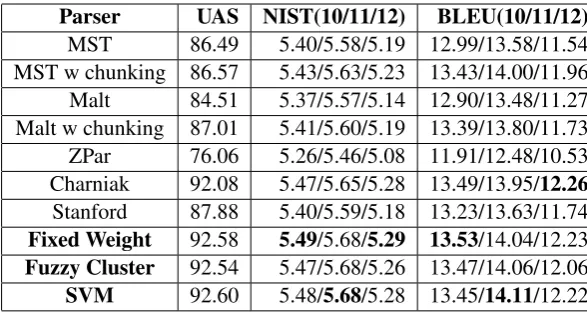
As seen in Table 1, the highest resulting BLEU score for the 2010 data set is from the fixed weight ensemble system. The other two ensemble sys-tems are beaten by one component system, Char-niak. However, this changes when comparing NIST scores. Two of the ensemble method have higher NIST scores than Charniak, similar to their UAS scores.
WMT 2011
Parser UAS NIST(10/11/12) BLEU(10/11/12)
MST 86.49 5.40/5.58/5.19 12.99/13.58/11.54
MST w chunking 86.57 5.43/5.63/5.23 13.43/14.00/11.96
Malt 84.51 5.37/5.57/5.14 12.90/13.48/11.27
Malt w chunking 87.01 5.41/5.60/5.19 13.39/13.80/11.73
ZPar 76.06 5.26/5.46/5.08 11.91/12.48/10.53
Charniak 92.08 5.47/5.65/5.28 13.49/13.95/12.26
Stanford 87.88 5.40/5.59/5.18 13.23/13.63/11.74
Fixed Weight 92.58 5.49/5.68/5.29 13.53/14.04/12.23
Fuzzy Cluster 92.54 5.47/5.68/5.26 13.47/14.06/12.06
[image:4.595.148.442.61.217.2]SVM 92.60 5.48/5.68/5.28 13.45/14.11/12.22
Table 1: Scores for each machine translation run for each dataset (WMT 2010, 2011 and 2012)
the ensemble systems, the order of systems by UAS scores corresponds exactly to the systems or-dered by NIST score and corelates strongly (Table 2). Unlike the 2010 data, the MST parser was the highest base parser in terms of the BLEU metric.
WMT 2012
The ensemble increases are statistically significant for both the SVM and the Fixed Weight system over the MST with chunking parser with 99% con-fidence, our previous baseline and best scoring base system from 2011 in terms of BLEU score. We examine our data versus MST with chunking instead of Charniak since we have preprocessed our gold data set with MST, allowing us a direct comparison in improvements. The fuzzy cluster system achieves a higher BLEU evaluation score than MST, but is not significant. In pairwise tests it wins approximately 78% of the time. This is the first dataset we have looked at where the BLEU score is higher for a component parser and not an ensemble system, although the NIST score is still higher for the ensemble systems.
NIST BLEU
2010 0.98 0.93
2011 0.98 0.94
[image:4.595.375.457.500.559.2]2012 0.95 0.97
Table 2: Pearson correlation coefficients for each year and each metric when measured against UAS. Statistics are taken from the WMT results in Table 1. Overall NIST has the stronger correlation to UAS scores, however both NIST and BLEU show a strong relationship.
3.3.2 Human Manual Evaluation: SVM vs the Baseline System
We selected 200 sentences at random from our an-notations and they were given to 7 native Czech speakers. 77 times the reviewers preferred the SVM system, 48 times they preferred the MST system, and 57 times they said there was no differ-ence between the sentdiffer-ences. On average each re-viewer looked at 26 sentences with a median of 30 sentences. Reviewers were allowed three options: sentence 1 is better, sentence 2 is better, both sen-tences are of equal quality. Sensen-tences were dis-played in a random order and the systems were randomly shuffled for each question and for each user.
+ =
-+ 12 12 0
= 3 7
[image:4.595.126.237.590.648.2]- 7
Table 3: Agreement for sentences with 2 or more annotators for our baseline and SVM systems. (-,-) all annotators agreed the baseline was better, (+,+) all annotators agreed the SVM system was better, (+,-) the annotators disagreed with each other
Table 3 indicates that the SVM system was pre-ferred. When removing annotations marked as equal, we see that the SVM system was preferred 24 times to the Baseline’s 14.
3.3.3 MT Results with Gold Data
In the perfect situation of having gold standard de-pendency trees, we obtained a NIST of 5.30 and a BLEU of 12.39. For our gold standard system run, the parsing component was removed and re-placed with our hand annotated data. These are the highest NIST and BLEU scores we have ob-tained including using all base parsers or any com-binations of parsers. This indicates that while an old problem which is a “solved” problem for some languages, Parsing is still worth researching and improving for its cascading effects down the NLP pipeline.
4 Conclusion
We have shown that ensemble parsing techniques have an influence on syntax-based machine trans-lation both in manual and automatic evaluation. Furthermore we have shown a stronger correlation between parser accuracy and the NIST rather than the more commonly used BLEU metric. We have also introduced a gold set of English dependency trees based on the WMT 2012 machine translation task data, which shows a larger increase in both BLEU and NIST. While on some datasets it is in-conclusive whether using an ensemble parser with better accuracy has a large enough effect, we do show that practically you will not do worse using one and in many cases do much better.
5 Acknowledgments
This research has received funding from the European Commission’s 7th Framework Pro-gram (FP7) under grant agreement n◦ 238405 (CLARA). Additionally, this work has been us-ing language resources developed and/or stored and/or distributed by the LINDAT-Clarin project of the Ministry of Education of the Czech Repub-lic (project LM2010013).
References
Sabine Buchholz and Erwin Marsi. 2006. CoNLL-X Shared Task on Multilingual Dependency Parsing. In Proceedings of the Tenth Conference on Com-putational Natural Language Learning, CoNLL-X ’06, pages 149–164, Stroudsburg, PA, USA. Associ-ation for ComputAssoci-ational Linguistics.
Thomas G. Dietterich. 2000. Ensemble Methods in Machine Learning. InProceedings of the First
International Workshop on Multiple Classifier Sys-tems, MCS ’00, pages 1–15, London, UK. Springer-Verlag.
Jason Eisner. 1996. Three New Probabilistic Mod-els for Dependency Parsing: An Exploration. In Proceedings of the 16th International Conference on Computational Linguistics (COLING-96), pages 340–345, Copenhagen, August.
Rich´ard Farkas and Bernd Bohnet. 2012. Stacking of Dependency and Phrase Structure Parsers. In Pro-ceedings of COLING 2012, pages 849–866, Mum-bai, India, December. The COLING 2012 Organiz-ing Committee.
Nathan Green and Zdenˇek ˇZabokrtsk´y. 2012. Hy-brid Combination of Constituency and Dependency Trees into an Ensemble Dependency Parser. In Pro-ceedings of the EACL 2012 Workshop on Innovative hybrid approaches to the processing of textual data, Avignon, France.
Nathan Green and Zdenˇek ˇZabokrtsk´y. 2012. Ensem-ble Parsing and its Effect on Machine Translation. Technical Report 48.
Nathan Green, Septina Dian Larasati, and Zdenˇek ˇ
Zabokrtsk´y. 2012a. Indonesian Dependency Treebank: Annotation and Parsing. In Proceed-ings of the 26th Pacific Asia Conference on Lan-guage, Information, and Computation, pages 137– 145, Bali,Indonesia, November. Faculty of Com-puter Science, Universitas Indonesia.
Nathan Green, Loganathan Ramasamy, and Zdenˇek ˇ
Zabokrtsk´y. 2012b. Using an SVM Ensemble Sys-tem for Improved Tamil Dependency Parsing. In Proceedings of the ACL 2012 Joint Workshop on Statistical Parsing and Semantic Processing of Mor-phologically Rich Languages, pages 72–77, Jeju, Republic of Korea, July 12. Association for Com-putational Linguistics.
Gholamreza Haffari, Marzieh Razavi, and Anoop Sarkar. 2011. An Ensemble Model that Combines Syntactic and Semantic Clustering for Discrimina-tive Dependency Parsing. In Proceedings of the 49th Annual Meeting of the Association for Com-putational Linguistics: Human Language Technolo-gies, pages 710–714, Portland, Oregon, USA, June. Association for Computational Linguistics.
Jan Hajiˇc. 1998. Building a Syntactically Annotated Corpus: The Prague Dependency Treebank. In Eva Hajiˇcov´a, editor, Issues of Valency and Meaning. Studies in Honor of Jarmila Panevov´a, pages 12–19. Prague Karolinum, Charles University Press.
Richard Johansson and Pierre Nugues. 2007. Ex-tended Constituent-to-dependency Conversion for English. InProceedings of NODALIDA 2007, pages 105–112, Tartu, Estonia, May 25-26.
Dan Klein and Christopher D. Manning. 2003. Ac-curate unlexicalized parsing. InProceedings of the 41st Annual Meeting on Association for Computa-tional Linguistics - Volume 1, ACL ’03, pages 423– 430, Stroudsburg, PA, USA. Association for Com-putational Linguistics.
Ryan McDonald, Fernando Pereira, Kiril Ribarov, and Jan Hajiˇc. 2005. Non-projective dependency pars-ing uspars-ing spannpars-ing tree algorithms. InProceedings of the conference on Human Language Technology and Empirical Methods in Natural Language Pro-cessing, HLT ’05, pages 523–530, Morristown, NJ, USA. Association for Computational Linguistics.
Joakim Nivre and Ryan McDonald. 2008. Integrat-ing Graph-Based and Transition-Based Dependency Parsers. In Proceedings of ACL-08: HLT, pages 950–958, Columbus, Ohio, June. Association for Computational Linguistics.
Joakim Nivre. 2003. An Efficient Algorithm for Pro-jective Dependency Parsing. InProceedings of the 8th International Workshop on Parsing Technologies (IWPT, pages 149–160.
Petr Pajas and Peter Fabian. 2011. TrEd 2.0 - newly refactored tree editor. http://ufal.mff.cuni.cz/tred/, Institute of Formal and Applied Linguistics, MFF UK.
Kishore Papineni, Salim Roukos, Todd Ward, and Wei-Jing Zhu. 2002. BLEU: A Method for Automatic Evaluation of Machine Translation. In Proceed-ings of the 40th Annual Meeting on Association for Computational Linguistics, ACL ’02, pages 311– 318, Morristown, NJ, USA. Association for Com-putational Linguistics.
Martin Popel and Zdenˇek ˇZabokrtsk´y. 2010. Tec-toMT: modular NLP framework. InProceedings of the 7th international conference on Advances in nat-ural language processing, IceTAL’10, pages 293– 304, Berlin, Heidelberg. Springer-Verlag.
Martin Popel, David Mareˇcek, Nathan Green, and Zdenek Zabokrtsky. 2011. Influence of parser choice on dependency-based mt. InProceedings of the Sixth Workshop on Statistical Machine Transla-tion, pages 433–439, Edinburgh, Scotland, July. As-sociation for Computational Linguistics.
Chris Quirk and Simon Corston-Oliver. 2006. The im-pact of parse quality on syntactically-informed sta-tistical machine translation. In Proceedings of the 2006 Conference on Empirical Methods in Natural Language Processing, EMNLP ’06, pages 62–69, Stroudsburg, PA, USA. Association for Computa-tional Linguistics.
Kenji Sagae and Alon Lavie. 2006. Parser Combina-tion by Reparsing. In Proceedings of the Human Language Technology Conference of the NAACL, Companion Volume: Short Papers, pages 129–132, New York City, USA, June. Association for Compu-tational Linguistics.
Kenji Sagae and Jun’ichi Tsujii. 2007. Dependency Parsing and Domain Adaptation with LR Models and Parser Ensembles. InProceedings of the CoNLL Shared Task Session of EMNLP-CoNLL 2007, pages 1044–1050, Prague, Czech Republic, June. Associ-ation for ComputAssoci-ational Linguistics.
Mihai Surdeanu and Christopher D. Manning. 2010. Ensemble models for dependency parsing: cheap and good? In Human Language Technologies: The 2010 Annual Conference of the North American Chapter of the Association for Computational Lin-guistics, HLT ’10, pages 649–652, Stroudsburg, PA, USA. Association for Computational Linguistics.
Daniel Zeman and Zdenˇek ˇZabokrtsk´y. 2005. Improv-ing ParsImprov-ing Accuracy by CombinImprov-ing Diverse Depen-dency Parsers. InIn: Proceedings of the 9th Inter-national Workshop on Parsing Technologies.