Leveraging Crowdsourcing for Paraphrase Recognition
Martin Tschirsich
Department of Computer Science, TU Darmstadt
Gerold Hintz
Department of Computer Science, TU Darmstadt
Abstract
Crowdsourcing, while ideally reducing both costs and the need for domain ex-perts, is no all-purpose tool. We review how paraphrase recognition has benefited from crowdsourcing in the past and iden-tify two problems in paraphrase acqui-sition and semantic similarity evaluation that can be solved by employing a smart crowdsourcing strategy. First, we employ the CrowdFlower platform to conduct an experiment on sub-sentential paraphrase acquisition with early exclusion of low-accuracy crowdworkers. Second, we com-pare two human intelligence task designs for evaluating phrase pairs on a semantic similarity scale. While the first experiment confirms our strategy successful at tack-ling the problem of missing gold in para-phrase generation, the results of the sec-ond experiment suggest that, for both se-mantic similarity evaluation on a contin-uous and a binary scale, querying crowd-workers for a semantic similarity value on a multi-grade scale yields better results than directly asking for a binary classifi-cation.
1 Introduction
Paraphrase recognition1 means to analyse whether two texts are paraphrastic, i.e. “a pair of units of text deemed to be interchangeable” (Dras, 1999). It has numerous applications in information retrieval, information extraction, machine translation and plagiarism detection. For instance, an internet search provider could recognize "murder of the 35th U.S. president" and "assassination of John F. Kennedy" to be
1the terms
paraphrase detectionandparaphrase identifi-cationmight be used instead
paraphrases of each other and thus yield the same result. Paraphrase recognition is an open research problem and, even though having progressed immensely in recent years (Socher et al., 2011), state of the art performance is still below the human reference.
In this research, we analyse how crowdsourcing can contribute to paraphrase recognition. Crowd-sourcing is the process of outCrowd-sourcing a vast number of small, simple tasks, so calledHITs2, to a distributed group of unskilled workers, so called crowdworkers3. Reviewing current literature on the topic, we identify two problems in paraphrase acquisition and semantic similarity evaluation that can be solved by employing a smart crowdsourc-ing strategy. First, we propose how to reduce paraphrase generation costs by early exclusion of low-accuracy crowdworkers. Second, we compare two HIT designs for evaluating phrase pairs on a continuous semantic similarity scale. In order to evaluate our crowdsourcing strategies, we conduct our own experiments via the CROWDFLOWER4
platform.
The rest of the paper is structured as follows. Section 2 first gives an overview of related work and lines out current approaches. We then pro-ceed to our own experiments on crowdsourcing paraphrase acquisition (3.3) and semantic similar-ity evaluation (3.4). Section 4 and 5 conclude the study and propose future work in the area of para-phrase recognition and crowdsourcing.
2 Literature Review
Many research fields rely on paraphrase recogni-tion and contribute to it, as there are many related concepts. These include inference rule discovery for question-answering and information retrieval (Lin and Pantel, 2001), idiom or multiword
ex-2
Human Intelligence Tasks
3
often referred to asturkers
4http://crowdflower.com
pression acquisition (Fellbaum et al., 2006) and identification (Boukobza and Rappoport, 2009), machine translation evaluation (Snover et al., 2009), textual entailment recognition, and many more.
2.1 Paraphrase Definition
The notion of a paraphrase is closely related to the concepts of semantic similarity and word ontol-ogy and an exact definition is not trivial. Often, complex annotation guidelines and aggregated ex-pert agreements decide whether phrases are to be considered paraphrastic or not (Dolan and Brock-ett, 2005). Formal definitions based e.g. on a do-main theory and derivable facts (Burrows et al., 2013) have little practical relevance in paraphrase recognition. In terms of the semantic similarity relations’equals’,’restates’,’generalizes’, ’spec-ifies’and’intersects’(Marsi and Krahmer, 2010), ’paraphrase’is equated with’restates’.
It is important to note that in the context of crowdsourcing, we, as well as most authors, rely on the crowdworker’s intuition of what a para-phrase is. Usually, only a limited list of examples of desired valid paraphrases is given to the crowd-worker as a reference.
2.2 Paraphrase Recognition
According to Socher et al. (2011), paraphrase recognition “determines whether two phrases of arbitrary length and form capture the same mean-ing”. Paraphrase recognition is mostly under-stood as a binary classification process, although recently, some authors proposed a continuous se-mantic similarity measure (Madnani et al., 2012).
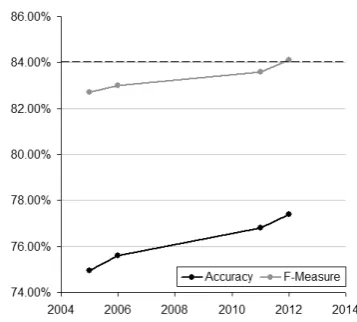
Competing paraphrase recognition approaches are often compared by their performance on the Microsoft Research Paraphrase Corpus (MSRPC). Until 2011, simple features such as n-gram over-lap, dependency tree overlap as well as depen-dency tree edit distance produced the best results in terms of accuracy and F-measure values. How-ever, algorithms based solely on such features can not identify semantic equivalence of synonymous words or phrases. Therefore, some authors sub-sequently integrated Wordnet synonyms as well as other corpus-based semantic similarity mea-sures. The work of Madnani et al. (2012) based on the TERP machine translation evaluation
[image:2.595.324.503.62.223.2]met-ric (Snover et al., 2009) using synonyms and sub-sentential paraphrases presents the current state of the art for paraphrase detection on the MSRPC
Figure 1: Highest ranking accuracy and F-measure over time for paraphrase recognition on the MSRPC with an inter-rater agreement amongst human annotators of 84%
with an accuracy of 77.4% and F-measure of 84.1%. The inter-rater agreement amongst human annotators of 84% on the MSRPC can be consid-ered as an upper bound for the accuracy that could be obtained using automatic methods (Fernando and Stevenson, 2008).
As has become apparent, modern paraphrase recognition algorithms are evaulated on and incor-porate semantic similarity measures trained on ac-quired paraphrases. Therefore, we subsequently give an overview over established paraphrase ac-quisition approaches.
2.3 Paraphrase Acquisition
Paraphrase acquisition5is the process of collecting or generating phrase-paraphrase pairs, often for a given set of phrases. All strategies require a sub-sequent verification of the acquired paraphrases, either done by experts or trusted crowdworkers.
2.3.1 Sentential Paraphrases
Most literature on paraphrase acquisition deals with sentential or sentence-level paraphrases. Bouamor et al. (2012) identify five strategies such as the translation based methods (Zhou et al., 2006) using parallel corpora or alignment of topic-clustered news articles (Dolan and Brockett, 2005).
Via Crowdsourcing In an outstanding ap-proach, Chen and Dolan (2011) collected para-phrases by asking crowdworkers to describe short
videos. A more cost-effective multi-stage crowd-sourcing framework was presented by Negri et al. (2012) with the goal to increase lexical divergence of the collected paraphrases.
2.3.2 Sub-Sentential Paraphrases
Incorporating sub-sentential paraphrases in ma-chine translation metrics also used for paraphrase detection has proven effective (Madnani et al., 2012). A large corpus consisting of more than 15 million sub-sentential paraphrases was assem-bled by Bannard and Callison-Burch (2005) using a pivot-based paraphrase acquisition method.
Via Crowdsourcing Buzek et al. (2010) ac-quired paraphrases of sentence parts problematic for translation systems using AMAZONMECHAN
-ICALTURK. Bouamor et al. (2012) collected
sub-sentential paraphrases in the context of a web-based game.
2.3.3 Passage-level paraphrases
Passage-level paraphrase acquisition has been treated within the context of the evaluation lab on uncovering plagiarism, authorship, and social software misuse (PAN) (Potthast et al., 2010): Burrows et al. (2013) acquired passage-level paraphrases for the WEBIS-CPC-11 corpus via
crowdsourcing.
2.4 Semantic Similarity Evaluation
Paraphrase verification can be said to be a man-ual semantic similarity evaluation done by experts or trusted crowdworkers, most often on a binary scale. However, Madnani et al. (2012) believe that “binary indicators of semantic equivalence are not ideal and a continuous value [. . . ] in-dicating the degree to which two pairs are para-phrastic is more suitable for most approaches”. They propose averaging a large number of bi-nary crowdworker judgements or, alternatively, a smaller number of judgements on an ordinal scale as in the SEMEVAL-2012 Semantic Textual Simi-larity (STS) task (Agirre et al., 2012). A continu-ous semantic similarity score is also used to weigh the influence of sub-sentential paraphrases used by the TERPmetric.
3 Our Experiments
3.1 The CrowdFlower Platform
CROWDFLOWER is a web service for HIT providers, abstracting from the actual platform on
which these tasks are run. A web interface, incor-porating a graphical editor as well as the CROWD -FLOWER MARKUPLANGUAGE6 (CML), can be used to model these tasks. CROWDFLOWER pro-vides fine-grained controls over how these tasks are executed, for instance, by restricting crowd-workers to live in specific countries or by limiting the number of HITs a single worker is allowed to complete.
Furthermore, CROWDFLOWER provides a
so-phisticated system to verify the correctness of the collected data, aiming at early detection and ex-clusion of spammers and low-accuracy workers from the job: gold items. Gold items consist of a HIT, e.g. a pair of paraphrasestogether withone or more possible valid answers. Once gold items are present in the dataset, workers are prompted to an-swer these correctly before being eligible to work on the actual data. Additionally, during the run of a job, CROWDFLOWER uses hidden gold items to revise the trustworthiness of a human worker.
3.2 Human Intelligence Task Design
Apart from gold items, the actual HIT design has the biggest impact on the quality of the collected data. Correct instructions as well as good exam-ples have a great influence on data quality. By us-ing CML validation features, bad user input can be prevented from being collected in the first place. Care must also be taken not to introduce an artifi-cial bias by offering answer choices of different (time-)complexity. Within our experiments, we followed common human interface design princi-ples such as colour coding answer options.
3.3 Crowdsourcing Sub-Sentential Paraphrase Acquisition
The biggest challenge in paraphrase acquisition via crowdsourcing is the low and varying accu-racy of the crowdworkers: “The challenge [. . . ] is automatic quality assurance; without such means the crowdsourcing paradigm is not effective, and without crowdsourcing the creation of test cor-pora is unacceptably expensive for realistic order of magnitudes” (Burrows et al., 2013).
We propose a new crowdsourcing strategy that allows for early detection of low-accuracy work-ers during the generation stage. This prevents these unwanted crowdworkers from completing
6CML documentation: http://crowdflower.
HITs that would almost certainly not be validated later on. We focus on the acquisition of sub-sentential paraphrases for a given set of phrases, where pivot-based paraphrase acquisition methods might not be applicable. Transferring our observa-tions to other types of paraphrases should be un-problematic.
3.3.1 Phrase-Paraphrase Generation
For this simple baseline strategy, we asked the crowdworker to generate a short phrase along with its paraphrase(p1, p2)while providing a small set of examples.
3.3.2 Two-Staged Paraphrase Generation
This is the traditional crowdsourcing strategy. In a first generation stage, we presented the crowd-worker with a phrase p1 and asked for its para-phrase p2. In a second validation stage, two or three workers were asked to verify each gener-ated phrase-paraphrase pair until an unambigu-ous agreement was reached. As the answers in the validation stage are binary, gold-items were added to improve the accuracy of the collected val-idation judgements. Negri et al. (2012) showed that after such a validation stage, expert raters agreed in 92% of the cases with the aggregated crowdworker judgements. However, the genera-tion stage is without gold and we cannot exclude low accuracy workers early enough not to cost money. We used the regular expression verifier provided by CROWDFLOWER to ensure that the
generated paraphrases contain at least one word and are not equal to the given phrases. Other than this however, the worker could enter any text.
Input Phrases As input data, we required mean-ingful chunks. For this, anyconstituentof a sen-tence can be used. A small number of examples suggested that verb phrases have a high potential of yielding interesting paraphrases, as they often have to be replaced as an isolated unit(“get a flu”
→ “catch a cold”). Therefore, we extracted verb phrases of two to five words from a source cor-pus. For this, we used the POS tagger of NLTK7 (A Maxent Treebank POS tagger trained on Penn Treebank) and a simple chunking grammar parser.
Offering a Choice of Input Phrase A crowd-worker might not always be able to come up with a paraphrase for a given phrase. If a worker receives
7N
ATURALLANGUAGE TOOLKIT (NLTK): http:// nltk.org/
phrases
v
e
ri
fy
Para-phrases
phrases
phrases phrases
g
e
n
e
ra
te
g
e
n
e
ra
te
Para-phrases
phrases
g
e
n
e
ra
te
…
v
e
ri
fy
phrases
v
e
ri
fy
Para-phrases
phrases
phrases phrases
g
e
n
e
ra
te
g
e
n
e
ra
te
Para-phrases
phrases
g
e
n
e
ra
te
…
v
e
ri
[image:4.595.314.519.59.343.2]fy
Figure 2: Illustration of the multi-stage paraphrase generation process
one chunk at a time, he has to deal with it no mat-ter how unfeasible it is for paraphrasing. One so-lution to this problem would be to offer a back-out option, in which a worker could declare a unit as unsolvableand possibly explain why. This how-ever could easily be exploited by human workers, resulting in many unsolved items. An alternative solution is to offer workers a choice of the input phrase they want to paraphrase. We designed a HIT with a set of three different input phrases of which they have to pick one to paraphrase. If one of these options is repeatedly declined by multiple workers, we can declare it asbad, without having a worker pass on a unit. However, it turned out that less than 1% provedunsolvableand we therefore deemed such measures unnecessary.
3.3.3 Multi-Staged Paraphrase Generation
phrase pairs allows the usage of gold-items. We can now assess the trustworthiness of a crowd-worker through gold, and we indirectlyinfertheir ability toparaphrasefrom their ability to decide if two items are paraphrases. The aim of this process is to reduce the number of incorrect paraphrases being generated in the first place, and thus improve the efficiency of the CROWDFLOWERtask.
In contrast to Negri et al. (2012), we did not re-strict access to the later stages of this job to high-accuracy workers of previous stages since our in-termingled gold-items are expected to filter out low-accuracy workers in each succeeding stage. Therefore, we expect to attract contributors from a bigger pool of possibly cheaper workers.
3.3.4 Evaluation
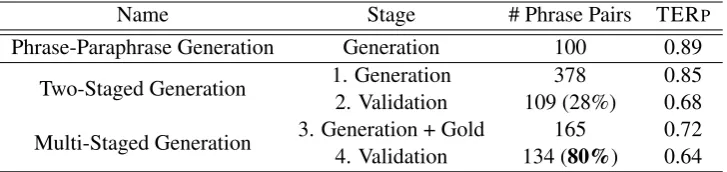
While only 28% of the collected pairs were val-idated after the traditional two-staged paraphrase generation, this percentage increased to 80% in the second validation stage belonging to the multi-stage approach. Although the experiment was conducted on a small number of phrases, this re-sult is a good indicator that our hypothesis is cor-rect and that a combined generation and verifi-cation stage with gold items can reduce costs by early exclusion of low-accuracy workers.
Lexical divergence measures (TERP) decline, but this is expected after filtering out pos-sibly highly divergent non-paraphrastic pairs. While our generation costs per non-validated sub-sentential paraphrase were around the same as those reported by Buzek et al. (2010) (0.024$), the costs for validated sub-sentential paraphrases were not much higher (0.06$). Negri et al. (2012) report costs of 0.27$ per sentential paraphrase, however these costs are difficult to compare, also because we did not optimize for lexical divergence.
3.4 Crowdsourcing Semantic Similarity Evaluation
We conducted an experiment in order to determine how to optimally query continuous semantic sim-ilarity scores from crowdworkers. The two dif-ferent examined methods originally proposed by Madnani et al. (2012) are binary and senary8 se-mantic similarity evaluation. Paraphrases were taken from the MSRPC. Optimality was defined by two different criteria: First, we analysed how well the (binary) paraphrase classification by do-main experts on the MSRPC can be reproduced
8senary:{0,1,2,3,4,5}as opposed to binary{0,1}.
from our collected judgements. Second, we anal-ysed how consistent our collected judgements are. Since we could not find any reference corpus for semantic similarity evaluation apart from the SEMEVAL-2012 STS gold that was also acquired via crowdsourcing, we resorted to training a ma-chine learning classifier and comparing relative performance on the collected training data.
3.4.1 Binary Semantic Similarity
Crowdworkers were asked to give a binary clas-sification of two phrases as either paraphrastic or non-paraphrastic. Binary decisions were enforced since no third option was given. Three examples of valid paraphrases were given.
A minimum of 20 judgements each for 207 phrase pairs were collected for 0.01$ per judge-ment. In order to deter spammers and the most in-accurate workers, we converted 14% of the phrase pairs - those with high expected inter-rater agree-ment - to gold items. Low inter-rater agreeagree-ment on a phrase pair hinted at medium, high inter-rater agreement hinted at low or high semantic similar-ity. Trusted crowdworkers had an average gold ac-curacy of 93% on these gold items.
3.4.2 Senary Semantic Similarity
Crowdworkers were asked to give a senary clas-sification of two phrases. The six classes were equivalent to those defined by the SemEval STS task. A short annotation guide consisting of one example per category was provided.
A minimum of 8 judgements each for 667 phrase pairs were collected for 0.02$ per judge-ment. In order to deter spammers and the most in-accurate workers, we converted 13% of the phrase pairs to gold items. Gold items were accepted as long as the judgement lay within an acceptable range of an expected similarity value.
3.4.3 Input Aggregation and Normalization
The following two phrase pairs demonstrate the relationship between binary inter-rater agreement and aggregated senary semantic similarity:
1. „It appears that many employers accused of workplace discrimination will be considered guilty until they can prove themselves inno-cent," he said.
Name Stage # Phrase Pairs TERP
Phrase-Paraphrase Generation Generation 100 0.89
Two-Staged Generation 1. Generation 378 0.85 2. Validation 109 (28%) 0.68
[image:6.595.118.482.62.148.2]Multi-Staged Generation 3. Generation + Gold 165 0.72 4. Validation 134 (80%) 0.64
Table 1: Two-staged (1. - 2.) and multi-staged (1. - 4.) paraphrase generation results. Percentage values denote the amount of validated pairs relative to the preceding generation stage.
2. Sixteen days later, as superheated air from the shuttle’s reentry rushed into the damaged wing, "there was no possibility for crew survival," the board said.
Sixteen days later, as superheated air from the shuttle’s re-entry rushed into the damaged wing, there was no possibility for crew survival, the board said.’
The binary inter-rater agreement for the first phrase pair is low (10%), so crowdworkers seem-ingly could not decide between paraphrastic and non-paraphrastic. Accordingly, the averaged senary semantic similarity takes an intermediate value (3.4).
The binary inter-rater agreement for the sec-ond phrase pair however is very high (100%), so we expect the sentences to be either clearly non-paraphrastic or clearly non-paraphrastic. A maximal averaged senary semantic similarity value of 5.0 confirms this intuition.
In order to make aggregated binary and senary input comparable, we scaled the binary judge-ments so that the sampled average and variance matched that of the senary judgements. These semantic similarities are strongly correlated (3a) with Pearson coefficient of 0.81 and seem to re-spect the MSRPC expert annotator rating with positive correlation between aggregated semantic similarity and binary MSRPC classification.
With reference to Denkowski and Lavie (2010), we used the following aggregation and normaliza-tion techniques:
Straight Average The aggregated semantic sim-ilarity is the average of all collected judge-ments. This is our baseline approach.
Judge Normalization To compensate for differ-ent evaluation standards, each judge’s judge-ments are scaled so that its sample average and variance matches that of the average (3b).
Judge Outlier Removal Removing judges whose inter-rater agreement with the average is less than 0.5; motivated by Agirre et al. (2012): “Given the high quality of the annotations among the turkers, we could alternatively use the correlation between the turkers itself to detect poor quality annotators”.
Weighted Voting Each judge’s judgements are weighted by its inter-rater agreement with the average.
We also wanted to know whether limiting the amount of possible HITs or judgements per crowdworker could increase the quality of the collected judgements. However, while high-throughput crowdworkers showed lower variance in their agreement compared to crowdworkers with a small number of completed HITs, correla-tion between the number of completed HITs and agreement was very weak (3c) with Pearson coef-ficient of 0.01.
3.4.4 Machine Learning Evaluation
1 2 3 4 5 1
2 3 4 5
Senary Semantic Similarity
Bi
n
a
ry
Se
ma
n
ti
c
Si
mi
la
ri
ty
(a) Correlation between aggregated senary and binary semantic similar-ity (black = paraphrases according to MSRPC)
0 5 10 15
0 1 2 3 4 5
Phrase Pair
Ju
d
g
e
me
n
t
Judge Average Normalized
(b) Judge normalization
0 200 400 600
−0.2 0 0.2 0.4 0.6 0.8 1 1.2
Number of HITs
Agreement
[image:7.595.328.505.288.363.2](c) The activity of a crowdworker does not correlate with agreement to the aver-age
Figure 3: Input aggregation and normalization
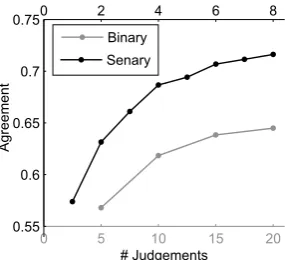
machine learning classifier performs best when trained on semantic similarity data collected on a senary scale (4). Even if we only take the first three senary judgements per phrase pair into ac-count, it is still superior to 20 binary judgements although the total amount of information queried from the crowdworkers is much smaller.
In a second step, we compared the perfor-mance while employing different input normaliza-tion techniques on the whole set of 667 phrase pairs with senary judgements. While all tech-niques increased the trained classifier’s perfor-mance, weighted voting performed best (2).
0 5 10 15 20
0.55 0.6 0.65 0.7 0.75
# Judgements
0 2 4 6 8
Ag
re
e
me
n
t
Binary
Senary
Figure 4: Machine learning results (agreement = correlation with training data)
3.4.5 MSRPC Evaluation
In addition to the machine learning evaluation, we compared our results to the binary semantic simi-larity classification given by the MSRPC expert annotators. In order to do so, we had to find an optimal threshold in[0,5]splitting our seman-tic similarity range in two, dividing
paraphras-Technique Correlation
Straight Average 0.716 Judge Outlier Removal 0.719 Judge Normalization 0.721 Weighted Voting 0.722
Table 2: Input normalization results
tic from non-paraphrastic phrase pairs. Again, this was repeated multiple times while varying the number of judgements used in the aggrega-tion of the semantic similarity values. However, this time we did not simply take the first n judge-ments each, but averaged over different possible sampling combinations. We measured percentage agreement with MSRPC and the optimal thresh-old for non-weighted and weighted judgements, since weighted voting performed best in the ma-chine learning evaluation (5c).
Surprisingly, even for binary paraphrastic-non-paraphrastic classification, querying a senary se-mantic similarity value from crowdworkers yields better results than directly asking for a binary clas-sification. However, the results also indicate that in both cases, input normalization plays an im-portant role and agreement could be improved by more sophisticated or combined input normaliza-tion techniques as well as by collecting addinormaliza-tional judgements.
[image:7.595.108.251.476.606.2]0 1 2 3 4 5 0
20 40 60 80
(a) Optimal threshold for senary semantic similarity is 3.1
0 1 2 3 4 5
0 50 100 150
(b) Optimal threshold for binary semantic similarity is 3.5
0 4 8 12 16 20
0.78 0.8 0.82 0.84 0.86 0.88
# Judgements
Ag
re
e
me
n
t
Binary Senary Weighted Weighted
0 2 4 6 8 10
[image:8.595.96.513.80.236.2](c) Average agreement with MSRPC with optimal threshold per number of judgements
Figure 5: MSRPC evaluation (agreement = percentual agreement with aggregated judgements)
(senary, 8 judgements) compared to 0.20$ for the SEMEVAL-2012 STS task (senary, 5 judgements). However, we did not examine how this and possi-ble further cost reduction impacts agreement with MSRPC.
4 Conclusion
We presented a multi-stage crowdsourcing ap-proach tackling the problem of missing gold in paraphrase generation. This approach has shown to work very well for sub-sentential paraphrase generation and we strongly believe that it will work equally well for sentential paraphrase gen-eration, resulting in significantly reduced costs of paraphrase corpus creation.
We also compared different crowdsourcing ap-proaches towards semantic similarity evaluation, showing that for both semantic similarity evalua-tion on a continuous and a binary scale, querying an ordinal senary semantic similarity value from crowdworkers yields better results than directly asking for a binary classification.
5 Future Work
Our goal to sub-sentential paraphrase generation was cost minimization by early removal of low-accuracy workers. Apart from being grammatical and paraphrastic, we did not enforce other qual-ity constraints on the collected data. A combina-tion of our multi-stage approach with that of Ne-gri et al. (2012) could prove successful if both cost and quality, i.e. lexical divergence between phrase-paraphrase pairs, are to be optimized.
There is also room for reducing the cost of the verification stage e.g. by automatically
filter-ing out paraphrases before presentfilter-ing them to a crowdworker using e.g. lexical divergence, length of the sentence or other measures as it was done by Burrows et al. (2013).
Another interesting question we could not an-swer due to budget constraints is: Can the crowd replace the expert and if yes, how many crowd-workers are needed to do so reliably? One pos-sible way to answer this question for paraphrase evaluation would be to collect semantic similarity judgements for the whole MSRPC and to see how many judgements per phrase are needed to reliably reproduce the MSRPC classification results with an inter-rater agreement of 84% for the whole cor-pus.
Acknowledgements
The authors would like to thank Chris Biemann of TU Darmstadt, Germany, for pointing us to the problem of paraphrase evaluation via crowdsourc-ing leadcrowdsourc-ing to this research as well as his supervi-sion and helpful suggestions. We also thank our reviewers for their feedback.
References
Colin Bannard and Chris Callison-Burch. 2005. Para-phrasing with bilingual parallel corpora. In Pro-ceedings of the 43rd Annual Meeting on Association for Computational Linguistics, ACL ’05, pages 597– 604, Stroudsburg, PA, USA. Association for Com-putational Linguistics.
Daniel Bär, Chris Biemann, Iryna Gurevych, and Torsten Zesch. 2012. Ukp: Computing seman-tic textual similarity by combining multiple content similarity measures. InProceedings of the 6th In-ternational Workshop on Semantic Evaluation, held in conjunction with the 1st Joint Conference on Lex-ical and Computational Semantics, pages 435–440, Montreal, Canada, Jun.
Houda Bouamor, Aurélien Max, Gabriel Illouz, and Anne Vilnat. 2012. A contrastive review of paraphrase acquisition techniques. In Proceed-ings of the Eight International Conference on Lan-guage Resources and Evaluation (LREC’12), Istan-bul, Turkey, may.
Ram Boukobza and Ari Rappoport. 2009. Multi-word expression identification using sentence surface fea-tures. In Proceedings of the 2009 Conference on Empirical Methods in Natural Language Process-ing, pages 468–477, Singapore, August. Association for Computational Linguistics.
Steven Burrows, Martin Potthast, and Benno Stein. 2013. Paraphrase Acquisition via Crowdsourcing and Machine Learning. Transactions on Intelligent Systems and Technology (ACM TIST) (to appear).
Olivia Buzek, Philip Resnik, and Benjamin B. Beder-son. 2010. Error driven paraphrase annotation using mechanical turk. InProceedings of the NAACL HLT 2010 Workshop on Creating Speech and Language Data with Amazon’s Mechanical Turk, CSLDAMT ’10, pages 217–221, Stroudsburg, PA, USA. Associ-ation for ComputAssoci-ational Linguistics.
David L. Chen and William B. Dolan. 2011. Collect-ing highly parallel data for paraphrase evaluation. In
Proceedings of the 49th Annual Meeting of the As-sociation for Computational Linguistics, pages 190– 200, Portland, Oregon, USA, June.
Michael Denkowski and Alon Lavie. 2010. Ex-ploring normalization techniques for human judg-ments of machine translation adequacy collected using amazon mechanical turk. In Proceedings of the NAACL HLT 2010 Workshop on Creating Speech and Language Data with Amazon’s Mechan-ical Turk, CSLDAMT ’10, pages 57–61, Strouds-burg, PA, USA. Association for Computational Lin-guistics.
William B. Dolan and Chris Brockett. 2005. Auto-matically constructing a corpus of sentential para-phrases. InThird International Workshop on Para-phrasing (IWP2005). Asia Federation of Natural Language Processing.
Mark Dras. 1999. Tree Adjoining Grammar and the Reluctant Paraphrasing of Text. Ph.D. thesis, Mac-quarie University.
Christiane Fellbaum, Alexander Geyken, Axel Herold, Fabian Koerner, and Gerald Neumann. 2006. Corpus-based Studies of German Idioms and Light Verbs. International Journal of Lexicography, 19(4):349–360, December.
Samuel Fernando and Mark Stevenson. 2008. A se-mantic similarity approach to paraphrase detection. InProceedings of the 11th Annual Research Collo-quium of the UK Special Interest Group for Compu-tational Linguistics.
Dekang Lin and Patrick Pantel. 2001. Discovery of inference rules for question-answering. Nat. Lang. Eng., 7(4):343–360, December.
Nitin Madnani, Joel Tetreault, and Martin Chodorow. 2012. Re-examining machine translation metrics for paraphrase identification. InProceedings of the 2012 Conference of the North American Chapter of the Association for Computational Linguistics: Human Language Technologies, NAACL HLT ’12, pages 182–190, Stroudsburg, PA, USA. Association for Computational Linguistics.
Erwin Marsi and Emiel Krahmer. 2010. Automatic analysis of semantic similarity in comparable text through syntactic tree matching. In Proceedings of the 23rd International Conference on Computa-tional Linguistics (Coling 2010), pages 752–760, Beijing, China, August. Coling 2010 Organizing Committee.
Matteo Negri, Yashar Mehdad, Alessandro Marchetti, Danilo Giampiccolo, and Luisa Bentivogli. 2012. Chinese whispers: Cooperative paraphrase acqui-sition. In Proceedings of the Eight International Conference on Language Resources and Evaluation (LREC’12), Istanbul, Turkey, may.
Martin Potthast, Alberto Barrón-Cedeño, Andreas Eiselt, Benno Stein, and Paolo Rosso. 2010. Overview of the 2nd international competition on plagiarism detection.Notebook Papers of CLEF, 10.
Matthew G Snover, Nitin Madnani, Bonnie Dorr, and Richard Schwartz. 2009. Ter-plus: Paraphrase, se-mantic, and alignment enhancements to translation edit rate. Machine Translation, 23(2):117–127.
Richard Socher, Eric H. Huang, Jeffrey Pennington, Andrew Y. Ng, and Christopher D. Manning. 2011. Dynamic Pooling and Unfolding Recursive Autoen-coders for Paraphrase Detection. In Advances in Neural Information Processing Systems 24.