Is there syntactic adaptation in language comprehension?
Alex B. Fine, Ting Qian, T. Florian Jaeger and Robert A. Jacobs Department of Brain and Cognitive Sciences
University of Rochester Rochester, NY, USA
{afine, tqian, fjaeger, robbie}@bcs.rochester.edu
Abstract
In this paper we investigate the manner in which the human language comprehension system adapts to shifts in probability dis-tributions over syntactic structures, given experimentally controlled experience with those structures. We replicate a classic reading experiment, and present a model of the behavioral data that implements a form of Bayesian belief update over the course of the experiment.
1 Introduction
One of the central insights to emerge from ex-perimental psycholinguistics over the last half century is that human language comprehension and production are probability-sensitive. Dur-ing language comprehension, language users ex-ploit probabilistic information in the linguistic sig-nal to make inferences about the speaker’s most likely intended message. In syntactic compre-hension specifically, comprehenders exploit statis-tical information about lexical and syntactic co-occurrence statistics. For instance, (1) is temporar-ily ambiguous at the noun phrasethe study, since the NP can be parsed as either the direct object (DO) of the verb acknowledge or as the subject NP of a sentence complement (SC).
(1) The reviewers acknowledged the study...
• DO: ... in the journal.
• SC: ... had been revolutionary. The ambiguity in the SC continuation is resolved athad been, which rules out the direct object in-terpretation of the study. Reading times at had been—the so-called point of disambiguation—are correlated with a variety of lexical-syntactic prob-abilities. For instance, if the probability of a SC is low, given the verb, subjects aregarden-pathed and will display longer reading times athad been.
Conversely, if the probability of a SC is high, the material at the point of disambiguation is rela-tively unsurprising (i.e. conveys less information), and reading times will be short. Readers are also sensitive to the probability of the post-verbal NP occurring as the direct object of the verb. This is often discussed in terms ofplausibility—in (1),the studyis a plausible direct object ofacknowledge (relative to, say,the window), which will also con-tribute to longer reading times in the event of a SC continuation (Garnsey et al., 1997).
Thus, humans make pervasive use of proba-bilistic cues in the linguistic signal. A question that has received very little attention, however, is how language users maintain or update their rep-resentations of the probability distributions rele-vant to language use, given new evidence—a phe-nomenon we will call adaptation. That is, while we know that language users have access to lin-guistic statistics, we know little about the dynam-ics of this knowledge in language users: is the probabilistic information relevant to comprehen-sion derived from experience during a critical pe-riod of language acquisition, or do comprehenders update their knowledge on the basis of experience throughout adulthood? A priori, both scenarios seem plausible—given the sheer number of cues relevant to comprehension, it would be advanta-geous to limit the resources devoted to acquiring this knowledge; on the other hand, any learner’s linguistic experience is bound to be incomplete, so the ability to adapt to novel distributional patterns in the linguistic input may prove to be equally use-ful. The goal of this paper is to explore this is-sue and to take an initial step toward providing a computational framework for characterizing adap-tation in language processing.
1.1 Adaptation in Sentence Comprehension
Both over time and across situations, humans are exposed to linguistic evidence that, in principle,
ought to lead to shifts in our representations of the relevant probability distributions. An efficient lan-guage processing system is expected to take new evidence into account so that behavior (decisions during online production, predictions about up-coming words, etc.) will be guided by accurate es-timates of these probability distributions. At least at the level of phonetic perception and produc-tion, there is evidence that language users quickly adapt to the statistical characteristics of the am-bient language. For instance, over the course of a single interaction, the speech of two interlocu-tors becomes more acoustically similar, a phe-nomenon known as spontaneous phonetic imita-tion (Goldinger, 1998). Perhaps even more strik-ingly, Clayards et al. (2008) demonstrated that, given a relatively small number of tokens, compre-henders shift the degree to which they rely on an acoustic cue as thevariance of that cue changes, reflecting adaptation to the distributions of proba-bilistic cues in speech perception.
At the level of syntactic processing, belief up-date/adaptation has only recently been addressed (Wells et al., 2009; Snider and Jaeger, in prep). In this study, we examine adaptation at the level of syntactic comprehension. We provide a computa-tional model of short- to medium-term adaptation to local shifts in the statistics of the input. While the Bayesian model presented can account for the behavioral data, the quality of the model depends on how control variables are treated. We discuss the theoretical and methodological implications of this result.
Section 2 describes the behavioral experiment, a slight modification of the classic reading experi-ment reported in Garnsey et al. (1997). The study reported in section 3 replicates the basic findings of (Garnsey et al., 1997). In sections 4 and 5 we outline a Bayesian model of syntactic adapta-tion, in which distributions over syntactic struc-tures are updated at each trial based on the ev-idence in that trial, and discuss the relationship between the model results and control variables. Section 6 concludes.
2 Behavioral Experiment
2.1 Participants
Forty-six members of the university community participated in a self-paced reading study for pay-ment. All were native speakers of English with normal or corrected to normal vision, based on
self-report.
2.2 Materials
Subjects read a total of 98 sentences, of which 36 were critical items containing DO/SC ambiguities, as in (1). These 36 sentences comprise a subset of those used in Garnsey et al. (1997). The stim-uli were manipulated along two dimensions: first, verbs were chosen such that the conditional prob-ability of a SC, given the verb, varied. In Garnsey et al. (1997), this conditional probability was es-timated from a norming study, in which subjects completed sentence fragments containing DO/SC verbs (e.g.the lawyer acknowledged...). We adopt standard psycholinguistic terminology and refer to this conditional probability as SC-bias. The verbs used in the critical sentences in Garnsey et al. (1997) were selected to span a wide range of SC-bias values, from .01 to .9. Each sentence con-tained a different DO/SC verb. In addition to SC-bias, half of the sentences presented to each sub-ject included the complementizerthat, as in (2).
(2) The reviewers acknowledged that the study had been revolutionary.
Sentences with a complementizer were included as an unambiguous baseline (Garnsey et al. 1997). The presence of a complementizer was counter-balanced, such that each subject saw half of the sentences with a complementizer and all sen-tences occurred with and without a complemen-tizer equally often across subjects. All of the criti-cal sentences contained a SC continuation. The 36 critical items were interleaved with 72 fillers that included simple transitives and intransitives.
2.3 Procedure
com-prehension question followed all experimental and filler sentences.
2.4 Analysis
In keeping with standard procedure, we used length-corrected residual per-word reading times as our dependent measure. Following Garnsey et al. (1997), we define the point of disambiguation in the critical sentences as the two words follow-ing the post-verbal NP (e.g. had beenin (1) and (2)). All analyses reported here were conducted on residual reading times at this region. For a given subject, residual reading times more than two stan-dard deviations from that subject’s mean residual reading time were excluded.
3 Study 1
Residual reading times at the point of disambigua-tion were fit to a linear mixed effects regression model. This model included the full factorial de-sign (i.e. all main effects and all interactions) of logged SC-bias (taken from the norming study re-ported in Garnsey et al. 1997) and complemen-tizer presence. Additionally, the model included random intercepts of subject and item. This was the maximum random effect structure justified by the data, based on comparison against more com-plex models.1 All predictors in the model were
centered at zero in order to reduce collinearity. P-values reported in all subsequent models were calculated using MCMC sampling (where N = 10,000).
3.1 Results
This model replicated the findings reported by Garnsey et al. (1997). There was a significant main effect of complementizer presence (β =
−3.2, t = −2.5, p < .05)—reading times at
the point of disambiguation were lower when the complementizer was present. Additionally, there was a significant two-way interaction be-tween complementizer presence and logged SC-bias (β = 3.0, t = 2.5, p < .05)—SC-bias has a
stronger negative correlation with reading times in the disambiguating region when the complemen-tizer is absent, as expected. Additionally, Gar-nsey et al. (1997) found a main effect of SC-bias. For us, this main effect did not reach significance
1For a detailed description of the procedure used,
see http://hlplab.wordpress.com/2009/05/14/random-effect-should-i-stay-or-should-i-go/
(β =−1.2, t=−1.11, p=.5), possibly owing to
the fact that we tested a much smaller sample than Garnsey et al. (1997) (51 compared to 82 partici-pants).
4 Study 2: Bayesian Syntactic Adaptation
Reading times at the point of disambiguation in these stimuli reflect, among other things, sub-jects’ estimates of the conditional probability
p(SC|verb)(Garnsey et al. 1997), which we have
been calling SC-bias. Thus, we model the task fac-ing subjects in this experiment as one of Bayesian inference, where subjects are, when reading a sen-tence containing the verbvi, inferring a posterior
probability P(SC|vi), i.e. the probability that a
sentence complement clause will follow a verbvi.
According to Bayes rule, we have:
p(SC|vi) = p(vi|SC)p(SC)
p(vi) (1)
In Equation (1), we use the relative frequency ofvi(estimated from the British National Corpus)
as the estimate forp(vi). The first term in the
nu-merator,p(vi|SC), is the likelihood, which we
es-timate by using the relative frequency ofviamong
all verbs that can take a sentence complement as their argument. These values are taken from the corpus study by Roland et al. (2007). Roland et al. (2007) report, among other things, the number of times a SC occurs as the argument of roughly 200 English verbs. These values are reported across a number of corpora. We use the values from the BNC to computep(vi|SC).
The prior probability of a sentence complement clause, p(SC), is the estimate of interest in this
study. We hypothesize that, under the assumptions of the current model, subjects update their esti-mate for p(SC) based on the evidence presented
in each trial. As a result, the posterior probability varies from trial to trial, not only because the verb used in each stimulus is different, but also because the belief about the probability of a sentence com-plement is being updated based on the evidence in each trial. We employ the beta-binomial model to simulate this updating process, as described next.
4.1 Belief Update
we predict that subjects will update both the likeli-hoodp(vi|SC)for that verb, as well as the
proba-bilityp(SC). Because each verb occurs only once
for a given subject, the effect of updating the first quantity is impossible to measure in the current ex-perimental paradigm. We therefore focus on mod-eling how subjects update their belief of p(SC)
from trial to trial.
We make the simplifying assumption that the only possible argument that DO/SC verbs can take is either a direct object or a sentence complement clause. Further, subjects are assumed to have an initial belief about how probable a sentence com-plement is, on a scale of 0 to 1. Let θ denote
this probability estimate, andp(θ)the strength of
this estimate. From the perspective of an ideal observer, p(θ) will go up for θ > 0.5 when a
DO/SC verb is presented with a sentence comple-ment as its argucomple-ment. This framework assumes that subjects do not computeθby merely relying
on frequency (otherwise,θwill be simply the
ra-tio between SC and DO structures in a block of trials), but they have a distribution P(θ), where
each possible estimate of θ is associated with a
probability indicating the confidence on that es-timate. In order to make our results comparable to existing models, however, we use the expected value ofP(θ)in each iteration of training as point
estimates. Therefore, for one subject, we have 36 estimatedθˆvalues, each corresponding to the
changed belief after seeing a sentence containing SC in an experiment of 36 trials. Because none of the filler items included DO/SC verbs, we as-sume that filler trials have no effect on subjects’ estimates ofP(θ).
Since all stimuli in our experiment have the SC structure, the general expectation is the distribu-tionP(θ)will shift towards the end whereθ= 1.
Our belief update model tries to capture the shape of this shift during the course of the experiment. Using Bayesian inference, we can describe the up-dating process as the following, where θi
repre-sents a particular belief of the valueθ.
p(θ=θi|obs.) = p(obs.|θ=θi)p(θ=θi)
p(obs.)
= p(obs.|θ=θi)p(θ=θi)
! 1
0
p(obs.|θ)p(θ)dθ
(2)
This posterior probability is hypothesized to re-flect how likely a subject would consider the
prob-ability of SC to beθi after being exposed to one
experimental item. We discretizedθto 100 evenly
spacedθi values, ranging from 0 to 1. Thus, the
denominator can be calculated by marginalizing over the 100θi values. The two terms in the
nu-merator in Equation (2) are estimated in the fol-lowing manner.
Likelihood function p(obs.|θ=θi)is modeled
by a binomial distribution, where the parameters are θi (the probability of observing a SC clause)
and1−θi (the probability of observing a direct
object), and where the outcome is the experimen-tal item presented to the subject. Therefore:
p(obs.|θ=θi) = (
nsc+ndo)!
nsc!ndo!
θnsc
i (1−θi)ndo
(3) In the current experiment,ndois always 0 since
all stimuli contain the SC argument. In addition, between-trial reading time differences are mod-elled at one item a step for each subject so thatnsc
is always 1 in each trial. It is in theory possible to setnscto other numbers.
The prior In online training, the posterior of the previous iteration is used as the prior for the cur-rent one. Nevertheless, the prior p(θ = θi) for
the very first iteration of training needs to be es-timated. Here we assume a beta distribution with parametersα andβ. The probability of the prior
then is:
p(θ=θi) =
θiα−1(1−θi)β−1
B(α, β)
Intuitively,αandβcapture the number of times
subjects have observed the SC and DO outcomes, respectively, before the experiment. In the context of our research, this model assumes that subjects’ beliefs aboutp(SC)andp(DO)are based onα−1
observations of SC andβ−1observations of DO prior to the experiment.
The values of the parameters of the beta distri-bution were obtained by searching through the pa-rameter space with an objective function based on the Bayesian information criterion (BIC) score of a regression model containing the log of the pos-terior computed using the updated prior p(SC),
k∗ln(n), where k is the number of parameters in
the model, n the number of data points, andLis the models data likelihood). Smaller BIC indicate better models. The α and β values yielding the lowest BIC score are used.
In estimatingαandβ, we considered all pairs of
non-negative integers such that both values were below 1000. The values ofαandβused here were
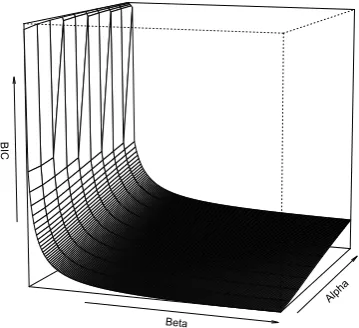
1 and 177, respectively. These values do not im-ply that subjects have seen only 1 SC and 177 DOs prior to the experiment, but that only this many ob-servations inform subjects’ prior beliefs about this distribution. The relationship between the choice of the parameters of the beta distribution, α and β, and the BIC of the model used in the parameter
estimation is shown in Figure 1.
Beta
Alpha
[image:5.595.309.526.69.282.2]BIC
Figure 1: The relationship between the BIC of the model used in the parameter estimation step and values ofαandβin the beta distribution
Because we model subjects’ estimates of
p(SC|vi) in terms of Bayesian inference, with a
continuously updated prior, p(SC), the value of p(SC|vi) depends, in our model, on both
verb-specific statistics (i.e. the likelihoodp(vi|SC)and
the probability of the verbp(vi)) and the point in
the experiment at which the trial containing that verb is encountered. We can visualize this rela-tionship in Figure 2, which shows the values given by the model of p(SC|vi)for four particular
dif-ferent verbs, depending on the point in the experi-ment at which the verb is seen.
The approach we take is hence fundamentally
Presentation Order
Posterior p(SC|v)
0.2 0.4 0.6 0.8
0 10 20 30
confide deny
know
0 10 20 30
[image:5.595.97.277.326.490.2]0.2 0.4 0.6 0.8 print
Figure 2: The relationship, for four of the verbs, between the value ofp(SC|vi)given by the model
as a function ofwhenin the experimentvi is
en-countered
different from the approach commonly taken in psycholinguistics, which is to use static estimates of quantities such asp(SC|vi) derived from
cor-pora or norming studies.
4.2 Analysis
To test whether the model-derived values of
p(SC|vi) are a good fit for the behavioral data,
we fit residual reading times at the point of dis-ambiguation using linear mixed effects regression. The model included main effects ofp(SC|vi)—as
given by the model just described—and comple-mentizer presence, as well as the two-way inter-action between these two predictors. Additionally, there were random intercepts of subject and item.
p(SC|vi)was logged and centered at zero.
4.3 Results
There was a highly significant main effect of the posterior probabilityp(SC|vi) yielded by the
beta-binomial model (β = −40, t = −21.2, p < .001), as well as a main effect of
complemen-tizer presence (−4.5, t = −3.7, p < .001).
The two-way interaction between complementizer presence and the posterior probability from the beta-binomial model did not reach significance (β = 0.5, t = .5, p > .05). The reason is likely
SC-bias is high, the complementizer has less of an effect; in our model, the posterior probabil-ityp(SC|vi)is both generally higher and has less
variance than the same quantity when based on corpus- or norming study estimates, since the prior probabilityp(SC)is continuously increasing over
the course of the experiment. This would have the effect of eliminating or at least obscuring the in-teraction with complementizer presence.
The posterior p(SC|vi) has a much stronger
negative correlation with residual reading times than the measure of SC-bias used in Study 1 (β =
−40as opposed toβ =−1.2).
4.4 Discussion
So far, we have replicated a classic finding in the sentence processing literature (Study 1), provided evidence that subjects’ estimates of the conditional probability p(SC|vi) change based on evidence
throughout the experiment, and that this process is captured well by a model which implements a form of incremental Bayesian belief update. We take this as evidence that the language comprehen-sion system isadaptive, in the sense that language users continually update their estimates of proba-bility distributions over syntactic structures.
5 Syntactic Adaptation vs. Motor Adaptation
The results of the model presented in section 4 are amenable to (at least) two explanations. We have hypothesized that, given exposure to new ev-idence about probability distributions over syn-tactic structures in English, subjects update their beliefs about these probability distributions, re-flected in reading times—a phenomenon we refer to as syntactic adaptation. An alternative explana-tion, however, is one that appeals tomotor adap-tation, rather than syntactic adaptation. Specifi-cally, it could be that subjects are simply adapt-ing to the task—rather than to changes in syntactic distributions—as the experiment proceeds, lead-ing to faster readlead-ing times.
We expect the effect of motor adaptation to be captured by presentation order, or the point in the experiment at which subjects encounter a given stimulus. In particular, we predict a neg-ative correlation between presentation order and reading times. Unfortunately, in the current ex-periment, presentation order andp(SC|vi)derived
from the Beta-binomial model are positively
cor-related (r=.6)—the latter increases with
increas-ing presentation order, since participants only see SC continuations. The results we observed above could hence also be due to an effect of presentation order.
The expectedshapeof a possible effect of task adaptation is not obvious. That is, it is not clear whether the relationship between presentation or-der and reading times will be linear. On the one hand, linearity would be the default assumption prior to theoretical considerations about the dis-tributional properties of presentation order. On the other hand, presentation order is a lower-bounded variable, which often are distributed ap-proximately log-normally. Additionally, it is pos-sible that there may be a floor effect: participants may get used to having to press the space bar to ad-vance to the next word and may quickly get faster at that procedure until RTs converge against the minimal time it takes to program the motor move-ment to press the space bar. Such an effect would likely lead to an approximately log-linear effect of presentation order.
We test for an effect of motor adaptation by ex-amining the effect of presentation order on read-ing times, comparread-ing the effect of linear and log-transformed presentation order.
5.1 Controlling for Presentation Order in the Beta-binomial model
We test for separate effects of syntactic adaptation and motor adaptation by conducting stepwise re-gressions with two models containing the full fac-torial design of the Beta-binomial posterior, com-plementizer presence, and, for the first model, a linear effect of presentation order and, for the second model, log-transformed presentation order. We conducted stepwise regressions using back-ward elimination, starting with all predictors and removing non-significant predictors (i.e. p > .1),
one at a time, until all non-significant predictors are deleted.
is significantly different from zero) as well asχ2 -based tests for significance (i.e. the difference be-tween a model with that predictor and one with-out). Comparing the two resulting models based on the Bayesian Information Criterion, the model containing log-transformed presentation order is a better model than one with a linear effect of pre-sentation order (BIClog = 37467;BICnon−log =
37510).
Pres. order untransformed
Coef. andχ2-based tests
Predictor β p χ2 p
Comp. pres. −4.3 < .05 4.9 < .05 Pres. order −.7 < .001 28.2 < .001
Pres. order log-transformed
Coef. andχ2-based tests
Predictor β p χ2 p
[image:7.595.310.522.295.455.2]Comp. pres. −4.3 < .05 4.8 < .05 Pres. order −33.8 < .001 29.4 < .001
Table 1: Coefficient- and χ2-based tests for
sig-nificance of model resulting from stepwise regres-sion
In sum, the beta-binomial derived posterior ap-pears to have no predictive power after presenta-tion order is controlled for. This result does not depend on how presentation order is treated (i.e. log-transformed or not).
5.2 The interaction between SC-bias and presentation order
The results from the previous section suggest that the Beta-binomial derived posterior carries no pre-dictive power after presentation order is controlled for. Is there any evidence at all for syntactic adap-tation (as opposed to motor, or task, adapadap-tation)?
To attempt to answer this, we analyzed the read-ing data usread-ing the model reported in section 3, with an additional main effect of presentation or-der, as well as the interactions between presenta-tion order and the other predictors in the model. An overall decrease in reading times due to mo-tor adaptation should surface as a main effect of presentation order, as mentioned; syntactic adap-tation, however, is predicted to show up as a two-way interaction between SC-bias and presentation order—since subjects only see SC continuations, subjects should expect this outcome to become more and more probable over the course of the ex-periment, causing the correlation between SC-bias and reading times to become weaker (thus we
pre-dict the interaction to have a positive coefficient). To test for such an interaction, we performed a stepwise regressions with two models contain-ing the full factorial design of SC-bias, comple-mentizer presence, and, for the first model, a lin-ear effect of presentation order and, for the second model, log-transformed presentation order. The stepwise regression procedure here was identical to the one reported in the previous section.
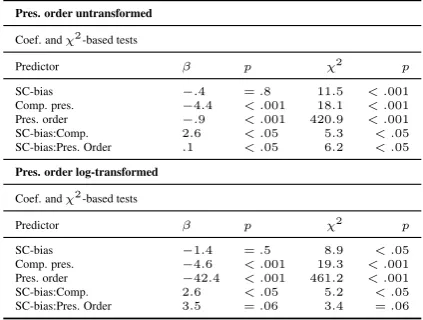
For both models, the remaining predictors were main effects of presentation order, complemen-tizer presence, and SC-bias, as well as a two-way interaction between SC-bias and complementizer presence and a two-way interaction between SC-bias and presentation order. The results of these models are given in Table 2.
Pres. order untransformed
Coef. andχ2-based tests
Predictor β p χ2 p
SC-bias −.4 =.8 11.5 < .001
Comp. pres. −4.4 < .001 18.1 < .001 Pres. order −.9 < .001 420.9 < .001 SC-bias:Comp. 2.6 < .05 5.3 < .05 SC-bias:Pres. Order .1 < .05 6.2 < .05
Pres. order log-transformed
Coef. andχ2-based tests
Predictor β p χ2 p
SC-bias −1.4 =.5 8.9 < .05
Comp. pres. −4.6 < .001 19.3 < .001 Pres. order −42.4 < .001 461.2 < .001 SC-bias:Comp. 2.6 < .05 5.2 < .05 SC-bias:Pres. Order 3.5 =.06 3.4 =.06
Table 2: Coefficient- and χ2-based tests for sig-nificance of model resulting from stepwise regres-sion
The main findings reported in Study 1 (i.e. a main effect of complementizer presence and a two-way interaction between SC-bias and com-plementizer presence) are replicated here, and do not depend on whether presentation order is log-transformed. However, the interaction between SC-bias and presentation order is less reliable when presentation order is log-transformed, reach-ing only marginal significance. In short, an ad-equate account of the data requires reference to both motor adaptation (in the form of a main effect of presentation order, log-transformed) and syn-tactic adaptation.
is the case—a strong negative correlation between presentation order and reading times holds across all regions. Evidence that the observed interac-tion is due to syntactic belief update comes from the fact that the interaction between SC-bias and presentation order, unlike the main effect of pre-sentation order, is limited to the disambiguating region of the sentence. We performed the regres-sion reported above on residual reading times at the main verb (e.g.acknowledge), ambiguous (e.g. the study), and disambiguating (e.g.had been) re-gions. These analyses revealed, as expected, main effects of presentation order across all regions. At the verb and ambiguous regions, however, presen-tation order did not interact with SC-bias.
Region β p−value
Main effect of pres. order
Verb −.95 < .001
Ambig. region −.9 < .001 Disambig. region −.9 < .001 Pres. order X SC-bias interaction
Verb .09 =.24
Ambig. region .04 =.37
Disambig. region .1 < .05
Table 3: Main effect of presentation order and in-teraction of presentation order with SC-bias at dif-ferent regions in the critical sentences
This finding provides initial evidence that sub-jects adapt their linguistic expectations to the evi-dence observed throughout the experiment. How-ever, the interaction between presentation order and SC-bias in this analysis is amenable to an al-ternative interpretation: interactions between pre-sentation order and other variables could emerge if subjects’ reaction times reach some minimum value over the course of the experiment, causing any other variable to become less strongly corre-lated with the dependent measure as reaction times approach that minimum value. Thus this interac-tion could be an artefact of afloor effect.
To test the possibility that the SC-bias-presentation order interaction is the result of a floor effect, we compared the 1st, 5th, and 10th fastest percentiles of residual reading times across all regions. As shown in Figure 3, faster reading times are observed at each quantile in at least one other region. In other words, reading times in the disambiguating region do not seem to be bounded by motor demands associated with the task. We
[image:8.595.306.523.129.338.2]hence tentatively conclude that the interaction be-tween SC-bias and log-transformed presentation order is not the result of a floor effect, although this issue deserves further attention.
Figure 3: Minimum and upper boundary of 1st, 5th, and 10th percentile values of residual reading times across all sentence regions
6 Conclusion
Teasing apart the effects of motor adaptation and linguistic adaptation will require experimen-tal designs in which these two factors are not as highly correlated as in the present study. Ongoing work addresses this issue.
Acknowledgements
The authors wish to thank Neal Snider and mem-bers of the Human Language Processing lab, as well as three anonymous ACL reviewers for help-ful discussion and feedback. We are also very grateful to Jeremy Ferris for help in collecting the data reported here. This work was supported by the University of Rochesters Provost Award for Multidisciplinary Research and NSF grant BCS-0845059 to TFJ.
References
John Anderson. 1990. The adaptive character of thought. Lawrence Erlbaum.
Bock and Griffin. 2000. The persistence of structural priming: Transient activation or implicit learning? Journal of Experimental Psychology, 129(2):177– 192.
Chang, Dell, and Bock. 2006. Becoming syntactic. Psychological Review, 113(2):234–272.
Clayards, Tanenhaus, Aslin, and Jacobs. 2008. Per-ception of speech reflects optimal use of probabilis-tic cues. Cognition, 108:804–809.
Garnsey, Pearlmutter, Myers, and Lotocky. 1997. The contributions of verb bias and plausibility to the comprehension of temporarily ambiguous sen-tences. Journal of Memory and Language, (37):58– 93.
S.D. Goldinger. 1998. Echoes of echoes? an episodic theory of lexical access. Psychological Review, (105):251–279.
Florian Jaeger. in press. Redundancy and reduc-tion: speakers manage syntactic information density. Cognitive Psychology.
Just, Carpenter, and Woolley. 1982. Paradigms and processes in reading comprehension. Journal of Ex-perimental Psychology: General, 111:228–238.
Rohde. 2005. Linger experiment presentation soft-ware. http://tedlab.mit.edu/ dr/Linger/.
Schwarz. 1978. Estimating the dimension of a model. Annals of Statistics, 6:461–464.
Herbert Simon, 1987. 77K New Palgrave Dictionary of Economics, chapter Bounded Rationality, pages 266–268. Macmillan, London.
Neal Snider and Florian Jaeger. in prep.
Thothathiri and Snedeker. 2008. Give and take: Syntactic priming during language comprehension. Cognition, 108:51–68.