Object Search: Supporting Structured Queries in Web Search Engines
Kim Cuong Pham†, Nicholas Rizzolo†, Kevin Small‡, Kevin Chen-Chuan Chang†, Dan Roth†
University of Illinois at Urbana-Champaign† Department of Computer Science
{kimpham2, rizzolo, kcchang, danr}@illinois.edu
Tufts University‡
Department of Computer Science [email protected]
Abstract
As the web evolves, increasing quantities of structured information is embedded in web pages in disparate formats. For example, a digital camera’s description may include its
price and megapixels whereas a professor’s description may include her name, univer-sity, and research interests. Both types of pages may include additional ambiguous in-formation. General search engines (GSEs) do not support queries over these types of data because they ignore the web document semantics. Conversely, describing requi-site semantics through structured queries into databases populated by information extraction (IE) techniques are expensive and not easily adaptable to new domains. This paper de-scribes a methodology for rapidly develop-ing search engines capable of answerdevelop-ing struc-tured queries over unstrucstruc-tured corpora by uti-lizing machine learning to avoid explicit IE. We empirically show that with minimum ad-ditional human effort, our system outperforms a GSE with respect to structured queries with clear object semantics.
1 Introduction
General search engines (GSEs) are sufficient for fulfilling the information needs of most queries. However, they are often inadequate for retrieving web pages that concisely describe real world ob-jects as these queries require analysis of both un-structured text and un-structured data contained in web pages. For example, digital cameras with specific
brand,megapixel, zoom, andpriceattributes might
be found on an online shopping website, or a pro-fessor with her name, university, department, and
research interest attributes might be found on her homepage. Correspondingly, as the web continues to evolve from a general text corpus into a hetero-geneous collection of documents, targeted retrieval strategies must be developed for satisfying these more precise information needs. We accomplish this by using structured queries to capture the intended semantics of a user query and learning domain spe-cific ranking functions to represent the hidden se-mantics of object classes contained in web pages.
It is not uncommon for a user to want to pose an
object query on the web. For example, an online shopper might be looking for shopping pages that sellcanon digital cameras with5 megapixels cost-ing no more than $300. A graduate student might be looking forhomepagesofcomputer science pro-fessors who work in theinformation retrieval area. Such users expect to get a list web pages containing objects they are looking for, orobject pages, which we will define more precisely in later sections.
GSEs rarely return satisfactory results when the user has a structured query in mind for two primary reasons. Firstly, GSEs only handle keyword queries whereas structured queries frequently involve data field semantics (e.g. numerical constraints) and ex-hibit field interdependencies. Secondly, since GSEs are domain-agnostic, they will generally rank cam-era pages utilizing the same functions as a profes-sor’s homepage, ignoring much of the structured in-formation specific to particular domains.
Conversely, vertical search engines (e.g. DBLife, cazoodle.com, Rexa.info, etc.) approach this
lem from the information extraction (IE) perspec-tive. Instead of searching an inverted index directly, they first extract data records from text (Kushmer-ick et al., 1997; McCallum et al., 2000). IE solu-tions, even with large scale techniques (Agichtein, 2005), do not scale to theentireweb and cost signif-icantly more than GSEs. Secondly, creating domain-specific models or wrappers require labeling training examples and human expertise for each individual site. Thirdly, pre-extracting information lacks flexi-bility; decisions made during IE are irrevocable, and at query time, users may find additional value in par-tial or noisy records that were discarded by the IE system.
These issues motivate our novel approach for de-signing a GSE capable of answering complex struc-tured queries, which we refer to as Object Search. At a high level, we search web pages containing structured information directly over their feature in-dex, similarly to GSEs, adding expressivity by re-formulating the structured query such that it can be executed on a traditional inverted index. Thus, we avoid the expense incurred by IE approaches when supporting new object domains. From a techni-cal perspective, this work describes a principled ap-proach to customizing GSEs to answer structured queries from any domain by proposing a composi-tional ranking model for ranking web pages with regards to structured queries and presenting an in-teractive learning approach that eases the process of training for a new domain.
2 The Object Search Problem
The Object Search problem is to find the object pagesthat answer a user’sobject query. An object query belongs to an object domain. An object do-main defines a set of object attributes. An object query is simply a set of constraints over these at-tributes. Thus we define an object query as a tuple ofnconstraintsq ≡c1∧c2∧..∧cn, whereci is a constraint on attributeai. More specifically, a con-straintci is defined as a set of acceptable valuesθi for attributeai; i.e.ci = (ai ∈θi). For example, an equality constraint such as “the brand is Canon” can be specified as (abrand ∈ {Canon}) and a numeric range constraint such as “the price is at most $200” can be specified as (aprice ∈ [0,200]). When the
user does not care about an attribute, the constraint is the constanttrue.
Given an object query, we want a set of satis-fying object pages. Specifically, object pages are pages that represent exactly one inherent object on the web. Pages that list several objects such as a department directory page or camera listing pages are not considered object pages because even though they mentioned the object, they do not represent any particular object. There is often a single object page but there are many web pages that mention the ob-ject.
The goal of Object Search is similar to learning to rank problems (Liu, 2009), in that its goal is to learn a ranking functionρ : D × Q → Rthat ranks any (document, query)pairs. This is accomplished by learning an function over a set of relevant features. Each feature can be modeled as a function that takes the pair and outputs a real valueφ : D × Q → R. For example, a term frequency feature outputs the number of times the query appears in the document. We define a functionΦ = (φ1, φ2, ...φn)that takes a (document, query)pair and outputs a vector of fea-tures. The original ranking function can be written asρ(d, q) = ρ0(Φ(d, q))whereρ0 :Rn→ Ris the function; i.e.:
ρ = ρ0◦Φ (1)
Despite the similarities, Object Search differs from traditional information retrieval (IR) problems in many respects. First, IR can answer only keyword queries whereas an object query is structured by keyword constraints as well as numeric constraints. Second, Object Search results are “focused”, in the sense that they must contain an object, as opposed to the broad notion ofrelevancein IR. Finally, since object pages of different domains might have little in common, we cannot apply the same ranking func-tion for different object domains.
As a consequence, in a learning to rank problem, the set of features Φ are fixed for all query. The major concern is learning the functionρ0. In Object Search settings, we expect differentΦfor each ob-ject domain. Thus, we have to derive both Φand ρ0.
structured information embedded in web pages. In many cases, an object attribute such as professor’s university might appear only once in his homepage. Thus, using a traditional bag-words model is of-ten insufficient, because one cannot distinguish the professor own university from other university men-tioned in his homepage. Second, we will need train-ing data to train a new ranktrain-ing function for each new object domain. Thus, we require an efficient bootstrapping method to tackle this problem. Fi-nally, any acceptable solution must scale to the size of the web. This requirement poses challenges for efficient query processing and efficient ranking via the learned ranking function.
3 Object Search Framework
In this section, we illustrate the primary intuitions behind our aproach for an Object Search solu-tion. We describe its architecture, which serves as a search engine framework to support structured queries of any domain. The technical details of ma-jor components are left for subsequent sections.
3.1 Intuition
The main idea behind our proposed approach is that we develop different vertical search engines to sup-port object queries in different domains. However, we want to keep the cost of supporting each new domain as small as possible. The key principles to keep the cost small are to 1) share as much as pos-sible between search engines of different domains and 2) automate the process as much as possible using machine learning techniques. To illustrate our proposed approach, we suppose that an user is searching the web for cameras. Her object query is q=abrand ∈ {canon} ∧aprice ∈[0,200].
First, we have to automatically learn a functionρ that ranks web pages given an object query as de-scribed in Section 2. We observe web pages rele-vant to the query and notice several salient features such as “the wordcanonappears in the title”, “the word canonappears nearmanufacturer”, “interest-ing words that appear includepowershot,eos,ixus”, and “a price value appears after ’$’ near the word
price or sale”. Intuitively, pages containing these features have a much higher chance of containing the Canon camera being searched. Given labeled
training data, we can learn a ranking function that combines these features to produce the probability of a page containing the desired camera object.
Furthermore, we need to answer user query at query time. We need to be able to look up these features efficiently from our index of the web. A na¨ıve method to index the web is to store a list of web pages that have the above features, and at query time, union all pages that have one or more features, aggregate the score for each web page, and return the ranked result. There are three problems with this method. First, these features are dependent on each object domain; thus, the size of the index will in-crease as the number of domains grows. Second, each time a new domain is added, a new set of fea-tures needs to be indexed, and we have to extract features for every single web page again. Third, we have to know beforehand the list of camera brands, megapixel ranges, price ranges, etc, which is infea-sible for most object domain.
However, we observe that the above query de-pendent features can be computed efficiently from a query independent index. For example, whether “the wordcanonappears nearmanufacturer” can be computed if we index all occurrences of the words
canonandmanufacturer. Similarly, the feature “the wordcanonappears in the title” can be computed if we index all the words from web pages’ title, which only depends on the web pages themselves. Since the words and numbers from different parts of a web page can be indexed independently of the object do-main, we can share them across different domains. Thus, we follow the first principle mentioned above. Of course, computing query dependent features from the domain independent index is more expen-sive than computing it from the na¨ıve index above. However, this cost is scalable to the web. As a mat-ter of fact, these features are equivalent to “phrase search” features in modern search engines.
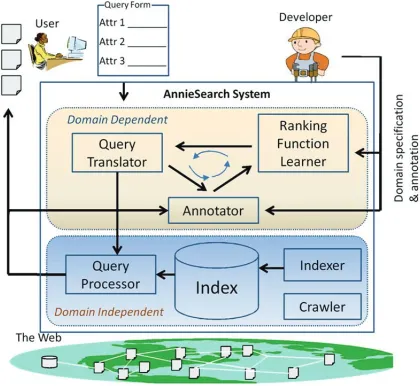
Figure 1: Object Search Architecture
3.2 System Architecture
The main goal of our Object Search system is to en-able searching the web with object queries. In order to do this, the system must address the challenges described in Section 2. From the end-user’s point of view, the system must promptly and accurately return web pages for their object query. From the developer’s point of view, the system must facilitate building a new search engine to support his object domain of interest. The goal of the architecture is to orchestrate all of these requirements.
Figure 1 depicts Object Search architecture. It shows how different components of Object Search interact with an user and a developer. The end-user can issue any object query of known domains. Each time the system receives an object query from the end-user, it translates the query into a domain in-dependent feature query. Then the Query Processor executes the feature query on the inverted index, ag-gregates the features using learned function ρ0, and returns a ranked list of web pages to the user.
The developer’s job is to define his object domain and train a ranking function for it. He does it by incrementally training the function. He starts by an-notating a few web pages and running a learning al-gorithm to produce a ranking function, which is then used to retrieve more data for the developer to anno-tate. The process iterates until the developer is satis-fied with his trained ranking function for the object domain.
More specifically, the Ranking Function Learner
module learns the functionρ0andΦas mentioned in
Section 2. The Query Translator instantiatesΦwith user object queryq, resulting inΦ(q). Recall thatΦ is a set of feature functionsφi. Eachφiis a function of a(d, q)pair such as “term frequency ofakin title” (akis an attribute of the object). Thus we can instan-tiateφ(q)by replacingak withθk, which is part of the query q. For example, if θk = {canon}in the previous example, thenφ(q) is “term frequency of
canonin title”. Thusφ(q)becomes a query indepen-dent feature andΦ(q)becomes a feature query that can be executed in our inverted index by the Query Processor.
4 Learning for Structured Ranking
We now describe how we learn the domain depen-dent ranking function ρ, which is the core learn-ing aspect of Object Search. As mentioned in the previous section, ρ differs from existing learning to rank work due to the structure in object queries. We exploit this structure to decompose the ranking function into several components (Section 4.1) and combine them using a probabilistic model. Exist-ing learnExist-ing to rank methods can then be leveraged to rank the individual components. Section 4.2 de-scribes how we fit individual ranking scores into our probabilistic model by calibrating their probability.
4.1 Ranking model
As stated, ρ models the joint probability distribu-tion over the space of documents and queriesρ = P(d, q). Once estimated, this distribution can rank documents inDaccording to their probability of sat-isfying q. Since we are only interested in finding satisfying object pages, we introduce a variable ω which indicates if the documentdis an object page. Furthermore, we introducenvariablesζi which in-dicate whether constraintci in the queryq is satis-fied. The probability computed byρis then:
P(d, q) = P(ζ1, . . . , ζn, d) = P(ζ1, . . . , ζn, d, ω)
+P(ζ1, . . . , ζn, d, ω)
' P(ω|d) n Y
i=1
P(ζi|d, ω) (3)
Equation 2 holds because non-object pages do not satisfy the query, thus,P(ζ1, . . . , ζn|d, ω) = 0. Equation 3 holds because we assume a uniform dis-tribution overdand conditional independence over ζigivendandω.
Thus, the rest of the problem is estimatingP(ω|d) andP(ζi|d, ω). The difference between these prob-ability estimates lies in the features we use. Sinceω depends only indbut notq, we use query indepen-dent features. Similarly, ζi only depends on dand ci, thus we use features depending onci andd.
4.2 Calibrating ranking probability
In theory, we can use any learning algorithm men-tioned in (Liu, 2009)’s survey to obtain the terms in Equation 3. In practice, however, such learning al-gorithms often output a ranking score that does not estimate the probability. Thus, in order to use them in our ranking model, we must transform that rank-ing score into a probability.
For empirical purposes, we use theaveraged Per-ceptron (Freund and Schapire, 1999) to discrimina-tively train each component of the factored distri-bution independently. This algorithm requires a set of input vectors, which we obtain by applying the relational feature functions to the paired documents and queries. For each constraintci, we have a fea-ture vectorxi= Φi(d, q). The algorithm produces a
weight vector of parameterswias output. The
prob-ability ofcibeing satisfied bydgiven thatdcontains an object can then be estimated with a sigmoid func-tion as:
P(ci|d, ω)≡P(true|Φi(d, q))≡
1 1 +exp(−wT
i xi) (4) Similarly, to estimate P(ω|d), we use a fea-ture vector that is dependent only on d. De-noting the function as Φ0, we have P(ω|d) = P(true|Φ0(d, q)), which can be obtained from (4).
While the sigmoid function has performed well empirically, probabilities it produces are not cali-brated. For better calibrated probabilities, one can apply Platt scaling (Platt, 1999). This method intro-duces two parametersAandB, which can be
com-puted using maximum likelihood estimation:
P(true|Φi(d, q))≡ 1
1 +exp(AwT
i Φi(d, q) +B) (5) In contrast to the sigmoid function, Platt scaling can also be applied to methods that give un-normalized scores such as RankSVM (Cao et al., 2006).
Substituting (4) and (5) into (3), we see that our final learned ranking function has the form
ρ(d, q) = n Y
i=0
1 (1 +exp(AiwT
i Φi(d, q) +Bi)) (6)
5 Learning Based Programming
Learning plays a crucial role in developing a new ob-ject domain. In addition to using supervised meth-ods to learnρ, we also exploit active learning to ac-quire training data from unlabeled web pages. The combination of these efforts would benefit from a unified framework and interface to machine learn-ing. Learning Based Programming (LBP) (Roth, 2005) is such a principled framework. In this sec-tion, we describe how we applied and extended LBP to provide a user friendly interface for the developer to specify features and guide the learning process. Section 5.1 describes how we structured our frame-work around Learning Based Java (LBJ), an instance of LBP. Section 5.2 extends the framework to sup-port interactive learning.
5.1 Learning Based Java
LBP is a programming paradigm for systems whose behaviors depend on naturally occurring data and that require reasoning about data and concepts in ways that are hard, if not impossible, to write explic-itly. This is exactly our situation. Not only do we not know how to specify a ranking function for an object query, we might not even know exactly what features to use. Using LBP, we can specify abstract information sources that might contribute to deci-sions and apply a learning operator to them, thereby letting a learning algorithm figure out their impor-tances in a data-driven way.
function(FGF). This allows the programmer to rea-son in terms of featuretypes, rather than specifying individual features separately, and to treat them as native building blocks in a language for constructing learned functions. For example, instead of specify-ing individual features such as the phrases “profes-sor of”,“product description”, etc., we can specify a higher level feature type called “bigram”, and let an algorithm select individual features for ranking pur-poses.
From the programming point of view, LBJ pro-vides a clean interface and abstracts away the te-dium of feature extraction and learning implemen-tations. This enabled us to build our system quickly and shorten our development cycle.
5.2 Interactive Machine Learning
We advocate an interactive training process (Fails and Olsen, 2003), in which the developer iteratively improves the learner via two types of interaction (Algorithm 1).
The first type of interaction is similar to active learning where the learner presents unlabeled in-stances to the developer for annotation which it be-lieves will most positively impact learning. In rank-ing problems, top ranked documents are presented as they strongly influence the loss function. The small difference from traditional active learning in our setting is that the developer assists this process by also providing more queries other than those en-countered in the current training set.
The second type of interaction is feature selec-tion. We observed that feature selection contributed significantly in the performance of the learner espe-cially when training data is scarce. This is because with little training data and a huge feature space, the learner tends to over-fit. Fortunately in web search, the features used in ranking are in natural language and thereby intuitive to the developer. For example, one type of feature used in ranking the university
constraint of a professor object query is the words surrounding the query field as in “university of ...” or “... university”. If the learner only sees examples from the University of Anystate at Anytown, then it’s likely that Anytown will have a high weight in addition to University and of. However, the Any-townfeature will not generalize for documents from other universities. Having background knowledge
like this, the developer can unselect such features. Furthermore, the fact thatAnytownhas a high weight is also an indication that the developer needs to pro-vide more examples of other universities so that the learner can generalize (the first type of interaction).
Algorithm 1Interactive Learning Algorithm 1: The developer uses keyword search to find and
annotate an initial training set.
2: The system presents a ranked list of features computed from labeled data.
3: The developer adds/removes features.
4: The system learns the ranking function using se-lected features.
5: The developer issues queries and annotates top ranked unlabeled documents returned by the system.
6: If performance is not satisfactory, go to step 2.
The iterative algorithm starts with zero training data and continues until the learner’s performance reaches a satisfactory point. At step 2, the developer is presented with a ranked list of features. To deter-mine which features played the biggest role in the classifier’s decision making, we use a simple rank-ing metric called expected entropy loss (Glover et al., 2001). Let f represent the event that a given feature is active. LetC be the event that the given example is classified as true. The conditional en-tropy of the classification distribution given that f occurs is H(C|f) ≡ −P(C|f) log(P(C|f))−
P(C|f) log(P(C|f)and similarly, whenf does not occur, we replacef byf. The expected entropy loss is
L(C|f) ≡ H(C)−E[H(C|f)] = H(C)−(P(f)H(C|f) +
P(f)H(C|f) (7)
The intuition here is that if the classification loses a lot of entropy when conditioned on a particular feature, that feature must be very discriminative and correlated with the classification itself.
domain # pages train test
homepage 22.1 11.1 11
laptop 21 10.6 10.4
camera 18 9 9
random 97.8 48.9 48.8
[image:7.612.103.269.55.142.2]total 158.9 79.6 79.2
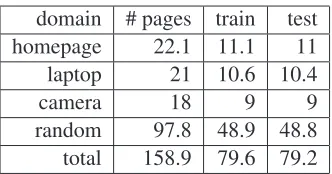
Table 1: Number of web pages (in thousands) collected for experiment
features we use to query the web pages, keeping the number of features small will ensure that searching is fast enough to be useful.
6 Experimental Results
In this section we present an experiment that com-pares Object Search with keyword search engines.
6.1 Experimental Setting
Since we are the first to tackle this problem of an-swering structured query on the web, there is no known dataset available for our experiment. We col-lected the data ourselves using various sources from the web. Then we labeled search results from differ-ent object queries using the same annotation proce-dure described in Section 5.
We collected URLs from two main sources: the open directory (DMOZ) and existing search en-gines (SE). For DMOZ, we included URLs from relevant categories. For SE, we manually entered queries with keywords related to professors’ home-pages, laptops, and digital cameras, and included all returned URLs. Having collected the URLs, we crawled their content and indexed them. Table 1 summarizes web page data we have collected.
We split the data randomly into two parts, one for training and one for testing, and created a single in-verted index for both of them. The developer can only see the training documents to select features and train ranking functions. At testing time, we ran-domly generate object queries, and evaluate on the testing set. Since Google’s results come not from our corpus but the whole web, it might not be fair to compare against our small corpus. To accommodate this, we also added Google’s results into our testing corpus. We believe that most ‘difficult’ web pages that hurt Google’s performance would have been
in-Field Keywords Example Laptop domain
brand laptop,notebook lenovolaptop
processor ghz, processor 2.2ghz
price $, price $1000..1100
Professor domain
name professor,
re-search professor, faculty
research profes-sorscott
university university, uni-versity of
[image:7.612.312.550.56.210.2]stanf ord university
Table 2: Sample keyword reformulation for Google
cluded in the top Google result. Thus, they are also available to test ours. In the future, we plan to im-plement a local IR engine to compare against ours and conduct a larger scale experiment to compare to Google.
We evaluated the experiment with two different domains: professor and laptop. We consider home-pages and online shopping home-pages as object home-pages for the professor and laptop domains respectively.
For each domain, we generated 5 random object queries with different field configurations. Since Google does not understand structured queries, we reformulated each structured query into a simple keyword query. We do so by pairing the query field with several keywords. For example, a query field abrand ∈ {lenovo}can be reformulated as “lenovo laptop”. We tried different combinations of key-words as shown in table 2. To deal with numbers, we use Google’s advanced search feature that sup-ports numeric range queries1. For example, aprice constraintaprice∈[100,200]might be reformulated as “price $100..200”. Since it is too expensive to find the best keyword formulations for every query, we picked the combination that gives the best result for the first Google result page (Top 10 URLs).
6.2 Result
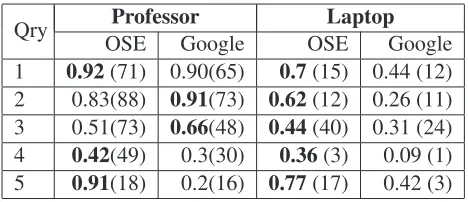
We measure the ranking performance with average precision. Table 3 shows the results for our search engine (OSE) and Google. Our ranking function outperforms Google for most queries, especially in
1
Qry Professor Laptop
OSE Google OSE Google
1 0.92(71) 0.90(65) 0.7(15) 0.44 (12) 2 0.83(88) 0.91(73) 0.62(12) 0.26 (11) 3 0.51(73) 0.66(48) 0.44(40) 0.31 (24)
4 0.42(49) 0.3(30) 0.36(3) 0.09 (1)
[image:8.612.71.305.56.157.2]5 0.91(18) 0.2(16) 0.77(17) 0.42 (3)
Table 3: Average precision for 5 random queries. The number of positive documents are in brackets
the laptop domain. In the professor domain, Google wins in two queries (“UC Berkeley professor” and “economics professors”). This suggests that in cer-tain cases, reformulating to keyword query is a sen-sible approach, especially if all the fields in the ob-ject query are keywords. Even though Google can be used to reformulate some queries, it is not clear how and when this will succeed. Therefore, we need a principled solution as proposed in this paper.
7 Related Work
Many recent works propose methods for supporting structured queries on unstructured text (Jain et al., 2007), (Cafarella et al., 2007), (Gruhl et al., 2004). These works follow a typical extract-then-query ap-proach, which has several problems as we discussed in section 1. (Agichtein, 2005) proposed using sev-eral large scale techniques. Their idea of using spe-cialized index and search engine is similar to our work. However those methods assumes that struc-tured data follows some textual patterns whereas our system can flexibly handle structured object using textual patterns as well as web page features.
Interestingly, the approach of translating struc-tured queries to unstrucstruc-tured queries has been stud-ied in (Liu et al., 2006). The main difference is that SEMEX relies on carefully hand-tuned heuris-tics on open-domain SQL queries while we use ma-chine learning to do the translation on domain spe-cific queries.
Machine Learning approaches to rank documents have been studied extensively in IR (Liu, 2009). Even though much of existing works can be used to rank individual constraints in the structured query. We proposed an effective way to aggregate these ranking scores. Further more, existing learning to
rank works assumed a fixed set of features, whereas, the feature set in object search depends on object domain. As we have shown, the effectiveness of the ranking function depends much on the set of features. Thus, an semi-automatic method to learn these was proposed in section 5.
Our interactive learning protocol inherits features from existing works in Active Learning (see (Set-tles, 2009) for a survey). (Fails and Olsen, 2003) coined the term “interactive machine learning” and showed that a learner can take advantage of user in-teraction to quickly acquire necessary training data. (Roth and Small, 2009) proposed another interactive learning protocol that improves upon a relation ex-traction task by incremetally modifying the feature representation.
Finally, this work is related to document re-trieval mechanisms used for question answering tasks (Voorhees, 2001) where precise retrieval meth-ods are necessary to find documents which con-tain specific information for answering factoids (Agichtein et al., 2001).
8 Conclusion
We introduces the Object Search framework that searches the web for documents containing real-world objects. We formalized the problem as a learning to rank for IR problem and showed an ef-fective method to solve it. Our approach goes be-yond the traditional bag-of-words representation and views each web page as a set of domain independent features. This representation enabled us to rank web pages with respect toobject query. Our experiments showed that, with small human effort, it is possi-ble to create specialized search engines that out-performs GSEs on domain specific queries. More-over, it is possible to search the web for documents with deeper meaning, such as those found inobject pages. Our work is a small step toward semantic search engines by handling deeper semantic queries.
Acknowledgement
References
Eugene Agichtein, Steve Lawrence, and Luis Gravano. 2001. Learning search engine specific query trans-formations for question answering. In WWW ’01: Proceedings of the 10th international conference on World Wide Web, pages 169–178, New York, NY, USA. ACM.
Eugene Agichtein. 2005. Scaling Information Extraction to Large Document Collections. IEEE Data Eng. Bull, 28:3.
Michael Cafarella, Christopher Re, Dan Suciu, and Oren Etzioni. 2007. Structured Querying of Web Text Data: A Technical Challenge. InCIDR.
Yunbo Cao, Jun Xu, Tie-Yan Liu, Hang Li, Yalou Huang, and Hsiao-Wuen Hon. 2006. Adapting Ranking SVM to Document Retrieval. InSIGIR ’06: Proceedings of the 29th annual international ACM SIGIR conference on Research and development in information retrieval, pages 186–193, New York, NY, USA. ACM.
Jerry Alan Fails and Dan R. Olsen, Jr. 2003. Interactive machine learning. InIUI ’03: Proceedings of the 8th international conference on Intelligent user interfaces, pages 39–45, New York, NY, USA. ACM.
Yoav Freund and Robert E. Schapire. 1999. Large Mar-gin Classification Using the Perceptron Algorithm.
Machine Learning, 37(3):277–296.
Eric J. Glover, Gary W. Flake, Steve Lawrence, Andries Kruger, David M. Pennock, William P. Birmingham, and C. Lee Giles. 2001. Improving Category Specific Web Search by Learning Query Modifications. Ap-plications and the Internet, IEEE/IPSJ International Symposium on, 0:23.
D. Gruhl, L. Chavet, D. Gibson, J. Meyer, P. Pattanayak, A. Tomkins, and J. Zien. 2004. How to Build a Web-Fountain: An Architecture for Very Large Scale Text Analytics. IBM Systems Journal.
A. Jain, A. Doan, and L. Gravano. 2007. SQL Queries Over Unstructured Text Databases. InData Engineer-ing, 2007. ICDE 2007. IEEE 23rd International Con-ference on, pages 1255–1257.
N. Kushmerick, D. Weld, and R. Doorenbos. 1997. Wrapper Induction for Information Extraction. In IJ-CAI, pages 729–737.
Jing Liu, Xin Dong, and Alon Halevy. 2006. Answering Structured Queries on Unstructured Data. InWebDB. Tie-Yan Liu. 2009. Learning to Rank for Information
Retrieval. Found. Trends Inf. Retr., 3(3):225–331. Andrew Kachites McCallum, Kamal Nigam, Jason
Ren-nie, and Kristie Seymore. 2000. Automating the Con-struction of Internet Portals with Machine Learning.
Information Retrieval, 3(2):127–163.
J. Platt. 1999. Probabilistic outputs for support vec-tor machines and comparison to regularized likelihood
methods. InIn Advances in Large Margin Classifiers. MIT Press.
N. Rizzolo and D. Roth. 2007. Modeling Discriminative Global Inference. In Proceedings of the First Inter-national Conference on Semantic Computing (ICSC), pages 597–604, Irvine, California, September. IEEE. Dan Roth and Kevin Small. 2009. Interactive feature
space construction using semantic information. In
CoNLL ’09: Proceedings of the Thirteenth Conference on Computational Natural Language Learning, pages 66–74, Morristown, NJ, USA. Association for Com-putational Linguistics.
Dan Roth. 2005. Learning Based Programming. Innova-tions in Machine Learning: Theory and ApplicaInnova-tions. Burr Settles. 2009. Active learning literature survey.
Computer Sciences Technical Report 1648, University of Wisconsin-Madison.