The Linguistics of Readability: The Next Step for Word Processing
Neil Newbold Lee Gillam
University of Surrey University of Surrey
Guildford Guildford
Surrey, GU2 7XH, UK Surrey, GU2 7XH, UK
[email protected] [email protected]
Abstract
In this paper, we present a new approach to writing tools that extends beyond the rudi-mentary spelling and grammar checking to the content of the writing itself. Linguistic meth-ods have long been used to detect familiar lexical patterns in the text to aid automatic summarization and translation of documents. We apply these methods to determine the quality of the text and implement new tech-niques for measuring readability and provid-ing feedback to authors on how to improve the quality of their documents. We take an ex-tended view of readability that considers text cohesion, propositional density, and word fa-miliarity. We provide simple feedback to the user detailing the most and least readable sen-tences, the sentences most densely packed with information and the most cohesive words in their document. Commonly used verbose words and phrases in the text, as identified by The Plain English Campaign, can be replaced with user-selected replacements. Our tech-niques were implemented as a free download extension to the Open Office word processor generating 6,500 downloads to date.
1 Introduction
Spell and grammar checking have become inherent tools in many modern word processors even if their results are not always deemed appropriate. Work on writing tools has largely focused on improving these services, with superior grammar checkers being the emphasis of this work. However, there has been little effort on providing a deeper analysis of the text, such as covering its semantic content
and its potential success in conveying the authors intended message to the reader. Research on read-ability aimed to provide an indication of the pro-portion of the population could understand the text but has been limited to simple checks of word and sentence length providing only some degree of feedback on where and why text is difficult to un-derstand. Writing tools such as ‘Stylewriter’ scores documents based on average sentence length, number of passive verbs and overall style. The style analysis uses an indexes check for a wide variety of common editorial issues like jargon, hy-phenation, sexist writing, clichés, grammar, redun-dancies and troublesome words which are either abstract, complex, misused or overused. However, their approach is based on a simple lookup of common writing patterns with no analysis of over-all message clarity. More robust tools such as ‘Coh-Metrix’ (Graesser et al., 2004) deliver a sub-stantial analysis but can leave casual users con-fused with the quantity of numerical data produced.
2 Background
In principle, readability measures identify some proportion of the population who could comforta-bly read a text. Historically, readability research has focused primarily on producing a numeric evaluation of style of writing to associate textual content to a particular rating or the level of educa-tion of readers. Readability research largely traces its origins to an initial study by Kitson (1921) who demonstrated tangible differences in sentence lengths and word lengths, measured in syllables, between two newspapers and two magazines. Kit-son’s work led variously to the development of readability metrics, many of which are available in certain software applications. Further discussion of these formulae can be found elsewhere (Dubay, 2004). More recent considerations of readability account for reader factors, which consider certain abilities of the reader, and text factors, which con-sider the formulation of the text (Oakland and Lane, 2004). Reader factors include the person’s ability to read fluently, level of prior subject knowledge, lexical knowledge or familiarity with the language, and motivation and engagement. Text factors account to some extent for current readability metrics, but also cover considerations of syntax, lexical selection, idea density, and cog-nitive load. Oakland and Lane’s view of readabil-ity suggest that it may be possible to generically measure the difficulty of text as an artifact, but that “text difficulty” necessitates consideration of each reader. Our work elaborates that of Oakland and Lane in identifying difficulties in the apparently neat separation of the factors. In this section, we propose a new framework for readability that builds on Oakland and Lane by making considera-tion of the relaconsidera-tionship between text, reader, and author. We explore, subsequently, how word proc-essors might use such a framework to help authors get across their intended messages.
2.1 Matching Text to Readers
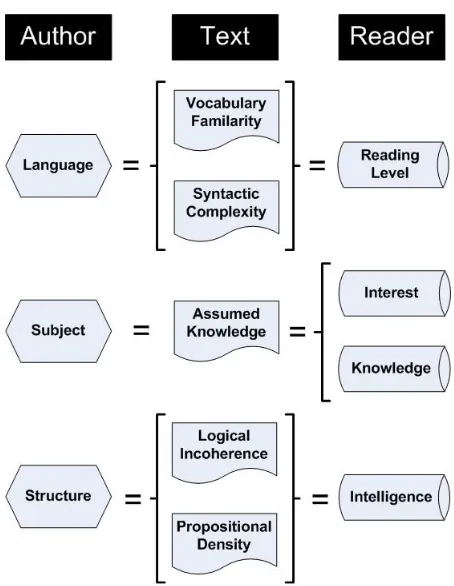
In writing a document, an author has to be mindful of the needs of his anticipated audience, particu-larly if they are to continue reading. There must be some correlation across three principal aspects of a text: the nature and extent of its subject matter, its use of language, and its logical or narrative struc-ture. The audience can be defined by their degree
of interest in the subject, how much they already know about it, their reading ability, and their gen-eral intelligence. If the author needs to learn more about a set of potential readers, standardized tests are available to measure levels of intelligence and reading skill, while interest and prior knowledge can be assessed by ad hoc surveys.
Two kinds of measure are suited to appraising text structure: logical coherence and propositional density. By logical coherence, we mean the extent to which one statement is ordered according to a chain of reasoning, a sequence or chain of events, a hierarchy or a classificatory system. By proposi-tional density we mean the closeness, measured by intervening words, between one crucial idea and the next. The less coherently ordered are it’s the ideas and the greater their density, the larger the cognitive load on the reader.
Figure 1: Matches needed for easy reading
2.2 Language
When matching text to reader, the author needs to consider the level of language and style of writing. This can be described as the vocabulary familiarity and syntactic complexity of the writing. These aspects are generally measured by the existing readability formulas as word length and sentence length. Readability metrics generally determine the difficulty of a word by counting characters or syllables. However, Oakland and Lane suggest that word difficulty can be determined by examin-ing whether the word is challengexamin-ing, unusual or technical, and cite word familiarity as more effec-tive means of measuring word difficulty. The process by which readers develop word familiarity is through their language acquisition and the de-velopment of their language capability. Frequency plays an important role in building knowledge of a language so that it is sufficient to understand its written content. Diessel (2007) showed that lin-guistic expressions stored in a person’s memory are reinforced by frequency so that the language user expects a particular word or word category to
appear with a linguistic expression. These linguis-tic expectations help comprehension.
Frequency was also found to be fundamental in reading fluency as words are only analyzed when they cannot be read from memory as sight words. A limited knowledge of words affects reading flu-ency as readers are likely to dwell over unfamiliar words or grammatical constructions. This impedes the reader’s ability to construct an ongoing inter-pretation of the text. The reading fluency of the reader is dependent on their familiarity with lan-guage. When readers find text populated with un-familiar words it becomes harder for them to read. This is especially prevalent in scientific or techni-cal documents where anyone unfamiliar with the terminology would find the document hard to un-derstand. The terminological nature of specialized documents means that terms will appear with dis-proportionate frequently throughout the documents in contrast to what one would expect to encounter in everyday language. Terminology extraction techniques exploit this relationship to identify terms. We adapt this method by contrasting word frequency within documents with familiarity in general language. We determine the difficulty of a word by its familiarity.
Vocabulary does not tend to exist in isolation. The vocabulary may be well-defined, yet included in overly verbose sentences. Consider these two sentences:
1. “We endeavor to maintain the spinning of all the plates.”
2. “We try to keep all the plates spinning.”
2.3 Subject
To learn from text, a reader needs to associate the new information to their existing knowledge. This task can be helped by the reader’s interest level. Kintsch et al. (1975) showed that we find stories easier to remember than technical texts because they are about human goals and actions, something to which we can all generally relate. Scientific and technical texts require specific knowledge that is often uncommon, making the texts impenetrable to those outside the domain. This suggests that read-ability is not merely an artifact of text with differ-ent readers having contrasting views of difficulty on the same piece of text. Familiarity with certain words depends on experience: a difficult word for a novice is not always the same as a difficult word for an expert. Reader characteristics such as moti-vation and knowledge may amplify or negate prob-lems with difficult text. When matching text to reader, the author needs to consider the target audience and the extent of their knowledge.
Many readability metrics do not make distinc-tions based on the background knowledge of the reader. As discussed in relation to vocabulary, word familiarity can give a better indication of word difficulty than word length. A longer word may only be difficult for a particular reader if un-familiar, and certain shorter words may even be more difficult to understand. Consider a general reader confronted in text discussing a ‘muon’: This short term would be rated as simple by current readability formulae. However, a majority of peo-ple would be unfamiliar with this term, and only physicists are likely to know more about the term, its definition, and related items. One way to meas-ure background knowledge would be to consider the extent of use of known terms in the text with direct consideration of previous documents within the reader’s experience.
Entin and Klare (1985) showed that more read-able text is beneficial for those with less knowl-edge and interest. In their study, students were presented with written material below their reading level. When the reader’s interest was high, text below their grade level did not improve compre-hension. However, when the reader’s interest was low their comprehension was improved by simpler text. This suggests that more readable text im-proves comprehension for those less interested in the subject matter. We consider the need to
cap-ture and analyze the user’s experience with prior documents as a proxy for reader knowledge and motivation. Given a reading history for a user, we might next build their personalized vocabulary with frequency information, and therefore measure familiarity with words on an individual basis. In the same way that an expert is familiar with the terminology of their subject, we can reflect the background knowledge required by a reader to in-terpret the text correctly. When matching text to reader, word difficulty should be measured, if the information is available, on an individual basis.
2.4 Structure
Well-written text requires a structure that readers can readily use to find the information they need and to understand it correctly. Text can become confusing when information is inappropriately pre-sented. Most sentences, when taken out of context, can become multiply ambiguous. When we read text, we build a collection of the concepts de-scribed within it. We identify these concepts with words and phrases using pragmatic, semantic, and syntactic features. We build certain interpretations with these blocks of words that tend not to com-bine randomly or freely, but rather they keep pre-ferred company (Firth, 1957). These collocations are evidence of preference for certain friends, and these friends may be kept at certain distances. For example, words impose restrictions over syno-nyms, excluding some from their group of friends so that ‘strong tea’ may be acceptable, but ‘power-ful tea’ may not. A reader unfamiliar with such constructions might not understand the precise meanings or variations. In addition, individual words may not be particularly difficult but their combination may produce different meanings to the component words. Collocation statistics may indicate compound nouns with specialized mean-ing but increased likelihood of misinterpretation. Consider, for example, ‘glass crack growth rate’: each word should be relatively easy to understand, but interpretations due to bracketing (Pustejovsky et al., 1994) might lead to interpretations of a ‘crack growth rate’ made of ‘glass’, and an un-packing of semantics may be useful in removing ambiguities due to bracketing.
and can be found using statistical measures of as-sociation. Some linguists consider collocations are the building blocks of language, with the whole collocation being stronger than the sum of its parts. They describe collocations as lexical items that represent uniquely identifiable concepts or seman-tic units. Smadja (1993) elaborated criteria for a collocation, describing them as recurring and cohe-sive domain-dependent lexical structures such as ‘stock market’ and ‘interest rate’, and suggested how components can imply collocations, for ex-ample ‘United’ produces an expectation of ‘King-dom’, ‘Nations’, or ‘States’. When frequently combined linguistic expressions develop into a processing unit, many of the linguistic elements are ignored and the whole chunk is compressed and treated as one semantic unit. These units often develop into terms with multiword units represent-ing srepresent-ingular concepts. This relates back to the as-sumed knowledge of the reader. However, for readers unfamiliar with the terms, we have identi-fied two methods called ‘Propositional Density’ and ‘Lexical Incoherence’ for processing semantic units.
When a significant amount of information is conveyed in a relatively small amount of text, the reader can become confused. We identify this problem as ‘Propositional Density’. Although long collocations form semantic units that reduce con-ceptual complexity, problems occur when numer-ous semantic units are described within a short space of each other causing the reader to make numerous inferences. The number of ideas ex-pressed in the text contributes to the work required of the reader to interpret the text correctly. Pro-positional density may be measurable by examin-ing the quantity of objects within short distances of each other. These objects can be labeled with sin-gle nouns or multi-word expressions. By measur-ing the number of unique semantic units, we can approximate the workload required for processing or interpreting the text correctly.
The second problem with text structure is called ‘Lexical Incoherence’ and occurs when writers present new information to the reader without making clear its relationship to previous informa-tion. The writer assumes that they have provided enough information to allow readers to follow their arguments logically. Repetition of concepts, terms, and other referents provides a structure for the reader to connect with. It is through this
repeti-tion that a series of links can be made between the sentences. There is a relationship here to work on lexical cohesion (Hoey, 1991). If a large number of new, seemingly unrelated ideas are being intro-duced, low cohesion would be expected and meas-urable. Efficiency can be increased here by using synonyms. Semantic units can be referred to by a number of different labels and by identifying these different labels we can more accurately find the prominent ideas in the text.
3 Open Office Readability Report
To implement our new techniques for measuring readability, we used OpenOffice.org 3, which is the leading open-source office software suite. As it can be downloaded and used free of charge, it has an already established user base and allows third-party developers to write extensions for their applications. These extensions are made available to download for any OpenOffice.org user. We cre-ated the readability report extension for ‘Writer’, the open office word processor, to implement our readability techniques. The extension generates 5 separate components devised from our framework for readability incorporating the matches for easy reading. The components analyze the text factors in the framework to provide an indication of the corresponding reader factor. The author can use this information to help match their text to their audience. Each author and reader element is ad-dressed by a component as follows:
o Language -> Reading Level o Weirdness Measure o SimpleText SmartTags o Subject -> Interest and Knowledge
o Not yet implemented o Structure -> Intelligence
o Propositional Density o Lexical Coherence
3.1 Weirdness Measure
The first generated report uses our new readability formula based on word frequency. Unlike the es-tablished readability formulas, our measure can be applied to an individual sentence, allowing the re-port to highlight the most and least readable sen-tences in the document. We use frequency information from the 100 million word tokens of the British National Corpus (BNC) to act as a ref-erence corpus. The frequency counts for each word along with the number of words in the sen-tence are used to determine the sensen-tence readabil-ity. The score for the document can then be ascertained as an average value for each sentence. We use log and other arbitrary values to bring the final number into a similar range as the other read-ability formulas.
) ) 1 ( ln(
1 .
2
!
+ "
SL GL
GL SL SL
n f
n f
n (1)
Eqn. 1 sentence-based familiarity
f is word frequency, nis word count at sentence level (SL) or corpus level (GL).
Based on research by Stuart et al., (2004) con-cerning the frequency of use of apostrophes by children, contractions such as “n’t” and “’s” were considered as separate words with their difficulty determined by their frequency count as per any other word. This method for analyzing contrac-tions generated more effective results from the BNC.
In addition, to the weirdness measure the report provided the scores from the established readabil-ity formulas, ‘Flesch Easy Reading’, ‘Flesch Kin-caid’, ‘FOG’, ‘SMOG’ and ‘ARI’. To help authors understand the significance of the readability val-ues, a series of ratings were provided for each measure (inc. Weirdness), which grade a document as either ‘Simple’, Easy’, ‘Good’, ‘Challenging’ or ‘Difficult’ using a series of threshold values.
3.2 SimpleText SmartTags
SmartTags were developed in Open Office to high-light sections of documents and add contextual information. The readability report extension uses SmartTags to highlight difficult words and phrases
in the text, as identified by
http://www.plainenglish.co.uk/. The ‘SimpleText SmartTags’ provide suitable alternatives for these phrases which can be inserted automatically into the text. The user can click on the SmartTags and select a possible alternative from a list of suitable replacements. These SmartTags help authors avoid using common, verbose expressions that hinder the clarity of their writing. Gillam and Newbold (2007) showed that plain English substi-tutions can lower readability scores.
3.3 Propositional Density
To measure the structure of the text, we use an analysis of propositional density. This report analyses how many concepts and ideas are referred too in the text and was entitled the ‘Brain Overload Report’ to make it more accessible to the users. An expert in a particular subject will often use spe-cific terms and jargon resulting in too much infor-mation being presented to the reader within a short space. This can lead to learners become fatigued and confused. The report measured the amount of single and compound nouns in comparison to the length of the sentence in which they occurred. Sentences with contained a large amount of ‘glue’ words, such as ‘the’, ‘at’, etc. would score lower than sentences loaded with multi-word expres-sions. The score for the document is determined as an average value for each sentence. For user con-venience, we use some arbitrary values to bring the final number into a similar range as other readabil-ity formulas.
) ( 3 2
c n
n u n
!
+ (2)
Eqn. 2 sentence-based propositional density
uis the number of semantic units, nis sentence length, cis the number of collocated words.
low on propositional density. As with the previous report, the resulting score is graded as either ‘Gen-eral’, ‘Introductory’, ‘Scholarly’, ‘Technical’ or ‘Specialized’ to help authors understand the impact their text will have on their intended audience.
For further feedback, the most frequent multi-word expressions are listed to show authors which expressions are contributing the most to their score. Each expression is unpacked into its com-ponent expressions and a frequency count through-out the document is taken for each. The most frequent component expression is then used as a basis for unpacking the full expression. For exam-ple, ‘current account balance’ will be unpacked into either ‘balance of current account’ or ‘account balance which is current’, depending on which of the component expressions, ‘current account’ and ‘account balance’ are more frequent. If a suitable component expression is found, the full unpacked expression is suggested to the user as a possible way of rewriting the collocation. The separating glue words are selected depending on the Part-Of-Speech tagging of the concluding phrase in the rewritten expression.
3.4 Cohesion Measure
The ‘Cohesion Report’ uses techniques for auto-matic summarization to measure how easy a document is to follow. It identifies the lexical words in each sentence and uses them to recognize sentence bonds. Hoey (1991) described a sentence bond as two sentences sharing 3 or more lexical words. The score for a document is determined by the number of sentence bonds against the total number of possible sentence bonds.
) 1 (s!
s
b (3)
Eqn. 3 document-based lexical coherence
bis the number of sentence bonds, sis the number of sentences.
The sentence with the highest number of bonds is highlighted in the report as the most representa-tive of the document. For further feedback, the report shows the words that are the strongest themes in the text. These are lexical words that were used the most often to create sentence bonds. By increasing the references to these themes the
author can improve the cohesion of their text. Authors need to pay particular attention to sen-tences with no sentence bonds are these are adding nothing to the coherence of the text. These can be seen by using the detailed report described in the next section. The cohesion measure is primarily useful for documents about a specific subject; fic-tional writing will often score low for cohesion. As with previous reports, a document will be graded as either ‘Creative’, ‘Digressing’, ‘Consis-tent’, ‘Coherent’, or ‘Fluent’.
3.5 Detailed Report
An option is provided for a detailed report that al-lows authors to view the readability score of each sentence in their document. The report is dis-played in a spreadsheet and shows the results of each of the established readability measures and the new scores discussed in this paper. The spreadsheet can be used to identify the most trou-blesome sentence in the document. This is particu-larly useful for examining the results of the cohesion measure, as sentences that are not adding to the cohesion of a document can be easily identi-fied.
4 Conclusion
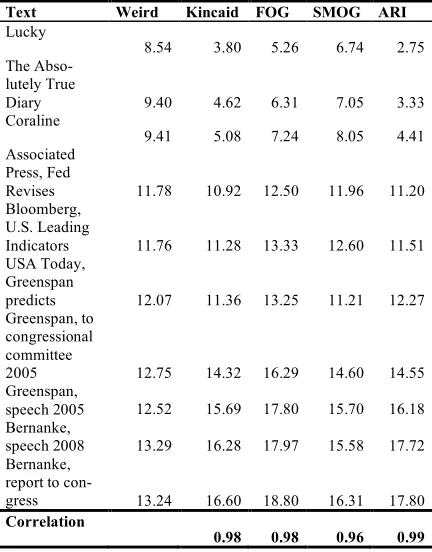
Text Weird Kincaid FOG SMOG ARI
Lucky
8.54 3.80 5.26 6.74 2.75 The
Abso-lutely True
Diary 9.40 4.62 6.31 7.05 3.33 Coraline
9.41 5.08 7.24 8.05 4.41 Associated
Press, Fed
Revises 11.78 10.92 12.50 11.96 11.20 Bloomberg,
U.S. Leading
Indicators 11.76 11.28 13.33 12.60 11.51 USA Today,
Greenspan
predicts 12.07 11.36 13.25 11.21 12.27 Greenspan, to
congressional committee
2005 12.75 14.32 16.29 14.60 14.55 Greenspan,
speech 2005 12.52 15.69 17.80 15.70 16.18 Bernanke,
speech 2008 13.29 16.28 17.97 15.58 17.72 Bernanke,
report to
con-gress 13.24 16.60 18.80 16.31 17.80
Correlation
[image:8.612.79.295.84.360.2]0.98 0.98 0.96 0.99
Table 1: Correlation of weirdness measure with estab-lished readability formulas
Currently, we have not implemented a means to measure the user’s experience with prior docu-ments as a proxy for reader knowledge and motiva-tion. In future, we would build a personalized vocabulary for each user with frequency informa-tion, and therefore measure familiarity with words on an individual basis. At present the Open Office extension is more useful for writing general texts as opposed to specialized or technical documents. Certain elements such as the weirdness measure and the SimpleText SmartTags become less useful with more expert texts and the prevailing use of terminology. Other aspects such as propositional density and lexical coherence are of less use when analyzing children’s books. This style of writing can score high for propositional density due to ex-travagant character names (e.g., “The Mad Hatter” and “Cheshire Cat”) increasing the number of compound nouns. Lexical cohesion is also low for any fictional writing.
We are looking at improving the lexical cohe-sion measure with the consideration of synonyms. Semantic units can be referred to by a number of different labels and by identifying these synonyms;
we can more accurately identify the prominent ideas in the text. It is the repetition of terms and their synonyms, along with other referents that provide a structure for the reader to connect with.
The extension was made available on the Open Office website in July 2009. In six months the ex-tension had received over 6,500 downloads indi-cating, along with positive user feedback that demand for word processors to go beyond simple spelling and grammar checking of text and provide more feedback is considerable.
References
H. Diessel. 2007. Frequency effects in language acquisi-tion language use, and diachronic change. New Ideas in Psychology, 25(2):108–127.
W. H. DuBay. 2004. The Principles of Readability. Costa Mesa, CA: Impact Information.
E. B. Entin, G. R. Klare. 1985. Relationships of meas-ures of interest, prior knowledge, and readability comprehension of expository passages. Advances in reading/language research, 3: 9–38.
J. R. Firth. 1957. Papers in Linguistics: 1934-1951. London, Oxford University Press.
L. Gillam, and N. Newbold. 2007. Quality assessment. Deliverable 1.3 of EU eContent project LIRICS, URL:http://lirics.loria.fr/doc_pub/T1.3Deliverable.fi nal.2.pdf, last accessed 28 February 2010.
A. C. Graesser, D. S. McNamara, M. M. Louwerse, and Z. Cai. 2004. Coh-Metrix: Analysis of text on cohe-sion and language. Behavior Research Methods, In-struments, and Computers, 36:193–202.
M. Hoey. 1991. Patterns of Lexis in Text. Oxford, OUP. W. Kintsch, E. Kozminsky, W. J. Streby, G. McKoon,
and J.M. Keenan. 1975. Comprehension and recall as a function of content variables. Journal of Verbal Learning and Verbal Behavior, 14:196–214.
H. D. Kitson. 1921. The mind of the buyer. New York, Macmillan.
T. Oakland and H. B. Lane. 2004. Language, reading, and readability formulas: Implications for developing and adapting tests. International Journal of Testing, 4(3):239–252.
The Plain English Campaign. Established 1979. URL:http://www.plainenglish.co.uk/, last accessed 28 February 2010.
J. Pustejovsky, S. Bergler, P. Anick. 1994. Lexical se-mantic techniques for corpus analysis. Computa-tional Linguistics, 19(2):331–358.
F. Smadja. 1993. Retrieving collocations from text: Xtract. Computational Linguistics, 19(1):143–178. M. Stuart, M. Dixon, and J. Masterson. 2004. Use of