The C-Score – Proposing a Reading Comprehension Metrics as a
Common Evaluation Measure for Text Simplification
Irina Temnikova
Linguistic Modelling Department, Institute of Information and Communication Technologies,
Bulgarian Academy of Sciences [email protected]
Galina Maneva
Lab. of Particle and Astroparticle Physics, Institute of Nuclear Research
and Nuclear Energy, Bulgarian Academy of Sciences [email protected]
Abstract
This article addresses the lack of common approaches for text simplification evalu-ation, by presenting the first attempt for a common evaluation metrics. The arti-cle proposes reading comprehension eval-uation as a method for evaluating the re-sults of Text Simplification (TS). An ex-periment, as an example application of the evaluation method, as well as three for-mulae to quantify reading comprehension, are presented. The formulae produce an unique score, the C-score, which gives an estimation of user’s reading comprehen-sion of a certain text. The score can be used to evaluate the performance of a text simplification engine on pairs of complex and simplified texts, or to compare the performances of different TS methods us-ing the same texts. The approach can be particularly useful for the modern crowd-sourcing approaches, such as those em-ploying the Amazon’s Mechanical Turk1 or CrowdFlower2. The aim of this paper is thus to propose an evaluation approach and to motivate the TS community to start a relevant discussion, in order to come up with a common evaluation metrics for this task.
1 Context and Motivation
Currently, the area of Text Simplification (TS) is getting more and more attention. Starting as early as in the 1996, Chandrasekar et al. pro-posed an approach for TS as a pre-processing step before feeding the text to a parser. Next, the
1
http://aws.amazon.com/mturk/. Last accessed on May 3rd, 2013.
2http://crowdflower.com/. Last accessed on June 14th, 2013.
PSET project (Devlin, 1999; Canning, 2002), pro-posed two modules for simplifying text for apha-sic readers. The text simplification approaches continued in 2003 with Siddharthan (2003) and Inui et al. (2003), and through the 2005-2006 until the recent explosion of TS approaches in 2010-2012. Recently, several TS-related work-shops took place: PITR 2012 (Williams et al., 2012), SLPAT 2012 (Alexandersson et al., 2012), and NLP4ITA 20123 and 2013. As in
confirma-tion with the text simplificaconfirma-tion definiconfirma-tion as the ”process for reducing text complexity at differ-ent levels” (Temnikova, 2012), the TS approaches tackle a variety of text complexity aspects, rang-ing from lexical (Devlin, 1999; Inui et al., 2003; Elhadad, 2006; Gasperin et al., 2009; Yatskar et al., 2010; Coster and Kauchak, 2011; Bott et al., 2012; Specia et al., 2012; Rello et al., 2013; Drndarevi´c et al., 2013), syntactic (Chandrasekar et al., 1996; Canning, 2002; Siddharthan, 2003; Inui et al., 2003; Gasperin et al., 2009; Zhu et al., 2010; Woodsend and Lapata, 2011; Coster and Kauchak, 2011; Drndarevi´c et al., 2013), to discourse/cohesion (Siddharthan, 2003). The va-riety of problems tackled by the TS approaches differ, according to their final aim: (1) being a pre-processing step of an input to text process-ing applications, or (2) addressprocess-ing the readprocess-ing dif-ficulties of specific groups of readers. The first type of final application ranges between parser input (Chandrasekar et al., 1996), small screens displays (Daelemans et al., 2004; Grefenstette, 1998), text summarization (Vanderwende et al., 2007), text extraction (Klebanov et al., 2004), se-mantic role labeling (Vickrey and Koller, 2008) and Machine Translation (MT) (Ruffino, 1982; Streiff, 1985).The TS approaches addressing spe-cific human reading needs, instead, address read-ers with low levels of literacy (Siddharthan, 2003;
3http://www.taln.upf.edu/nlp4ita/. Last accessed on May 3rd, 2013.
Gasperin et al., 2009; Elhadad, 2006; Williams and Reiter, 2008), language learners (Petersen and Ostendorf, 2007), and readers with specific cogni-tive and language disabilities. The TS approaches, addressing this last type of readers target those suffering from aphasia (Devlin, 1999; Canning, 2002), deaf readers (Inui et al., 2003), dyslexics (Rello et al., 2013) and the readers with general disabilities (Max, 2006; Drndarevi´c et al., 2013).
Despite the large number of current work in TS, there has been almost no attention to defin-ing common text simplification evaluation ap-proaches, which would allow the comparison of different TS systems. Until the present moment, usually, each approach has applied his/her own methods and materials, often taken from other Natural Language Processing (NLP) fields, mak-ing the comparison difficult or impossible.
The aim of this paper is thus to propose an eval-uation method and to foster the discussion of this topic in the text simplification community, as well as to motivate the TS community to come up with common evaluation metrics for this task.
Next, Section 2 will describe the existing ap-proaches to evaluating TS, as well as the few attempts towards offering a common evaluation strategy. After that, the next sections will present our evaluation approach, starting with Section 3 describing its context, Section 4 presenting the for-mulae, Section 5 offering the results, and finally Section 6, providing a Discussion and the Conclu-sions.
2 Evaluation Methods in Text Simplification
As mentioned in the previous section, until now, the different authors adopted different combina-tions of metrics, without reaching to a common approach, which would allow the comparison of different systems. As the different TS evalua-tion methods are applied on a variety of different text units (words, sentences, texts), this makes the comparison between approaches even harder. As the aim of this article is to propose a text simpli-fication evaluation metrics which would take into account text comprehensibility and reading com-prehension, in this discussion we will focus mostly on the approaches, whose aim is to simplify texts for target readers and their evaluation strategies.
The existing TS evaluation approaches focus ei-ther on the quality of the generated text/sentences,
or on the effectiveness of text simplification on reading comprehension. The first group of ap-proaches include human judges ratings of simpli-fication, content preservation, and grammatical-ity, standard MT evaluation scores (BLEU and NIST), a variety of other automatic metrics (per-plexity, precision/recall/F-measure, and edit dis-tance). The methods, aiming to evaluate the text simplification impact on reading comprehension, use, instead, reading speed, reading errors, speech errors, comprehension questions, answer correct-ness, and users’ feedback. Several approaches use a variety of readability formulae (the Flesch, Flesch-Kincaid, Coleman-Liau, and Lorge formu-lae for English, as well as readability formuformu-lae for other languages, such as for Spanish). Due to the criticisms of readability formulae (DuBay, 2004), which often restrict themselves to a very super-ficial text level, they can be considered to stand on the borderline between the two previously de-scribed groups of TS evaluation approaches. As can be seen from the discussion below, different TS systems employ a combination of the listed evaluation approaches.
who also used precision and recall and Yatskar et al. (2010), who employed three annotators com-paring pairs of words and indicating them same, simpler, or more complex. Williams and Reiter (2008) run two experiments, the larger one in-volving 230 subjects and measured oral reading rate, oral reading errors, response correctness to comprehension questions and finally, speech er-rors. Drndarevic et al. (2013) used 7 readabil-ity measures for Spanish to evaluate the degree of simplification, and twenty-five human annota-tors to evaluate on a Likert scale the grammat-icality of the output and the preservation of the original meaning. The recent approaches consid-ering TS as an MT task, such as Specia (2010), Zhu et al. (2010), Coster and Kauchak (2011) and Woodsend and Lapata (2011), apply standard MT evaluation techniques, such as BLEU (Pap-ineni et al., 2002), NIST (Doddington, 2002), and TERp (Snover et al., 2009). In addition, Wood-send and Lapata (2011) apply two readability mea-sures (Flesch-Kincaid, Coleman-Liau) to evalu-ate the actual reduction in complexity and human judges ratings for simplification, meaning preser-vation, and grammaticality. Zhu et al. (2010) ap-ply the Flesch readability score (Flesch, 1948) and n-gram language model perplexity, and Coster and Kauchak (2011) – two additional automatic tech-niques (the word-level-F1 and simple string accu-racy), taken from sentence compression evaluation (Clarke and Lapata, 2006).
As we consider that the aim of text simplifica-tion for human readers is to improve text com-prehensibility, we argue that reading comprehen-sion must be evaluated, and that evaluating just the quality of produced sentences is not enough. Differently from the approaches that employ hu-man judges, we consider that it is better to test real human comprehension with target readers popula-tions, rather than to make conclusions about the extent of population’s understanding on the basis of the opinion of a small number of human judges. In addition, we consider that measuring reading speed, rate, as well as reading and speed errors, requires much more complicated and expensive tools, than having an online system to measure time to reply and recognize correct answers. Fi-nally, we consider that cloze tests are an evalu-ation method that cannot really reflect the com-plexity of reading comprehension (for example for measuring manipulations of the syntactic
struc-ture of sentences), and for this reason, we select multiple-choice questions as the testing method, which we consider the most reflecting the speci-ficities of the complexity of a text, more accessi-ble than eye-tracking technologies, and more ob-jective than users’ feedback. The approach does not explicitly evaluate the fluency, grammaticality and content preservation of the simplified text, but can be coupled with such additional evaluation.
The closest to ours approach is that of Rello et al. (2013) who evaluated reading comprehen-sion with over ninety readers with and without dyslexia. Besides using eye-tracking (reading time and fixations duration), different reading devices, and users rating the text according to how easy it is it read, to understand and to remember, they obtain also a comprehension score based on multiple-choice questions (MCQ) with 3 answers (1 cor-rect, 1 partially correct and 1 wrong). The dif-ference with our approach is that we consider that having only one correct answer (as suggested by Gronlund (1982)), is a more objective evaluation, rather than having one partially correct answer, which would introduce subjectivity in evaluation.
To support our motivation, some state-of-the-art approaches state the scarcity of evaluation with target readers (Williams and Reiter, 2008), note that there are no commonly accepted evaluation measures (Coster and Kauchak, 2011), attempt to address the need of developing reading com-prehension evaluation methods (Siddharthan and Katsos, 2012), and propose common evaluation frameworks (Specia et al., 2012; De Belder and Moens, 2012). More concretely, Siddhathan and Katsos (2012) propose the magnitude estimation of readability judgements and the delayed sen-tence recall as reading comprehension evaluation methods. Specia et al. (2012) provide a lexical simplification evaluation framework in the context of Semeval-2012. The evaluation is performed us-ing a measure of inter-annotator agreement, based on Cohen (1960). Similarly, De Belder and Moens (2012) propose a dataset for evaluating lexical simplification. No common evaluation framework has been yet developed for syntactic simplifica-tion.
com-parison of existing approaches. The next section presents our evaluation approach, which we offer as a candidate for common evaluation metrics.
3 Proposed Evaluation Metrics
3.1 The Evaluation Experiment
The metrics proposed in this article, was devel-oped in the context of a previously conducted large-scale text simplification evaluation experi-ment (Temnikova, 2012). The experiexperi-ment aimed to determine whether a manual, rule-based text simplification approach (namely a controlled lan-guage), can re-write existing texts into more un-derstandable versions. Impact on reading com-prehension was necessary to evaluate, as the pur-pose of text simplification was to enhance in first place the reading comprehension of emergency in-structions. The controlled language used for sim-plification was the Controlled Language for Cri-sis Management (CLCM, more details in (Tem-nikova, 2012)), which was developed on the ba-sis of existing psychological and psycholinguis-tic literature discussing human comprehension un-der stress, which ensures its psychological valid-ity. The text units evaluated in this experiments were whole texts, and more concretely pairs of original texts and their simplified versions. We ar-gue that using whole texts for measuring reading comprehension is better than single sentences, as the texts provide more context for understanding. The experiment took place in the format of an on-line experiment, conducted via a specially devel-oped web interface, and required users to read sev-eral texts and answer Multiple-Choice Questions (MCQ), testing the readers’ understanding of each of the texts. Due to the purpose of the text simpli-fication (emergency situations simulation), users were required to read the texts in a limited time, as to imitate a stressful situation with no time to think and re-read the text. This aspect will not be taken into account in the evaluation, as the pur-pose is to propur-pose a general formula, applicable to a variety of different text simplification experi-ments. After reading the text in a limited time, the text was hidden from the readers, and they were presented with a screen, asking if they were ready to proceed with the questions. Next, each question was displayed one by one, along with its answers, with the readers not having the option to go back to the text. In order to ensure the constant atten-tion of the readers and to reduce readers’ tiredness
fact or, the texts were kept short (about 150-170 words each), and the number of texts to be read by the reader was kept to four. In addition, to en-sure comparability, all the texts were selected in a way to be more or less of the same length. The ex-periment employed a collection of a total of eight texts, four of which original, non simplified (’com-plex’) versions, and the other four – their manu-ally simplified versions. Each user had to read two complex and two simplified texts, none of which was a variant of the other. The interface automati-cally randomized the order of displaying the texts, to ensure that different users would get different combinations of texts in one of the following two different sequences:
• Complex-Simplified-Complex-Simplified
• Simplified-Complex-Simplified-Complex
the users’ comprehension, collected during the ex-periment, was, on one hand the time for answering each question, and on the other hand, the number of correct answers given by all participants while replying to the same question. Besides the fact that we used a specially developed interface, this eval-uation approach can be applied to any experiment employing an interface capable of calculating the time for answering and to distinguish the correct answers from the incorrect ones.
The efficiency of the experiment design was thoroughly tested by running it through several rounds of pilot experiments and requiring partic-ipants’ feedback.
We claim that the evaluation approach proposed in this paper can be applied to more simply orga-nized experiments, as the randomization aspects are not reflected in the evaluation formulae.
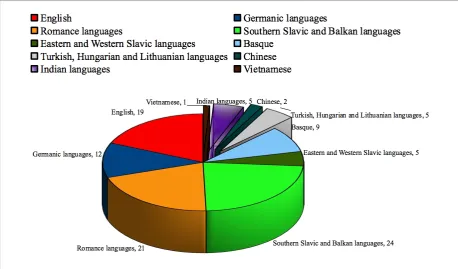
The final experiment involved 103 participants, collected via a request sent to several mailing lists. The participants were 55 percent women and 44 percent male, and ranged from undergraduate stu-dents to retired academicians (i.e. corresponded to nineteen to fifty-nine years old). As the ex-periment allowed entering lots of personal data, it was also known that participants had a vari-ety of professions (including NLP people, teach-ers, and lawyers), knew English from the beginner through intermediate, to native level, and spoke a large variety of native languages, allowing to have native speakers from many of the World’s language families (Non European and Indo-European included). Figure 1 shows the coarse-grained classification made at the time of the ex-periment, and the distribution of participants per native languages. A subset of specific native lan-guage participants will be selected to give an ex-ample of applying the evaluation metrics to a real evaluation experiment.
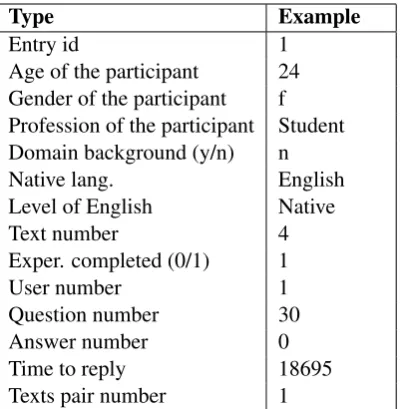
In order to obtain results, we have asked the participants to enter a rich selection of informa-tion, and recorded the chosen answer (be it cor-rect or not), and the time which each participant employed to give each answer (correct or wrong). Table 1 shows the data we recorded for each single answer of every participant.
The data in Table 1 is:Entry idis each given an-swer, theDomain background(answery– yes and n – no) indicates whether the participant has any previous knowledge of the experiment (crisis man-agement) domain. As each text, question and
com-Type Example
Entry id 1
Age of the participant 24 Gender of the participant f Profession of the participant Student Domain background (y/n) n Native lang. English Level of English Native
Text number 4
Exper. completed (0/1) 1
User number 1
Question number 30
Answer number 0
[image:5.595.318.519.61.266.2]Time to reply 18695 Texts pair number 1
Table 1: Participant’s information recorded for each answer.
plex/simplified texts pair are given reference num-bers, respectivelyText number,Question number, and Texts pair number record that. As required by the evaluation method, each entry records also theTime to replyeach question (measured in ’mil-liseconds’), and theAnswer number. As said be-fore, the correct answers are marked in a special way, allowing to distinguish them at a later stage, when counting the number of correct answers.
3.2 Definitions and Evaluation Hypotheses
In order to correctly evaluate the performance of the text simplification method on the basis of the above described experiment, the data obtained was thoughtfully analyzed. The two criteria selected to best describe the users’ performance were time to reply and number of correct answers. The eval-uation was done offline, after collecting the data from the participants. The evaluation analysis aimed to test the followingtwo hypotheses:
If the text simplification approach has a positive impact on the reading comprehension:
1. The percentage of correct answers given for the simplified text will be higher than the per-centage of correct answers given for the com-plex text.
Figure 1:Coarse-grained distribution of participants per native languages.
reply correctly to the questions about the complex text.
The two hypotheses were tested previously by employing only the key variables (time to reply and number of correct answers). It has been proven that comprehension increases with the per-centage of correct answers and decreases with the increase of the time to reply. On the basis of these facts, we define theC-Score(a text Compre-hension Score) – an objective evaluation metrics, which allows to give a reading comprehension es-timate to a text, or to compare two texts or two or more text simplification approaches. The C-Score is calculated text per text. In order to address a va-riety of situations, we propose three versions of the C-Score, which cover, gradually, all possible vari-ables which can affect comprehension in such an experiment. In the following sections we present their formulae, the variables involved, and discuss their results, advantages and shortcomings.
3.3 The C-Score Version One. The C-Score Simple.
Given a text comprehension experiment featuring ntexts with mquestions withr answers each, an ability to measure time to reply to questions and to recognize the correct answers, we define the C-Score Simpleas given below:
Csimple=
P r tmean
(1)
Where:Pris the percentage of correct answers, from all answers given to all the questions about this text, and tis the average time to reply to all questions about this text (both with a correct and a wrong answer). The time is expressed in arbi-trary seconds-based units, depending on the ex-periment. The logic behind this formula is simple: we consider that comprehension increases with the percentage of correctly answered questions, and diminishes if the mean time to answer questions increases.
3.4 The C-Score Version Two. C-Score Complete.
The C-Score complete takes into consideration a rich selection of variables reflecting the questions and answers complexity. In this C-Score version, we consider that the experiment designers will se-lect short texts (e.g. 150 words) of a similar length, with the aim to reduce participants’ tiredness fac-tor, as we did in our experimental settings.
Ccomplete=
P r N q
N q
X
q=1
Qs(q)
tmean(q)
(2)
number of questions of this text (4-5 in our experi-ment), andtis the average time to reply to all ques-tions about this text (4-5 in our experiment). We introduce the concept Question Size, (Qs), which is calculated for each question and takes into ac-count the number of answers of the question (Na), the question length in words (Lq), and the total length in words of its answers (La):
Qs=N a(Lq+La) (3)
We consider that the number of questions nega-tively influences the comprehension results, as the reader gets cognitively tired to process more and more questions about different key aspects of the text. In addition, Gronlund (1982) suggests to re-strict the number of questions per text to four-five to achieve better learning. For this reason, we con-sider that comprehension decreases, if the num-ber of questions is higher. We also consider that answering correctly/faster to a difficult question shows better text comprehension than giving fast a correct answer to a simply-worded question. For this reason we award question difficulty, and we place it above the fraction.
3.5 The C-Score Version Three. C-Score Textsize.
Finally, the last version of C-Score takes into ac-count the case when the texts used for compari-son can be of a different length, and in this way, the texts’ complexity (for example, when compar-ing the results of two different TS engines, without having access to the same texts). For this reason, the C-Score 3 considers the text length (calledtext size, Ts) of the texts used in the experiment. As a longer text will be more difficult to understand than a shorter text, the text length is placed near thepercentage of correct answers.
Ctextsize=
P rT s N q
N q
X
q=1
Qs(q)
tmean(q)
(4)
4 C-Score Results
We have implemented and applied the above de-scribed formulae to the experimental data, pre-sented in Section 3.1. As we have only one text simplification approach, two user scenarios are presented:
1. Original (’Complex’) vs. Simplified (’Sim-ple’) pairs of texts comparison. The subset of
participants are the speakers of Basque, Turk-ish, Hungarian, Lithuanian, Vietnamese, Chi-nese, and Indian languages. All three formu-lae have been applied.
2. Comparison of the comprehension of the same text of readers from different sub-groups. The readers have been divided by age. This scenario can be used to infer psycho-linguistic findings about the reading abilities of different participants.
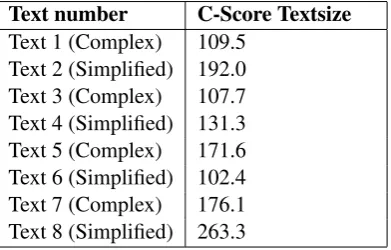
Please note that the texts pairs are: Text 1 and 2; Text 3 and 4; Text 5 and 6; and Text 7 and 8. In each couple, the first text is complex and the second is its simplified version. The results for the first evaluation scenario are respectively dis-played in Table 2 forC-Score Simple, Table 3 for C-Score Complete and Table 4 for C-Score Text-size. The results of C-Score Complete have been multiplied per 100 for better readability. As a re-minder, we consider that higher the score is, better is text comprehension. From this point of view, if the text simplification approach was successful, Text 2 (Simplified) should have a higher C-Score than its original, complex Text 1, Text 4 (Simpli-fied) should have a higher C-Score than its orig-inal Text 3, Text 6 (Simplified) – a higher score than the complex Text 5, and Text 8 (Simplified) – a higher score than its original Text 7.
In the second scenario, the participants data has been divided into data relevant to participants under 45 years old (ninety-two participants) and into participants over 45 years old (eleven partic-ipants). In this case only the C-Score Simple has been applied. The results of this evaluation are shown in Table 5. As our aim is to compare the reading abilities of different ages of people, and not the results of text simplification, only the com-plex texts are taken into account. The results show that the comprehension score of participants under 45 years old is higher for all texts (despite the un-even participants’ distribution), except in the case of complex Text 5.
dif-Text number C-Score Simple Text 1 (Complex) 21.3
[image:8.595.88.280.62.185.2]Text 2 (Simplified) 35.3 Text 3 (Complex) 24.8 Text 4 (Simplified) 34.9 Text 5 (Complex) 36.8 Text 6 (Simplified) 23.6 Text 7 (Complex) 40.5 Text 8 (Simplified) 51.5
Table 2: Experiment results for C-Score Simple.
ferences in reading comprehension between par-ticipants under 45 years old and parpar-ticipants over 45 years old, Text 5 has more or less the same comprehension score for both groups of readers. From this fact we can assume that this text is prob-ably fairly easy, so this type of combination of text simplification rules does not simplify it, and in-stead, when applied makes it less comprehensible or more awkward for the human readers.
Text number C-Score Complete Text 1 (Complex) 66.3
[image:8.595.317.523.62.132.2]Text 2 (Simplified) 114.3 Text 3 (Complex) 65.3 Text 4 (Simplified) 89.9 Text 5 (Complex) 104.0 Text 6 (Simplified) 66.9 Text 7 (Complex) 106.7 Text 8 (Simplified) 153.0
Table 3: Experiment results for C-Score Com-plete.
Text number C-Score Textsize Text 1 (Complex) 109.5
Text 2 (Simplified) 192.0 Text 3 (Complex) 107.7 Text 4 (Simplified) 131.3 Text 5 (Complex) 171.6 Text 6 (Simplified) 102.4 Text 7 (Complex) 176.1 Text 8 (Simplified) 263.3
Table 4: Experiment results for C-ScoreTextsize.
5 Discussion and Conclusions
This article has presented an extended discussion of the methods employed for evaluation in the text
[image:8.595.81.285.360.483.2]Text number Under 45 Over 45 Text 1 (Complex) 39.7 22.5 Text 3 (Complex) 37.2 18.4 Text 5 (Complex) 38.4 38.9 Text 7 (Complex) 54.3 35.9
Table 5: C-Score Simple for one text.
[image:8.595.85.281.545.670.2]autis-tic readers. Future work will involve the com-parison of the above proposed evaluation metrics with any of the metrics already employed in the related work, such as the recent and classic read-ability formulae, eye-tracking, reading rate, hu-man judges ratings, and others. We consider that content preservation and grammaticality are not necessary to be evaluated for this approach, as the simplified texts have been produced manually, by linguists, who were native speakers of English.
Acknowledgments
The authors would like to thank Prof. Dr. Petar Temnikov for the ideas and advices about the re-search methodology, Dr. Anke Buttner for the psy-cholinguistic counseling about the experiment de-sign, including questions, answers and texts se-lection and the simplification method psycholog-ical validity, and Dr. Constantin Orasan and Dr. Le An Ha for the testing interface implementa-tion. The research of Irina Temnikova reported in this paper was partially supported by the project AComIn ”Advanced Computing for Innovation”, grant 316087, funded by the FP7 Capacity Pro-gramme (Research Potential of Convergence Re-gions).
Finally, the authors would also like to thank the PITR 2013 reviewers for their useful feedback.
References
Jan Alexandersson, Peter Ljunglf, Kathleen F. Mc-Coy, Brian Roark, and Annalu Waller, editors. 2012.Proceedings of the Third Workshop on Speech and Language Processing for Assistive Technolo-gies. Association for Computational Linguistics, Montr´eal, Canada, June.
Stefan Bott, Luz Rello, Biljana Drndarevi´c, and Hora-cio Saggion. 2012. Can spanish be simpler? lexsis: Lexical simplification for spanish. InProceedings of the 24th International Conference on Computational Linguistics (Coling 2012), Mumbai, India (Decem-ber 2012).
Yvonne Canning. 2002. Syntactic Simplification of Text. Ph.D. thesis, University of Sunderland, UK.
Raman Chandrasekar, Christine Doran, and Bangalore Srinivas. 1996. Motivations and methods for text simplification. In Proceedings of the 16th confer-ence on Computational linguistics-Volume 2, pages 1041–1044. Association for Computational Linguis-tics.
James Clarke and Mirella Lapata. 2006. Models for sentence compression: A comparison across
do-mains, training requirements and evaluation mea-sures. InProceedings of the 21st International Con-ference on Computational Linguistics and the 44th annual meeting of the Association for Computa-tional Linguistics, pages 377–384. Association for Computational Linguistics.
Jacob Cohen et al. 1960. A coefficient of agreement for nominal scales. Educational and psychological measurement, 20(1):37–46.
William Coster and David Kauchak. 2011. Learning to simplify sentences using wikipedia. InProceedings of the Workshop on Monolingual Text-To-Text Gen-eration, pages 1–9. Association for Computational Linguistics.
Walter Daelemans, Anja H¨othker, and Erik Tjong Kim Sang. 2004. Automatic sentence simplification for subtitling in dutch and english. InProceedings of the 4th International Conference on Language Re-sources and Evaluation, pages 1045–1048.
Jan De Belder and Marie-Francine Moens. 2012. A dataset for the evaluation of lexical simplification. In Computational Linguistics and Intelligent Text Processing, pages 426–437. Springer.
Siobhan Devlin. 1999. Automatic Language Simplifi-cation for Aphasic Readers. Ph.D. thesis, University of Sunderland, UK.
George Doddington. 2002. Automatic evaluation of machine translation quality using n-gram co-occurrence statistics. InProceedings of the second international conference on Human Language Tech-nology Research, pages 138–145. Morgan Kauf-mann Publishers Inc.
Biljana Drndarevi´c, Sanja ˇStajner, Stefan Bott, Susana Bautista, and Horacio Saggion. 2013. Automatic text simplification in spanish: A comparative evalu-ation of complementing modules. InComputational Linguistics and Intelligent Text Processing, pages 488–500. Springer.
William H. DuBay. 2004. The principles of readabil-ity.Impact Information, pages 1–76.
No´emie Elhadad. 2006. User-sensitive text summa-rization: Application to the medical domain. Ph.D. thesis, Columbia University.
Rudolf Flesch. 1948. A new readability yardstick.The Journal of applied psychology, 32(3).
Caroline Gasperin, Erick Maziero, Lucia Specia, TAS Pardo, and Sandra M Aluisio. 2009. Natural lan-guage processing for social inclusion: a text sim-plification architecture for different literacy levels. the Proceedings of SEMISH-XXXVI Semin´ario Inte-grado de Software e Hardware, pages 387–401.
AAAI Spring Symposium on Intelligent Text summa-rization, pages 111–118.
Norman Edward Gronlund. 1982. Constructing achievement tests. Prentice Hall.
Kentaro Inui, Atsushi Fujita, Tetsuro Takahashi, Ryu Iida, and Tomoya Iwakura. 2003. Text simplifica-tion for reading assistance: a project note. In Pro-ceedings of the second international workshop on Paraphrasing-Volume 16, pages 9–16. Association for Computational Linguistics.
Beata Beigman Klebanov, Kevin Knight, and Daniel Marcu. 2004. Text simplification for information-seeking applications. In On the Move to Mean-ingful Internet Systems 2004: CoopIS, DOA, and ODBASE, pages 735–747. Springer.
Irving Lorge. 1948. The lorge and flesch readabil-ity formulae: A correction. School and Society, 67:141–142.
Aur´elien Max. 2006. Writing for language-impaired readers. In Computational Linguistics and Intelli-gent Text Processing, pages 567–570. Springer.
Kishore Papineni, Salim Roukos, Todd Ward, and Wei-Jing Zhu. 2002. Bleu: a method for automatic evaluation of machine translation. InProceedings of the 40th annual meeting on association for compu-tational linguistics, pages 311–318. Association for Computational Linguistics.
Sarah E. Petersen and Mari Ostendorf. 2007. Text sim-plification for language learners: a corpus analysis. In In Proc. of Workshop on Speech and Language Technology for Education.
Luz Rello, Ricardo Baeza-Yates, Stefan Bott, and Ho-racio Saggion. 2013. Simplify or help? text sim-plification strategies for people with dyslexia. Proc. W4A, 13.
J. Richard Ruffino. 1982. Coping with machine trans-lation. Practical Experience of Machine Transla-tion.
Advaith Siddharthan and Napoleon Katsos. 2012. Of-fline sentence processing measures for testing read-ability with users. InProceedings of the First Work-shop on Predicting and Improving Text Readability for target reader populations, pages 17–24. Associ-ation for ComputAssoci-ational Linguistics.
Advaith Siddharthan. 2003. Syntactic simplification and text cohesion. Ph.D. thesis, University of Cam-bridge, UK.
Matthew Snover, Nitin Madnani, Bonnie J Dorr, and Richard Schwartz. 2009. Fluency, adequacy, or hter?: exploring different human judgments with a tunable mt metric. In Proceedings of the Fourth Workshop on Statistical Machine Translation, pages 259–268. Association for Computational Linguis-tics.
Lucia Specia, Sujay Kumar Jauhar, and Rada Mihal-cea. 2012. Semeval-2012 task 1: English lexi-cal simplification. InProceedings of the First Joint Conference on Lexical and Computational Seman-tics, pages 347–355. Association for Computational Linguistics.
Lucia Specia. 2010. Translating from complex to sim-plified sentences. InComputational Processing of the Portuguese Language, pages 30–39. Springer.
A. A. Streiff. 1985. New developments in titus 4. Lawson (1985), 185:192.
Irina Temnikova. 2012. Text Complexity and Text Sim-plification in the Crisis Management domain. Ph.D. thesis, Wolverhampton, UK.
Lucy Vanderwende, Hisami Suzuki, Chris Brockett, and Ani Nenkova. 2007. Beyond sumbasic: Task-focused summarization with sentence simplification and lexical expansion. Information Processing & Management, 43(6):1606–1618.
David Vickrey and Daphne Koller. 2008. Sentence simplification for semantic role labeling. In Pro-ceedings of the 46th Annual Meeting of the Asso-ciation for Computational Linguistics: Human Lan-guage Technologies (ACL-2008: HLT), pages 344– 352.
Sandra Williams and Ehud Reiter. 2008. Generating basic skills reports for low-skilled readers. Natural Language Engineering, 14(4):495–525.
Sandra Williams, Advaith Siddharthan, and Ani Nenkova, editors. 2012. Proceedings of the First Workshop on Predicting and Improving Text Read-ability for target reader populations. Association for Computational Linguistics, Montr´eal, Canada, June.
Kristian Woodsend and Mirella Lapata. 2011. Learn-ing to simplify sentences with quasi-synchronous grammar and integer programming. InProceedings of the Conference on Empirical Methods in Natural Language Processing, pages 409–420. Association for Computational Linguistics.
Mark Yatskar, Bo Pang, Cristian Danescu-Niculescu-Mizil, and Lillian Lee. 2010. For the sake of sim-plicity: Unsupervised extraction of lexical simplifi-cations from wikipedia. InHuman Language Tech-nologies: The 2010 Annual Conference of the North American Chapter of the Association for Computa-tional Linguistics, pages 365–368. Association for Computational Linguistics.