Statistical Stemming for Kannada
Suma Bhat
Beckman Institute for Advanced Science and Technology, University of Illinois,
Urbana-Champaign, IL 61801, USA
Abstract
Stemming is a process that groups mor-phologically related words into the same class and is widely used in information retrieval for improving recall rate. Here we study a set of statistical stemmers for Kannada, a resource-poor language with highly inflectional and agglutinative mor-phology. We compare stemming using simple truncation, clustering and an un-supervised morpheme segmentation algo-rithm on a sample from a text collection.
We observe that a distance measure that rewards longest prefix matches is the best performing clustering-based stemmer. However, using a reasonably perform-ing unsupervised morpheme segmentation seems to outperform the other stemming schemes considered.
1 Introduction
With the ongoing quest for developing lan-guage processing techniques and tools for under-resourced languages there is an emerging need to study various aspects of these languages. Kan-nada, with nearly 70 million speakers is one of the 40 most spoken languages in the world. It is one of the scheduled languages of India and the official and administrative language of the state of Karnataka in South India. Its rich literary her-itage has endowed the language with an immense written resource and efforts are currently under-way to bring them to web scales. However, avail-able computational tools for Kannada are only in their incipient stages. Simultaneously, there is an ever increasing number of internet users who are creating online materials in Kannada. As more in-formation becomes available it becomes impera-tive to develop language processing tools that help us organize, search and understand information in
Kannada. One such task is that of information re-trieval and the time is ripe for developing language processing tools for efficient information retrieval in Kannada.
Stemming serves to conflate morphologically related word forms into a common form. The role of stemming in improving retrieval effective-ness, particularly for highly inflected languages and monolingual retrieval has been well docu-mented in studies including (Larkey and Connell, 2003; Majumder et al., 2007; Dolamic and Savoy, 2010). In addition, the efficiency of IR systems owing to a decrease in size of the index term set (and a concomitant decrease in storage) is an added effect of stemming. Consequently, with the goal of developing a suitable stemmer for Kannada (a resource-poor language as far as current lan-guage processing resources are concerned), the fo-cus of this study is statistical approaches to stem-ming in Kannada. We study stemstem-ming via three strategies. The first is truncation by a prefix of cer-tain length, the second, a clustering approach us-ing strus-ing distance measures and the third involves using the result of unsupervised morpheme seg-mentation. In this context the goals of the current study are the following.
1. To choose the most effective distance sure from among a set of string distance mea-sures and determine a distance threshold that results in good stemming performance; and,
2. To compare the performance of the resulting clustering-based stemmer with traditional al-gorithms such as truncation and unsupervised morpheme segmentation.
For the purpose of this study, we evaluate the stem-ming performance without distinguishing between inflectional and derivational morphology.
The rest of this paper is organized as follows. In Section 2 a description in brief of prior research
related to our study is presented. Section 3 deals with a description of the data used. The method-ology used in the study is the content of Section 4. The experimental details are found in Section 5. Section 6 highlights the results and the re-lated analysis occurs in Section 7. In Section 8 we present conclusions drawn from the study and outline some directions for further study.
2 Prior Work
As a recall enhancing technique in IR and efficient storage mechanism (since morphologically related word forms are conflated to the same stem), var-ious stemming procedures have been studied for several languages. Stemming experiments and their effectiveness in IR have been carried out for English and other European languages (Goldsmith et al., 2000; Savoy, 2006; Fautsch and Savoy, 2009; Korenius et al., 2004; Majumder et al., 2008) and for a few Indian languages (Majumder et al., 2007; Dolamic and Savoy, 2010). There is empirical evidence that a stemming procedure im-proves retrieval effectiveness when applied to Eu-ropean languages including French, Portuguese, German and Hungarian (Savoy, 2006). For pro-cessing agglomerative languages such as Turk-ish and FinnTurk-ish, stemming effectiveness has been studied (Ekmekc¸ioglu and Willett, 2000; Sever and Bitirim, 2003; Korenius et al., 2004). Further, indexing and search strategies have been found to perform significantly better with the applica-tion of the various stemming strategies (compared to an indexing scheme without a stemmer), for Hindi, Bengali and Marathi (Dolamic and Savoy, 2010; Majumder et al., 2007). Retrieval exper-iments on English, French, Bengali, Hindi and Marathi datasets show that a statistical stemming approach via clustering is effective for languages that are primarily suffixing in nature (Majumder et al., 2007; Dolamic and Savoy, 2010; Ekmekc¸ioglu and Willett, 2000; Sever and Bitirim, 2003).
As an effective bootstrapping approach to stem-ming, statistical methods have been explored for several languages. The popular stemming algo-rithms for English are based on language-specific rules explored in (Lovins, 1968) and (Porter, 1980), whereas for several other languages tical stemming has been considered. The statis-tical stemmer studied in (Majumder et al., 2007; ˇSnajder and Baˇsic, 2009) is a cluster-based suffix stripping algorithm, whereas a probabilistic suffix
stripping algorithm is explored in (Di Nunzio et al., 2004). In (Ekmekc¸ioglu and Willett, 2000) a rule-based morphological analysis stemmer is used for Turkish.
Studies on developing morphological analyz-ers (mostly rule-based) for Kannada are available (Antony et al., 2010; Veerappan et al., 2011; Shas-tri, 2011; Murthy, 1999), but there have been no reports of evaluations of their propositions in terms of stemming effectiveness. In (Bhat, 2012), a preliminary study of unsupervised algorithms for morpheme segmentation in Kannada is available which observed that a statistical morpheme seg-mentation algorithm such as (Dasgupta and Ng, 2006) shows a reasonable performance for mor-pheme segmentation in Kannada. Taking the re-sults of prior studies further, the current study is cast in the knowledge-base gained and compares stemming using a clustering-based approach with stemming using simple truncation and that us-ing an unsupervised morpheme segmentation al-gorithm. The favorable results of prior studies with languages that are primarily suffixing in na-ture and those of the agglutinative type, prompts us to consider their stemming approaches for Kan-nada.
2.1 Challenges to Morphological Analysis in Kannada
morpheme boundaries are difficult to detect be-cause they are fused together. In addition, ram-pant morphophonemic processes (sandhi), pro-ductive compounding and agglutinating morphol-ogy of inflectional and derivational suffixes (the latter mostly with words of Sanskrit origin natu-ralized into Kannada) drive the prolific word for-mation processes of the language (Sridhar, 1990).
3 Data
Corpus: For the purpose of experimentation we use the Kannada portion of the EMILLE corpus (Baker et al., 2002). In order to avoid words with typographical errors we restrict the sample to those word types occurring at least two times. Here, instead of resorting to clustering the lexicon from the given collection, we reduce the compu-tational cost of the experiment by focusing on a subset of the lexicon. Thus, our experimental data set has 10020 words which are chosen so as to in-clude the most morphologically productive words (manually chosen from the lexicon). We consider a suitable Roman transliteration of the Kannada unicode characters for computational ease.
Gold set: For evaluating the stemmers, we man-ually group the related forms of words in the sam-ple into equivalence classes. In preparing the classes we do not distinguish between inflection-ally and derivationinflection-ally related forms. Thus, mor-phologically and semantically related words oc-cur in the same group (for instance, compound forms semantically related to the root word occur in the same class). Moreover, in the case of poly-semy, it suffices if some of their senses are related (note that semantic relations between members of such groups are less clear without the context). In such cases, the sense was arbitrarily chosen. It is worth pointing out that the groups here leave out compound words where the anchoring word oc-curs in the non-first position (a feature not intrinsic to Kannada, but derived from Sanskrit - e.g. ma-hAraja“great king” is derived fromraja“king” ). Our resulting gold set of equivalence classes con-sists of 667 such groups. Table 1 shows an excerpt from the sample in which 34 word forms occur in the same group.
4 Method
We perform a clustering-based approach to dis-cover equivalence classes of root words and their morphological variants. Using a set of string
dis-tance measures a subset of a given text collection in Kannada is clustered to identify these equiva-lence classes. The proposed approach is compared with simple truncation based stemming and that based on unsupervised morpheme segmentation.
4.1 String Distance Measures
We consider the set of string distance measures proposed in (Majumder et al., 2007) for cluster-ing a set of words. The distance measures assign a real value (distance) to a pair of strings, with the distance being indicative of the similarity between the two strings - a smaller value means higher sim-ilarity between the strings. Accordingly, we define the distance between two identical strings to be 0. For two stringsX andY, (if X and Y are of un-equal length, we pad the shorter string with null characters to make the string lengths equal) let the length of the strings ben+ 1. Let mdenote the position of the first mismatch betweenX andY. The distance measures are given by,
D2(X, Y) = 1 m
n
X
i=m
1 2i−m,
D3(X, Y) =n−m+ 1 m
n
X
i=m
1 2i−m,
D4(X, Y) =
n−m+ 1 n+ 1
n
X
i=m
1 2i−m.
Intuitively, measure D2 rewards long match-ing prefixes,D4penalizes long non-matching suf-fixes andD3 does both. Motivated by the the ef-fectiveness of the statistical stemmer (using the three measures) for the Indian languages - Hindi, Marathi and Bengali - as in (Majumder et al., 2007; Dolamic and Savoy, 2010), we use the same measures to study stemming for Kannada which is of the strongly suffixing type.
4.2 Clustering
vidyArthi, vidyArthigU ,vidyArthigaLU , vidyArthigaLa, vidyArthigaLalli, vidyArthigaLalliruva, vidyArthigaLannU
vidyArthigaLannu, vidyArthigaLeMdare,vidyArthigaLiMda, vidyArthigaLigAgi, vidyArthigaLigU, vidyArthigaLige, vidyArthigaLigiMta vidyArthigaLirabEku, vidyArthigaLoMdige, vidyArthigaLu, vidyArthige, vidyArthiniyara, vidyArthinilaya, vidyArthinilayada
vidyArthinilayadalli, vidyArthinilayagaLu, vidyArthinilayakke, vidyArthiyAgi, vidyArthiyAgiddAga, vidyArthiyAgidda, vidyArthiyAgiddaru vidyArthiyAgidde, vidyArthiyU, vidyArthiya, vidyArthiyannu, vidyArthiyobbana, vidyArthiyu
Table 1: An example of a word group with words derived fromvidyArthi“student”
clusters, referred to as complete-linkage, single-linkage, and average-linkage algorithm, respec-tively. Complete-linkage results in small and com-pact clusters, single-linkage results in long and branched clusters, whereas the result of average linkage is somewhere in between (in contrast to single linkage, each element needs to be relatively similar to all members of the other cluster, rather than to just one). For our experiment, we use average-linkage clustering. The resulting hierar-chical structure is only used to the extent that members along a branch (below a certain distance) belong to the same cluster.
The main drawback of hierarchical agglomer-ative clustering is its computational inefficiency. Because the number of word forms in our sam-ple is of the order of thousands, we adopt the fol-lowing complexity reducing technique before pro-ceeding to the hierarchical clustering step. We carry out the clustering in two consecutive steps: a divisive step followed by an agglomerative step. The idea is to use the divisive step to partition the set of word forms into pre-clusters and then to per-form agglomerative clustering on each of the pre-clusters separately. In order to facilitate the merg-ing of morphologically related words in the ag-glomerative step, it is essential that the pre-clusters be sufficiently coarse grained. We first group the words into pre-clusters by truncating them to the firstncharacters, n = 1, . . . ,7. For a given pre-fix length, this results in a set of pre-clusters. This step serves a two-fold purpose in this study; it not only reduces the computational complexity, but also serves as a baseline for comparing the stem-ming performance of the subsequent hierarchical clustering step.
4.3 Unsupervised Morpheme Segmentation Algorithm
We consider an extension of Keshava and Pitler’s algorithm (Keshava and Pitler, 2006) for language-independent morpheme induction stud-ied in (Dasgupta and Ng, 2006). This algorithm was chosen since it was the overall best
perform-ing morpheme segmentation algorithm as stud-ied in (Bhat, 2012) with a favorable F-measure of 72%. The algorithm (hereafter abbreviated as Morphind) being unsupervised, accepts as input an untagged corpus as a list of words with their frequency occurrence in the corpus. The key idea for morpheme discovery used here is that the con-ditional probability of a letter given its context ex-hibits a sudden jump at a morpheme boundary. The algorithm proceeds by first creating a forward tree and a backward tree, which provide the basis for efficient calculation of transitional probabili-ties of a letter given its context. It is then followed by the affix acquisition step, during which a set of morphemes is identified from the corpus. The third step uses the morphemes identified to seg-ment words.
4.4 Evaluation
1-UI and 1-OI.
5 Experiments
5.1 Stemming Algorithms
We use Morphind with its default parameters (which govern the size of the suffix list for seg-mentation) as in (Bhat, 2012). The algorithm ex-cludes from its analysis words seen only once in the corpus. This has the obvious disadvantage that several morphological variants are lost from being considered for the analysis.
5.2 Clustering
The distance threshold during the agglomerative clustering procedure governs the stemming qual-ity; a lower threshold corresponds to ‘light’ stem-ming and a higher threshold corresponds to a heav-ier stemming. In (Majumder et al., 2007), the op-timum distance threshold in the hierarchical clus-tering stage was chosen based upon the number of clusters being generated. As in ( ˇSnajder and Baˇsic, 2009), we choose the optimum threshold for hierarchical clustering by looking at the stem-ming quality obtained by stemstem-ming the words in the gold set. The optimum threshold is chosen to be that which maximizes the stemming quality.
6 Results
Experiments were conducted using the sample of 10020 words and evaluated against the manually created equivalence classes of 667 groups.
6.1 Pre-clustering
Length Total Largest UI OI SQ
1 26 1106 0.00 0.87 0.23
2 125 406 0.00 0.62 0.55
3 258 382 0.00 0.37 0.77
4 432 280 0.14 0.27 0.79
5 949 234 0.53 0.21 0.59
6 1840 108 0.73 0.03 0.42
[image:5.595.305.523.463.659.2]7 2976 66 0.85 0.01 0.26
Table 2: Total number of clusters, size of the largest cluster, understemming (UI), overstem-ming (OI) indices and stemoverstem-ming quality (SQ) in the pre-clustering stage with different prefix lengths
The divisive step of clustering, with word forms truncated to the first n letters, n = 1, . . . ,7,
re-sults in a set of clusters whose details are tab-ulated in Table 2. For each partition, we indi-cate the number of clusters, the size of the largest cluster, the understemming and overstemming in-dices and the stemming quality. The understem-ming index reflects the errors made by truncation (assigning morphologically related word forms to distinct pre-clusters by truncating to a prefix of given length). The problem of pre-clustering with a common fixed-length prefix is that, in order to obtain pre-clusters of manageable sizes, the prefix length must be high. This splits apart many mor-phologically related groups, as indicated by the in-creasing understemming values as we move down the column.
From Table 2, we notice that SQ peaks at a pre-clustering level of length 4. However, we also ob-serve that the pre-clusters with a common prefix of length 3 have a lower understemming index. With the primary goal of keeping a low UI, and knowing that once split at the pre-clustering level, related words cannot be merged during the sub-sequent clustering stages, we choose pre-clusters with a common prefix of length 3 for subsequent agglomerative clustering. For hierarchical cluster-ing, we use the distance measuresD2,D3andD4 as defined in Section 4.1.
0 1 2 3 4 5 6 7 8 9 10
0.0
0.1
0.2
0.3
0.4
0.5
0.6
0.7
0.8
0.9
1.0
threshold
SQ
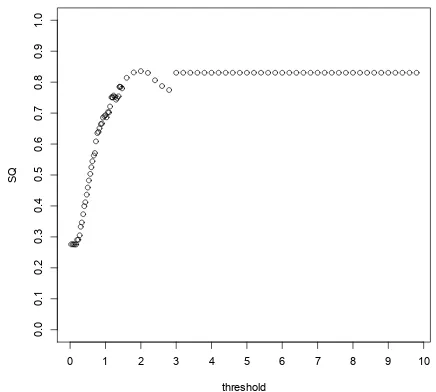
Figure 1: Plot of the stemming quality of cluster-ing uscluster-ing the distance measureD2as a function of the distance threshold
[image:5.595.74.291.536.648.2]the optimal stemming quality for a threshold of 2.0 and the maximum stemming quality is 83.46%.
Stemmer t UI% OI% SQ%
[image:6.595.80.283.102.187.2]D2 2.0 10.19 22.05 83.46 D3 35.8 11.53 23.08 82.10 D4 7.0 0.17 28.97 83.00 trunc(3) - 0.25 36.69 77.20 Morphind - 19.65 0.7 88.82
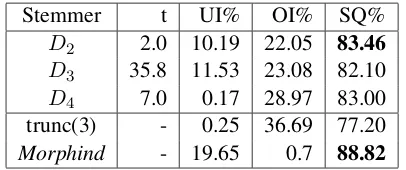
Table 3: Comparison of the optimal stemming per-formances of the approaches studied
Table 3 shows the optimal stemming quality of the string distance measures and the correspond-ing distance threshold values t. We note that clus-tering using measure D2 yields the best perfor-mance for stemming by clustering. We notice that the optimum SQ, however, comes at the expense of a higher UI compared to the truncation scheme. Next, comparing the stemming performance via clustering with that resulting from morpheme seg-mentation, we notice that the higher stemming quality (88.82%) in the latter case comes at the cost of a significantly higher UI.
The OI-UI plot on Figure 2 shows the stem-ming performance of the three distance measures. In particular, the OI-UI variation while varying the distance threshold is shown (since the distance thresholds were different for each measure, the corresponding information was omitted from the plot). As the value of the distance threshold in-creases, clusters are merged resulting in decreased UI and an increase in OI. The plot reveals that for the most part, the three measures perform better than simple truncation.
7 Discussion
An evaluation of the stemming performance cru-cially depends on the manually created groups of morphologically related word forms. Given that the grouping process was done by subjective hu-man judgement rather than an objective criterion, variations in grouping are highly likely. For in-stance, semantic relatedness of words is different depending on the context and has varied granular-ity. To cite an example, consider the word group shown in Table 1. The group consists of words de-rived fromvidyArthi“student”. While vidyArthi-gaLu “students (nominative plural)” is related to vidyArthiby inflectional morphology,vidyArthini
“female student” is also related and so is vid-yArthinilaya“ student residence” or vidyArthivE-tana“financial aid (scholarship)”. Depending on the topic being discussed, “student residence” and “scholarship” may be grouped together with “stu-dent” or not. We would like to remind the fact that words were grouped based only on their surface form with no additional information (such as con-text). It is important to also note here that in order to facilitate a clustering process, only words re-lated by a suffixing process were grouped together which means that the manual grouping process has an inherent UI. As a result, words such asBASe “language” and ADuBASe “vernacular (common language)” were relegated to different groups.
With the choice of an appropriate distance threshold (for a description see Section 5.2), the SQ by clustering using measure D2 can exceed 80%. Thus, clustering using string distance mea-sures seems to be a favorable statistical stemming approach compared to simple truncation, which (on the same sample) reaches to SQ = 77.20%. The agreeable stemming quality of the truncation method suggests that a simplistic statistical stem-mer, of taking fixed length substrings of words as stems, may in itself, result in an increased perfor-mance for IR.
The ease of implementation of the clustering procedure could be considered as an advantage over Morphind, which requires an informed set-ting of its parameters (language-dependent) for optimum segmentation performance. A more con-clusive comparison of the two methods will have to be done in a task-specific setting such as that of IR evaluation.
Let us now take a look at an instance of the clus-tering procedure. We begin with the pre-cluster ‘vid’ (which included the group of words in Ta-ble 1) which was later clustered hierarchically. At the optimum threshold of t = 2.0, with the distance measureD2, the group consisting of the morpho-logical variants of vidyArthi was clustered along with the words found in Table 5. Here we notice that the words are broadly related, but certainly do not belong to the same group, indicating the source of understemming error.
0.0 0.1 0.2 0.3 0.4 0.5 0.6 0.7 0.8 0.9 1.0
0.0
0.1
0.2
0.3
0.4
0.5
0.6
0.7
0.8
0.9
1.0
Understemming index
O
ve
rst
emmi
ng
in
de
x
6 7
5
4 3 2
1
Precluster D2
[image:7.595.136.447.95.379.2]D3 D4
Figure 2: UI-OI plots of the hierarchical clustering with the distance measures compared with that in the pre-clustering with different prefix lengths
Method No. of stems Compression (%)
Gold set 666 93.00
Clustering(D2) 227 97.61
Truncation(3) 258 97.29
Morphind 1946 79.57
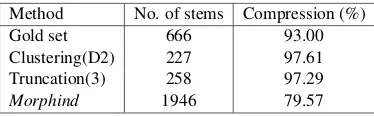
Table 4: Compression rates compared
vidyArthigaL, vidyArthiyAgidde, vidyArthiy-obbanaandvidyArthinilaya. The resulting over-stemming error can be attributed to the inability of the morpheme segmentation algorithm to han-dle word forms such as vidyArthinilayaand vid-yArthiyAgidde (compounding) and vidyArthiyob-bana(external sandhi).
Another perspective of the stemming perfor-mance can be seen in Table 4. Here we list the compression rates in terms of the number of reduced words in the dictionary after stemming. The rather high compression ratio in the manu-ally created grouping can be explained by notic-ing that the words comprise a subsample of the word types occurring in the collection chosen from among the most productive words occurring in
the corpus. (True compression rates of the lexi-con are expected to be lower than what is noted here, but certainly higher than that of English since the morphology is more complex than that of En-glish.) Notice how the morpheme segmentation al-gorithm results in the creation of about three times as many groups as needed. This explains the cor-responding high UI and low OI in Table 3
In the current study, the manually created equiv-alence classes did not distinguish between inflec-tional and derivainflec-tional forms. If such a grouping were to be available, the distance threshold could have been tuned to isolate inflectionally related forms from derivationally related forms.
[image:7.595.205.392.444.502.2]vidyA2ara,vidyA2arara,vidyA2ikAri,vidyAByAsa,vidyAByAsada,vidyAByAsadalli,vidyAByAsakkAgi, vidyAByAsakke,vidyAByAsavannu,vidyAbud2i,vidyAbud2ivaMtaru,vidyAdAna,vidyAlayada,vidyAlayagaLalli, vidyAmaMtrigaLa,vidyAni2i,vidyAnilayada,vidyApariNitaru,vidyArthivEtana,vidyArthivEtanavannu,vidyAraNya, vidyAraNyara,vidyArhate,vidyArjaneyalli,vidyAsaMs4egaLalli,vidyAtajxara,vidyAvaMta,vidyAvaMtanAgalu,
vidyAvaMtanU,vidyAvaMtarAdarU,vidyAvaMtarAgi,vidyAvaMtarU,vidyAvaMtara,vidyAvaMtaralli,vidyAvaMtarannAgi, vidyAvaMtarannu,vidyAvaMtarige,vidyAvaMtaru,vidye,vidyegU,vidyegaLa,vidyegaLannu,
vidyeyAgide,vidyeya,vidyeyalli,vidyeyannU,vidyeyannu,vidyeyu
Table 5: The set of words clustered along with words derived fromvidyArthi“student”
from the lemma (the dictionary form of the root). It would be convenient to have a distance mea-sure that helps us distinguish between inflectional forms and derivational forms of a lemma. To-wards this, we again consider the lemmavidyArthi “student” and its morphologically related forms in Table 1. We consider the distance between the lemma and the other forms using the measuresD2, D3 and D4 and rank order them with increasing order of distance (words with tied distances are grouped together and only the top-10 words are listed).
D2 ={vidyArthi,{vidyArthigU,vidyArthige,
vidyArthiyU, vidyArthiya, vidyArthiyu}, {vidyArthigaLU, vidyArthigaLa, vidyArthi-gaLu, vidyArthiyAgi},vidyArthigaLalli}
D3 ={vidyArthi,{vidyArthigU,vidyArthige,
vidyArthiyU, vidyArthiya, vidyArthiyu}, {vidyArthigaLU, vidyArthigaLa, vidyArthi-gaLu, vidyArthiyAgi},vidyArthiyannu}
D4 ={vidyArthi,{vidyArthigU,vidyArthige,
vidyArthiyU, vidyArthiya, vidyArthiyu}, {vidyArthigaLU, vidyArthigaLa, vidyArthi-gaLu, vidyArthiyAgi},vidyArthiyannu}
Here we observe that inflectionally related forms (in bold) are ranked higher than derivation-ally related forms. It is also worth pointing out that the stemming procedures considered here work by targeting the primarily suffixing processes of Kan-nada. As a result of this, forms related resulting via the umlauting process (such as shikSaNa be-comingshykSaNikaas a denominal adjective) are not conflated.
The stemming performance ofMorphindis crit-ically dependent upon the accuracy of the mor-pheme segmentation process. In (Bhat, 2012) an F-measure of 72% was reported. Upon closer in-spection, we notice that several assumptions in the algorithm are specific to English, resulting in a low recall for Kannada, whose morphology is more complex than that of English. In particular, the assumptions that - all stems are valid words in the
lexicon, affixes occur at the beginning or end of words only and affixation does not change stems - are clearly violated in Kannada. Moreover, as noted in (Bhat, 2012), morpheme segmentation is better for nouns than for verbs. An intuitive expla-nation here is that the noun inflectional process is seen more often than the verb variants.
8 Conclusions and Future Work
The results of the above experiment suggest that, for Kannada, the stemming performance of a truncation-based algorithm can be improved by subsequent clustering of the generated groups. Moreover a string distance measure, such as D2, that rewards long matching prefixes emerges as an effective distance measure for clustering morpho-logically related words. Overall, comparing sta-tistical stemmers, an unsupervised morpheme seg-mentation approach (such asMorphind) to stem-ming works better than a clustering-based ap-proach in the case of Kannada.
We are well aware that a rule-based linguistic stemmer will perform better than a non-linguistic statistical stemmer. However, this exercise serves as a bootstrapping mechanism of the stemming process for Kannada. Looking ahead, the per-formance of an aggressive stemmer that not only removes inflectional suffixes but also removes derivational suffixes via a set of rules would be of interest.
This work does not account for possible word ambiguities since each word is taken as an isolated entity, and is grouped according to its typical con-notation. As noted in (Paice, 1996), it would cer-tainly be of interest to allow different senses of a word to be assigned to different groups, using in-formation about the meaning of each specific word taken in its context.
References
P. J. Antony, M.A. Kumar, and K. P. Soman. 2010. Paradigm based morphological analyzer for kannada language using machine learning approach. Interna-tional Journal on Advances in ComputaInterna-tional Sci-ences and Technology ISSN, pages 0973–6107.
Paul Baker, Andrew Hardie, Tony McEnery, Hamish
Cunningham, and Robert Gaizauskas. 2002.
Emille, a 67-million word corpus of indic languages: Data collection, mark-up and harmonisation. In Proceedings of Language Resources and Evaluation Conference (LREC).
Suma Bhat. 2012. Morpheme segmentation for kan-nada standing on the shoulder of giants. In Proceed-ings of the WSANLP, pages 411–415.
Sajib Dasgupta and Vincent Ng. 2006. Unsupervised morphological parsing of bengali. Language Re-sources and Evaluation, 40(3):311–330.
Giorgio Di Nunzio, Nicola Ferro, Massimo Melucci, and Nicola Orio. 2004. Experiments to evaluate probabilistic models for automatic stemmer gener-ation and query word translgener-ation. In Comparative evaluation of multilingual information access sys-tems, pages 220–235. Springer.
Ljiljana Dolamic and Jacques Savoy. 2010. Compar-ative study of indexing and search strategies for the hindi, marathi, and bengali languages. ACM Trans-actions on Asian Language Information Processing, 9(3):1–24.
Matthew S. Dryer and Martin Haspelmath, editors. 2011. The World Atlas of Language Structures On-line. Max Planck Digital Library, Munich, 2011 edi-tion.
F Cuna Ekmekc¸ioglu and Peter Willett. 2000. Ef-fectiveness of stemming for turkish text retrieval. PROGRAM-LONDON-ASLIB, 34(2):195–200.
Claire Fautsch and Jacques Savoy. 2009. Algorithmic stemmers or morphological analysis? an evaluation. Journal of the American Society for Information Sci-ence and Technology, 60:16161624.
John Goldsmith, Derrick Higgins, and Svetlana Soglas-nova. 2000. Automatic language-specific stemming in information retrieval. InProceedings of the Work-shop on Cross-Language Evaluation Forum (CLEF), pages 273–284.
Samarth Keshava and Emily Pitler. 2006. A simpler, intuitive approach to morpheme induction. In Pro-ceedings of 2nd Pascal Challenges Workshop, pages 31–35.
Tuomo Korenius, Jorma Laurikkala, Kalervo J¨arvelin, and Martti Juhola. 2004. Stemming and lemma-tization in the clustering of finnish text documents. InProceedings of the thirteenth ACM international conference on Information and knowledge manage-ment, CIKM ’04, pages 625–633.
Leah S. Larkey and Margaret E. Connell. 2003. Struc-tured queries, language modeling, and relevance modeling in cross-language information retrieval. InInformation Processing and Management Special Issue on Cross Language Information Retrieval.
Julie Lovins. 1968. Development of a stemming al-gorithm. MIT Information Processing Group, Elec-tronic Systems Laboratory.
Prasenjit Majumder, Mandar Mitra, Swapan Parui, Gobinda Kole, Pabitra Mitra, and Kalyankumar Datta. 2007. Yass: Yet another suffix stripper. ACM transactions on information systems (TOIS), 25(4):18.
Prasenjit Majumder, Mandar Mitra, and Dipasree Pal. 2008. Bulgarian, hungarian and czech stemming us-ing yass. In Advances in Multilingual and Multi-modal Information Retrieval, pages 49–56. Springer.
Kavi Narayana Murthy. 1999. A network and pro-cess model for morphological analysis/generation. InICOSAL-2, the Second International Conference on South Asian Languages, Punjabi University, Pa-tiala, India.
Chris Paice. 1996. Method for evaluation of stem-ming algorithms based on error counting. Journal of the American Society for Information Science, 47(8):632–649.
Martin Porter. 1980. An algorithm for suffix strip-ping. Program: electronic library and information systems, 14(3):130–137.
Jacques Savoy. 2006. Light stemming approaches for the french, portuguese, german and hungarian lan-guages. In Proceedings of the 2006 ACM sympo-sium on Applied computing, SAC ’06, pages 1031– 1035.
Hayri Sever and Yıltan Bitirim. 2003. Findstem: analysis and evaluation of a turkish stemming al-gorithm. InString Processing and Information Re-trieval, pages 238–251. Springer.
G. Shastri. 2011. Kannada morphological analyser and generator using trie. IJCSNS, 11(1):112.
Jan ˇSnajder and B Dalbelo Baˇsic. 2009. String distance-based stemming of the highly inflected croatian language. In Proceedings of the Inter-national Conference RANLP-2009. Borovets, Bul-garia: Association for Computational Linguistics, pages 411–415.
S.N. Sridhar. 1990. Kannada. Routledge.