Proceedings of the Second International Conference on Dependency Linguistics (DepLing 2013), pages 167–176,
Reasoning with Dependency Structures and Lexicographic Definitions
using Unit Graphs
Maxime Lefranc¸ois
and
Fabien Gandon
Wimmics, Inria, I3S, CNRS, UNSA
2004 rte des Lucioles, BP. 93, 06902 Sophia Antipolis, France
{
maxime.lefrancois,fabien.gandon
}
@inria.fr
Abstract
We are interested in a graph-based Knowl-edge Representation (KR) formalism that would allow for the representation, manip-ulation, query, and reasoning over depen-dency structures, and linguistic knowledge of the lexicon in the Meaning-Text Theory framework. Neither the semantic web for-malisms nor the conceptual graphs appear to be suitable for this task, and this led to the introduction of the new Unit Graphs (UG) framework. In this paper we will overview the foundational concepts of this framework: the UGs are defined over a UG-support that contains: i) a hierarchy of unit types which is strongly driven by the actantial structure of unit types, ii) a hierarchy of circumstantial symbols, and iii) a set of unit identifiers. Based on these foundational concepts and on the defini-tion of UGs, this paper justifies the use of a deep semantic representation level to represent meanings of lexical units. Rules over UGs are then introduced, and lexi-cographic definitions of lexical units are added to the hierarchy of unit types. Fi-nally this paper provides UGs with seman-tics (in the logical sense), and pose the en-tailment problem, so as to enable the rea-soning in the UGs framework.
1 Introduction
We are interested in a graph-based Knowledge Representation (KR) formalism that would allow for the representation, manipulation, query, and reasoning over dependency structures and linguis-tic knowledge of the Explanatory Combinatorial Dictionary (ECD), which is the lexicon at the core of the Meaning-Text Theory (MTT) (Mel’ˇcuk, 2006).
Most past or current projects that aimed at im-plementing the ECD did so in a lexicographic perspective. One important example is the RE-LIEF project (Lux-Pogodalla and Polgu`ere, 2011), which aims at representing a lexical system graph named RLF (Polgu`ere, 2009), where lexical units are interlinked by paradigmatic and syntagmatic links of lexical functions (Mel’ˇcuk, 1996). In the RELIEF project, the description of Lexical Functions is based on a formalization proposed by Kahane and Polgu`ere (2001). Moreover, lexico-graphic definitions start to be partially formalized in the RELIEF project using the markup type that has been developed in the Definiens project (Bar-que and Polgu`ere, 2008; Bar(Bar-que et al., 2010).
One exception is the proprietary linguistic pro-cessor ETAP-3 that implements a variety of ECD for Natural Language Processing (Apresian et al., 2003; Boguslavsky et al., 2004). Linguistic knowledge are asserted, and linguistic and gram-matical rules are directly formalized in first order logic.
actantial structure, i.e., actant slots, the ways in which their instances may be linked to other units in a UG.
The main research question of this paper is the following: What semantics can be attributed to UGs, and how can we define the entailment prob-lem for UGs ?
The rest of this paper is organized as follows. We will first overview the issues of existing graph-based KR formalisms that led to the introduction of the new UGs framework (§2). The foundational concepts of this framework are then introduced (§3). From these foundational concepts we define the lexicographic definitions of Lexical Unit Types (LexUTs) (§4). Finally we provide UGs with se-mantics (in the logical sense), and pose the entail-ment problem (§5).
2 The Unit Graphs Formalism
At first sight, two existing KR formalisms seem in-teresting for representing dependency structures: semantic web formalisms (RDF1, RDFS2, OWL3, SPARQL4), and Conceptual Graphs (CGs) (Sowa, 1984; Chein and Mugnier, 2008). Both for-malisms are based on directed labelled graph structures, and some research has been done to-wards using them to represent dependency struc-tures and knowledge of the lexicon (OWL in (Lefranc¸ois and Gandon, 2011; Boguslavsky, 2011), CGs at the conceptual level in (Bohnet and Wanner, 2010)). Yet authors in (Lefranc¸ois, 2013) showed that neither of these KR formalisms can represent linguistic predicates. Let us list the main drawbacks of these existing formalisms:
• The RDF is insufficient because its semantics is limited to that of oriented labelled graphs. • In RDFS, OWL and the CGs, there is a strong
distinction between concept types and rela-tions. Yet, a linguistic predicate may be con-sidered both as a concept type as it is instan-tiated in dependency structures, and as a rela-tion as its instances may link other instances. • RDFS and OWL only model binary relations, which is not the case of most linguistic
pred-1RDF - Resource Description Framework, c.f.,http://w3.org/RDF/
2RDFS - RDF Schema,
c.f.,http://www.w3.org/TR/rdf-schema/ 3OWL - Web Ontology Language,
c.f.,http://www.w3.org/TR/owl2-overview/ 4SPARQL, c.f.,
http://www.w3.org/TR/sparql11-overview/
icates. One would need to use reification of
n-ary relations, but then no semantics is at-tributed to such relations.
• CGs supportn-ary relations, but the
inheri-tance mechanism of relation types is such that two relations with different arities must be in-comparable. Yet the Semantic Actant Slots (SemASlots) of a lexical unit are determined by linguistic criteria and may thus differ from those of the lexical unit from which its sense derives (Mel’ˇcuk, 2004, p. 38). One thus cannot use the natural inheritance mechanism of CGs to model the meaning specialization of predicates.
As the CGs formalism is the closest to the se-mantic networks, the following choice has been made to overcome these issues: Modify the CGs formalism basis, and define transformations to the RDF syntax for sharing knowledge and publish-ing over the web of data. As we are to represents linguistic units of different nature (e.g., seman-tic units, lexical units, grammaseman-tical units, words), termunithas been chosen to be used in a generic manner, and the result of this adaptation is thusthe Unit Graphs (UGs) framework.
3 Unit Graphs
For a specific Lexical Unit L, (Mel’ˇcuk, 2004, p. 5) distinguishes considering L in language (i.e., in the lexicon), or in speech (i.e., in an utterance). KR formalisms and the Unit Graphs (UGs) for-malism also make this distinction using types. In this paper and in the UGs formalism, there is thus a clear distinction between units (e.g., semantic unit, lexical unit), which will be represented in the UGs, and theirtypes(e.g., semantic unit type, lex-ical unit type), which are roughly classes of units for which specific features are shared. It is those types that specify through actant slots how their instances (i.e., units) are to be linked to other units in a UG.
3.1 Support
Following the example of CGs, UGs are defined over a so-calledsupport.
Definition 1. A UG support is denoted S def= (T,C,M)and is composed of a hierarchy of unit
typesT, a hierarchy of circumstantial symbolsC, and a set of unit identifiersM.
First, unit types and their actantial structure are described in a structure called hierarchy and de-noted T. Whether they are semantic, lexical or grammatical, unit types haveActant Slots (ASlots)
with symbols. Moreover, ASlots may be optional, obligatory, or prohibited (Lefranc¸ois and Gandon, 2013a). Let us briefly introduce two of the com-ponents ofT, and leave details for section 3.3.
• The core of T is the set of so-called
Prim-itive Unit Types (PUTs), denoted T. Now a unit type may consist of several conjoint PUTs. In particular, it may be a lexical PUT and multiple grammatical PUTs, like {def, plur,CAT}. To represent this, we intro-duce the setT∩of possibleConjunctive Unit Types (CUTs)overTas the powerset5ofT.
• T contains a set of binary relation symbols of type predicate-argument called Actant Sym-bols (ASymSym-bols), and denotedST. ST
con-tains numbers for the semantic unit types, and other ”classical” symbols for the other lev-els under consideration (e.g, roman numer-als I to VI for the MTT’s Deep Syntactic level). Every unit type has anactantial struc-turethat consists in a set of optional, oblig-atory and prohibited ASlots associated with some ASymbols. The actantial structure of a PUT specify how units of this type shall be linked to other units through so-called actan-tial relationsin a dependency structure.
Second, there exists dependencies other than ac-tantial: circumstantial relations (Mel’ˇcuk, 2004). Circumstantial relations are considered of type instance-instance contrary to actantial relations. Example of such relations are the deep syntactic representation relations ATTR, COORD, APPEND
of the MTT, but we may also use such relations to represent communicative dependencies for in-stance. Circumstantial relations are labelled by symbols chosen in a set of so-called Circumstan-tial Symbols (CSymbols), denoted SC, and their
classes and usage are described in a hierarchy denoted C. Section 3.4 details the hierarchy of CSymbols.
Finally, one actually needs symbols to identify units. We thus introduce a set of so-called unit identifiers, denotedM. Every element ofM iden-tifies a specific unit, but multiple elements of M may identify the same unit.
5The powerset ofXis the set of all subsets ofX:2X
3.2 Definition of UGs
The UGs represent different types of dependency structures (e.g., semantic, syntactic). In a UG, unit nodes that are typed are interlinked by dependency relations that are either actantial or circumstantial. Definition 2. A UG Gdefined over a supportS is a tuple denotedG = (U,def l, A, C, Eq)whereU
is the set of unit nodes, l is a labelling mapping overU,AandCare respectively actantial and
cir-cumstantial triples, andEqis a set of asserted unit node equivalences.
Let us detail the components ofG.
U is the set of unit nodes. Every unit node
represents a specific unit, but multiple unit nodes may represent the same unit. Unit nodes are typed and marked so as to respectively specify what CUT they have and what unit they represent. The marker of a unit node is a set of unit identifiers, for mathematical reasons. The set of unit node markers is denoted M∩ and is the powerset5 of
M. If a unit node is marked by∅, it is said to be
generic, and the represented unit is unknown. On the other hand, if a unit node is marked{m1, m2},
then the unit identifiersm1andm2actually
iden-tify the same unit. l is thus a labelling mapping over U that assigns to each unit node u ∈ U a
couplel(u) = (t∩, m∩)∈T∩×M∩of a CUT and
a unit node marker. We denotet∩ =type(u)and m∩ = marker(u). Unit nodes are illustrated by
rectangles with their label written inside.
Ais the set ofactantial triples(u, s, v)∈ U× ST × U. For all a = (u, s, v) ∈ A, the unit
represented byvfills the ASlotsof the unit
rep-resented by u. We denote u = governor(a), s = symbol(a) and v = actant(a). We also
denote arc(a) = (u, v). Actantial triples are
il-lustrated by double arrows.
C is the set ofcircumstantial triples(u, s, v)∈
U×SC ×U. For allc= (u, s, v) ∈ C, the unit
represented byugoverns the unit represented byv
with respect tos. We denoteu = governor(c), s = symbol(c) and v = circumstantial(c). We also denotearc(c) = (u, v). Circumstantial
triples are illustrated by simple arrows.
Eq ⊆ U2 is the set of so-calledasserted unit node equivalences. For all couple (u1, u2) in
Eq,u1 and u2 represent the same unit. The Eq
relation is not an equivalence relation over unit nodes6. We thus distinguish explicit and implicit
knowledge. Asserted unit node equivalences are illustrated by dashed arrows.
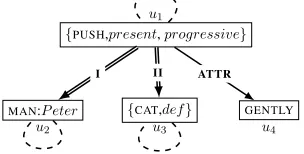
[image:4.612.98.292.271.314.2]For instance, figure 1a is a semantic represen-tation of sentence Peter tries to push the cat. in which units are typed by singletons and ASym-bols are numbers, in accordance with the MTT. Figure 1b is a simplified deep syntactic represen-tation of Peter is gently pushing the cat. In this figure unit nodes u2 and u4 are typed by
single-tons, and only unit nodeu2is not generic and has
a marker: {P eter}. P is composed of(u1,I, u2)
and(u1,II, u3), whereIandII are ASymbols. C
is composed of (u1,ATTR, u4) where ATTR is a
CSymbol. In the relation Eq there is (u1, u1),
(u2, u2), and(u3, u3).
(Peter) (try)
(push) (cat)
1
2
1
2
(a) Semantic representation of sentencePeter tries to push the cat.
{PUSH,present,progressive}
MAN:P eter {CAT,def} GENTLY u1
u2 u3 u4
I II ATTR
(b) Deep syntactic representation of sentencePeter is gently pushing the cat.
Figure 1: Examples of Unit Graphs.
UGs so defined are the core dependency struc-tures of the UG mathematical framework. Before we present what they may be used for in more de-tails, let us look more closely into components of the support on which UGs are defined: the unit types hierarchy and the CSymbols hierarchy. 3.3 Unit Types Hierarchy
As already stated in section 3.1, unit types and their actantial structure is described in the unit types hierarchy which is denotedT.
Definition 3. A hierarchy of unit types, denoted T, is a tuple T =def (TD,ST, γγγ, γγγ1, γγγ0, CA,⊥uA,{ςςςt}t∈T) that enables to construct a pre-ordered7 set of Conjunctive
transitive relation.
7A pre-order is a reflexive and transitive binary relation.
Unit Types (CUTs)T∩ with optional, obligatory,
or prohibited ASlots.
This structure has been thoroughly described in (Lefranc¸ois and Gandon, 2013a; Lefranc¸ois, 2013). Let us overview its components.
TD is a set of declared Primitive Unit Types
(PUTs). This set is partitioned into linguistic PUTs of different nature (e.g., deep semantic, se-mantic, lexical). ST is a set of Actant Symbols
(ASymbols). γγγ (resp1. γγγ1, resp2. γγγ0) assigns to everys ∈ ST its radix8 (resp1. obligat9, resp2.
prohibet10) unit typeγγγ(s) (resp1. γγγ1(s), resp2.
γγγ0(s)) that introduces (resp1. makes obligatory, resp2. makes prohibited) an Actant Slot (ASlot) of symbols.
The set ofPrimitive Unit Types (PUTs) is de-notedTand defined as the disjoint union of TD,
the range ofγγγ,γγγ1andγγγ0, plus theprime univer-sal PUT> and theprime absurd PUT ⊥. T is then pre-ordered by a relation . which is com-puted from the set of asserted PUTs comparisons
CA⊆T2.t1.t2models the fact that the PUTt1
is more specific than the PUTt2. A unit type may
consist of several conjoint PUTs. We introduce the setT∩of possibleConjunctive Unit Types (CUTs)
overTas the powerset5ofT. The set⊥u
Ais the set
of declared absurd CUTs that can not be instanti-ated.
The actantial structure of a unit typet∩is a set
of ASlots, whose symbols are chosen in the setST,
and that may be optional, obligatory, or prohibited. Moreover, ASlots are signed. The signature oft∩
for one of its ASlotssis denotedςςς∩t∩(s), and
char-acterises the type of the unit that fills this slot. The set of signatures oft∩is computed from the set of
PUTs signatures{ςςςt}t∈T.
Finally the pre-order.overTis extended to a pre-order.∩ overT∩as defined by Lefranc¸ois and
Gandon (2013a). Lefranc¸ois and Gandon (2013b) proved that in the hierarchy of unit types, ift∩1
∩ . t∩
2 then the actantial structure of t∩1 is more
spe-cific than that oft∩2, except for some degenerated
cases. Thus as one goes down the hierarchy of unit types, an ASlot with symbolsis introduced by the radix{γγγ(s)}and first defines an optional ASlot for any unit typet∩more specific than{γγγ(s)}, as long
8radix is a latin word that means(root).
9obligat is the conjugated form of the latin verb obligo, 3p
sing. pres.,(it makes mandatory).
[image:4.612.122.274.354.431.2]ast∩is not more specific than the obligat{γγγ1(s)}
(resp. the prohibet{γγγ0(s)}) ofs. If that happens, the ASlot becomes obligatory (resp. prohibited). Moreover, the signature of an ASlot may only be-come more specific.
3.4 Circumstantial Symbols Hierarchy As for any slot in a predicate, one ASlot of a unit may be filled by only one unit at a time. Now, one may also encounter dependencies of another type in some dependency structures: circumstan-tial dependencies (Mel’ˇcuk, 2004). Circumstancircumstan-tial relations are considered of type instance-instance contrary to actantial relations. Example of such relations are the deep syntactic representation re-lationsATTR,COORD,APPENDof the MTT.
We thus introduce a finite set of so-called Cir-cumstantial Symbols (CSymbols)SCwhich is a set
of binary relation symbols. In order to classify SC in sets and subsets, we introduce a partial
or-der.C overSC. C
.is the reflexo-transitive closure of a set of asserted comparisonsCSC ⊆ T
2.
Fi-nally, to each CSymbol is assigned a signature that specifies the type of units that are linked through a relation having this symbol. The set of sig-natures of CSymbol {σσσs}s∈SC is a set of
cou-ples of CUTs:{(domain(s), range(s))}s∈SC. As
one goes down the hierarchy of PUTs, we impose that the signature of a CSymbol may only become more specific. We may hence introduce the hierar-chy of CSymbols:
Definition 4. The hierarchy of Circumstantial Symbols, denotedC = (def SC,CSC,T,{σσσs}s∈SC), is
composed of a finite set of CSymbolsSC, a set of
declared comparisons of CSymbolsCSC, a
hierar-chy of unit typesT, and a set of signatures of the CSymbols{σσσs}s∈SC.
3.5 UG Homomorphisms
Unit Graphs have an underlying oriented labelled graph. It is thus convenient for reasoning ap-plications to introduce the notion of UGs homo-morphism. Recall that for non-labelled graphs, an homomorphism from H to G, is an
edge-preserving mapping from nodes of H to nodes of G. We will thus introduce the notion of
homomorphism of UGs, based on homomor-phism of their underlying oriented labelled graphs. Let us first introduce the notion of UGs map-ping. Let H = (Uh,lh, Ah, Ch, Eqh)and G = (Ug,lg, Ag, Cg, Eqg)be two UGs defined over the
same support.
Definition 5. A UGs mapping f from H to G, writtenf : H → G, corresponds to a mapping
of their underlying oriented labelled graphs, i.e., a mappingf : Uh →Ugfrom the unit nodes ofH
to the unit nodes ofG.
Then there is a homomorphism of UGs if there is a homomorphism of their underlying oriented labelled graphs. To define such a homomorphism, one needs to choose pre-orders over labels for unit nodes and arcs. We use inclusion for unit node markers,.∩ for types, and.C for circumstantial re-lations.
Definition 6. There is ahomomorphismfromHto Gif and only if there exists a mappingπ:H →G
such that all of the following is true:
• ∀u∈Uh,marker(u)⊆marker(π(u));
• ∀u∈Uh,type(π(u)).∩ type(u);
• (u, s, v)∈Ah⇒(π(u), s, π(v))∈Ag;
• (u, s, v) ∈ Ch ⇒ ∃c ∈ Cg, arc(c) =
(π(u), π(v))andsymbol(c).C s; • (u, v)∈Eqh⇒(π(u), π(v))∈Eqg.
4 Rules and Lexicographic Definitions
Now that we have defined the core structures of the UGs framework, and before we introduce se-mantics of UGs, we need to sketch some advance concepts of the UGs framework. Namely, the deep semantic representation level (§4.1), rules (§4.2), and unit types definitions (§4.3)4.1 The deep-surface semantic interface In the MTT, semantic ASymbols are numbers. For instance, the french lexical unitINSTRUMENT(en: instrument) has a SemASlot1that corresponds to the activity for which the instrument is designed. PEIGNE (en: comb) has a more specific meaning than INSTRUMENT, and also two SemASlots: 1
correspond to the person that uses the comb, and
2is a split variable11that corresponds either to the
hair or to the person that is to be combed.
As the specialization of PUTs implies the spe-cialization of their actantial structure, the pre-order over semantic unit types can not correspond to a meaning specialization relation. Lefranc¸ois and Gandon (2013a) hence defined a deeper level of representation for the MTT: thedeep semantic level. At the deep semantic level, the pre-order
over unit types may correspond to a meaning spe-cialization relation. TheDeep Semantic Unit Type (DSemUT) associated with a Lexical Unit Type (LexUT) L is denoted/L\, and the set of
ASym-bols that is used to symbolize ASlots is a set of se-mantic roles (e.g., agent, experiencer,object).
For instance, the DSemUT /instrument\
associ-ated with the LexUT INSTRUMENT may have an ASlot arbitrarily symbolized activity, which
would be inherited by the DSemUT /peigne\.
Then /peigne\ also introduces three new ASlots:
one arbitrarily symbolized possessor that corre-sponds to the ASlot1of(peigne), and two
arbitrar-ily symbolized combedhair, andcombedperson
that correspond to the ASlot2of(peigne).
4.2 Rules
One question one may ask at this point is: how to represent the correspondence between the ac-tantial structure of a DSemUT, and the acac-tantial structure of its associated Surface Semantic Unit Type (SSemUT)? First and parallel with CGs, we will defineλ-UGs that enable to distinguish some generic unit nodes of a UG.
Definition 7. Aλ-UGL={u1, . . . , un}Gof size
n defined over a supportS is composed of a UG
G = (U,l, A, C, Eq), and a set ofngeneric unit
nodes ofG,{u1, . . . , un}, denoted the free nodes
ofL.
λ-UG are actually generalized UGs, and a UG may be considered as a λ-UG of size0. A rule
may then be simply represented by twoλ-UGs and
a bijection between their free nodes.
Definition 8. A rule is a triple R = (H, C, κ)def
where H andC are twoλ-UGs of the same size defined over the same support, H is denoted the hypothesis,Ctheconclusion, andκis a bijection
from free nodes ofHto free nodes ofC.
A rule is said to beapplicableto a UGGif and
only if there exists a homomorphism from H to G. Letπbe such a homomorphism fromHtoG. The application ofRonGwith respect toπis the
UG obtained by merging C in Gwith respect to π◦κ−1, i.e.,
1. addCtoG;
2. for all (uc, ug) ∈ π ◦ κ−1, merge uc
and ug as follows: (i) add a new node u,
with type(u) = type(uc)∪ type(ug) and
marker(u) = marker(uc)∪marker(ug);
(ii) replaceucandugbyuin any dependency
triple inA∪Cand in any element ofEq.
Among other, rules enable to represent corre-spondences between representations of two adja-cent levels, and they shall be automatically gen-erated from the dictionary. Let us just note two issues with the definition of rules for the moment:
• in the correspondence between actantial structures of /peigne\ and (peigne), the
ASlot2of(peigne)may correspond either to
the ASlotcombedhair or tocombedperson
of /peigne\. One thus need to define two
different correspondence rules, one that as-sumes slotcombedhairis filled, and one that assumes slotcombedpersonis filled.
• if a LexUT has an optional SemASlot, then one would need two different correspondence rules between its associated DSemUT and SSemUT: one that assumes the ASlot is filled and one that assumes the ASlot is not filled.
These remarks are valid not only at the deep-surface semantic interface, and the number of rules would grow in case of several optional ASlots, several split ASlots, or optional split Se-mASlots for instance. The semantic web SPARQL query language has OPTIONAL and UNION con-structors that we could draw inspiration from to extend the definition of rules so as to factorize these cases. Now for the purpose of our presenta-tion we will hold on the simple definipresenta-tion of rules given above, and rely on the fact that we do have means to compute all the possible correspondence rules.
4.3 Unit Types Hierarchy with Definitions We formalize the notion ofdefinitionof a Primi-tive Unit Type (PUT) and include a set of PUTs definitions in the definition of the unit types hier-archy. Definitions are of special interest to rep-resent lexicographic definitions of a LexUT L, which corresponds to the definition of its associ-ated DSemUT /L\. Informally, a definition
de-fines an equivalence between twoλ-UG defined
over the same support. One of them has a cen-tral free unit node typed with the defined PUT and some of its ASlots filled by free unit nodes. The otherλ-UG is called theexpansionoft. There is
no circumstantial triple in these twoλ-UG because
they must not be part of the lexicographic defini-tion of a LexUT.
Definition 9. A definitionDtof a PUTtis a triple
Dt
def
• Dt− ={u−t , v−1, . . . , vn−}(U−,l−, A−,∅,∅)
contains only free unit nodes;
• u−t is called the thecentral unit nodeofDt−,
and is typed{t};
• the actantial triples of A− are of the form (u−t , si, vi−)where the set ofsiis a subset of
the ASlots oft;
• for all(u−t , si, vi−)∈A−, the type ofv−i
cor-responds to the signature oftfor its ASlotsi;
• Dt+ ={u+t , v+1, . . . , vn+}(U+,l+, A+,∅,∅)
is called theexpansionoft;
• κ is a bijection from {u−t , v−1, . . . , v−
n} to
{u+t , v+1, . . . , vn+}, such that κ(u−t ) = u+t ,
and for alli,κ(vi−) =vi+;
• the type ofu+t is called thegenusoftand is denotedgenus(t).
Figure 2 is an example of lexicographic defini-tion ofPEIGNE: an instrument that a person X uses to detangle the hair Y1of a person Y2.
/peigne\
/person\ /hair\
/person\
possessor combedperson
combedhair
/instrument\
/person\ /detangle\
/person\ /hair\ activity
agent object
[image:7.612.99.295.325.471.2]partof
Figure 2: Lexicographic definition ofPEIGNE.
Intuitively, a definition corresponds to two re-ciprocal rules: (Dt−, D+t , κ)and(D+t , D−t , κ−1).
If there is the defined PUT in a UG then one may infer its definition, and vice versa. Again, there is currently an issue with the definitions with op-tional ASlots. In fact, one would need two differ-ent definitions, one with the ASlot filled, and one with the ASlot not filled. For the purpose of our presentation we will hold on the simple definition of definitions given above, and simply represent multiple definitions for a given PUT.
A set of PUTs definitionsDmay thus be added to the unit types hierarchy:
Definition 10. A hierarchy of unit types, denoted T, is a tuple T =def (TD,ST, γγγ, γγγ1, γγγ0, CA,⊥uA,{ςςςt}t∈T,D) that
enables to construct a pre-ordered7 set of unit
typesT∩with their actantial structure, and withD
being definitions of some PUTs.
5 Semantics of UGs
5.1 Closure of a UG
The UGs framework makes the open-world as-sumption, which means that a UG along with the support on which it is defined represents explicit knowledge, and that additional knowledge may be inferred. Consider the UGG = (U,l, A, C, Eq)
defined over the supportSillustrated in figure 3a. Some knowledge inGis implicit:
1. two unit nodes u1 and u2 share a common
unit marker M ary, so one may infer that
they represent the same unit. (u1, u2) may
be added toEq.
2. every PUT is a subtype of >, so one could add>to all the types of unit nodes inG.
3. there are two unit nodesv1andv2that fill the
same ASlotactivityof the unit node typed
/instrument\. So one may infer thatv
1 and
v2 represent the same unit. Said otherwise,
(v1, v2)may be added toEq.
4. one may recognize the expansion of/peigne\
as defined in figure 2, so this type may be made explicit in the unit node typed
/instrument\.
Each of the rules behind these cases explicit knowledge inG. More generally, table 1 lists a
set of rules that one may use to explicit knowledge in any UG. Cases 1 to 4 respectively correspond to rulesmrk-eq,u-typ,a-fp, anddef-. The complete set of rules defines the axiomatization of the UGs semantics.
Definition 11(Closing a UG). The process of ap-plying the set of rules of figure 1 onGuntil none
of them has any effect is calledclosingG, and
re-sults incl(G).
u-typ For allu∈U, andtype(u).∩ t∩. . . Addt∩ intype(u) u-bot For allu∈U, if⊥ ∈type(u), . . . Error: inconsistency !
eq-ref For allu∈U . . . Add(u, u) inEq
eq-sym For all(u1, u2)∈Eq . . . Add(u2, u1) inEq
eq-trans For all(u1, u2)and(u2, u3)∈Eq. . . Add(u1, u3) inEq
eq-typ For all(u1, u2)∈Eq. . . Addtype(u1) intype(u2)
eq-mrk For all(u1, u2)∈Eq. . . Addmarker(u1) inmarker(u2)
mrk-eq For allu1, u2∈U, ifmarker(u1)∩marker(u2)6=∅, Add(u1, u2) inEq
a-eq-g For all(u1, s, v)∈Aand(u1, u2)∈Eq. . . Add(u2, s, v) inA
a-eq-a For all(u, s, v1)∈Aand(v1, v2)∈Eq. . . Add(u, s, v2) inA
a-fp For all(u, s, v1)and(u, s, v2)∈A. . . Add(v1, v2) inEq
a-radix For all(u, s, v)∈A. . . Addγγγ(s) intype(u) a-obl For allu∈Uands∈ST, ifγγγ1(s)∈type(u) . . . Ensure there exists(u, s, v)inA a-pro For all(u, s, v)∈A, ifγγγ0(s)∈type(u),. . . Error: inconsistency !
a-sig For all(u, s, v)∈A. . . Addςςςtype∩ (u)(s) intype(v) c-eq-g For all(u1, s, v)∈Cand(u1, u2)∈Eq. . . Add(u2, s, v) inC
c-eq-c For all(u, s, v1)∈Cand(v1, v2)∈Eq. . . Add(u, s, v2) inC
c-dom For all(u, s, v)∈C. . . Adddomain(s) intype(u) c-rng For all(u, s, v)∈C. . . Addrange(s) intype(v) c-sop For all(u, s1, v)∈Cands1
C
.s2. . . Add(u, s2, v) inC
[image:8.612.106.521.55.333.2]def+ For allDt∈ D, if(Dt−, Dt+, κ)is applicable and(D+t , Dt−, κ−1)is not, apply(D−t , Dt+, κ) def- For allDt∈ D, if(Dt+, Dt−, κ−1)is applicable and(Dt−, D+t, κ)is not, apply(D+t , Dt−, κ−1)
Table 1: Semantics of the Unit Graphs.
/instrument\ /person\:Mary
/do\ /detangle\
/person\:Mary
/hair\
activity activity
agent
object
partof
u1 u2
v2 v1
(a) Incomplete deep semantic representationG
{/peigne\,/instrument\,>}
{/person\,>}:Mary
{/detangle\,/do\,>} {/detangle\,/do\,>}
{/person\,>}:Mary
{/hair\,>}
activity activity
combedperson combedperson
possessor possessor
combedhair
agent agentagent agent
partof partof object object
[image:8.612.109.527.379.595.2](b) Closure of the unit graphG
Figure 3: Closure of a UG.
{>,/person\}:P eter u
{>,/person\,/woman\} v
{>,/person\,/woman\} {>,/person\,/woman\} {/woman\}
mother mother mother
[image:8.612.89.524.648.686.2]5.2 Reasoning with Homomorphisms
Now that we provided UGs with semantics and that we have means to explicit knowledge, we will define the prime decision problem of the UGs framework: Considering two UGsG and H de-fined over the same supportS, does the knowledge ofGentails the knowledge ofH? The notion of entailmentmay intuitively be defined for UGs as follows:GentailsHif and only ifcl(G)includes H.
There are two issues with this definition of en-tailment. The first is that one needs to define what is the precise meaning of inclusion of a UG. The second is thatcl(G)may be infinite, thus
prevent-ing decidability of entailment.
The answer to the first issue is straightforward as we already defined the UGs homomorphism.
cl(G) includesH if and only if there is a
homo-morphism fromHtocl(G).
Now, the second issue is more problematic. Indeed, the closure of a finite UG may be in-finite, thus preventing decidability of the deci-sion problem. This problem is illustrated on a simple example in figure 4, suppose one asserts that deep semantic PUTs /person\ has a
oblig-atory ASlot mother with ςςς/person\(mother) = /woman\, and of course, /woman\ . /person\.
Consider the UG G = ({u},l,∅,∅,{(u, u)}),
such that marker(u) = P eter and type(u) =
{>,/person\}. One knows that the unit
repre-sented by ushould have a unit of type/woman\
that fills its obligatory ASlot mother. So rule add-a is applicable and one could add a unit node v to represent that argument, with (u, mother, v) ∈ A. Ruleu-typ will then make
v be of type {>,/person\,/woman\}, and rule
add-a is again applicable on v. Thus cl(G)
is an infinite chain of unit nodes having type {>,/person\,/woman\} and that fill the ASlot
motherof one another.
In the set of inference rules of table 1, only three rules add unit nodes to the UG when triggered: add-g,def-anddef+. An open problem is thus to find a sufficient condition on the unit types hier-archy and the set of definitions so that we are en-sured that the closure of a finite UG is finite.
6 Conclusion
We studied how to formalize, in a knowledge en-gineering perspective, the dependency structures and the linguistic predicates, in order to
repre-sent, manipulate, query, and reason with linguistic knowledge.
We provided a rationale the introduction of the new graph-based Unit Graphs (UGs) KR formal-ism, and gave an overview of the foundational concepts of the UGs framework. The linguistic predicates are represented by unit types, and are described in a unit types hierarchy. Circumstantial relations are another kind of dependency relation that are described in a hierarchy, and along with a set of unit identifiers these two structures form a UGs support on which UGs may be defined. As UG have an underlying oriented labelled graph, one could introduce the notion of UG homomor-phism which is useful to define the applicability of rules and the entailment problem.
The strong coherence in the unit types hierarchy justifies the introduction of a deep semantic rep-resentation level that is deeper than the semantic level, and in which one may represent the actual meaning of Lexical Unit Type (LexUT). It is at the deep semantic level that the lexicographic defini-tions of LexUTs shall be represented, and we gave a definition of the definition of the associated Deep Semantic Unit Type (DSemUT) of a LexUT.
Once we added a set of unit types definitions in the unit types hierarchy, we introduced the se-mantics of UGs and we posed the entailment prob-lem for UGs. A UGs along with the support on which it is defined represents explicit knowledge, and additional knowledge may be inferred. We in-troduced a set of entailment rules that one may use to compute the closurecl(G)of a UGG, i.e., make explicit all of the knowledge that is implicit. We then defined the entailment problem of H by G
as a directed labelled graphs homomorphism prob-lem betweenH, and the closure ofG: cl(G). In
casecl(G)is finite, the entailment problem is thus
NP-complete.
In this paper we also sketched two directions for future research:
• Many rules may be needed to represent correspondences between the deep seman-tic and the semanseman-tic representation levels in case some Semantic ASlots are optional or split. More research is needed to adapt the SPARQL OPTIONAL and UNION construc-tors in these cases. The same can be said about definitions of DSemUTs that have op-tional ASlots.
that occurs it makes the closure undecidable, along with the entailment problem. We are currently working of the definition of restric-tions of the unit types hierarchy and the set of definitions in order to ensure that any UG has a finite closure.
References
Juri Apresian, Igor Boguslavsky, Leonid Iomdin, Alexander Lazursky, Vladimir Sannikov, Victor Sizov, and Leonid Tsinman. 2003. ETAP-3 linguis-tic processor: A full-fledged NLP implementation
of the MTT. In First International Conference on
Meaning–Text Theory (MTT’2003), pages 279–288.
Lucie Barque and Alain Polgu`ere. 2008. Enrichisse-ment formel des d´efinitions du Tr´esor de la Langue Franc¸aise informatis´e (TLFi) dans une perspective
lexicographique.Lexique, 22.
Lucie Barque, Alexis Nasr, and Alain Polgu`ere. 2010. From the Definitions of the ’Tr´esor de la Langue Franc¸aise’ To a Semantic Database of the French
Language. In Fryske Akademy, editor,Proceedings
of the XIV Euralex International Congress, Fryske Akademy, pages 245–252, Leeuwarden, Pays-Bas. Anne Dykstra et Tanneke Schoonheim, dir.
Igor Boguslavsky, Leonid Iomdin, and Viktor Sizov. 2004. Multilinguality in ETAP-3: reuse of lexical
resources. In Gilles S´erasset, editor,Proc. COLING
2004 Multilingual Linguistic Ressources, pages 1–8, Geneva, Switzerland. COLING.
Igor Boguslavsky. 2011. Semantic Analysis Based on Linguistic and Ontological Resources. In Igor
Boguslavsky and Leo Wanner, editors,Proceedings
of the 5th International Conference on Meaning-Text Theory (MTT’2011), pages 25–36, Barcelona, Spain. INALCO.
Bernd Bohnet and Leo Wanner. 2010. Open source graph transducer interpreter and grammar
develop-ment environdevelop-ment. In Proceedings of the Seventh
International Conference on Language Resources and Evaluation (LREC’10), pages 19–21, Valletta, Malta. European Language Resources Association (ELRA).
Michel Chein and Marie-Laure Mugnier. 2008.
Graph-based Knowledge Representation: Computa-tional Foundations of Conceptual Graphs. Springer-Verlag New York Incorporated.
Sylvain Kahane and Alain Polgu`ere. 2001. Formal
foundation of lexical functions. InProceedings of
ACL/EACL 2001 Workshop on Collocation, pages 8–15.
Maxime Lefranc¸ois and Fabien Gandon. 2011. ILexi-cOn: Toward an ECD-Compliant Interlingual Lex-ical Ontology Described with Semantic Web For-malisms. In Igor Boguslavsky and Leo Wanner,
ed-itors, Proceedings of the 5th International
Confer-ence on Meaning-Text Theory (MTT’2011), pages 155–164, Barcelona, Spain. INALCO.
Maxime Lefranc¸ois and Fabien Gandon. 2013a. The Unit Graphs Framework: A graph-based Knowl-edge Representation Formalism designed for the
Meaning-Text Theory. In Proceedings of the 6th
International Conference on Meaning-Text Theory (MTT’2013), Prague, Czech Republic.
Maxime Lefranc¸ois and Fabien Gandon. 2013b. The Unit Graphs Mathematical Framework. Research Report RR-8212, Inria.
Maxime Lefranc¸ois. 2013. Repr´esentation des con-naissances du DEC: Concepts fondamentaux du
for-malisme des Graphes d’Unit´es. InProceedings of
the 15`eme Rencontre des ´Etudiants Chercheurs en Informatique pour le Traitement Automatique des Langues (RECITAL’2013), Les Sables d’Olonne, France.
Veronika Lux-Pogodalla and Alain Polgu`ere. 2011. Construction of a French Lexical Network:
Method-ological Issues. InProceedings of the International
Workshop on Lexical Resources, Ljubljana.
Igor Mel’ˇcuk. 1996. Lexical Functions: A Tool for the Description of Lexical Relations in a Lexicon.
In Leo Wanner, editor, Lexical Functions in
Lexi-cography and Natural Language Processing, pages 37–102. Benjamins Academic Publishers, Amster-dam/Philadelphia.
Igor Mel’ˇcuk. 2004. Actants in Semantics and Syntax
I: Actants in Semantics. Linguistics, 42(1):247–291.
Igor Mel’ˇcuk. 2006. Explanatory combinatorial
dic-tionary. Open Problems in Linguistics and
Lexicog-raphy, pages 225–355.
Alain Polgu`ere. 2009. Lexical systems: graph models
of natural language lexicons. Language resources
and evaluation, 43(1):41–55.
John F Sowa. 1984. Conceptual structures: