Surface Text based Dialogue Models for Virtual Humans
Sudeep Gandhe and David Traum USC Institute for Creative Technologies, 12015 Waterfront Drive, Playa Vista, CA 90094, USA [email protected], [email protected]
Abstract
We present virtual human dialogue mod-els which primarily operate on the surface text level and can be extended to incor-porate additional information state annota-tions such as topics or results from simpler models. We compare these models with previously proposed models as well as two human-level upper baselines. The mod-els are evaluated by collecting appropri-ateness judgments from human judges for responses generated for a set of fixed dia-logue contexts. Our results show that the best performing models achieve close to human-level performance and require only surface text dialogue transcripts to train.
1 Introduction
Virtual Humans (VH) are autonomous agents who can play the role of humans in simulations (Rickel and Johnson, 1999; Traum et al., 2005). For these simulations to be convincing these agents must have the ability to communicate with humans and other agents using natural language. Like other di-alogue system types, different architectures have been proposed for virtual human dialogue sys-tems. These architectures can afford different fea-tures and require different sets of resources. E.g., an information state based architecture such as the one used in SASO-ST (Traum et al., 2005) can model detailed understanding of the task at hand and progression of dialogue, but at the cost of re-quiring resources such as information state update rules and an annotated corpus or grammar to be able to map surface text to dialogue acts.
For some virtual human dialogue genres such as simple question-answering or some negotiation domains, a simple model of dialogue progression would suffice. In such a case we can build dia-logue models that primarily operate on a surface
text level. These models only require surface text dialogue transcripts as a resource, and don’t re-quire expensive manual update rules, grammars, or even extensive corpus annotation.
In this paper, we describe the construction and evaluation of several models for engaging in dia-logue byselectingan utterance that has been seen previously in a corpus. We include one model that has been used for this task previously (Gandhe and Traum, 2007b), an adaptation of a model that has been used in a similar manner, though on hand-authored data sets, rather than data sets extracted automatically from a corpus (Leuski and Traum, 2008), as well as a new set of models, using per-ceptrons on surface text features as well as more abstract information state annotations such as top-ics. We also tackle the question of evaluating such dialogue models manually as well as automati-cally, starting with systematically analyzing var-ious decisions involved in the evaluation process. We situate our work with respect to previous eval-uation methods.
2 Related Work
The task of a dialogue model is to formulate an utterance given a dialogue context. There are two approaches towards formulating an utterance:
Generation, where a response is compositionally created from elements of the information state, including the context of previous utterances, and
Selection, where a response is chosen from pre-viously seen set of responses. In (Gandhe and Traum, 2010), we examined the theoretical poten-tial for the selection approach, looking at a wide variety of domains, and evaluating based on sim-ilarity between the actual utterance and the best match in the previously seen corpus. We saw a wide variance in scores across domains, both as to the similarity scores and improvement of scores as more data is considered. For task-oriented plan-ning domains, such as Monroe (Stent, 2000) and
TRAINS (Heeman and Allen, 1994), as well as open conversation in Switchboard (Godfrey et al., 1992), the performance was very low. On the other hand, for more limited domains such as simple question-answering (Leuski et al., 2006) or role-play negotiation in a scenario, the performance was high, with METEOR scores averaging over 0.8.
One possible selection criterion is to assume that the most appropriate response is the most probable response according to a model trained on human-human dialogues. More formally, let there be a dialoguehu1, u2, . . . , ut−1, ut, . . . , uTi, where utterance ut appears in contextt =
hu1, u2, . . . , ut−1i. If we have a dialogue model
P estimated from the training corpus then the
for-mulated responseuqfor some unseencontextqis given by,
ut= argmax i
P(ui|contextt) ∀ui ∈Upossible
whereUpossibleis a set of all possible response ut-terances. Ideally we would like to estimate a prob-ability distribution P, but since it’s hard to esti-mate and we only need argmax for this applica-tion, we approximateP with a ranking function.
We can compare previous work within this frame-work.
In our previous work (Gandhe and Traum, 2007a), we used context similarity as the rank-ing functionP (see section 3.1 for details). This model is trained from in-domain surface text di-alogue transcripts. Leuski et al. (2006) model P
as cross-lingual relevance, where the task of se-lecting an appropriate response is seen as cross-lingual information retrieval where the response utterance ut is the relevant document and the
contexttis treated as a query from different lan-guage. This model has been applied to simple question answering where context is the previous utterance and the training data is manually anno-tated question-answer pairs. DeVault et al. (2011) have proposed to use a multi-class classification model (such as maximum entropy) for estimat-ing P. Their method restricts the set Upossible to a set of canonical utterances which represent distinct dialogue acts. This allows for a limited number of classes (|Upossible|) and also maximizes the number of distinct contexts seen per utterance. This model is also trained from manually anno-tated utterance-context pairs and can additionally use manually created utterance paraphrases.
Apart from the models discussed above which have been mainly applied to dialogue domains situated in a story context, there has been some work in surface text based dialogue models for open domains. Ritter et al. (2011) use informa-tion retrieval based and statistical machine trans-lation (SMT) based approaches towards predicting the next response in Twitter conversations. Also Chatbots typically use surface text based process-ing such as strprocess-ing transformations (e.g., AIML rules (Wallace, 2003)). Such rules can also be learned from a dialogue corpus (Abu Shawar and Atwell, 2005). Systems employing SMT or string transformation rules are formulating a response by Generation approach and it can be frequently ungrammatical or incoherent, unlike the selection approach which will always pick something that someone has once said (even though it might be inappropriate in the current context).
3 Dialogue Models
3.1 Nearest Context
In previous work (Gandhe and Traum, 2007a), we modeledP as,
P(ui|contextq)≈Sim(contexti, contextq)
wherecontexti is the context in which utterance
ui was seen in training corpus and Sim is con-text similarity in a customized vector-space model. The model restricts the set of possible response utterances (Upossible) to the set of utterances ob-served in the training data (Utrain). The context is approximated using the previous two utterances (one from each speaker). This model does not use the contents of the utteranceuiitself.
3.2 Cross-lingual Relevance Model
Leuski et al. (2006) modelPas a cross-lingual
rel-evance model. This model takes into account the content of the utteranceuias well as the content of the context. It does not impose any restriction on
non-availability of an automatic and reliable esti-mate of the model’s performance. Here, for the first time, we apply this model to automatically extracted pairs of utterance-context and evaluate it. For our model we used the implementation that is available as a part of NPCEditor (Leuski and Traum, 2011) and manually set the field weights corresponding to the two previous utterances to be equal (0.5).
3.3 Perceptron
As discussed earlier, the task of selecting the most appropriate response can be viewed as multi-class classification. But there are a couple of issues. First, since we operate at the surface text level, each unique response utterance will be labeled as a separate class. The number of classes is the number of unique utterances seen in the training set, which is relatively large. As the training data grows, the number of classes will increase. Sec-ond, there are very few examples (on average a single example) per class. We need a classifier that can overcome these issues.
The perceptron algorithm and its variants – voted perceptron and averaged perceptron are well known classification models (Freund and Schapire, 1999). They have been extended for use in various natural language processing tasks such as part-of-speech tagging (Collins, 2002), pars-ing (Collins, 2004) and discriminative language modeling (Roark et al., 2007). Here we use the averaged perceptron model for mapping from dia-logue context to an appropriate response utterance. Collins (2002) outlines the following four com-ponents of a perceptron model:
• The training data. In our case it is a set of
au-tomatically extracted utterance-context pairs
{. . . ,hui, contextii, . . .}
• A functionGEN(context) that enumerates a set of all possible outputs (response utter-ances) for any possible input (dialogue con-text)
• A feature extraction function Φ :
hu, contexti → Rd that is defined over
all possible pairings of response utterances and dialogue contexts. dis the total number
of possible features.
• A parameter vectorα¯∈Rd
Using such a perceptron model, the most appropri-ate response utterance (ut) for the given dialogue context (contextt) is given by,
uq = argmax ui∈GEN(context)
Φ(ui, contextq)·α¯
Algorithm 1Perceptron Training Algorithm Initialize:t←0;α¯0←0
foriter= 1toMAX ITERdo
fori= 1toN do ri ← argmax
u∈GEN(contexti)
Φ(u, contexti)·α¯t
ifri 6=uithen ¯
αt+1 ← α¯t + Φ(ui, contexti) − Φ(ri, contexti)
else
¯
αt+1 ←α¯t
end if
t←t+ 1
end for end for
return α¯←(Ptα¯t)/(MAX ITER×N)
The parameter vector α¯ is trained using the training algorithm described in Algorithm 1. The algorithm goes through the training data one in-stance at a time. For every training inin-stance, it computes the best response utterance (ri) for the context based on its current estimate of the param-eter vectorα¯t. The algorithm changes the param-eter vector only if it makes an error (ri 6=ui). The update drives the parameter vector away from the error (ri) and towards the correct output (ui). The final parameter vectorα¯is an average of all the in-termediateα¯tvalues. The averaging of parameter vectors avoids overfitting.
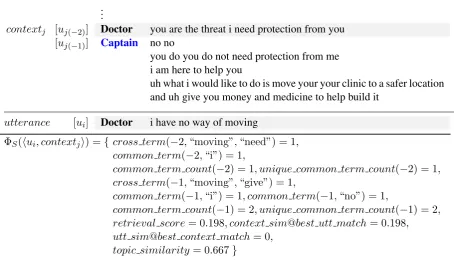
The feature extraction function Φ can list any arbitrary features from the pairhu, contexti. We consider information state annotations (ISt) along with the surface text corresponding to the previous two turns. The features could also include scores computed from other models, such as those pre-sented in sections 3.1 and 3.2. Figure 1 illustrates an example context and utterance, and several fea-tures. We examine several sets of features, Surface text based features (ΦS), Retrieval model based features (ΦR), and Topic based features (ΦT).
Surface text based features (ΦS) are the fea-tures extracted from the surface text of the previ-ous utterances in the dialogue context (contextj) and the response utterance (ui).ΦS(d)(ux, uy) ex-tracts surface text features from two utterances – a response utterance (ux) and an utterance (uy) from the context that is (d) utterances away. There are
• common term(d, w) features indicate the number of times a wordwappears in both the
utterances. The total number of possible fea-tures isO(|V|) and we select a small subset of words (Selected common(d)) from the vocabulary.
• The common term count(d) feature indi-cates the number of words that appear in both utterances.
• The unique common term count(d) fea-ture indicates the number of unique words that appear in both utterances.
• cross term(d, wx, wy) features indicate the number of times the wordwx appears in the utteranceux and the wordwy appears in the utterance uy. The total possible number of such cross features is very large (O(|V|2)), where |V| is the utterance vocabulary size. In order to keep the training tractable and avoid overfitting, we select a small subset of cross features (Selected cross(d)) from all possible features.
In this model, we perform feature selection by selecting the subsetsSelected cross(d)and
Selected common(d). The training algorithm re-quires evaluating the feature extraction (ΦS) func-tion for all possible pairings of response utterances and contexts. One simple feature selection crite-rion is to allow the features only appearing intrue pairings of response utterance and context (i.e. features from ΦS(hui, contextji)∀i = j). The subsetSelected common(d)forcommon term
features is selected by extracting features from only suchtrue pairings.
For selecting cross term(d, wx, wy) features we use only true pairings but we need to reduce this subset even further. We im-pose additional constraints based on the col-lection frequency of lexical events such as,
cf(wx) > thresholdx, cf(wy) > thresholdy,
cf(hwx, wyi) > thresholdxy. Further reduction in size of the selected subset of cross term
fea-tures is achieved by ranking the feafea-tures using a suitable ranking function and choosing the top n
features. In this model, we rank the cross term
features based on pointwise mutual-information
pmi(hwx, wyi)given by,
log p(hwx, wyi)
p(wx)p(wy) = log
#
hwx,wyi
#h·,·i
#
hwx,·i
#h·,·i
·##h·h·,w,·iyi
Summing up, ΦS(d)(ux, uy) =
{cross term(d, wx, wy) :wx∈ux∧
wy ∈uy∧ hwx, wyi ∈Selected cross(d)}
∪ {common term(d, w) :w∈ux∧w∈uy∧
w∈Selected common(d)}
∪ {common term count(d)}
∪ {unique common term count(d)}
Retrieval model based features (ΦR) are the scores computed in a fashion similar to the Nearest Context model. Sim(ux, uy) is a cosine similarity function for tf-idf weighted vector space representations of utterances and
Sim(contexta, contextb) is the same function fromNearest Contextmodel. We define three fea-tures,
• retrieval score= |L|
max
k=1 Sim(contextj, contextk)·Sim(ui, uk)
• context sim@best utt match=
Sim(contextj, contextb)
where,b=argmax|L|
k=1
Sim(ui, uk)
• utt sim@best context match=Sim(ui, ub)
where, b=argmax|L|
k=1
Sim(contextj, contextk)
ΦR(hui, contextji) ={retrieval score,
context sim@best utt match, utt sim@best context match}
Topic based feature (ΦT)tracks the topic sim-ilarity between the topic of the dialogue context and the response utterance. A topic is marked as mentioned if a set of keywords triggering that topic have been previously mentioned in the dia-logue. Each information state (IS) consists of a
topic signature which can be viewed as a boolean vector representing mentions of topics.
ΦT(hui, contextji) = {topic similarity}
topic similarity= cosine(ISi, ISj) where, ISi is the topic and is part of contexti which is the context associated with the utterance
ui.
...
contextj [uj(−2)] Doctor you are the threat i need protection from you [uj(−1)] Captain no no
you do you do not need protection from me i am here to help you
uh what i would like to do is move your your clinic to a safer location and uh give you money and medicine to help build it
utterance [ui] Doctor i have no way of moving
ΦS(hui, contextji) ={cross term(−2,“moving”,“need”) = 1,
common term(−2,“i”) = 1,
common term count(−2) = 1, unique common term count(−2) = 1, cross term(−1,“moving”,“give”) = 1,
common term(−1,“i”) = 1, common term(−1,“no”) = 1,
common term count(−1) = 2, unique common term count(−1) = 2, retrieval score= 0.198, context sim@best utt match= 0.198, utt sim@best context match= 0,
[image:5.595.74.529.59.323.2]topic similarity = 0.667}
Figure 1: Features extracted from a context (contextj) and a response utterance (ui)
respect to the size of the training data. The per-ceptron model can rank an arbitrary set of utter-ances given a dialogue context. But some of the features (e.g., topic similarity) require that the
utterance ui(ui ∈ |GEN(context)|) be associated with a known context (contexti). For all our mod-els we useGEN(context) =Utrain.
We have implemented three different vari-ants of the perceptron model based on the choice of features used. Perceptron(surface)
model uses only surface text features (Φ = ΦS). The other two models are
Percep-tron(surface+retrieval)whereΦ = ΦS∪ΦRand
Perceptron(surface+retrieval+topic) where Φ = ΦS∪ΦR∪ΦT.
Figure 2 shows a schematic representation of these models along with the set of resources be-ing used by each model. The figure also shows the relationships between these models. The arrows point from a less informative model to a more in-formative model and the annotations on these ar-rows indicate the additional information used.
4 Evaluation
For the experiments reported in this paper, we used the human-human spoken dialogue corpus collected for the project SASO-ST (Traum et al., 2005). In this scenario, the trainee acts as an Army Captain negotiating with a simulated
doc-Figure 2: A schematic representation of imple-mented unsupervised dialogue models and the re-lationships between the information used by their ranking functions.
tor to convince him to move his clinic to another location. The corpus is a collection of 23 roleplay dialogues and 13 WoZ dialogues lasting an aver-age of 40 turns (a total of≈1400 turns and≈30k words).
[image:5.595.320.513.366.531.2]human-human dialogues and are not affected by the dialogue model being evaluated. For every turn whose role is to be played by the system, we predict the most appropriate response in place of that turn given the dialogue context.
Since the goal for virtual humans is to be as human-like as possible, a suitable evaluation met-ric is how appropriate or human-like the responses are for a given dialogue context. The evaluation reported here employs human judges. We set up a simple subjective 5-point likert scale for rating ap-propriateness – 1 being a very inappropriate non-sensical response and 5 being a perfectly appropri-ate response.
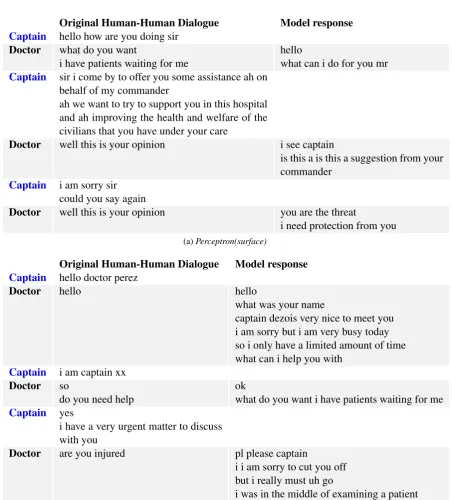
We built five dialogue models to play the role of the doctor in SASO-ST domain, viz.: Near-est Context(section 3.1),Cross-lingual Relevance Model(section 3.2) and three perceptron models (section 3.3) with different feature sets. These dialogue models are evaluated using 5 in-domain human-human dialogues from the training data (2 roleplay and 3 WoZ dialogues, referred to as test dialogues). A dialogue model is trained in a leave-one-out fashion where the training data consists of all dialogues except the one test dialogue that is being evaluated. A dialogue model trained in this fashion is then used to predict the most appropri-ate response for every context that appears in the test dialogue. This process is repeated for each test dialogue and for each dialogue model being evalu-ated. In this evaluation setting, the actual response utterance found in the original human-human dia-logue may not belong to the set of utterances being ranked by the dialogue model. We also compare these five dialogue models with two human-level upper baselines. Figure 4 in the appendix shows some examples of utterances returned by a couple of the models.
4.1 Human-level Upper Baselines
In order to establish an upper baseline for human-level performance for the evaluation task, we con-ducted a wizard data collection. We asked human volunteers (wizards) to perform a similar task to that performed by the dialogue models being eval-uated. The wizard is presented with a set of ut-terances (Utrain) and is asked to select a subset from these that will be appropriate as a response for the presented dialogue context. Compared to this, the task of the dialogue model is to select a single most appropriate response for the given
context.
DeVault et al. (2011) carried out a similar wiz-ard data collection but at the dialogue act level, where wizards were asked to select only one re-sponse dialogue act for each dialogue context. Their findings suggest that there are several valid response dialogue acts for a dialogue context. A specific dialogue act can be realized in several ways at the surface text level. For these reasons we believe that for a given dialogue context there are often several appropriate response utterances at the surface text level. In our setting the dia-logue models work at the surface text level and hence the wizards were asked to select a subset of surface text utterances that would be appropriate responses. Each wizard was asked to select sev-eral (ideally between five and ten, but always at least one) appropriate responses for each dialogue context. Four wizards participated in this data col-lection with each wizard selecting responses for the contexts from the same five human-human test dialogues. The set of utterances to chose from (Utrain) for every test dialogue was built in the same leave-one-out fashion as used for evaluating the implemented dialogue models.
There are a total of 89 dialogue contexts where the next turn belongs todoctor. As expected, wiz-ards frequently chose multiple utterances as ap-propriate responses (mean = 7.80, min = 1, max = 25).
This data collected from wizards is used to build two human-level upper-baseline models for the task of selecting a response utterance given a di-alogue context:
Wizard Max Voted model returns the response which gets the maximum number of votes from the four wizards. Ties are broken randomly.
Wizard Random model returns a random utter-ance from the list of all utterutter-ances marked as appropriate by one of the wizards.
4.2 Comparative Evaluation of Models
We performed a static context evaluation using four judges for the above-mentioned two human-level baselines (Wizard RandomandWizard Max Voted) and five dialogue models (Nearest Con-text, Cross-lingual Relevance Model and three
models based on the automatic evaluation met-ric, Weak Agreement(DeVault et al., 2011). Ac-cording to this evaluation metric a response utter-ance is judged as perfectly appropriate (a score of 5) if any of the wizards chose this response utterance for given context and inappropriate (a score of 0) otherwise. The Perceptron(surface)
model was trained using 30 iterations, the Per-ceptron(surface+retrieval) using 20 iterations, and the Perceptron(surface+retrieval+topic) was trained using 25 iterations. For all perceptron models we used thresholdx = thresholdy =
thresholdxy = 3.
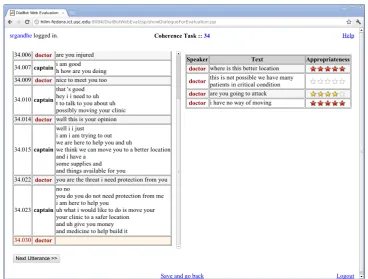
For a comparative evaluation of dialogue mod-els, we need an evaluation setup where judges could see the complete dialogue context along with the response utterances generated by the di-alogue models to be evaluated. In this setup, we show all the response utterances next to each other for easy comparison and we do not show the ac-tual response utterance that was encountered in the original human-human dialogue. We built a web interface for collecting appropriateness rat-ings that addresses the above requirements. Fig-ure 3 shows the web interface used by the four judges to evaluate the appropriateness of response utterances for given dialogue context. The appro-priateness was rated on the same scale of 1 to 5. The original human-human dialogue (roleplay or WoZ) is shown on the left hand side and the re-sponse utterances from different dialogue models are shown on the right hand side. In cases where different dialogue models produce the same sur-face text response only one candidate sursur-face text is shown to judge. Once the judge has rated all the candidate responses they can proceed to the next dialogue context. This setting allows for compar-ative evaluation of different dialogue models. The presentation order of responses from different di-alogue models is randomized. Two of the judges also performed the role of the wizards in our wiz-ard data collection as outlined in section 4.1, but the wizard data collection and the evaluation tasks were separated by a period of over 3 months.
Table 1 shows the results of our compara-tive evaluation for each judge and averaged over all judges. We also computed inter-rater agree-ment for individual ratings for all response ut-terances using Krippendorff’s α (Krippendorff,
2004). There were a total of n = 397 distinct response utterances that were judged by the
eval-uators. The Krippendorff’s α for all four judges was 0.425 and it ranges from 0.359 to 0.495 for different subsets of judges. The value ofα
indi-cates that the inter-rater agreement is substantially above chance (α >0), but indicates a fair amount of disagreement, indicating that judging appropri-ateness is a hard task even for human judges. Al-though there is low inter-rater agreement at the individual response utterance level there is high agreement at the dialogue model level. Pearson’s correlation between the average appropriateness for different dialogue models ranges from 0.928 to 0.995 for different pairs of judges.
We performed a paired Wilcoxon test to check for statistically significant differences in differ-ent dialogue models. Wizard Max Voted is sig-nificantly more appropriate than all other models (p <0.001).Wizard Randomis significantly more appropriate than Cross-lingual Relevance Model
(p < 0.05) and significantly more appropriate than the three perceptron models as well as Near-est Context model (p < 0.001). Cross-lingual
Relevance Model is significantly more appropri-ate than Nearest Context (p < 0.01). All other differences are not statistically significant at the 5 percent level.
We found that adding topic annotations did not help. This is in contrast with previous observa-tion (Gandhe and Traum, 2007b), where topic in-formation helped when evaluation was performed inDynamic Contextsetting. InDynamic Context
setting, the dialogue model is used in an online fashion where the response utterances it generates become part of the dialogue contexts with respect to which the subsequent responses are predicted and evaluated. The topic information ensures sys-tematic progression of dialogue. But for static context evaluation such help is not required as the dialogue contexts are extracted from human hu-man dialogues and are fixed.
5 Conclusion
Figure 3: Screenshot of the user interface for static context comparative evaluation of dialogue models
Model #Utts Avg. appropriateness Appropriateness(All judges)
Judge 1 Judge 2 Judge 3 Judge 4 Avg stddev
Nearest Context 89 4.12 3.98 3.40 3.53 3.76 1.491
Perceptron(surface) 89 3.97 4.11 3.51 3.62 3.80 1.445
Perceptron
(surface+retrieval) 89 4.26 4.12 3.51 3.72 3.90 1.414 Perceptron
(surface+retrieval+topic)
89 4.21 4.09 3.51 3.57 3.85 1.433
Cross-lingual Relevance
Model 89 4.28 4.31 3.70 3.91 4.05 1.314
Wizard Random 89 4.55 4.55 4.03 4.16 4.32 1.153
Wizard Max Voted 89 4.76 4.84 4.40 4.52 4.63 0.806
Table 1: Offline comparative evaluation of dialogue models.
can be seen from the fact that utterances which receive more wizard votes (Wizad Max Voted) re-ceive significantly higher appropriateness ratings than those which receive fewer votes (Wizard Ran-dom). The performance of best performing dia-logue models are close to human-level baselines. In future we plan to use larger datasets which should be easy, since no additional annotations are required for training these dialogue models.
Acknowledgments
The effort described here has been sponsored by the U.S. Army. Any opinions, content or informa-tion presented does not necessarily reflect the posi-tion or the policy of the United States Government, and no official endorsement should be inferred.
References
[image:8.595.81.520.374.552.2]Michael Collins. 2002. Discriminative training meth-ods for hidden markov models: theory and experi-ments with perceptron algorithms. InProceedings of the ACL-02 conference on Empirical methods in natural language processing - Volume 10, EMNLP ’02, pages 1–8, Stroudsburg, PA, USA. Association for Computational Linguistics.
Michael Collins, 2004. Parameter estimation for sta-tistical parsing models: theory and practice of distribution-free methods, pages 19–55. Kluwer Academic Publishers, Norwell, MA, USA.
David DeVault, Anton Leuski, and Kenji Sagae. 2011. Toward learning and evaluation of dialogue policies with text examples. InProceedings of the SIGDIAL 2011 Conference, pages 39–48, Portland, Oregon, June. Association for Computational Linguistics. Yoav Freund and Robert E. Schapire. 1999. Large
margin classification using the perceptron algorithm.
Mach. Learn., 37:277–296, December.
Sudeep Gandhe and David Traum. 2007a. Creating spoken dialogue characters from corpora without an-notations. InProceedings of Interspeech-07. Sudeep Gandhe and David Traum. 2007b. First steps
towards dialogue modeling from an un-annotated human-human corpus. In5th Workshop on knowl-edge and reasoning in practical dialogue systems, Hyderabad, India.
Sudeep Gandhe and David Traum. 2010. I’ve said it before, and i’ll say it again: an empirical investiga-tion of the upper bound of the selecinvestiga-tion approach to dialogue. InProceedings of the 11th Annual Meet-ing of the Special Interest Group on Discourse and Dialogue, SIGDIAL ’10, pages 245–248, Strouds-burg, PA, USA. Association for Computational Lin-guistics.
Sudeep Gandhe. 2013. Rapid prototyping and evalu-ation of dialogue systems for virtual humans. Ph.D. thesis, University of Southern California.
J. J. Godfrey, E. C. Holliman, and J. McDaniel. 1992. Switchboard: Telephone speech corpus for research and development. In Proc. of ICASSP-92, pages 517–520.
P. A. Heeman and J. Allen. 1994. The TRAINS 93 di-alogues. TRAINS Technical Note 94-2, Department of Computer Science, University of Rochester. Klaus Krippendorff. 2004. Content Analysis, An
Intro-duction to Its Methodology 2nd Edition. Sage Pub-lications.
Anton Leuski and David Traum. 2008. A statistical approach for text processing in virtual humans. In
Proccedings of 26th Army Science Conference. Anton Leuski and David Traum. 2011. Npceditor:
Creating virtual human dialogue using information retrieval techniques. AI Magazine, 32(2):42–56.
Anton Leuski, Ronakkumar Patel, David Traum, and Brandon Kennedy. 2006. Building effective ques-tion answering characters. In Proceedings of the 7th SIGdial Workshop on Discourse and Dialogue, pages 18–27, Sydney, Australia, July. Association for Computational Linguistics.
Jeff Rickel and W. Lewis Johnson. 1999. Virtual hu-mans for team training in virtual reality. In Proceed-ings of the Ninth International Conference on Artifi-cial Intelligence in Education, pages 578–585. IOS Press.
Alan Ritter, Colin Cherry, and William B. Dolan. 2011. Data-driven response generation in social media. In
Proceedings of the Conference on Empirical Meth-ods in Natural Language Processing, EMNLP ’11, pages 583–593, Stroudsburg, PA, USA. Association for Computational Linguistics.
Brian Roark, Murat Saraclar, and Michael Collins. 2007. Discriminative n-gram language modeling.
Comput. Speech Lang., 21:373–392, April.
A. J. Stent. 2000. The monroe corpus. Technical Report 728, Computer Science Dept. University of Rochester.
David Traum, William Swartout, Jonathan Gratch, and Stacy Marsella. 2005. Virtual humans for non-team interaction training. InAAMAS-05 Workshop on Creating Bonds with Humanoids, July.
Original Human-Human Dialogue Model response
Captain hello how are you doing sir
Doctor what do you want
i have patients waiting for me
hello
what can i do for you mr
Captain sir i come by to offer you some assistance ah on behalf of my commander
ah we want to try to support you in this hospital and ah improving the health and welfare of the civilians that you have under your care
Doctor well this is your opinion i see captain
is this a is this a suggestion from your commander
Captain i am sorry sir could you say again
Doctor well this is your opinion you are the threat
i need protection from you
(a)Perceptron(surface)
Original Human-Human Dialogue Model response
Captain hello doctor perez
Doctor hello hello
what was your name
captain dezois very nice to meet you i am sorry but i am very busy today so i only have a limited amount of time what can i help you with
Captain i am captain xx
Doctor so
do you need help
ok
what do you want i have patients waiting for me
Captain yes
i have a very urgent matter to discuss with you
Doctor are you injured pl please captain
i i am sorry to cut you off but i really must uh go
i was in the middle of examining a patient
[image:10.595.80.533.121.622.2](b)Cross-lingual Relevance Model