Munich Personal RePEc Archive
A Survey of Experimental Research on
Contests, All-Pay Auctions and
Tournaments
Dechenaux, Emmanuel and Kovenock, Dan and Sheremeta,
Roman
27 October 2014
Online at
https://mpra.ub.uni-muenchen.de/59714/
A Survey of Experimental Research on
Contests, All-Pay Auctions and Tournaments
Emmanuel Dechenaux a
Dan Kovenock b Roman M. Sheremeta c,*
a Department of Economics, Kent State University
Kent, OH 44242, USA
b Economic Science Institute, Chapman University
One University Drive, Orange, CA 92866, USA
c Weatherhead School of Management, Case Western Reserve University
and the Economic Science Institute, Chapman University 11119 Bellflower Road, Cleveland, OH 44106, U.S.A.
October 27, 2014
Abstract
Many economic, political and social environments can be described as contests in which agents exert costly efforts while competing over the distribution of a scarce resource. These environments have been studied using Tullock contests, all-pay auctions and rank-order tournaments. This survey provides a comprehensive review of experimental research on these three canonical contests. First, we review studies investigating the basic structure of contests, including the number of players and prizes, spillovers and externalities, heterogeneity, risk and incomplete information. Second, we discuss dynamic contests and multi-battle contests. Then we review studies examining sabotage, feedback, bias, collusion, alliances, group contests and gender, as well as field experiments. Finally, we discuss applications of contests and suggest directions for future research.
JEL Classifications: C7, C9, D7, H4, J4, J7, K4, L2, M5
Keywords: contests, all-pay auctions, tournaments, experiments.
* Corresponding author: Roman Sheremeta, [email protected] and [email protected]
1. Introduction
Many economic, political and social environments can be described as contests in which competing agents have the opportunity to expend scarce resources – such as effort, money, time, or troops – in order to affect the probabilities of winning prizes. Examples range from the competition for mates, college admission, patents, or promotions within firms, to the process of litigation or lobbying politicians, to elections, sports competitions, and violent global conflicts (Tullock, 1967; Krueger, 1974). As is obvious from this list, these environments have attracted considerable attention in applications in a wide range of fields, both in- and out-side of economics. They have also been studied extensively by economic theorists in what has become known as the field of contest theory (Konrad, 2009). Although this field continues to attract many young theorists, it has its roots in three models developed in the mid-seventies to early eighties: the Tullock (1980) model of rent-seeking, the Lazear and Rosen (1981) rank-order tournament model, and the all-pay auction (Hirshleifer and Riley, 1978; Nalebuff and Stiglitz, 1983; Dasgupta, 1986; Hillman and Riley, 1989). Despite the fact that the three models historically developed somewhat independently, they represent special cases of a general contest model that can be formulated in a unified framework.
Despite an extensive and established theoretical literature, much less effort has been devoted to empirically investigate individual behavior in different contests and compare such behavior with theoretical predictions. The main reason is that it is not trivial to measure individual effort in the field since the researcher can only observe the performance of contestants, which is a function of effort, ability and luck (Ericsson and Charness, 1994). The majority of empirical studies use either firm level data (Prendergast, 1999) or sports data (Szymanski, 2003). Because it is typically difficult to measure the actual effort expended by players in the field, almost all of these studies focus solely on investigating whether the pattern of outcomes is consistent with the theoretical predictions.
Controlled experiments allow researchers to test contest theory without confounding effects and endogeneity issues. Some experiments allow direct measurement of individual effort, while controlling for the relative abilities of contestants and the amount of noise (luck) in the tournament. The first studies to test contest theory using laboratory methods were conducted by Bull et al. (1987) and Millner and Pratt (1989). These studies have inspired a substantial and rapidly developing experimental literature on contests. The purpose of this paper is to survey this work. We begin by identifying the three canonical contest models and their common applications.
The assumptions underlying the three contest models lead to vastly different equilibrium behaviors. Tullock (or lottery) contests and rank-order tournaments usually have pure strategy equilibria for the specifications applied, whereas all-pay auctions have only non-degenerate mixed strategy equilibria (in the case of complete information). Moreover, the models have traditionally been applied to different areas of economic analysis. The term Tullock or lottery contest has been commonly used in the study of R&D races and political or rent-seeking
competitions. Rank-order tournaments (or sometimes tournaments) have been used in the principal-agent, contract design and labor literatures. Therefore, resources exerted in the process of competing in these contests are usually called efforts or expenditures. All-pay auctions have
been used in the auction literature and in lobbying and military applications. Resources exerted competing in all-pay auctions are usually called bids or expenditures.
competition, contest expenditure is often viewed as social waste, in the sense that a welfare maximizing social-planner would seek to minimize it (Tullock, 1980). In contrast, in management applications where rank-order tournaments have often been applied, effort is viewed as valuable because it contributes to the firm’s output. Similarly, for patent races a social planner may desire the positive externalities generated from increases in R&D spending. Finally, in many all-pay auction applications expenditure is viewed as desirable, such as the case of charitable fundraising or a seller of an object engaging in an all-pay auction to maximize revenue. Consequently, in some applications of contests the designer may be interested in maximizing expenditure and in some cases minimizing expenditure. Although applications of the three canonical models are usually different, all three models assume that (i) players exert costly irreversible efforts while competing for a prize and (ii) an individual player’s probability of winning the prize depends on the players’ relative expenditures. Obviously, the exact probability of winning the prize is defined differently for the three contests and is determined by a contest success function that maps the vector of player expenditures to the probability of winning. In the
all-pay auction, the player exerting the highest effort wins the prize with certainty. In the rank-order tournament, the player with the highest performance, which is the sum of effort and a random component, wins the prize with certainty. Finally, in the Tullockcontest, the probability
of winning equals the ratio of a player’s effort to a fixed power r ≥ 0 to the sum of each of the
other players’ efforts, each raised to the same power r. The special case where r = 1 is the case of
the lottery contest.
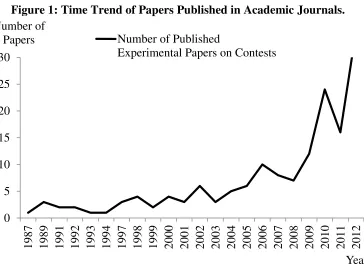
We survey 231 experimental papers on contests; for a complete list of references see the working version of this paper (Dechenaux et al., 2012).1 The majority of these papers are already published or in press (159 papers), while other papers are still cited as working papers (72 papers). More than 90% of the working papers have been written within the last five years. Figure 1 displays the time trend of papers published in academic journals. The figure indicates a dramatic increase in the number of published papers over the last decade, with more than 50% of the papers published in the last five years. The vast majority of published experimental studies are conducted in the lab (87%) employing chosen-effort experiments (75%). Some experimental studies are conducted in the field (13%), with more than 70% of the field studies published within the last five years. Out of 158 published papers, 35% of the papers are based on lottery contests, 25% are based on all-pay auctions, 25% on rank-order tournaments and about 15% of the studies examine other contest structures (usually using binary decisions or real-effort tasks).
We begin by introducing the three canonical contest models in Section 2. There are four important lessons that we learn from studies discussed in Section 2: (1) most studies on lottery contests and all-pay auctions find significant overbidding relative to the Nash equilibrium prediction; (2) in contrast to lottery contests and all-pay auctions, there is little overbidding in rank-order tournaments and aggregate effort usually conforms to the theoretical predictions; (3) in all three canonical contests there is significant heterogeneity in the behavior of individual subjects; (4) in lottery contests and rank-order tournaments bids are usually distributed around the equilibrium, while in all-pay auctions the distribution of bids is bimodal, with some subjects submitting very low and others submitting very high bids.
1 Our survey is comprehensive, so we tried to include all of the available experimental papers on contests which
In Section 3 we present experimental studies investigating the basic structure of contests, including the number of players and prizes, spillovers and externalities, heterogeneity, risk and incomplete information. The main lesson that we learn from the experiments discussed in Section 3 is that most studies find support for the comparative statics predictions of contest theory. Some commonly supported comparative statics results are the impact of incomplete information on individual behavior, the “discouragement effect”, and the impact of contest parameters (e.g., the number of players and the number of prizes) on effort.
Then we identify some common areas of focus within the literature and present a general review of relevant studies. For example, Section 4 reviews contests with a dynamic structure, such as sequential move contests, wars of attrition, multi-stage contests, patent races, best-of-n
contests, multi-stage elimination contests, and contests with endogenous entry. Section 5 reviews experimental studies on games of multiple contests with linkages, such as Colonel Blotto games and multi-battle contests. Section 6 presents natural extensions of the experimental analysis of contests, such as sabotage, feedback, bias, collusion, alliances, group contests, and gender effects. Section 7 reviews field experiments on contests. Section 8 discusses a number of applications of contests, including litigation, political campaigning, lobbying, wars, sales, and charity giving.
Finally, Section 9 suggests several directions for future research, including an examination of (1) the sources of overbidding in lottery contests and all-pay auctions, (2) the reasons for little (or no) overbidding in rank-order tournaments, (3) potential overbridging in field settings with real-effort and high stakes, and (4) potential mechanisms of de-escalation, deterrence, management and resolution of conflicts.
2. Three Canonical Contest Models
A contest is a game in which players are able to expend scarce resources (such as money, time or effort) in order to affect the probabilities of winning prizes, the values of which are ranked identically by the players (but may not be identical in absolute terms). The distinguishing characteristic of a contest is the fact that a higher expenditure of the scarce resource(s) has a nonnegative (and sometimes strictly positive) effect on the probability of winning the more valuable prizes.
There is a wide variety of possible contests that meet the above conditions, but our focus throughout this survey will be, respectively, on (i) the Tullock contest, (ii) the all-pay auction and (iii) the rank-order tournament. In this section, we provide a simple theoretical overview of all three models in the context of a one-shot simultaneous-move contest of complete information between homogeneous players.
Assume there are 𝑛 risk-neutral players competing for a single prize with common value 𝑣. Each player 𝑖 expends an effort 𝑒𝑖 and bears a cost of effort 𝑐(𝑒𝑖). The performance or output of player 𝑖, 𝑦𝑖, depends on player 𝑖’s effort 𝑒𝑖 and a random variable 𝜀𝑖, independently drawn from some common distribution with cumulative distribution function 𝐹:
𝑦𝑖(𝑒𝑖, 𝜀𝑖) = 𝑒𝑖 + 𝜀𝑖. (1)
The additive random component 𝜀𝑖, can be thought of as unobservable luck or performance error. It can also be interpreted as an unknown ability 𝜀𝑖 (Rosen, 1986).
𝑝̂𝑖(𝑦𝑖, 𝑦−𝑖) = 𝑦𝑖
𝑟
∑𝑛𝑗=1𝑦𝑗𝑟, (2)
if ∑𝑛𝑗=1𝑦𝑗 > 0 and 𝑝̂𝑖(𝑦𝑖, 𝑦−𝑖) =1
𝑛 otherwise, where 𝑟 ≥ 0 is a parameter that measures the sensitivity of the probability of winning to the ratio of individual player outputs. In practice, for the appropriate measure of the outputs, 𝑝̂𝑖(𝑦𝑖, 𝑦−𝑖) may be estimated because it is based purely on the observable player outputs, rather than the potentially unobservable allocations of the scarce resource. The random mapping that compounds (1) and (2) to take a vector of player efforts 𝑒 = (𝑒1, 𝑒2, … , 𝑒𝑛) and obtain the probability that each player 𝑖 wins the contest is called the contest success function (CSF): 𝑝𝑖(𝑒𝑖, 𝑒−𝑖).
The outcome-contingent payoff of player 𝑖 in the contest is
𝜋𝑖 = {
𝑣 − 𝑐(𝑒𝑖) if 𝑖 wins
𝑣/𝑛 − 𝑐(𝑒𝑖) if 𝑖 ties
−𝑐(𝑒𝑖) if 𝑖 loses
. (3)
Given the performance function (1), the CSF induced by (1) and (2), and the outcome-contingent payoff function (3), the expected payoff for player 𝑖 can be written as:
𝐸(𝜋𝑖) = 𝑝𝑖(𝑒𝑖, 𝑒−𝑖)𝑣 − 𝑐(𝑒𝑖). (4)
A simple version of a Tullock contest can be obtained by setting 𝑦𝑖 = 𝑒𝑖 in (1), 𝑟 ≥ 0 in
(2), and 𝑐(𝑒𝑖) = 𝑒𝑖 in (3). One may interpret such a contest as a case in which there is no noise in the performance function (1), so 𝜀𝑖 = 0, but where the CSF coincides with (2), so that the probability of winning the prize equals the ratio of individual effort to aggregate effort and individual output to aggregate output. When 𝑟 is relatively small (a sufficiently noisy CSF) and there are no externalities of effort, the Nash equilibrium in a simple Tullock contest is in pure strategies and it is unique. The case where 𝑟 = 1 is referred to as the lottery contest. The
equilibrium is not in pure strategies when 𝑟 is relatively large (Baye et al., 1994), and it is not unique when there are externalities of effort (Chowdhury and Sheremeta, 2011b). In the remainder of the paper we refer to contests where 0 ≤ 𝑟 < ∞ and 𝑦𝑖 = 𝑒𝑖 as Tullockcontests.
To obtain a simple version of the all-pay auction, we set 𝑦𝑖 = 𝑒𝑖 in (1), 𝑟 = ∞ in (2), and
𝑐(𝑒𝑖) = 𝑒𝑖 in (3). The crucial difference when compared to the Tullock contest is that, except in the event of ties, the outcome is deterministic; the player with higher effort wins the contest with certainty. There is no pure strategy equilibrium in the all-pay auction. Only non-degenerate mixed strategy Nash equilibria exist in which players choose efforts randomly over the interval
[0, 𝑣] (Hillman and Riley, 1989; Baye et al., 1996).
Finally, to obtain a simple rank-order tournament we set 𝑦𝑖 = 𝑒𝑖 + 𝜀𝑖 in (1), 𝑟 = ∞ in
(Lazear and Rosen, 1981). In the rest of the paper we will refer to contests where 𝑟 = ∞ and
𝑦𝑖 = 𝑒𝑖 + 𝜀𝑖 as Lazear-Rosen or rank-order tournaments.
2.1. Tullock or Lottery Contests
The first attempt to examine a lottery contest using laboratory methods dates back to Millner and Pratt (1989). Their experiment was based on the original Tullock (1980) model with
r = 1 and r = 3. Subjects were placed in groups of two and the composition of the groups
changed from period to period. However, instead of using a design in which the subjects make simultaneous single decisions, the subjects were allowed to adjust their decisions during a continuous time interval. For the benchmark lottery case of r = 1 the two main findings of
Millner and Pratt (1989) are that (i) the average dissipation rate (measured as the total effort divided by the prize value) in the lottery contest is significantly higher than the risk-neutral equilibrium prediction and (ii) there is a large variation in individual effort levels.
Since Millner and Pratt (1989), many other experiments on lottery contests (e.g., Davis and Reilly, 1998; Potters et al., 1998; Anderson and Stafford, 2003; Sheremeta, 2010a, 2010b, 2011a; Sheremeta and Zhang, 2010; Savikhin and Sheremeta, 2012; Morgan et al., 2012) have replicated (i) overbidding (which we also refer to as over-expenditure of effort) and (ii) heterogeneous behavior of ex-ante symmetric contestants. Figure 2 displays a distribution of effort commonly observed in lottery contests. The data are taken from Sheremeta (2011a), where
𝑛 = 2 players compete for a prize of 𝑣 = 60 in a lottery contest (i.e., 𝑟 = 1, 𝑦𝑖 = 𝑒𝑖, and 𝑐(𝑒𝑖) =
𝑒𝑖). According to the theoretical prediction, the Nash equilibrium effort is 𝑒∗ = 𝑣(𝑛 − 1)/𝑛2 = 15. Nevertheless, average efforts are significantly higher than predicted and the variance is substantial.
There are different explanations that have been proposed in the literature for overbidding (Sheremeta, 2013, 2015). The first is that, in addition to monetary incentives, subjects derive a non-monetary utility from winning (Schmitt et al., 2004; Parco et al., 2005; Sheremeta, 2010a, 2010b; Price and Sheremeta, 2011, 2014; Brookins and Ryvkin, 2014; Mago et al., 2014). Sheremeta (2010b) illustrates subjects’ non-monetary utility of winning in an example of a simple lottery contest with a prize value of zero (i.e., 𝑣 = 0). Interestingly, about 40% of the subjects exert positive costly effort in contests for a prize of 𝑣 = 0 and these efforts are correlated with efforts in contests for a strictly positive prize of 𝑣 = 120. Figure 3 displays the correlation between effort for a prize of 𝑣 = 0 and effort for a prize of 𝑣 = 120. The data are taken from Sheremeta (2010b), where 𝑛 = 4 players compete in a lottery contest. According to the theoretical prediction, when 𝑣 = 120, the Nash equilibrium effort is 𝑒∗ = 𝑣(𝑛 − 1)/𝑛2 = 22.5. Figure 3 shows that subjects who exert higher efforts for the prize of zero also exert higher efforts for the positive monetary prize of 120 (correlation coefficient of 0.38).2
The second reason for overbidding is that, in addition to the utility from winning, subjects care about their relative payoffs (Herrmann and Orzen, 2008; Mago et al., 2014). Using a modified utility function, Mago et al. (2014) prove theoretically that status-seeking subjects who strive to maximize their relative payoffs should exert higher efforts in equilibrium. In their experiment, Mago et al. (2014) find that 51% of subjects indicate positive utility from winning
2 Whether this correlation comes from non-pecuniary benefits from winning or other sources demands further
and 67% of subjects behave as status-seekers, suggesting that overbidding in contests can be explained by a combination of a utility from winning and relative payoff maximization.
The third explanation is based on the fact that subjects are prone to mistakes. These mistakes add noise to the Nash equilibrium solution, and thus may cause overbidding in contests. Several studies have provided support for this argument by analyzing the quantal response equilibrium model (McKelvey and Palfrey, 1995), which accounts for errors made by subjects, and testing the predictions of this model in lottery contests (Sheremeta, 2011a; Chowdhury et al., 2014; Lim et al., 2014).
A fourth explanation suggests that overbidding in contests can also be explained by the fact that subjects exhibit certain judgmental biases, such as non-linear probability weighting and the hot hand fallacy, which prevent them from exerting rational effort levels in contests (Parco et al., 2005; Amaldoss and Rapoport, 2009; Sheremeta and Zhang, 2010).
Finally, several recent studies suggested that a significant amount of non-equilibrium behavior in contests can be explained by features of the experimental design (Fallucchi et al., 2013; Chowdhury et al., 2014; Masiliunas et al., 2014). For example, in a two-by-two design, Chowdhury et al. (2014) vary whether the prize is assigned probabilistically (i.e., efforts determine the probabilities of winning the prize) or proportionally (i.e., efforts determine the shares of the prize) and whether the cost function is linear or convex, while holding the Nash equilibrium effort level constant. They find that compared to the probabilistic CSF, the proportional rule results in average effort closer to the Nash prediction. Combining the share rule with a convex cost function further enhances this result.
Heterogeneous behavior of ex-ante symmetric contestants is usually attributed to demographic differences, heterogeneous preferences towards winning, risk, losses and inequality (Sheremeta, 2013, 2015). Price and Sheremeta (2014), for example, find that men and more religious subjects tend to exert up to 25% lower effort than women and less religious subjects. Sheremeta (2010a, 2010b) finds that subjects who demonstrate having higher non-monetary utility of winning exert higher effort in lottery contests (see Figure 3). Many studies find that risk-averse subjects exert lower efforts in lottery contests than risk-neutral or risk-seeking subjects (Millner and Pratt, 1991; Anderson and Freeborn, 2010; Sheremeta and Zhang, 2010; Sheremeta, 2011a; Shupp et al., 2013; Mago et al., 2013). Shupp et al. (2013) find that more loss-averse subjects exert lower efforts than less loss-averse subjects. Finally, Mago et al. (2014) find that inequality-averse subjects exert higher efforts than subjects who care only about their own payoffs.
2.2. All-Pay Auctions
In this section we discuss the contest known as an all-pay auction with complete information (Hillman and Riley, 1989; Baye et al., 1996).3 In such a contest the highest bidder wins the prize with certainty and all bidders have to pay their bids. Baye et al. (1996) characterize the entire set of equilibria for the all-pay auction with complete information, a continuous strategy space and arbitrary prize valuations. All equilibria are in mixed strategies and in games with three or more players, for certain configurations of the players’ valuations of the prize, multiple equilibria exist. One feature of Nash equilibrium is that it may be asymmetric even in symmetric games.
3
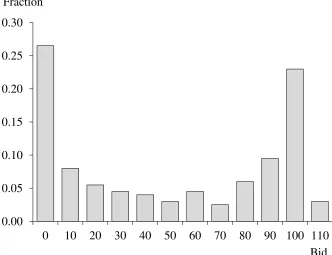
As in Tullock contests, overbidding relative to the Nash equilibrium prediction in aggregate data emerges as an empirical regularity. Davis and Reilly (1998) were arguably the first to report substantial overbidding in all-pay auctions using a design that focused on asymmetric auctions. Their important finding carries over to symmetric all-pay auctions. Indeed, except for Potters et al. (1998), the majority of studies using symmetric all-pay auctions with complete information also find that session averages reflect overbidding (Gneezy and Smorodinsky, 2006; Lugovskyy et al., 2010; Fehr and Schmidt, 2011; Klose and Sheremeta, 2012; Ernst and Thöni, 2013; Ong and Chen, 2013). While Potters et al. find evidence of equilibrium play in their two-player all-pay auction experiment, their design imposed an exogenous cap on bids (15% above the prize value), which may have biased behavior toward lower, equilibrium bids. In contrast, a study by Gneezy and Smorodinsky (2006) finds that the sum of effort levels (or “revenue”, in the language of auction theory) is much higher than predicted and often twice to five times higher than the common prize value. Winning bids are frequently within 10 percentage points of the value of the prize and sometimes exceed it. Moreover, Gneezy and Smorodinsky (2006) find that subjects appear to randomize over a set of bids as theory predicts, but they tend to place too much weight on relatively low and relatively high bids. Figure 4 displays a distribution of bids in one of the treatments from Gneezy and Smorodinsky (2006). In this treatment, there are 𝑛 = 4 players competing for a prize of 𝑣 = 100 in an all-pay auction (i.e., 𝑟 = ∞, 𝑦𝑖 = 𝑒𝑖, and 𝑐(𝑒𝑖) = 𝑒𝑖). The picture shows clear evidence of
bimodal behavior, with some subjects submitting very low and others submitting very high bids.4
Many other all-pay auction studies generate distributions with a similar shape. Klose and Sheremeta (2012) and Ernst and Thöni (2013) rely on loss aversion from Kahneman and
Tversky’s (1979) prospect theory to explain bimodal behavior. The basic assumption is that players evaluate outcomes relative to a reference point. If they earn more than their reference point, they are in the domain of gains, otherwise in the domain of losses. The utility function is concave in the domain of gains and convex in the domain of losses. In addition, people suffer more from the loss of a certain amount of money than they enjoy from the win of the same amount. A utility function based on these assumptions gives rise to a bimodal bidding behavior in the equilibrium of an all-pay auction.
Lugovskyy et al. (2010) further explore observed deviations from Nash equilibrium in all-pay auctions. In long sessions, lasting 60 periods, with fixed matching of four-player groups, they show that learning seems to bring bids closer to the Nash equilibrium prediction in the aggregate. Aggregate over-dissipation also decreases in long sessions under random matching, but remains above the levels observed with fixed matching. In their early experimental treatment of an asymmetric all-pay auction, Davis and Reilly (1998) also report that experience reduces overbidding.
While caution is warranted when drawing parallels between the two contest forms, it is natural to ask whether the pattern of overbidding in all-pay auctions arises from the same factors as in lottery contest experiments. For example, as in lottery contests, overbidding in all-pay auctions may be caused by mistakes, a non-monetary utility of winning or judgmental biases. However, further research is required to conclusively determine whether patterns of data in all-pay auctions and lottery contests are caused by the same phenomenon.
4
2.3. Rank-Order Tournaments
Since the seminal paper by Lazear and Rosen (1981), rank-order tournaments have been extensively investigated in the lab. To the best of our knowledge the first laboratory experiment on rank-order tournaments is Bull et al. (1987). Bull et al. implement rank-order tournaments between pairs of subjects whose output is the sum of effort and a uniformly distributed productivity shock, i.e., 𝑦𝑖 = 𝑒𝑖+ 𝜀𝑖 where 𝜀𝑖~𝑈[−𝑎, 𝑎]. In their design, a sufficiently disperse support of the distribution of the noise parameter 𝜀𝑖 guarantees that a unique pure strategy Nash equilibrium exists. The main purpose of the experiment was to test the theory and to compare the performance of a rank-order tournament to a simple piece-rate incentive scheme. The main results of Bull et al. (1987) are that the average effort levels in tournaments are well predicted by theory and are similar to efforts under the piece-rate scheme.5 However, the variance of effort is much greater under the tournament.
The findings of Bull et al. (1987) have been replicated by a large number of experiments on rank-order tournaments (Schotter and Weigelt, 1992; Nalbantian and Schotter, 1997; Harbring and Irlenbusch, 2005, 2008; Orrison et al., 2004; Wu and Roe, 2005; Wu et al. 2006; Harbring et al., 2007; Harbring and Lünser, 2008; Eriksson et al., 2009b; Sheremeta and Wu, 2011; Eisenkopf and Teyssier, 2012, 2013; Agranov and Tergiman, 2013). Several exceptions are Chen et al. (2011), who observe over-expenditure in contests with asymmetric contestants, and Kräkel and Nieken (2012), who observe twice as high effort levels than predicted in a tournament with minimum productivity requirements. Figure 5 displays the dynamics of average effort over the length of the experiment commonly observed in rank-order tournaments. The data are taken from Orrison et al. (2004) where 𝑛 = 2, 4 or 6 symmetric players compete for large prizes of 𝑣1 = $2.04 (1, 2 or 3 prizes, respectively) and small prizes of 𝑣2 = $0.86 (1, 2 or 3 prizes, respectively) in a rank-order tournament (i.e., 𝑟 = ∞, 𝑦𝑖 = 𝑒𝑖 + 𝜀𝑖, 𝜀𝑖~𝑈[−𝑎, 𝑎] and
𝑐(𝑒𝑖) = 𝑒𝑖2/𝑏, where 𝑎 = 60 and 𝑏 = 15,000). According to the theoretical prediction, the Nash equilibrium effort is 𝑒∗ = (𝑣1− 𝑣2)𝑏/4𝑎 = 73.5. As Figure 5 indicates, for every 𝑛, the average effort is quite close to the predicted level and there is no overbidding.
Although on average there is little (or no) overbidding in rank-order tournaments, heterogeneity of individual behavior is widespread (Bull et al., 1987). The high variance of effort is especially problematic because in a labor-management context, where rank-order tournaments are often employed in the field (for a review see Charness and Kuhn, 2011), a high variance in individual performance can impose a substantial cost on employers and reduce the overall efficiency of the work place (Lazear, 1999, 2000). What might account for the high variance in individual effort? In their follow-up to Bull et al. (1987), Drago and Heywood (1989) argue that part of the variance in the Bull et al. data may simply be due to relatively flat payoff functions. They conduct several additional treatments and show that the variance in effort is comparable between a tournament and piece-rate scheme when payoff functions (as functions of vectors of efforts) are kept as similar as possible across the two reward schemes. Eriksson et al. (2009b) experimentally examine an alternative explanation for the high variance in effort in simple
5 An important advantage of rank-order tournaments over alternative compensation schemes is that tournament
incentives are not affected by common shocks (random noise that impacts all players equally), since common shocks do not change the relative ranking of players’ efforts (Wu and Roe, 2005; Wu et al., 2006; Agranov and Tergiman, 2013). As a result of filtering common shocks, tournaments reduce agents’ risk exposure, making them more
order tournaments. They find that allowing subjects to choose their payment scheme between the tournament and the piece-rate scheme significantly reduces the variance of effort in rank-order tournaments. They also find that risk-averse subjects are less likely to participate in the tournament, which has an additional negative effect on the variance of effort.
In summary, there are four important lessons that we learn from experimental studies discussed in this section. First, most studies on lottery contests and all-pay auctions find significant overbidding relative to the Nash equilibrium prediction. Second, in contrast to lottery contests and all-pay auctions, there is very little overbidding in rank-order tournaments and aggregate effort usually conforms to the theoretical predictions. Third, in all three canonical contests there is significant heterogeneity in the behavior of individual subjects. Finally, in lottery contests and rank-order tournaments bids are usually distributed around the equilibrium, while in all-pay auctions the distribution of bids is bimodal, with some subjects submitting very low and others submitting very high bids.
3. Contest Structure
As discussed by Konrad (2009), even simple one-stage contests are often characterized by many parameters (i.e., number of players, heterogeneity of players and number of prizes) and they can have very different structures (i.e., incomplete information, risk aversion, spillovers and externalities). All of these factors play an important role in influencing the behavior of individual players. In this section we review the experimental literature investigating some of these factors.
3.1. Number of Players
Theoretically, it is not clear how the number of players impacts individual behavior in contests. For example, for the symmetric case it is generally true that when a contest is modeled as an all-pay auction or as a lottery contest, then the expected individual effort decreases with the number of players (Konrad, 2009). However, when the contest is modeled as a rank-order tournament, then, depending on the distribution of noise, the expected effort may decrease, increase, or remain unchanged when the number of players increases (Gerchak and He, 2003).
The experimental evidence on the effect of the number of players on individual behavior in contests is also somewhat mixed. Sheremeta (2011a), for example, finds that the average effort in a symmetric two-player lottery contest is 33% of the prize value, while in the corresponding four-player contest the average effort is 25% of the prize. Therefore, as predicted by the theory, the average individual effort decreases in the number of players. Morgan et al. (2012) also find support for this comparative static prediction with different group sizes. On the other hand, Lim et al. (2014) find that the average individual effort does not respond to the number of players. They attribute their findings to the fact that subjects make mistakes when choosing an effort level.
In all-pay auctions, Gneezy and Smorodinsky (2006) find that the average effort decreases in the number of players. On the other hand, Harbring and Irlenbusch (2003) document that the average effort weakly increases in the number of players. An explanation for these differences is that in Harbring and Irlenbusch (2003), subjects’ efforts are restricted by a maximum effort cap set, while in Gneezy and Smorodinsky (2006), subjects can choose any effort (even higher than the prize value).
design three treatments in which, depending on the noise distribution, a risk-neutral contestant’s effort should decrease, increase or remain the same. They find that, contrary to theoretical predictions, the average individual effort always decreases in the number of players.
To summarize, across the three canonical contests, the evidence seems to favor a negative relationship between group size and individual effort. However, such an interpretation should be taken with caution because the relationship between group size and individual effort depends both on the experimental design and the underlying theoretical structure.
3.2. Heterogeneous Players
The theoretical literature on contests has recognized that greater heterogeneity between players (appropriately normalized depending on the contest) leads to lower aggregate effort (Baye et al., 1993, 1996; Gradstein, 1995; Baik, 1994; Stein, 2002). The reason for this is the so called “discouragement effect.” Although the technical details underlying the discouragement effect differ from model to model, they basically arise because a weaker player, either with higher unit costs of effort or a lower value of winning, finds it relatively unprofitable to try to beat the stronger player and, consequently, cuts back on his costly expenditure. This, in turn, may allow the stronger player to bid more passively as well when compared to a contest in which he faces a player of similar strength.
The impact of player heterogeneity on individual behavior has been thoroughly investigated in lottery contests. Davis and Reilly (1998), for example, compare a four-player symmetric lottery contest for a given prize with a five-player lottery contest in which the added player has a higher value of the prize. They find that adding the high-value bidder increases the total expenditure, which is consistent with the comparative static prediction. However, individual expenditures across the two contests for the four low-value players increase, which is not consistent with the comparative static prediction. Anderson and Stafford (2003) use a more complex design with a variable number of players, cost heterogeneity and an entry fee to study the theoretical predictions of Gradstein (1995). They find that, consistent with the theoretical predictions, cost heterogeneity reduces the aggregate number of players who enter. Moreover, for larger groups, higher heterogeneity decreases individual and aggregate efforts. Fonseca (2009), Anderson and Freeborn (2010) and Kimbrough et al. (2014) experimentally study lottery contests with heterogeneous players, where heterogeneity arises from the contestants’ differing impacts on the CSF. All three studies find that, as predicted by the theory, more heterogeneity between players leads to lower effort in lottery contests.
Asymmetries have also been investigated in rank-order tournaments (Weigelt et al., 1989; Schotter and Weigelt, 1992). Weigelt et al. (1989), for example, study biased rank-order tournaments, and find that when one player has an unfair head-start over another, both players exert lower effort than symmetric players. Schotter and Weigelt (1992) extend this analysis to the case of both “unfair” (where the rules favor one identical player over another) and “uneven” (where players have different costs of effort) tournaments. As before, they find that either asymmetry between players reduces individual efforts.
3.3. Multiple Prizes
Theoretical research has shown that the optimal prize structure in contests depends on many factors (for a review see Sisak, 2009). Clark and Riis (1998) and Fu and Lu (2009), for example, show that in a symmetric lottery contest modified to allow multiple prizes the highest aggregate effort is obtained by offering one grand prize. Barut and Kovenock (1998) show that in an n-player symmetric contest in which the m-th highest bidder receives the m-th largest prize,
any distribution of a fixed purse across n (nonnegative) prizes yields the same expected total
expenditure as long as the lowest value prize is zero. Moldovanu and Sela (2001) show that in the all-pay auction with incomplete information and private values of a multiplicative coefficient in the cost function (reflecting idiosyncratic ability) one grand prize elicits the highest effort from participants when the common component of the cost of effort function is either linear or concave. However, if the contestants have a convex common component of cost several prizes may be optimal. Moreover, across a wide range of specific contest models, multiple prizes may generate higher efforts when contestants are risk-averse (Krishna and Morgan, 1998; Kalra and Shi, 2001) or heterogeneous (Szymanski and Valletti, 2005; Moldovanu et al., 2007).
There is a growing number of experimental studies investigating the optimality of the prize structure in contests (Harbring and Irlenbusch, 2003; Orrison et al., 2004; Müller and Schotter, 2010; Chen et al., 2011; Sheremeta, 2011a; Shupp et al., 2013; Lim et al., 2014; Stracke et al., 2014). These studies are based on different theoretical models (i.e., lottery contests, all-pay auctions and rank-order tournaments), and thus they are not directly comparable. Nevertheless, one aspect common to all of these studies is the assumption that the contest designer allocates a fixed amount of money either to one grand prize or split between multiple prizes.
Sheremeta (2011a) compares the performance of single-prize and two-prize lottery contests with four symmetric players, where the total prize value is held constant across the treatments. Consistent with the theoretical predictions of Clark and Riis (1998), the single-prize contest generates higher effort than multiple-prize contests. Shupp et al. (2013) also find that the single-prize contest results in a higher aggregate effort than the multiple-prize contest, although their theoretical model predicts that under risk neutrality both contests are equivalent. Stracke et al. (2014) show that even in a multi-stage elimination lottery contest between symmetric players, a single-prize generates higher efforts than when multiple prizes are allocated at the end of the contest.
efforts than a one-prize contest.6 They also find that, although theory predicts effort levels that are continuous and increasing in the coefficient representing ability, observed effort is bimodal. Low ability players drop out and exert little or no effort, while high ability players try too hard and overbid.
Orrison et al. (2004), were perhaps the first to experimentally investigate how prize structure impacts effort in rank-order tournaments. They found that total effort is lower in tournaments with many small prizes than with few large prizes.However, in theory, multiple-prize contests may generate higher efforts if, for example, contestants are heterogeneous (Szymanski and Valletti, 2005; Moldovanu et al., 2007). Intuitively, if there is one very strong player and only one prize, then the weaker players may be discouraged from exerting effort as per the “discouragement effect” introduced in Section 3.2. Chen et al. (2011) investigate the optimal number of winning prizes in rank-order tournaments with heterogeneous contestants, where strong players have an ex ante advantage in terms of their initial endowment over weak players. They find that strong players increase their effort when the number of prizes is raised from one to two.
Finally, Kalra and Shi (2001) show theoretically that a multiple-prize rank-order tournament may generate higher total expenditure than a single-prize tournament when contestants are risk-averse. To test these predictions, Lim et al. (2009) investigate the optimality of a multiple-prize tournament in the presence of symmetric risk-averse contestants. Based on the model by Kalra and Shi, Lim et al. predict that multiple positive prizes, in which each prize is of different value, should generate higher efforts than a single prize. Consistent with the theoretical predictions, their experimental results indicate that increasing the number of winners generates higher effort under risk aversion.
3.4. Endogenous Prizes, Spillovers and Externalities
In many contests, it is appropriate to consider endogenously determined prizes that are functions of the profile of efforts rather than the more common assumption of an exogenous prize value. The endogeneity may be imposed by a designer, or may be the result of effort spillovers or externalities that arise naturally in the contest environment. Contests with endogenous prizes are especially interesting because theoretically they can generate qualitatively different predictions than contests with exogenous prizes (Chung, 1996; Baye and Hoppe, 2003; Long and Vousden, 1987; Chowdhury and Sheremeta, 2011a, 2011b, 2014; Baye et al., 2012). For instance, Baye et al. (2012) show that in some cases, all-pay auctions with endogenous prizes will have pure strategy equilibria. Recall that by contrast, all-pay auctions of complete information with exogenous prizes only have mixed strategy equilibria. Sacco and Schmutzler (2008) study an all-pay auction where endogenous prizes depend positively on own effort and negatively on the competitors’ effort. They find evidence that subjects often coordinate on asymmetric pure strategy equilibria, where one player exerts all the effort while others exert no effort at all.
Cason et al. (2010) suggest that to attract more entrants into a contest it may be beneficial for a contest designer to use a proportional-prize structure. In the proportional-prize contest, there are no winners or losers as described in the payoff function (3) and determined by the probability specified in (2). Instead, each player 𝑖 wins with certainty a prize 𝑣𝑖(𝑒𝑖, 𝑒−𝑖) that is
6
endogenously determined by the vector of efforts of the contestants. This yields a payoff structure similar to (4), but where 𝑣𝑖(𝑒𝑖, 𝑒−𝑖) replaces 𝑝𝑖(𝑒𝑖, 𝑒−𝑖)𝑣. The simplest form of a proportional-prize contest is a share contest in which efforts determine the shares of a prize 𝑣 (i.e., instead of probabilistically, the prize is assigned proportionally). Cason et al. (2013) compare the performance of a share contest to a single-prize contest.7 They find that, consistent with theory, single-prize contests generate higher efforts than share contests, but at the same time, share contests generate higher and more equitable payoffs. This specific feature of proportional-prize contests can explain why proportional prizes elicit higher entry rates than lottery contests with a single prize (Cason et al., 2010).
Baye et al. (2005, 2012) and Chowdhury and Sheremeta (2011a, 2011b, 2014) examine contests in which winner and loser prizes may be asymmetrically influenced by rival effort. For
example, in innovation contests one firm’s R&D effort may provide information spillovers that
benefit its rival, the value of which may depend on the identity of the winner. Alternatively, in such a race the expenditure of a rival might decrease the patent value for the winner by hastening further innovation, creating a negative spillover. Another example where spillovers and externalities are important is litigation. Depending on the litigation system, losers have to compensate winners for a portion of their legal expenditures or, under one prominent proposal, up to the amount actually spent by the loser.
Several experimental studies have examined contests with spillovers. For instance, Dechenaux and Mancini (2008) have examined a two-player contest with a generalized contest payoff function as in Baye et al. (2005). Specifically, instead of a payoff function (3), the payoff for player 𝑖 is given by
𝜋𝑖(𝑒𝑖, 𝑒𝑗) = {
𝑣𝑖 − 𝛽𝑒𝑖 − (1 − 𝛼)𝑒𝑗 if 𝑖 wins
𝑣𝑖/2 − 𝑒𝑖 if 𝑖 ties
−𝛼𝑒𝑖 − (1 − 𝛽)𝑒𝑗 if 𝑖 loses
. (5)
The CSF in Dechenaux and Mancini (2008) corresponds to an all-pay auction. By contrast, Coughlan and Plott (1997) employ a lottery CSF and a payoff function that differs slightly from that in equation (5). As in contests without spillovers, both studies find significant overbidding in comparison to the Nash benchmark.
Cohen and Shavit (2012) study a lottery contest version of the sad loser auction (see Riley and Samuelson, 1981; Baye et al., 2012). In such a contest, the designer reimburses the
winner’s cost of effort (bid), so the payoff for player 𝑖 is given by
𝜋𝑖(𝑒𝑖, 𝑒𝑗) = { 𝑣−𝑒𝑖 if 𝑖 wins
𝑖 if 𝑖 loses. (6)
Theory predicts that lottery contests with refunds should generate higher average bids than all-pay lottery contests (Matros and Armanios, 2009). The results of the experiment provide support for this prediction. Theory also predicts that the revenue of a contest designer should be higher in
the lottery contest with refunds (once the cost of the winner’s effort is refunded). This prediction
is not supported in the experiment, mainly because low valuation players bid too low in contests
7
with refunds. Overall, Cohen and Shavit (2012) find evidence that subjects’ behavior is more consistent with a corner solution, in which low valuation players bid zero.
3.5. Risk and Loss Aversion
Most of the theoretical results in the contest literature are derived under the assumption of risk neutrality. However, it is well documented that the majority of individuals are risk-averse (Holt and Laury, 2002). Most theoretical models of contests incorporate risk aversion by assuming that the utility function is non-separable in the prize value 𝑣 and cost of effort 𝑐(𝑒𝑖). In this case, instead of the expected payoff function (4), the following expected utility function applies:
𝐸(𝜋𝑖) = 𝑝𝑖(𝑒𝑖, 𝑒−𝑖)𝑈(𝑣 − 𝑐(𝑒𝑖)) + (1 − 𝑝𝑖(𝑒𝑖, 𝑒−𝑖))𝑈(−𝑐(𝑒𝑖)). (7)
When examining the expected utility function (7) it is not clear how preferences impact individual behavior in contests. Millner and Pratt (1991) focused on symmetric two player contests and showed that risk aversion may not reduce total effort. They noted that, theoretically, the direction of the effect of risk aversion on effort depended on the third derivative of utility. If this was positive (a condition that has become known as “prudence”) risk aversion would reduce total effort. Otherwise, total effort would increase. This observation was later extended to symmetric n-player contests by Treich (2010) and to a class of asymmetric contests by Cornes and Hartley (2012).
Millner and Pratt (1991) also carried out an experiment to assess the effect of risk aversion on effort. They found that more averse subjects choose lower efforts than less risk-averse subjects, but efforts are still higher than predicted. Following Millner and Pratt, many studies have replicated the finding that risk-averse subjects exert lower effort in lottery contests than risk-neutral or risk-seeking subjects (Anderson and Freeborn, 2010; Sheremeta and Zhang, 2010; Sheremeta, 2011a; Mago et al., 2013; Shupp et al., 2013). Therefore, it appears that although theoretical predictions regarding risk aversion are ambiguous, the findings from experimental studies suggest that more risk-aversion leads to lower effort in contests.
Related to risk-aversion, there are several experimental studies examining the impact of loss-aversion on individual behavior in contests. Shupp et al. (2013), for example, compare
individuals’ decisions across three resource allocation contests which are isomorphic under risk -neutrality. They also elicit preferences toward risk, ambiguity and losses, and find that loss aversion preferences are best at predicting individual behavior in contests, with more loss-averse subjects exerting lower efforts than less averse subjects. Experimental investigations of loss-aversion in contests also include Müller and Schotter (2010), Ernst and Thöni (2013) and Klose and Sheremeta (2012) for all-pay auctions and Gill and Prowse (2012) and Eisenkopf and Teyssier (2013) for rank-order tournaments.
3.6. Incomplete Information
Ryvkin (2010) and Wasser (2013) and treatments of all-pay auctions can be found in Krishna and Morgan (1997) and Moldovanu and Sela (2001).
Brookins and Ryvkin (2014) compare lottery contests with complete and incomplete information regarding the marginal cost of effort. Each player’s marginal cost of effort is an i.i.d. draw from a uniform distribution. They show that with two players, whether or not information is complete does not affect equilibrium effort expenditure significantly. However, with four players, players with a low marginal cost (high marginal cost) submit lower (higher) effort bids under complete information than under incomplete information. These equilibrium predictions are borne out by the data, but not surprisingly, the authors also observe substantial overbidding.
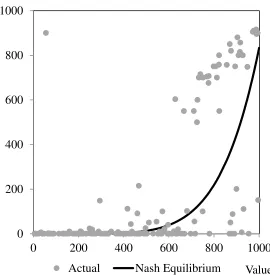
Barut et al. (2002) were the first to experimentally examine all-pay auctions in a symmetric private values environment, but the focus of their study was all-pay auctions with multiple units. They assumed uniformly distributed private values for a single unit. Relative to the symmetric Bayesian Nash equilibrium, underbidding at low valuations and overbidding at high valuations was observed, and the outcomes were not always efficient, in the sense that higher-valued players did not necessarily win the units. In the aggregate, there was overbidding so that average revenue is higher than predicted. The follow up study by Noussair and Silver (2006) used six-player single-prize all-pay auctions, again with uniformly distributed private values. They also found aggregate overbidding relative to the Bayesian Nash equilibrium, with average revenues far above the theoretically predicted expected revenue. As in Barut et al. auction outcomes were not always efficient. When considering subject level data, a prominent outcome in both Barut et al. and Noussair and Silver is the phenomenon Müller and Schotter (2010) refer to as bifurcation: low-valuation subjects underbid, while high-valuation subjects
tend to overbid. For instance, Figure 6 is drawn from data obtained from Noussair and Silver (2006). The frequency of zero bids is much higher than predicted by equilibrium behavior. For example, in the Bayesian Nash equilibrium only subjects with a valuation of zero should bid zero, whereas in the experiment, the modal bid for subjects with valuations in the 25th percentile appears to be zero. It was also common for subjects with valuations in the 75th percentile to place bids near their valuation.8 Müller and Schotter (2010) invoke loss aversion to explain bifurcation. By contrast, Minor (2012) uses the concept of “coarse thinking,” a psychological phenomenon by which subjects collapse possible competitors into a single stereotype (i.e., strong and weak).
In the papers mentioned above players are ex-ante symmetric, i.e., their values (or costs) are independently drawn from the same distribution. Wärneryd (2003) analyzes a two player lottery contest in which one contestant is informed of the common value of the prize prior to bidding, while the other player knows only the continuous distribution from which this value is drawn. Grosskopf et al. (2010) experimentally study asymmetric information contests reminiscent of Wärneryd (2003), and find that, in general, informed bidders tend to bid more aggressively than uninformed bidders. Interestingly, the average sum of bids in asymmetric information lottery contests and all-pay auctions are not statistically different, while they differ under symmetric information. The empirical result for asymmetric information contests does not conform to the theoretical prediction, which is that expected revenue in the all-pay auction is greater than expected revenue in the lottery contest.
8
In two-player all-pay auctions, Dechenaux and Mancini (2008) find that low-valuation players behave more
In summary, the main lesson that we learn from experimental studies discussed in this section is that most studies find support for the comparative statics predictions of contest theory. Some commonly supported comparative statics results are the impact of incomplete information on individual behavior, the “discouragement effect”, and the impact of contest parameters (e.g., the number of players and the number of prizes) on effort.
4. Dynamic Contests
In this section we discuss contests with a dynamic structure. That is, contests in which some players can make decisions based on the actions of others. First, we discuss contests in which players move sequentially. Second, we discuss wars of attrition, which are multi-period contests of exit, which in some contexts can be interpreted as simultaneous move contests. Third, we examine a class of multi-stage contests with a finite horizon in which the set of players remains fixed. These include patent races and best-of-n contests. Fourth, we discuss multi-stage elimination contests, in which a certain number of players are eliminated at each stage of the competition. Finally, we conclude with a discussion of endogenous entry into contests.
4.1. Sequential Contests
In a sequential contest, the players choose effort sequentially, with players moving later
in the game observing the previous players’ choices. Dixit (1987) derives theoretical predictions for two-player sequential contests under standard assumptions on the CSF which include the lottery CSF as a special case. If players are symmetric, then the simultaneous move Nash equilibrium effort levels constitute a subgame perfect Nash equilibrium (SPNE) outcome. By contrast, if the leader is a favorite, in the sense that his probability of winning the contest in the
simultaneous move Nash equilibrium is greater than one half, then the leader’s SPNE effort level
in the sequential contest is higher than under simultaneous moves. Leininger and Yang (1994) show that with the Tullock CSF with r > 2 and symmetric players, in the unique SPNE, the
first-mover preempts the second-first-mover by expending an effort level that forces the second-first-mover to expend zero. In a game such as Dixit’s (1987) in which the choice of timing is endogenized, Baik and Shogren (1992) show that in a SPNE, the favorite chooses to follow whereas the underdog chooses to lead. They use this result to argue that the favorite would not lead aggressively and, in fact, endogenous leadership by the underdog causes both players to expend less effort than under simultaneous moves. This theoretical prediction forms the basis for a number of related experiments.
First, Shogren and Baik (1992) investigate the form of exogenous leadership that does not arise in their game of timing, the case of the “favorite leader” –“underdog follower” sequential contest. Assuming a lottery CSF, they compare behavior in this dynamic game to behavior in the simultaneous move contest. Their experiments identify several key behavioral departures from
Dixit’s prediction. In the sequential contest, favorite first-movers submit effort levels that are no
different from the favorites’ expenditures in the simultaneous move game. Overall, second-movers best respond to the first-movers’ choices. Finally, the authors note that in their role as followers, underdogs sometimes seek to equalize the probability of winning across players rather than maximize their expected payoff.9
9 Using a real-effort experiment, Gill and Prowse (2012) study a sequential-move tournament in which the second
Weimann et al. (2000) also examine a sequential two-player contest, but employ a design with symmetric players and the Tullock CSF with r = 8. In equilibrium, the first-mover preempts
the second-mover by submitting the lowest effort level for which the second-mover’s best response is to play zero. A striking finding is the lack of evidence for a first-mover advantage in the data. In many instances, second movers earn average payoffs above those earned by first-movers. As Vogt et al. (2002) state when referring to Weimann et al.’s results, it appears as though second-movers “punished preemptive attempts and exploited cooperative attempts” (pg. 74).
Fonseca (2009) reconsiders experimental sequential contests under both symmetric and asymmetric conditions. More specifically, his experiment allows for a two-by-two comparison of contests by varying both the degree of symmetry between players (symmetric versus asymmetric) and the timing (simultaneous versus sequential). In the contest with symmetric players but asymmetric timing, first-movers submit effort levels in excess of the prediction. In contests with asymmetric players and timing, Fonseca’s findings replicate Shogren and Baik’s (1992) results to some extent. Favorite first-movers often fail to exploit their theoretically predicted first-mover advantage. Although a large proportion of preemptive attempts succeed, such aggressive (equilibrium) behavior by first-movers sometimes engenders retaliation by the second-mover. Indeed underdog second-movers often submit rather large effort levels, a behavior that can be rationalized by inequality aversion.
Vogt et al. (2002) study contests in which players alternate in submitting bids and each
player’s bids are summed across the duration of the contest to determine a player’s overall or total bid. At each point in time, previously submitted bids are public information and the window of opportunity during which contestants may submit bids closes after a randomly determined number of rounds. This design is broadly similar to that in Weimann et al. (2000) and is meant to experimentally implement Leininger and Yang’s (1994) infinite horizon alternating move model. In that model there exists a Markov perfect equilibrium in which tit-for-tat strategies are employed, generating a path of play on which bidding ends with the second mover (who bids zero). The experimental data exhibit patterns reminiscent of this equilibrium. Contestants stop accumulating effort relatively quickly (after 6 to 10 periods) so that bidding never escalates. As a result, average earnings are higher than in Weimann et al.’s simple leader-follower games. These findings suggest that alternating-move contests with an uncertain final period yield more efficient outcomes than one-shot leader-follower contests.
The experiments discussed above involved either exogenously specified leader-follower roles or alternating moves. Baik et al. (1999) examine the natural extension of the leader-follower setting to a game where the choice of timing is endogenous. In the first stage of the game, the players simultaneously choose either to commit to an effort level or to wait. If one player, the endogenous leader, immediately commits to an effort level and the other player, the endogenous follower, waits, then the follower learns the leader’s effort level and must choose his own effort level. If both players choose to wait, then they play a simultaneous contest. The results of the experiments indicate that subgame perfection predicts actual timing choices rather well. In particular, when subjects are given up to two days to think about their strategy, in a majority of cases, favorites endogenously choose to follow and underdogs choose to lead.
4.2. Wars of Attrition
experimental study of the war of attrition is Bilodeau et al. (2004).10 They test a dynamic model of the volunteer’s dilemma in which the clock stops as soon as one participant volunteers.11 This model is similar to a discrete time war of attrition with complete information and a finite horizon. In five different treatments, the authors consider various parameters that influence the
players’ benefit and cost of public good provision. Subgame perfection accurately predicts the
identity of the volunteer only 41% of the time. One of the key departures from subgame perfection is that subjects rarely volunteer immediately. However, behavior responds to incentives in a sensible manner. For instance, other things equal, players with a greater benefit from volunteering do volunteer more often than other players. Similarly, other things equal, players with a lower cost of volunteering are more likely to stop the clock first. These qualitative
predictions are consistent with a descriptive model in which contestants have “first-order beliefs” (see for instance, Nagel 1995). In this model, the contestants believe their opponents’ volunteering times are random draws from an identical distribution and they choose their volunteering time to maximize their expected payoff.12
Hörisch and Kirchkamp’s (2010) experiment offers a direct comparison of the all-pay auction, the static representation of the war of attrition (i.e., the second-price all-pay auction) and the dynamic war of attrition (where an actual clock runs and the loser is the first player to stop it). In contrast to Bilodeau et al. (2004), Hörisch and Kirchkamp set up an environment with private costs drawn independently from an identical distribution. One of the main qualitative implications is that in the symmetric equilibrium of the war of attrition, almost all player types do not stop immediately. Moreover, the static and dynamic wars of attrition have the same symmetric equilibrium. In the laboratory, the authors find that overbidding prevails in the all-pay auction and the static war of attrition. However, subjects tend to undersupply effort in the dynamic war of attrition by stopping the clock earlier than predicted. For all treatments, the authors test for evidence of bifurcation in empirically estimated bidding functions, but even in the all-pay auction, they find no significant evidence of the commonly-observed behavioral pattern.
Oprea et al. (2013) design an experiment based on the duopoly model of Fudenberg and Tirole (1986). In this model, two firms must decide whether or not to remain in a market or to
exit. A player’s cost per unit of time of remaining in the market is private information and for a
large range of these unit costs, duopoly profit is negative and monopoly profit is positive. For such values of unit costs, remaining in a duopoly market has an instantaneous cost equal to duopoly profit and a future benefit to a surviving firm equal to the monopoly profit. Oprea et al.’s design varies the dispersion in the distribution of costs to induce more or less uncertainty
10
The first experimental study of a competitive environment resembling a war of attrition is Phillips and Mason (1997). However, in the dynamic Cournot game they analyze, players do not choose the time at which they wish to exit. Rather, a player remains in the game until he is forced to exit when his cumulative profit falls to zero.
11 The static
volunteer’s dilemma is a simultaneous move game in which each of n players has two actions,
“volunteer” and “not volunteer”. Any player who volunteers incurs a cost, c. If at least one player volunteers then all players receive an identical prize, v. If none of the players volunteer, then all players earn a payoff of zero. If v–c > 0, the game has multiple Nash equilibria, including pure strategy equilibria in which one player volunteers and n– 1 players do not volunteer, as well as a symmetric equilibrium in non-degenerate mixed strategies. Diekmann (1985, 1986) experimentally studies symmetric games and the effect of the number of players on the probability of
volunteering, and finds that a player’s likelihood of volunteering is decreasing in the number of players. Diekmann (1993) experimentally studies an asymmetric version of the game where players differ in their cost of volunteering, and finds that the players with the lowest cost of volunteering are more likely to volunteer.
12