Bayesian Reordering Model with Feature Selection
Abdullah Alrajehaband Mahesan Niranjanb
aComputer Research Institute, King Abdulaziz City for Science and Technology (KACST)
Riyadh, Saudi Arabia, [email protected]
bSchool of Electronics and Computer Science, University of Southampton
Southampton, United Kingdom,{asar1a10, mn}@ecs.soton.ac.uk
Abstract
In phrase-based statistical machine trans-lation systems, variation in grammatical structures between source and target lan-guages can cause large movements of phrases. Modeling such movements is cru-cial in achieving translations of long sen-tences that appear natural in the target lan-guage. We explore generative learning approach to phrase reordering in Arabic to English. Formulating the reordering problem as a classification problem and using naive Bayes with feature selection, we achieve an improvement in the BLEU score over a lexicalized reordering model. The proposed model is compact, fast and scalable to a large corpus.
1 Introduction
Currently, the dominant approach to machine translation is statistical, starting from the math-ematical formulations and algorithms for param-eter estimation (Brown et al., 1988), further ex-tended in (Brown et al., 1993). These early mod-els, widely known as the IBM modmod-els, were word-based. Recent extensions note that a better ap-proach is to group collections of words, or phrases, for translation together, resulting in a significant focus these days on phrase-based statistical ma-chine translation systems.
To deal with the alignment problem of one-to-many word alignments in the IBM model formulation, whereas phrase-based models may have many-to-many translation relationships, IBM models are trained in both directions, source to tar-get and tartar-get to source, and their word alignments are combined (Och and Ney, 2004).
While phrase-based systems are a significant improvement over word-based approaches, a par-ticular issue that emerges is long-range reorder-ings at the phrase level (Galley and Manning,
2008). Analogous to speech recognition systems, translation systems relied on language models to produce more fluent translation. While early work penalized phrase movements without considering reorderings arising from vastly differing grammat-ical structures across language pairs like Arabic-English, many researchers considered lexical re-ordering models that attempted to learn orienta-tion based on content (Tillmann, 2004; Kumar and Byrne, 2005; Koehn et al., 2005). These approaches may suffer from the data sparseness problem since many phrase pairs occur only once (Nguyen et al., 2009).
As an alternative way of exploiting function ap-proximation capabilities offered by machine learn-ing methods, there is recent interest in formulatlearn-ing a learning problem that aims to predict reorder-ing from lreorder-inguistic features that capture their con-text. An example of this is the maximum entropy method used by (Xiang et al., 2011; Nguyen et al., 2009; Zens and Ney, 2006; Xiong et al., 2006).
In this work we apply a naive Bayes classifier, combined with feature selection to address the re-ordering problem. To the best of our knowledge, this simple model of classification has not been used in this context previously. We present em-pirical results comparing our work and previously proposed lexicalized reordering model. We show that our model is scalable to large corpora.
The remainder of this paper is organized as fol-lows. Section 2 discusses previous work in the field and how that is related to our paper. Section 3 gives an overview of the baseline translation sys-tem. Section 4 introduces the Bayesian reorder-ing model and gives details of different inference methods, while, Section 5 describes feature selec-tion method. Secselec-tion 6 presents the experiments and reports the results evaluated as classification and translation problems. Finally, we end the pa-per with a summary of our conclusions and pa- per-spectives.
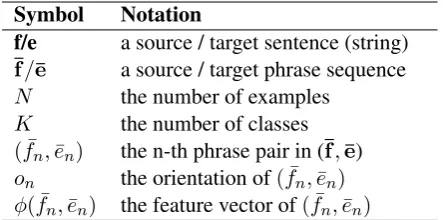
Symbol Notation
f/e a source / target sentence (string)
¯f/¯e a source / target phrase sequence
N the number of examples
K the number of classes
( ¯fn,en¯ ) the n-th phrase pair in (¯f,¯e)
[image:2.595.71.293.62.172.2]on the orientation of( ¯fn,e¯n) φ( ¯fn,¯en) the feature vector of( ¯fn,e¯n)
Table 1: Notation used in this paper.
2 Related Work
The phrase reordering model is a crucial compo-nent of any translation system, particularly be-tween language pairs with different grammatical structures (e.g. Arabic-English). Adding a lex-icalized reordering model consistently improved the translation quality for several language pairs (Koehn et al., 2005). The model tries to predict the orientation of a phrase pair with respect to the pre-vious adjacent target words. Ideally, the reorder-ing model would predict the right position in the target sentence given a source phrase, which is dif-ficult to achieve. Therefore, positions are grouped into limited orientations or classes.The orientation probability for a phrase pair is simply based on the relative occurrences in the training corpus.
The lexicalized reordering model has been ex-tended to tackle long-distance reorderings (Gal-ley and Manning, 2008). This takes into account the hierarchical structure of the sentence when considering such an orientation. Certain exam-ples are often used to motivate syntax-based sys-tems were handled by this hierarchical model, and this approach is shown to improve translation per-formance for several translation tasks with small computational cost.
Despite the fact that the lexicalized reordering model is always biased towards the most frequent orientation for such a phrase pair, it may suffer from a data sparseness problem since many phrase pairs occur only once. Moreover, the context of a phrase might affect its orientation, which is not considered as well.
Adopting the idea of predicting orientation based on content, it has been proposed to represent each phrase pair by linguistic features as reorder-ing evidence, and then train a classifier for predic-tion. The maximum entropy classifier is a popu-lar choice among many researchers (Zens and Ney, 2006; Xiong et al., 2006; Nguyen et al., 2009;
Xi-ang et al., 2011). Max-margin structure classifiers were also proposed (Ni et al., 2011). Recently, Cherry (2013) proposed using sparse features op-timize BLEU with the decoder instead of training a classifier independently.
We distinguish our work from the previous ones in the following. We propose a fast reordering model using a naive Bayes classifier with feature selection. In this study, we undertake a compari-son between our work and lexicalized reordering model.
3 Baseline System
In statistical machine translation, the most likely translation ebest of an input sentence f can be
found by maximizing the probability p(e|f), as follows:
ebest= arg maxe p(e|f). (1)
A log-linear combination of different models (features) is used for direct modeling of the poste-rior probabilityp(e|f)(Papineni et al., 1998; Och and Ney, 2002):
ebest= arg maxe
n
X
i=1
λihi(f,e) (2)
where the feature hi(f,e) is a score function
over sentence pairs. The translation model and the language model are the main features in any sys-tem although additional featuresh(.) can be inte-grated easily (such as word penalty). State-of-the-art systems usually have around ten features (i.e.
n= 10).
In phrase-based systems, the translation model can capture the local meaning for each source phrase. However, to capture the whole meaning of a sentence, its translated phrases need to be in the correct order. The language model, which en-sures fluent translation, plays an important role in reordering; however, it prefers sentences that are grammatically correct without considering their actual meaning. Besides that, it has a bias towards short translations (Koehn, 2010). Therefore, de-veloping a reordering model will improve the ac-curacy particularly when translating between two grammatically different languages.
3.1 Lexicalized Reordering Model
where each phrase position considered as a class (Tillmann, 2004). Some researchers classified phrase movements into three categories (mono-tone, swap, and discontinuous) but the classes can be extended to any arbitrary number (Koehn and Monz, 2005). In general, the distribution of phrase orientation is:
p(ok|f¯n,e¯n) =Z1 h( ¯fn,¯en, ok). (3)
This lexicalized reordering model is estimated by relative frequency where each phrase pair (fn,¯ en¯ ) with such an orientation (ok) is counted and then normalized to yield the probability as fol-lows:
p(ok|f¯n,¯en) = Pcount( ¯fn,e¯n, ok)
ocount( ¯fn,en, o¯ ). (4)
The orientation class of a current phrase pair is defined with respect to the previous target word or phrase (i.e. word-based classes or phrase-based classes). In the case of three categories (mono-tone, swap, and discontinuous): monotone is the previous source phrase (or word) that is previ-ously adjacent to the current source phrase, swap is the previous source phrase (or word) that is next-adjacent to the current source phrase, and discon-tinuous is not monotone or swap.
Galley and Manning (2008) extended the lex-icalized reordering mode to tackle long-distance phrase reorderings. Their hierarchical model en-ables phrase movements that are more complex than swaps between adjacent phrases.
4 Bayesian Reordering Model
Many feature-based reordering models have been proposed to replace the lexicalized reordering model. The reported results showed consistent im-provement in terms of various translation metrics. Naive Bayes method has been a popular clas-sification model of choice in many natural lan-guage processing problems (e.g. text classifica-tion). Naive Bayes is a simple classifier that ig-nores correlation between features, but has the ap-peal of computational simplicity. It is a generative probabilistic model based on Bayes’ theorem as below:
p(ok|fn,¯ en¯ ) = Pp( ¯fn,en¯ |ok)p(ok)
op( ¯fn,¯en|o)p(o). (5)
The class prior can be estimated easily as a rel-ative frequency (i.e. p(ok) = Nk
N ). The
likeli-hood distributionp( ¯fn,¯en|ok)is defined based on
the type of data. The classifier will be naive if we assume that feature variables are conditionally in-dependent. The naive assumption simplifies our distribution and hence reduces the parameters that have to be estimated. In text processing, multi-nomial is used as a class-conditional distribution (Rogers and Girolami, 2011). The distribution is defined as:
p( ¯fn,e¯n|q) =C
Y
m
qφm( ¯fn,e¯n)
m (6)
where C is a multinomial coefficient,
C = ( P
mφm( ¯fn,e¯n))!
Q
mφm( ¯fn,e¯n)! , (7)
andqare a set of parameters, each of which is a probability. Estimating these parameters for each class by maximum likelihood,
arg max
qk
Nk Y
n
p( ¯fn,en¯ |qk), (8)
will result in (Rogers and Girolami, 2011):
qkm=
PNk
n φm( ¯fn,en¯ )
PM
m0PNnkφm0( ¯fn,e¯n). (9)
MAP estimate It is clear that qkm might be zero which means the probability of a new phrase pair with nonzero feature φm( ¯fn,e¯n) is always
zero because of the product in (6). Putting a prior overqis one smoothing technique. A conjugate prior for the multinomial likelihood is the Dirich-let distribution and the MAP estimate forqkm is
(Rogers and Girolami, 2011):
qkm= α−1 +
PNk
n φm( ¯fn,¯en) M(α−1) +PMm0PnNkφm0( ¯fn,¯en)
(10) where M is the feature vector’s length or the feature dictionary size andαis a Dirichlet param-eter with a value greater than one. The derivation is in Appendix A.
probability distribution overqas follows:
p( ¯fn,e¯n|ok) =
Z
p( ¯fn,e¯n|qk)p(qk|αk) dqk
=CΓ (
P
mαkm)
Q
mΓ(αkm)
Q
mΓ(αkm+φm( ¯fn,e¯n))
Γ Pmαkm+φm( ¯fn,¯en).
(11) Here αk are new hyperparameters of the
pos-terior derived by means of Bayes theorem as fol-lows:
p(qk|αk) = p(qk|α)
QNk
n p( ¯fn,e¯n|qk)
R
p(qk|α)QNnkp( ¯fn,e¯n|qk)dqk.
(12) The solution of (11) will result in:
αk =α+ Nk X
n
Φ( ¯fn,¯en). (13)
For completeness we give a summary of deriva-tions of equaderiva-tions (11) and (13) in Appendix B, more detailed discussions can be found in (Barber, 2012).
5 Feature Selection
In several high dimensional pattern classification problems, there is increasing evidence that the discriminant information may be in small sub-spaces, motivating feature selection (Li and Niran-jan, 2013). Having irrelevant or redundant fea-tures could affect the classification performance (Liu and Motoda, 1998). They might mislead the learning algorithms or overfit them to the data and thus have less accuracy.
The aim of feature selection is to find the op-timal subset features which maximize the ability of prediction, which is the main concern, or sim-plify the learned results to be more understand-able. There are many ways to measure the good-ness of a feature or a subset of features; however the criterion will be discussed is mutual informa-tion.
5.1 Mutual Information
Information criteria are based on the concept of entropy which is the amount of randomness. The distribution of a fair coin, for example, is com-pletely random so the entropy of the coin is very high. The following equation calculates the en-tropy of a variable X (MacKay, 2002):
H(X) =−X
x
p(x) logp(x). (14)
The mutual information of a feature X can be mea-sured by calculating the difference between the prior uncertainty of the class variable Y and the posterior uncertainty after using the feature as fol-lows (MacKay, 2002):
I(X;Y) =H(Y)−H(Y|X) (15)
=X
x,y
p(x, y) logpp((xx, y)p(y)).
The advantage of mutual Information over other criteria is the ability to detect nonlinear patterns. The disadvantage is its bias towards higher ar-bitrary features; however this problem can be solved by normalizing the information as follows (Est´evez et al., 2009):
Inorm(X;Y) = min(HI((XX;)Y, H)(Y)). (16)
6 Experiments
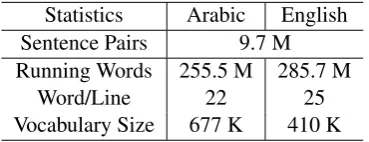
The corpus used in our experiments is MultiUN which is a large-scale parallel corpus extracted from the United Nations website1 (Eisele and Chen, 2010). We have used Arabic and English portion of MultiUN. Table 2 shows the general statistics.
Statistics Arabic English
Sentence Pairs 9.7 M
Running Words 255.5 M 285.7 M
Word/Line 22 25
[image:4.595.325.510.436.507.2]Vocabulary Size 677 K 410 K
Table 2: General statistics of Arabic-English Mul-tiUN (M: million, K: thousand).
We simplify the problem by classifying phrase movements into three categories (monotone, swap, discontinuous). To train the reordering models, we used GIZA++ to produce word align-ments (Och and Ney, 2000). Then, we used the extracttool that comes with the Moses2toolkit (Koehn et al., 2007) in order to extract phrase pairs along with their orientation classes.
Each extracted phrase pair is represented by lin-guistic features as follows:
• Aligned source and target words in a phrase pair. Each word alignment is a feature.
1http://www.ods.un.org/ods/
• Words within a window around the source phrase to capture the context. We choose ad-jacent words of the phrase boundary.
Most researchers build one reordering model for the whole training set (Zens and Ney, 2006; Xiong et al., 2006; Nguyen et al., 2009; Xiang et al., 2011). Ni et al. (Ni et al., 2011) simpli-fied the learning problem to have as many sub-models as source phrases. Training data were di-vided into small independent sets where samples having the same source phrase are considered a training set. In our experiments, we have chosen the first method.
We compare lexicalized and Bayesian reorder-ing models in two phases. In the classification phase, we see the performance of the models as a classification problem. In the translation phase, we test the actual impact of these reordering mod-els in a translation system.
6.1 Classification
[image:5.595.314.524.152.319.2]We built naive Bayes classifier with both MAP es-timate and Bayesian inference. We also used mu-tual Information in order to select the most infor-mative features for our classification task.
Table 3 reports the error rate of the ing models compared to the lexicalized reorder-ing model. All experiments reported here were repeated three times to evaluate the uncertainties in our results. The results shows that there is no advantage to using Bayesian inference instead of MAP estimate.
Classifier Error Rate
Lexicalized model 25.2%
Bayes-MAP estimate 19.53%
[image:5.595.314.525.394.559.2]Bayes-Bayesian inference 20.13% Table 3: Classification error rate of both lexical-ized and Bayesian models.
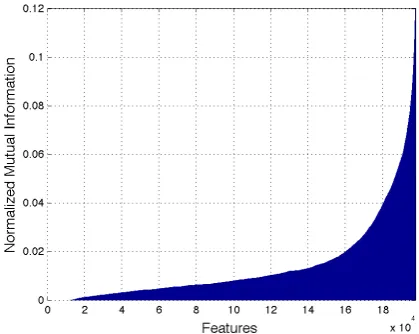
The feature selection process reveals that many features have low mutual information. Hence they are not related to the classification task and can be excluded from the model. Figure 1 shows the nor-malized mutual information for all extracted fea-tures.
A ranking threshold for selecting features based on their mutual information is specified experi-mentally. In Figure 2, we tried different thresh-olds ranging from 0.001 to 0.05 and measure the error rate after each reduction. Although there
is no much gain in terms of performance but the Bayesian model maintains low error rate when the proportion of selected features is low. The model with almost half of the feature space is as good as the one with full feature space.
Figure 1: Normalized mutual information for all extracted features (ranked from lowest to highest).
0 0.1 0.2 0.3 0.4 0.5 0.6 0.7 0.8 0.9 1
19 19.5 20 20.5 21 21.5 22 22.5
Percentage of Feature Reductuion
Error Rate
Figure 2: Classification error rate of the Baysien model with different levels of feature reduction.
6.2 Translation
6.2.1 Experimental Design
We used the Moses toolkit (Koehn et al., 2007) with its default settings. The language model is a 5-gram with interpolation and Kneser-Ney smoothing (Kneser and Ney, 1995). We tuned the system by using MERT technique (Och, 2003).
[image:5.595.87.275.510.569.2]baseline system without reordering model. In all cases, orientation extraction is hierarchical-based since it is the best approach while orientations are monotone, swap and discontinuous. The model is trained in Moses by specifying the configuration stringhier-msd-backward-fe.
As commonly used in statistical machine trans-lation, we evaluated the translation performance by BLEU score (Papineni et al., 2002). The test sets are NIST MT06 and NIST MT08. Table 4 shows statistics of development and test sets. We also computed statistical significance for the pro-posed models using the paired bootstrap resam-plingmethod (Koehn, 2004).
Evaluation Set Arabic English
Development sentences 696 696
words 19 K 21 K
NIST MT06 sentences 1797 7188
words 49 K 223 K
NIST MT08 sentences 813 3252
words 25 K 117 K
Table 4: Statistics of development and test sets. The English side in NIST is larger because there are four translations for each Arabic sentence.
6.2.2 Results
We first demonstrate in Table 5 a general com-parison of the proposed model and the lexicalized model in terms of disc size and average speed in a translation system. The size of Bayesian model is far smaller. The lexicalized model is slightly faster than the Bayesian model because we have over-head computational cost to extract features and compute the orientation probabilities. However, the disc size of our model is much smaller which makes it more efficient practically for large-scale tasks.
Model Size (MB) Speed (s/sent)
Lexicalized model 604 2.2
Bayesian model 18 2.6
Table 5: Disc size and average speed of the re-ordering models in a translation system.
Table 6 shows the BLEU scores for the transla-tion systems according to two test sets. The base-line system has no reordering model. In the two test sets, our Bayesian reordering model is better than the lexicalized one with at least 95%
statis-tical significance. As we have seen in the clas-sification section, Bayes classifier with Bayesian inference has no advantage over MAP estimate.
Translation System MT06 MT08
Baseline 28.92 32.13
BL+ Lexicalized model 30.86 34.22
BL+ Bayes-MAP estimate 31.21* 34.72* BL+ Bayes-Baysien inference 31.20 34.69 Table 6: BLEU scores for Arabic-English trans-lation systems (*: better than the baseline with at least 95% statistical significance).
7 Conclusion
In this paper, we have presented generative mod-eling approach to phrase reordering in machine translation. We have experimented with trans-lation from Arabic to English and shown im-provements over the lexicalized model of estimat-ing probabilities as relative frequencies of phrase movements. Our proposed Bayesian model with feature selection is shown to be superior. The training time of the model is as fast as the lexical-ized model. Its storage requirement is many times smaller which makes it more efficient practically for large-scale tasks.
The feature selection process reveals that many features have low mutual information. Hence they are not related to the classification task and can be excluded from the model. The model with almost half of the feature space is as good as the one with full feature space.
Previously proposed discriminative models might achieve higher score than the reported re-sults. However, our model is scalable to large-scale systems since parameter estimation require only one pass over the data with limited memory (i.e. no iterative learning). This is a critical advan-tage over discriminative models.
References
D. Barber. 2012. Bayesian Reasoning and Machine
Learning. Cambridge University Press.
P. Brown, J. Cocke, S. Della Pietra, V. Della Pietra, F. Jelinek, R. Mercer, and P. Roossin. 1988. A sta-tistical approach to language translation. In12th In-ternational Conference on Computational Linguis-tics (COLING), pages 71–76.
P. Brown, V. Pietra, S. Pietra, and R. Mercer. 1993. The mathematics of statistical machine translation:
Parameter estimation. Computational Linguistics,
19(2):263–311.
C. Cherry. 2013. Improved reordering for phrase-based translation using sparse features. In Proceed-ings of the 2013 Conference of the North American Chapter of the Association for Computational Lin-guistics: Human Language Technologies, pages 22– 31, Atlanta, Georgia, June. Association for Compu-tational Linguistics.
A. Eisele and Y. Chen. 2010. Multiun: A multilingual corpus from united nation documents. In Daniel Tapias, Mike Rosner, Stelios Piperidis, Jan Odjik, Joseph Mariani, Bente Maegaard, Khalid Choukri, and Nicoletta Calzolari (Conference Chair), editors,
Proceedings of the Seventh conference on Interna-tional Language Resources and Evaluation, pages 2868–2872. European Language Resources Associ-ation (ELRA), 5.
P. Est´evez, M. Tesmer, C. Perez, and J. Zurada. 2009. Normalized mutual information feature selection.
Trans. Neur. Netw., 20(2):189–201, February. M. Galley and C. Manning. 2008. A simple and
effective hierarchical phrase reordering model. In
Proceedings of the 2008 Conference on Empirical Methods in Natural Language Processing, pages 848–856, Hawaii, October. Association for Compu-tational Linguistics.
R. Kneser and H. Ney. 1995. Improved backing-off
for m-gram language modeling. IEEE International
Conference on Acoustics, Speech and Signal Pro-cessing, pages 181–184.
P. Koehn and C. Monz. 2005. Shared task: Sta-tistical machine translation between european
lan-guages. InProceedings of ACL Workshop on
Build-ing and UsBuild-ing Parallel Texts, pages 119–124. Asso-ciation for Computational Linguistics.
P. Koehn, A. Axelrod, A. Mayne, C. Callison-Burch, M. Osborne, and D. Talbot. 2005. Edinburgh sys-tem description for the 2005 IWSLT speech
trans-lation evaluation. In Proceedings of International
Workshop on Spoken Language Translation, Pitts-burgh, PA.
P. Koehn, H. Hoang, A. Birch, C. Callison-Burch, M. Federico, N. Bertoldi, B. Cowan, W. Shen, C. Moran, R. Zens, C. Dyer, O. Bojar, A. Constantin,
and E. Herbst. 2007. Moses: Open source toolkit for statistical machine translation. In Proceedings of the ACL 2007 Demo and Poster Sessions, pages 177–180.
P. Koehn. 2004. Statistical significance tests for ma-chine translation evaluation. In Dekang Lin and
Dekai Wu, editors, Proceedings of EMNLP 2004,
pages 388–395, Barcelona, Spain, July. Association for Computational Linguistics.
P. Koehn. 2010. Statistical Machine Translation.
Cambridge University Press.
S. Kumar and W. Byrne. 2005. Local phrase reorder-ing models for statistical machine translation. In
Proceedings of Human Language Technology Con-ference and ConCon-ference on Empirical Methods in Natural Language Processing, pages 161–168, Van-couver, British Columbia, Canada, October. Associ-ation for ComputAssoci-ational Linguistics.
Hongyu Li and M. Niranjan. 2013. Discriminant sub-spaces of some high dimensional pattern
classifica-tion problems. InIEEE International Workshop on
Machine Learning for Signal Processing (MLSP), pages 27–32.
H. Liu and H. Motoda. 1998. Feature Selection for
Knowledge Discovery and Data Mining. Kluwer Academic Publishers, Norwell, MA, USA.
D. MacKay. 2002. Information Theory, Inference &
Learning Algorithms. Cambridge University Press, New York, NY, USA.
V. Nguyen, A. Shimazu, M. Nguyen, and T. Nguyen. 2009. Improving a lexicalized hierarchical
reorder-ing model usreorder-ing maximum entropy. In
Proceed-ings of the Twelfth Machine Translation Summit (MT Summit XII). International Association for Machine Translation.
Y. Ni, C. Saunders, S. Szedmak, and M. Niranjan. 2011. Exploitation of machine learning techniques in modelling phrase movements for machine
transla-tion. Journal of Machine Learning Research, 12:1–
30, February.
F. Och and H. Ney. 2000. Improved statistical
align-ment models. In Proceedings of the 38th Annual
Meeting of the Association of Computational Lin-guistics (ACL).
F. Och and H. Ney. 2002. Discriminative training and maximum entropy models for statistical ma-chine translation. InProceedings of the 40th Annual Meeting of the Association for Computational Lin-guistics (ACL).
F. Och. 2003. Minimum error rate training in statisti-cal machine translation. InProceedings of the 41st Annual Meeting on Association for Computational Linguistics - Volume 1, ACL ’03, pages 160–167, Stroudsburg, PA, USA. Association for Computa-tional Linguistics.
K. Papineni, S. Roukos, and T. Ward. 1998. Max-imum likelihood and discriminative training of di-rect translation models. InProceedings of ICASSP, pages 189–192.
K. Papineni, S. Roukos, T. Ward, and W. Zhu. 2002. Bleu: a method for automatic evaluation of machine translation. InProceedings of the 40th Annual Meet-ing on Association for Computational LMeet-inguistics, pages 311–318, Stroudsburg, PA, USA. Association for Computational Linguistics.
S. Rogers and M. Girolami. 2011. A First Course in
Machine Learning. Chapman & Hall/CRC, 1st edi-tion.
C. Tillmann. 2004. A unigram orientation model for
statistical machine translation. In Proceedings of
HLT-NAACL: Short Papers, pages 101–104.
B. Xiang, N. Ge, and A. Ittycheriah. 2011. Improving reordering for statistical machine translation with smoothed priors and syntactic features. In Proceed-ings of SSST-5, Fifth Workshop on Syntax, Semantics and Structure in Statistical Translation, pages 61– 69, Portland, Oregon, USA. Association for Com-putational Linguistics.
D. Xiong, Q. Liu, and S. Lin. 2006. Maximum en-tropy based phrase reordering model for statistical machine translation. InProceedings of the 21st In-ternational Conference on Computational Linguis-tics and 44th Annual Meeting of the ACL, pages 521–528, Sydney, July. Association for Computa-tional Linguistics.
R. Zens and H. Ney. 2006. Discriminative reorder-ing models for statistical machine translation. In
Proceedings on the Workshop on Statistical Machine Translation, pages 55–63, New York City, June. As-sociation for Computational Linguistics.
A MAP Estimate Derivation
Multinomial distribution is defined as:
p(x|q) =CY m
qxm
m (17)
where C is a multinomial coefficient,
C= ( P
mxm)!
Q
mxm! , (18)
andqmis an event probability (Pmqm= 1).
A maximum a posteriori probability (MAP) es-timate requires a prior overq. Dirichlet distribu-tion is a conjugate prior and is defined as:
p(q|α) = Γ ( P
mαm)
Q
mΓ(αm)
Y
m
qmαm−1 (19)
whereαm is is a parameter with a positive value.
Finding the MAP estimate forqgiven a data is as follows:
q∗= arg max
q p(q|α,X)
= arg max
q {p(q|α)p(X|q)}
= arg max
q
(
p(q|α)Y
n
p(xn|q)
)
= arg max
q
( Y
m
qαmm−1Y n,m
qxnm
m
)
= arg max
q
( X
m
logqmαm−1+X
n,m
logqxnm
m
)
.
(20)
Since our function is subject to constraints (Pmqm = 1), we introduce Lagrange multiplier
as follows:
f(q) =X
m
logqαm−1
m +
X
n,m
logqxnm
m −λ(
X
m
qm−1).
(21) Now we can findq∗by taking the partial deriva-tive with respect to one variableqm:
∂f(q)
∂qm =
αm−1 +Pnxnm qm −λ qm =αm−1 +
P
nxnm
λ . (22)
Finally, we sum both sides overM to findλ:
λX m
qm =X
m
αm−1 +X
n xnm
!
λ=X
m
(αm−1) +
X
n,m
xnm. (23)
The solution can be simplified by choosing the same value for eachαm which will result in:
qm= α−1 + P
nxnm
B Bayesian Inference Derivation
In Appendix A, the inference is based on a single point estimate ofq that has the highest posterior probability. However, it can be based on the whole parameter space to incorporate uncertainty. The probability of a new data point marginalized over the posterior as follows:
p(x|α,X) = Z
p(x|q)p(q|α,X) dq, (25)
p(q|α,X) = R p(q|α)p(X|q)
p(q|α)p(X|q)dq. (26)
Since Dirichlet and Multinomial distributions are conjugate pairs, they form the same density as the prior. Therefore the posterior is also Dirichlet. Now we can expand the posterior expression and re-arrange it to look like a Dirichlet as follows:
p(q|α,X)∝p(q|α)Y
n
p(xn|q)
∝Y
m
qαm−1
m
Y
n
Y
m qxnm
m
∝Y
m
q(αm+P
nxnm)−1
m . (27)
The new hyperparameters of the posterior is:
α∗
m=αm+
X
n
xnm. (28)
Finally, we expand and re-arrange Dirichlet and multinomial distributions inside the integral in (25) as follows:
p(x|α,X) = Z
C Y m
qxm
m Γ (
P
mα∗m)
Q
mΓ(α∗m)
Y
m qα∗m−1
m dq
=C Γ (
P
mα∗m)
Q
mΓ(α∗m)
Z Y
m
qα∗m+xm−1
m dq. (29)
Note that inside the integral looks a Dirichlet without a normalizing constant. If we multiply and divide by its normalizing constant (i.e. Beta function), the integral is going to be one because it is a density function, resulting in:
p(x|α,X) =CΓ (
P
mα∗m)
Q
mΓ(α∗m)
B(α∗+x)
Z 1
B(α∗+x) Y
m
qα∗m+xm−1
m dqc
=CΓ (
P
mα∗m)
Q
mΓ(α∗m) B(α
∗+x)
=CΓ (
P
mα∗m)
Q
mΓ(α∗m)
Q
mΓ(α∗m+xm)
Γ (Pm(α∗