Evaluation for Partial Event Coreference
Jun Araki Eduard Hovy Teruko Mitamura
Language Technologies Institute Carnegie Mellon University Pittsburgh, PA 15213, USA
[email protected], [email protected], [email protected]
Abstract
This paper proposes an evaluation scheme to measure the performance of a system that detects hierarchical event structure for event coreference resolution. We show that each system output is represented as a forest of unordered trees, and introduce the notion of conceptual event hierarchy to simplify the evaluation process. We enu-merate the desiderata for a similarity met-ric to measure the system performance. We examine three metrics along with the desiderata, and show that metrics extended from MUC and BLANC are more ade-quate than a metric based on Simple Tree Matching.
1 Introduction
Event coreference resolution is the task to de-termine whether two event mentions refer to the same event. This task is important since resolved event coreference is useful in various tasks such as topic detection and tracking, information extrac-tion, question answering, textual entailment, and contradiction detection.
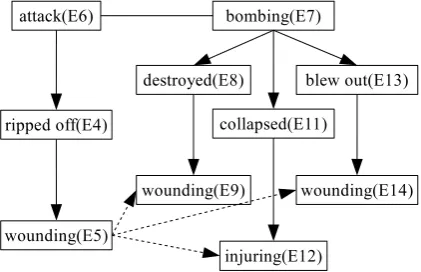
A key challenge for event coreference resolu-tion is that one can define several relaresolu-tions be-tween two events, where some of them exhibit subtle deviation from perfect event identity. For clarification, we refer to perfect event identity as full (event) coreference in this paper. To ad-dress the subtlety in event identity, Hovy et al. (2013) focused on two types of partial event iden-tity:subeventandmembership. Subevent relations form a stereotypical sequence of events, or a script (Schank and Abelson, 1977; Chambers and Juraf-sky, 2008). Membership relations represent in-stances of an event collection. We refer to both aspartial (event) coreference in this paper. Fig-ure 1 shows some examples of the subevent and
membership relations in the illustrative text be-low, taken from the Intelligence Community do-main of violent events. Unlike full coreference, partial coreference is a directed relation, and forms hierarchical event structure, as shown in Figure 1. Detecting partial coreference itself is an important task because the resulting event structures are ben-eficial to text comprehension. In addition, such structures are also useful as background knowl-edge information to resolve event coreference.
A car bomb that police said was set by Shining Path guerrillas ripped off(E4) the front of a Lima police station before dawn Thursday,wounding(E5) 25 peo-ple. Theattack(E6) marked the return to the spotlight of the feared Maoist group, recently overshadowed by a smaller rival band of rebels. The pre-dawn bomb-ing(E7)destroyed(E8) part of the police station and a municipal office in Lima’s industrial suburb of Ate-Vitarte,wounding(E9) 8 police officers, one seriously, Interior Minister Cesar Saucedo told reporters. The bombcollapsed(E11) the roof of a neighboring hospi-tal,injuring(E12) 15, andblew out(E13) windows and doors in a public market,wounding(E14) two guards.
Figure 1: Examples of subevent and member-ship relations. Solid and dashed arrows represent subevent and membership relations respectively, with the direction from a parent to its subevent or member. For example, we say that E4 is a subevent of E6. Solid lines without any arrow heads represent full coreference.
In this paper, we address the problem of
[image:1.595.312.523.496.632.2]ating the performance of a system that detects par-tial coreference in the context of event coreference resolution. This problem is important because, as with other tasks, a good evaluation method for par-tial coreference will facilitate future research on the task in a consistent and comparable manner. When one introduces a certain evaluation metric to such a new complex task as partial event coref-erence, it is often unclear what metric is suitable to what evaluation scheme for the task under what assumptions. It is also obscure how effectively and readily existing algorithms or tools, if any, can be used in a practical setting of the evaluation. In or-der to resolve these sub-problems for partial coref-erence evaluation, we need to formulate an evalu-ation scheme that defines assumptions to be made regarding the evaluation, specifies some desider-ata that an ideal metric should satisfy for the task, and examines how adequately particular metrics can satisfy them. For this purpose, we specifi-cally investigate three existing algorithms MUC, BLANC, and Simple Tree Matching (STM).
The contributions of this work are as follows:
• We introduce a conceptual tree hierarchy that simplifies the evaluation process for partial event coreference.
• We present a way to extend MUC, BLANC, and STM for the case of unordered trees. Those metrics are generic and flexible enough to be used in evaluations involving data structures based on unordered trees.
• Our experimental results indicate that the ex-tended MUC and BLANC are better than Simple Tree Matching for evaluating partial coreference.
2 Related Work
Recent studies on both entity and event coref-erence resolution use several metrics to evaluate system performance (Bejan and Harabagiu, 2010; Lee et al., 2012; Durrett et al., 2013; Lassalle and Denis, 2013) since there is no agreement on a sin-gle metric. Currently, five metrics are widely used: MUC (Vilain et al., 1995), B-CUBED (Bagga and Baldwin, 1998), two CEAF metrics CEAF-φ3and CEAF-φ4 (Luo, 2005), and BLANC (Recasens and Hovy, 2011). We can divide these metrics into two groups: cluster-based metrics, e.g., B-CUBED and CEAF, and link-based metrics, e.g.,
MUC and BLANC. The former group is not ap-plicable to evaluate partial coreference because it is unclear how to define a cluster. The latter is not readily applicable to the evaluation because it is unclear how to penalize incorrect directions of links. We discuss these aspects in Section 4.1 and Section 4.2.
Tree Edit Distance (TED) is one of the tradi-tional algorithms for measuring tree similarity. It has a long history of theoretical studies (Tai, 1979; Zhang and Shasha, 1989; Klein, 1998; Bille, 2005; Demaine et al., 2009; Pawlik and Augsten, 2011). It is also widely studied in many applications, in-cluding Natural Language Processing (NLP) tasks (Mehdad, 2009; Wang and Manning, 2010; Heil-man and Smith, 2010; Yao et al., 2013). However, TED has a disadvantage: we need to predefine ap-propriate costs for basic tree-edit operations. In addition, an implementation of TED for unordered trees is fairly complex.
Another tree similarity metric is Simple Tree Matching (STM) (Yang, 1991). STM measures the similarity of two trees by counting the max-imum match with dynamic programming. Al-though this algorithm was also originally devel-oped for ordered trees, the underlying idea of the algorithm is simple, making it relatively easy to extend the algorithm for unordered trees.
Tree kernels have been also widely studied and applied to NLP tasks, more specifically, to cap-ture the similarity between parse trees (Collins and Duffy, 2001; Moschitti et al., 2008) or between dependency trees (Croce et al., 2011; Srivastava et al., 2013). This method is based on a super-vised learning model with training data; hence we need a number of pairs of trees and associated nu-meric similarity values between these trees as in-put. Thus, it is not appropriate for an evaluation setting.
3 Evaluation Scheme
3.1 Assumptions on Partial Coreference We make the following three assumptions to eval-uate partial coreference.
Twinless mentions: Twinless mentions (Stoyanov et al., 2009) are the mentions that exist in the gold standard but do not in a system response, or vice versa. In reality, twinless mentions often happen since an end-to-end system might produce them in the process of detecting mentions. The assump-tion regarding twinless menassump-tions has been inves-tigated in research on entity coreference resolu-tion. Cluster-based metrics such as B-CUBED and CEAF assume that a system is given true men-tions without any twinless menmen-tions in the gold standard, and then resolves full coreference on them. Researchers have made different assump-tions about this issue. Early work such as (Ji et al., 2005) and (Bengtson and Roth, 2008) simply ignored such mentions. Rahman and Ng (2009) removed twinless mentions that are singletons in a system response. Cai and Strube (2010) proposed two variants of B-CUBED and CEAF that can deal with twinless mentions in order to make the evalu-ation of end-to-end coreference resolution system consistent.
In evaluation of partial coreference where twin-less mentions can also exist, we believe that the value of making evaluation consistent and compa-rable is the most important, and hypothesize that it is possible to effectively create a metric to mea-sure the performance of partial coreference while dealing with twinless mentions. A potential prob-lem of making a single metric handle twinless mentions is that the metric would not be informa-tive enough to show whether a system is good at identifying coreference links but poor at identify-ing mentions, or vice versa (Recasens and Hovy, 2011). However, our intuition is that the prob-lem is avoidable by showing the performance of mention identification with metrics such as pre-cision, recall, and the F-measure simultaneously with the performance of link identification. In this work, therefore, we assume that a metric for par-tial coreference should be able to handle twinless mentions.
Intransitivity: As described earlier, partial coref-erence is a directed relation. We assume that par-tial coreference is not transitive. To illustrate the intransitivity, letei −→s ej denote a subevent
rela-tion that ej is a subevent of ei. In Figure 1, we
have E7 −→s E8 and E8 −→s E9. In this case,
E9 is not a subevent of E7 due to the intransi-tivity of subevent relations. One could argue that the event ‘wounding(E9)’ is one of stereotypical events triggered by the event ‘bombing(E7)’, and thus E7 −→s E9. However, if we allow transitiv-ity of partial coreference, then we have to measure all implicit partial coreference links (e.g., the one between E7 and E9) from hierarchical event struc-tures. Consequently, this evaluation policy could result in an unfair scoring scheme biased toward large event hierarchy.
Link propagation: We assume that partial coref-erence links can be propagated due to a combi-nation of full coreference links with them. To il-lustrate the phenomenon, letei ⇔ ej denote full
coreference between ei andej. In Figure 1, we
haveE6 ⇔ E7andE7 −→s E8. In this case, E8 is also a subevent of E6, i.e., E6 −→s E8. The rationale behind this assumption is that if a sys-tem identifies E6 −→s E8 instead of E7 −→s E8, then there is no reason to argue that the identified subevent relation is incorrect given thatE6⇔E7 andE7 −→s E8. The discussion here also applies to membership relations.
3.2 Conceptual Event Hierarchy
The assumption of link propagation poses a chal-lenge in measuring the performance of partial coreference. We illustrate the challenge with the example in the discussion on link propagation above. We focus only on subevent relations to de-scribe our idea, but one can apply the same dis-cussion to membership relations. Suppose that a system detects a subevent linkE7 −→s E8, but not
E6 −→s E8. Then, is it reasonable to give the system a double reward for two linksE7 −→s E8 andE6 −→s E8due to link propagation, or should one require a system to perform such link propa-gation and detectE7−→s E8as well for the system to achieve the double reward? In the evaluation scheme based on event trees whose nodes repre-sent event mentions, we need to predefine how to deal with link propagation of full and partial coref-erence in evaluation. In particular, we must pay at-tention to the potential risk of overcounting partial corefrence links due to link propagation.
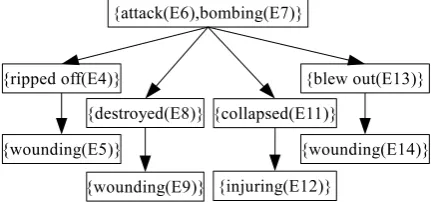
coreference and subevent relations in Figure 1. Using set notation, each node of the tree represents an abstract event. For instance, node {E6, E7} represents an “attacking” event which both event mentions E6 and E7 refer to.
Figure 2: A conceptual subevent tree constructed from the full coreference and subevent relations in Figure 1.
The notion of a conceptual event tree obviates the need to cope with link propagation, thereby simplifying the evaluation for partial coreference. Given a conceptual event tree, an evaluation met-ric is basically just required to measure how many links in the tree a system successfully detects. When comparing two conceptual event trees, a link in a tree is identical to one in the other tree if there is at least one event mention shared in par-ent nodes of those links and at least one shared in child nodes of those links. For example, sup-pose that system A identifiesE6 −→s E8, system BE7 −→s E8, system C both, and all the systems identifyE6 ⇔ E7in Figure 1. In this case, they gain the same score since the subevent links that they identify correspond to one correct subevent link {E6, E7} −→ {s E8} in Figure 2. It is pos-sible to construct the conceptual event hierarchy for membership relations in the same way as de-scribed above. This means that the conceptual event hierarchy allows us to show the performance of a system on each type of partial coreference separately, which leads to more informative evalu-ation output.
One additional note is that the conceptual event tree representing partial coreference is an un-ordered tree, as illustrated in Figure 2. Although we could represent a subevent tree with an or-dered tree because of the stereotypical sequence of subevents given by definition, partial coreference is in general represented with a forest of unordered trees1.
1For example, it is impossible to intuitively define a
se-3.3 Desiderata for Metrics
In general, a system output of partial event coref-erence in a document is represented not by a sin-gle tree but by a forest, i.e., a set of disjoint trees whose nodes are event mentions that appear in the document. LetT be a tree, and letF be a forest
F ={Ti}. Letsim(Fg, Fr)∈[0,1]denote a
sim-ilarity score between the gold standard forest Fg
and a system response forest Fr. We define the
following properties that an ideal evaluation met-ric for partial event coreference should satisfy.
P1. Identity:sim(F1, F1) = 1.
P2. Symmetricity:sim(F1, F2) =sim(F2, F1). P3. Zero: sim(F1, F2) = 0ifF1 andF2 are
to-tally different forests.
P4. Monotonicity: The metric score should in-crease from 0 to 1 monotonically as two to-tally different forests approach the identical one.
P5. Linearity: The metric score should increase linearly as each single individual correct piece of information is added to a system re-sponse.
The first three properties are relatively intuitive. P4 is important because otherwise a higher score by the metric does not necessarily mean higher quality of partial event coreference output. In P5, a correct piece of information is the addition of one correct link or the deletion of one incorrect link. This property is useful for tracking performance progress over a certain period of time. If the met-ric score increases nonlinearly, then it is difficult to compare performance progress such as a 0.1 gain last year and a 0.1 gain this year, for example.
In addition, one can think of another property with respect to structural consistency. The moti-vation for the property is that one might want to give more reward to partial coreference links that form hierarchical structures, since they implicitly form sibling relations among child nodes. For in-stance, suppose that system A detects two links {E6, E7}−→ {s E8}and{E6, E7}−→ {s E11}, and system B two links{E8}−→ {s E9}and{E11}−→s {E12} in Figure 2. We can think that system A performs better since the system successfully de-tects an implicit subevent sibling relation between {E8} and{E11} as well. Due to space limita-tions, however, we do not explore the property in this work, and leave it for future work.
4 Evaluation Metrics
In this section, we examine three evaluation met-rics based on MUC, BLANC, and STM respec-tively under the evaluation scheme described in Section 3.
4.1 B-CUBED and CEAF
B-CUBED regards a coreference chain as a set of mentions, and examines the presence and absence of mentions in a system response that are relative to each of their corresponding mentions in the gold standard (Bagga and Baldwin, 1998). Let us call such set a mention cluster. A problem in applying B-CUBED to partial coreference is that it is diffi-cult to properly form a mention cluster for partial coreference. In Figure 2, for example, we could form a gold standard cluster containing all nodes in the tree. We could then form a system response cluster, given a certain system output. The prob-lem is that B-CUBED’s way of counting mentions overlapped in those clusters cannot capture parent-child relations between the mentions in a cluster. It is also difficult to extend the counting algorithm to incorporate such relations in an intuitive man-ner. Therefore, we observe that B-CUBED is not appropriate for evaluating partial coreference.
We see the basically same reason for the inade-quacy of CEAF. It also regards a coreference chain as a set of mentions, and measures how many men-tions two clusters share using two similarity met-ricsφ3(R, S) =|R∩S|andφ4(R, S) = |2R|R|+∩|SS||, given two clustersRandS. One can extend CEAF for partial coreference by selecting the most ap-propriate tree similarity algorithm forφthat works well with the algorithm to compute maximum bi-partite matching in CEAF. However, that is an-other line of work, and due to space limitations we leave it for future work.
4.2 Extension to MUC and BLANC
MUC relies on the minimum number of links needed when mapping a system response to the gold standard (Vilain et al., 1995). Given a set of key entitiesKand a set of response entitiesR, pre-cision of MUC is defined as the number of com-mon links between entities inKandRdivided by the number of links inR, whereas recall of MUC is defined as the number of common links between entities inKandRdivided by the number of links inK. After finding a set of mention clusters by re-solving full coreference, we can compute the
num-ber of correct links by counting all links spanning in those mention clusters that matched the gold standard. It is possible to apply the idea of MUC to the case of partial coreference simply by chang-ing the definition of a correct link. In the partial coreference case, we define a correct link as a link matched with the gold standard including its di-rection. Let MUCpdenote such extension to MUC
for partial coreference.
Similarly, it is also possible to define an ex-tension to BLANC. Let BLANCp denote the
ex-tension. BLANC computes precision, recall, and F1 scores for both coreference and non-coreference links, and average them for the final score (Recasens and Hovy, 2011). As with MUCp,
BLANCp defines a correct link as a link matched
with the gold standard including its direction. An-other difference between BLANC and BLANCpis
the total number of mention pairs, denoted asL. In the original BLANC,L=N(N −1)/2whereN
is the total number of mentions in a document. We useLp = N(N −1)instead for BLANCp since
we consider two directed links in partial corefer-ence with respect to each undirected link in full coreference.
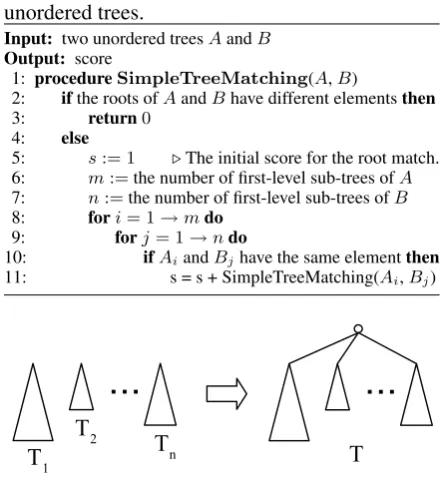
4.3 Extension to Simple Tree Matching The underlying idea of STM is that if two trees have more node-matching, then they are more sim-ilar. The original STM uses a dynamic program-ming approach to perform recursive node-level matching in a top-down fashion. In the case of partial coreference, we cannot readily use the ap-proach because partial coreference is represented with unordered trees, and thus time complexity of node-matching is the exponential order with re-spect to the number of child nodes. However, par-tial event coreference is normally given in a small hierarchy with three levels or less. Taking ad-vantage of this fact and assuming that each event mention is uniquely identified in a tree, we ex-tend STM for the case of unordered trees by using greedy search. Algorithm 1 shows an extension to the STM algorithm for unordered trees.
sim-Algorithm 1 Extended simple tree matching for unordered trees.
Input: two unordered treesAandB
Output: score
1: procedureSimpleTreeMatching(A,B)
2: ifthe roots ofAandBhave different elementsthen 3: return0
4: else
5: s:= 1 .The initial score for the root match. 6: m:=the number of first-level sub-trees ofA 7: n:=the number of first-level sub-trees ofB 8: fori= 1→mdo
9: forj= 1→ndo
10: ifAiandBjhave the same elementthen
[image:6.595.70.293.77.318.2]11: s = s + SimpleTreeMatching(Ai,Bj)
Figure 3: Conversion from a forest to a single tree with an additional dummy root.
ilarity of two forests comprising unordered trees. Let STMp denote the extended STM. Finally, we
normalize STMp. Let NSTMp be a normalized
version of STMp as follows: NST Mp(F1, F2) =
ST Mp(F1, F2)/max(|F1|,|F2|) where |F| de-notes the number of nodes inF.
4.4 Flexibility of Metrics
Making assumptions on evaluation for a particular task and defining desiderata for a metric determine what evaluation scheme we are going to formulate. However, this kind of effort tends to make result-ing evaluation metrics too restrictive to be reusable in other tasks. Such metrics might be adequate for that task, but we also value the flexibility of a metric that can be directly used or be easily ex-tended to other tasks. To investigate the flexibil-ity of MUCp, BLANCpand STMp, we will
exam-ine these metrics without making the assumptions of twinless mentions and intransitivity of partial coreference against each metric. We consider that the assumption of link propagation is more funda-mental and regard it as a basic premise, and thus we will continue to make that assumption.
MUC was originally designed to deal with re-sponse links spanning mentions that even key links do not reach. Thus, it is able to handle twinless mentions. If we do not assume intransitivity of
partial coreference, we do not see any difficulty in changing the definition of correct links in MUCp
and making it capture transitive relations. There-fore, MUCp does not require both assumptions of
twinless mentions and intransitivity.
In contrast, BLANC was originally designed to handle true mentions in the gold standard. Since BLANCpdoes not make any modifications on this
aspect, it cannot deal with twinless mentions ei-ther. As for intransitivity, it is possible to easily change the definition of correct and incorrect links in BLANCp to detect transitive relations. Thus,
BLANCp does not require intransitivity but does
require the assumption of no twinless mentions. Since STMpsimply matches elements in nodes
as shown in Algorithm 1, it does not require the as-sumption of twinless mentions. With respect to in-transitivity, we can extend STMp by adding extra
edges from a parent to grandchild nodes or others and applying Algorithm 1 to the modified trees. Hence, it does not require the assumption of in-transitivity.
5 Experiments
To empirically examine the three metrics de-scribed in Section 4.2 and Section 4.3, we con-ducted an experiment using the artificial data shown in Table 1. Since BLANCp cannot
han-dle twinless mentions, we removed twinless men-tions. We first created the gold standard shown in the first row of the table. It contains fifty events, twenty one singleton events, and seven event trees with three levels or less. We believe this distri-bution of partial coreference is representative of that of real data. We then created several system responses that are ordered toward two extremes. One extreme is all singletons in which they do not have correct links. The other is a single big tree that merges all event trees including singletons in the gold standard.
Response Output
Gold standard (1(2(6))(3(7))(4)(5)) (8(9(11)(12))(10)) (13(14)(15)(16)(17)(18)) (19(20(21))(22)) (23(24)(25))(26(27)) (28(29))(30) (31) (32) (33) (34) (35) (36) (37) (38) (39) (40) (41) (42) (43) (44) (45) (46) (47) (48) (49) (50)
System 1 (1(4)(5)(2(6))(3(7))) (8(9(11)(12))(10)) (13(18)(14)(15)(16)(17)) (19(22)(20(21))) (23(24)(25))(26(27)) (28(29))(30) (31) (32) (33) (34) (35) (36) (37) (38) (39) (40) (41) (42) (43) (44) (45) (46) (47) (48)(49(50))
System 2 (1) (2) (3) (4) (5) (6) (7) (8) (9) (10) (11) (12) (13) (14) (15) (16) (17) (18) (19) (20) (21) (22) (23) (24)(25) (26) (27)(28(29))(30) (31) (32) (33) (34) (35) (36) (37) (38) (39) (40) (41) (42) (43) (44) (45) (46) (47) (48) (49) (50)
[image:7.595.310.526.319.483.2]System 3 (1) (2) (3) (4) (5) (6) (7) (8) (9) (10) (11) (12) (13) (14) (15) (16) (17) (18) (19) (20) (21) (22) (23) (24)(25) (26) (27) (28) (29) (30) (31) (32) (33) (34) (35) (36) (37) (38) (39) (40) (41) (42) (43) (44) (45) (46) (47) (48) (49) (50)
Table 1: Examples of a system response against a gold standard partial coreference. Each event tree is shown in the bold font and in the Newick standard format with parentheses.
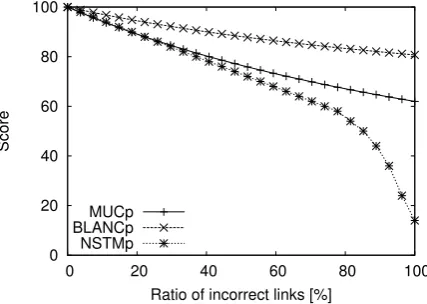
with the perfect output, and then added one incor-rect link49−→s 50shown in System 1. In a manner similar to case (a), we added incorrect links up to the merged tree one by one in a bottom-up fashion. The results indicate that MUCp and BLANCp
meet the desiderata defined in Section 3.3 more adequately than NSTMp. The curve of MUCpand
BLANCp in Figure 4 are close to the linearity,
which is practically useful as a metric. In contrast, NSTMp fails to meet P4 and P5 in case (a), and
fails to meet P5 in case (b). This is because STM first checks whether root nodes of two trees have the same element, and if the root nodes have dif-ferent elements, STM stops searching the rest of nodes in the trees.
6 Discussion
In Section 4.4, we observed that MUCpand STMp
are more flexible than BLANCp because they can
measure the performance coreference in the case of twinless mentions as well. The experimental re-sults in Section 5 show that MUCpand BLANCp
more adequate in terms of the five properties de-fined in Section 3.3. Putting these together, MUCp
seems the best metric for partial event coreference. However, MUC has two disadvantages that (1) it prefers systems that have more mentions per en-tity (event), and (2) it ignores recall for singletons (Pradhan et al., 2011). MUCpalso has these
disad-vantages. Thus, BLANCpmight be the best choice
for partial coreference if we could assume that a system is given true mentions in the gold standard. Although STMp fails to satisfy P4 and P5, it
has potential power to capture structural
0 20 40 60 80 100
0 20 40 60 80 100
Score
Ratio of correct links [%] MUCp BLANCp NSTMp
(a) The number of correct links increases from singletons to the perfect output (the gold standard) one by one.
0 20 40 60 80 100
0 20 40 60 80 100
Score
Ratio of incorrect links [%] MUCp
BLANCp NSTMp
(b) The number of incorrect links increases from the perfect output to a single tree merging all trees one by one.
Figure 4: Score comparison among MUCp,
[image:7.595.312.526.517.669.2]ties of partial coreference described in Section 3.3. This is because STM’s recursive fashion of node-counting can be easily extend to node-counting the num-ber of correct sibling relations.
7 Conclusion
We proposed an evaluation scheme for partial event coreference with conceptual event hierar-chy constructed from mention-based event trees. We discussed possible assumptions that one can make, and examined extensions to three existing metrics. Our experimental results indicate that the extensions to MUC and BLANC are more ade-quate than the extension to STM. To our knowl-edge, this is the first work to argue an evaluation scheme for partial event coreference. Neverthe-less, we believe that our scheme is generic and flexible enough to be applicable to other directed relations of events (e.g., causality and entailment) or other related tasks to compare hierarchical data based on unordered trees (e.g., ontology compari-son). One future work is to improve the metrics by incorporating structural consistency of event trees as an additional property and implementing the metrics from the perspective of broad contexts beyond local evaluation by link-based counting.
8 Acknowledgements
This research was supported in part by DARPA grant FA8750-12-2-0342 funded under the DEFT program. Any opinions, findings, and conclusion or recommendations expressed in this material are those of the authors and do not necessarily reflect the view of the DARPA or the US government. We would like to thank anonymous reviewers for their helpful comments.
References
Amit Bagga and Breck Baldwin. 1998. Algorithms
for Scoring Coreference Chains. InProceedings of
LREC 1998 Workshop on Linguistics Coreference, pages 563–566.
Cosmin Bejan and Sanda Harabagiu. 2010. Unsuper-vised Event Coreference Resolution with Rich Lin-guistic Features. InProceedings of ACL 2010, pages 1412–1422.
Eric Bengtson and Dan Roth. 2008. Understanding the Value of Features for Coreference Resolution. In
Proceedings of EMNLP 2008, pages 294–303.
Philip Bille. 2005. A Survey on Tree Edit Distance and
Related Problems. Theoretical Computer Science,
337(1-3):217–239.
Jie Cai and Michael Strube. 2010. Evaluation Metrics For End-to-End Coreference Resolution Systems. In
Proceedings of SIGDIAL 2010, pages 28–36. Nathanael Chambers and Dan Jurafsky. 2008.
Un-supervised Learning of Narrative Event Chains. In
Proceedings of ACL-HLT 2008, pages 789–797. Michael Collins and Nigel Duffy. 2001. Convolution
Kernels for Natural Language. In Proceedings of
NIPS 2001, pages 625–632.
Danilo Croce, Alessandro Moschitti, and Roberto Basili. 2011. Structured Lexical Similarity via
Con-volution Kernels on Dependency Trees. In
Proceed-ings of EMNLP 2011, pages 1034–1046.
Erik D. Demaine, Shay Mozes, Benjamin Rossman, and Oren Weimann. 2009. An Optimal
Decomposi-tion Algorithm for Tree Edit Distance. ACM
Trans-actions on Algorithms (TALG), 6(1):2:1–2:19.
Greg Durrett, David Hall, and Dan Klein. 2013. De-centralized Entity-Level Modeling for Coreference
Resolution. In Proceedings of ACL 2013, pages
114–124.
Michael Heilman and Noah A. Smith. 2010. Tree Edit Models for Recognizing Textual Entailments,
Para-phrases, and Answers to Questions. InProceedings
of NAACL-HLT 2013, pages 1011–1019.
Eduard Hovy, Teruko Mitamura, Felisa Verdejo, Jun Araki, and Andrew Philpot. 2013. Events are Not Simple: Identity, Non-Identity, and Quasi-Identity. In Proceedings of NAACL-HLT 2013 Workshop on Events: Definition, Detection, Coreference, and Representation, pages 21–28.
Heng Ji, David Westbrook, and Ralph Grishman. 2005. Using Semantic Relations to Refine Coreference
Decisions. In Proceedings of EMNLP/HLT 2005,
pages 17–24.
Philip N. Klein. 1998. Computing the Edit-Distance
Between Unrooted Ordered Trees. In
Proceed-ings of the 6th European Symposium on Algorithms (ESA), pages 91–102.
Emmanuel Lassalle and Pascal Denis. 2013. Im-proving pairwise coreference models through
fea-ture space hierarchy learning. In Proceedings of
ACL 2013, pages 497–506.
Heeyoung Lee, Marta Recasens, Angel Chang, Mi-hai Surdeanu, and Dan Jurafsky. 2012. Joint En-tity and Event Coreference Resolution across
Doc-uments. In Proceedings of the Conference on
Xiaoqiang Luo. 2005. On Coreference Resolution
Per-formance Metrics. InProceedings of EMNLP 2005,
pages 25–32.
Yashar Mehdad. 2009. Automatic Cost Estimation for Tree Edit Distance Using Particle Swarm
Optimiza-tion. In Proceedings of ACL-IJCNLP 2009, pages
289–292.
Alessandro Moschitti, Daniele Pighin, and Roberto Basili. 2008. Tree Kernels for Semantic Role La-beling. Computational Linguistics, 34(2):193–224.
Mateusz Pawlik and Nikolaus Augsten. 2011. RTED: A Robust Algorithm for the Tree Edit Distance.
Proceedings of the VLDB Endowment (PVLDB), 5(4):334–345.
Sameer Pradhan, Lance Ramshaw, Mitchell Marcus, Martha Palmer, Ralph Weischedel, and Nianwen Xue. 2011. CoNLL-2011 Shared Task: Modeling
Unrestricted Coreference in OntoNotes. In
Proceed-ings of CoNLL Shared Task 2011, pages 1–27.
Altaf Rahman and Vincent Ng. 2009. Supervised
Models for Coreference Resolution. InProceedings
of EMNLP 2009, pages 968–977.
Marta Recasens and Eduard Hovy. 2011. BLANC: Implementing the Rand index for coreference
eval-uation. Natural Language Engineering, 17(4):485–
510.
Roger C. Schank and Robert P. Abelson. 1977.Scripts, Plans, Goals, and Understanding: An Inquiry into Human Knowledge Structures. Lawrence Erlbaum Associates.
Shashank Srivastava, Dirk Hovy, and Eduard Hovy. 2013. A Walk-Based Semantically Enriched Tree Kernel Over Distributed Word Representations. In
Proceedings of EMNLP 2013, pages 1411–1416.
Veselin Stoyanov, Nathan Gilbert, Claire Cardie, and Ellen Riloff. 2009. Conundrums in Noun Phrase Coreference Resolution: Making Sense of the
State-of-the-Art. In Proceedings of ACL/IJCNLP 2009,
pages 656–664.
Kuo-Chung Tai. 1979. The Tree-to-Tree Correction
Problem. Journal of the ACM (JACM), 26(3):422–
433.
Marc Vilain, John Burger, John Aberdeen, Dennis Con-nolly, and Lynette Hirschman. 1995. A
Model-Theoretic Coreference Scoring Scheme. In
Pro-ceedings of the 6th Message Understanding Confer-ence (MUC), pages 45–52.
Mengqiu Wang and Christopher D. Manning. 2010. Probabilistic Tree-Edit Models with Structured La-tent Variables for Textual Entailment and Question
Answering. InProceedings of COLING 2010, pages
1164–1172.
Wuu Yang. 1991. Identifying Syntactic Differences
Between Two Programs. Software: Practice and
Experience, 21(7):739–755.
Xuchen Yao, Benjamin Van Durme, Chris Callison-burch, and Peter Clark. 2013. Answer Extraction as Sequence Tagging with Tree Edit Distance. In
Proceedings of NAACL-HLT 2013, pages 858–867. Kaizhong Zhang and Dennis Shasha. 1989. Simple
Fast Algorithms for the Editing Distance Between
Trees and Related Problems. SIAM J. Comput.,