Foreign Words and the Automatic Processing
of Arabic Social Media Text Written in Roman Script
Ramy Eskander, Mohamed Al-Badrashiny†, Nizar Habash‡and Owen Rambow
Center for Computational Learning Systems, Columbia University {reskander,rambow}@ccls.columbia.edu
†Department of Computer Science, The George Washington University
‡Computer Science Department, New York University Abu Dhabi
Abstract
Arabic on social media has all the prop-erties of any language on social media that make it tough for natural language processing, plus some specific problems. These include diglossia, the use of an alternative alphabet (Roman), and code switching with foreign languages. In this paper, we present a system which can process Arabic written in Roman alpha-bet (“Arabizi”). It identifies whether each word is a foreign word or one of an-other four categories (Arabic, name, punc-tuation, sound), and transliterates Arabic words and names into the Arabic alphabet. We obtain an overall system performance of 83.8% on an unseen test set.
1 Introduction
Written language used in social media shows dif-ferences from that in other written genres: the vocabulary is informal (and sometimes the syn-tax is as well); there are intentional deviations from standard orthography (such as repeated let-ters for emphasis); there are typos; wrilet-ters use non-standard abbreviations; non-linguistic sounds are written (haha); punctuation is used creatively; non-linguistic signs such as emoticons often com-pensate for the absence of a broader communica-tion channel in written communicacommunica-tion (which ex-cludes, for example, prosody or visual feedback); and, most importantly for this paper, there fre-quently is code switching. These facts pose a well-known problem for natural language processing of social media texts, which has become an area of interest as applications such as sentiment analy-sis, information extraction, and machine transla-tion turn to this genre.
This situation is exacerbated in the case of Ara-bic social media. There are three principal rea-sons. First, the Arabic language is a collection of varieties: Modern Standard Arabic (MSA), which is used in formal settings, and different forms of Dialectal Arabic (DA), which are commonly used informally. This situation is referred to as “diglos-sia”. MSA has a standard orthography, while the dialects do not. What is used in Arabic so-cial media is typically DA. This means that there is no standard orthography to begin with, result-ing in an even broader variation in orthographic forms found. Diglossia is seen in other linguistic communities as well, including German-speaking Switzerland, in the Czech Republic, or to a some-what lesser extent among French speakers. Sec-ond, while both MSA and DA are commonly ten in the Arabic script, DA is sometimes writ-ten in the Roman script. Arabic writwrit-ten in Roman is often called “Arabizi”. It is common in other linguistic communities as well to write informal communication in the Roman alphabet rather than in the native writing system, for example, among South Asians. And third, educated speakers of Arabic are often bilingual or near-bilingual speak-ers of another language as well (such as English or French), and will code switch between DA and the foreign language in the same utterance (and sometimes MSA as well). As is well known, code switching is common in many linguistic commu-nities, for example among South Asians.
In this paper, we investigate the issue of pro-cessing Arabizi input with code switching. There are two tasks: identification of tokens that are not DA or MSA (and should not be transliterated into Arabic script for downstream processing), and then the transliteration into Arabic script of the parts identified as DA or MSA. In this paper, we
use as a black box an existing component that we developed to transliterate from Arabizi to Arabic script (Al-Badrashiny et al., 2014). This paper concentrates on the task of identifying which to-kens should be transliterated. A recent release of annotated data by the Linguistic Data Consor-tium (LDC, 2014c; Bies et al., 2014) has enabled novel research on this topic. The corpus pro-vides each token with a tag, as well as a translit-eration if appropriate. The tags identify foreign words, as well as Arabic words, names, punctua-tion, and sounds. Only Arabic words and names are transliterated. (Note that code switching is not distinguished from borrowing.) Emoticons, which may be isolated or part of an input token, are also identified, and converted into a conventional sym-bol (#). This paper presents taggers for the tags, and an end-to-end system which takes Arabizi in-put and produces a complex outin-put which consists of a tag for each input token and a transliteration of Arabic words and names into the Arabic script. To our knowledge, this is the first system that han-dles the complete task as defined by the LDC data. This paper focuses on the task of identifying for-eign words (as well as the other tags), on creating a single system, and on evaluating the system as a whole.
This paper makes three main contributions. First, we clearly define the computational prob-lem of dealing with social media Arabizi, and pro-pose a new formulation of the evaluation metric for the LDC corpus. Second, we present novel modules for the detection of foreign words as well as of emoticons, sounds, punctuation marks, and names in Arabizi. Third, we compose a single sys-tem from the various components, and evaluate the complete system.
This paper is structured as follows. We start by presenting related work (Section 2), and then we present relevant linguistic facts and explain how the data is annotated (Section 3). After summariz-ing our system architecture (Section 4) and exper-imental setup (Section 5), we present our systems for tagging in Sections 6, 7 and 8. The evaluation results are presented in Section 9.
2 Related Work
While natural language processing for English in social media has attracted considerable attention recently (Clark and Araki, 2011; Gimpel et al., 2011; Gouws et al., 2011; Ritter et al., 2011; Der-czynski et al., 2013), there has not been much
work on Arabic yet. We give a brief summary of relevant work on Arabic.
Darwish et al. (2012) discuss NLP problems in retrieving Arabic microblogs (tweets). They dis-cuss many of the same issues we do, notably the problems arising from the use of DA such as the lack of a standard orthography. However, they do not deal with DA written in the Roman alphabet (though they do discuss non-Arabic characters).
There is some work on code switching be-tween Modern Standard Arabic (MSA) and di-alectal Arabic (DA). Zaidan and Callison-Burch (2011) are interested in this problem at the inter-sentence level. They crawl a large dataset of MSA-DA news commentaries. They use Ama-zon Mechanical Turk to annotate the dataset at the sentence level. Then they use a language model-ing approach to predict the class (MSA or DA) for an unseen sentence. There is other work on dialect identification, such as AIDA (Elfardy et al., 2013; Elfardy et al., 2014). In AIDA, some statistical and morphological analyses are applied to capture code switching between MSA and DA within the same sentence. Each word in the sen-tence is tagged to be either DA or MSA based on the context. The tagging process mainly de-pends on the language modeling (LM) approach, but if a word is unknown in the LM, then its tag is assigned through MADAMIRA, a morphological disambiguator Pasha et al. (2014).
and emoticons. Furthermore, Darwish (2013) uses around 5K words for training his taggers and 3.5K words for testing; this is considerably smaller than our training and test sets of 113K and 32K words, respectively.
Chalabi and Gerges (2012) presented a hybrid approach for Arabizi transliteration. Their work does not address the detection of English words, punctuation, emoticons, and so on. They also do not handle English when mixed with Arabizi.
Voss et al. (2014) deal with exactly the prob-lem of classifying tokens in Arabizi as Arabic or not. More specifically, they deal with Moroccan Arabic, and with both French and English, mean-ing they do a three-way classification. There are many differences between our work and theirs: they have noisy training data, and they have a much more balanced test set. They also only deal with foreignness, and do not address the other tags we deal with, nor do they actually discuss translit-eration itself.
3 Linguistic Facts and Data Annotation
3.1 Arabizi
Arabizi refers to Arabic written using the Roman script (Darwish, 2013; Voss et al., 2014). Ara-bizi orthography is spontaneous and has no stan-dard references, although there are numerous com-monly used conventions making specific usage of the so-called Arabic numerals and punctuation in addition to Roman script letters. Arabizi is com-monly used by Arabic speakers to write mostly in dialectal Arabic in social media, SMS and chat ap-plications.
Arabizi orthography decisions mainly depend on a phoneme-to-grapheme mapping between the Arabic pronunciation and the Roman script. This is largely based on the phoneme-to-grapheme mapping used in English (in Middle Eastern Arab countries) or French (in Western North African Arab countries). Since there is no standard or-thography for Arabizi, it is nota simple translit-eration of Arabic. For example, in Arabizi, words omit vowels far less frequently than is done when writers follow standard Arabic orthography. Fur-thermore, there are several cases of many-to-many mappings between Arabic phonemes and Roman script letters: for example, the letter “t” is used to represent the sound of the Arabic letters
H
t1and1Arabic transliteration is presented in the
Habash-Soudi-Buckwalter scheme (Habash et al., 2007): (in alphabetical
T(which itself can be also be represented using the digit “6”).
Text written in Arabizi also tends to have a large number of foreign words, that are either borrow-ings such as telephone, or code switching, such as love you!. Note that Arabizi often uses the source language orthography for borrowings (es-pecially recent borrowings), even if the Arabic pronunciation is somewhat modified. As a re-sult, distinguishing borrowings from code switch-ing is, as is usually the case, hard. And, as in any language used in social media and chat, Arabizi may also include abbreviations, such asisawhich means
é<Ë@ ZA à@
ˇAn šA’ Allh ‘God willing’ and lol‘laugh out loud’.The rows marked with Arabizi in Figure 1 demonstrate some of the salient features of Ara-bizi. The constructed example in the figure is of an SMS conversation in Egyptian Arabic.
3.2 Data Annotation
The data set we use in this paper was created by the Linguistic Data Consortium (Bies et al., 2014; LDC, 2014a; LDC, 2014b; LDC, 2014c). We summarize below the annotation decisions. The system we present in this paper aims at predicting exactly this annotation automatically. The input text is initially segregated into Arabic script and Arabizi. Arabic script text is not modified in any way. Arabizi text undergoes two sets of annotation decisions: Arabizi word tagging and Arabizi-to-Arabic transliteration. All of the Arabizi annota-tions are initially done using an automatic process (Al-Badrashiny et al., 2014) and then followed by manual correction and validation.
Arabizi Word Tagging Each Arabizi word re-ceives one of the following five tags:
• ForeignAll words from languages other than Arabic are tagged asForeign if they would be kept in the same orthographic form when translated into their source language (which in our corpus is almost always English). Thus, non-Arabic words that include Arabic affixes are not tagged asForeign. The defini-tion of “foreign” thus means that uninflected borrowings spelled as in the source language orthography are tagged as “foreign”, while borrowings that are spelled differently, as well as borrowing that have been inflected
(1)ArabiziYoumna i need to know anti gaya wala la2 ? Tag Name Foreign Foreign Foreign Foreign Arabic Arabic Arabic Arabic Punct Arabic
ú æÖß
ø@
YJ K
ñK
ñ K
úæ K@ éKAg. Bð
B ?
ymný Ay nyd tw nw Anty jAy¯h wlA l ?
EnglishYoumna I need to know you coming or not ?
(2)ArabiziMmmm ok ana 7aseb el sho3’l now w ageelk isa :-) Tag Sound Foreign Arabic Arabic Arabic Arabic Foreign Arabic Arabic Arabic Arabic Arabic
ÕÜØ
éJ»ð@
A K@
I.Ag
[+]È@ É ª ðA K
[+]ð
½Ë
[-]úk.@ é<Ë@
[-]ZA
[-]à@
#mmm Awkyh AnA HAsyb Al[+] šgl nAw w[+] Ajy[-]lk An[-]šA’[-]Allh # English mmm OK I will-leave the work now and I-come-to-you God-willing :-) (3)Arabizi qishta!:D
Tag Arabic
[image:4.595.72.516.59.229.2]Arabic #[-]
! é¢ ¯
qšT¯h![-]# Englishcream!:D (slang forcool!)Figure 1: A short constructed SMS conversation written in Arabizi together with annotation of word tags and transliteration into Arabic script. A Romanized transliteration of the Arabic script and English glosses are provided for clarity. The cells with gray background are the parts of the output that we evaluate.
following Arabic morphology, are not tagged as “foreign” (even if the stem is spelled as in the source language, such asAlmobile). The Arabic transliterations of these words are not manually corrected.
• PunctPunctuation marks are a set of conven-tional signs that are used to aid interpretation by indicating division of text into sentences and clauses, etc. Examples of punctuation marks are the semicolon ;, the exclamation mark! and the right brace}. Emoticons are not considered punctuation and are handled as part of the transliteration task discussed below.
• SoundSounds are a list of interjections that have no grammatical meaning, but mimic non-linguistic sounds that humans make, and that often signify emotions. Examples of sounds arehahaha(laughing),hmm (wonder-ing) andeww(being disgusted). It is common to stretch sounds out to make them stronger, i.e., to express more intense emotions. For example, hmm could be stretched out into hmmmmm to express a stronger feeling of wondering. The Arabic transliterations of these words are not manually corrected.
• Name Proper names are tagged as such and later manually corrected.
• ArabicAll other words are tagged asArabic and are later manually corrected.
See the rows marked with Tagin Figure 1 for examples of these different tags. It is impor-tant to point out that the annotation of this data
was intended to serve a project focusing on ma-chine translation from dialectal Arabic into En-glish. This goal influenced some of the annotation decisions and was part of the reason for this selec-tion of word tags.
Arabizi-to-Arabic Transliteration The second annotation task is about converting Arabizi to an Arabic-script-based orthography. Since, dialectal Arabic including Egyptian Arabic has no standard orthography in Arabic script, the annotation uses a conventionalized orthography for Dialectal Arabic called CODA (Habash et al., 2012a; Eskander et al., 2013; Zribi et al., 2014). Every word has a single orthographic representation in CODA.
In the corpus we use, only words tagged as Arabic or Name are manually checked and cor-rected. The transliteration respects the white-space boundaries of the original Arabizi words. In cases where an Arabizi word represents a prefix or suffix that should be joined in CODA to the next or previous word, a [+] symbol is added to mark this decision. Similarly, for Arabizi words that should be split into multiple CODA words, the CODA words are written with added [-] sym-bol delimiting the word boundaries.
word, are replaced by a single hash symbol (#). Free-standing emoticons are tagged asArabic. At-tached emoticons are not tagged separately; the word they are attached to is tagged according to the usual rules. See Figure 1 for examples of these different decisions.
Since words tagged asForeign,Punct, orSound are not manually transliterated in the corpus, in our performance evaluation we combine the de-cisions of tags and transliteration. For foreign words, punctuation and sounds, we only consider the tags for accuracy computations; in contrast, for names and Arabic words, we consider both the tag and transliteration.
4 System Architecture
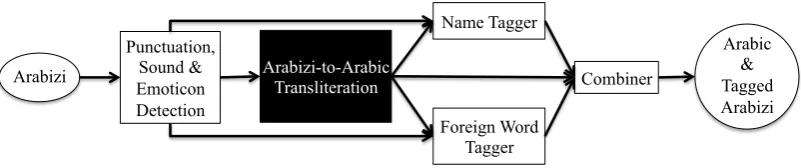
Figure 2 represent the overall architecture of our system. We distinguish below between existing components that we use and novel extensions that we contribute in this paper.
4.1 Existing Arabization System
For the core component of Arabizi-to-Arabic transliteration, we use a previously published sys-tem (Al-Badrashiny et al., 2014), which converts Arabizi into Arabic text following CODA conven-tions (see Section 3). The existing system uses a finite state transducer trained on 8,500 Arabizi-to-Arabic transliteration pairs at the character level to obtain a large number of possible transliterations for the input Arabizi words. The generated list is then filtered using a dialectal Arabic morphologi-cal analyzer. Finally, the best choice for each input word is selected using a language model. We use this component as a black box except that we re-train it using additional re-training data. In Figure 2, this component is represented using a central black box.
4.2 Novel Extension
In this paper, we add Word Type Tagging as a new set of modules. We tag the Arabizi words into five categories as discussed above: Arabic, For-eign, Names, Sounds, and Punctuation. Figure 2 illustrates the full proposed system. First, we pro-cess the Arabizi input to do punctuation and sound tagging, along with emoticon detection. Then we run the transliteration system to produce the cor-responding Arabic transliteration. The Arabizi in-put and Arabic outin-put are then used together to do name tagging and foreign word tagging. The Arabictag is assigned to all untagged words, i.e.,
words not tagged as Foreign, Names, Sounds, or Punctuation. The outputs from all steps are then combined to produce the final Arabic translitera-tion along with the tag.
5 Experimental Setup
5.1 Data Sets
We define the following sets of data:
• Train-S: A small size dataset that is used to train all taggers in all experiments to deter-mine the best performing setup (feature engi-neering).
• Train-L: A larger size dataset that is used to train the best performing setup.
• Dev: The development set that is used to measure the system performance in all exper-iments
• Test: A blind set that is used to test the best system (LDC, 2014a).
The training and development sets are extracted from (LDC, 2014b). Table 1 represents the tags distribution in each dataset. Almost one of every five words is not Arabic text and around one of every 10 words is foreign.
5.2 Arabizi-to-Arabic Transliteration Accuracy
For the Arabizi-to-Arabic transliteration system, we report on using the two training data sets with two modifications. First, we include the 8,500 word pairs from Al-Badrashiny et al. (2014), namely 2,200 Arabizi-to-Arabic script pairs from the training data used by Darwish (2013) (man-ually revised to be CODA-compliant) and about 6,300 pairs of proper names in Arabic and En-glish from the Buckwalter Arabic Morphologi-cal Analyzer (Buckwalter, 2004). (Since these pairs are not tagged, we do not use them to train the taggers.) Second, we exclude all the foreign tagged words from training the transliteration sys-tem since they were not manually corrected.
Arabizi-to-Arabic Transliteration
Arabizi
Punctuation, Sound & Emoticon Detection
Name Tagger
Foreign Word Tagger
Combiner
[image:6.595.98.499.67.151.2]Arabic & Tagged Arabizi
Figure 2: The architecture of our complete Arabizi processing system. The "Punctuation, Sound and Emoticon Detection" component does labeling that is read by the "Name" and "Foreign Word" taggers, While the actual Aribizi-to-Arabic transliteration system is used as a black box.
Data # Words Arabic Foreign Name Sound Punct Emoticon
[image:6.595.75.288.333.393.2]Train-S 21,950 80.5% 12.1% 2.8% 1.7% 1.3% 1.6% Train-L 113,490 82.3% 9.8% 2.4% 1.8% 1.1% 2.6% Dev 5,061 76.3% 16.2% 2.9% 1.8% 1.2% 1.5% Test 31,717 86.1% 6.0% 2.7% 1.6% 0.9% 2.8%
Table 1: Dataset Statistics
Data Translit. Acc.
Al-Badrashiny et al. (2014) 68.6%
Train-S 76.9%
Train-L 79.5%
Table 2: Transliteration accuracy of Arabic words and names when using different training sets and evaluating onDev
bigger training setTrain-L. The overall transliter-ation accuracy of Arabic words and names onTest using the bigger training setTrain-Lis 83.6%. 6 Tagging Punctuation, Emoticons and
Sounds
6.1 Approach
We start the tagging process by detecting three types of closed classes: punctuation, sounds and emoticons. Simple regular expressions perform very well at detecting their occurrence in text. The regular expressions are applied to the Arabizi in-put, word by word, after lower-casing, since both emoticons and sounds could contain either small or capital letters.
Since emoticons can be composed of just con-catenated punctuation marks, their detection is re-quired before punctuation is tagged. Once de-tected, emoticons are replaced by#. Then punctu-ation marks are detected. If anon-emoticonword is only composed of punctuation marks, then it gets tagged as Punct. Sounds are targeted next.
A word gets tagged as Sound if it matches the sound detection expression, after stripping out any attached punctuation marks and/or emoticons.
6.2 Results
Table 6 in Section 9 shows the accuracy, recall, precision and F-score for the classification of the PunctandSoundtags and detection of emoticons. Since emoticons can be part of another word, and in that case do not receive a specific tag (as spec-ified in the annotation guidelines by the LDC), emoticon evaluation is concerned with the num-ber of detected emoticons within an Arabizi word, as opposed to a binary tagging decision. In other words, emoticon identification is counted as cor-rect (“positive”) if the number of detected emoti-cons in a word is correct in the test token. The Punct and Sound tags represent standard binary classification tasks and are evaluated in the usual way.
7 Tagging Names
7.1 Approach
We consider the following set of binary features for learning a model of name tagging. The fea-tures are used either separately or combined using a modeling classifier implemented with decision trees.
• MADAMIRAMADAMIRA is a system for morphological analysis and disambiguation of Arabic (Pasha et al., 2014). We run MADAMIRA on the Arabic output after run-ning the Arabizi-to-Arabic transliteration. If the selected part-of-speech (POS) of a word is proper noun (NOUN_PROP), then the word is tagged asName.
• CALIMACALIMA is a morphological an-alyzer for Egyptian Arabic (Habash et al., 2012b). If the Arabic transliteration of a given Arabizi word has a possible proper noun analysis in CALIMA, then the word is tagged asName.
• Maximum Likelihood Estimate (MLE)An Arabizi word gets assigned theName tag if Nameis the most associated tag for that word in the training set.
• Tharwa Tharwa is a large scale Egyptian Arabic-MSA-English lexicon that includes POS tag information (Diab et al., 2014). If an Arabizi word appears in Tharwa as an En-glish gloss with a proper noun POS, then it is tagged asName.
• Name Language Model We use a list of 280K unique lower-cased English words as-sociated with their probability of appearing capitalized (Habash, 2009). When using this feature, any probability that is not equal to one is rounded to zero.
All the features above are modeled after case-lowering the Arabizi input, and removing speech effects. Any attached punctuation marks and/or emoticons are stripped out. One exception is the capitalization feature, where the case of the first letter of the Arabizi word is preserved. The tech-niques above are then combined together using de-cision trees. In this approach, the words tagged as Nameare given a weight that balances their infre-quent occurrence in the data.
7.2 Results
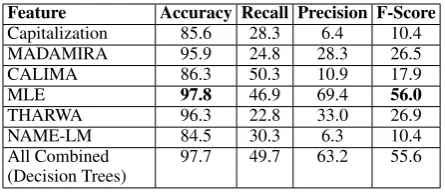
Table 3 shows the performance of theName tag-ging on Dev using Train-S. The best results are obtained when looking up the MLE value in the training data, with an accuracy and F-score of 97.8% and 56.0%, respectively. When using Train-L, the accuracy and F-score given by MLE go up to 98.1% and 63.9%, respectively. See Ta-ble 6. The performance of the combined approach
Feature Accuracy Recall Precision F-Score Capitalization 85.6 28.3 6.4 10.4
MADAMIRA 95.9 24.8 28.3 26.5
CALIMA 86.3 50.3 10.9 17.9
MLE 97.8 46.9 69.4 56.0
THARWA 96.3 22.8 33.0 26.9
NAME-LM 84.5 30.3 6.3 10.4
[image:7.595.306.529.62.158.2]All Combined 97.7 49.7 63.2 55.6 (Decision Trees)
Table 3:Nametagging results onDevwithTrain-S
does not outperform the most effective single clas-sifier, MLE. This is because adding other features decreases the precision by an amount that exceeds the increase in the recall.
8 Tagging Foreign Words
As shown earlier, around 10% of all words in Ara-bizi text are foreign, mostly English in our data set. Tagging foreign words is challenging since there are many words that can be either Arabic (in Ara-bizi) or a word in a foreign languages. For exam-ple the Arabizi wordmeshcan refer to the English reading or the Arabic word
Ó
mš‘not’. There-fore, simple dictionary lookup is not sufficient to determine whether a word is Arabic or Foreign. Our target in this section is to identify the foreign words in the input Arabizi text .8.1 Baseline Experiments
We define a foreignness index formula that gives each word a score given its unigram probabili-ties against Arabic and English language models (LMs).
ε(w) =αPE(w) + (1−α) (1−PA(wt)) (1)
ε(w)is the foreignnessscoreof the Arabizi word w. PE(w) is the unigram probability ofwin the
English LM, and PA(wt) is the unigram
proba-bility in the Arabic LM of the transliteration into Arabic (wt) proposed by our system for the
Ara-bizi wordw.αis a tuning parameter varying from zero to one. From equation 1 we define the mini-mum and maximini-mumεvalues as follows:
εmin=αPEmin+ (1−α) (1−PAmax) εmax=αPEmax+ (1−α) (1−PAmin) (2)
WherePEmin andPEmax are the minimum and
and maximum uni-gram probabilities in the Ara-bic LM. The foreignness indexF oreignness(w)
is the normalized foreignnessscorederived using equations 1 and 2 as follow:
F oreignness(w) =εε(w)−εmin
max−εmin (3)
If the foreignness index of a word is higher than a certain thresholdβ, we consider the word For-eign. We define three baseline experiments as fol-lows:
• FW-index-manual: Use brute force search to find the best α and β that maximize the foreign words tagging onDev.
• FW-index-SVM: Use the bestαfrom above and train an SVM model using the foreign-ness index as sole feature. Then use this model to classify each word inDev.
• LM-lookup: The word is said to beForeign if it exists in the English LM and does not exist in the Arabic LM.
8.2 Machine Learning Experiments
We conducted a suite of experiments by train-ing different machine learntrain-ing techniques ustrain-ing WEKA (Hall et al., 2009) on the following groups of features. We performed a two-stage feature ex-ploration, where we did an exhaustive search over all features in each group in the first phase, and then exhaustively searched over all retained fea-ture groups. In addition, we also performed an ex-haustive search over all features in the first three groups.
• Word n-gram features: Run the input Ara-bizi word through an English LM and the cor-responding Arabic transliteration through an Arabic LM to get the set of features that are defined in "Group1" in Table 4. Then find the best combination of features that maximizes the F-score onDev.
• FW-char-n-gram features: Run the input Arabizi word through a character-level n-gram LM of the Arabizi words that are tagged as foreign in the training data. We get the set of features that are defined in "Group2" in Ta-ble 4. Then find the best feature combination from this group that maximizes the F-score onDev.
• AR-char-n-gram features: Run the input Arabizi word through a character-level n-gram LM of the Arabizi words that are tagged
Group Description
Group1 Uni and bi-grams probabilities from English and Arabic LMs
Group2 1,2,3,4, and 5 characters level n-grams of foreign words
Group3 1,2,3,4, and 5 characters level n-grams of Arabic words
Use the Arabizi word itself as a feature
Group4 Was the input Arabizi word tagged as foreign in the gold training data?
Was the input Arabizi word tagged as Arabic in the gold training data?
Does the input word has speech effects? Group5 Word length
[image:8.595.307.528.61.216.2]Is the Arabizi word capitalized?
Table 4: List of the different features that are used in the foreign word tagging
as non-foreign in the training data. We get the set of features that are defined in "Group3" in Table 4. Then find the best feature that maxi-mizes the F-score onDev.
• Word identity: Use the input Arabizi word to get all features that are defined in "Group4" in Table 4. Then find the best combination of features that maximizes the F-score onDev.
• Word properties: Use the input Arabizi word to get all features that are defined in "Group5" in Table 4. Then find the best com-bination of features that maximizes the F-score onDev.
• Best-of-all-groups: Use the best selected set of features from each of the above experi-ments. Then find the best combination of these features that maximizes the F-score on Dev.
• All-features: Use all features from all groups.
• Probabilistic-features-only: Find the best combination of features from "Group1", "Group2", and "Group3" in Table 4 that max-imizes the F-score onDev.
8.3 Results
Experiment Recall Precision F-Score Classifier Selected Features
LM-lookup 7.6 95.4 14.1
FW-index-manual 75.0 51.0 60.7 α=0.8 ,β= 0.23
FW-index-SVM 4.0 89.0 7.7 SVM
Word n-gram features 76.7 73.2 74.9 AR-unigram, EN-unigram AR-char-n-gram features 55.4 34.8 42.8 AR-char-4-grams FW-char-n-gram features 42.4 52.2 46.8 FW-char-3-grams
Word properties 2.4 28.6 4.5 Has-speech-effect, Word-length, Is-capitalized Word identity 70.3 63.0 66.4 SVM FW-tagged-list
Best-of-all-groups 82.1 76.1 79.0 AR-unigram, EN-unigram, Word-length All-features 69.4 87.7 77.5 All features from all groups
Probabilistic-features-only 84.5 80.6 82.5 AR-unigram, EN-unigram, AR-char-3-grams, FW-char-3-grams
Word n-gram features 82.8 80.5 81.6 AR-unigram, EN-unigram AR-char-n-gram features 80.6 63.2 70.8 AR-char-5-grams FW-char-n-gram features 73.8 76.3 75.0 FW-char-3-grams
Word properties 1.9 25.4 3.6 Has-speech-effect, Word-length Word identity 73.2 60.9 66.5 Decision-Tree FW-tagged-list
Best-of-all-groups 87.0 81.5 84.1 AR-unigram, EN-unigram, AR-char-5-grams, FW-char-3-grams
All-features 92.0 53.4 67.6 All features from all groups
[image:9.595.72.527.59.301.2]Probabilistic-features-only 89.9 84.9 87.3 EN-Unigram, AR-char-2-grams, FW-char-1-grams, FW-char-2-grams, FW-char-5-grams
Table 5: Foreign words tagging results onDevin terms of F-score (%).
9 System Evaluation
9.1 Development and Blind Test Results
We report the results on Dev using Train-L and with the best settings determined in the previous three sections. Table 6 summarizes the recall, pre-cision and F-score results for the classification of thePunct,Sound,Foreign,NameandArabictags, in addition to emoticon detection.
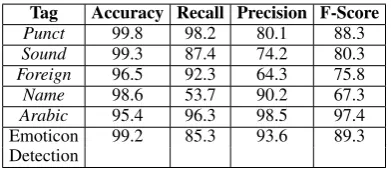
We report our results on Test, our blind test set, using Train-L and with the best settings de-termined in the previous three sections in Table 7. The punctuation, sounds and emoticons have high F-scores but lower than expected. This is likely due to the limitations of the regular expres-sions used. The performance on these tags drops further on the test set. A similar drop is seen for theForeign tag. Nameis the hardest tag overall. But it performs slightly better in test compared to the development set, and so does theArabictag.
Tag Accuracy Recall Precision F-Score
Punct 99.8 100.0 88.7 94.0
Sound 99.4 93.5 78.9 85.6
Foreign 95.8 91.6 84.0 87.6
Name 98.1 57.5 71.8 63.9
Arabic 94.5 95.6 97.3 96.4
Emoticon 100.0 97.5 98.7 98.1
Detection
Table 6: Tagging results onDevusingTrain-L
Tag Accuracy Recall Precision F-Score Punct 99.8 98.2 80.1 88.3 Sound 99.3 87.4 74.2 80.3 Foreign 96.5 92.3 64.3 75.8
Name 98.6 53.7 90.2 67.3
[image:9.595.318.514.341.426.2]Arabic 95.4 96.3 98.5 97.4 Emoticon 99.2 85.3 93.6 89.3 Detection
Table 7: Tagging results onTestusingTrain-L
9.2 Overall System Evaluation
In this subsection we report on evaluating the over-all system accuracy. This includes the correct tag-ging and Arabizi to Arabic transliteration. How-ever, since there is no manually annotated gold transliteration for foreign words, punctuation, or sounds into Arabic, we cannot compare the system transliteration of foreign words to the gold translit-eration. Thus, we define the following metric to judge the overall system accuracy.
Overall System Accuracy Metric A word is said to be correctly transliterated according to the following rules:
1. If the gold tag is anything other thanArabic andName, the produced tag must match the gold tag.
[image:9.595.72.296.635.719.2]Data Baseline Accuracy System Accuracy
Dev 65.7% 82.5%
[image:10.595.70.293.129.205.2]Test 76.8% 83.8%
Table 8: Baseline vs. System Accuracy
Tag NotGold ErrorsOver NotSystem ErrorsOver Typos Tagged generated Tagged generated
Punct 100.0 0.0 0.0 0.0 0.0
Sound 79.3 10.3 10.3 0.0 0.0
Foreign 47.2 1.9 12.3 20.3 18.4
Name 26.3 13.7 45.3 8.4 6.3
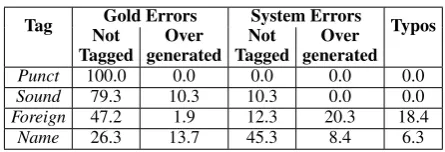
Table 9: Error Analysis of tag classification errors
As a baseline, we use the most frequent tag, which isArabicin our case, along with the translit-eration of the word using our black box system. Then we apply the above evaluation metric on both DevandTest. The results are shown in table 8. The baseline accuracies onDevandTestare 65.7% and 76.8% respectively. By considering the actual out-put of our system, the accuracy on theDevandTest data increases to 82.5% and 83.8% respectively.
9.3 Error Analysis
We conducted an error analysis for tag classifica-tion on the development set. The analysis is done for the tags that we built models for, which are Punct,Sound,ForeignandName.2 Table 9 shows
the different error types for classifying the tags. Tagging errors could be either gold errors or sys-tem errors. These errors could be either due to tag over-generation or because the correct tag is not detected. Additionally, there are typos in the input Arabizi that sometimes prevent the system from assigning the correct tags. Gold errors con-tribute to a large portion of the tagging errors, rep-resenting 100.0%, 89.6%, 49.1% and 40.0% for thePunct,Sound,ForeignandNametags, respec-tively.
10 Conclusion and Future Work
We presented a system for automatic processing of Arabic social media text written in Roman script, or Arabizi. Our system not only transliterates the Arabizi text in the Egyptian Arabic dialect but also classifies input Arabizi tokens as sounds, punc-tuation marks, names, foreign words, or Arabic words, and detects emoticons. We define a new 2As mentioned in Section 4, theArabictag is assigned to
any remaining untagged words after running the classification models.
task-specific metric for evaluating the complete system. Our best setting achieves an overall per-formance accuracy of 83.8% on a blind test set.
In the future, we plan to extend our work to other Arabic dialects and other language contexts such as Judeo-Arabic (Arabic written in Hebrew script with code switching between Arabic and Hebrew). We plan to explore the use of this com-ponent in the context of specific applications such as machine translation from Arabizi Arabic to En-glish, and sentiment analysis in social media. We also plan to make the system public so it can be used by other people working on Arabic NLP tasks related to Arabizi.
Acknowledgement
This paper is based upon work supported by DARPA Contract No. HR0011-12-C-0014. Any opinions, findings and conclusions or recommen-dations expressed in this paper are those of the au-thors and do not necessarily reflect the views of DARPA. Nizar Habash performed most of his con-tribution to this paper while he was at the Center for Computational Learning Systems at Columbia University.
References
Mohamed Al-Badrashiny, Ramy Eskander, Nizar Habash, and Owen Rambow. 2014. Automatic Transliteration of Romanized Dialectal Arabic. In
Proceedings of the Eighteenth Conference on Com-putational Natural Language Learning, pages 30– 38, Ann Arbor, Michigan, June. Association for Computational Linguistics.
Ann Bies, Zhiyi Song, Mohamed Maamouri, Stephen Grimes, Haejoong Lee, Jonathan Wright, Stephanie Strassel, Nizar Habash, Ramy Eskander, and Owen Rabmow. 2014. Transliteration of Arabizi into Ara-bic Orthography: Developing a Parallel Annotated
Arabizi-Arabic Script SMS/Chat Corpus. InArabic
Natural Language Processing Workshop, EMNLP, Doha, Qatar.
Tim Buckwalter. 2004. Buckwalter Arabic Morpho-logical Analyzer Version 2.0. LDC catalog number LDC2004L02, ISBN 1-58563-324-0.
Achraf Chalabi and Hany Gerges. 2012. Romanized
Arabic Transliteration. In Proceedings of the
Sec-ond Workshop on Advances in Text Input Methods (WTIM 2012).
Eleanor Clark and Kenji Araki. 2011. Text normal-ization in social media: Progress, problems and ap-plications for a pre-processing system of casual
en-glish. Procedia - Social and Behavioral Sciences,
Kareem Darwish, Walid Magdy, and Ahmed Mourad. 2012. Language Processing for Arabic Microblog
Retrieval. In Proceedings of the 21st ACM
Inter-national Conference on Information and Knowledge Management, CIKM ’12, pages 2427–2430, New York, NY, USA. ACM.
Kareem Darwish. 2013. Arabizi Detection and Con-version to Arabic. CoRR.
Kareem Darwish. 2014. Arabizi Detection and Con-version to Arabic . InArabic Natural Language Pro-cessing Workshop, EMNLP, Doha, Qatar.
Leon Derczynski, Alan Ritter, Sam Clark, and Kalina Bontcheva. 2013. Twitter part-of-speech tagging for all: Overcoming sparse and noisy data. In
Proceedings of the International Conference Recent Advances in Natural Language Processing RANLP
2013, pages 198–206, Hissar, Bulgaria, September.
INCOMA Ltd. Shoumen, BULGARIA.
Mona Diab, Mohamed Al-Badrashiny, Maryam Aminian, Mohammed Attia, Pradeep Dasigi, Heba Elfardy, Ramy Eskander, Nizar Habash, Abdelati Hawwari, and Wael Salloum. 2014. Tharwa: A Large Scale Dialectal Arabic - Standard Arabic -
En-glish Lexicon. InProceedings of the Language
Re-sources and Evaluation Conference (LREC), Reyk-javik, Iceland.
Heba Elfardy, Mohamed Al-Badrashiny, and Mona Diab. 2013. Code Switch Point Detection in Arabic. InProceedings of the 18th International Conference on Application of Natural Language to Information Systems (NLDB2013), MediaCity, UK, June. Heba Elfardy, Mohamed Al-Badrashiny, and Mona
Diab. 2014. AIDA: Identifying Code Switching
in Informal Arabic Text. In Workshop on
Compu-tational Approaches to Linguistic Code Switching, EMNLP, Doha, Qatar, October.
Ramy Eskander, Nizar Habash, Owen Rambow, and Nadi Tomeh. 2013. Processing Spontaneous
Or-thography. InProceedings of the 2013 Conference
of the North American Chapter of the Association for Computational Linguistics: Human Language Technologies (NAACL-HLT), Atlanta, GA.
Kevin Gimpel, Nathan Schneider, Brendan O’Connor, Dipanjan Das, Daniel Mills, Jacob Eisenstein, Michael Heilman, Dani Yogatama, Jeffrey Flanigan, and Noah A. Smith. 2011. Part-of-speech tagging for twitter: Annotation, features, and experiments. In Proceedings of the 49th Annual Meeting of the Association for Computational Linguistics: Human Language Technologies: Short Papers - Volume 2, HLT ’11, pages 42–47, Stroudsburg, PA, USA. As-sociation for Computational Linguistics.
Stephan Gouws, Donald Metzler, Congxing Cai, and Eduard Hovy. 2011. Contextual bearing on lin-guistic variation in social media. InProceedings of the Workshop on Languages in Social Media, LSM ’11, pages 20–29, Stroudsburg, PA, USA. Associa-tion for ComputaAssocia-tional Linguistics.
Nizar Habash, Abdelhadi Soudi, and Tim Buckwalter. 2007. On Arabic Transliteration. In A. van den
Bosch and A. Soudi, editors, Arabic
Computa-tional Morphology: Knowledge-based and Empiri-cal Methods. Springer.
Nizar Habash, Mona Diab, and Owen Rabmow. 2012a. Conventional Orthography for Dialectal Arabic. In
Proceedings of the Language Resources and Evalu-ation Conference (LREC), Istanbul.
Nizar Habash, Ramy Eskander, and Abdelati Hawwari. 2012b. A Morphological Analyzer for Egyptian Arabic. InProceedings of the Twelfth Meeting of the Special Interest Group on Computational Morphol-ogy and PhonolMorphol-ogy, pages 1–9, Montréal, Canada. Nizar Habash. 2009. REMOOV: A tool for online
han-dling of out-of-vocabulary words in machine trans-lation. In Khalid Choukri and Bente Maegaard, ed-itors,Proceedings of the Second International Con-ference on Arabic Language Resources and Tools. The MEDAR Consortium, April.
Mark Hall, Eibe Frank, Geoffrey Holmes, Bernhard Pfahringer, Peter Reutemann, and Ian H. Witten. 2009. The WEKA data mining software: an update.
SIGKDD Explorations, 11(1):10–18.
LDC. 2014a. BOLT Phase 2 SMS and Chat Ara-bic DevTest Data – Source Annotation,
Translit-eration and Translation. LDC catalog number
LDC2014E28.
LDC. 2014b. BOLT Phase 2 SMS and Chat Ara-bic Training Data – Source Annotation, Translit-eration and Translation R1. LDC catalog number LDC2014E48.
LDC. 2014c. BOLT Program: Romanized Arabic (Arabizi) to Arabic Transliteration and Normaliza-tion Guidelines. Version 3. Linguistic Data Consor-tium.
Marco Lui, Jey Han Lau, and Timothy Baldwin. 2014. Automatic detection and language identification of
multilingual documents. InProceedings of LREC.
Arfath Pasha, Mohamed Al-Badrashiny, Mona Diab, Ahmed El Kholy, Ramy Eskander, Nizar Habash, Manoj Pooleery, Owen Rambow, and Ryan M. Roth. 2014. MADAMIRA: A Fast, Comprehensive Tool for Morphological Analysis and Disambiguation of
Arabic. InProceedings of the Language Resources
and Evaluation Conference (LREC), Reykjavik, Ice-land.
Alan Ritter, Sam Clark, Mausam, and Oren Etzioni. 2011. Named entity recognition in tweets: An
ex-perimental study. InProceedings of the Conference
on Empirical Methods in Natural Language Pro-cessing, EMNLP ’11, pages 1524–1534, Strouds-burg, PA, USA. Association for Computational Lin-guistics.
Piperidis, editors,Proceedings of the Ninth Interna-tional Conference on Language Resources and Eval-uation (LREC’14), Reykjavik, Iceland, may. Euro-pean Language Resources Association (ELRA). Omar F Zaidan and Chris Callison-Burch. 2011. The
Arabic online commentary dataset: an annotated dataset of informal Arabic with high dialectal con-tent. InProceedings of ACL, pages 37–41.
Ines Zribi, Rahma Boujelbane, Abir Masmoudi, Mariem Ellouze, Lamia Belguith, and Nizar Habash. 2014. A Conventional Orthography for Tunisian
Arabic. InProceedings of the Language Resources