BUCC Shared Task: Cross-Language Document Similarity
Serge Sharoff University of Leeds
Leeds, UK
Pierre Zweigenbaum LIMSI, CNRS
Orsay, France
Reinhard Rapp University of Mainz
Mainz, Germany
Abstract
We summarise the organisation and results of the first shared task aimed at detecting the most similar texts in a large multilin-gual collection. The dataset of the shared was based on Wikipedia dumps with inter-language links with further filtering to en-sure comparability of the paired articles. The eleven system runs we received have been evaluated using the TREC evaluation metrics.
1 Task description
Parallel corpora of original texts with their transla-tions provide the basis for multilingual NLP appli-cations since the beginning of the 1990s. Relative scarcity of such resources led to greater attention to comparable (=less parallel) resources to mine information about possible translations. Many studies have been produced within the paradigm of comparable corpora, including publications in the BUCC workshop series since 2008.1
However, the community so far has not con-ducted an evaluation which compared different ap-proaches for identifying more or less parallel doc-uments in a large amount of multilingual data. Also, it is not clear how language-specific such approaches are. In this shared task we propose the first evaluation exercise, which is aimed at detect-ing the most similar texts in a large multildetect-ingual collection.
2 Data set 2.1 Description
The dataset is derived from static Wikipedia dumps of the main articles. A feature of Wikipedia is that it provides so-called inter-language links between many corresponding articles of different
1Seehttp://comparable.limsi.fr/
languages, i.e. between articles describing the same or corresponding headwords. These inter-language links are provided by the authors of the articles, i.e. they are based on expert judgement. For the shared task we selected bilingual pairs of articles which fulfilled the following require-ments:
1. The inter-language links between the articles had to be bidirectional, i.e. not only an article in Language1needs to be linked to the corre-sponding article in Language2, but also vice versa. This ensured a page in one language is not linked only to a portion of a page in another one.
2. The size of the textual content of the two ar-ticles within a pair (i.e. their length measured as the number of characters) had to be similar (see Section 2.2 below).
Note that this selection procedure for the article pairs implies that an article pair selected for one language pair may or may not be selected for an-other language pair. All articles which satisfied the selection conditions have been considered for the evaluation run.
The data for each language pair has been split randomly into two sets:
Training set articles with information about the correct links for the respective language pairs provided to the participants;
Test set articles without the links.
The task is for each article in the test set to sub-mit up to five ranked suggestions to its linked ar-ticle, assuming that the gold standard contains its counterpart in another language. The submissions had to be in the tab-separated format as used in the submissions to the shared tasks of the Text Re-trieval Conference (TREC2) with six fields:
2Seehttp://trec.nist.gov/.
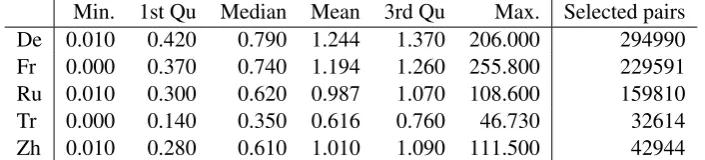
Min. 1st Qu Median Mean 3rd Qu Max. Selected pairs De 0.010 0.420 0.790 1.244 1.370 206.000 294990 Fr 0.000 0.370 0.740 1.194 1.260 255.800 229591 Ru 0.010 0.300 0.620 0.987 1.070 108.600 159810 Tr 0.000 0.140 0.350 0.616 0.760 46.730 32614 Zh 0.010 0.280 0.610 1.010 1.090 111.500 42944
Table 1: Ratios of lengths of aligned articles to English
id1 X id2 Y score run.name The X and Y fields are not used, but they are re-served by the TREC evaluation script (and it does not use them either).id1andid2are the respec-tive article identifiers in a source language and in English. Thescoreshould reflect the similarity be-tween id1 and id2, the higher the closer. The participants were invited to submit up to five runs of their system with different parameters, as iden-tified by a keyword in the last field.
The evaluation script and more information about the format have been made available in ad-vance.3
The languages in the shared task were Chinese, French, German, Russian and Turkish. Pages in these languages needed to be linked to a page in English.
The choice of languages reflects variation in the available clues for linking the pages. The lan-guages vary in:
• their writing systems (Latin, Cyrillic,
logo-graphic);
• tokenisation (clitics in French, compounds in German, no orthographic word boundaries in Chinese);
• their morphology (covering isolating, inflect-ing and agglutinative languages);
Even though the writing system issue is su-perficial, it shifts the clues for linking the arti-cles. Thus, it requires more intelligent mapping between the languages. In the same writing sys-tem, many clues remain the same or nearly iden-tical (Paris, Frankfurt), while in another set they have to adapt to the target language requirements: Париж (‘Paris’, transliterated asParizh in Rus-sian) or巴黎(‘Paris’, pinyinBaliin Chinese).
Morphology accounts for variation of forms for connection with the dictionaries. It is considerably larger in morphologically rich languages, such as
3Seehttp://trec.nist.gov/trec_eval/
Russian or Turkish. Therefore, mapping of word forms is likely to be more sparse.
2.2 Preparation
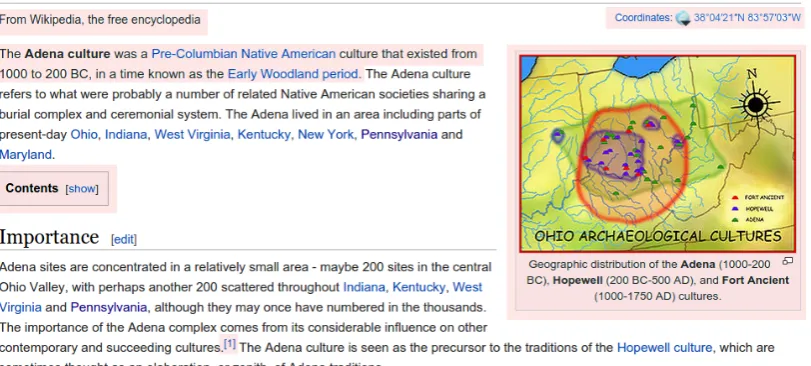
We started with the downloadable Wikipedia dumps,4which were cleaned to their text only con-tents by removing standard formatting codes, fig-ures (with their captions), templates, tables and external links. Given that the first sentence in Wikipedia articles provide a concise summary of the article contents, the first sentence (defined as a sequence of characters to the first full stop) has been also removed to make the task more similar to detection of webpages in context unrelated to Wikipedia. Shaded areas in Figure 1 demonstrate the extent of cleaning.
We selected a subset of articles aligned to En-glish. Table 1 lists the distribution of the length ratios of the respective articles to their English counterparts and the number of articles remaining after pruning their length. A small number of ar-ticles are much shorter than their English coun-terparts. Less frequently this happens in the op-posite direction, and the length ratio is more than one (the median is always less than one). Usu-ally articles which differ in their length are not good candidates for comparable corpora. We took only those within the inter-quartile range. This left us with 50% of article pairs in the original list, which are all reasonably comparable in their con-tents. Examples for each language bordering on the 1st quartile in ratio to English all show reason-able amount of text to be considered as compara-ble entries:
de Aaron Ramsey
fr Adena culture
ru Quantum mechanics
tr Cyrano de Bergerac (play)
zh Blood transfusion
Figure 1: Example of cleanup (shaded areas indicate removed text).
For example, theAdena culturearticle has been selected only for the French-English pair, since the articles in other languages are much shorter than the English one to be considered as reasonably comparable.
3 Evaluation
Evaluation has been done using standard TREC evaluation measures, modeling the task as the re-trieval of a ranked list of links from a source page. Extrinsic evaluation setups, for example, via terminology extraction, would possibly provide more interesting measures, but this would require a baseline system which works with all the lan-guages in question.
3.1 Metrics
For each source page there exists exactly one cor-rect linked page in the gold standard. Systems were required to return a ranked list of hypotheses in which the correct target page should be ranked as high as possible.
Several evaluation measures are relevant to this situation in the trec_eval program used in TREC evaluations. The Success measures cor-respond to commonly used measures when eval-uating term translations in comparable corpora. We use them here to evaluate the proposed inter-language links between the articles. Success@1 determines the proportion of source articles for which the correct target article has been ranked in the top position; Success@5 determines the proportion of source articles for which the
cor-rect target article has been ranked among the top 5 positions. Mean Reciprocal Rank (MRR) is also a relevant measure: If the correct target ar-ticle is ranked at position N, a score of 1/N is given to this source article. Then these scores are averaged over the set of source articles. These measures are respectively obtained by parameters success.1, success.5, and recip_rank intrec_eval.
4 Results
Overall, we have received eleven runs: one entry for Chinese (Table 2), three entries for French (Ta-ble 2), and seven for German (Ta(Ta-ble 3).
4.1 Methods used
The method used by the system CCNUNLPis
de-scribed in (Li and Gaussier, 2013). In essence, it uses a bilingual dictionary for converting the word feature vectors between the languages and estimat-ing their overlap. The other systems are discussed in details in the current proceedings (Morin et al., 2015; Zafarian et al., 2015). The LINA system
(Morin et al., 2015) is based on matching ha-pax legomena, i.e., words occurring only once. In addition to using hapax legomena, the quality of linking in one language pair, e.g., French-English, is also assessed by using information available in pages in another language pair, e.g., German-English. The AUTsystem (Zafarian et al., 2015)
French Chinese runid ccnunlp lina.p lina.cl ccnunlp num_q 114423 114423 78529 21467 num_ret 572115 572111 143542 107335 num_rel 114423 114423 78529 21467 num_rel_ret 87367 42777 47561 18474 MRR 0.669 0.329 0.590 0.769 success@1 0.607 0.300 0.577 0.710 success@5 0.764 0.374 0.606 0.861
Table 2: Evaluation results for French and Chinese. lina.pcorresponds to Pigeonhole,lina.clto Cross-lingual in the authors’ paper.
German
runid lina.p lina.cl aut1 aut2 aut3 aut4 aut5 num_q 147220 92020 147515 147515 147515 147515 147515 num_ret 736100 166051 147516 147516 147516 147516 147516 num_rel 147220 92020 147515 147515 147515 147515 147515 num_rel_ret 52223 58828 6870 2703 2029 1371 890 MRR 0.290 0.622 0.047 0.018 0.014 0.009 0.006 success@1 0.249 0.607 0.047 0.018 0.014 0.009 0.006 success@5 0.355 0.639 0.047 0.018 0.014 0.009 0.006
Table 3: Evaluation results for German
feature transformation matrix. This helps in se-lecting a relatively small subset of pages to detect possible links. Second, document similarity is as-sessed using three pipelines, namely, a polylingual topic model, a named entities detection tool and a word feature mapping procedure using MT.
4.2 Comparison of results
SinceAUTsubmitted exactly one target article for
each source article, its MRR, success@1 and suc-cess@5 measures are identical.
For each run, success@1 is the strictest mea-sure, hence provides the lowest score, because it can only obtain points if the top ranked article is the correct one. Mean reciprocal rank (MRR) yields the same score when the top ranked ar-ticle is correct, but also scores decreasing frac-tions of one when the correct article is found any-where in the ranking: this results in a higher av-erage score than success@1. Finally, success@5 also takes into account articles beyond the first, but only until the fifth; if the correct article is present in this range, the full score of one is as-signed to the article; otherwise no point is ob-tained. Therefore a system which generally ranks correct articles beyond the fifth position will have a lower success@5 than its MRR; but a system
which ranks correct articles before the sixth posi-tion often enough will have a higher success@5 than MRR. This is the case of all systems ex-cept aut, which only returned one target article per source article.
The tables show that the rankings obtained by the three measures, MRR, success@1 and suc-cess@5 are the same in all cases, i.e., rank cor-relation of the results is always 1. This suggests that system results ranked the correct article in the top 5 often enough.
4.3 Comparison of methods
The best results were obtained on Chinese with a succes@1 of 0.710 and a success@5 of 0.861. This is a very good performance, but also reveals that the problem is not solved.
Although the number of different runs is not sufficient to draw general conclusions, we can compare the same methods across different guage pairs and different methods on the same lan-guage pairs.
CCNUNLP obtained better results on Chinese
than on French, probably because of the quality of the underlying dictionaries. LINA.CLworked
[image:4.595.113.489.232.356.2]transpired that the submissions ofAUThad a data
processing bug.
Overall, theCCNUNLPmethod obtained the best
results on Chinese and French, followed by the
LINA.CLmethod (second best on French, and best
on German).
4.4 Discussion
The results are encouraging. Success@1 rates reach 0.71 for Chinese and 0.61 for French and German. However, this level of accuracy is still far from reliable identification of comparable pages. Given a small number of participating systems and an uneven coverage of the language pairs involved it is difficult to make predictions about which methods are more or less successful. A dictionary-based method (CCNUNLP) is slightly ahead of a
method based on hapax legomena (LINA.*). A
multi-stage method like the one used by AUT is
promising, but its complexity makes it prone to er-rors.
Another question concerns the evaluation sce-nario. The shared task has been evaluated by using gold standard data in intrinsic evaluation. Given that the purpose of collecting comparable corpora is to provide more data for terminology extraction or Machine Translation, we need to evaluate text collections by referring to their successful use in such tasks. The limitation in using extrinsic eval-uation is the lack of gold-standard methods and resources.
In the next shared task we plan to address this issue by specifically targeting either terminology extraction or MT development methods by using comparable corpora. This shared task will use the resources we developed for the current one.
4.5 Conclusions
In addition to obtaining an estimate of the qual-ity of various methods for measuring comparabil-ity, the major outcomes of the evaluation exercise concerns the available standardised dataset which is split into the training and testing parts. We en-courage our readers to develop better systems and to test them on our data. The dataset is available from:
http://corpus.leeds.ac.uk/serge/BUCC/
We intend to keep the data on the web for many years as a benchmark for measuring comparability on the text level.
References
Li, B. and Gaussier, E. (2013). Exploiting compara-ble corpora for lexicon extraction: Measuring and improving corpus quality. In Sharoff, S., Rapp, R., Zweigenbaum, P., and Fung, P., editors, Building and Using Comparable Corpora, pages 131–149. Springer-Verlag.
Morin, E., Hazem, A., Boudin, F., and Loginova-Clouet, E. (2015). Lina: Identifying comparable documents from wikipedia. In Proc. Workshop on Building and Using Comparable Corpora at ACL 2015.