An combined sentiment classification system for SIGHAN-8
Qiuchi Li1, Qiyu Zhi2and Miao Li11Multimedia Signal and Intelligent Information Processing Lab,
Department of Electronic Engineering, Tsinghua University, Beijing, P.R.China 2School of Information and Communication Engineering,
Beijing University of Posts and Telecommunications, Beijing, P.R.China
[email protected], [email protected], [email protected]
Abstract
This paper describes our system (MSI-IP THU) used for Topic-Based Chinese Message Polarity Classification Task in SIGHAN-8. In our system, a lexicon-based classifier and a statistical machine learning-based classifier are built up, fol-lowed by a linear combination of these t-wo models. The overall performance of the proposed framework ranks in the mid-dle of all terms participating in the task. 1 Introduction
Sentiment analysis is becoming an alluring task in natural language processing(NLP). Since an in-creasing amount of data is available on the World Wide Web, sentiment analysis is playing an im-portant role in lots of real-world applications. In particular, sentiment analysis on microblogs is e-specially essential as microblog becomes one of the most fashionable ways for people to commu-nicate with each other, express opinions and ac-quire newest information. However, with limited length, sentiment analysis on microblog remains a challenging task.
In this paper, we focus on sentiment classifi-cation for Chinese microblog, i.e. Weibo. The research on Weibo sentiment starts later and pro-duces higher challenges due to the complexity in Chinese language. On one hand, different from alphabetic languages such as English, word seg-mentation is needed and is more difficult for Chi-nese sentences. On the other hand, polysemy in Chinese is abundant.
As for existing works in the area of Weibo sen-timent analysis, some methods are proposed on the lexicon basis. (Taboada et al., 2011) proposed Semantic Orientation CALculator (SO-CAL) us-ing dictionaries of words annotated with their se-mantic orientation, (Baccianella et al., 2010) pre-sented SENTIWORDNET 3.0, a lexical resource
explicitly devised for supporting sentiment classi-fication and opinion mining applications. Other researchers focus on machine learning approach-es. (Mullen and Collier, 2004) introduced an ap-proach to sentiment analysis which used support vector machines (SVMs) to bring together diverse sources of potentially pertinent information. The same framework is adopted in (Mohammd et al., 2013), where systematic experiments on a great variety of features were conducted, leading to the best-performed results in SEMEVAL-2013 Twit-ter Sentiment Classification competition. In this task, we combine these two typical methods to build our system.
The rest of this paper is organized as follows. Section 2 describes the topic-based sentiment clas-sification task and its dataset. Section 3 introduces our preprocess procedure for Weibo. Section 4 and Section 5 respectively shows the lexicon-based model and the statistical model used in this task. Section 6 describes the combination method and the experimental results. Finally we conclude this paper in Section 7.
2 Task Description
The paper is targeted on the Topic-Based Chinese Message Polarity Classification. Given a message from Chinese Weibo Platform and a topic, one needs to classify whether the message is of pos-itive, negative, or neutral sentiment towards the given topic. Each participant is required to submit two results based on the restricted resource and unrestricted resource respectively. The restrict-ed resource includes restrictrestrict-ed lexicon and corpus, which have been released together with the test da-ta.
The given training corpus has around 5,000 Chi-nese Weibos from 5 different topics. After du-plicate removal we obtain 4619 Weibos. The 3-class annotation of all Weibos are given in another file. Moreover, we collected 43789 Weibos from
NLPCC 2012,2013 and 2014 evaluation. These Weibos have no topic labels, but are annotated with 3-class labels. We use the collection as ex-tra resource for the unrestricted resource task. The test data involves 19489 Weibos from 20 topic-s. These topics are different from the ones in the training corpus. The task is to annotate each Wei-bo in the test data.
The key measures for evaluation are overall ac-curacies and F-parameters for positive label and negative label. The mathematical formulations for these measures are omitted here because they are the most commonly used ones in sentiment analy-sis evaluations.
3 Preprocess Procedure
Although having a 140-character limitation, most Weibo has some unexpected characters, which poses an obstacle for us to extract features from the corpus and segment the sentence. Hence, pre-processing the Weibo data is a necessary step in sentiment analysis.
With regard to the corpus of this task, we first eliminate all the rare characters, then we extrac-t all extrac-the puncextrac-tuaextrac-tion, URLs and Weibo funcextrac-tion- function-al symbols such as “@” and “#”. Finfunction-ally we use NLPIR (Zhang et al., 2003) to segment the Weibo sentence.
4 Lexicon-based Approaches
Here we present our Lexicon-Based sentimen-t analysis approach. Sensentimen-timensentimen-t lexicon is a simple, direct and efficient method to analyze sentiment by statistical method. In this section, the lexicon is firstly introduced, and then the algorithms for restricted and unrestricted lexicon are presented.
4.1 Basic Sentiment Lexicon
[image:2.595.336.497.70.124.2]There are lots of lexicons that can be used for our task, such as Hownet Sentiment Dictionary (Dong, 2000), National Taiwan University Sentiment Dic-tionary (NTUSD) (Ku and Chen, 2007) and Chi-nese Emotion Word Ontology (CEWO) (Yan et al., 2008). Since Hownet labels every word with dif-ferent emotion intensity, such as 3,5,7,9, and CE-WO covers words with too many different cate-gories, We choose NTUSD as our base sentiment lexicon. The composition of this sentiment lexi-con is shown in Table 1.
Table 1: NTUSD Sentiment Lexicon Polarity Number
1 2810
-1 8276
4.2 Weibo Emoticon Lexicon
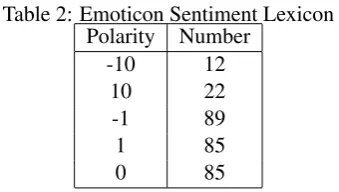
Emoticon is proved to be important for Weibo sentiment classification task. Since sarcasm is common in Weibo expressions, a sentiment word may express the opposite emotion in sarcasm case, while the emoticons often reflect the real senti-ment of the writer. We build a Weibo emoticon lexicon for unrestricted resources task. We first extract all of the emoticons in training corpus, and then incorporate common emoticons from Weibo platform, including all emoticons in the first three emoticon pages. We manually label every emoti-con in our lexiemoti-con with 10,−10,1,−1,0. ±10
represents the sentiment intensity for an emoti-con strong enough to affect the sentiment of the whole sentence, while ±1 refers to an emoticon with clear sentiment but not enough to decide the sentence sentiment. 0represent emoticon without any emotional tendency. The composition of this emoticon lexicon is shown in Table 2.
Table 2: Emoticon Sentiment Lexicon Polarity Number
-10 12
10 22
-1 89
1 85
0 85
4.3 The Lexicon-based classifier
Like many Lexicon-based methods, we simply calculate the score of a Weibo sentence by adding up the scores of each sentiment words appeared in the sentence. For restricted resource task, only N-TUSD Lexicon is used. Our Emoticon Lexicon is added to the Lexicon in unrestricted resource task.
5 Machine Learning-Based Approaches
[image:2.595.332.502.452.548.2]5.1 Features
5.1.1 Linguistic Features
In this part, different linguistic features are sidered. For the choice of n-gram, we only con-sider n=1 (refer to as unigram) and n=2 (refer to as bigram) due to the limited size of training cor-pus. For other linguistic features, we also extrac-t characextrac-ter-bigram and TFIDF feaextrac-tures from extrac-the training dataset. In section 5.2 we will discuss ways to select these features.
5.1.2 Weibo-Based Features
Apart from linguistic features, we also extract a series of Weibo-based features shown as follows:
• Textlength. It is believed that long Weibos tend to contain more sentiment terms, and thus are more likely to be non-neutral in sen-timent.
• Hashtag. We consider Hashtags (“#”) be-cause they usually include topic information for a Weibo. The number of Hashtags are ex-tracted in our experiment.
• Punctuation. We assume that punctuation is relevant to Weibo sentiment. We extract the number of four commonly used punctuation as features: period(“。”), comma(“,”),
ex-clamation (“!”) and question (“?”).
• Emoticon. Based on the pre-constructed dic-tionary, we extract the number of positive and negative emoticons respectively for a Weibo, forming a 2-dimension feature vector.
• POS. It is spontaneous that a Weibo’s senti-ment can be reflected in the Part-Of-Speech (POS) features. In this paper the number of nouns, adjectives, verbs and adverbs are ex-tracted, forming a 4-dimension feature vec-tor.
• URL. The contents in the url link may be rel-evant to the content of the Weibo and the sen-timent polarity. The number of URLs is ex-tracted in our model.
[image:3.595.307.527.70.259.2]• ATSign. ATSigns (”@”) associate a Weibo with other people, and prior knowledge of those people may affect the Weibo sentimen-t. The number of ATSigns is extracted in our model.
Table 3: results for feature selection
features neuF posF negF
all 0.6096 0.1975 0.3194
-Unigram 0.6091 0.1941 0.3258
-Bigram 0.6444 0.2083 0.3296
-Character-Bigram 0.7099 0.2210 0.3410
-TFIDF 0.6313 0.2105 0.3358
-textLength 0.5969 0.1905 0.3459
-# 0.6096 0.1979 0.3182
-punctuation 0.6159 0.1949 0.3282
-Emoticon 0.6134 0.1987 0.3194
-POS 0.5482 0.178 0.3346
-URL 0.5987 0.1934 0.3194
-@ 0.5995 0.1837 0.3580
5.2 Feature Selection
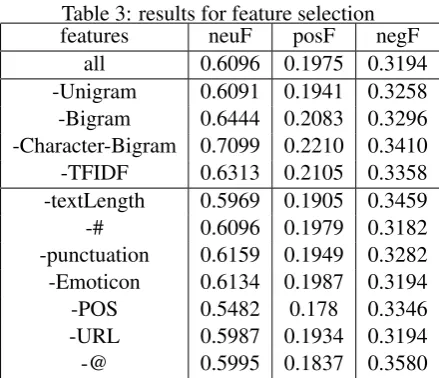
The feature selection method is inspired by (Mo-hammd et al., 2013). For a detailed description, we first experiment on all aforementioned fea-tures, and then in turn kick out every feature and repeat the experiment. To make a fair compari-son, in each experiment a five-fold cross valida-tion method is proposed on the training set, and we average the F-parameters for negative, neutral and positive labels over the five sub-experiments to measure the performance of the feature combi-nation. For the SVM training setup, we use linear kernel and default parameter. The results for the feature selection experiments are shown in Table 3.
From Table 3, the elimination of Bigram, Character-Bigram and TFIDF bring about in-creased performance, the elimination of POS leads to decreased performance, while the elimination of other features does not influence much of the per-formance. Therefore, we choose Unigram as the only linguistic feature, and remain all the Weibo-based features.
6 Model-Fusion Framework
Our final system is set up by merging the two mod-els discussed in Chapter 4 and 5 respectively. The merging method is shown as follows. For a Weibo w, we have
decisionV alue(w) =λCdic(w) + (1−λ)Csvm(w) (1)
decision valuedecisionV alue(w)is a real-valued number in [-1,1], based on which we obtain the final sentiment polarity as the output of our model-fusion framework:
sentiment(w) =
1 decisionV alue(w)>=0.5
0 |decisionV alue(w)|<0.5 −1 decisionV alue(w)<=-0.5 7 Experiments
7.1 Experimental Setup
The model-fusion framework is adopted on both restricted and unrestricted requirements, but the parameter choices are slightly different for these two cases.
For restricted results, the parameter λis set to be 1, which means only lexicon-based system is adopted. Since only two different results can be submitted, we submit the results by considering I) main body of the Weibo only and II)main body and forward chains.
For unrestricted results, we combine the pro-vided training corpus with extra training dataset to train the SVM classifier for machine learning-based system. For lexicon-learning-based system, the main body only is considered, but the emoticon lexicon is incorporated. The two results were generated by setting the fusion parameterλas 1(lexicon-based only) and 0.5 respectively.
7.2 Results and Discussions
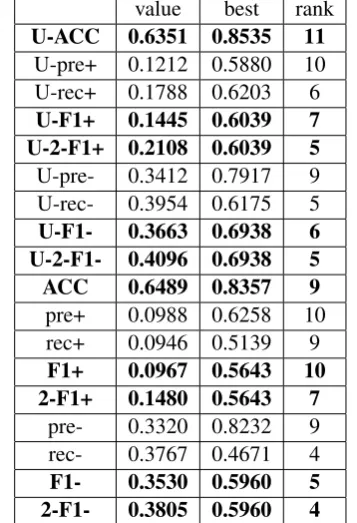
For each subtask (restricted and unrestricted), the better performed system is automatically chosen from the two submitted results, and performance and rank are returned. The results for our system is shown in table 4.
[image:4.595.326.505.97.359.2]The results show that our system generally ranks in the middle of the 13 teams who partic-ipated in the evaluation, which proves the effec-tiveness of our system. Since our system is target-ed on improving F-values, and most Weibos are of neutral sentiment for both training and testing cor-pus, more non-neutral labels will be generated but with low accuracy. Therefore, our system is un-satisfactory in overall accuracy and precision, but rather competitive in terms of recall and F-values. It is further revealed that the other system has consistently higher F-values than the accepted sys-tem for both tasks. This means that the abandoned system generates more non-neutral polarities, re-sulting in higher F-values for both positive and
Table 4: Performance and ranks of our system in evaluation.
value best rank
U-ACC 0.6351 0.8535 11
U-pre+ 0.1212 0.5880 10
U-rec+ 0.1788 0.6203 6
U-F1+ 0.1445 0.6039 7 U-2-F1+ 0.2108 0.6039 5
U-pre- 0.3412 0.7917 9
U-rec- 0.3954 0.6175 5
U-F1- 0.3663 0.6938 6 U-2-F1- 0.4096 0.6938 5 ACC 0.6489 0.8357 9
pre+ 0.0988 0.6258 10
rec+ 0.0946 0.5139 9
F1+ 0.0967 0.5643 10 2-F1+ 0.1480 0.5643 7
pre- 0.3320 0.8232 9
rec- 0.3767 0.4671 4
F1- 0.3530 0.5960 5 2-F1- 0.3805 0.5960 4
Note: Words that start with ‘”U-” stand for unrestricted situation. Words that end with ”+” and ”-” stand for results on positive and negative polarities. Words that contains ”2” refer to the other submitted system. The highlighted values
correspond to key measures in the evaluation.
negative class, but the overall accuracy is also low-er than the recorded system, so it is neglected au-tomatically by the evaluation system.
Nevertheless, the system still needs further im-provements. The topic information is not consid-ered, which is a major drawback for our system. The author believes that it will probably be an im-provement to discover the topic-specific knowl-edge using some unsupervised methods prior to the whole system. These knowledge can not only be somehow incorporated into the lexicon-based approach, but be treated as extra features for the machine learning-based system.
8 Conclusion
References
Stefano Baccianella, Andrea Esuli, and Fabrizio Sebas-tiani. 2010. Sentiwordnet 3.0: An enhanced lexical resource for sentiment analysis and opinion mining. InLREC, volume 10, pages 2200–2204.
Corinna Cortes and Vladimir Vapnik. 1995. Support-vector networks. Machine Learning, 20:273–297. Zhengdong Dong. 2000. Introduction to hownet.
http://www.keenage.com.
Lun-Wei Ku and Hsin-Hsi Chen. 2007. Mining opinions from the web: Beyond relevance retrieval. Journal of the American Society for Information Sci-ence and Technology, 58(12):1838–1850.
Saif M Mohammd, Svetlana Kirichenko, and Xiaodan Zhu. 2013. NRC-Canada: Building the State-of-the-Art in Sentiment Analysis of Tweets. Second Joint Conference on Lexical and Computational Se-mantics, 2:321–327.
Tony Mullen and Nigel Collier. 2004. Sentiment anal-ysis using support vector machines with diverse in-formation sources. In EMNLP, volume 4, pages 412–418.
Maite Taboada, Julian Brooke, Milan Tofiloski, Kim-berly Voll, and Manfred Stede. 2011. Lexicon-based methods for sentiment analysis. Computa-tional linguistics, 37(2):267–307.
Jiajun Yan, David B Bracewell, Fuji Ren, and Shin-go Kuroiwa. 2008. The creation of a chinese emo-tion ontology based on hownet.Engineering Letter-s, 16(1):166–171.