Tuning Phrase-Based Segmented Translation for a
Morphologically Complex Target Language
Stig-Arne Grönroos
Department of Signal Processing and Acoustics Aalto University, Finland
Sami Virpioja
Department of Computer Science Aalto University, Finland
Mikko Kurimo
Department of Signal Processing and Acoustics Aalto University, Finland
Abstract
This article describes the Aalto Uni-versity entry to the English-to-Finnish shared translation task in WMT 2015. The system participates in the con-strained condition, but in addition we impose some further constraints, using no language-specific resources beyond those provided in the task. We use a morphological segmenter, Morfessor FlatCat, but train and tune it in an un-supervised manner. The system could thus be used for another language pair with a morphologically complex tar-get language, without needing modifi-cation or additional resources.
1 Introduction
In isolating languages, such as English, suit-able smallest units of translation are easy to find using whitespace and punctuation char-acters as delimiters. This approach of us-ing words as the smallest unit of transla-tion is problematic for synthetic languages with rich inflection, derivation or compound-ing. Such languages have very large vocabu-laries, leading to sparse statistics and many out-of-vocabulary words.
A synthetic language uses fewer words than an isolating language to express the same sentence, by combining several grammatical markers into each word and using compound words. This difference in granularity is prob-lematic in alignment, when a word in the iso-lating language properly aligns with only a part of a word in the synthetic language.
In order to balance the number of tokens between target and source, it is often
possi-ble to segment the morphologically richer side. Oversegmentation is detrimental, however, as longer windows of history need to be used, and useful phrases become more difficult to extract. It is therefore important to find a balance in the amount of segmentation. A linguistically accurate segmentation may be oversegmented for the task of translation, if some of the distinctions are either unmarked or marked in a similar way in the other lan-guage.
An increase in the number of tokens means that the distance spanned by dependencies becomes longer. Recurrent Neural Network (RNN) based language models have been shown to perform well for English (Mikolov et al., 2011). Their strength lies in being the-oretically capable of modeling arbitrarily long dependencies.
Moreover, a huge vocabulary is particularly detrimental for neural language models due to their computationally heavy training and need to marginalize over the whole vocabulary dur-ing prediction. As morphological segmenta-tion can reduce the vocabulary size consider-ably, using RNN language models seems even more suitable for this approach.
Our system is designed for translation in the direction from a morphologically less complex to a more complex language. The opposite direction – simplifying morphology – has re-ceived more attention, especially with English as the target language.
Of the target languages in this year’s task, Finnish is the most difficult to translate into, shown by Koehn (2005) and reconfirmed by the evaluations of this shared task. Even though the use of supervised linguistic tools
(such as taggers, parsers, or morphological an-alyzers) was allowed in the constrained con-dition, our method does not use them. It is therefore applicable to other morphologically complex target languages.
1.1 Related work
The idea of transforming morphology to im-prove statistical machine translation (SMT) is well established in the literature. An early ex-ample is Nießen and Ney (2004), who apply rule-based morphological analysis to enhance German→English translation.
In particular, many efforts have focused on increasing the symmetry between languages in order to improve alignment. Lee (2004) uses this idea for Arabic→English translation. In this translation direction, symmetry is in-creased through morphological simplification. It has been shown that a linguistically cor-rect segmentation does not coincide with the optimal segmentation for purposes of align-ment, both using rule-based simplification of linguistic analysis (Habash and Sadat, 2006), and through the use of statistical methods (Chung and Gildea, 2009).
Using segmented translation with unsuper-vised statistical segmentation methods has yielded mixed results. Virpioja et al. (2007) used Morfessor Categories-MAP in transla-tion between three Nordic languages, in-cluding Finnish, while Fishel and Kirik (2010) used Morfessor Categories-MAP in English↔Estonian translation. In these stud-ies, segmentation has in many cases worsened BLEU compared to word-based translation. The main benefit of segmentation has been a decrease in the ratio of untranslated words.
Salameh et al. (2015) translate
English→Arabic, and find that
segmen-tation is most useful when the extracted phrases are morphologically productive, and that using a word-level language model reduces this productivity (albeit increasing the BLEU score).
The desegmentation process, and the ef-fect of different strategies for marking the word-internal token boundaries, have mostly been examined in recombining split compound words. Stymne and Cancedda (2011) explore different marking strategies, including use of part-of-speech tags, in order to allow the
trans-lation system to produce compounds unseen in the training data.
2 System overview
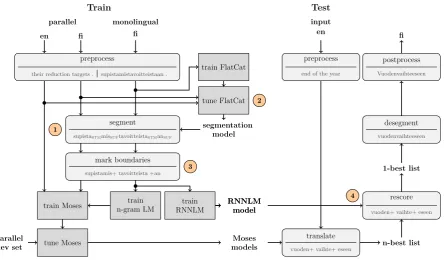
An overview of the system is shown in Fig-ure 1. The four main contributions of this work are indicated by numbered circles:
1. Use of unsupervised Morfessor FlatCat (Grönroos et al., 2014) for morphological segmentation,
2. Tuning the morphological segmentation directly to balance the number of trans-lation tokens between source and target,
3. A new marking strategy for morph boundaries,
4. Rescoring n-best lists with RNNLM (Mikolov et al., 2010).
Our system extends an existing phrase-based SMT system to perform segmented translation, by adding pre-processing and post-processing steps, with no changes to the decoder. As translation system to be ex-tended, we used the Moses release 3.0 (Koehn et al., 2007). We used GIZA++ alignment, and a 5-gram LM with modified-KN smooth-ing. Many Moses settings were left at their default values: phrase length 10, grow-diag-final-and alignment symmetrization, msd-bidirectional-fe reordering, and distortion limit 6.
The standard pre-processing steps not spec-ified in Figure 1 consist of normalization of punctuation, tokenization, and statistical truecasing. All three of these were performed with the tools included in Moses.
In addition, the parallel data was cleaned and duplicate sentences were removed. Clean-ing was performed after morphological seg-mentation, as the segmentation can increase the length in tokens of a sentence.
The post-processing steps are the reverse of the pre-processing steps: desegmentation, detruecasing, and detokenization. Rescor-ing of the n-best list was done before post-processing.
.. parallel. en . fi . monolingual . fi . Train . . preprocess .
their reduction targets .
. supistamistavoitteistaan . . train FlatCat . tune FlatCat . segmentation model . . segment .
supistaSTMmisSUFtavoitteistaSTManSUF
.
.
mark boundaries
.
supistamis+ tavoitteista +an
. train n-gram LM . train RNNLM . RNNLM model . train Moses . tune Moses . parallel dev set . Moses models . RNNLM model . Test . input . en . . preprocess .
end of the year
.
.
translate
.
vuoden+ vaihte+ eseen
. n-best list . . rescore .
vuoden+ vaihte+ eseen
[image:3.595.84.529.61.324.2]. . desegment . vuodenvaihteeseen . 1-best list . . postprocess . Vuodenvaihteeseen . fi . 1 . 2 . 3 . 4
Figure 1: A pipeline overview of training and testing of the system. Main contributions are hilighted with numbers 1-4.
against a tuning set as the metric. 20 random restarts per MERT iteration were used, with iterations repeated until convergence.
A similar MERT procedure was also used for choosing the interpolation weights for rescor-ing, with 100 random restarts in a single iter-ation. A single-iteration approach was chosen, as there was no need to translate a new n-best list during the MERT for rescoring.
2.1 Morphological segmentation
For morphological segmentation, we use the latest Morfessor variant, FlatCat (Grönroos et al., 2014). Morfessor FlatCat is a proba-bilistic method for learning morphological seg-mentations, using a prior over morph lexicons inspired by the Minimum Description Length principle (Rissanen, 1989).
Morfessor FlatCat applies a Hidden Markov
model for morphotactics. Compared to
Morfessor Baseline, it provides morph cat-egory tags (stem, prefix, suffix) and has superior consistency especially in compound word splitting. In contrast to Categories-MAP (Creutz and Lagus, 2005), used for sta-tistical machine translation e.g. by Clifton and Sarkar (2011), it supports semi-supervised
learning and hyper-parameter tuning.
No annotated data was used in the training of Morfessor FlatCat, neither in training nor parameter tuning. Instead of aiming for a lin-guistic morphological segmentation, our goal was to balance the number of translation to-kens between source and target languages.
In order to bring the number of tokens on the Finnish target side closer to the En-glish source side, we segmented the Finnish text with an unsupervised Morfessor FlatCat model, tuned specifically to achieve this bal-ance. The corpus weight hyper-parameter α was chosen by minimizing the sentence-level difference in token counts between the English and the segmented Finnish sides of the parallel corpus
α=arg min α
∑
(e,f)∈(E,F)
#(e)−#(M(f;α)),
(1)
where # gives the number of tokens in the sen-tence, andM(f;α)is the segmentation with a particularα.
unseg-mented, but translated by Moses without any special handling.
2.2 Morph boundary marking strategy
In the desegmentation step, consecutive to-kens are concatenated either with or with-out an intermediary space. Morph boundaries must be distinguished from word boundaries, so that the desegmentation step can recon-struct the words correctly. There are various ways to mark the boundaries, some of them shown in Table 1.
A common way is to attach a symbol to all morphs on the right (or left) side of the morph boundary. We call this strategyright-only.
Alternativelyboth-sidesof the boundary can be marked. In this strategy, a decision must be made whether to be aggressive or conserva-tive in joining morphs, if the translation sys-tem outputs an incorrect sequence where the markers do not match up on both sides. For these experiments we chose the conservative approach, removing the unmatched marker from a half-marked boundary, and treating it as a word boundary.
A downside of the right-onlyand both-sides strategies is that a stem is marked differently depending on whether it has a prefix attached or not, even if the surface form of the stem does not change.
The morph categories produced by FlatCat can be used for marking boundaries according to the structure of the word. We can mark affixes from the side that points towards the stem, leaving stems unmarked regardless of the presence of affixes. However, this would leave the boundaries between compound parts indistinguishable from word boundaries, mak-ing some additional markmak-ing necessary.
Marking affixes by category and compound boundaries with a special linking token is called the compound-symbol strategy. Instead marking the last morpheme in the compound modifiers (non-final compound parts), results in thecompound-left strategy.
After initial unimpressive results with the compound marking strategies, we concluded that segmenting the compound modifiers does not lead to productive translation phrases, in contrast to boundaries between compound parts and boundaries separating inflective af-fixes. In response, we formulated theadvanced
Strategy Example
Surface form supistamistavoitteistaan
Segmentation supistaSTMmisSUFtavoitteistaSTManSUF
Translation of their reduction targets
right-only supista +mis +tavoitteista +an
both-sides supista+ +mis+ +tavoitteista+ +an
compound-sym supista +mis +@+ tavoitteista +an
compound-left supista +mis@ tavoitteista +an
advanced supistamis+ tavoitteista +an
Table 1: Morph boundary marking strategies.
marking strategy, which goes beyond bound-ary marking to modify the segmentation, by rejoining the morphs in the modifier parts of compounds.
The sequence of morph categories is used for grouping the morphs into compound parts. A word consists of one or more compound parts. Each compound part consists of exactly one stem, and any number of preceding prefixes and following suffixes.
CompoundPart=Pre∗ Stm Suf∗
Word=CompoundPart+ (2)
For all compound parts except the last one, the affixes are rejoined to their stem. Morphs of length 5 or above were treated as stems, regardless of the category assigned to them by FlatCat.
Prefixes and compound modifiers are
marked with a trailing ’+’, suffixes are marked with a leading ’+’, and the stems of the word-final compound parts are left unmarked.
2.3 Rescoring n-best lists
Segmentation of the word forms increases the distances spanned by dependencies that should be modeled by the language model. To compensate this, we apply a strong recurrent neural network language model (RNNLM) (Mikolov et al., 2010). The additional lan-guage model is used in a separate rescoring step, to speed up translation, and for ease of implementation.
Monolingual data Parallel data
Purpose news2014 v2 europarl v8 wikititles newsdev2015 test2006
Training Morfessor fi fi fi
Training LMs fi fi fi
Training Moses en – fi en – fi
Tuning Morfessor en – fi
Tuning RNNLM fi
Tuning Moses en – fi
Development testing en – fi
[image:5.595.65.527.63.231.2]Sentences 1378582 1926114 153728 1500 2000
Table 2: The data sets used for different purposes. “en–fi” signifies that parallel data was used, “fi” signifies monolingual data, or using only the Finnish side of parallel data.
order 4, backpropagation through 5 time steps, with blocksize 25.
At translation time, 1000-best lists of morph segmented hypotheses produced by Moses were scored using the RNNLM.
The Moses features were extended by in-cluding the RNNLM score as an additional fea-ture. A new linear combination of the features was optimized with MERT, and used for the final hypothesis ranking. For the BLEU mea-surement in MERT the segmented hypothe-sis was post-processed (including desegmenta-tion) and compared to an un-preprocessed ref-erence.
3 Data
The data sets used in training and tuning are shown in Table 2. Both europarl v8 and wik-ititles were used as parallel training data, but only europarl was used for tuning the hyper-parameterα, as the titles do not follow a typ-ical sentence structure.
The Finnish side of the parallel sets was used to extend the monolingual training data. The monolingual data were concatenated for LM training, instead of interpolating different n-gram models.
After cleaning, the combined parallel train-ing data contained 2,004,450 sentences. The parallel set used for testing during develop-ment is test2006, a europarl subset of 2000 sentences sampled from three last months of 2000.1
1http://matrix.statmt.org/test_sets/list
dev-test test
test2006 newstest2015
Configuration BLEU BLEU
advanced,α= 0.7 .147 .112
+rescoring .147 .116
advanced,α= 0.4 .145 .112
both-sides .141 .114
compound-left .140 .113
compound-sym .139 .111
right-only .139 .111
(word) .146 .100
Table 3: Results of evaluation.
4 Results
Table 3 shows cased BLEU scores on the in-domain development set and out-of-in-domain test set, for various configurations. The en-try markedword is a baseline system without segmentation.
When evaluating on the in-domain develop-ment set, most configurations that use seg-mentation achieve worse BLEU compared to the word baseline. Only the best configura-tions, using theadvanced strategy, are able to achieve slightly higher BLEU.
[image:5.595.307.522.285.446.2]the out-of-domain test corpus.
The proportion of word tokens that were segmented into at least two parts was 19.8%. The joining of compound modifiers did not have a large effect on the total number of to-kens, causing a reduction from 49,524,520 to 49,475,291 (0.1%).
Using the sentence-level balancing, the op-timal value for the corpus weight hyper-parameterαwas 0.7. The change in the num-ber of tokens caused by the joining of com-pound modifiers did not affect the optimum. Balancing the token count of the whole cor-pus yielded a much lower α of 0.4, leading to oversegmentation and lower BLEU.
The weight of the RNNLM in the final linear combination was 0.092, compared to 0.119 of the n-gram LM. This indicates that it is able to complement the n-gram model, but does not dominate it.
In the human evaluation of WMT15, the system with advanced morph boundary mark-ing strategy and RNNLM rescormark-ing was ranked in tied second place of five methods participating in the constrained condition.
5 Conclusions
To improve English-to-Finnish translation in a phrase-based machine translation system, we tuned an unsupervised morphological segmen-tation preprocessor to balance the token count between source and target languages. Ap-propriate choice of morph boundary marking strategy and amount of segmentation brought the BLEU score slightly above a word-based baseline, in contrast to some previous work with unsupervised segmentation (Virpioja et al., 2007; Fishel and Kirik, 2010).
To compensate for the need of longer con-texts, we added a recurrent neural network language model as a rescoring step. It did not help for the in-domain development corpus, but improved results on the out-of-domain test corpus.
Possible directions for future work include Minimum Bayes Risk combination of trans-lation hypotheses from systems trained with different segmentations and marking strate-gies (De Gispert et al., 2009), using morphol-ogy generation instead of segmented transla-tion (Clifton and Sarkar, 2011), and improving
the alignment directly in addition to balancing of token counts (Snyder and Barzilay, 2008).
Acknowledgments
This research has been supported by the Academy of Finland under the Finnish Cen-tre of Excellence Program 2012–2017 (grant n°251170), and LASTU Programme (grants n°256887 and 259934). Computer resources within the Aalto University School of Science “Science-IT” project were used.
References
[Chung and Gildea2009] Tagyoung Chung and
Daniel Gildea. 2009. Unsupervised tokeniza-tion for machine translatokeniza-tion. In Proceedings of the 2009 Conference on Empirical Methods
in Natural Language Processing: Volume
2-Volume 2, pages 718–726. Association for Computational Linguistics.
[Clifton and Sarkar2011] Ann Clifton and Anoop
Sarkar. 2011. Combining morpheme-based
machine translation with post-processing mor-pheme prediction. In Proceedings of ACL-HLT, pages 32–42. Association for Computational Lin-guistics.
[Creutz and Lagus2005] Mathias Creutz and Krista Lagus. 2005. Inducing the morphological lex-icon of a natural language from unannotated text. In Timo Honkela, Ville Könönen, Matti Pöllä, and Olli Simula, editors, Proceedings of AKRR’05, pages 106–113, Espoo, Finland, June. Helsinki University of Technology, Labo-ratory of Computer and Information Science.
[De Gispert et al.2009] Adrià De Gispert, Sami Virpioja, Mikko Kurimo, and William Byrne.
2009. Minimum Bayes risk combination of
translation hypotheses from alternative morpho-logical decompositions. In Proceedings of HLT-NAACL 2009: Short Papers, pages 73–76. As-sociation for Computational Linguistics.
[Fishel and Kirik2010] Mark Fishel and Harri Kirik. 2010. Linguistically motivated unsuper-vised segmentation for machine translation. In
LREC.
[Habash and Sadat2006] Nizar Habash and Fatiha Sadat. 2006. Arabic preprocessing schemes for statistical machine translation. In Proceedings of HLT-NAACL. Association for Computational Linguistics.
[Koehn et al.2007] Philipp Koehn, Hieu Hoang, Alexandra Birch, Chris Callison-Burch, Mar-cello Federico, Nicola Bertoldi, Brooke Cowan, Wade Shen, Christine Moran, Richard Zens, et al. 2007. Moses: Open source toolkit for statistical machine translation. In Proceedings of the 45th annual meeting of the ACL on interactive poster and demonstration sessions, pages 177–180. Association for Computational Linguistics.
[Koehn2005] Philipp Koehn. 2005. Europarl: A parallel corpus for statistical machine transla-tion. In MT summit, volume 5, pages 79–86.
[Lee2004] Young-Suk Lee. 2004. Morphological analysis for statistical machine translation. In
Proceedings of HLT-NAACL 2004: Short Pa-pers, pages 57–60. Association for Computa-tional Linguistics.
[Mikolov et al.2010] Tomas Mikolov, Martin
Karafiát, Lukas Burget, Jan Cernockỳ, and Sanjeev Khudanpur. 2010. Recurrent neural
network based language model. In
INTER-SPEECH 2010, 11th Annual Conference of the International Speech Communication Associa-tion, Makuhari, Chiba, Japan, September 26-30, 2010, pages 1045–1048.
[Mikolov et al.2011] Tomas Mikolov, Anoop De-oras, Stefan Kombrink, Lukas Burget, and Jan Honza Cernocky. 2011. Empirical eval-uation and combination of advanced language modeling techniques. InInterspeech. ISCA, Au-gust.
[Nießen and Ney2004] Sonja Nießen and Hermann Ney. 2004. Statistical machine translation with scarce resources using morpho-syntactic infor-mation. Computational linguistics, 30(2):181– 204.
[Och2003] Franz Josef Och. 2003. Minimum er-ror rate training in statistical machine transla-tion. InProceedings of the 41st Annual Meeting on Association for Computational Linguistics-Volume 1, pages 160–167. Association for Com-putational Linguistics.
[Papineni et al.2002] Kishore Papineni, Salim Roukos, Todd Ward, and Wei-Jing Zhu. 2002. BLEU: a method for automatic evaluation of machine translation. InProceedings of the 40th annual meeting on association for computa-tional linguistics, pages 311–318. Association for Computational Linguistics.
[Rissanen1989] Jorma Rissanen. 1989. Stochastic Complexity in Statistical Inquiry, volume 15. World Scientific Series in Computer Science, Singapore.
[Salameh et al.2015] Mohammad Salameh, Colin Cherry, and Grzegorz Kondrak. 2015. What matters most in morphologically segmented SMT models? Syntax, Semantics and Structure in Statistical Translation, page 65.
[Snyder and Barzilay2008] Benjamin Snyder and Regina Barzilay. 2008. Unsupervised multi-lingual learning for morphological segmentation. InACL, pages 737–745.
[Stymne and Cancedda2011] Sara Stymne and
Nicola Cancedda. 2011. Productive generation of compound words in statistical machine trans-lation. InProceedings of the Sixth Workshop on Statistical Machine Translation, pages 250–260. Association for Computational Linguistics.
[Virpioja et al.2007] Sami Virpioja, Jaakko J
Väyrynen, Mathias Creutz, and Markus