Open Relation Extraction for Polish: Preliminary Experiments
Jakub Piskorski
Linguistic Engineering Group Polish Academy of Sciences
Abstract
This paper presents preliminary experi-ments on Open Relation Extraction for Polish. In particular, a variant of a prior-art algorithm for open relation extraction for English has been adapted and tested on a set of articles from Polish on-line news. The paper provides initial evaluation re-sults, which constitute the point of depar-ture for in-depth research in this area.
1 Introduction
While traditional Information Extraction (IE) sys-tems are tailored to the extraction of predefined set of target relations (Appelt, 1999), an Open In-formation Extraction (OIE) system focuses on the extraction of non predefined, domain-independent relations from texts. The main drive behind the emergence of the OIE paradigm comes from the need to scale IE methods to the size and diversity of the Web (Etzioni et al., 2008).
Analogously to traditional IE, OIE systems de-ploy either machine-learned extraction patterns, hand-crafted heuristics or a combination of both
of them. TEXTRUNNER (Etzioni et al., 2008)
was the first OIE system based on a ML ap-proach, where the OIE paradigm was introduced. WOE (Wu and Weld, 2010) is an extension of TEXTRUNNER, where the Wikipedia corpus was
exploited as training data to boost the coverage. (Etzioni et al., 2011; Fader et al., 2011) introduced
REVERB, the first linguistically-lightweight OIE
system based on heuristics, which initially iden-tifies verb phrases and light verb constructions that express relations, and subsequently extracts the relations’ arguments in the left/right context thereof. (Mausam et al., 2012) and (Del Corro and Gemulla, 2013) are examples of hybrid systems that deploy dependency parsing. Relatively little work has been reported on OIE for non-English
languages, e.g., (Gamallo et al., 2012) presents an approach based on dependency parsing and provides evaluation figures for non-English lan-guages. An extensive overview of research and open problems in OIE is provided in (Xavier et al., 2015).
This paper reports on preliminary experiments on developing a scalable linguistically light-weight OIE approach to extraction of arbitrary bi-nary relations from Polish texts. We are particu-larly interested in extraction of relations from on-line news. Although the recently reported OIE techniques for extracting binary relations from En-glish texts are advancing rapidly, they might not be directly applicable to languages such as Polish with various phenomena that complicate both IE and OIE tasks (Przepiórkowski, 2007), e.g., rela-tively free word order, rich morphology (includ-ing complex proper noun declension paradigm), syncretism of forms (i.e., single form may fulfill different grammatical functions: subject/object), zero anaphora and existence of pro-drop pronouns. To our best knowledge, the only work on OIE for Polish has been reported in (Wróblewska and Sydow, 2012), where a dependency parsing-based approach to binary relation extraction has been in-troduced. The main difference of the aforemen-tioned work vs. ours is that the former focuses solely on the extraction of relations that hold be-tween named entities of certain type, whereas in the presented work we do not introduce such lim-itations. Secondly, we deliberately intend to ap-proach the OIE problem in an incremental man-ner, i.e., start explorations with as linguistically-poor methods as possible and identify the phenom-ena/issues that complicate the task at hand most before elaborating more sophisticated solutions, whereas the work described in (Wróblewska and Sydow, 2012) deploys relatively linguistically so-phisticated chain of NLP modules, including a de-pendency parser, which might prohibit applying it
on Web-scale corpora. Finally, although the evalu-ation results reported in (Wróblewska and Sydow, 2012) are promising, they only refer to a limited
number of preselected relation types (e.g., ‘born
in), thus making a direct comparison difficult.
2 Simple Relation Extraction for Polish
In order to start explorations on OIE for Pol-ish we developed SREP (Simple Relation Ex-tractor for Polish) that extracts binary rela-tions from free texts in Polish in a form of
triples(arg1,relation,arg2), e.g., (
prezy-dent Komorowski,spotkał si˛e z,lekarzem) (presi-dent Komorowski, met with, the doctor). SREP
is to a large extent a direct adaptation of RE
-VERB(i.e., it borrows the main idea), an open
re-lation extractor for English (Fader et al., 2011). It first identifies candidate relation phrases that sat-isfy certain syntactic and lexical constraints, and subsequently finds for each such phrase potential NP arguments. In a third (optional) step, a set of generic lexico-syntactic patterns for extracting bi-nary relations is applied to capture specific phe-nomena and harder-to-tackle constructions in Pol-ish. In case the application of such a pattern covers a larger text span than a text span corresponding to a relation extracted at an earlier stage then the latter is discarded. All identified relation extrac-tions are assigned a confidence score and the ones, for which confidence is higher than a prespecified threshold are returned by the system.
A more detailed description of SREP is given below. In order to create some of the resources
de-scribed below aTraining Corpusconsisting of ca.
1200 sentences randomly selected from a larger
collection of on-line Polish news (News Corpus),
consisting of 20 MB of text was used.1.
1. Pre-processing: SREP takes as input a se-quence of sentences and performs tokeniza-tion and morphological analysis thereof. For obtaining part-of-speech information we use
Polimorf (Woli´nski et al., 2012), a freely available morphological dictionary for Pol-ish, consisting of circa 6.7 million word forms, including proper names.
2. Relation Phrase Extraction: Relation phrase candidates are extracted using a small-scale POS-based regular grammar consisting 1The news articles were gathered using Europe Media
Monitor (emm.newsbrief.eu), a multilingual news aggre-gation engine.
of 6 patterns, which appeared frequently in the training corpus, e.g., patterns like:
1. "nie" V (V)?
2. V (V)? N? "si˛e"? PREP
The second pattern covers for instance the
phrase urodził si˛e w (was born in) or
za-warł umow˛e z (made a deal with). In or-der to eliminate implausible relation phrases
a ‘stop’ list of phrases2 is used (e.g., it
con-tains the phraseni˙z do- meaning "bow down
to" (something) or "than to", where the sec-ond interpretation is more prevalent and is not used to express relations. If any pair of matches overlap or are adjacent then they are merged into a single relation phrase. Each extracted relation phrase is associated with a confidence score that depends on the rule that has triggered the extraction and also other pa-rameters, e.g., length of the extraction. For instance, the second pattern above is less re-liable than the first one, hence it is associated with a lower confidence. Confidence score for a given pattern has been computed based on the fraction of ‘correct’ extractions it pro-duced in the training corpus.
3. Noun Phrase Recognition: Analogously to Step 2 NPs are extracted subsequently using 8 POS-based patterns, where each pattern is associated with a confidence score, computed in a similar manner as above, e.g., the pattern
(Adj)+ N (Adj)+3 is less reliable than
N+.
4. Argument Extraction: For each relation
phrase rel identified in Step 2, the nearest
noun phraseX to the left of relis identified,
which is neither a pronoun nor WHO-adverb.
Analogously, the nearest noun phraseYto the
right ofrelis identified. In case such X and
Ycould be found the system returns (X,rel,Y)
triple as an extraction. Each such extraction is assigned a confidence score, which is the product of the confidence of extracting the constituents of the relation triple.
2This list consist of circa 400 entries and was created
based on frequency analysis of application of the aforemen-tioned grammar on the news corpus.
3Adjectives may appear in Polish both on the left and right
5. Application of Lexico-Syntactic patterns (Optional): A set of 12 generic lexico-syntactic patterns for extracting binary rela-tions is applied optionally at this stage, many of which are intended to cover either more complex constructions or phenomena typical
for Polish.4 In particular, the patterns rely on
previously computed relation phrases in Step 2. Some sample patterns are given below (in
a simplified form), where REL refers to the
relation phrases extracted in Step 2.
1. NP-1 REL-1 NP-2, "który" REL-2 NP-2
-> (NP-1,REL-1,NP-2) (NP-2,REL-2,NP-3)
2. NP-1 "to" NP-2 PREP NP-3 -> (NP-1,NP-2 PREP,NP-3)
3. PREP NP(GEN)-1 REL NP-2
-> (NP-2,REL-1 PREP, NP(GEN)-1)
4. NP-1 REL NP-2 ("," or CONJ) REL-2 NP-3
-> (NP-1,REL,NP-2) (NP-1,REL-2,NP-3)
The first pattern extracts two relations from a text fragment that includes a relative clause
(starting with the word który - which),
whereas the second pattern covers relations
that are not expressed using verbs5, e.g.,
Oborniki to miasto w Wielkopolsce(Oborniki is a city in Wielkopolska) is covered by this rule and results in the extraction of (Oborniki,miasto w,Wielkopolsce). The third pattern covers a specific construction, in which the relation phrase is not a continu-ous sequence of tokens, that turns to occur
frequently in Polish, e.g., Do Polski
przy-jechał prezydent USA(To Poland has arrived president of USA). Finally, the fourth pattern extracts relations from a particular elliptical
construction, e.g., from the sentence Lech
wygrał z Legi ˛a i przegrał z Ruchem (Lech won with Legia and lost to Ruch). Analo-gously to Step 4, each pattern is assigned a confidence score, which reflects the fraction of correct extractions this pattern triggered on the sentences in the training corpus.
4Analogously to Step 2, the patterns for Step 5 were
cre-ated via identification of the most prevalent constructions in the test corpus.
5The word ‘to’ is a pronoun (meaning either ‘it’ or ‘this’)
that can be used to express ’is-a’ relation in Polish.
The creation and testing of all underlying lin-guistic resources mentioned above, i.e., the patterns, took 3-4 days for a single person.
3 Evaluation
Four instances of the algorithm sketched in 2 have been evaluated: SREP (the algorithm without Step 5), PAT (the algorithm with Step 5), SREP-OV (the algorithm without Step 5, where the text fragments from which relation triples are extracted may overlap, e.g., two relations are extracted from the same text fragment), and SREP-PAT-OV (the algorithm with Step 5, where the text fragments from which relations are extracted may overlap). The rationale of including ‘OV’ variants was to estimate the number of potentially missed extrac-tions by the base versions of the algorithm.
3.1 Test Corpus
In order to create the Test Corpus 238 sentences (either first or second sentence) from on-line news articles in Polish published during May 2015 were
randomly selected using theEurope Media
Mon-itor. These sentences cover various domains,
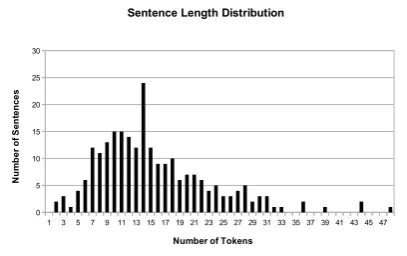
in-cluding economy, finances, world and local poli-tics, sports, culture and crisis situations. The main motivation behind the selection of initial sentences was due to our particular interest in the extrac-tion of relaextrac-tions related to the main events of the news articles (Tanev et al., 2008). Figure 1 shows the histogram for sentences length in the test cor-pus. Nearly 50% of the sentences consists of 15 or more tokens which reflects the complexity level.
1 3 5 7 9 11 13 15 17 19 21 23 25 27 29 31 33 35 37 39 41 43 45 47 0
5 10 15 20 25 30
Sentence Length Distribution
Number of Tokens
N
u
m
b
e
r
o
f
S
e
n
te
n
c
e
[image:3.595.314.518.533.661.2]s
Figure 1: Sentence length distribution.
re-lations per sentence. It is important to note that
n-nary (where n > 3) relations (e.g., X took
place in Y at Z) were annotated asn−1triples
accordingly: (X,took place in, Y) and (X,took
place at,Z). For instance, for the sentence ‘Lechia Gda´nsk okazała si˛e znacznie lepsza od APOEL-u Nikozja i pokonała go w meczu sparingowym a˙z 4:1 (1:0)’ (Lechia Gda´nsk turned out to be signifi-cantly better than APOEL Nicosia and defeated it in a friendly match 4:1 (1:0)) in the test corpus the
following two annotations6are made:
(Lechia Gda´nsk,okazała si˛e lepsza od, APOEL-u Nikozja)
(Lechia Gda´nsk,pokonała,APOEL-u Nikozja)
The system does not lemmatize the arguments, i.e., the arguments in the returned triples are 1:1
copy of the surface forms in the text, e.g.,
APOEL-u Nikozjainstead ofAPOEL Nikozja.
3.2 Experiments
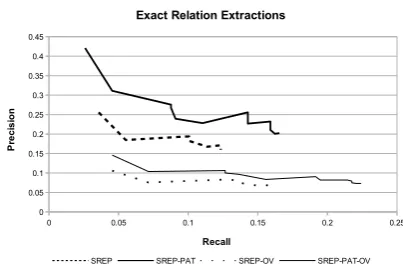
Figure 2 shows the precision-recall curves for the exact relation extraction task7 for the four
configurations: SREP, SREP-PAT, SREP-OV and SREP-PAT-OV (see 2), computed by varying the confidence threshold. Somewhat unsurprisingly, one can observe that the overall results for ex-act matching are rather poor, in particular as re-gards recall. The version of the algorithm that in-cludes the application of generic lexico-syntactic patterns (SREP-PAT) performs better than the ver-sion without (SREP) in terms of both recall and precision. Furthermore, one can observe a small boost in recall (at the cost of lowering precision figures) when ‘overlapping’ was allowed (SREP-PAT-OV), which indicates an area where improve-ment could be made.
In order to have a more in-depth picture of the error types we have computed precision-recall curves for the subtask of exact relation extraction
task, namely, the relation phrase extraction task,
which are depicted in Figure 3. One can observe significant improvement as regards both precision and recall vs. extracting entire relations, in partic-ular for SREP and SREP-PAT configurations, for which the figures still lag behind the ones reported for relation phrase extraction for English (Fader et al., 2011) but are getting closer.
6One corresponding to ‘being better’ and one to ‘winning
a match’ relation.
7Relation phrase and both arguments have to be identical
with the corresponding annotation in the test corpus.
0 0.05 0.1 0.15 0.2 0.25
0 0.05 0.1 0.15 0.2 0.25 0.3 0.35 0.4 0.45
Exact Relation Extractions
SREP SREP-PAT SREP-OV SREP-PAT-OV
Recall
P
re
c
is
io
[image:4.595.316.518.76.208.2]n
Figure 2: Precision-Recall curves for the exact re-lation extraction task.
0 0.05 0.1 0.15 0.2 0.25 0.3 0.35 0.4 0.45 0.5 0
0.1 0.2 0.3 0.4 0.5 0.6 0.7 0.8 0.9
Relation Phrase Extractions
SREP SREP-PAT SREP-OV SREP-PAT-OV
Recall
P
re
c
is
io
[image:4.595.311.522.292.434.2]n
Figure 3: Precision-Recall curves for the relation phrase extraction task.
One can also conclude from Figure 3 that a significant number of errors stems from non cor-rect extraction of the arguments of a relation. To study the problem more thoroughly we also
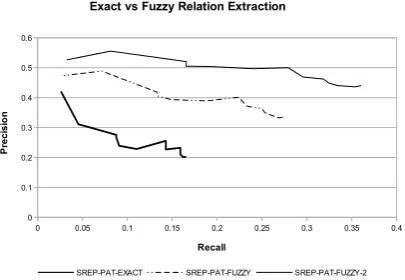
computed the precision-recall curves for thefuzzy
relation extraction task, in which an extracted
triple (X,rel,Y) is considered to be correct if rel
is identical with the corresponding value in the
test corpus, whereas X and Y are similar to the
corresponding values in the test corpus, i.e., the string distance between the extracted values and the correct ones in the test corpus is relatively small. For the purpose of computing string
dis-tance we used thelongest common substrings
relation phrase in the test corpus. Although both precision and recall figures are higher vs. figures for exact relation matching, there is an indication (cf. Figure 3) that there is still a fraction of ex-tracted relations for which the extraction of at least one of the arguments entirely failed, i.e., the error is not related to mismatching left/right boundary of the NP representing the argument.
0 0.05 0.1 0.15 0.2 0.25 0.3 0.35 0.4 0
0.1 0.2 0.3 0.4 0.5 0.6
Exact vs Fuzzy Relation Extraction
SREP-PAT-EXACT SREP-PAT-FUZZY SREP-PAT-FUZZY-2
Recall
P
re
c
is
io
[image:5.595.84.287.199.339.2]n
Figure 4: Fuzzy vs. exact relation extraction.
The analysis of the errors for the SPAT-PAT-FUZZY-2 configuration (i.e., errors that go beyond simple mismatching of the left/right boundaries of the text pieces that are to be extracted (both arguments and relation phrases)), revealed that: 34.8% of the errors are related to the extraction of triples that do not represent relations at all; 23.3% of the errors are due to the failure of extracting the first argument correctly (subject of the pred-icate); 14.0% of the errors are due to extracting
arg1 asarg2and vice versa; 7.0% of errors
con-stitute errors, in whicharg2is wrongly extracted;
whereas remaining errors cover issues related to more significant mismatch of left/right margin of
arg1,arg2or the relation phrase itself.
The main cause of missed relations was due to, i.a.,: (a) relation phrase not being present in the text between arguments (36.7%); (b)
non-contiguous relation phrase structure (28.3%)8; (c)
non-matching of POS-based patterns for detection of relation phrases (10.4%); and (d) non handling of constructions, in which arguments of the
rela-tions are "embraced" in verbs (8.9%)9.
8Although some of the patterns in Step 5 of the algorithm
do cover such cases.
9Polish is a null-subject language. No mechanism for
de-tecting null-subjects was used.
4 Conclusions and Outlook
We presented initial experiments on developing a linguistically-lightweight tool for open relation extraction for Polish that is an adaptation of an existing approach to open relation extraction for English. An evaluation carried out on a small set of sentences randomly extracted from Polish on-line news and a coarse-grained error analysis re-vealed that: (a) precision/recall figures for relation phrase extraction are promising, although a signif-icant part of errors is due to extracting triples that
do not represent any relations (ca. 35%), (b)
per-formance of the extraction of relation arguments needs to be significantly improved as this is the main cause of errors, although, the observed errors did not result only from incorrect NP boundary
de-tection10, but also due to errors of different nature,
e.g., extractingarg1asarg2and vice versa (14%).
We believe that the work in progress reported in this paper constitutes useful source of knowl-edge for researchers aiming at working on OIE for Slavic languages. In particular, the linguistically-poor approach to open relation extraction and the accompanying performance figures presented here could serve as a baseline to use against which to compare more sophisticated solutions.
Apart from improving the overall approach and fine-tuning the underlying resources, future work could possibly encompass integration of a mech-anism to: (a) aid detecting argument boundaries, e.g., as the one in (Etzioni et al., 2011) and (b) decompose sentence into parts that belong to-gether (Bast and Haussmann, 2013), but without deploying linguistically sophisticated tools, e.g., dependency parsers, in case one is interested in developing a Web-scale solution. Most likely, some of the identified problems could be tack-led through the deployment of additional linguis-tic processing modules for Polish, e.g., a named-entity recognition component (Savary and Pisko-rski, 2011) could be used to improve NP boundary detection, while deployment of even a rudimen-tary co-reference resolution mechanism (Broda et al., 2012) could potentially help to handle zero anaphora to increase the recall. Finally, in-stead of relying on full-form lexica for computing POS information, full-fledged POS taggers could be deployed (Piasecki, 2007; Aceda´nski, 2010; Radziszewski, 2013).
10It constitutes one of the core problems while developing
Acknowledgments
We are indebted to Hristo Tanev from the Joint Re-search Centre of the European Commission, who provided the corpus of news articles in Polish.
References
Szymon Aceda´nski. 2010. A morphosyntactic Brill tagger for inflectional languages. In Hrafn Loftsson, Eiríkur Rögnvaldsson, and Sigrún Helgadóttir,
edi-tors,IceTAL, volume 6233 ofLecture Notes in
Com-puter Science, pages 3–14.
Douglas E. Appelt. 1999. Introduction to information
extraction. AI Commun., 12(3):161–172.
Hannah Bast and Elmar Haussmann. 2013. Open in-formation extraction via contextual sentence
decom-position. In Proceedings of ICSC’13, pages 154–
159.
Bartosz Broda, Łukasz Burdka, and Marek Maziarz. 2012. Ikar: An improved kit for anaphora resolu-tion for Polish. In Martin Kay and Christian Boitet,
editors, COLING 2012, 24th International
Confer-ence on Computational Linguistics, Proceedings of the Conference: Demonstration Papers, pages 25– 32.
Luciano Del Corro and Rainer Gemulla. 2013.
Clausie: Clause-based open information extraction. InProceedings of the 22nd International Conference on World Wide Web, WWW ’13, pages 355–366. Oren Etzioni, Michele Banko, Stephen Soderland, and
Daniel S. Weld. 2008. Open information extraction
from the web. Commun. ACM, 51(12):68–74,
De-cember.
Oren Etzioni, Anthony Fader, Janara Christensen, Stephen Soderland, and Mausam Mausam. 2011. Open information extraction: The second
genera-tion. InProceedings of the Twenty-Second
International Joint Conference on Artificial Intelligence -Volume -Volume One, IJCAI’11, pages 3–10. Anthony Fader, Stephen Soderland, and Oren Etzioni.
2011. Identifying relations for open information
ex-traction. In Proceedings of the Conference on
Em-pirical Methods in Natural Language Processing, EMNLP ’11, pages 1535–1545, Stroudsburg, PA, USA.
Pablo Gamallo, Marcos Garcia, and Santiago
Fernández-Lanza. 2012. Dependency-based
open information extraction. In Proceedings of
the Joint Workshop on Unsupervised and Semi-Supervised Learning in NLP, ROBUS-UNSUP ’12, pages 10–18.
Mausam, Michael Schmitz, Robert Bart, Stephen Soderland, and Oren Etzioni. 2012. Open language
learning for information extraction. InProceedings
of the 2012 Joint Conference on Empirical Methods in Natural Language Processing and Computational Natural Language Learning, EMNLP-CoNLL ’12, pages 523–534.
Gonzalo Navarro. 2001. A guided tour to approximate
string matching. ACM Comput. Surv., 33(1):31–88.
Maciej Piasecki. 2007. Polish tagger TaKIPI: Rule
based construction and optimisation. Task
Quar-terly, 11(1–2):151–167.
Adam Przepiórkowski. 2007. Slavonic information
extraction and partial parsing. InProceedings of the
Workshop on Balto-Slavonic Natural Language Pro-cessing: Information Extraction and Enabling Tech-nologies, ACL 2007, pages 1–10.
Adam Radziszewski. 2013. A tiered CRF
tag-ger for Polish. In H. Rybi´nski M. Kryszkiewicz M. Niezgódka R. Bembenik, Ł. Skonieczny, editor,
Intelligent Tools for Building a Scientific Informa-tion Platform: Advanced Architectures and Solu-tions. Springer Verlag.
Agata Savary and Jakub Piskorski. 2011. Language resources for named entity annotation in the
na-tional corpus of Polish. Control and Cybernetics,
40(2):361–391.
Hristo Tanev, Jakub Piskorski, and Martin Atkinson. 2008. Real-time news event extraction for global
crisis monitoring. In Proceedings of the 13th
In-ternational Conference on Natural Language and Information Systems: Applications of Natural Lan-guage to Information Systems, NLDB ’08, pages 207–218.
Marcin Woli´nski, Marcin Miłkowski, Maciej Ogrod-niczuk, and Adam Przepiórkowski. 2012. Polimorf: a (not so) new open morphological dictionary for Polish. In Nicoletta Calzolari (Conference Chair), Khalid Choukri, Thierry Declerck, Mehmet Ugur Dogan, Bente Maegaard, Joseph Mariani, Asuncion Moreno, Jan Odijk, and Stelios Piperidis, editors,
Proceedings of the Eight International Conference on Language Resources and Evaluation (LREC’12), pages 860–864, Istanbul, Turkey.
Alina Wróblewska and Marcin Sydow. 2012. DEB-ORA: dependency-based method for extracting entity-relationship triples from open-domain texts
in Polish. In Foundations of Intelligent Systems
-20th International Synposium (ISMIS) 2012, Macau, China, December 4-7, 2012, Proceedings, pages 155–161.
Fei Wu and Daniel S. Weld. 2010. Open information
extraction using Wikipedia. In Proceedings of the
48th Annual Meeting of the Association for Compu-tational Linguistics, ACL ’10, pages 118–127. Clarissa Castellã Xavier, Vera Lúcia Strube de Lima,
and Marlo Souza. 2015. Open information
ex-traction based on lexical semantics. Journal of the