D S Sharma, R Sangal and E Sherly. Proc. of the 12th Intl. Conference on Natural Language Processing, pages 158–165, Trivandrum, India. December 2015. c2015 NLP Association of India (NLPAI)
Isolated Word Recognition System for Malayalam using Machine
Learning
Maya Moneykumar
IIITM-K, Trivandrum maya.moneykumar @iiitmk.ac.in
Elizabeth Sherly
IIITM-K , Trivandrum [email protected]
Win Sam Varghese
IIITM-K , Trivandrum sam.varghese @iiitmk.ac.in
Abstract
Automatic Speech Recognition (ASR) has received greater level of acceptance as it creates speech recognition by the human machine interface. This paper focuses on developing a syllable based speech recog-nition system for Malayalam language. The proposed system consists of three dif-ferent phases such as preprocessing, seg-mentation and classification. The prepro-cessing is performed for noise reduction, DC component removal, pre-emphasis and framing. The segmentation process imple-mented using Syllable Segmentation Al-gorithm segments the word utterances into syllables, that are inturn fed into the sys-tem for feature extraction. In the fea-ture extraction step, we have proposed a novel approach by adding energy and zero crossing, along with MFCC features. The classification is done using Artificial Neu-ral Network and is also compared with HMM classifier. Experiments are carried out with real-time utterances of 100 words, and obtained 96.4 % accuracy in ANN, which outperformed HMM.
1 Introduction
Automatic Speech Recognition (ASR) system, es-pecially speech to text conversion is one of the most challenging tasks in nowadays. The ulti-mate aim of ASR is to understand spontaneous speech using a computer. However, a word-level identification, which is a complex task in itself is also a major chore in any ASR system. In this paper, a word-level identification is performed to make a computer identify the isolated words spo-ken by a person and to convert it into correspond-ing text. ASR is basically a pattern recognition problem which also involves a number of
tech-nologies and research areas like Signal Process-ing, Natural Language ProcessProcess-ing, Statistics and Cognitive Science. Different factors like gender, emotional state, accent and pronunciation make speech recognition a complex task. The mode of articulation, nasality, pitch, volume, and speed variability in speech also make speech recogni-tion a difficult task. Even when speech is recog-nized, the accuracy rate can be less due to vari-ous behaviors of speech, usage of words, higher variability, background noise and the linguistic features of language and speech. This can seri-ously affect the system performance. There exists works which attempt for speaker dependent and speaker independent recognition. Our attempt is to achieve Speaker independence, which is diffi-cult to achieve because in order to recognize the speech patterns, these models should be trained with speech data of a large group of people. Developing an efficient speech recognizer that can exhibit natural capabilities of every human pos-sesses, along with language capability is much harder. As far as Malayalam language is consid-ered, which has a rich set of vocabulary and the modern Malayalam alphabet has 15 vowel letters, 41 consonant letters, and a few other symbols. Malayalam is one of the richest languages in terms of number of alphabets and also one of the tough-est languages while considering speech. This is because of the variations in pronunciation. Speech recognition in Malayalam language is still in its in-fancy stage and the dream of a system which can interact with the users in native language is still in its early stage. Hence, developing an efficient speech recognition system in Malayalam has great relevance. An isolated word identification system aims at identifying a spoken word from the trained vocabulary.
problem and the relevance of the problem in the current scenario is explained. The third section gives a review of already existing methods and the comparative study about the advantages and dis-advantages of the existing methods. The fourth section is the core part of this work which intro-duces the methodology adopted to solve the prob-lem, and the implementation of the algorithm for the same. The results are analyzed in the fifth sec-tion which also contains a detailed study about the results obtained. The future scope of the work is included in the last section.
2 Literature Review
ASR technology, during the yesteryears has made advancement to a great extent and has reached the point where this facility is used in various fields by millions. Speech recognition works, in foreign languages, advanced a lot since 1920. The first work in speech recognition was the development of a toy named Radio Rex, a celluloid dog,which was developed in 1920. Even though researches were carried out since 1936, the first successful speech recognizer was developed in the year 1952 by David et.al, which could recognize digit utter-ances by a single speaker. The system used spec-tral energy and formant frequencies for recogni-tion purpose. Another notable development in this field was the implementation of phoneme based speech recognizer in the year 1959. In 1960s Japan made their first leap into the field of speech recognition and developed a special purpose hard-ware to improve the computational speed of the then systems. They also developed a hardware phoneme recognizer in 1962 followed by a digit recognizer in 1963 (Nnamdi Okomba S et al. , 2015).
The ASR works were extended to the field of isolated word utterance recognition in 1970s, during which prominent works were carried out by Velichko and Zagoruyko in Russia , Itakura in United State and Cakoe and Chiba in Japan. Meantime, CMU also played their role in the ASR field. Several other systems such as HEARSAY II(1975), HARPY(1976), HWIM (1977) and KEAL (1977) were implemented during this pe-riod. A major shift in the ASR technology hap-pened in 1980, where the template based approach got replaced by statistical modeling methods like Hidden Markov Model (HMM). Different interna-tional languages, including English, French and
Pashto implemented speech recognition systems with HMM and proved successful. An auto-matic dictation system in French implemented us-ing HMM gave an accuracy of 76.2%. A digit recognition system for English implemented us-ing HMM gave an accuracy rate of 88%. It was in 1980s itself, that Support Vector Machine and Neural Network approach got popularity despite of its faded entry in the early 1950s. This period also witnessed the progress in speech recognition works carried out with continuous speech. ASR using Artificial Neural Networks (ANN) achieved excellent results in tasks such as voiced/unvoiced discrimination in 1989 as well as phoneme recog-nition and spoken digit recogrecog-nition in 1989. Peel-ing and Moore applied Multi Layer Perceptron (MLP) to digit recognition and thereby obtained excellent results. Various foreign languages, in-cluding Malay, Indonesian and Arabic, later im-plemented ASR using ANN. The work carried out in Malay language using MLP considered utter-ances of 4 different speakers and obtained an ac-curacy of 95% in identifying words within the trained vocabulary (Ahmed et al., 2012; Sheila D Apte, 2012; Nnamdi Okomba S et al. , 2015).
nizer for Hindi(2000), Speech recognizer for Spe-cific Domain in Tamil (2001), Speech Recogni-tion of Isolated Telugu Vowels Using Neural Net-works ( 2003) and Digit Recognizer for Hindi (2006). Several other Indian languages like Pun-jabi, Marathi, Gujarathi, Assamese and Kannada successfully imprinted their footsteps in the field of ASR during early 2000s (Kurian Cini, and Kannan Balakrishnan. , 2012; Akila A and E. Chandra, 2013; Akila A and E. Chandra, 2014).
Eventhough Malayalam is still in the budding stage while considering ASR, there exist some noteworthy works and the significant one was from CDAC, Trivandrum where they developed a speech recognition system for visually impaired people. MFCC method was used as a front-end to extract acoustic features from the input signal and a hybrid model integrating rule based and statisti-cal method was used to handle pronunciation vari-ations in the dictionary. The system achieved word accuracy of 75%. A speaker independent con-tinuous speech recognizer based on PLP Cepstral Coefficient, was also developed for Malayalam which employs Hidden Markov Model for pattern recognition. The system got trained with 21 male and female speakers and obtained a word accu-racy of 89% when tested with continuous speech data. While considering LPC features for clas-sification, Malayalam speech recognition system obtained an accuracy rate of 81.2%, which is in-deed a notable work. Vimal Krishnan et.al devel-oped a small vocabulary (5 words) speech recog-nition where Artificial neural network technique (ANN) is used for classification and recognition purpose and achieved a recognition rate of 89%. Raji Kumar et.al presented recognition of the iso-lated question words from the Malayalam speech query using DWT and ANN and recognition accu-racy of 80% has been reported.
3 Methodology
The word identification system designed for Malayalam language uses a syllable based seg-mentation approach. Instead of training the sys-tem with independent words, we use syllable com-binations for training and identification. This eliminates the problem of maintaining a large set of training data, as different words share com-mon syllables as well as phone segments. New words can be added to the vocabulary without building new models for the existing syllables
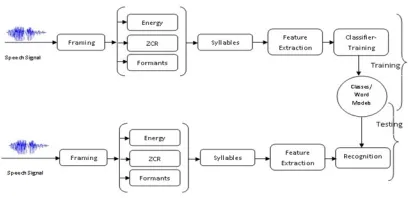
[image:3.612.323.527.196.295.2]and phonemes corresponding to the word. Here, we design a word identification system based on two popular classifier techniques which are Hid-den Markov Model (HMM)and Artificial Neural Network (ANN). The various phases involved in speech recognition include data preparation, syl-labification and classification. The general system architecture of the speech recognition system im-plemented in this work is given below.
Figure 1: General System Architecture
3.1 Data Preparation
The work maintains a database of utterances which consists of a total of 100 words used in the agriculture domain. Multiple utterances of these words by 9 different speakers(6 male & 3 females) were recorded using an audio tool Audacity with a sampling frequency of 16000Hz. A speech cor-pus was in turn developed which consists of these audio files along with the syllable transcription.
In audio recording, a DC offset is an undesirable characteristic of a recording sound which occurs during sound capturing. The offset causes the cen-ter of the waveform to not be at 0, but at a higher value. This can cause two problems:
• Either the loudest part of the signal will be
clipped prematurely, since the base of the waveform has been moved up
• Inaudible low frequency distortion will occur.
The signal, hence should undergo a DC compo-nent removal which is done as
x(n) =a(n)avg, avg=mean(a); (1)
where a is the speech signal
reduction and filtering. Pre-emphasis refers to a process designed to increase the magnitude of some (usually higher) frequencies with respect to the magnitude of other (usually lower) frequencies in order to improve the overall signal-to-noise ratio. In speech processing, a pre-emphasis is applied by high pass filtering the signal to smooth the spectrum to achieve a uniform energy distribution spectrum.
Pre-emphasis is done by applying the formula
y(n) =x(n)−0.9955∗x(n−1) (2)
In speech processing, it is often advanta-geous to divide the signal into frames to achieve stationarity. A frame based analysis is essential for speech signal. Framing is the process of decomposing the speech signal into a series of overlapping/non-overlapping frames. The speech signal is stationary within windows of 20 to 30 ms duration and hence is divided into non-overlapping frames with a duration of 30 ms (Sheila D Apte, 2012) .
3.2 Syllabification & Feature Extraction 3.2.1 Syllabification
In this work, syllabification plays an important role and hence every recorded utterance which be-comes the input to the system should eventually undergo syllabification. Instead of using com-monly used approaches for syllabification includ-ing group delay method, we have developed a novel approach to syllabify utterances which make use of short time energy, zero crossing rate as well as formant frequencies. In syllabification, each and every utterance is segmented into respective syllables irrespective of the number of syllables it consist of. The Syllable Segmentation Algorithm introduced in this work is implemented using Mat-lab and has obtained an accuracy of 95%.
Syllable Segmentation Algorithm
The algorithm segments syllables, based on the concept that the energy measure for a vowel (voiced segment) is much higher than the si-lence part and the energy measure of the conso-nant(unvoiced segment) is lower than the voiced segment(vowel) but higher than the silence part. The zero crossing rate is higher for the silence part and lower for the voiced part of a signal.
Algorithm 1:Algorithm for Syllable Segmen-tation
Input:Signal of Isolated Word utterance:I Output:.wav files of Syllables
1 Signal Acquisition
2 Preprocessing
3 Apply a high pass filter and calculate ZCR
4 Apply low pass filter and calculate Energy
5 Calculate the formants F1 & F2 6 calculate the peaks
7 Calculate the Residual Energy
8 Find the approximate syllable boundaries
using the calculated values.
9 Attenuate the syllables based on their energy to get the accurate syllable boundary.
10 Apply window function
11 Store the segmented syllables as wav files
After obtaining the energy and ZCR values of frames, it is necessary to smooth the signal to find the energy and ZCR peaks. Smoothing means that we even out a signal, by mixing its elements with their neighbors. In order to obtain an accurate measure, we are considering two different energy calculations. The first one is the energy of the sig-nal which is the short time energy and the second is the energy of the signal filtered with low pass filter with a cutoff frequency of 1100Hz. This en-ergy calculation will help us in discarding the mis identified syllable boundaries.
The preprocessed signal then undergoes the syllabification process by detecting the syllable boundaries. Energy and Zero crossing
E=
NX−1
n=0
s2(n) (3)
and zero crossing rate as
Z =X
n
|sgn(s(n))−sgn(s(n−1))| (4)
where sgn(s(n)) = 1, if s(n)≥0, sgn(s(n)) =−1, if s(n)<0
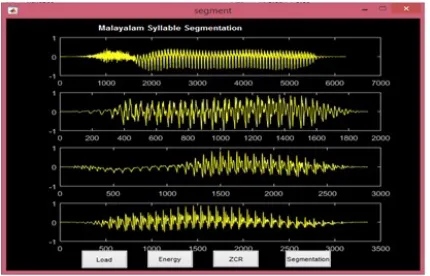
Figure 2: Speech signal for utterance chiinavala
Figure 3: Result of Syllabification
3.2.2 Feature Extraction
The syllables which are stored as .wav files are then fed into the feature extraction process. The syllabified speech signal is divided into non-overlapping frames of 30 ms length by keeping in mind the concept that spectral evaluation are reliable in the case of a stationary signal and that a speech signal is stationary within a window of duration 20-30 ms. For the purpose of feature extraction, spectral analysis algorithm such as MFCC is used. Cepstral analysis has been widely used as the main analysis method for speech recognition. The mel-frequency cepstral coefficients (MFCC) appear to furnish a more efficient representation of speech spectra than other analysis methods. Human auditory system is assumed to process speech signal in a non-linear fashion. Lower frequency components of speech signal contain more information. The mel-frequency cepstrum (MFC) can be defined as the short-time power spectrum of a speech signal
which is calculated as the linear cosine transform of the log power spectrum. Conversion from normal frequency to mel-frequency is given by
m= 2595log10(1 + (f = 700))(4.7) (5)
where f indicates normal frequency and m is the corresponding mel-frequency. In order to improve the recognition accuracy, later two additional pa-rameters, energy and zero crossing rate are also considered along with MFCC.
3.3 HMM Classification System
After preprocessing, syllabification and feature extraction, HMM is used to recognize the speech and training. The system is being trained using task grammar, acoustic models and lexical models using HTK toolkit.
For training, a 5 state HMM prototype model was created with the first and last non- emitting states. The main step in HMM training is defining a prototype model as a model structure. A train file is also created which will redirect HTK to the location where the feature vector files (mfcc files) are stored. Realigning the training data is done next where the word-to-phone mapping operation is performed. In this case, all pronunciations for each word is considered and then output the pronunciation that best matches the acoustic data. In order to recognize the word using phoneme combinations, triphone files are also generated (Pammi S. C and V. Keri., 2005).
The testing phase which is responsible for rec-ognizing the utterances also follows the same set of steps till feature extraction, as in the training phase. The testing signals were also converted into a series of feature vectors. During the test-ing phase, recognition happens where the decoder compiles the recognition network using the task level word network. The word level transcriptions are constructed from the recognition network, as the next step.
3.3.1 ANN Based Speech Recognition System
[image:5.612.81.296.267.405.2]rate. The architecture used for ANN based ASR is given below.
Table 1: ANN Architecture
No: of input neurons 60
No: of neurons in the hidden layer 100
No: of hidden layers 1
No: of output neurons 80
Activation function Sigmoid
The system is trained using Backpropagation algorithm with learning rate 0.3 and number of epochs 200. The training and testing were per-formed with various scenarios. The system is trained only with MFCC and MFCC, along with energy and zero crossing. A notable greater per-formance is shown in later case.
4 Result & Discussions
The goal of this work was to design a speech recognition system for Malayalam. In order to identify a method which gives better recognition accuracy, we used two well known approaches which will solve pattern recognition problems. The system was trained with both Artificial Neu-ral Network and Hidden Markov Model so that if a syllable is given, it will identify the class to which it belongs to. To test the performance of both ANN and HMM, various test data were given where the accuracy in recognizing words within the vocabu-lary and out of vocabuvocabu-lary words, by the same as well as different speakers. The test data is catego-rized as follows:
Exp Test Data Speaker
Test1 OOV Same Speaker
Test2 OOV Diff. Speaker
same gender Test3 within the vocabulary Same Speaker Test4 within the vocabulary DIff. Speaker
same gender
Test5 OOV Diff. gender
[image:6.612.353.492.302.491.2]Test6 within the vocabulary Diff. gender
Table 2: Test Data Set
The system was provided a data set with a total of 564 instances out of which 70% of the data was taken for training and rest 30% for testing.
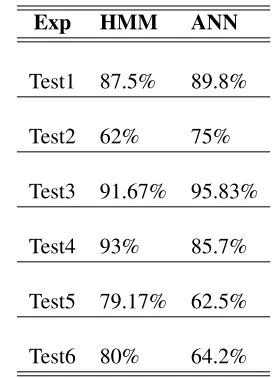
By comparing overall performance of both HMM and ANN, it was found that ANN outperformed HMM in almost all the test cases except for that of a different gender utterances. It was also found that the speech recognition system based on ANN performs better while adding more features other than the conventional MFCC features.
Given, are the results of recognition by both HMM and ANN, while using only MFCC features for training and testing.
Here, ANN has shown a better recognition accuracy in especially different speaker utter-ances and out of vocabulary utterutter-ances. But the performance of both HMM and ANN were not satisfactory in the case of different gender utterances, even though HMM showed slightly improved result.
Exp HMM ANN
Test1 87.5% 89.8%
Test2 62% 75%
Test3 91.67% 95.83%
Test4 93% 85.7%
Test5 79.17% 62.5%
Test6 80% 64.2%
[image:6.612.81.298.536.666.2]Table 3: Results comparison HMM & ANN
Figure 4: Results comparison HMM & ANN
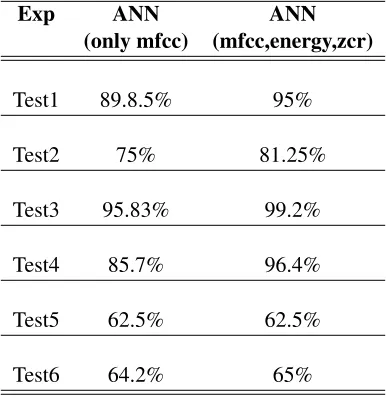
[image:6.612.313.534.555.689.2]with the MFCC parameters, energy measure as well as zero crossing rate of the signal was also considered as attributes for ANN. This choice was proved correct by the recognition accuracy re-sulted. Given below, is the table and graph de-picting the difference in performance by the sys-tem trained with ANN where the parameters se-lection alone is different. The total instances used for training and testing and also the test conditions were the same.
Exp ANN ANN
(only mfcc) (mfcc,energy,zcr)
Test1 89.8.5% 95%
Test2 75% 81.25%
Test3 95.83% 99.2%
Test4 85.7% 96.4%
Test5 62.5% 62.5%
[image:7.612.315.534.36.157.2]Test6 64.2% 65%
Table 4: ANN Results Comparison
Eventhough, addition of new parameters helped in improving recognition accuracy of Test 1 to Test 4, Test 5 and Test 6 didnt show any improvement. The system didnt successfully identify a different gender utterance.
Figure 5: ANN Result Comparison
[image:7.612.93.286.190.389.2]The diagram below depicts the overall perfor-mance comparison of the system perforperfor-mance.
Figure 6: Overall Performance Comparison
5 Conclusion & Future Scope
This work addresses the problem of automatic speech recognition for isolated words in Malay-alam language. A new algorithm was proposed with a feature set of formant frequencies, energy measure and zero crossing rate. An ANN based and HMM based models have been created and testing was performed words within the vocabu-lary and out of vocabuvocabu-lary. Based on performance evaluation, it is shown that Artificial Neural Net-work is well suited for speech recognition system of isolated words. However, the system perfor-mance is not satisfactory for gender specific.
5.1 Future Directions
In this research work, a speech recognition sys-tem with a moderate degree of accuracy is de-signed. The emphasis was on speech recognition for isolated words which finds applications in dif-ferent areas where there is a man- machine terface. By considering the various factors, in-cluding noisy environment and gender specific, a deep leaning approach may be considered as fu-ture scope. The system shall also be extended for continuous speech recognition using syllable based approach. Attempts should be made to tify the features which will help the system iden-tify utterances irrespective of the gender of the speaker.
References
. Ahmed, Irfan, Nasir Ahmad, Hazrat Ali, and Gulzar Ahmad. 2012. The development of isolated words pashto automatic speech recognition system., In Automation and Computing (ICAC), 18th Interna-tional Conference on IEEE, 1-4
[image:7.612.79.299.537.668.2]toolkit (HTK).. In Information Technology (ITSim), International Symposium on IEEE, vol. 2, 557-562
. Kurian Cini, and Kannan Balakrishnan. 2012. Con-tinuous speech recognition system for Malayalam language using PLP cepstral coefficient. Journal of Computing and Business Research, vol. 3.1
. Akila A and E. Chandra. 2013. Isolated Tamil Word Speech Recognition System Using HTK. Interna-tional Journal of Computer Science , vol. 3.02, 30-38
. Akila A and E. Chandra. 2014. Performance en-hancement of syllable based Tamil speech recog-nition system using time normalization and rate of speech. CSI Transactions on ICT , vol. 2.2, 77-84
. Khetri G. P., Padme S. L., Jain D. C., Fadewar H. S., Sontakke B. R., and Pawar V. P. 2012. Au-tomatic Speech Recognition for Marathi Isolated Words. Application or Innovation in Engineering & Management (IJAIEM) , vol.1(3)
Resch Barbara 2003. Automatic Speech Recognition with HTK. Signal Processing and Speech Communi-cation Laboratory. Inffeldgase. Austria , Disponible en Internet: http://www. igi. tugraz. at/lehre/CI .
Sheila D Apte 2012. Speech and audio processing. Wiley publication , Feb 2012
Sunny Sonia, S. David Peter, and K. Poulose Ja-cob 2013. Performance of Different Classifiers in Speech Recognition. International Journal of Re-search in Engineering and Technology , vol 2
Kurian Cini and Kannan Balakrishnan 2011. Malay-alam Isolated Digit Recognition using HMM and PLP cepstral coefficient. International Journal of Advanced Information Technology (IJAIT) , vol 1.5
Kurian Cini and Kannan Balakrishnan 2011. Malay-alam Isolated Digit Recognition using HMM and PLP cepstral coefficient. International Journal of Advanced Information Technology (IJAIT) , vol 1.5
Pammi S. C., and V. Keri 2005. A package for auto-matic segmentation..
Zegers Pablo 1998. Speech recognition using neural networks. Diss. University of Arizona
Gaikwad, Santosh K. Bharti W. Gawali and Pravin Yannawar 2010. A review on speech recognition technique. International Journal of Computer Ap-plications , vol 10.3
Sunny Sonia, D. Peter, and K. Jacob 2013. Combined Feature Extraction Techniques And Naive Bayes Classiffier For Speech Recognition. CS & IT-CSCP
Jurafsky D. and Martin J 2000. Speech and Language Processing: An Introduction to Natural Language Processing. Computational Linguistics and Speech Recognition. Delhi, India , Pearson Education
Nnamdi Okomba S., Adegboye Mutiu Adesina, and Candidus O. Okwor. 2015. Survey of Technical Progress in Speech Recognition by Machine over Few Years of Research. IOSR Journal of Electronics and Communication Engineering Vol 10, Issue 4, Ver. I (Jul - Aug .2015), PP 61-67