Assessing the Readability of Sentences: Which Corpora and Features?
Felice Dell’Orletta, Martijn Wieling•◦, Andrea Cimino, Giulia Venturi
and Simonetta Montemagni
Istituto di Linguistica Computazionale “Antonio Zampolli” (ILC–CNR)
ItaliaNLP Lab -www.italianlp.it
{name.surname}@ilc.cnr.it
•Department of Humanities Computing, University of Groningen, The Netherlands
◦Department of Quantitative Linguistics, University of T¨ubingen, Germany
Abstract
The paper investigates the problem of sentence readability assessment, which is modelled as a classification task, with a specific view to text simplification. In par-ticular, it addresses two open issues con-nected with it, i.e. the corpora to be used for training, and the identification of the most effective features to determine sen-tence readability. An existing readabil-ity assessment tool developed for Italian was specialized at the level of training cor-pus and learning algorithm. A maximum entropy–based feature selection and rank-ing algorithm (graftrank-ing) was used to iden-tify to the most relevant features: it turned out that assessing the readability of sen-tences is a complex task, requiring a high number of features, mainly syntactic ones.
1 Introduction
Over the last ten years, work on automatic read-ability assessment employed sophisticated NLP techniques (such as syntactic parsing and statisti-cal language modeling) to capture highly complex linguistic features, and used statistical machine learning to build readability assessment tools. A variety of different NLP–based approaches has been proposed so far in the literature, differing at the level of the number of identified readabil-ity classes, the typology of features taken into ac-count, the intended audience of the texts under evaluation, or the application within which read-ability assessment is carried out, etc.
Research focused so far on readability assess-ment at the docuassess-ment level. However, as pointed out by Skory and Eskenazi (2010), methods devel-oped perform well when the task is characterizing the readability level of an entire document, while they are unreliable for short texts, including single
sentences. Yet, for specific applications, assessing the readability level of individual sentences would be desirable. This is the case, for instance, for text simplification: in current approaches, text read-ability is typically assessed with respect to the en-tire document, while text simplification is carried out at the sentence level, as e.g. done in Alu´ısio et al. (2010), Bott and Saggion (2011) and Inui et al. (2003). By decoupling the readability assess-ment and simplification processes, the impact of simplification operations on the overall readabil-ity level of a given text may not always be clear. With sentence–based readability assessment, this is expected to be no longer a problem. Sentence readability assessment thus represents an open is-sue in the literature which is worth being further explored. To our knowledge, the only attempts in this direction are represented by Dell’Orletta et al. (2011) and Sj¨oholm (2012) for the Italian and Swedish languages respectively, followed more recently by Vajjala and Meurers (2014) dealing with English.
In this paper, we tackle the challenge of assess-ing the readability of individual sentences as a first step towards text simplification. The task is mod-elled as a classification task, with the final aim of shedding light on two open issues connected with it, namely the reference corpora to be used for training (i.e. collections of sentences classified according to their readability level), and the iden-tification of the most effective features to deter-mine sentence readability. For what concerns the former, sentence readability assessment poses the remarkable issue of classifying sentences accord-ing to their difficulty: if all sentences occurraccord-ing in simplified texts can be assumed to be easy–to–read sentences, the reverse does not necessarily hold since not all sentences occurring in complex texts are to be assumed difficult–to–read. This fact has important implications at the level of the composi-tion of the corpora to be used for training. The
ond issue is concerned with whether and to what extent the features playing a significant role in the assessment of readability at the sentence level co-incide with those exploited at the level of docu-ment. In particular, the following research ques-tions are addressed:
1. in assessing sentence readability, is it bet-ter to use a small gold standard training cor-pus of manually classified sentences or a much bigger training corpus automatically constructed from readability–tagged docu-ments possibly containing misclassified sen-tences?
2. which are the features maximizing sentence readability assessment?
3. to what extent do important features for sen-tence readability classification match those playing a role in the document readability classification?
We will try to answer these questions by work-ing on Italian, which is a less–resourced language as far as readability is concerned. To this end, READ–IT (Dell’Orletta et al., 2011; Dell’Orletta et al., 2014), which represents the first NLP–based readability assessment tool for Italian, was spe-cialized in different respects, namely at the level of the training corpus and of the learning algorithm; to investigate questions 2. and 3. above, a maxi-mum entropy–based feature selection and ranking algorithm (i.e. grafting) was selected. The specific target audience of readers addressed in this study is represented by people characterised by low lit-eracy skills and/or by mild cognitive impairment. The paper is organized as follows: Section 2 de-scribes the background literature, Section 3 intro-duces our approach to the task, in terms of used corpora, features and learning algorithm. Finally, Sections 4 and 5 describe the experimental setting and discuss achieved results.
2 Background
In spite of the acknowledged need of perform-ing readability assessment at the sentence level, so far very few attempts have been made to sys-tematically investigate the issues and challenges concerned with the readability assessment of sen-tences (as opposed to documents). The first two studies in this direction focused on languages other than English, namely Italian (Dell’Orletta
et al., 2011) and Swedish (Sj¨oholm, 2012). In both cases, the authors start from the assump-tion that while all sentences occurring in simpli-fied texts can be assumed to be easy–to–read tences, the reverse is not true, since not all sen-tences occurring in complex texts are difficult–to– read. This has important consequences at the level of the evaluation of sentence classification results: i.e. erroneous readability assessments within the class of difficult–to–read texts may either corre-spond to those easy–to–read sentences occurring within complex texts or represent real classifi-cation errors. To overcome this problem in the readability assessment of individual sentences, a notion of distance with respect to easy-to-read sentences was introduced by Dell’Orletta et al. (2011). Focusing on English, a similar issue is addressed more recently by Vajjala and Meur-ers (2014) who developed a binary sentence clas-sifier trained on Wikipedia and Simple English Wikipedia: they showed that the low accuracy ob-tained by their classifier stems from the incorrect assumption that all Wikipedia sentences are more complex than the Simple Wikipedia ones.
Besides readability, sentence–based analyses are reported in the literature for related tasks: for instance, in a text simplification scenario by Drn-darevi´c et al. (2013), Alu´ısio et al. (2008), ˇStajner and Saggion (2013) and Barlacchi and Tonelli (2013); or to predict writing quality level by Louis and Nenkova (2013). Sheikha and Inkpen (2012) report the results of both document– and sentence– based classification in the different but related task of assessing formal vs. informal style of a docu-ment/sentence. For students learning English, An-dersen et al. (2013) made a self–assessment and tutoring system available which was able to assign a quality score for each individual sentence they write: this provides automated feedback on learn-ers’ writing.
features in this task was considered, and more re-cently, the role of discourse features (e.g., dis-course topic, disdis-course cohesion and coherence) has also been taken into account (see e.g., Barzi-lay and Lapata (2008), Pitler and Nenkova (2008), Kate et al. (2010), Feng et al. (2010) and Tonelli et al. (2012)). Many of these studies also explored the usefulness of features belonging to individual levels of linguistic description in predicting text readability. For example, Feng et al. (2010) sys-tematically evaluated a wide range of features and compared the results of different statistical classi-fiers trained on different classes of features. Sim-ilarly, the correlation between level–specific fea-tures has been calculated by Pitler and Nenkova (2008) with respect to human readability judg-ments, and by Franc¸ois and Fairon (2012) with respect to readability levels. In both cases, the classes of features which turned out to be highly correlated with readability judgments were used in a readability assessment tool to test their effi-cacy. Note, however, that in all cases the predic-tive power of the selected features was evaluated at the document level only.
3 Our Approach
In this section, we introduce the main ingredi-ents of our approach to sentence readability as-sessment, corpora used for training and testing, selected features and the learning and feature se-lection algorithm.
3.1 Corpora
We relied on two different corpora: a newspaper corpus, La Repubblica (henceforth,Rep), and an easy–to–read newspaper,Due Parole(henceforth,
2Par). 2Par includes articles specifically written by Italian linguists experts in text simplification for an audience of adults with a rudimentary lit-eracy level or with mild intellectual disabilities (Piemontese, 1996), which represents the target audience of this study. The two corpora – selected as representative of complex vs. simplified texts within the journalistic genre – differ significantly with respect to the distribution of features typi-cally correlated with text complexity (Dell’Orletta et al., 2011) and thus represent reliable training datasets. However, whereas such a distinction is valid as far as documents are concerned, it appears to be a simplistic generalization when the focus is on sentences. In other words, whereas we can
con-sider all sentences of2Paras easy–to–read, not all
Repsentences are expected to be difficult–to–read. From this it follows that whereas the internal com-position of 2Par is homogeneous at the sentence level, this is not the case forRep.
To overcome this asymmetry and in particular to assess the impact of the noise in theRep train-ing corpus, we constructed different traintrain-ing sets differing in size and internal composition, going from a noisy set which assumes allRepsentences to be difficult–to–read to a clean but smaller set in which the easy–to–read sentences occurring in
Rep were manually filtered out. These training sets were used in different experiments whose re-sults are reported in Section 4.2.
The corpus containing only difficult–to–read sentences was manually built by annotating Rep
sentences according to their readability (i.e. easy vs. difficult). The annotation process was car-ried out by two annotators with a background in computational linguistics. In order to assess the reliability of their judgements, we started with a small annotation experiment: the two annotators were provided with the same 5 articles from the
Repcorpus (for a total of 107 sentences) and were asked to extract the difficult–to–read sentences (as opposed to both easy–to–read and not–easy–to– classify sentences). The first annotator carried out the task in 5 minutes and 46 seconds, while the second annotator took 9 minutes and 8 seconds. The two annotators agreed on the classification of 81 difficult–to–read sentences out of 107 consid-ered ones (in particular, the first annotator iden-tified 90 difficult–to–read–sentences and the sec-ond one 93 sentences). The agreement between the two annotators was calculated in terms of pre-cision, by taking one of the annotation sets as the gold standard and the other as response: on aver-age, we obtained a precision of 0.88 in the retrieval of sentences definitely classified as difficult–to– read. Given the high level of agreement, the two annotators were asked to select difficult sentences from two sets of distinct Rep articles. This re-sulted in a set of 1,745 difficult–to–read sentences which were used together with a random selection of easy–to–read sentences from2Par for training and testing.1
1The collection can be downloaded from
Feature Ranking position Feature Ranking position Sent. class. Doc. class. Sent. class. Doc. class.
Raw text features:
[1] Sentence length 1 1 [2] Word length 2 2
Lexical features:
[3] Word types in theBasic Italian
Vocabu-lary 14 42 [6] “High availability words” 21 22
[4] “Fundamental words” 10 9 [7] TTR (form) 7
[5] “High usage words” 22 38 [8] TTR (lemma) 53
Morpho–syntactic features:
[9] Adjective 46 [26] Aux. verb – inf. mood 64
[10] Adverb 29 59 [27] Aux. verb – part. mood 51
[11] Article 49 25 [28] Aux. verb – subj. mood 55
[12] Conjunction 40 [29] Main verb – cond. mood 40 43
[13] Determiner 43 54 [30] Main verb – ger. mood 48 48
[14] Interjection [31] Main verb – imp. mood 37 57
[15] Noun 12 19 [32] Main verb – indic. mood 16 11
[16] Number 65 44 [33] Main verb – inf. mood 13 13
[17] Predeterminer [34] Main verb – part. mood 26 28
[18] Preposition 61 [35] Main verb – subj. mood 46 32
[19] Pronoun 27 30 [36] Modal verb - inf. mood 54 56
[20] Punctuation 35 [37] Modal verb – cond. mood 41 36
[21] Residual [38] Modal verb – imp. mood
[22] Verb 63 34 [39] Modal verb – indic. mood 18 23
[23] Lexical density 34 33 [40] Modal verb – part. mood
[24] Aux. verb – cond. mood 59 60 [41] Modal verb – subj. mood 60 58 [25] Aux. verb – indic. mood 17 17
Syntactic features:
[42] Argument 62 [65] Sentence root 35 62
[43] Auxiliary 70 [66] Subject 39 52
[44] Clitic 63 [67] Subordinate clause 64
[45] Complement 28 29 [68] Temporal complement 45 55
[46] Concatenation 66 [69] Temporal modifier [47] Conjunct in a disjunctive compound 58 67 [70] Temporal predicate [48] Conjunct linked by a copulative
con-junction 38 37 [71] Parse tree depth 5 4
[49] Copulative conjunction 31 39 [72] Embedded complement ‘chains’ 8 24
[50] Determiner 50 26 [73] Verbal Root 6 3
[51] Direct object 44 27 [74] Arity of verbal predicates 3 15 [52] Disjunctive conjunction 57 68 [75] Pre–verbal subject 4 12
[53] Indirect complement/object 66 [76] Post–verbal subject 25 16 [54] Locative complement 52 51 [77] Pre–verbal object 36 41
[55] Locative modifier [78] Post–verbal object 9 21
[56] Locative predicate [79] Main clauses 23 14
[57] Modal verb 61 [80] Subordinate clauses 42 45
[58] Modifier 20 47 [81] Subordinate clauses in pre–verbal
posi-tion 32 10
[59] Negative 56 69 [82] Subordinate clauses in post–verbal
po-sition 19 20
[60] Passive subject [83] ‘Chains’ of embedded subordinate
clauses 11 5
[61] Predicative complement 49 [84] Finite complement clauses 30 18
[62] Preposition [85] Infinitive clauses 53 50
[63] Punctuation 24 31 [86] Length of dependency links 15 8
[image:4.595.74.525.58.528.2][64] Relative modifier 47 65 [87] Maximum length of dependency links 7 6
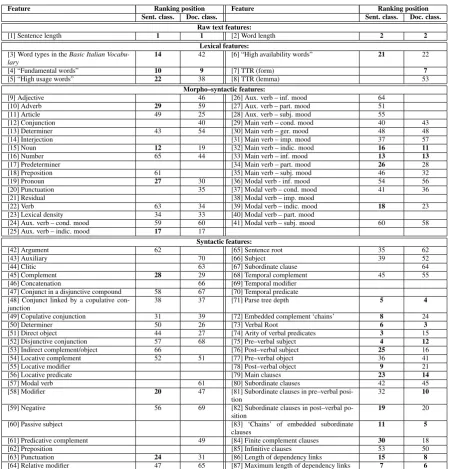
Table 1: Typology of features and ranking position in sentence and document readability assessment experiments. Only about 14 features are needed for an adequate model of document readability, whereas this number increases to 30 for sentence readability (marked in boldface). Features which were not selected during ranking have no rank.
3.2 Linguistic Features
The set of features used in the experiments re-ported in this paper is wide, spanning across dif-ferent levels of linguistic analysis. They can be broadly classified into four main classes, as reported in Table 1: raw text features, lexical features, morpho–syntactic features and syntactic features, shortly described below.2
2For an exhaustive discussion including the motivations
underlying this selection of features, the interested reader is
Raw text features (Features [1–2] in Table 1) refer to those features typically used within tra-ditional readability metrics and include sentence length, calculated as the average number of words per sentence, and word length, calculated as the average number of characters per words.
both the internal composition of the vocabulary and the lexical richness of the text. For what con-cerns the former, theBasic Italian Vocabularyby De Mauro (2000) was taken as a reference re-source, including a list of 7000 words highly fa-miliar to native speakers of Italian. In particular, we consider: a) the percentage of all unique words (types) on this reference list occurring in the text, and b) the internal distribution of the occurring ba-sic Italian vocabulary words into the usage classi-fication classes of ‘fundamental words’ (very fre-quent words), ‘high usage words’ (frefre-quent words) and ‘high availability words’ (relatively lower fre-quency words referring to everyday life). Lexical richness of texts is monitored by computing the Type/Token Ratio (TTR), which refers to the ratio between the number of lexical types and the num-ber of tokens within a text. Due to its sensitivity to sample size, this feature is computed for text samples of equivalent length.
The set of morpho–syntactic features (Features [9–41] in Table 1) is aimed at capturing differ-ent aspects of the linguistic structure affecting in one way or another the readability of a text. They range from the probability distribution of part– of–speech (POS) types, to the lexical density of the text, calculated as the ratio of content words (verbs, nouns, adjectives and adverbs) to the to-tal number of lexical tokens in a text. This class also includes features referring to the distribution of verbs by mood and/or tense, which can be seen as a language–specific feature exploiting the pre-dictive power of the Italian rich morphology.
The set of syntactic features (Features [42–87] in Table 1) captures different aspects of the syntac-tic structure which are taken as reliable indicators for automatic readability assessment, namely:
• the unconditional probability of syntactic de-pendency types, e.g. subject, direct object, modifier, etc. (Features 42–70);
• parse tree depth features (71–72), going from thedepth of the whole parse tree, calculated in terms of the longest path from the root of the dependency tree to some leaf, to a more specific feature referring to the aver-age depth of embedded complement ‘chains’
governed by a nominal head and including either prepositional complements or nominal and adjectival modifiers;
• verbal predicate features (73–78) aimed at
capturing different aspects of the behaviour of verbal predicates: they range from the
number of verbal rootswith respect to num-ber of all sentence roots occurring in a text, to more specific features such as the arity of verbs, meant as the number of instanti-ated dependency links sharing the same ver-bal head (covering both arguments and modi-fiers) and therelative ordering of subject and object with respect to the verbal head;
• as subordination is widely acknowledged to be an index of structural complexity in language, subordination features (79– 85) include: the distribution of subordinate vs. main clauses; for subordinates, the dis-tribution of infinitives vs finite complement clauses, their relative ordering with respect to the main clauseand theaverage depth of ‘chains’ of embedded subordinate clauses;
• the length of dependency links is another characteristic connected with the syntactic complexity of sentences. Features 86–87 measure dependency length in terms of the words occurring between the syntactic head and the dependent: they focus on all depen-dency links vs. maximum dependepen-dency links only.
3.3 Model Training and Feature Ranking Given the twofold goal of this study, i.e. re-liably assessing sentence readability and finding the most predictive features undelying it, we used GRAFTING(Perkins et al., 2003), as this approach allows to train a maximum entropy model while si-multaneously including incremental feature selec-tion. The method uses a gradient–based heuristic to select the most promising feature (to add to the set of selected featuresS), and then performs a full weight optimization over all features inS. This process is repeated until a certain stopping crite-rion is reached. As the grafting approach we use integrates thel1regularization (preventing overfit-ting), features are only included (i.e. have a non-zero weight) when the reduction of the objective function is greater than a certain treshold. In our case, thel1prior we use was selected on the basis of evaluating maximum entropy models with vary-ingl1 values (range: 1e-11, 1e-10, ..., 0.1, 1) via 10–fold cross validation. We used TINYEST3, a
grafting-capable maximum entropy parameter es-timator for ranking tasks (de Kok, 2011; de Kok, 2013), to select the features and estimate their weights. Whereas our task is not a ranking task, but rather a binary classification problem, we were able to model it as a ranking task by assigning a high score (1) to difficult–to–read sentences and a low score (0) to easy–to–read sentences. Conse-quently, a sentence having a score <0.5 was in-terpreted as an easy–to–read sentence, whereas a sentence which was assigned a score ≥ 0.5 was interpreted to be a difficult–to–read sentence. 4 Experiments and Results
4.1 Experimental Setup
In all experiments, the corpora were automatically tagged by the part–of–speech tagger described in Dell’Orletta (2009) and dependency–parsed by the DeSR parser (Attardi, 2006) using Support Vector Machines as learning algorithm. We de-vised two different experiments, aimed at explor-ing the research questions investigated in this pa-per. To this end, READ–IT was adapted by inte-grating a specialized training corpus and a maxi-mum entropy–based feature selection and ranking algorithm (i.e. grafting).
Experiment 1
This experiment, investigating the first research question, is aimed at identifying what is the most effective training data for sentence readability as-sessment. In particular, the goal is to compare the results on the basis of using a small set of gold standard data with respect to a (potentially larger, but) noisy data set (i.e. without manual re-vision) where everyRepsentence was assumed to be difficult–to–read. In particular, the comparison involved four datasets:
• a collection of gold standard data consisting of 1,310 easy–to–read sentences randomly extracted from the 2Par corpus and 1,310 manually selected difficult–to-read sentences from theRepcorpus;
• a large and unbalanced collection of uncor-rected data consisting of the whole2Par cor-pus (3,910 easy–to–read sentences) and the whole Rep corpus (8,452 sentences, classi-fieda priorias difficult–to–read);
• a balanced collection of uncorrected sen-tences, consisting of 3,910 sentences from
2Parand 3,910 sentences fromRep;
• a balanced collection of uncorrected sen-tences having the same size as the gold stan-dard dataset, namely 1,310 sentences from
2Parand 1,310 sentences fromRep.
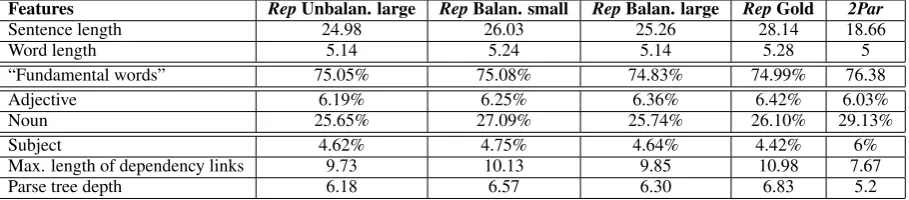
To assess similarities and differences at the level of the different corpora used for training in this experiment, in Table 2 we report a selection of linguistic features (see Section 3.2) characterizing the four datasets with respect to the whole 2Par
corpus.We can observe that 2Par differs from all fourRepcorpora for all reported features, and that the four Rep corpora show similar trends. Inter-estingly, however, theRep Gold corpus is almost always the most distant one from2Par(i.e. at the level of sentence length, word length, distribution of adjectives and subjects, average length of de-pendency links and parse tree depth).
On the basis of the fourRepdatasets, four mod-els were built which we evaluated using a held– out test set consisting of 435 sentences from2Par
and 435 manually classified difficult–to–read sen-tences fromRep. Using the grafting method, we calculated the classification score for each sen-tence in our test set on the basis of an increasing number of features (ranging from 1 to all non-zero weighted features for the specific dataset): sen-tences with a score below 0.5 were classified as easy–to–read, whereas sentences having a score greater or equal to 0.5 were classified as difficult– to–read. This procedure was repeated for each of the four models.
Experiment 2
The second experiment is aimed at answering our second and third research questions, focusing on the features relevant for sentence readability, and the relationship of those features with document readability classification. For this purpose, we compared sentence– and document–based read-ability classification results. In particular, we com-pared the features used by the sentence–based readability model trained on the gold standard data and the features used by the document–based model trained on Rep and 2Par. With respect to the document classification, we used a cor-pus of 638 documents (319 extracted from 2Par
Features RepUnbalan. large RepBalan. small RepBalan. large RepGold 2Par
Sentence length 24.98 26.03 25.26 28.14 18.66
Word length 5.14 5.24 5.14 5.28 5
“Fundamental words” 75.05% 75.08% 74.83% 74.99% 76.38
Adjective 6.19% 6.25% 6.36% 6.42% 6.03%
Noun 25.65% 27.09% 25.74% 26.10% 29.13%
Subject 4.62% 4.75% 4.64% 4.42% 6%
Max. length of dependency links 9.73 10.13 9.85 10.98 7.67
[image:7.595.74.529.64.164.2]Parse tree depth 6.18 6.57 6.30 6.83 5.2
Table 2: Distribution of some linguistic features inRepand2Partraining data
Accuracy Precision (all ft)
Training data 2 ft 10 ft 30 ft 50 ft all ft Easy Difficult
Unbalanced large 50 63.7 74.9 78.4 78.9 (85 ft) 69.2 88.5
Balanced small 64 67.9 79.2 80.8 82.5 (82 ft) 82.5 82.5 Balanced large 63.9 70.6 79.7 81.0 82.3 (85 ft) 83.0 81.6 Gold data 65.6 69.8 79.9 81.3 83.7 (66 ft) 84.8 82.5
Table 3: Sentence classification results using four training datasets and a varying number of features
4.2 Which Training Corpus for Sentence Classification?
Table 3 reports the results for the sentence classi-fication task using the four training datasets de-scribed above. Results are reported in terms of both overall accuracy (calculated as the proportion of correct answers against all answers) and preci-sion within each readability class (when using all features), defined as the number of easy or diffi-cult sentences correctly identified as such (in their respective columns).
Accuracy was computed for all training models tested using an increasing number of features (2, 10, 30, 50 and all features) as resulting from the GRAFTING–based ranking and detailed in Table 1. Note that the first two features correspond in all cases to the traditional readability features of sen-tence length and word length. The classification model trained on the small gold standard dataset turned out to almost always outperform all other models: it achieved the best accuracy (83.7%) us-ing a relatively small number of features (66), and also for a fixed number of features (i.e. 2, 30 and 50). Only when using the top–10 features, the uncorrected balanced large dataset slightly out-performed the gold standard dataset. The accu-racy when using the unbalanced dataset for train-ing was always significantly (p<0.05) worse (us-ing McNemar’s test) than the accuracy based on the other training data. The only other significant difference existed between the balanced small and large dataset for 10 features. All other differences are non–significant.
It is also interesting to note that in the results reported in column 2 ft of Table 3 a significant difference is observed when comparing the accu-racy achieved using the unbalanced large data set with that achieved with the gold standard data: i.e. about15.5percentage points of difference for the
2 ftmodel against 3−6%using higher numbers of features. This result originates from the fact that the unbalanced corpus contains to a larger extent sentences which are short and complex at the same time whose correct readability assessment requires linguistically–grounded features (see below).
The last two columns of Table 3 report preci-sion results for easy– vs. difficult–to–read sen-tences for each of the four training datasets (all features). It is clear that for the class of difficult– to–read sentences the highest precision (88.5%) is obtained when using the whole2ParandRep cor-pora for training (i.e. unbalanced large), whereas for the class of easy–to–read sentences the best precision results (84.8%) are obtained with the system trained on the gold standard dataset. In-terestingly, the worst precision results (69.2%) are reported for the class of easy–to–read sentences with the unbalanced large training data set.
read-ability classifier without any manual filtering of sentences. Nevertheless, the results of this ex-periment demonstrate that readability assessment accuracy and in particular the precision in identi-fying easy–to–read sentences can be improved by using a manually selected training dataset. Bal-ancing the size of larger but potentially noisy (i.e. without manual revision) data sets appears to cre-ate a positive trade–off between accuracy and pre-cision for both classes, thus representing a viable alternative to the construction of a gold standard dataset.
4.3 Sentence vs. Document Classification: which and how many features?
To identify the typology of features needed for sentence readability assessment and compare them to those needed for assessing document read-ability, we compared the results obtained by the grafting–based feature selection in the sentence classification task (using the gold standard dataset for training, see Table 3) to those obtained in the document classification task whose accuracy on the test set is reported in Table 4 for increasing numbers of features selected viaGRAFTING.
Train. data 2 ft 10 ft 30 ft 50 ft 70 ft (all)
Rep-2Par 80 93.3 96.6 96.6 95 Table 4: Accuracy of document classification for a varying number of features
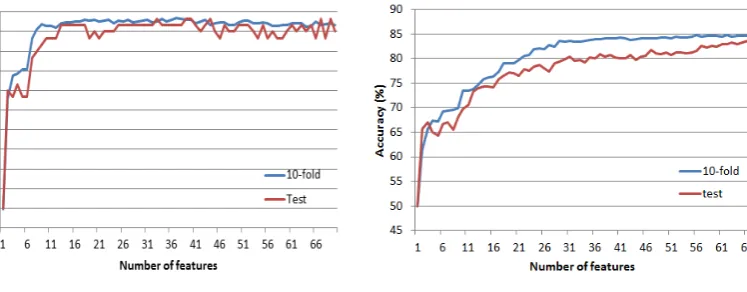
By comparing the document classification re-sults with respect to those obtained for sentences, it can be noticed that the best accuracy is achieved using a set of 30 features: in contrast to sentence classification where adding features keeps increas-ing the performance, more features do not appear to help for document classification. Sentence read-ability classification thus seems to be a more com-plex task, requiring a higher amount of features. This trend emerges more clearly in Figures 1(a) and 1(b), where the classification results on the training set (using 10–fold cross–validation) and the held–out test set are visualized for increas-ing amounts of features selected via GRAFTING. As Figure 1(a) shows, the document classifica-tion task requires about 14 features after which the performance appears to stabilize (97.4% accu-racy for the ten–fold cross-validation and 96.7% for the held–out test set). In contrast, Figure 1(b) shows that sentence classification requires at
least 30 features (83.4% accuracy for the ten–fold cross-validation and 79.9% for the test set).
Noticeable differences can also be observed in the typology of features playing a prominent role in the two tasks. For each feature taken into ac-count, Table 1 reports its ranking as resulting from sentence– and document–based classification ex-periments (columns “Sent. class.” and “Doc. class.” respectively). Note that in interpreting the rank associated with each feature it should be considered that in sentence– and document– classification the number of required features is significantly different, i.e. 30 and 14 respectively: this is to say that approximately the same rank as-sociated to the same feature does not entail a com-parable role across the two classification tasks.
As already pointed out, for both sentences and documents raw text features (i.e. Sentence length
andWord length) turned out to be the top features, leading however to significantly different results: i.e. 80% accuracy for documents vs. 65% for sentences. Among the remaining features, graft-ing results show that syntactic features do play a central role in both sentence– and document– based readability assessment: many of these are highly ranked, with some differences. Syntactic features playing a similar role in both readabil-ity classification tasks include: Verbal root [73],
Parse tree depth[71],‘Chains’ of embedded sub-ordinate clauses[83] and Max. length of depen-dency links [87], covering important aspects of syntactic complexity such as depth of the syntactic dependency (sub–)tree and length of dependency links. Features that are mainly useful for sentence readability turned out to be Arity of verbal pred-icates [74], Pre–verbal subject [75], Post–verbal object [78] and Embedded complement ‘chains’
[72], which can all be seen as representing local features referring to sentence parts. The feature
(a) Document classification (b) Sentence classification
Figure 1: Document vs Sentence classification results
maximum dependency links from each sentence. Whereas [86] plays a similar role for sentences and documents (in both cases it is a middle rank feature), [87] is a global feature playing a more prominent role in document classification.
At the morpho–syntactic level, the feature rank-ing is more comparable. However, it is interest-ing to note that very few morpho–syntactic fea-tures were selected by the feature selection pro-cess: this is particularly true for document classi-fication. This can follow from the fact that these features can be considered as proxies of the syn-tactic structure which in these experiments was represented through specific features: in this situ-ation, the grafting process preferred syntactic fea-tures over morpho–syntactic ones, in spite of the lower accuracy of the dependency parser with re-spect to the part–of–speech tagger. Interestingly, this result is in contrast with what reported by Falkenjack and J¨onsson (2014) for what concerns document readability assessment, who claim that an optimal subset of text features for readability based document classification does not need fea-tures induced via parsing. Among the morpho– syntactic features, it appears that verbal features play an important role: this can follow both by the language dealt with which is a a morphologically rich language, and by the fact that these features do not have a counterpart at the syntactic level.
Lexical features show a much more mixed re-sult. Type–Token Ratio (TTR) is only important for document classification, whereas most of the other features are important for sentence readabil-ity, but not for document readability (with the ex-ception of the presence of ‘fundamental words’ of theBasic Italian Vocabulary).
5 Discussion
Acknowledgments
The research reported in this paper was carried out in the framework of the Short Term Mobility pro-gram of international exchanges funded by CNR (Italy). We thank Dani¨el de Kok for his help in applying TINYESTto our data and Giulia Benotto for her help in manual revision of training data.
References
Sandra M. Alu´ısio, Lucia Specia, Thiago A.S. Pardo, Erick G. Maziero, and Renata P.M. Fortes. 2008. Towards brazilian portuguese automatic text simpli-fication systems. InProceedings of the Eighth ACM Symposium on Document Engineering, pages 240– 248.
Sandra Alu´ısio, Lucia Specia, Caroline Gasperin, and Carolina Scarton. 2010. Readability assessment for text simplification. In Proceedings of the NAACL HLT 2010 Fifth Workshop on Innovative Use of NLP for Building Educational Applications, pages 1–9.
Øistein E. Andersen, Helen Yannakoudakis, Fiona Barker, and Tim Parish. 2013. Developing and testing a self-assessment and tutoring system. In
Proceedings of the Eighth Workshop on Innovative Use of NLP for Building Educational Applications, pages 32–41.
Giuseppe Attardi. 2006. Experiments with a multi-language non-projective dependency parser. In Pro-ceedings of the Tenth Conference on Computational Natural Language Learning (CoNLL-X ’06), New York City, New York, pages 166–170.
Gianni Barlacchi and Sara Tonelli. 2013. Ernesta: A sentence simplification tool for children’s stories in italian. In Proceedings of the 14th Conferences on Computational Linguistics and Natural Language Processing (CICLing 2013), pages 476–487.
Regina Barzilay and Mirella Lapata. 2008. Model-ing local coherence: An entity-based approach. vol-ume 34.
Stefan Bott and Horacio Saggion. 2011. An un-supervised alignment algorithm for text simplifica-tion corpus construcsimplifica-tion. In Proceedings of the Workshop on Monolingual Text-To-Text Generation, pages 20–26.
Dani¨el de Kok. 2011. Discriminative features in reversible stochastic attribute-value grammars. In
Proceedings of the EMNLP Workshop on Language Generation and Evaluation, pages 54–63. Associa-tion for ComputaAssocia-tional Linguistics.
Dani¨el de Kok. 2013. Reversible Stochastic Attribute-Value Grammars. Ph.D. thesis, Rijksuniversiteit Groningen.
Tullio De Mauro. 2000. Il dizionario della lingua ital-iana. Paravia, Torino.
Felice Dell’Orletta, Simonetta Montemagni, and Giu-lia Venturi. 2011. Read-it: Assessing readability of italian texts with a view to text simplification. In
Proceedings of the Workshop on Speech and Lan-guage Processing for Assistive Technologies (SLPAT 2011), pages 73–83.
Felice Dell’Orletta, Simonetta Montemagni, and Giulia Venturi. 2014. Assessing document and sentence readability in less resourced languages and across textual genres. InInternational Journal of Applied Linguistics (ITL). Special Issue on Readability and Text Simplification. To appear.
Felice Dell’Orletta. 2009. Ensemble system for part-of-speech tagging. In Proceedings of Evalita’09, Evaluation of NLP and Speech Tools for Italian, Reggio Emilia, December.
Biljana Drndarevi´c, Sanja ˇStajner, Stefan Bott, Susana Bautista, and Horacio Saggion. 2013. Automatic text simplification in spanish: A comparative evalu-ation of complementing modules. InComputational Linguistics and Intelligent Text Processing, pages 488–500. Springer Berlin Heidelberg.
Johan Falkenjack and Arne J¨onsson. 2014. Classify-ing easy-to-read texts without parsClassify-ing. In Proceed-ings of the ProceedProceed-ings of the 3rd Workshop on Pre-dicting and Improving Text Readability for Target Reader Populations (PITR), Gothenburg, Sweden. Association for Computational Linguistics.
Lijun Feng, Martin Jansche, Matt Huenerfauth, and No´emie Elhadad. 2010. A comparison of features for automatic readability assessment. In Proceed-ings of the 23rd International Conference on Com-putational Linguistics (COLING 2010), pages 276– 284.
Thomas Franc¸ois and C´edrick Fairon. 2012. An “AI readability” formula for french as a foreign lan-guage. In Proceedings of the 2012 Joint Confer-ence on Empirical Methods in Natural Language Processing and Computational Natural Language Learning, Jeju Island, Korea, pages 466–477. Michael J. Heilman, Kevyn Collins, and Jamie Callan.
2007. Combining lexical and grammatical features to improve readability measures for first and second language texts. InProceedings of the Human Lan-guage Technology Conference, pages 460–467. Kentaro Inui, Atsushi Fujita, Tetsuro Takahashi, Ryu
Iida, and Tomoya Iwakura. 2003. Text simplifica-tion for reading assistance: A project note. In Pro-ceedings of the Second International Workshop on Paraphrasing, pages 9–16.
predict readability using diverse linguistic features. In oceedings of the 23rd International Conference on Computational Linguistics, pages 546–554.
J. Peter Kincaid, Lieutenant Robert P. Fishburne, Richard L. Rogers, and Brad S. Chissom. 1975. Derivation of new readability formulas for navy enlisted personnel. In Research Branch Report, Millington, TN: Chief of Naval Training, pages 8– 75.
Annie Louis and Ani Nenkova. 2013. A corpus of sci-ence journalism for analysing writing quality. vol-ume 4.
Simon Perkins, Kevin Lacker, and James Theiler. 2003. Grafting: Fast, incremental feature selection by gradient descent in function space. The Journal of Machine Learning Research, 3:1333–1356.
Maria Emanuela Piemontese. 1996. Capire e farsi capire. Teorie e tecniche della scrittura controllata. Tecnodid, Napoli.
Emily Pitler and Ani Nenkova. 2008. Revisiting readability: A unified framework for predicting text quality. In Proceedings of the 2008 Conference on Empirical Methods in Natural Language Process-ing, pages 186–195.
Sarah E. Schwarm and Mari Ostendorf. 2005. Reading level assessment using support vector machines and statistical language models. In Proceedings of the 43rd Annual Meeting on Association for Computa-tional Linguistics (ACL 05), pages 523–530.
Fadi Abu Sheikha and Diana Inkpen. 2012. Learning to classify documents according to formal and infor-mal style. volume 8.
Johan Sj¨oholm. 2012. Probability as readability: A new machine learning approach to readability as-sessment for written Swedish. LiU Electronic Press, Master thesis.
Adam Skory and Maxine Eskenazi. 2010. Predicting cloze task quality for vocabulary training. In Pro-ceedings of the NAACL HLT 2010 Fifth Workshop on Innovative Use of NLP for Building Educational Applications, pages 49–56.
Sara Tonelli, Ke Tran Manh, and Emanuele Pianta. 2012. Making readability indices readable. In Pro-ceedings of the First Workshop on Predicting and Improving Text Readability for Target Reader Popu-lations, pages 40–48.
Sowmya Vajjala and Detmar Meurers. 2014. On as-sessing the reading level of individual sentences for text simplification. InProceedings of the 14th Con-ference of the European Chapter of the Association for Computational Linguistics (EACL-14), Gothen-burg, Sweden. Association for Computational Lin-guistics.
Sanja ˇStajner and Horacio Saggion. 2013. Readabil-ity indices for automatic evaluation of text simplifi-cation systems: A feasibility study for spanish. In