Morpho-syntactic Regularities in Continuous Word Representations:
A Multilingual Study
Garrett Nicolai†Colin Cherry‡Grzegorz Kondrak†
†Department of Computing Science ‡National Research Council Canada
University of Alberta 1200 Montreal Road
Edmonton, AB, T6G 2E8, Canada Ottawa, ON, K1A 0R6, Canada
{nicolai,gkondrak}@ualberta.ca [email protected]
Abstract
We replicate the syntactic experiments of Mikolov et al. (2013b) on English, and ex-pand them to include morphologically com-plex languages. We learn vector representa-tions for Dutch, French, German, and Span-ish with the WORD2VECtool, and investigate
to what extent inflectional information is pre-served across vectors. We observe that the ac-curacy of vectors on a set of syntactic analo-gies is inversely correlated with the morpho-logical complexity of the language.
1 Introduction
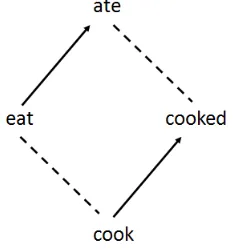
Mikolov et al. (2013b) demonstrate that vector rep-resentations of words obtained from a neural net-work language model provide a way of capturing both semantic and syntactic regularities in language. They observe that by manipulating vector offsets between pairs of words, it is possible to derive an approximation of vectors representing other words, such asqueen≈king−man+woman. Similarly, an abstract relationship between the present and past tense may be computed by subtracting the base form
eat from the past form ate; the result of compos-ing such an offset with the base formcookmay turn out to be similar to the vector forcooked(Figure 1). They report state-of-the-art results on a set of anal-ogy questions of the form “a is to b as c is to ”, where the variables represent various English word forms.
[image:1.612.368.485.226.351.2]Our work is motivated by two observations re-garding Mikolov et al.’s experiments: first, the syn-tactic analogies that they test correspond to morpho-logical inflections, and second, the tests only eval-uate English, a language with little morphological
Figure 1: An example of vector offsets.
complexity. In this paper, we replicate their syntac-tic experiments on four languages that are more mor-phologically complex than English: Dutch, French, German, and Spanish.
2 Replication Experiments
In order to to validate our methodology, we first replicate the results of Mikolov et al. (2013b) on En-glish syntactic analogies.
2.1 Training Corpus for Word Vectors
The vectors of Mikolov et al. (2013b) were trained on 320M tokens of broadcast news data, as de-scribed by Mikolov et al. (2011). Since we have no access to this data, we instead train English vectors on a corpus from the Polyglot project (Al-Rfou et al., 2013), which contains tokenized Wikipedia dumps intended for the training of vector-space models. For comparison with the results of Mikolov et al. (2013b), we limit the data to the first 320M lower-cased tokens of the corpus.
Mikolov et al. (2013b) obtain their best results with vectors of size 1600 that combine several mod-els, but do not elaborate how this composite model was constructed. Instead, we take as a point of ref-erence their second-best model, which employs 640-dimensional vectors produced by a single recursive neural network (RNN) language model.1
Rather than use an RNN model to learn our own vectors, we employ the far simpler skip-gram model. Mikolov et al. (2013a) show that higher accuracy can be obtained using vectors derived using this model, which is also far less expensive to train. The skip-gram model eschews a language modeling ob-jective in favor of a logistic regression classifier that predicts surrounding words. The WORD2VEC
pack-age includes code for learning skip-gram models from very large corpora.2 We train 640-dimensional
vectors using the skip-gram model with a hierarchi-cal softmax, a context window of 10, sub-sampling of 1e-3, and a minimum frequency threshold of 10.
2.2 Test Set
The test set of Mikolov et al. (2013b) is publicly available3. They extract their gold standard
inflec-tions, as well as frequency counts, from tagged newspaper text. Their test set was constructed as follows: after tagging 267M words, the 100 most frequent plural nouns, possessive nouns, compara-tive adjeccompara-tives, and verbal infinicompara-tives were selected. Each was paired with 5 randomly-selected words of the same part-of-speech, and analogy questions were constructed for each word pair. For example, for the pair peopleandcity, two questions are cre-ated:people:person::cities:city, and its mirror: per-son:people::city:cities.
To solve the analogies in this test set, we ap-ply the word-analogy tool that is included with WORD2VEC. For each analogy a : b :: c :?, the
tool searches the entire vocabulary for the vectord
that is most similar to the vector estimated by per-forming a linear analogy on the query tripleta, b, c:
d= argmaxd0 = cos(d0, c+b−a) (1)
We calculate accuracy as the percentage of analogies
1The vectors are available athttp://rnnlm.org. 2https://code.google.com/p/word2vec.
3http://research.microsoft.com/en-us/projects/rnn
Test Set M13 Ours
Adjectives 21.0 18.8
Nouns 40.1 55.2
[image:2.612.362.491.56.115.2]Verbs 54.8 50.6
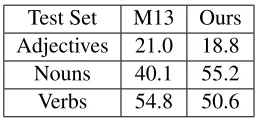
Table 1: The results of replicating the experiments of Mikolov et al. (2013b) on English.
whose answers are correctly predicted, according to an exact match.
The analogies involve nouns, adjectives, and verbs. Nominal analogies consist of comparisons between singular and plural forms, and possessive and nominative forms. Due to the tokenization method used in our training corpus, we are unable to build vectors for English possessives. We therefore modify the nominal test set to only include questions that contain the singular vs. plural distinction. We make no changes to the adjectival and verbal anal-ogy sets. The adjectival set contains analogies be-tween the comparative and the superlative, the com-parative and the base, and the superlative and the base. The verbal set includes comparisons between the preterite, the infinitive, and the 3rdperson singu-lar present, but not the past and present participles.
2.3 Results
In Table 1, we report two numbers for each part of speech. The first, labeled as M13, is the result of ap-plying the vectors of Mikolov et al. (2013b) to their test set. The results match the results reported in their paper, except for the nominal results, which reflect our modifications described in Section 2.2. The removal of the possessives improves the accu-racy from 25.2% reported in the original paper to 40.1%. The second column, labeled as Ours, reports the results for our vectors, which were trained using WORD2VECon the English data described in
Sec-tion 2.1.
3 Multilingual Experiments
Our second set of experiments examine to what ex-tent the syntactic regularities are captured by word vectors in four other languages: Dutch, French, Ger-man, and Spanish.
3.1 Training Corpora for Word Vectors
As in the previous experiment, our training corpora are from the Polyglot project. We limit each cor-pus to the first 320M lowercased tokens, except for the Dutch corpus, which has only 180M tokens. Since the WORD2VECtool cannot handle Unicode,
we map all non-ASCII characters to unused ASCII characters. We run WORD2VEC with exactly the
same hyper-parameters as in Section 2.1. The En-glish experiments in this section use the same train-ing data and vectors as in Section 2, but we construct a new test set to match our methodology for the other languages.
3.2 Test Sets
In order to make results between multiple languages comparable, we made several changes to the con-struction of syntactic analogy questions. We follow the methodology of Mikolov et al. (2013b) in limit-ing analogy questions to the 100 most frequent verbs or nouns. The frequencies are obtained from corpora tagged by TREETAGGER(Schmid, 1994).
We identify inflections using manually con-structed inflection tables from several sources. Spanish and German verbal inflections, as well as German nominal inflections, are from a Wik-tionary data set introduced by Durrett and DeNero (2013).4 Dutch verbal inflections and English
ver-bal and nominal inflections are from the CELEX database (Baayen et al., 1995). French verbal in-flections are from Verbiste, an online French conju-gation dictionary.5
Whereas Mikolov et al. create analogies from var-ious inflectional forms, we require the analogies to always include the base dictionary form: the in-finitive for verbs, and the nominative singular for nouns. In other words, all analogies are limited to
4We exclude Finnish because of its high morphological complexity and the small size of the corresponding Polyglot corpus.
5http://perso.b2b2c.ca/sarrazip/dev/verbiste.html
Set I Q Example
EN-V 5 3096 go:gone see:?
NL-V 9 5136 gaan:gegaan zien:?
DE-V 27 6514 gehen:gegangen sehen:?
FR-V 48 15573 aller:all´e voir:?
ES-V 57 22579 ir:ido ver:?
EN-N 2 876 bear:bears lion:?
[image:3.612.317.538.57.176.2]DE-N 8 1804 B¨ar:B¨aren L¨owe:?
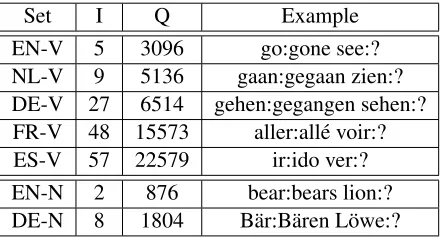
Table 2: The number of inflectional slots (I) and analogy questions (Q) for each language set.
comparisons between the base form and an inflected form. This is to prevent a combinatorial explosion of the number of analogies in languages that contain dozens of different inflection forms. We also create new English test sets using this methodology, in or-der to ensure a fair cross-lingual comparison. Table 2 shows the number of analogy questions for each language set. Note that the languages are ordered according to increasing morphological complexity.
Following Mikolov et al., we ensure that all analo-gies contain at least one pair of non-syncretic forms. It would make little sense to include analogies such as “setis tosetasputis to?” because both verbs in question have the same present and past tense form. However, we do allow analogies which involve syn-cretic forms for one half of the analogy. For exam-ple, eithertakenortookis a correct answer to “play
is toplayedastakeis to?”. These types of questions account for an average of 2.8% of analogies, rang-ing from 0%for English nouns to 8.9%for German verbs.
Set All Inflections Inflection Subset
EN-V 52.6 (21.3k) 52.6 (21.3k)
NL-V 37.8 (4.5k) 33.5 (7.0k)
DE-V 29.4 (5.0k) 40.0 (8.9k)
FR-V 25.9 (0.5k) 45.6 (8.6k)
ES-V 22.8 (0.5k) 48.2 (10.6k)
EN-N 52.2 (46.9k) 52.2 (46.9k)
[image:4.612.84.288.56.176.2]DE-N 28.2 (18.0k) 31.9 (35.6k)
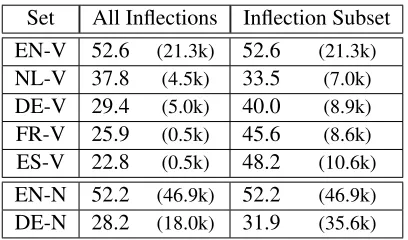
Table 3: Accuracy on analogy questions. The median fre-quencies of the types involved are provided in brackets.
3.3 Results
We conduct two experiments to quantify the extent that the syntactic regularities observed in English hold in the other languages. In the first experiment, which is referred to asAll Inflections, we measure the accuracy of vectors on all inflected forms. In the second experiment, namedInflection Subset, we attempt to factor out the variation in the number of inflectional forms across languages by considering only the forms that are observed in English (five forms for verbs, and two forms for nouns).
The results of the experiments are in Table 3. In the All Inflections column, we see that the overall accuracy decreases as the morphological complex-ity increases. However, theInflection Subsetcolumn reveals an opposite trend: the accuracy is increasing towards the bottom of the table, (although English stands out as a clear exception). Looking across the rows, the accuracy on the inflection subset is higher than on all inflections, except on Dutch. Noun analo-gies are only tested on two languages, but they seem to follow the same trends as verbs.
The results in Table 3 are not easy to interpret. It appears the lower frequencies of multiple inflected word forms make the task more difficult, which is reflected in the All Inflectionsresults. The median frequencies of individual verb forms in French and Spanish are approximately one-tenth of the corre-sponding numbers in Dutch and German, which in turn are about one-fourth of the English median. However, these ratios are not neatly correlated with the accuracy results in Table 3.
Regarding the contrasting results in theInflection Subset column, we conjecture that a larger
num-ber of inflections may makeindividual formseasier to disambiguate. This in turn allows WORD2VEC
to learn more precise vectors for each word type. The median frequencies of the forms in the inflec-tion subset tend to be higher than the correspond-ing values computed for all inflections, but there is a substantial variation between different languages. Dutch, in particular, sees a similar increase in me-dian frequency to German, but while German accu-racy increases, Dutch decreases. We conclude that although frequency is an important factor when per-forming syntactic analogies with vectors, there must be other factors contributing to these results.
It is perhaps unsurprising that English is the win-ner on its own inflection set. However, another rea-son that English does not follow the trend in the
Inflection Subsetcolumn may be related to the fre-quencies of its small set of wordforms, which are uniformly higher than in other languages. The ex-periments that we describe in the next section pro-vide additional insights into these results.
4 Hyper-Parameter Experiments
In this section, we describe experiments that quan-tify how the quality of the vectors is affected by the window size and the amount of training data.
4.1 Window size
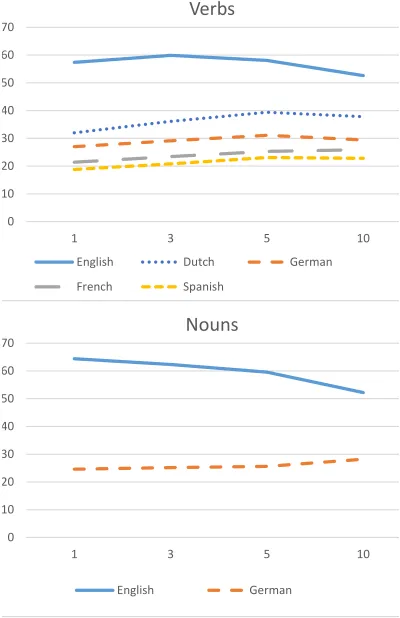
First, we investigate the role that the window size has on the accuracy of learned vectors. We expect that larger window sizes may create more topic-oriented vectors, while small windows result in vectors that capture syntactic information (Turney, 2012). While all experiments in Section 3 used a window size of 10, the languages have different syn-tactic and morphological patterns, and some of the results observed in Section 3 may simply be a side effect of better or worse window sizes for particular languages. We run an experiment that tests window sizes of 1, 3, 5 and 10, calculating the analogy accu-racy for each language and each window size.
0 10 20 30 40 50 60 70
1 3 5 10
Verbs
English Dutch German French Spanish
0 10 20 30 40 50 60 70
1 3 5 10
Nouns
[image:5.612.326.528.56.367.2]English German
Figure 2: Accuracy for different context windows.
which may be important when each type is observed less frequently. Our next experiment directly inves-tigates the impact of the training data size.
4.2 Learning curves
In this section, we investigate how varying the size of the vector training data affects the vector accu-racy. We progressively subsample the training data: starting with the complete training set, we construct a 50% subsample by selecting each sentence for in-clusion with probability 0.5. We then iterate this process, each time sampling roughly 50% of the sen-tences from the previously created subsample, until we have a subsample that is only 1.6% of the orig-inal training data. This gives us training sets with approximately 1.6, 3.1, 6.3, 12.5, 25, 50, and 100% of the full corpora. We set the window size to 5 for this experiment; the other hyper-parameters are the same as those in Section 2.1.
The learning curves for verbs and nouns are shown in Figure 3. We see that the trends observed
0 10 20 30 40 50 60 70
1.6 3.1 6.3 12.5 25 50 100
Verbs
English Dutch German
French Spanish
0 10 20 30 40 50 60 70
1.6 3.1 6.3 12.5 25 50 100
Nouns
[image:5.612.85.285.61.370.2]English German
Figure 3: Learning curves.
in Section 3 hold regardless of the amount of data that is used for training: namely, the accuracy of the vectors is inversely correlated with the number of inflection slots in a given language set. Secondly, while the English curves are beginning to level off, the curves for the other languages continue to rise, even as we reach 100%of our data. This suggests that there would be little gain in adding more En-glish data, but a potential gain to be seen by adding more data to the other languages. This seems to sup-port our hypothesis that the sparsity of the data is at least partially responsible for the lower accuracies on the morphologically complex languages.
5 Conclusion
in-versely proportional to morphological complexity, as measured by the number of inflections in the lan-guage. When we limit our test set to the small set of inflections common across languages, we see im-provements in the accuracy, which positively corre-late with the complexity of the language. This sug-gests that for frequently observed phenomena, mor-phological complexity may be an advantage, making each type distinct and easier to model. Additional experiments suggest that the accuracy on more com-plex languages may further improve if more training data is provided.
These results suggest two possible avenues for future work. The first is to build morphologically-aware vectors, such as those of Botha and Blunsom (2014), so that the more morphologically complex languages can make better use of limited training data. The second is to investigate methods that can distinguish syncretic forms in context. For example, it could be possible to modify the joint word-sense and vector induction algorithm of Neelakantan et al. (2014) to focus on syntactic parts-of-speech instead of topical senses.
Acknowledgments
This research was supported by the Natural Sciences and Engineering Research Council of Canada, and the Alberta Innovates – Technology Futures.
References
Rami Al-Rfou, Bryan Perozzi, and Steven Skiena. 2013. Polyglot: Distributed word representations for multi-lingual NLP. InProceedings of the Seventeenth Con-ference on Computational Natural Language Learn-ing, pages 183–192, Sofia, Bulgaria, August. Associa-tion for ComputaAssocia-tional Linguistics.
Harald R. Baayen, Richard Piepenbrock, and Leon Gu-likers. 1995. The CELEX Lexical Database. Release 2 (CD-ROM). Linguistic Data Consortium, University of Pennsylvania, Philadelphia, Pennsylvania.
Jan A. Botha and Phil Blunsom. 2014. Compositional Morphology for Word Representations and Language Modelling. In Proceedings of the 31st International Conference on Machine Learning (ICML), Beijing, China, jun. *Award for best application paper*. Greg Durrett and John DeNero. 2013. Supervised
learn-ing of complete morphological paradigms. In HLT-NAACL, pages 1185–1195.
Tomas Mikolov, Anoop Deoras, Daniel Povey, Lukas Burget, and Jan Cernocky. 2011. Strategies for training large scale neural network language models. InAutomatic Speech Recognition and Understanding (ASRU), 2011 IEEE Workshop on, pages 196–201. IEEE.
Tomas Mikolov, Kai Chen, Greg Corrado, and Jeffrey Dean. 2013a. Efficient estimation of word representa-tions in vector space. InProceedings of Workshop at ICLR, 2013.
Tomas Mikolov, Wen-tau Yih, and Geoffrey Zweig. 2013b. Linguistic regularities in continuous space word representations. In HLT-NAACL, pages 746– 751.
Arvind Neelakantan, Jeevan Shankar, Alexandre Passos, and Andrew McCallum. 2014. Efficient nonparamet-ric estimation of multiple embeddings per word in vec-tor space. InProceedings of EMNLP.
Helmut Schmid. 1994. Probabilistic part-of-speech tag-ging using decision trees. InProceedings of the inter-national conference on new methods in language pro-cessing, volume 12, pages 44–49. Citeseer.
Peter D Turney. 2012. Domain and function: A dual-space model of semantic relations and compositions.