An Analysis of the Ability of Statistical Language Models to Capture the
Structural Properties of Language
Aneiss Ghodsi and John DeNero
Computer Science Division University of California, Berkeley
{aneiss, denero}@berkeley.edu
Abstract
We investigate the characteristics and quan-tifiable predispositions of both n-gram and re-current neural language models in the frame-work of language generation. In modern ap-plications, neural models have been widely adopted, as they have empirically provided better results. However, there is a lack of deep analysis of the models and how they relate to real language and its structural properties. We attempt to perform such an investigation by analyzing corpora generated by sampling from the models. The results are compared to each other and to the results of the same anal-ysis applied to the training corpus. We carried out these experiments on varieties of Kneser-Ney smoothed n-gram models and basic recur-rent neural language models. Our results re-veal a number of distinctive characteristics of each model, and offer insights into their be-havior. Our general approach also provides a framework in which to perform further analy-sis of language models.
1 Introduction
Statistical language modelling is critical to natural language processing and many generation systems. In recent years use has shifted from the previously prevalent n-gram model to the recurrent neural net-work paradigm that now dominates in most applica-tions. Researchers have long sought to find the best language modeling solutions for particular applica-tions, but it is important to understand the behav-ior of language models in a more generalizable way. This is advantageous both in developing language
models and in applying them practically. Whether in tasks where statistical models are used to directly generate language or in cases where the model is used for ranking for surface realization, the statis-tical predispositions of the language model will be reflected in the results. In this paper we compare the behavior of n-gram models and Recurrent Neural Network Language Models (RNNLMs) with regard to properties of their generated language.
We use the SRILM toolkit for training and gen-erating from n-gram models (Stolcke and others, 2002). Our n-gram model is a modified Kneser-Ney back-off interpolative model, unless otherwise stated (Chen and Goodman, 1999). We use Tomas Mikolov’s implementation of an RNNLM, avail-able at rnnlm.org (Mikolov et al., 2010). This model has a single hidden recurrent layer, and three defining parameters: class size, hidden layer size, and backpropagation through time (BPTT) steps. Classes are used to factor the vocabulary mappings to improve performance, by predicting a distribution over classes of words and then over words in a class (Mikolov et al., 2011). BPTT steps determine how many times the recurrent layer of the network is un-wrapped for training. Unless otherwise mentioned all neural models have class of 100 and use four BPTT steps. We use the Penn Tree Bank (PTB), constructed from articles from the Wall Street Jour-nal, as our primary training corpus, with the stan-dard training split of 42068 sentences (Marcus et al., 1993). Correspondingly, our generated language corpora also contain 42068 sentences. Novel sen-tences are easily sampled from trained language models by prompting with a start of sentence token,
Figure 1:Sentence Length Distributions
sampling from the predicted distribution, using the result as context, and repeating until an end of sen-tence token is encountered.
We select three primary metrics with which to evaluate the various resulting corpora. The first is the distribution of sentence lengths. Sentence length is compared visually and through the sum of error as compared to the length distribution from the training corpus. The second metric is word frequency. Word frequency is analyzed by fitting a Zipfian distribu-tion (Kingsley, 1932), and comparing between the distributions for each model. Third is pronoun fre-quency relative to distance from the start of a sen-tence. This was selected as a metric due to the fact that one-word pronouns are a small class fairly eas-ily identifiable regardless of context (though there are a few that can be other parts of speech), partly avoiding the ambiguities and challenges that follow from part of speech taggers. This is especially useful in a corpus with a restricted vocabulary resulting in the replacement of uncommon tokens with a single token, such as the PTB, and with generated language that is not always semantically sound. These experi-ments were repeated multiple times with small vari-ations, ensuring the key patterns in the results were not a product of chance.
Through these three metrics we seek to develop some insights into the behavior of standard stochas-tic models in language generation.
2 Sentence Lengths
The natural expectation is that a recurrent neural model, with its superior ability to ‘remember’
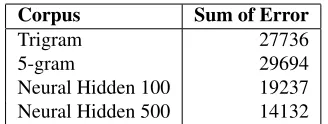
com-Corpus Sum of Error
Trigram 27736
5-gram 29694
Neural Hidden 100 19237 Neural Hidden 500 14132
Table 1:Sum of errors for sentence lengths, including normal-ized over total sentences.
plex context, would vastly outperform even fairly high order n-gram models in modeling sentence length. While in training errors are only propagated as far back as truncated backpropagation is executed (the BPTT steps hyperparameter), the power of the recurrent layer seems to exceed its apparent depth during training, taking advantage of the ability of re-current memory to retain subtle contextual informa-tion. As seen in Figure 1, even the four BPTT step model performs fairly well. Contrastingly, n-gram models perform very poorly. Table 1 notes the sum of the absolute errors across the full range of mod-els. N-gram models exhibit no improvement with increasing order. In neural production, however, we see substantial improvements with increasing net-work complexity; specifically, with an increase in the size of the hidden layer and the number of BPTT steps. However, the neural models tested here are unable to replicate the precise shape of the distribu-tion. All models overestimate the incidence of very long sentences.
3 Vocabulary Distribution
Zipf’s Law states that, forN unique words andsas the defining parameter, the frequency of a word with rankkis given by the following (Kingsley, 1932):
f(k;s, N) = PN1/ks n=1(1/ns)
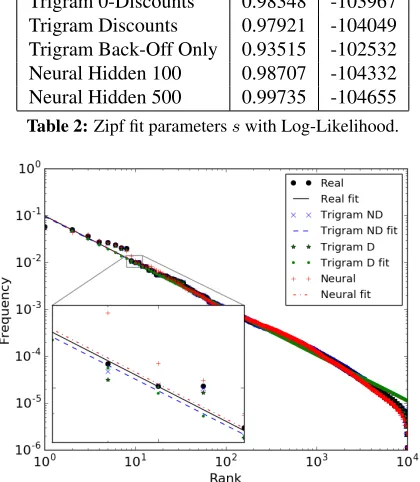
There are two aspects of evaluation for word fre-quencies: First, the difference between the Zipf parameters of distributions fitted to various text sources; second, the error on the data set to which a Zipfian distribution is fitted, indicating how closely the data follows a distribution known to match natu-ral language production.
[image:2.612.345.509.56.118.2]Corpus s LL
Real 0.99193 -104598
[image:3.612.318.528.55.218.2] [image:3.612.90.285.56.153.2]Unigram 0-Discount 0.99293 -104416 Trigram 0-Discounts 0.98348 -103967 Trigram Discounts 0.97921 -104049 Trigram Back-Off Only 0.93515 -102532 Neural Hidden 100 0.98707 -104332 Neural Hidden 500 0.99735 -104655 Table 2:Zipf fit parametersswith Log-Likelihood.
Figure 2:Zipf Distributions
approach the same distribution as real language, due to the fact that a unigram model behaves like direct sampling of words from the training corpus. Thus it is intuitive that the interpolated models, in which unigram information always influences generation, performs better than a simple Kneser-Ney back-off model. Critically, on any configuration, non-zero discounting seems to worsen the distribution. As discounting is a method by which probability is held out to distribute amongst less likely or unseen se-quences or tokens, it is reasonable that it would af-fect the distribution. Figure 2 shows the distributions from a selection of models on a log-log scale, with the trigram model with non-zero discounts (D) and with zero discounts (ND).
4 Pronoun Frequency with Depth
Finally, we observe the probability of encountering a pronoun at an index according to the following ex-pression:
P
s∈sentencess[i]∈pronouns P
s∈sentenceslen(s)≥i+ 1
[image:3.612.79.289.99.340.2]We find that there is a spike in the probability
Figure 3:Pronoun Probability with Position
of encountering a pronoun as the first word in a sentence, to approximately 0.15, an intuitive result given the prevalence of pronouns as sentence sub-jects. All models captured this fairly well. More in-terestingly, the probability of generating or observ-ing a pronoun decreases with depth into a sentence. This phenomenon is clearly observable in the train-ing set, with a fairly linear slope, which we cal-culate to be approximately −6.9×10⁻⁴ when re-stricted to the first twenty indices, excluding zero, due to the low number of samples at further posi-tions in the sentence causing noise to dominate. In order to verify this result, the slope was calculated by sampling 20 subsets of sentences and averaging the slope across subsets. A comparable slope exists even when the domain is restricted to a set of sen-tences all of the same length (for example fourteen word sentences). This means the phenomenon is not an artifact resulting from the distribution of sentence lengths and a relationship between pronoun occur-rences and sentence endings.
first ten to twenty words, but with depressed overall probabilities, and a loss of the pattern after a certain depth. Figure 3 also shows that increasing RNNLM complexity, whether in class, hidden size, or number of BPTT steps, does little to change the performance of the model in this metric.
This is concerning regarding the ability of this form of RNNLM to capture certain complex struc-tural patterns, and indicates that the structure is in-herently limited. It may be that a model with a Long-Short Term Memory unit (LSTM) as the re-current component could perform better, with its superior ability to capture longer term contextual dependencies (Hochreiter and Schmidhuber, 1997). Indeed, LSTMs have become highly popular in many sequential learning tasks. However, given that these same basic RNNLMs performed well in the position-dependent sentence length metric, this re-sult is disappointing.
5 Future Work
There are a number of clear steps to expand on this line of research, including experimenting with a greater variety of language models. In particular, a recurrent model with a Long Short-Term Memory unit (LSTM) might improve on the weaknesses of the simple RNNLM demonstrated here.
Additionally, further diversification of data sets is important to learning about patterns as they differ or remain consistent across sources. For example, preliminary analysis of the more stylistically diverse Brown corpus (Francis, 1964) indicates that the pro-noun trend observed in the PTB may not be present in other domains, at least not as clearly. Addition-ally to profiling models on specific text genres, the experiments must be recreated on a far more sizeable dataset, such as the Wikipedia text corpus.
Finally, the introduction of new metrics to the lan-guage model analysis could add further value. Auto-matic tagging and parsing systems are likely to suf-fer from significant inaccuracy on the often flawed text produced by stochastic models; however, the results from applying such systems could prove in-formative about language model quality, as a model is not effectively capturing structural and semantic properties of language if parsing and tagging results statistics are not comparable to those of real
lan-guage. Statistical analysis of parsing results would help expand the quantitative portrait of a language model.
6 Conclusion
Our work characterizes some key structural proper-ties of language generated from two common sta-tistical models. The results presented here ver-ify many of the expectations regarding the behav-ior of n-gram and RNN techniques, and also intro-duce some new observations. RNNs have a struc-tural capacity largely missing from n-gram models, which is particularly apparent in sentence length dis-tributions. The recurrent model used here, however, struggled in reproducing the more complex pattern represented by the pronoun distribution over posi-tion. The results of the Zipfian distribution analysis indicate that neural networks with reasonable com-plexity are capable of approaching the correct vo-cabulary distribution, and competing favorably with the most vocabulary-optimized n-gram models. We found some interesting phenomena where smooth-ing, especially with high order n-gram models, flat-tened the Zipf distribution. At the very least we see that basic RNNLMs exhibit no real weaknesses next to n-gram models, beyond training time.
Overall, the methods we present here comprise an approach to language model analysis that is more in-dependent from specific applications than previous reviews of language model performance. By select-ing structural properties of language that are mea-surable and ideally equally valid on real and sam-pled language, it is possible to characterize language models and examine their learning capacities and predispositions in generation and ranking. Future avenues of investigation in line with this paradigm can provide more detailed portraits and serve as guidance both in the selection of models for applica-tions and for further developments in statistical lan-guage modeling.
Acknowledgments
References
Stanley F Chen and Joshua Goodman. 1999. An empir-ical study of smoothing techniques for language mod-eling.Computer Speech & Language, 13(4):359–393. Winthrop Nelson Francis. 1964. A standard sample of
present-day english for use with digital computers. Sepp Hochreiter and J¨urgen Schmidhuber. 1997. Long
short-term memory. Neural computation, 9(8):1735– 1780.
Zipf George Kingsley. 1932. Selective studies and the principle of relative frequency in language.
Mitchell P Marcus, Mary Ann Marcinkiewicz, and Beat-rice Santorini. 1993. Building a large annotated cor-pus of english: The penn treebank. Computational lin-guistics, 19(2):313–330.
Tomas Mikolov, Martin Karafi´at, Lukas Burget, Jan Cer-nock`y, and Sanjeev Khudanpur. 2010. Recurrent neural network based language model. In INTER-SPEECH, volume 2, page 3.
Tom´aˇs Mikolov, Stefan Kombrink, Luk´aˇs Burget, Jan ˇCernock`y, and Sanjeev Khudanpur. 2011. Extensions of recurrent neural network language model. In2011 IEEE International Conference on Acoustics, Speech and Signal Processing (ICASSP), pages 5528–5531. IEEE.