Building a learner corpus for Russian
∗Ekaterina Rakhilina Anastasia Vyrenkova Elmira Mustakimova
National Research University Higher School of Economics 21/4, Staraya Basmannaya Ulitsa, 105066, Moscow, Russia
erakhilina,avyrenkova,[email protected]
Alina Ladygina
Eberhard Karls Universit¨at T¨ubingen 19-23, Wilhelmstrasse,
72074, T¨ubingen, Germany
Ivan Smirnov Sholokhov Moscow State University for the Humanities
3/7a Vladimirskaya Ulitsa, 111123, Moscow, Russia
Abstract
In this paper we describe an open learner cor-pus of Russian. The Russian Learner Corcor-pus (RLC) is the first corpus with clear distinction between foreign language learners and her-itage speakers. We discuss the structure of the corpus, its development and the annota-tion principles. This paper describes the plat-form of the RLC which combines online tools for text uploading, processing, error annota-tion and corpus search.
1 Introduction
Designing learner corpora has become a rapidly de-veloping branch of corpus linguistics, which is ac-counted for by obvious reasons — both research and practical. As annotated collections of texts produced by non-native speakers of a certain language, learner corpora open up new horizons in areas, such as quantitative studies in second language acquisition, contrastive interlanguage analysis (Granger, 1996), etc., and the urge for well-organized error classifica-tion and frequency based error analysis can hardly be overestimated for language teaching. Moreover, computerized learner data serve as training and test data sets for various NLP tasks, such as native lan-guage identification task (Jarvis and Paquot, 2015),
∗
Support from the Basic Research Program of the National Research University Higher School of Economics is gratefully acknowledged.
automatic error detection (Leacock et al., 2014), etc. The goal of this paper is to present a recently created Russian Learner Corpus (RLC)1. The novelty of the RLC is threefold:
1. It is the first open learner corpus for the Russian language enabling search over lemma, gram-matical features, and error tags;
2. It is the first learner corpus that draws a clear distinction between HL (heritage language)2
and L2 (second language) speakers;
3. It is built on an integrated multifunctional plat-form that provides a single interface for upload-ing, annotating and search.
Russian Learner Corpus is an international project carried out by the Linguistic Laboratory for Corpus Technologies at the Higher School of Economics in close collaboration with experts from more than 10 countries (see “Our partners” at http://www.web-corpora.net/RLC). The corpus currently comprises more than 730000 tokens. 56 per cent of the data is produced by L2 learners of Russian, 44 per cent - by heritage speakers of Russian, who are college/university-age students at the proficiency
1RLC is available at http://web-corpora.net/
RLC.
2
level of intermediate and higher. The first version of the RLC contained only texts from American English-dominant speakers of Russian. The num-ber of dominant languages has by far grown to eight. Three of them are at the moment scarcely presented in the corpus, however, more data on them and two more languages are being prepared for upload. A valuable part of the RLC is a large longitudinal sub-corpus of academic writing called RULEC collected by Olessya Kisselev and Anna Alsufieva. All the respondents signed a special consent form and their names are anonymized in the corpus. In the lon-gitudinal RULEC the speakers were assigned fake names so that the user could easily trace the progress of each student. Other respondents are assigned a unique students code.
In Section 2 we give an overview of similar projects developed for the Russian language. Sec-tion 3 describes corpus data and metainformaSec-tion provided to each text. Section 4 presents annota-tion principles, and Secannota-tion 5 focuses on character-istics of the corpus platform. In Section 6 we will make some concluding remarks and discuss our fu-ture work.
2 Related works
To date there have been several projects focus-ing on Russian as a target language for learners. Among them are studies based on collections of narratives (Protassova, 2016; Isurin and Ivanova-Sullivan, 2008; Polinsky, 2008), academic writing repositories (e.g. Corpus of Russian Students Texts (Zevakhina and Dzhakupova, 2015), ReBiSlav3) and learner translations (Russian Learner Transla-tor Corpus, see (Kutuzov and Kunilovskaya, 2014). Despite their obvious usefulness and prominence, however, none of these projects can be named a full-fledged learner corpus for the reasons that we outline below.
Narrative collections present a huge interest for teachers and linguists studying non-native speech (see (Pavlenko, 2008) for more detail), yet those that are listed above are relatively small, closed and used for specific purposes of a researcher, which
in-3
http://www.uni-regensburg.de/ sprache-literatur-kultur/slavistik/ rund-ums-institut/korpora/rebislav
evitably entails heterogeneity in annotation princi-ples. The Corpus of Russian Student Texts (CoRST) is an open annotated resource, however, it consists of the samples of academic writing produced by native speakers of Russian, and thus the understanding of the termlearnerfor this project is not at all common, as it implies the process of mastering a new regis-ter of Russian by native Russian speakers. Transla-tion corpora are tradiTransla-tionally granted a special status primarily because they contain constrained language production and should be particularly designed.
Another important feature of the RLC is that it allows for differentiating between heritage and L2 production. Contrasting heritage speakers and L2 learners has attracted much attention from both ped-agogical and theoretical researchers in the recent decades. At the same time learner corpora do not normally incorporate data on heritage production or probably do not make any clear distinction between heritage and L2 texts. There are also several collec-tions solely devoted to Heritage Russian data (Cor-pus for Heritage Language Variation and Change4, (Polinsky, 2008). However, to our knowledge, by far there have been no open annotated resources cover-ing both L2 and heritage data.
Thus, the Russian Learner Corpus (RLC) that we wish to present here is the first collection of oral and written texts by Heritage and L2 speakers of Russian integrated under a single interface and annotated ac-cording to single principles.
3 Data
The corpus consists of two data subsets: the first subset is composed of texts produced by second lan-guage learners of Russian (about 2000 texts), and the second one contains written texts and transcripts of speech by Russian heritage speakers (about 1500 texts). The texts were collected by our colleagues who are teaching Russian as a second or heritage language and/or making their research in SLA and heritage linguistics. The students filled in the form of consent and a sociolinguistic questionnaire. RLC represents the texts of Russian language learners who have 5 different dominant languages (Ameri-can English, French, Korean, Kazakh, and German,
4http://projects.chass.utoronto.ca/ngn/
including Swiss German).
Furthermore, the data from Italian, Serbian, Japanese, Swedish, Norwegian and Dutch students are going to be released soon. The sampling of dom-inant languages is explained by two reasons: we were initially aiming at presenting typologically dif-ferent L1 in the sample, and presenting texts coming from both foreign and Post-Soviet countries. Cur-rently, however, there is a bias in the data that is spelled out by its accessibility. The corpus also rep-resents various genres: essays and summaries of the articles on social, cultural, historical, political and ecological topics, abstracts of term-papers, bi-ographical stories, blogs and narratives (cartoon and pictures description).
3.1 Metadata
In order to successfully use a corpus a researcher should be provided with relevant information about the origins and specific features of the data, i.e. metadata. Well-organized metadata enables setting various options for individual subcorpora thus pro-viding efficient search and broader opportunities for data analysis. It also gives a clear picture of overall corpus statistics.
According to Tono (2003), there are three major categories in learner corpora design: (a) language-related criteria (e.g. mode, medium, genre, topic), (b) task-related criteria (e.g. longitudinal vs. cross-sectional; spontaneous vs. prepared), and (c) learner-related criteria (e.g. EFL or ESL, age, gen-der, mother tongue, overseas experience). This clas-sification served as a starting point for developing metatextual markup for RLC and led us to determin-ing a set of 8 metadata items grouped into 2 cate-gories: author-related and text-related.
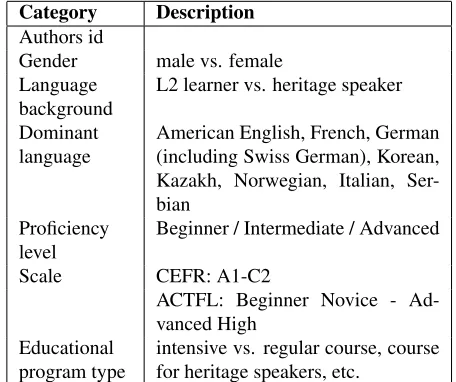
Among author-related items are author’s unique code, gender, language background (HL vs L2), dominant language, proficiency level and educa-tional type. Proficiency level is ascribed accord-ing to the Common European Framework of Ref-erence for Languages (CEFR) and American Coun-cil on the Teaching of Foreign Languages (ACTFL). These scales are most commonly used by language teachers in the USA and Europe, and the majority of texts in the corpus are authored by students with the proficiency level thus assessed. For search uni-fication, we have introduced three general tags for
student proficiency (“Beginner”, “Intermediate” or “Advanced”), they also allow to specify the level of students attested in line with other principles. Pro-ficiency level is assigned by the teacher against the scale they work with.
The text related data include mode (oral or writ-ten), genre, and time limit. The list of genres avail-able for the corpus metadata was developed in col-laboration with the teachers of Russian as a Foreign Language from our partner universities and repre-sents the most common tasks that students of Rus-sian complete to train free production skills (listed in Table 1 - 2). A more elaborated system of gen-res is pgen-resented in RULEC. We ask our partners to provide only free production data, however we dont have any exact information on whether students use any reference materials. In some cases the reliance on extra sources can be inferred from the task (cf. paraphrase or book description).
Category Description
Authors id
Gender male vs. female Language
background
L2 learner vs. heritage speaker
Dominant language
American English, French, German (including Swiss German), Korean, Kazakh, Norwegian, Italian, Ser-bian
Proficiency level
Beginner / Intermediate / Advanced
Scale CEFR: A1-C2
ACTFL: Beginner Novice - Ad-vanced High
Educational program type
intensive vs. regular course, course for heritage speakers, etc.
Table 1:Author-related metadata
Category Description
Mode Written / Oral
[image:3.612.312.540.360.551.2]Genre Answers to questions, academic es-say, non-academic eses-say, blog, let-ter, story, paraphrase, definition, bi-ography, description, summary Time limit limited / unlimited
4 Annotation
The texts in RLC are provided with morphological and error annotation.
Morphological markup is carried out automati-cally with help of the morphological analyzer MyS-tem (Segalovich and Titov, 1997). The tag set of 52 morphological labels5 meets the standard estab-lished by Russian National Corpus (ruscorpora.ru). However, morphological ambiguity is not resolved automatically: every ambiguous word is provided with all possible grammatical analyses, so the texts need to be manually disambiguated.
While designing the error annotation scheme for RLC, we took into account annotation schemes used in other learner corpora, such as ICLE (Granger, 1998), Cambridge Learner Corpus (Nicholls, 2003), FALKO (Reznicek et al., 2012) and ( ˇStindlov´a et al., 2013). Although these tagsets differ in granular-ity and error categories, it was necessary to compare various approaches. The annotation scheme of the Czech Learner Corpus was particularly relevant for our project, since Czech and Russian, both belong-ing to Slavic languages, share certain error types, e.g. inflectional and aspectual errors.
Furthermore, we examined error classifications created for Russian which describe common error types in the speech of Russian monolingual chil-dren (Tsejtlin, 1982; Rusakova, 2013), Russian first-generation emigrants (Zemskaya, 2001), Rus-sian L2 learners and heritage speakers (Polinsky, 2006; Polinsky, 2010; Ovchinnikova and Pavlova, 2016). Having compared these classifications, we identified common errors, typical for all categories of Russian language learners, and error particularly frequent for heritage speakers and second language learners. Such error types were included in our error tagset. Furthermore, the error taxonomy was dis-cussed with foreign language teachers of Russian and SLA researchers, collaborating with our project, and was additionally refined according to their sug-gestions.
The resulting error tagset consists of two tag classes: linguistic error classification and target
5
The tags contain information about parts of speech and all grammatical categories of the Russian language: gender, num-ber, case, animacy, aspect, tense, mood, person, transitivity, voice, degree, full/short form.
modification taxonomy. According to Tono (2003), at least these two aspects should be included into error annotation scheme. The first group of tags defines an error in terms of linguistic types, e.g. derivational errors, agreement errors etc. Our clas-sification includes broad categories corresponding to different levels of linguistic description, such as spelling, morphological, syntactic, lexical errors and errors in the use of constructions6
Each of these classes contains more specific error types. For instance, morphological errors comprise non-word errors, such as incorrect stem alternation, inflectional and derivational errors, as well as incor-rect derivation of plural/singular for pluralia and sin-gularia tantum nouns. We tried to avoid inclusion of infrequent error types in our tagset, in order to make it manageable for annotators. Therefore, the errors which do not correspond to more specific error types present in the tagset, are marked with a more gen-eral tag (e.g. “Morph” for morphological mistakes, “Syntax” for other syntactic errors etc.)
The target modification tags denote alternations of learner errors comparing to correct target element, such as deletion, insertion, substitution, transposi-tion. These are used only in combination with the linguistic tags. Also, we included an additional tag marking cases of language transfer. As the influ-ence of L1 can occur on different levels (spelling, morphology, syntax, lexical use), this tag should be combined with a linguistic error type, similar to tar-get modification tags.
Along with the tagset, we needed to formulate error annotation principles in order to reduce sub-jectivity in annotation process and assure reliable inter-annotator agreement. The focus of error an-notation in RLC is on severe spelling, grammatical and lexical errors which result in anomalous produc-tion. These errors should be corrected with minimal changes of the initial sentence, following the princi-ple of the so-called first target hypothesis (Reznicek et al., 2013; Meurers, 2015). Hence, stylistic,
dis-6The term construction is broadly used within the
course and pragmatic errors are not taken into ac-count, since correction and annotation of such er-rors might require deeper interpretation of a learners utterance and this might lead to high variation in an-notators decisions.
4.1 Inter-annotator agreement experiment
The error annotation is performed by students of lin-guistics and supervised by our team. Currently, the RLC annotation tool does not allow two annotators to work on the same texts without seeing the annota-tion decisions of each other. Therefore, we designed an offline inter-annotator agreement experiment in order to evaluate the consistency of annotation and to reveal ambiguous tags and/or inconsistencies in annotation guidelines.
The experiment was conducted on the sample consisted of 50 texts (8547 tokens in total) written by English and German L2 students. The annota-tion was made in files retrieved from the corpus. These have the following format: every word was presented on a separate line consisting of 6 columns — sentence number in the database, word, number of words in sentence, error tags, error correction, and annotator code.
Each text was annotated by two annotators (6 pairs in total). Before tagging each participant re-ceived 5 trial texts which were checked by super-visors. The most common mistakes were discussed with the annotators and outlined in the annotation guidelines. Afterwards the experimental sample was annotated, the tag mismatches were counted and Co-hens kappa coefficient (Cohen, 1960) was calcu-lated.
We assume that relatively low agreement (the highest score was obtained for syntactic (0.317) and spelling (0.249) errors, while the lowest coefficient of 0.185 was achieved for errors in constructions) was primarily caused by the lack of more detailed annotation guidelines. Although the current guide-lines list the definition of all the tags and illustrate them with corresponding examples, difficult or am-biguous cases have not been outlined yet. Thus, the annotators made typical errors and did not distin-guish between close error types, such as lexical er-rors and erer-rors in constructions or spelling and in-flectional errors. Moreover, since the experiment was performed outside the corpus platform, the
an-notators had to accommodate to a new data format and workflow, which might also serve as a source for inconsistent annotation. Therefore, an extensive annotation training might help to increase the inter-coder agreement score.
Having analyzed discrepancies in annotation, we decided to elaborate new annotation guidelines in or-der to improve the annotator agreement rate. We believe that this will lead to better results in the next session of our inter-annotator agreement exper-iments.
5 Corpus platform and tools
The corpus platform is a powerful and complex tool which enables various search options for re-searchers.
5.1 Development
The previous version7of the platform included only texts written by American learners of Russian; it also had no integrated annotation tool. Corpus users had only access to search interface and they could not upload their own texts or annotate them. The corpus workflow during that time was extremely time-consuming and ineffective. First, the contrib-utors needed to send the texts to the corpus chief, who then sent these texts to annotators. The lat-ter ran plain texts through morphological analyzer, which transformed them into XML files, and then annotated these XMLs using ”Les Crocodiles”8 an-notation software which works only on Windows. In the next stage, the annotated texts were collected by the chief and sent to the database manager, who up-loaded the texts to the corpus server and converted them into a special format, required to run the texts through the database indexator. As a result, we de-cided to automate the routine steps of the workflow and to enable the access to annotation for any OS (Windows, Mac, Linux).
The new platform is powered by Django, a web-framework written in Python programming lan-guage. The texts are kept in a MySQL database,
7
The first version of the platform is available at http: //web-corpora.net/RussianLearnerCorpus/ search/
8The tool ”Les Crocodiles” 2.7. was developed by Timofey
which has dedicated tables for each of the text lay-ers: metadata layer, sentence layer, morphological and error annotation layers. Such structure and the general Django framework allow to automate the majority of text processing. We also solved the OS problem by creating web-application for annotation, i.e. the annotation tool only needs a browser and In-ternet access and does not depend on the annotator’s OS. In the following sections we describe the new features of the corpus.
5.2 Online data management
First of all, corpus users can upload new texts to the system and add metadata (see Figure 1), so each user can contribute their own collections of L2 or heritage texts to the project. When the text is up-loaded, it is in the first place automatically processed by MyStem which includes sentence splitting and morphological analysis. Then the text is available for online annotation.
5.3 Annotation tool
The annotation tool is based on open-source JavaScript library Annotator.js9. The annotation is
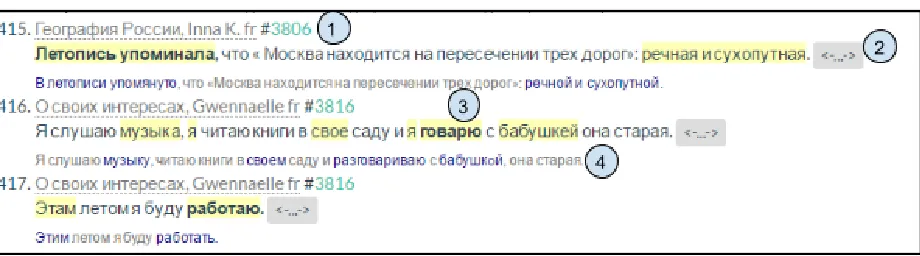
performed at three tiers. The first tier represents the original sentence: this is the tier where annota-tors mark errors. The second tier shows the original sentence with corrected spelling and morphological mistakes. The final corrected version of the sentence - with all syntactic and lexical changes that were added by annotators (see Figure 2) - is displayed by the third tier.
Some words in the first tier are underlined: this is done automatically when the corpus system detects a word which was analyzed by MyStem as “bastard”. Such feature was added to help annotators find er-rors; this is based on the idea that the word which is not present in MyStem dictionaries or does not link to any template is likely to have an error.
To add a new tag, the annotator selects a fragment of text in the first tier and clicks the ”Add annota-tion” button . After that a small dialog window ap-pears, it has three fields: for error tags, for correction and for adding a comment if necessary. The selected fragment might be a word or several consecutive words within one sentence. It is possible to assign
9Official website of Annotator.js: http://
annotatorjs.org/.
several tags to a single fragment if it contains multi-ple errors. The annotated spans might intersect: for example, one can annotate one word and then anno-tate a larger fragment including that word and sev-eral others. The comment section is meant to con-tain information about alternative target hypotheses (in case of competing target hypotheses) and possi-ble sources of errors (e.g. examples of calques).
Each text in the corpus is classified into one of three groups: not annotated texts, annotated texts, and texts that were annotated and checked. The last group includes texts that were first annotated by corpus contributors or students of linguistic de-partments and later that annotation was reviewed by the corpus staff. Annotators and staff members can change the texts category by clicking corresponding buttons in the annotators workspace: “Mark as an-notated” or “Mark as checked”. The corpus staff aims at having all texts annotated and checked. As for now, almost 20,000 errors are annotated in about 35% of texts.
5.4 Corpus search
As in many corpora, one can execute search queries online. The corpus search engine allows to search texts for exact quotes or perform lexico-grammatical search: by lemma, part of speech and other gram-matical features (like gender, number, voice, tense etc). These search queries can be also expanded with error tags. It is worth mentioning that the errors are searchable as soon as they are tagged in the annota-tion tool. For example, such queries can be executed in RLC:
• Find all code-switching errors tagged as CS;
• Find all examples of incorrect usage of passive voice;
• Find lemmaja– ’I, me’ in dative or instrumen-tal case tagged with any mistake;
• Find lemma ja – ’I, me’ followed by a verb and/or a preposition.
Figure 1:Data upload. Before uploading texts to the corpus, the user fills in metadata fields. The picture shows the form dedicated to author-related data.
Figure 2:Annotators workplace. (1) Comment field. (2) Field for error tags. (3) Correction field. (4) The two layers of corrections are displayed under the original sentence. All the changes are highlighted.
[image:7.612.79.539.521.649.2]Search results include the number of sentences and number of texts that match the query and the list of all the sentences (Figure 3). Each entry in the results page contains the title of the text, the native language of the author, the original sentence with all allocated annotations and the corrected variant.
There is a possibility to view the context of the passage, but the context is restricted to the maxi-mum of 3 sentences. Authorized users may have more access to the data. The corpus system was de-veloped with user hierarchy, where each group of users has different permissions. Guest access gives permission only for searching the corpus, annotator access permits full text view and annotation. Anno-tators can also edit or add annotations directly in the search results page and also can view larger context for each result entry. Contributor access licenses not only annotation, but also adding new texts and edit-ing their metadata. At the time of writedit-ing, RLC has around 100 users with different access permissions.
The corpus platform also creates a statistics page on the go: it is updated whenever anything is added to the corpus. It allows to see the whole perspective of available data at every moment.
6 Conclusion
In this paper we presented a pioneering Russian Learner Corpus which introduces a clear distinction between HL and L2. This resource has a unique plat-form with combined tools for corpus search and an-notation.
The future development of the RLC is connected with the following tasks. First, we intend to annotate the remaining texts. In order to assure annotation quality, we are planning to improve the annotation guidelines and create an online tool for carrying out inter-annotator agreement experiments. Second, we will add more texts with different L1s and balance dominant languages in the corpus. Third, our team is going to improve the corpus search tool, for exam-ple, by including an option to save selected search results to the users directory.
Although not all texts have been annotated yet, the corpus still enables to retrieve interesting patterns in over- and under-using of certain constructions, some of them have been already described in linguistic re-search (Vyrenkova et al., 2014; Rakhilina, 2015;
Polinsky et al., 2016). The annotated corpus data can also have numerous NLP applications, e.g. au-tomatic error correction for language learners, auto-matic error tagging, author’s native language identi-fication. For example, the RLC data served as train-ing and test data for tools for automatic error de-tection (Klyachko et al., 2013; Ramsajtseva et al., 2016). Therefore, we believe that the further corpus development will open new opportunities for SLA and heritage linguistics research, teaching Russian and creating tools for analyzing Russian learner in-terlanguage.
Acknowledgments
We would like to express our deep gratitude to ev-eryone who has contributed to the project: Maria Polinsky (University of Maryland), Olessya Kisse-lev (Penn State University), Anna Alsufieva, Evgeny Dengub (Middlebury Langugage Schools), Irina Dubinina (Brandeis University), Anna Mikhaylova (University of Oregon), Alla Smyslova (Columbia University), Ekaterina Protassova (University of Helsinki), Anna Pavlova (University of Mainz), Anna M¨ohl (Johannes Gutenberg University of Zurich), Anka Bergmann (Humboldt University of Berlin), Irina Kor Chahine (Aix-Marseille Univer-sity), Suhyoun Lee (Seoul National UniverUniver-sity), Svetlana Slavkova, Francesca Biagini and Monica Perotto (Bologna University), Svetlana Sokolova (Tromse University), Natalia Ringblom (Univer-sity of Stockholm), Hayashida Rie (Osaka Uni-versity), Margarita Kazakevich (Osaka Universty), Nazija Zhanpeisova (Aktubinsk University), Timo-fey Arkhangelsky, Olga Eremina, Ekaterina Shnittke and Evgenia Smolovskaya (Higher School of Eco-nomics), as well as BA and MA students (”Funda-mental and Computational Linguistics” program at the Higher School of Economics) who at different years participated in annotation process.
We would like to thank the anonymous reviewers for their valuable and insightful comments.
References
N. C. Ellis, 2013. Oxford Handbook of Construction Grammar, chapter Second language acquisition, pages 365–378. Oxford University Press, Oxford.
Charles J. Fillmore, Paul Kay, and Mary Catherine O’Connor. 1988. Regularity and idiomaticity in gram-matical constructions: the case of let alone. Language, 64(3):501–538.
Adele Goldberg. 1995. Constructions: A Construction Grammar Approach to Argument Structure. Univer-sity of Chicago Press, Chicago.
Adele Goldberg. 2006. Constructions at Work: The Na-ture of Generalization in Grammar. Oxford Univer-sity Press, Oxford.
Sylviane Granger. 1996. From CA to CIA and back: An integrated approach to computerized bilingual and learner corpora.Lund Studies in English, 88:37–51. Sylviane. Granger, 1998. The computer learner corpus:
a versatile new source of data for SLA research, pages 191–202. Longman, London.
Ludmila Isurin and Tanya Ivanova-Sullivan. 2008. Lost in between: The case of Russian heritage speakers.
Heritage Language Journal, 6(1):72–104.
S. Jarvis and M. Paquot, 2015. Native language identifi-cation. Cambridge University Press.
Elena Klyachko, Timofey Arkhangelskiy, Olesya Kisse-lev, and Ekaterina Rakhilina. 2013. Automatic error detection in Russian learner language. InProceedings of the First workshop Corpus Analysis with Noise in the Signal (CANS 2013), Lancaster, United Kingdom. Andrey Kutuzov and Maria Kunilovskaya, 2014. Russian
Learner Translator Corpus, pages 315–323. Springer International Publishing, Cham.
C. Leacock, M. Chodorow, M. Gamon, and J. Tetreault. 2014. Automated Grammatical Error Detection for Language Learners: Second Edition. Synthesis Lec-tures on Human Language Technologies. Morgan & Claypool Publishers.
Detmar Meurers, 2015. Learner Corpora and Natural Language Processing. Cambridge University Press. Diane Nicholls. 2003. The Cambridge learner corpus
-error coding and analysis for lexicography and ELT. In Dawn Archer, Paul Rayson, Andrew Wilson, and Tony McEnery, editors,Proceedings of the Corpus Linguis-tics 2003 conference. Lancaster University, UK. I.G. Ovchinnikova and A.V. Pavlova. 2016.
Perevodch-eskij bilingvizm. Po materialam oshibok pis’mennogo perevoda. FLINTA: Nauka, Moscow.
A. Pavlenko, 2008. Narrative analysis in the study of bi- and multilingualism, pages 311–325. Blackwell, Oxford.
Maria Polinsky, Ekaterina Rakhilina, and Anastasia Vyrenkova. 2016. Linguistic creativity in heritage speakers. Glossa. In print.
Maria Polinsky. 2006. Incomplete acquisition: Ameri-can Russian. Journal of Slavic Linguistics, pages 191– 262.
Maria Polinsky. 2008. Heritage language narratives.
Heritage Language Education: A New Field Emerg-ing, pages 149–164.
Maria Polinsky. 2010. Russkij jazyk pervogo i vtorogo pokolenija emigrantov, zhivuschix v ssha. Slavica Helsingiensia, 40:336–352.
Ekaterina Protassova. 2016. Narrative. frog stories in Russian: 41 transcripts – ages 5, 6, 7, 8, 9, 10, and adult.
E.V. Rakhilina. 2015. Stepeni sravneniya v svete russkoj grammatiki oshibok. Trudy instituta yazykoznaniya im. V.V. Vinogradova, 6:310–333.
Olga Ramsajtseva, Aleksandr Ivankov, Robert Zakoyan, and Alina Ladygina. 2016. Morphchecker for non-standard data: a tool for morphological error correc-tion in learner corpora. In print.
Marc Reznicek, Anke L¨udeling, Cedric Krummes, Franziska Schwantuschke, Maik Walter, Karin Schmidt, Hagen Hirschmann, and Torsten Andreas. 2012. Das Falko-Handbuch. Korpusaufbau und Annotationen Version 2.01.
Marc Reznicek, Anke L¨udeling, and Hagen Hirschmann, 2013. Competing target hypotheses in the Falko cor-pus: A flexible multi-layer corpus architecture. Stud-ies in Corpus Linguistics. John Benjamins Publishing Company.
M. Rusakova. 2013. Elementy antropotsentrichnoj grammatiki russkogo yazyka. Yazyki slavyanskikh kul’tur, Moscow.
Ilya Segalovich and Vitaly Titov. 1997. Mystem. Barbora ˇStindlov´a, Svatava ˇSkodov´a, Jirka Hana, and
Alexandr Rosen. 2013. A learner corpus of Czech: current state and future directions. In Sylviane Granger, Ga¨etanelle Gilquin, and Fanny Meunier, editors, Twenty Years of Learner Corpus Research: Looking back, Moving ahead. Proceedings of , 15-17 September 2011, Corpora and Language in Use, Louvain-la-Neuve. Presses Universitaires de Louvain. In print.
Michael Tomasello. 2003. Constructing a Language: A Usage-Based Theory of Language Acquisition. Har-vard University Press, HarHar-vard.
Y. Tono. 2003. Learner corpora: design, development and applications. InProceedings of the 2003 Corpus Linguistics Conference, pages 800–809.
S.N. Tsejtlin. 1982. Rechevye oshibki i ikh preduprezh-denie: posobie dlya uchitelej. Prosveschenie, Moscow.
A.S. Vyrenkova, M.S. Polinsky, and E.V. Rakhilina. 2014. Grammatika oshibok i grammatika konstrukt-sij: heritage (unasledovannyj) russkij yazyk. Voprosy yazykoznaniya, 3:3–19.
E.A. Zemskaya, editor. 2001. Yazyk russkogo zarubezha: Obschie protsessy i rechevye portrety. Yazyki slavyan-skoj kultury, Moscow.
Natalia Zevakhina and Svetlana Dzhakupova. 2015. Cor-pus of Russian student texts: design and prospects. In
Proceedings of the 21st International Conference on Computational Linguistics Dialog, Moscow.
7 Appendix A. Error tagset
Language level Tag Definition
Spelling errors Graph use of Latin alphabet Hyphen error in use of hyphen Space omission or insertion of space
Translit incorrect transliteration of a proper noun Ortho incorrect letter
Misspell multiple severe misspellings (in one token)
Morphological errors Infl incorrect inflectional ending (which does not belong to a paradigm of a word) Deriv made-up word
Altern error in stem alternation
Num non-existing number form (e.g. plural for singularia tantum) Gender gender confusion
Morph other morphological errors Syntactic errors AgrCase error in case agreement
AgrGender error in gender agreement AgrNum error in number agreement
AgrPers error in person agreement (between subject and verb) AgrPers incorrect subject for gerund
Asp error in verb aspect Passive error in passive Tense inappropriate tense form Mode inappropriate use of verb mode Refl incorrect use of a reflexive verb Gov wrong case
WO word-order error
Ref pronominal reference error Conj wrong conjunction Neg error in negation Aux incorrect use of auxilaries
Brev erroneous use of short-form adjective (or past passive participle) Syntax other syntactic errors
Construction Constr Error in construction Lexical errors Lex lexical error
CS code-switching Par use of a paronym Idiom error in idiom
Additional tags Del omission (of a character, a morpheme or a word) Insert insertion (of a character, a morpheme or a word) Subst substitution (of a character, a morpheme or a word) Transp transposition (of a character, a morpheme or a word) Transfer case of language transfer