Clustering-based Approach to Multiword Expression Extraction and
Ranking
Elena Tutubalina
Higher Institute for Information Technology and Information Systems Kazan Federal University
Kazan, Russia [email protected]
Abstract
We present a domain-independent clustering-based approach for automatic extraction of multiword expressions (MWEs). The method combines statistical information from a general-purpose corpus and texts from Wikipedia articles. We incorporate associa-tion measures via dimensions of data points to cluster MWEs and then compute the ranking score for each MWE based on the closest exemplar assigned to a cluster. Evaluation results, achieved for two languages, show that a combination of association measures gives an improvement in the ranking of MWEs compared with simple counts of co-occurrence frequencies and purely statistical measures.
1 Introduction
Extraction of multiword expressions (MWEs) is a challenging and well-known task, aimed at identi-fying lexical items with idiosyncratic interpretations that can be decomposed into single words (Sag et al., 2002). In this study, we primarily focus on the ex-traction of two-word expressions in Russian.
A number of lexical association measures and their combinations have been employed in previous studies about extraction of general-purpose collo-cations and domain-specific terms (Krenn and Ev-ert, 2001; Pearce, 2002; EvEv-ert, 2004; Pecina and Schlesinger, 2006; Hoang et al., 2009; Hartmann et al., 2012). Ranked collocations with higher associ-ation scores are selected into then-best list. These simple approaches are limited by the size of corpora and the effect of low frequency on ranking (Krenn and Evert, 2001; Evert and Krenn, 2005; Bouma,
2009). Most studies regard MWE as a classifica-tion task and based on supervised methods to predict the class (collocations or non-collocations) to which an MWE candidate relates (Pecina and Schlesinger, 2006; Ramisch, 2015). There is no labeled training set in Russian for these approaches, and data anno-tation is time-consuming. The task could be seen as a ranking task: ranking model group compara-ble entities into queries by criteria and construct-ing a rankconstruct-ing model usconstruct-ing trainconstruct-ing data with exem-plars to predict a ranking score. However, there are no formal principles on how to detect comparable MWEs from general-purpose corpora for Russian. Therefore, in this study we focus on clustering se-mantically similar MWE candidates using associa-tion measures, calculated on a general-purpose cor-pora and Wikipedia.
A particular general-purpose corpus, such as the Russian National Corpus or the British National Cor-pus, provides only a partial coverage of the modern language. Although association measures have been widely applied, they have a limitation: the computed probabilities may be small in the particular corpus, which gives a lower rank for MWE in the n-best list. To avoid this situation, we incorporate the stan-dard statistical measure, computed from the general-purpose corpus, with Wikipedia, that contains a vast amount of knowledge (e.g., named entities, domain-specific terms, and disambiguation of word senses). Given a small number of most representative MWEs as exemplars, our primary goal is to iden-tify MWE noun candidates, considering similarity between a candidate and the exemplars, based on association scores in both resources. Our method consists of three steps: (i) extracting bigrams that serve as MWE candidates, adopting Wikipedia
cles, and using predefined morphosyntactic patterns; (ii) grouping the candidates using clustering tech-niques; and (iii) ranking MWE candidates by a score, which is computed based on the distance between the candidate and the closest exemplar multiplied by the percent of exemplars in the cluster. The third step relies on the intuition that MWEs are highly ranked in clusters with a higher number of exemplars due to strong similarity between these expressions.
We demonstrate that combining association mea-sures from two resources is effective, and improve-ment according to precision-recall curves can be achieved by a small number of measures combined.
2 Related Work
Over the last few decades, a large number of works in computational corpus linguistics have been published concerning the extraction of multiword terms, collocations, and keyphrases that is well described in Evert (2004), Gries, (2013), Hasan and Ng (2014), and Ramisch (2015). The re-search area covers several different methods, for example, ranking MWEs by association measures (Krenn and Evert, 2001; Pearce, 2002; Evert, 2004; Braslavski and Sokolov, 2006); contrastive filter-ing of domain-specific MWEs (Bonin et al., 2010); methods that combine statistic measures to find complex ranking functions, using clustering algo-rithms and neural networks (Pecina and Schlesinger, 2006; Antoch et al., 2013); machine learning ap-proaches to classify MWEs into predefined cat-egories (Pecina and Schlesinger, 2006; Ramisch, 2015); and Wikipedia-based approaches (Medelyan et al., 2009a; Medelyan et al., 2009b).
Many methods combine the different properties of two or more association measures to find high-ranking collocations with a strong association based on these measures (Church et al., 1991; Pecina and Schlesinger, 2006; Liu et al., 2009). Church et al. (1991) used an association measure constructed from mutual information (MI) and t-score formu-lae with scaling functions for collocation identifica-tion. Pecina and Schlesinger (2006) presented su-pervised methods based on 82 association measures to define a ranker function. They did not select the “best universal method” for combining association measures because the task depends on many factors,
such as language and data, among others. Liu et al. (2009) adopted Wikipedia to compute term related-ness based on a vector of Wikipedia concepts for keyphrase extraction. They selected four measures to group terms of a given document based on the se-mantic relatedness between them. These measures are cosine similarity, Euclidean distance, pointwise mutual information (PMI), and normalized similar-ity distance. Antoch et al. (2013) combined associa-tion measures considered as binary classifiers using receiver operating characteristic curves. They used a hierarchical clustering algorithm to achieve better results by clustering these measures. The authors ob-served that high efficiency of combining representa-tives of the clusters of equivalent association mea-sures depends on a dataset. Jain (2010) proposed that there is no single clustering algorithm that is able to outperform other algorithms across all applications.
3 The Clustering-based Approach for
Ranking MWEs
In this section, we describe the proposed clustering-based approach. In contrast to classification meth-ods that predict whether a MWE is a true collocation or not, the goal is to determine which MWE candi-dates are best statistically similar to a small set of ex-emplars. Exemplars are MWEs (e.g., from the gold standard set) with a rather high degree of association between the word components. We employ Wik-tionary to extract MWE exemplars. We perform the clustering of the extracted MWEs using ak-means algorithm and log-likelihood measure.
The proposed approach is composed of three steps: (i) extracting a list of MWEs from Wikipedia article titles, (ii) computing the log-likelihood of the MWE data given the general-purpose corpus and texts from Wikipedia, and (iii) grouping MWE can-didates by thek-means clustering algorithm and then ranking cluster points by measuring the distance from these points to the closest exemplar multiplied by the percent of exemplars in the cluster.
3.1 Selecting MWE Candidates
con-sidered neighbors (adjacent words), is insufficient; and (ii) Wikipedia article titles have explicit phrase boundaries, marked by human editors in Wikipedia markup (Hartmann et al., 2012). The following fil-ter was applied to all the two-word sequences: the candidates were not allowed to contain punctuation marks except hyphenated expressions, and the candi-dates were not allowed to contain proper names and common geographic locations. The extracted candi-dates were then filtered by predefined morphosyn-tactic patterns (e.g., adjective + noun, noun + noun). The morphosyntactic analyzer Mystem1and NLTK library are applied for Russian and English, respec-tively. We used a list of patterns from Braslavski and Sokolov’s (2008) and Manning’s papers (1999) for texts in Russian and English, respectively.
3.2 Clustering MWE Candidates and Ranking
The proposed approach assigns MWE candidates to the clusters based on the distribution of statistical measures associated with each candidate in general-purpose corpora. The clustering method we apply isk-means that has been widely used with the Eu-clidean metric for computing the distance between points and cluster centers (Jain, 2010). As indicated from the results, reported in Section 4 of this paper and recent studies (Evert, 2004; Evert and Krenn; 2005), log-likelihood achieves better results than ranking by other statistical measures, such as t-score and MI. Therefore, we compute log-likelihood as statistical characteristics of MWE candidates, based on two different resources of texts.
In this approach, MWE candidates are represented as points in a two-dimensional space, where each dimension represents by log-likelihood. We make assumption that (i) the distribution over all exem-plars is similar to a distribution over all words in the corpus, and (ii) MWEs are independently dis-tributed and probabilities are estimated as frequency ratios, which is similar to the naive Bayes assump-tion (Baker and McCallum, 1998). MWE candidates are ranked by the following formula, that shows the ranking score of MWEjin clustercl:
score(mwe=j) = (1−mini=1,...,ncld(j, gsi)
rcl )∗npcl (1)
1
Mystem is available at https://tech.yandex.ru/mystem/.
wherenclindicates the number of exemplars in clus-tercl,npcldenotesncl in percent,d(j, gsi)denotes Euclidean distance between MWEjand the exem-plargsiin clustercl,rcldenotes radius of clustercl.
4 Evaluation
We use the Russian National Corpus (RNC) and the British National Corpus (BNC) as the general-purpose corpus of the Russian language and the En-glish language, respectively. For corpora in Russian, we generated frequency lists of bigrams in singu-lar and plural forms. We adoptn-gram data of En-glish Wikipedia and the BNC, extracted by Lin et al. (2010) and Leech and Rayson (2014). We suppose that all MWE candidates occur at least once in cor-pora due to frequency thresholds in the lists. Table 1 shows MWEs that are top-ranked by our approach.
Russian MWEs English MWEs
мировая война(mirovaya voyna) ‘world war’ world war
советский союз(sovetskiy soyuz) ‘soviet union’ soviet union
настоящее время(nastoyashchee vremya) ‘present time’ feature film
чемпионат мира(chempionat mira) ‘world cup’ binomial name
населенный пункт(naselennyy punkt) ‘human settlement’ world champion
водные ресурсы(vodnye resursy) ‘water resources’ popular culture
Table 1: Sample of top-ranked collocations.
We adopt Wiktionary as the gold standard dataset for Russian and English due to use of Russian Wik-tionary as a data source for WordNet-like resources. The single-word nouns from Wiktionary were used as “raw materials” for the Yet Another RussNet (YARN) project (Braslavski et al., 2014). Compar-ison of vocabularies in the English and Russian edi-tions of Wiktionary is described in (Krizhanovsky and Smirnov, 2013). The gold standard set for Rus-sian was filtered to remove non-collocations. Table 2 shows a summary of MWEs for two languages.
Language Russian English
No. of tokens in the general-purpose corpus
364,881,378 110,691,482
No. of Wikipedia arti-cles
1,172,000+ 4,675,000+
No. of MWE candidates 164,805 135,659 No. of MWEs, extracted
from Wiktionary
7433 40996
No. of MWEs, selected for the gold standard
3670 40996
[image:4.612.76.300.54.196.2]Intersection of the sets 2216 6342
[image:4.612.334.514.68.205.2]Table 2: Summary of the list of MWE candidates.
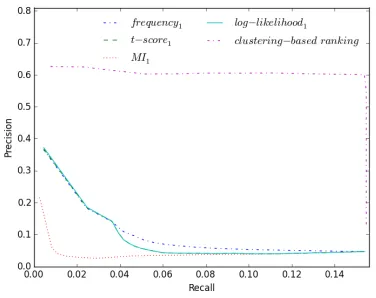
Figure 1: Precision-recall curves of the proposed ap-proach and association measures (for Russian).
Figure 2: Precision-recall curves of the proposed ap-proach and association measures (for English).
The results, shown in Figures 1 and 2, indicate that the proposed approach outperforms baseline ranking by association measures, but the precision of then -best list is significantly decreased with increase of recall. In order to evaluate the impact of a varied number of clusters, we conduct experiments on the
Figure 3: Comparison of F-measure curves of the pro-posed approach based on different statistical measures.
dataset in Russian using log-likelihood. We change the number of clusters from 5 to 30 to achieve the maximum F-measure with the minimum number of
n-best ranked MWEs. Results, shown in Table 3, indicate thatnequals 3,500 for each experiment, and the number of clusters is 5.
No. of clusters P@n R@n F-measure
5 0.553 0.6029 0.5769
10 0.5438 0.5928 0.5672
15 0.568 0.5418 0.5546
20 0.5634 0.5374 0.5501
25 0.5431 0.5181 0.5303
30 0.5371 0.5124 0.5245
Table 3: Evaluation results with a varied number of clus-ters,nequals to 3,500 (for Russian).
To confirm that a combination of association mea-sures from two resources significantly helps in the task of extracting MWEs, we compare our results with different combinations of measures according to F-measure. Figure 3 shows that the combination of log-likelihood, based on two corpora in Russian, gives the best results compared with others.
5 Conclusion and Future Work
[image:4.612.93.280.233.380.2] [image:4.612.92.280.429.578.2]efficiency of our approach depends on MWE prob-abilities in two corpora, and the small set of multi-word exemplars is required. For future works, we plan to split MWE candidates into small queries of comparable MWEs by linguistic criteria and then use query-dependent ranking for each query-MWE pair.
Acknowledgments
This work was partially supported by Russian Foun-dation for Basic Research (Project № 13-07-00773).
References
Antoch J., Prchal L., and Sarda P. 2013. Combining Association Measures for Collocation Extraction Us-ing ClusterUs-ing of Receiver OperatUs-ing Characteristic Curves. Journal of classification, 30(1):100-123. Baker L. D. and McCallum A. K. 1998. Distributional
clustering of words for text classification. Proceedings of the ACM SIGIR conference on Research and devel-opment in information retrieval, pp. 96-103.
Bonin F., Dell’Orletta F., Venturi G., & Montemagni S. 2010. Contrastive filtering of domain-specific multi-word terms from different types of corpora. Proceed-ings of 23rd International Conference on Computa-tional Linguistics, p. 77
Bouma G. 2009. Normalized (pointwise) mutual in-formation in collocation extraction. Proceedings of GSCL, pp. 31-40
Braslavski P. and Sokolov Е. 2008. Comparison of five methods for variable length term extraction. In Com-putational Linguistics and Intellectual Technologies: Proceedings of the International Conference “Dialog”, №. 7, pp. 14. (In Russian)
Braslavski P., Ustalov D., and Mukhin M. 2014. A spinning wheel for YARN: user interface for a crowd-sourced thesaurus. Proceedings of the 14th Confer-ence of the European Chapter of the Association for Computational Linguistics, pp. 101-104.
Evert S. and Krenn B. 2001. Multiword expressions: A pain in the neck for NLP. Proceedings of the 39th An-nual Meeting on Association for Computational Lin-guistics, pp. 188-195
Evert S. 2004. The statistics of word cooccurrences: word pairs and collocations.
Evert S. and Krenn B. 2005. Using small random sam-ples for the manual evaluation of statistical association measures. Computer Speech & Language, № 4. Gries S. T. 2013.50-something years of work on
colloca-tions: what is or should be next. International Journal of Corpus Linguistics, 18(1):137-166.
Gusfield D. 1997. Algorithms on Strings, Trees and Se-quences. Cambridge University Press, UK.
Pearce D. 2002. A Comparative Evaluation of Colloca-tion ExtracColloca-tion Techniques. LREC.
Pecina P. and Schlesinger P. 2006. Combining associa-tion measures for collocaassocia-tion extracassocia-tion. Proceedings of the COLING/ACL on Main conference poster ses-sions, pp. 651-658.
Hasan Kazi Saidul and Ng Vincent 2014. Automatic keyphrase extraction: A survey of the state of the art. Proceedings of the Association for Computational Lin-guistics (ACL).
Hartmann S., Szarvas G., & Gurevych I. 2012. Mining multiword terms from Wikipedia. Semi-Automatic On-tology Development: Processes and Resources. Semi-Automatic Ontology Development: Processes and Re-sources, pp. 226-258.
Hoang H. H., Kim S. N., & Kan M.-Y. 2009. A re-examination of lexical association measures. Proceed-ings of the ACL 2009 Workshop on Multiword Ex-pressions: Identification, Interpretation, Disambigua-tion and ApplicaDisambigua-tions, pp. 31–39.
Jain A. K. 2010. Data clustering: 50 years beyond K-means. Pattern recognition letters, 31(8):651-666. Lin, D., Church, K. W., Ji, H., Sekine, S., Yarowsky, D.,
Bergsma, S., & Narsale, S. 2010.New Tools for Web-Scale N-grams. LREC.
Krizhanovsky A. A. and Smirnov A. V. 2013. An approach to automated construction of a general-purpose lexical ontology based on Wiktionary. Jour-nal of Computer and Systems Sciences InternatioJour-nal, 52(2):215-225.
Leech G. & Rayson P. 2014. Word frequencies in writ-ten and spoken English: Based on the British National Corpus. Routledge.
Manning C. D. 1999. Foundations of statistical natural language processing. MIT press.
Medelyan Olena, Frank Eibe, and Witten Ian H. 2009a. Human-competitive tagging using automatic keyphrase extraction. Proceedings of the 2009 Con-ference on EMNLP, pp. 1318–1327.
Medelyan Olena, Milne David, Legg Catherine, and Wit-ten Ian H. 2009b. Mining meaning from Wikipedia. International Journal of Human-Computer Studies, № 9 (2009), pp. 716-754.
Ramisch, C. 2015. Evaluation of MWE Acquisition. Multiword Expressions Acquisition, pp. 105-125. Sag Ivan A., Baldwin Timothy, Bond Francis, Copestake
Ann, and Flickinger Dan 2002. Multiword expres-sions: A pain in the neck for NLP. Computational Lin-guistics and Intelligent Text Processing, pp. 38-43 Wermter J. and Hahn U. 2006.You can’t beat frequency