A Model for Composing Semantic Relations
Eduardo Blanco and Dan Moldovan Human Language Technology Research Institute
The University of Texas at Dallas {eduardo,moldovan}@hlt.utdallas.edu
Abstract
This paper presents a model to compose semantic relations. The model is independent of any particular set of relations and uses an extended definition for semantic relations. This extended def-inition includes restrictions on the domain and range of relations and utilizes semantic primitives to characterize them. Primitives capture elementary properties between the arguments of a relation. An algebra for composing semantic primitives is used to automatically identify the resulting rela-tion of composing a pair of compatible relarela-tions. Inference axioms are obtained. Axioms take as input a pair of semantic relations and output a new, previously ignored relation. The usefulness of this proposed model is shown using PropBank relations. Eight inference axioms are obtained and their accuracy and productivity are evaluated. The model offers an unsupervised way of accurately extracting additional semantics from text.
1
Introduction
Semantic representation of text is an important step toward text understanding, performing inferences and reasoning. Potentially, it could dramatically improve the performance of several Natural Language Processing applications.
Semantic relations have been studied in linguistics for decades. They are unidirectional underlying connections between concepts. For example, the sentence The construction slowed down the traffic
encodes aCAUSEand detecting it would help answer the questionWhy is traffic slower?
In Computational Linguistics, there have been several proposals to detect semantic relations. Current approaches focus on a particular set of relations and given a text they output relations. There have been competitions aiming at detecting semantic roles (i.e., relations between a verb and its arguments) (Carreras and M`arquez, 2005), and between nominals (Girju et al., 2007; Hendrickx et al., 2009).
In this paper, we propose a model to compose semantic relations to extract previously ignored rela-tions. The model allows us to automatically obtain inference axioms given a set of relations and is not coupled to any particular set. Axioms take as their input semantic relations and yield a new semantic relation as their conclusion.
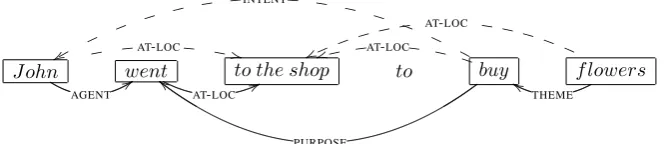
Consider the sentenceJohn went to the shop to buy flowers. Figure 1 shows semantic role annotation with solid arrows. By composing this basic annotation with inference axioms, one can obtain the relations shown with discontinuous arrows:Johnhad the intention tobuy, thebuyingevent took placeat the shop
andJohnand theflowerswere at some pointin the shop.
J ohn
AGENT
9
9
AT-LOC e b \ Y ++
went
AT-LOC 77
to the shop to buy
PURPOSE
c
c
AT-LOC T X [
t
t f c INTENT
N P S U X Z ]
x
x
b d g i l n q
f lowers
THEME
f
f
AT-LOC
Q S V X Z
w
w
[image:1.595.134.467.677.749.2]d f h k m
2
Semantic Relations
Semantic relations are the underlying relations between concepts expressed by words or phrases. In other words, semantic relations are implicit associations between concepts in text.
In general, a semantic relation is defined by stating the kind of connection linking two concepts. For example, Hendrickx et al. (2009) loosely defineENTITY-ORIGINasan entity is coming or is derived from
an origin (e.g., position or material)and give one example:Earth is located in the Milky Way. We find
this kind of definition weak and prone to confusion.
Following Helbig (2005), we propose an extended definition for semantic relations, including seman-tic restrictions for its domain and range. For example, DOMAIN(AGENT) must be ananimate concrete objectand RANGE(AGENT) must be asituation.
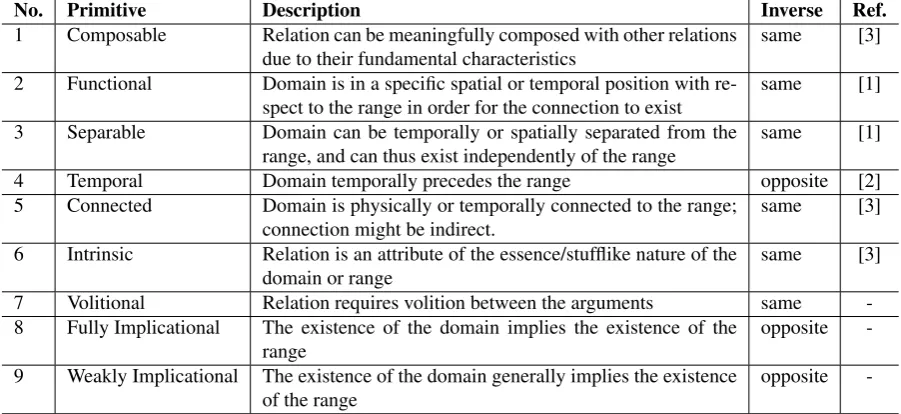
Moreover, we propose to characterize relations by semantic primitives. Primitives indicate if a certain property holds between the arguments of a relation. For example, the primitivetemporalindicates if the first argument must happen before the second in order for the relation to hold. This primitive holds for
CAUSE (a cause mustprecedeits effect) and it does not apply to PART-WHOLE since the later relation does not consider time.
Besides having a better understanding of each relation, this extended definition allows us to create a model that automatically obtains inference axioms for composing semantic relations. The model detects possible combinations of relations and identifies the conclusion of composing them.
Formally, we represent a relationRasR(x,y), where Ris the relation type andx andy are the first and second argument respectively. R(x,y) should be readx isRof Y. DOMAIN(R) and RANGE(R) are the sorts of concepts that can be part of the first and second argument respectively. Any ontology can be used to define domains and ranges, e.g., Helbig (2005) defined one to define a set of 89 relations. Primitives are represented by an array PR of lengthn, wherenis the number of primitives andPRi indicates the
valueRtakes for theith primitive.
The inverse ofRis denotedR−1and can be obtained by simply switching the arguments ofR. Given
R(x,y),R−1(y,x) always holds. We can easily defineR−1given the definition forR: DOMAIN(R−1) = RANGE(R), RANGE(R−1) =DOMAIN(R), andP
R−1 is defined according to the fourth column of Table
1 for each primitive, i.e.,∀i∈[1, n] :PRi−1 =Inverse(PRi).
2.1 Semantic Primitives
Relation primitives capture deep characteristics of relations. Huhns and Stephens (1989) define them as:
They [primitives] are independently determinable for each relation and relatively self-explanatory. They specify a relationship between an element of the domain and an element of the range of the semantic relation being described.
Relation primitives are fundamental properties that cannot be explained using other primitives; they are elemental. They specify basic attributes of a relation by stating if a particular property must hold by definition between the domain and range.
Each relation takes a value for each primitive from the setV ={+,−,0}, where ‘+’ indicates that the property holds, ‘−’ that it does not hold and ‘0’ that it does not apply. For example, the primitive
volitionalindicates if a relation requires volition between domain and range. AGENT takes as value+
for this primitive andPART-WHOLEtakes0.
Primitives complement the definition of a relation by stating if a particular property holds between its arguments. They help to understand the inter-relation differences and clustering relations. Primitives can be used as conditions to be fulfilled in order to determine if a potential relation holds. They are general enough to be determined for a relation, not a particular instantiation. In other words, they state properties that hold for all instances of a relation by definition.
No. Primitive Description Inverse Ref. 1 Composable Relation can be meaningfully composed with other relations
due to their fundamental characteristics
same [3]
2 Functional Domain is in a specific spatial or temporal position with re-spect to the range in order for the connection to exist
same [1]
3 Separable Domain can be temporally or spatially separated from the range, and can thus exist independently of the range
same [1]
4 Temporal Domain temporally precedes the range opposite [2]
5 Connected Domain is physically or temporally connected to the range; connection might be indirect.
same [3]
6 Intrinsic Relation is an attribute of the essence/stufflike nature of the domain or range
same [3]
7 Volitional Relation requires volition between the arguments same
-8 Fully Implicational The existence of the domain implies the existence of the range
opposite
-9 Weakly Implicational The existence of the domain generally implies the existence of the range
opposite
-Table 1:Primitives for characterizing semantic relations, values for the inverse relation and references. In the fifth column, [1] stands for Winston et al. (1987), [2] for Cohen and Losielle (1988) and [3] for Huhns and Stephens (1989). ‘-’ indicates new primitive.
1:Composable R2
R1 - 0 +
- × 0 ×
0 0 0 0
+ × 0 +
2:Functional R2
R1 - 0 +
- - 0 +
0 0 0 0
+ + 0 +
3:Separable R2
R1 - 0 +
- - -
-0 - 0 +
+ - + +
4:Temporal R2
R1 - 0 +
- - - ×
0 - 0 +
+ × + +
5:Connected R2
R1 - 0 +
- - - +
0 - 0 +
+ + + +
6:Intrinsic R2
R1 - 0 +
- - 0
-0 0 0 0
+ - 0 +
7:Volitional R2
R1 - 0 +
- - 0 +
0 0 0 0
+ + 0 +
8:F Impl. R2
R1 - 0 +
- - 0
-0 0 0 0
+ - 0 +
9:W Impl. R2
R1 - 0 +
- - 0
-0 0 0 0
[image:3.595.71.522.71.278.2]+ - 0 +
Table 2:Algebra for composing semantic primitives. Each cell of theith table indicatesPi
R1◦P i
R2.
from natural language. Whatever the set of chosen relations, it will describe the characteristics of events (who/when/where/how something happened), which elements were involved, connections be-tween events (e.g. CAUSE,CORRELATION). Time (whether an argument is guaranteed to happen before than the other), space and volition (whether or not there must be volition between the arguments) also play an important role.
The fourth column in Table 1 indicates the value of the primitive for the inverse relation.Samemeans the inverse relation takes the same value,oppositemeans it takes the opposite. The opposite of−is+, the opposite of−is+, and the opposite of0is0.
For example,PAGENT = {+,+,+,0,−,−,+,0,0}, indicating thatPAGENT5 = −andP 7
AGENT = +,
i.e.,AGENT(x,y) does not requirexandyto beconnectedand it requiresvolitionbetween the arguments.
Note thatPAGENT−1 =PAGENT.
2.2 An Algebra for Composing Semantic Relations
[image:3.595.82.511.334.496.2]GivenPi
R1 andP i
R2, i.e., the values ofR1andR2for a primitivepi, we define an algebra that indicates
the result of composing them (i.e.,Pi
R1 ◦P i
R2). Composing two primitives can yield three values: +,−
or0, indicating if the primitive holds, does not hold or does not apply to the composition ofR1 andR2. Additionally, the composition can be prohibited, indicated with ×. After composing all the primitives forR1andR2, we obtain the primitives values for the composition ofR1andR2(i.e.,PR1◦PR2).
We define the values for the composition using a table for each primitive. Table 2 depicts the whole algebra. The ith table indicates the rules for composing the ith primitive. For example, regarding the
intrinsicprimitive, we have the following rules:
• If both relations areintrinsic, the composition isintrinsic;
• else ifintrinsicdoes not apply to either relation, the primitive does not apply to the composition;
• else, the composition is notintrinsic.
Other rules stated by the algebra are: (1) two relations shall not compose if they have different opposite values for the primitivetemporal; (2) the composition of R1 andR2 is notseparableif either relation is notseparable; and (3) if eitherR1orR2areconnected, then the composition isconnected.
3
Necessary Conditions for Composing Semantic Relations
In principle, one could define axioms for every single possible combination of relations. However, there are two necessary conditions in order to composeR1andR2:
1. They have to be compatible. A pair of relations is compatible if it is possible, from a theo-retical point of view, to compose them. Formally, R1 andR2 are compatible iff RANGE(R1)∩ DOMAIN(R2)6=∅.
2. A third relationR3must fit as conclusion, that is,∃R3 such that DOMAIN(R3)∩DOMAIN(R1)6=∅
and RANGE(R3)∩RANGE(R2)6=∅.
Furthermore,PR3 must be compatible with the result of composingPR1 andPR2.
It is important to note that domain and range compatibility is not enough to compose two relations. For example, givenKINSHIP(Mary,John) andAT-LOCATION(John,Dallas), no relation can be inferred
betweenMary andDallas.
4
Inference Axioms
An axiom is defined as a set of relations called premises and a conclusion. The composition operator◦
is the basic way of combining two relations to form an axiom. We denote an inference axiom asR1(x,y)
◦ R2(y,z)→R3(x,z), whereR1 andR2 are the premises andR3 the conclusion. In order to instantiate an axiom the premises must have an argument in common,y.
In general, fornrelations there are n2 = n(n−1)
2 different pairs. For each pair, taking into account the two relations and their inverses, there are4×4 = 16different possible combinations.
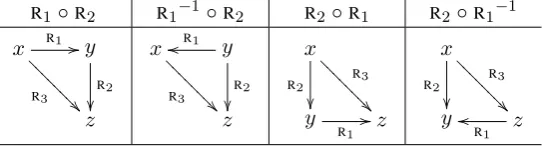
We note thatR1 ◦R2 = (R2−1◦R1−1)−1, reducing the total number of different combinations to 10. Out of these 10, (1) 4 combineR1,R2 and their inverses (Table 3); (2) 3 combineR1and its inverse; and (3) 3 combineR2and its inverse. The most interesting combinations to use as premises for an axiom fall into category (1), since the other two can be resolved by the transitivity property of a relation and its inverse. Therefore, fornrelations there are2n2+npotential axioms: n2×4+3n= 2×n(n−1)+3n= 2n2−2n+ 3n= 2n2+n.
4.1 An Algorithm for Obtaining Inference Axioms
R1◦R2 R1−1◦R
2 R2◦R1 R2◦R1−1
x R1
/ / R3 ? ? ? ? ? ? ? ? y R2 z x R3 ? ? ? ? ? ? ? ? y R2 R1 o o z x R2 R3 ? ? ? ? ? ? ? ? y
[image:5.595.162.434.71.144.2]R1 //z x R3 ? ? ? ? ? ? ? ? R2 y z R1 o o
Table 3:The four unique axioms taking as premisesR1andR2.R3indicates the conclusion.
Role Primitive Role Primitive
Composable Functional Separable Temporal Connected Intrinsic Volitional Fully
Impl.
W
eakly
Impl.
Composable Functional Separable Temporal Connected Intrinsic Volitional Fully
Impl.
W
eakly
Impl.
ARG0 + + + 0 - - + 0 0 ARG0−1
+ + + 0 - - + 0 0
ARG1 + - + 0 - - - 0 0 ARG1−1
+ - + 0 - - - 0 0
MLOC + + 0 0 + - 0 0 0 MLOC−1
+ + 0 0 + - 0 0 0
MCAU + + + + - + 0 + + MCAU−1
+ + + - - + 0 -
-MTMP + + 0 0 + - 0 0 0 MTMP−1
+ + 0 0 + - 0 0 0
MPNC + - + - - - - 0 - MPNC−1
+ - + + - - - 0 +
MMNR + - + 0 - - + 0 0 MMNR−1
+ - + 0 - - + 0 0
Table 4:Semantic Roles in PropBank, their inverses and their primitives.
Repeat Steps 1, 2 and 3 for(Ri,Rj)∈[(R1,R2),(R1−1,R2),(R2,R1),(R2,R1−1)]:
1. Domain and range compatibility
IfRANGE(Ri)∩DOMAIN(Rj) =∅,break
2. Primitives composition
Using the algebra for composing semantic primitives, calculatePRi◦PRj 3. Conclusion matchRepeat forR3 ∈R
IfDOMAIN(R3)∩DOMAIN(Ri)6=∅andRANGE(R3)∩RANGE(Rj)6=∅
andconsistent(PR3, PRi◦PRj),then
inf erence axioms+=Ri(x,y)◦Rj(y,z)→R3(x,z)
The method consistent(P1, P2) is a simple procedure that compares the values assigned to each primitive one by one. Two values for the same primitive are compatible unless they have different opposites or either value is ‘×’ (i.e., prohibited).
5
Case Study: PropBank
PropBank (Palmer et al., 2005) adds a layer of predicate-argument information, or semantic role labels, on top of the syntactic trees provided by the Penn TreeBank. Along with FrameNet, it is the resource most widely used for semantic role annotation.
PropBank uses a series of numeric core roles (ARG0 -ARG5) and a set of more general roles,ARGMs
(e.g. MTMP, MLOC, MMNR). The interpretation of the numeric roles is determined by a verb-specific framesets, althoughARG0 andARG1 usually correspond to the prototypicalAGENTandTHEME. On the other hand, the meaning ofAGRMs generalize across verbs.
An example of PropBank annotation is the following: [Winston]ARG0 [procrastinated]rel [a lot]MADV
[due to his nervous demeanor]MCAU. Palmer et al. (2005) discuss the creation of PropBank. For more
information about the semantics of each role, we refer the reader to the annotation guidelines1.
SinceARG2,AGR3,ARG4 andARG5 do not have a common meaning across verbs, they become not
composable. For example,ARG2 is used forINSTRUMENTin the framesetkick.01and forBENEFACTIVE
in the framesetcall.02.
R2
R1 a:
A
R
G
0
−
1
b:
A
R
G
1
−
1
c:
M
L
O
C
−
1
d:
M
C
A
U
−
1
e:
M
T
M
P
−
1
f:
M
P
N
C
−
1
g:
M
M
N
R
−
1
[image:6.595.222.372.69.211.2]a:ARG0 = - - a - a -b:ARG1 - = - - - b -c:MLOC - - = c - c -d:MCAU a - c = e - -e:MTMP - - - e = e -f:MPNC a b c - e = g g:MMNR - - - g =
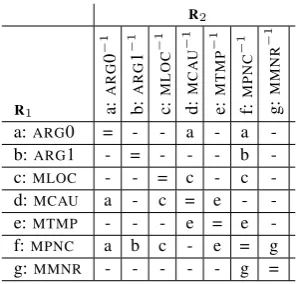
Table 5: Results after applying the steps depicted in Section 4.1 using PropBank semantic roles. A letter indicates an inference axiomR1◦R2→R3by indicating the conclusionR3. ‘-’ indicates that the combination is not prohibited but a relation compatible withPR1 ◦PR2 could not be found; ‘=’ indicates that the cell corresponds to a relation
and its inverse.
The remaining labels (ARG0,ARG1 and allARGMs) do generalize in meaning across verbs. Roles
MEXT, MDIS, MADV, MNEG, MMOD, MDIR, are not composable because they encode a very narrow
semantic connection. Manual examination of several examples leads to this conclusion.
Table 4 depicts the primitives for the roles which arecomposable and their inverses. Note that for any two relations their primitives are different.
PropBank does not provide domains and ranges for its roles, although we can specify our own. We do so by using the ontology defined by Helbig (2005). All relations in PropBank are denoted asR(x,y), wherex is an argument ofy, andy is a verb. The range of all relations is asituation. The domain of
AGR0 andARG1 areobjects, the domain ofMLOCandMTMPlocalandtemporal descriptors respectively, the domain ofMMNRqualitiesorstates, and the domain ofMPNCandMCAUaresituations.
5.1 Inference Axioms from PropBank
Out of the four possible axioms between any pair of relations (Table 3), the only way to compose two relations from PropBank is by using as common argumenty a verb. This restriction is due to the fact that PropBank exclusively annotates relations between a verb and its arguments. Thus, the only possible axiom for any pair of rolesR1andR2isR1(x,y)◦R2−1(y,z)→R
3(x,z), whereyis a verb.
Table 5 shows the eight inference axioms obtained after following the steps depicted in Section 4.1. Note that the matrix is symmetric as stated by the propertyR1◦R2= (R2−1◦R
1−1)−1. Some of the axioms obtained are:
• MCAU◦MLOC−1 →MLOC−1,the location of a cause is the same than the location of its effect.
• MPNC◦ARG0−1→ARG0−1,the agent of an action is inherited by its purpose.
• MPNC◦MMNR−1→MMNR−1,the manner of an action is inherited by its purpose.
5.2 Evaluation
First, we evaluated all the instantiations of axiom MPNC◦MMNR−1 → MMNR−1. This axiom can be instantiated 237 times using PropBank annotation, yielding 189 newMANNERnot present in PropBank. The overall accuracy is 0.797, superior to state-of-the art semantic role labelers.
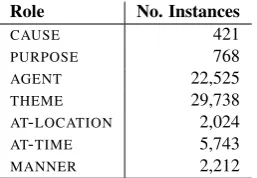
Role No. Instances
CAUSE 421
PURPOSE 768
AGENT 22,525
THEME 29,738
AT-LOCATION 2,024
AT-TIME 5,743
[image:7.595.235.364.70.159.2]MANNER 2,212
Table 6:Number of relations in PropBank for the first 31,450 sentences.
no heuristic with heuristic
No. Axiom No. Inst. Acc. Produc. No. Inst. Acc. Produc.
1 CAU◦AGT−1
→AGT−1
201 0.40 0.89% 75 0.67 0.33% 2 CAU◦AT-L →AT-L 17 0.82 0.84% 15 0.93 0.74%
3 CAU◦AT-T →AT-T 72 0.85 1.25% 69 0.87 1.20%
1-3 CAU◦R2 →R3 290 0.53 0.96% 159 0.78 0.53%
4 PRP ◦AGT−1 →AGT−1 375 0.89 1.66% 347 0.94 1.54%
5 PRP ◦THM−1
→THM−1
489 0.12 1.64% 87 0.65 0.29% 6 PRP ◦AT-L →AT-L 49 0.90 2.42% 48 0.92 2.37%
7 PRP ◦AT-T →AT-T 138 0.84 2.40% 129 0.88 2.25%
8 PRP ◦MNR−1
→MNR−1
71 0.82 3.21% 70 0.83 3.16% 4-8 PRP ◦R2 →R3 1,122 0.54 1.80% 681 0.88 1.09%
[image:7.595.113.481.188.337.2]1-8 All 1,412 0.54 2.26% 840 0.86 1.35%
Table 7: Axioms used during evaluation, number of instances, accuracy and productivity. Results are reported both using and not using the heuristic. Productivity refers to the number of relations added by the axiom in relative terms.
Table 7 depicts the total number of instantiations for each axiom and its accuracy (columns 3 and 4). Accuracies range from 0.12 to 0.90, showing that the plausibility of an axiom depends on the axiom. The average accuracy for axioms involvingMCAUis 0.53 and for axioms involvingMPNCis 0.54.
Axiom MCAU ◦ARG0−1 → ARG0−1 adds 201 relations, which corresponds to 0.89% in relative terms. Its accuracy is low, 0.40. Other axioms are less productive overall, but have a greater relative impact and accuracy. For example, axiom MPNC◦MMNR−1 → MMNR−1, only yields 71 newMMNR, and yet it is adding 3.21% in relative terms with an accuracy of 0.82.
It is worth noting that overall, applying the eight axioms used during evaluation adds 1,412 relations on top of the ones already present (2.26% in relative terms) with an accuracy of 0.54.
5.3 Error Analysis
Because of the low accuracy of axioms 1 and 5, an error analysis was performed. We found that unlike other axioms, these axioms often yield a relation type that is already present in the semantic representa-tion. Specifically, axioms 1 and 5 often yieldR(x,z) whenR(x’,z) is already known.
An example can be found in Figure 4, where axiom 5 yieldsARG1(orders,to buy) when the relation ARG1(the basket, to buy) is already present. We use the following heuristic in order to improve the accuracy of axioms 1 and 5: do not instantiate an axiomR1(x,y)◦R2(y,z)→ R3(x,z) if a relation of
the formR3(x’,z) is already known.
This simple heuristic allows us to augment the accuracy of the inferences at the cost of lowering their productivity. The last three columns in Table 7 show results when using the heuristic. The eight axioms add 840 relations (1.35% in relative terms) with an accuracy of 0.86.
5.4 Examples
In the f ibers division prof it remains 3 3 MLOC persistent overcapacity MCAU i i * * MLOC V W Y Z \ ] a b d e g h
Figure 2:In the fibers division, profit remains weak, largely because of persistent overcapacity.(wsj 0552, 28).
it
ARG0
9
9
ARG0
h h g f
f e e d c
c b a a ` `
+
+
^ ^ ] ] \ [ [ Z Z Y X X W
would takeii
MTMP
in the f ourth quarter
MTMP
e d c a ` ^ ] [ Z Y,,
plans to expand its systems operations
MCAU
j
[image:8.595.96.495.147.191.2]j
Figure 3: First Tennessee National Corp. said it would take a$4 million charge in the fourth quarter, as a result of plans to expand its systems operation.(wsj 0621, 0).
T he traders
ARG0 77
ARG0
n m lk j
g e
c a
'
'
] [ Y
W
T SR Q P place orders ARG1 f f
ARG1∗
q n l i g
d & & Z W U R P via computers MMNR e e MMNR
i d Z U ((
to buy
MPNC
e
e the basket
ARG1
g
[image:8.595.103.495.239.313.2]g
Figure 4: When it occurs, the traders place orders via computers to buy the basket of stocks . . . in whichever market is cheaper and sell them in the more expensive market; . . . (wsj 0118, 48).
A man . . .
ARG0
9
9
ARG0
k k j i h
g f e d
c c b a `
(
(
^ ] \ [ [ Z Y X W V
U T S
S
camehh
MLOC
g
g
MTMP
bef ore the House . . . yesterday to talk about
MPNC
g
g ''
MLOC P R T V X [ ] a c f h j
l i dMTMPZ U ((
Figure 5: A man from the Bush administration came before the House Agriculture Committee yesterday to talk about . . . (wsj 0134, 0).
Figures 2 and 3 instantiate axioms 1, 2 and 3. For these examples, all inferences are correct.
Figures 4 and 5 instantiate the rest of axioms. Not using the heuristic leads to a wrong inference in the example shown in Figure 4, indicated with *. Using the heuristic, all inferences are correct.
6
Comparison with Previous Work
There have been abundant proposals to detect semantic relations without taking into account composition of relations. All these approaches, regardless of their particular details, take as their input text and output the relations found in it. In contrast, the framework proposed in this article obtains axioms that take as their input relations found in text and output more relations previously ignored.
Generally, efforts to extract semantic relations have concentrated on particular sets of relations or a single relation, e.g.CAUSE(Bethard and Martin, 2008; Chang and Choi, 2006) andPART-WHOLE(Girju et al., 2006). Automatic detection of semantic roles has received a lot of attention lately (M`arquez et al., 2008; Carreras and M`arquez, 2005). The SemEval-2007 Task 04 (Girju et al., 2007) and SemEval-2010 Task 08 (Hendrickx et al., 2009) aimed at relations between nominals. There has been work on detecting relations within noun phrases (Moldovan et al., 2004; Nulty, 2007), clauses (Szpakowicz et al., 1995) and syntax-based comma resolution (Srikumar et al., 2008).
Previous research has exploited the idea of using semantic primitives to define and classify semantic relations under different names. Among others, the literature uses relation elements, deep structure,
[image:8.595.108.487.361.433.2]using primitives was made by Chaffin and Herrmann (1987). They introduce Relation Element Theory, and differentiate relations byrelation elements. The authors describe a set of 31 relations clustered in five groups (CONTRAST,SIMILARS,CLASS INCLUSION,CASE-RELATIONS,PART-WHOLE), and distinguish each relation by itsrelations elementsand not just a definition and examples. Their 30relation elements
are clustered into five groups (elements of intensional force, dimension elements, elements of agreement, propositional elements, elements of part-whole inclusion). They only use theelementsto define relations, not to compose relations.
Winston et al. (1987) work with six subtypes of PART-WHOLE and uses 3 relation elements (
func-tional, homeomerousandseparable) to distinguish the subtypes. Cohen and Losielle (1988) introduce
the notion ofdeep structureand characterize it using two aspects:hierarchicalandtemporal. Huhns and Stephens (1989) extend previous works by considering an extended set of 10 primitives.
In Computational Linguistics there have been previous proposals to combine semantic relations. Harabagiu and Moldovan (1998) manually extract plausible inference axioms using WordNet relations. Helbig (2005) transforms chains of relations into theoretical axioms. On the other hand, the model presented in this paper extracts inference axioms automatically.
Composing relations has been proposed before in the more general field of Artificial Intelligence, in particular in the context of Knowledge Bases. Cohen and Losielle (1988) point out that two relations shall combine if and only if they do not have contradictory values for the aspecthierarchicalortemporal. They work with a set of nine specific relations (CAUSES,COMPONENT-OF,FOCUS-OF,MECHANISM-OF, PRODUCT-OF,PURPOSE-OF,SETTING-OF,SUBJECT-OFandSUBFIELD-OF) and their inverses. Huhns and Stephens (1989) are the first to propose an algebra for composing semantic primitives. Unlike ours, their set of relations is not linguistically motivated; ten of them map to some sort of PART-WHOLE (e.g. PIECE-OF,SUBREGION-OF).
7
Conclusions
In this paper, we have presented a model to compose semantic relations. The model is independent of any particular set of relations and is able to obtain inference axioms. These axioms take as their input two semantic relations and yield a previously ignored relation as conclusion.
The model is based on an extended definition of semantic relations, including restrictions on domains and ranges and values for a set of semantic primitives. We have defined an algebra for composing semantic primitives. This algebra is the key to automatically identify the resulting relation of composing a pair of compatible relations and to form an axiom.
The proposed algorithm to compose semantic relations identifies eight inference axioms using Prop-Bank relations. When instantiated in a subset of PropProp-Bank, these axioms add 2.26% of annotation in relative terms with an accuracy of 0.54. We believe these results are worthwhile for a completely unsu-pervised approach to obtain semantic relations. Adding a simple heuristic improves the accuracy to 0.86, lowering the productivity in relative terms to 1.35%.
The model has limitations and is not always correct. First, relations are defined manually and mis-takes could be made when assigning values to their primitives. Second, the algebra for composing primitives is also manually defined.
We find the first problem easy to overcome. Whatever the set of relations one might use, we believe thinking in terms of primitives helps to understand the nature of the relations and their differences. An issue might be that the proposed set of primitives is not enough for a particular set, but more primitives could be added to solve this eventuality.
A further issue with the algebra is the fact that primitives are composed orthogonally. This is a simplification, but we have shown that this simplified algebra works.
References
Bethard, S. and J. H. Martin (2008). Learning Semantic Links from a Corpus of Parallel Temporal and Causal Relations. InProceedings of ACL-08: HLT, Short Papers, Columbus, OH.
Carreras, X. and L. M`arquez (2005). Introduction to the CoNLL-2005 shared task: semantic role label-ing. InProc. of the 9th Conf. on Computational Natural Language Learning, Morristown, NJ. Chaffin, R. and D. J. Herrmann (1987). Relation Element Theory: A New Account of the Representation
and Processing of Semantic Relations. In D. S. Gorfein and R. R. Hoffman (Eds.), Memory and
Learning. The Ebbinghaus Centennial Conference.
Chang, D. S. and K. S. Choi (2006). Incremental cue phrase learning and bootstrapping method for causality extraction using cue phrase and word pair probabilities.Information Processing &
Manage-ment 42(3), 662–678.
Cohen, P. R. and C. L. Losielle (1988). Beyond ISA: Structures for Plausible Inference in Semantic Networks. InProceedings of the Seventh National conference on Artificial Intelligence, St. Paul, MN. Girju, R., A. Badulescu, and D. Moldovan (2006). Automatic Discovery of Part-Whole Relations.
Com-putational Linguistics 32(1), 83–135.
Girju, R., P. Nakov, V. Nastase, S. Szpakowicz, P. Turney, and D. Yuret (2007). SemEval-2007 Task 04: Classification of Semantic Relations between Nominals. InProceedings of the Fourth International
Workshop on Semantic Evaluations, Prague, Czech Republic.
Harabagiu, S. and D. Moldovan (1998). Knowledge Processing on an Extended WordNet. In C. Fellbaum (Ed.),WordNet: An Electronic Lexical Database and Some of its Applications, Chapter 17, pp. 684– 714. The MIT Press.
Helbig, H. (2005).Knowledge Representation and the Semantics of Natural Language(1st ed.). Springer. Hendrickx, I., S. N. Kim, Z. Kozareva, P. Nakov, Diarmuid, S. Pad´o, M. Pennacchiotti, L. Romano, and S. Szpakowicz (2009). SemEval-2010 Task 8: Multi-Way Classification of Semantic Relations Between Pairs of Nominals. InProceedings of the Workshop on Semantic Evaluations, Boulder, CO. Huhns, M. N. and L. M. Stephens (1989). Plausible Inferencing Using Extended Composition. In
IJCAI’89: Proceedings of the 11th international joint conference on AI, San Francisco, CA.
M`arquez, L., X. Carreras, K. C. Litkowski, and S. Stevenson (2008, June). Semantic Role Labeling: An Introduction to the Special Issue.Computational Linguistics 34(2), 145–159.
Moldovan, D., A. Badulescu, M. Tatu, D. Antohe, and R. Girju (2004). Models for the Semantic Classi-fication of Noun Phrases. InHLT-NAACL 2004: Workshop on Computational Lexical Semantics. Nulty, P. (2007). Semantic Classification of Noun Phrases Using Web Counts and Learning Algorithms.
InProceedings of the ACL 2007 Student Research Workshop, Prague, Czech Republic.
Palmer, M., D. Gildea, and P. Kingsbury (2005). The Proposition Bank: An Annotated Corpus of Semantic Roles. Computational Linguistics 31(1), 71–106.
Srikumar, V., R. Reichart, M. Sammons, A. Rappoport, and D. Roth (2008). Extraction of Entailed Semantic Relations Through Syntax-Based Comma Resolution. InProceedings of ACL-08: HLT, Columbus, OH.
Szpakowicz, B., K. Barker, and S. Szpakowicz (1995). Interactive semantic analysis of Clause-Level Relationships. InProc. of the 2nd Conference of the Pacific Association for Computational Linguistics. Winston, M. E., R. Chaffin, and D. Herrmann (1987). A Taxonomy of Part-Whole Relations. Cognitive