Synchronous Tree Unification Grammar
Timm Lichte
Collaborative Research Center 991 University of D¨usseldorf
Abstract
This paper presents a novel grammar formalism, Synchronous Tree Unification Grammar (STUG), that borrows ideas from two rather distinct exemplars of tree-based grammar formalisms, namely Synchronous Tree Adjoining Grammar and Tree Unifi-cation Grammar. At the same time STUG differs considerably from those in that it al-lows for a clean separation of syntax and valency. Exploiting this potential in the modelling of natural language grammar has a number of interesting consequences that we will sketch in the course of this paper.
1 Motivation
The underlying motivation for the development of Synchronous Tree Unification Grammar (STUG) is to model syntax and valency as separated, yet linked dimensions of natural language signs. This sharply contrasts with the lexical amalgamation of syntax and valency found within the TAG work (and other main stream syntactic frame-works). Very generally speaking, we take
va-lency to be a mapping from semantic roles to sets
of morpho-syntactic properties and some marker for indicating necessity. Following common ter-minology, realizations of valency roles are also called arguments.
In TAG elementary trees, valency properties of the lexical anchor are commonly mapped bi-jectively onto non-terminal leaves due to well-formedness conditions (Abeill´e, 1988; Frank, 1992; Abeill´e and Rambow, 2000; Frank, 2002), while the realization of optional valency roles is reflected across the set of elementary trees with the same lexical anchor. However, the correspon-dence between elementary tree and valency frame
is blurred by functional items such as comple-mentizers, determiners and auxiliary verbs, which commonly anchor an elementary tree of their own.
This way of amalgamating elementary trees and valency information can be held responsible for a couple of difficulties that have shown up in various aspects of the TAG framework – amongst them the following:
Since elementary trees for predicative verbs en-force the surface realization of the verbal head and its obligatory arguments, TAG accounts have to cope with elliptical structures (i.e. with gap-ping) by means of more or less far reaching con-cessions: either tangled trees are generated from elementary trees using a non-trivial contraction operation (Sarkar and Joshi, 1996; Sarkar and Joshi, 1997), or one falls back on an infinitely ambiguous lexicon (Seddah, 2008; Seddah et al., 2010), or one includes empty words as a result of a deletion-like operation (Lichte and Kallmeyer, 2010) or as a result of lexical insertion using ex-tra elementary trees (Sarkar, 1997; Seddah and Sagot, 2006).
Since alternative valency frames and alterna-tive linearizations thereof multiply the set of (yet unanchored) tree templates (Prolo, 2002), the use of a metagrammar system in broad-coverage grammars is practically inevitable (XTAG Re-search Group, 2001; Duchier et al., 2004). Im-portant syntactic generalisations are therefore not expressed directly in a TAG, but emerge indirectly across elementary trees. Furthermore the factor-ization by means of metagrammars makes the clusion of empty words attractive, since they in-crease the reusability of tree fragments.
Finally, since elementary trees span over an
tended domain of locality and may relate a lexical anchor to more than one preceding constituent, it is far from obvious how incremental parsing can be performed. Proposals so far either add unlexi-calized trees (“prediction trees”) and a verification operation (Demberg and Keller, 2008; Demberg, 2010), or place the lexical anchor at the left edge of an elementary tree, the head of which can be left underspecified (Mazzei et al., 2007).
Each of these difficulties may seem resolvable in one of the mentioned ways. But in my view the sum of necessary adaptations and concessions makes it worth thinking about accounts that relate syntax and valency more indirectly. STUG repre-sents the first result of this line of thought.
2 The STUG formalism
2.1 The elementary structures
STUG and Synchronous Tree-Adjoining Gram-mar (STAG) (Shieber and Schabes, 1990; Shieber, 1994; Nesson and Shieber, 2008) share the idea, that syntactic and semantic representations are joined in the lexicon by making up a set of pairs of trees or multi-component structures. Further-more there is some way of directly linking nodes of the syntactic domain and the semantic domain within an elementary pair.
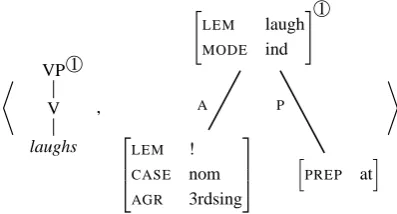
To provide an example, a STUG pair for the verb laughs is shown in Figure 1. We call the first element of the STUG pair the syntactic tree, and the second element the valency tree. While the syntactic tree corresponds to an elementary and derived tree known from TAG, the valency tree resembles a TAG derivation tree in that it is unordered and may have edge labels, which here indicate semantic roles. The valency tree for
laughs in Figure 1 mentions two argument roles,
namely A(GENT) and P(ATIENT), that are spec-ified along the feature structures in the respec-tive nodes. Note that features can be polarized in sense of (Guillaume and Perrier, 2009): fea-tures that must be specified carry an exclamation mark, while the #-symbol is attached to “neutral-ized” features which may not unify with another neutralized feature. Links, finally, are represented by circled numbers, i e. 1. . .n.
Speaking more formally, a STUG consists of tuples hσ,{φ1, . . . , φn}, ⌢i with σ being
a syntactic tree, with a set of valency trees
{φ1, . . . , φn}and a linking relation⌢, for which
* VP 1
V
laughs
,
"
LEM laugh MODE ind
#1
LEM ! CASE nom AGR 3rdsing
A
h
PREP ati P
[image:2.595.310.509.71.178.2]+
Figure 1: STUG pair for laughs.
the following holds:
• ⌢:P(Vσ) → 2Vφ1∪...∪Vφn, whereP(Vσ)is the partition of the set of nodes fromσ, and where 2Vφ1∪...∪Vφn is the power set of the union of the sets of nodes fromφ1, . . . , φn. • For every valency tree φi ∈ {φ1, . . . , φn}
with nodes Vi there exists at least one hVsyn, Vvali ∈⌢withVi∩Vval 6=∅.
In other words, (i) a link relates two sets of nodes, (ii) every syntactic node participates at most in one link and (iii) every valency tree must be linked with the syntactic tree. Note that we omit set braces around valency trees whenever a STUG pair includes only one valency tree, as is the case in Figure 1.
2.2 The combinatorial operations
While STAG uses substitution and adjunction in both domains, STUG combines syntactic trees by substitution and fusion, and valency trees by tree unification.
The fusion operation (Lichte, 2010) is a kind of tree unification where only single nodes unify, hereafter further limited to root nodes: When syn-tactic treesγi, γj with root nodesvi, vj are fused,
the resulting syntactic tree γ′ with root node v′
only includesγi′andγj′, whereγi′isγiwithvi
re-placed byv′, and whereγj′ isγj withvj replaced
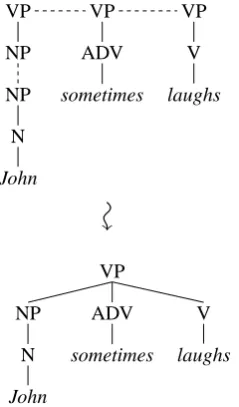
by v′. Furthermore every node from γi′ linearly precedes every node fromγj′. A sample derivation of John sometimes laughs using fusion and sub-stitution is shown in Figure 2, which also demon-strates, that fusion allows the generated syntactic structures to be flat.
s0 PP s1 NP s2 ADV s3 V s4 PP s5
[image:3.595.148.438.59.100.2]NP V
Figure 3: Sample finite state automaton for category VP.
VP VP VP
NP ADV V
NP sometimes laughs
N
John
;
VP
NP ADV V
N sometimes laughs
John
Figure 2: Derivation of John sometimes laughs. Dashed horizontal lines stand for fusion and dashed vertical lines stand for substitution.
order of daughter nodes in the following way: Let
lV(v)be the label of vand letfsa(lV(v))be the
FSA assigned tov. Ifv1. . . vnis the sequence of
daughter nodes ofv in the final derived tree, the wordlV(v1). . . lV(vn)must be inL(fsa(lV(v))).
To come back to our example, the derived tree in Figure 2 is licit, since the label sequence NP ADV V of the daughters of the VP node is in the language of the corresponding FSA shown in Fig-ure 3.
In the process of fusion, links in the syntac-tic trees are collapsed in the following way: Let
hVsyni, VvaliiandhVsynj, Vvaljibe the links asso-ciated with nodes vi, vj that are replaced by v′.
After fusion there is a new link hVsyni \ vi ∪ Vsynj \ {vj} ∪ {v′}, Vvali ∪ Vvalji. Some-thing similar applies during substitution.
The combination of valency trees falls back upon the more general notion of (tree) unification, as is known, e. g., from Tree Unification Grammar (TUG) (Popowich, 1989; Gerdes, 2004). Unify-ing treesγ1 and γ2 to obtain tree γ3 implies that
the unifying and the resulting nodes form one iso-morphic subtree inγ1,γ2 andγ3 respectively. In
order to narrow down the space of results, only
tree unifications with a maximal number of uni-fied nodes are considered. In STUG, the linking structure poses further constraints on tree unifica-tion: (i) unifying valency trees must be co-linked; (ii) if two unifying nodes carry links, they must be co-linked. When two nodes unify, their fea-tures strucfea-tures unify, just like the label of unify-ing edges.
Finally, it needs to be specified, what happens to the links when unifying nodes of valency trees. Roughly, the links of the resulting node form the set union of the links of the unifying nodes. More precisely, if nodesvi, vj are replaced by v, every
link hVsyn, Vvaliwith vi ∈ Vval orvj ∈ Vval is
replaced byhVsyn, Vval\ {vi, vj} ∪ {v}i.
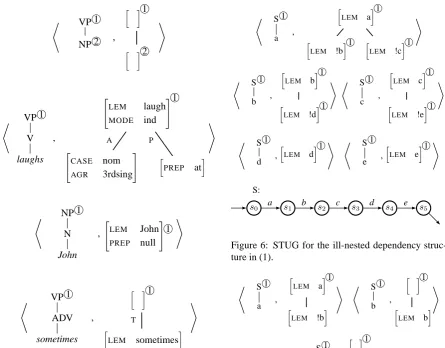
Coming back to the STUG derivation of the sentence John sometimes laughs, Figure 4 dis-plays the required elementary STUG pairs. Note that the valency structure of sometimes specifies a T(ENSE)-role and that the unlexicalized STUG
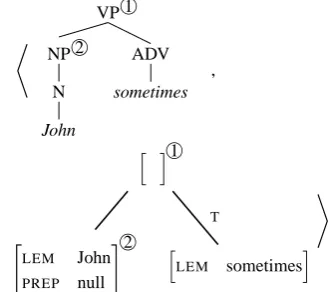
pair solely serves to embed NPs in a VP. The STUG derivation can be processed in two steps: first the syntactic tree is generated according to Figure 2, and after that the collected valency trees get unified into one. This two step approach is pursued in Figure 5.
3 Expressive power
STUG is powerful enough to account for ill-nested dependencies such as in (1):
(1) a b c d e
Assuming that the language contains only this string, the corresponding STUG in Figure 6 ex-ploits the fact that all words differ and every word has a unique valency structure. Then in a flat structure, licensed by a simple FSA directly on the words, every node of the valency structure is linked to the S node, so that polarized features bring about the intended dependency relations and nothing more.
[image:3.595.141.261.142.346.2]*
VP 1
NP 2 ADV V
N sometimes laughs
John ,
h i1
h i2
"
LEM laugh MODE ind
#1
" CASE nom AGR 3rdsing # A h
PREP ati P
"
LEM John PREP null
#2 h i 1
h
LEM sometimesi T +
;
* VP 1NP 2 ADV V
N sometimes laughs
John , " LEM laugh MODE ind
#1
LEM John PREP null CASE nom AGR 3rdsing 2 A h
PREP ati P
h
LEM sometimesi T +
Figure 5: STUG derivation of John sometimes laughs.
not the copy language). Apparently linking is not selective enough to relate ai only with bi,
while both can be in arbitrarily distant parts of the syntactic tree. Something similar also holds for the scrambling language SCRind = {σ(NP1, . . . ,NPm)Vm. . . V1|m ≥ 1and σ is a
permutation }, where every Vi + 1 is supposed
to governVi and which is beyond the expressive
power of LCFRS (Becker et al., 1991). The count-ing language {an bn|n > 0} with nested depen-dencies is different is this respect, as can be seen from the STUG in Figure 7.
If we make use of neutralized polarity in fea-tures (indicated by #), which prevents unifica-tion of neutralized features and therefore helps to keep apart certain nodes in the valency tree, it is possible to generate the MIX-language, i.e.
{w|w ∈ {a, b, c}∗,|a|w = |b|w = |c|w}, as
ure 8 proves. Furthermore the grammar in Fig-ure 8 can be easily adapted to derive the counting language{anbncndnen|n >0}which also lies
beyond the expressive power of TAG.
Hence, STUG seems to be both more and less powerful than TAG.
4 Formalism related questions
4.1 Valency structure = dependency structure?
* VP 1
NP 2 ,
h i1
h i2
+
* VP 1
V
laughs ,
"
LEM laugh
MODE ind
#1
"
CASE nom AGR 3rdsing
# A
h
PREP ati P
+
* NP 1
N
John ,
"
LEM John
PREP null
#
1
+
* VP 1
ADV
sometimes ,
h i1
h
LEM sometimesi T
[image:5.595.79.297.64.414.2]+
Figure 4: Elementary STUG pairs for John sometimes laughs.
One of the benefits in choosing valency struc-tures might be that it circumvents the notoriously unclear (i.e. somewhat arbitrary) status of func-tional elements in dependency representations.
Note that derived valency structures do not only include semantic roles of arguments, but also se-mantic roles of adjuncts (see Figure 5). Conse-quently, they seem to have much in common with descriptions known from scenes-and-frames se-mantics (Fillmore, 1977a; Fillmore, 1977b).
4.2 Sister adjunction instead of fusion?
Both fusion and sister adjunction (Rambow et al., 1995; Chiang, 2003) support the generation of flat structures. However, they do not seem to be interchangeable in the context of STUG (see (Lichte, 2010) for a related discussion concerning TT-MCTAG). While fusion merges the root nodes of trees, sister adjunction rather draws a new edge between nodes. Choosing sister adjunction in-stead of fusion therefore considerably reduces the
* S 1
a ,
h
LEM ai 1
h
LEM !bi 1
h
LEM !ci 1
+
* S 1
b ,
h
LEM bi 1
h
LEM !di 1
+ * S 1
c ,
h
LEM ci 1
h
LEM !ei 1
+
* S 1
d ,
h
LEM di 1
+ * S 1
e ,
h
LEM ei 1
+
S:
[image:5.595.71.517.67.415.2]s0 a s1 b s2 c s3 d s4 e s5
Figure 6: STUG for the ill-nested dependency struc-ture in (1).
* S 1
a ,
h
LEM ai 1
h
LEM !bi
+ * S 1
b ,
h i1
h
LEM bi
+
* S 1
S 2 ,
h i1
h i1
+
S:
s0 a s1 S s2 b s3
b
Figure 7: STUG for the stringan bn with nested
de-pendencies.
number of nodes, to which links can be attached in the lexicon. But since linking is a cornerstone of STUG, it is hard to see, how a STUG with sis-ter adjunction for the mentioned cases would look like, let alone whether this would perform any bet-ter.
4.3 Feature structures instead of trees?
[image:5.595.308.510.340.511.2]ex-* S 1
a ,
A #+ B !+ C !+
1
h i1
+ S:
s0
a,b,c
* S 1
b ,
A !+ B #+ C !+
1
+ *
S 1
c ,
A !+ B !+ C #+
1
[image:6.595.76.283.70.220.2]+
Figure 8: An STUG with neutralized features, marked up by exclamation marks, for deriving the MIX-language.
* VP 1
COMP
that ,
"
COMP that MODE !ind
#1
+
* VP 1
V
is ,
"
PART !+ MODE ind
#1
h
PREP byi A
h
CASE nomi P
+
Figure 9: STUG pairs for complementizer that and passive auxiliary is. Exclamation marks indicate po-larized features.
ample, the valency tree for laughs in Figure 1 could be replaced by the feature structure repre-sentation in Figure 10.
On the other side, a tree-based representation seems to pay off in cases where semantic roles are to be underspecified or where relations are non-functional, i.e. a single semantic role gets assigned to several constituents. The latter hap-pens most prominently with temporal or loca-tional roles.
5 Some consequences: ellipsis, grammar size and incrementality
Contrary to the amalgamation of syntax and va-lency in the TAG framework, STUG allows for a clear separation of syntax and valency, accord-ing to which syntax is only concerned with the
LEM laugh MODE ind
A
LEM ! CASE nom AGR 3rdsing
P
h
PREP ati
1
[image:6.595.361.475.71.160.2]
Figure 10: The valency tree of Figure 1 as feature structure.
*
VP 1
NP 2 ADV
N sometimes
John
,
h i1
"
LEM John PREP null
#2 h
LEM sometimesi T
+
Figure 11: Derived STUG pair for John sometimes, which could be the fragmentary answer to the question Who laughs?, based on the elementary STUG pairs in Figure 4.
linearization of words (based on their syntactic category) and the determination of the local do-main (based on the linking). Argument linking, however, completely rests on the unification of va-lency trees. This kind of separation has interest-ing consequences for the model of syntax. In the following we will discuss three of them involving ellipsis, grammar size and incrementality.
5.1 Ellipsis
Since syntactic trees can combine without there being any direct valency relation, STUG supports the base generation of ellipsis straightforwardly, as is shown in Figure 11 using the example of gap-ping. While the root node in the valency tree re-mains unspecified, the syntactic tree does not in-clude any kind of empty placeholder for the miss-ing verb. Furthermore neither extra rules nor ex-tra lexical entries are involved in the process of derivation. Reconstruction, however, has to be guided by context, which can be thought of as set of more or less salient valency structures.
[image:6.595.327.495.207.353.2] [image:6.595.80.283.291.459.2]syntax and valency. They start out from com-plete syntactic representations of valency frames, which they adapt in cases of incompleteness. In this respect TAG accounts behave similar to ac-counts from GB, CCG or HPSG. Either two com-plete syntactic representations are “contracted” (Sarkar and Joshi, 1996; Sarkar and Joshi, 1997), or one complete syntactic representation is aug-mented with empty words as a result of deletion (Lichte and Kallmeyer, 2010) or insertion (Sed-dah and Sagot, 2006), or the lexicon includes incomplete syntactic representations as defective variants (Sarkar, 1997). None of these strategies is pursued in STUG.
In favour of contraction accounts one could ar-gue, that contraction and reconstruction of ellipsis go hand in hand. Hence no extra mechanism for reconstruction is required. However, contraction is only applicable in cases where ellipsis and its antecedent can be located in the same sentence. It is therefore hardly applicable to fragementary answers or fragmentary corrections (Ginzburg and Sag, 2001; Schlangen, 2003; Ginzburg and Cooper, 2004), not to speak of discourse-inital fragments (Stainton, 1998; Stainton, 2006). For these cases a separate reconstruction mechanism based on the surrounding discourse is needed any-ways. (Lichte and Kallmeyer, 2010) propose to relate reconstruction to the derivation tree of the antecedent sentence.
Summing up it can be said that the sketched STUG account to ellipsis looks promising, as no extra syntactic mechanism is used and reconstruc-tion relates to valency structures, which seem at least as suitable as derivation trees.
5.2 Grammar size
For generating and maintaining a large-coverage TAG, the use of a metagrammar system is al-most inevitable due to the size of the grammar. Regarding, for example, XTAG (XTAG Research Group, 2001), (Prolo, 2002) counts 97 tree tem-plates for intransitive, transitive and ditransitive subcategorization frames. Taking all subcatego-rization frames (including e. g. those for idioms) into account, XTAG contains even 1008 verbal tree templates. This is due to the fact, that alter-native argument realizations tend to be derived by means of different tree templates. In other words, the set of tree templates is some subset of the “Cartesian product” (Prolo, 2002) of
subcatego-rization frames, alternative lineasubcatego-rizations and ac-tive/passive alternations.
On top of that, optional arguments further in-crease lexical ambiguity by joining different tree families. For example, the finite verb laughs an-chors intransitive tree families with and without PP argument, thus at least ten tree templates: two of the base configuration, three for extraction in-cluding preposition stranding, and five for relative clauses.
STUG helps to eliminate these two sources for large grammars and lexical ambiguity. Alterna-tive linearizations can be represented in one FSA, i. e. outside elementary structures, while optional and obligatory arguments can be differentiated lo-cally within a valency tree. Therefore the num-ber of elementary structures reduces substantially compared to TAG. This already becomes apparent with regard to the lexical STUG pair in Figure 1, which, in combination with the simplistic FSA in Figure 3, suffices to cover four out of the ten men-tioned tree templates for the finite verb laughs.
But it is not only the reduction of elementary structures that makes STUG attractive. Another source for grammar complexity lies in the rich feature structures with which nodes of TAG ele-mentary trees may be equipped. XTAG defines around 50 features and uses, for example, no less than nine features to get the sequencing of deter-miners in NPs right. But also the verbal projection is equipped with an impressive number of fea-tures. Some of them help to constrain lineariza-tion (e. g. INV and COMP), while others pass on case or agreement restrictions, such as ASSIGN
-CASE and AGR, or just display morphological properties of a phrasal head, auch asMODE.
* VP 1
V
seems
,
"
LEM seem MODE ind
#1
"
LEM ! MODE inf
#1 TH
"
CASE nom AGR 3rdsing
[image:8.595.111.247.72.202.2]# +
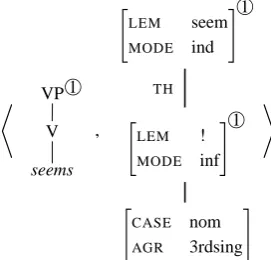
Figure 12: Lexical STUG pair for the raising verb seems.
5.3 Incrementality
Following (Sturt and Lombardo, 2005) incremen-tal processing does not only imply that a sen-tence is parsed left-to-right on a word-by-word basis, but also that a connected syntactic repre-sentation is available for every prefix of the sen-tence. (Sturt and Lombardo, 2005) call this prop-erty full connectedness. Parsing with TAG, how-ever, does not meet full connectedness out of the box, since, e. g., elementary trees of an argument and a modifier cannot be connected when pre-ceding their governor. To fill this gap, two TAG variants have been proposed so far, namely Dy-namic TAG (Mazzei, 2005; Mazzei et al., 2007) and PLTAG (Demberg and Keller, 2008; Dem-berg, 2010). Note that this is not at all a prob-lem specific to TAG, but also comparable gram-mar formalisms such as CCG and Dependency Grammar are affected (Demberg, 2010), which similarly pursue an amalgamation of syntax and valency.
Contrary to TAG, parsing with STUG can be conducted in a fully connected manner even for sentences like John sometimes laughs, as the derivation in Figure 2 can be read off from the left to the right. This is mainly due to three factors: (i) syntactic trees of governors are spinal (i. e., the extended domain of locality is not found in the syntactic trees, but in the valency trees) and (ii) arguments and modifiers can always be connected without mediation of the governor. Finally, (iii) the derivation of the syntactic tree and the valency tree can be done asynchronously. It remains to be seen, how STUG compares to advanced psy-cholinguistic models such as PLTAG. This seems particularly interesting, for STUG does not use traces and, moreover, has a stronger affinity for
free word order languages.
6 Conclusion
We presented a novel tree-based grammar for-malism, Synchronous Tree Unification Grammar (STUG), which differs significantly from usual grammar formalisms such as TAG in that it allows for a separation of syntax and valency. After ing described the functionality of STUG and hav-ing explored its expressive power, we briefly dis-cussed some prospects concerning the modeling of ellipsis, the size and complexity of the gram-mar, and incremental, fully connected parsing. As encouraging as they may be, there is no doubt that many details are still unclear and need to be elab-orated on in future work.
References
Anne Abeill´e and Owen Rambow. 2000. Tree adjoin-ing grammar: An overview. pages 1–68.
Anne Abeill´e. 1988. A lexicalized tree adjoin-ing grammar for French: The general framework. Technical Report MS-CIS-88-64, Department of Computer and Information Science , University of Pennsylvania.
Tilman Becker, Aravind K. Joshi, and Owen Rambow. 1991. Long-distance scrambling and tree adjoining grammars. In Proceedings of EACL-91.
David Chiang. 2003. Statistical parsing with an au-tomatically extracted tree adjoining grammar. In Rens Bod, Remko Scha, and Khalil Sima’an, edi-tors, Data Oriented Parsing, pages 299–316. CSLI Publications.
Vera Demberg and Frank Keller. 2008. A psycholin-guistically motivated version of TAG. In Proceed-ings of TAG+9, pages 25–32, T¨ubingen.
Vera Demberg. 2010. A Broad-Coverage Model of Prediction in Human Sentence Processing. Ph.D. thesis, The University of Edinburgh.
Denys Duchier, Joseph Le Roux, and Yannick Par-mentier. 2004. The Metagrammar Compiler: An NLP Application with a Multi-paradigm Architec-ture. In Second International Mozart/Oz Confer-ence (MOZ’2004).
Charles J. Fillmore. 1977a. The case for case re-opened. In Peter Cole and Jerrold M. Sadock, ed-itors, Grammatical Relations, volume 8 of Syntax and Semantics, pages 59–81. Academic Press, New York.
Robert Frank. 1992. Syntactic Locality and Tree Ad-joining Grammar: Grammatical, Acquisition and Processing Perspectives. Ph.D. thesis, Department of Computer and Information Science, University of Pennsylvania.
Robert Frank. 2002. Phrase Structure Composition and Syntactic Dependencies. MIT Press, Cam-bridge,MA.
Kim Gerdes. 2004. Tree Unification Grammar. In Lawrence S. Moss and Richard T. Oehrle, editors, Electronic Notes in Theoretical Computer Science, volume 53. Elsevier. Proceedings of the joint meet-ing of the 6th Conference on Formal Grammar and the 7th Conference on Mathematics of Language. Jonathan Ginzburg and Robin Cooper. 2004.
Clarifi-cation, ellipsis, and the nature of contextual updates. Linguistics and Philosophy, 27(3):297–366. Jonathan Ginzburg and Ivan A. Sag. 2001.
Interrog-ative Investigations: The Form, Meaning, and Use of English Interrogatives. CSLI Publications, Stan-ford, CA.
Bruno Guillaume and Guy Perrier. 2009. Interaction Grammars. Research on Language and Computa-tion, 7(2–4):171–208.
Timm Lichte and Laura Kallmeyer. 2010. Gapping through TAG derivation trees. In Proceedings of TAG+10, pages 93–100, New Haven, CT.
Timm Lichte. 2010. From partial VP fronting towards Spinal TT-MCTAG. In Proceedings of TAG+10, pages 85–92, New Haven, CT.
Alessandro Mazzei, Vincenzo Lombardo, and Patrick Sturt. 2007. Dynamic TAG and lexical depen-dencies. Research on Language and Computation, 5(3):309–332.
Alessandro Mazzei. 2005. Formal and Empirical Is-sues of Applying Dynamics to Tree Adjoining Gram-mars. Ph.D. thesis, University of Torino.
Rebecca Nesson and Stuart Shieber. 2008. Syn-chronous vector-TAG for natural language syn-tax and semantics. In Proceedings of TAG+9, T¨ubingen, Germany, 7–8 June.
Fred Popowich. 1989. Tree Unification Grammar. In Proceedings of ACL-89, pages 228–236, Vancou-ver, British Columbia, Canada, June.
Carlos A. Prolo. 2002. Generating the XTAG En-glish grammar using metarules. In Proceedings of COLING-02, pages 814–820, Taipei. Taiwan. Owen Rambow, K. Vijay-Shanker, and David Weir.
1995. D-tree grammars. In Proceedings of ACL-95, Cambridge, MA.
Anoop Sarkar and Aravind Joshi. 1996. Coordina-tion in tree adjoining grammars: FormalizaCoordina-tion and implementation. In Proceedings of COLING-96, pages 610–615, Copenhagen, August 5-9.
Anoop Sarkar and Aravind Joshi. 1997. Handling coordination in a tree adjoining grammar. Longer version of paper in Proceedings of COLING 1996. Draft of August 19, 1997.
Anoop Sarkar. 1997. Seperating dependency from constituency in a tree rewriting system. In Tilman Becker and Hans-Ulrich Krieger, editors, Proceed-ings of the Fifth Meeting on Mathematics of Lan-guage, pages 153–160, Saarbr¨ucken.
David Schlangen. 2003. A Coherence-Based Ap-proach to the Interpretation of Non-Sentential Ut-terances in Dialogue. Ph.D. thesis, University of Edinburgh.
Djam´e Seddah and Benoˆıt Sagot. 2006. Modeling and analysis of elliptic coordination by dynamic ex-ploitation of derivation forests in LTAG parsing. In Proceedings of TAG+8, pages 147–152, Syndey. Djam´e Seddah, Benoˆıt Sagot, and Laurence Danlos.
2010. Control verb, argument cluster coordina-tion and multi component TAG. In Proceedings of TAG+10, pages 101–109, New Haven, CT.
Djam´e Seddah. 2008. The use of MCTAG to process elliptic coordination. In Proceedings of TAG+9, pages 81–88, T¨ubingen.
Stuart M. Shieber and Yves Schabes. 1990. Syn-chronous tree-adjoining grammars. In Proceed-ings of COLING-90, volume 3, pages 253–258, Helsinki, Finland.
Stuart M. Shieber. 1994. Restricting the weak-generative capacity of synchronous Tree-Adjoining Grammar. Computational Intelligence, 10(4):371– 385.
Robert J. Stainton. 1998. Quantifier phrases, mean-ingfulness “in isolation”, and ellipsis. Linguistics and Philosophy, 21:311–340.
Robert J. Stainton. 2006. Words and Thoughts. Subsentences, Ellipsis, and the Philosophy of Lan-guage. Oxford Univ. Press.
Patrick Sturt and Vicenzo Lombardo. 2005. Process-ing coordinated structures: Incrementality and con-nectedness. Cognitive Science, 29(2):291–305. XTAG Research Group. 2001. A Lexicalized Tree